
Choosing your dissertation boot
camp format and tutor
free@thefreeschool.education
www.thefreeschool.education
Objective:
This presentation overviews the history of the dissertation boot camp (DBC).
It also discusses alternative formats and objectives of the dissertation boot
camp and the pedagogical rationale that underpins their design.
The information in this presentation may assist you to choose the most
suitable DBC if you are a graduate research candidate.
The information in this presentation is also useful for those who wish to draw
on evidence-based practice to design a DBC that is most suitable for their
educational institution and the scholars whom they support.
What is a
boot camp and
a DBC?
The core traits of a traditional boot camp
teaching model is the rigid format imposed on
those who participate. Scholars are subjected to a
regime that is identical or near-identical to their
colleagues. Students may pursue a specialist
area of instruction in the latter stages of the
training course (Bhattachan, 1996, p. 8).
Bhattachan, K. (1996), Teaching and learning process in social
sciences at Tribhuvan University: A need to move from a
boot-camp to a bazaar Model, Studies in Nepali History and
Society, 1(1), 247-254.
Ness, R. (2016), The rhetoric of composition: How we talk when we
talk about dissertations, <http://writing.wisc.edu/blog/?p=6580>.
The DBC draws parallels from the concept of the
indoctrination system imposed on military recruits
- a point that has been made by scholars who
have written about the DBC over the past decade.
The use of the term ‘boot camp’ refers to the
highly structured and managed environment
imposed on participants. It is also suggestive that
the thesis writing process is an unpleasant chore
that can only be surmounted with high levels of
self-discipline (e.g. Ness, 2016).
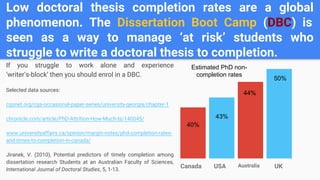
Low doctoral thesis completion rates are a global
phenomenon. The Dissertation Boot Camp (DBC) is
seen as a way to manage ‘at risk’ students who
struggle to write a doctoral thesis to completion.
If you struggle to work alone and experience
‘writer’s-block’ then you should enrol in a DBC.
Selected data sources:
cgsnet.org/cgs-occasional-paper-series/university-georgia/chapter-1
chronicle.com/article/PhD-Attrition-How-Much-Is/140045/
www.universityaffairs.ca/opinion/margin-notes/phd-completion-rates-
and-times-to-completion-in-canada/
Jiranek, V. (2010), Potential predictors of timely completion among
dissertation research Students at an Australian Faculty of Sciences,
International Journal of Doctoral Studies, 5, 1-13.
Canada USA Australia UK
Estimated PhD non-
completion rates
40%
43%
44%
50%
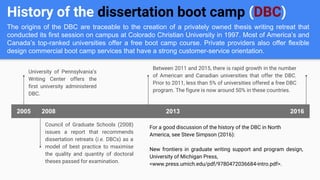
History of the dissertation boot camp (DBC)
University of Pennsylvania’s
Writing Center offers the
first university administered
DBC.
Council of Graduate Schools (2008)
issues a report that recommends
dissertation retreats (i.e. DBCs) as a
model of best practice to maximise
the quality and quantity of doctoral
theses passed for examination.
Between 2011 and 2015, there is rapid growth in the number
of American and Canadian universities that offer the DBC.
Prior to 2011, less than 5% of universities offered a free DBC
program. The figure is now around 50% in these countries.
2005 2008 2013 2016
The origins of the DBC are traceable to the creation of a privately owned thesis writing retreat that
conducted its first session on campus at Colorado Christian University in 1997. Most of America’s and
Canada’s top-ranked universities offer a free boot camp course. Private providers also offer flexible
design commercial boot camp services that have a strong customer-service orientation.
For a good discussion of the history of the DBC in North
America, see Steve Simpson (2016):
New frontiers in graduate writing support and program design,
University of Michigan Press,
<www.press.umich.edu/pdf/9780472036684-intro.pdf>.
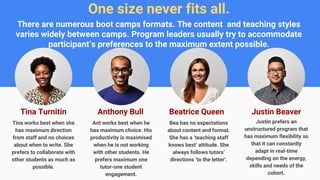
One size never fits all.
There are numerous boot camps formats. The content and teaching styles
varies widely between camps. Program leaders usually try to accommodate
participant’s preferences to the maximum extent possible.
Tina Turnitin
Tina works best when she
has maximum direction
from staff and no choices
about when to write. She
prefers to collaborate with
other students as much as
possible.
Anthony Bull Beatrice Queen
Ant works best when he
has maximum choice. His
productivity is maximised
when he is not working
with other students. He
prefers maximum one
tutor-one student
engagement.
Bea has no expectations
about content and format.
She has a ‘teaching staff
knows best’ attitude. She
always follows tutors’
directions ‘to the letter’.
Justin Beaver
Justin prefers an
unstructured program that
has maximum flexibility so
that it can constantly
adapt in real-time
depending on the energy,
skills and needs of the
cohort.
Just write format
Lee & Golde (2013, p. 2) argue that there are “two models” of the DBC. The first focuses
on the “Just Write” process. Participants focus solely or mostly on engaging in long writing
blocks. They may request assistance from staff when they encounter problems.
Most DBCs allocate most of their program schedule to the ‘just write’ process.
Procrastination and writer’s block are among the most common problems that inhibit thesis
completion. The ‘just write’ process is the best model to address this problem.
Lee, S. and Golde, C. (2013), Completing the dissertation and beyond: Writing centers and
dissertation bootcamps, The writing lab newsletter, 37(7-8), 1-16.
<https://wlnjournal.org/archives/v37/37.7-8.pdf>. Accessed 18 August 2016.
Thesis instruction format
The other DBC format is the “Writing Process” model. Under this structure, a suitably
qualified instructor offers formal tuition about dissertation writing skills. This includes topics
such as how to structure your: manuscript, chapters, paragraphs and sentences. In many
cases, the lecturer offers structured tuition via the workshop format where they stand out
the front and use PowerPoint slides to offer a presentation to around 15 scholars.
In some instances, the ‘just write’, format and the ‘thesis instruction format’ may overlap.
For example, if a doctoral candidate experiences writer’s block during unsupervised writing
time, they may request a tutor to sit with them and offer thesis writing advice that may aid
them to surmount this hurdle.
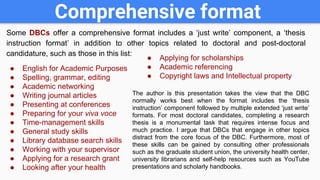
Comprehensive format
Some DBCs offer a comprehensive format includes a ‘just write’ component, a ‘thesis
instruction format’ in addition to other topics related to doctoral and post-doctoral
candidature, such as those in this list:
● English for Academic Purposes
● Spelling, grammar, editing
● Academic networking
● Writing journal articles
● Presenting at conferences
● Preparing for your viva voce
● Time-management skills
● General study skills
● Library database search skills
● Working with your supervisor
● Applying for a research grant
● Looking after your health
● Applying for scholarships
● Academic referencing
● Copyright laws and Intellectual property
The author is this presentation takes the view that the DBC
normally works best when the format includes the ‘thesis
instruction’ component followed by multiple extended ‘just write’
formats. For most doctoral candidates, completing a research
thesis is a monumental task that requires intense focus and
much practice. I argue that DBCs that engage in other topics
distract from the core focus of the DBC. Furthermore, most of
these skills can be gained by consulting other professionals
such as the graduate student union, the university health center,
university librarians and self-help resources such as YouTube
presentations and scholarly handbooks.
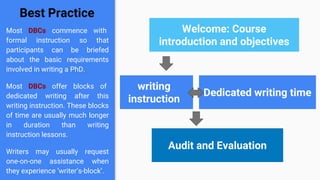
Best Practice
Most DBCs commence with
formal instruction so that
participants can be briefed
about the basic requirements
involved in writing a PhD.
Most DBCs offer blocks of
dedicated writing after this
writing instruction. These blocks
of time are usually much longer
in duration than writing
instruction lessons.
Writers may usually request
one-on-one assistance when
they experience ‘writer’s-block’.
Welcome: Course
introduction and objectives
Free
writing
time
Audit and Evaluation
writing
instruction
Dedicated writing time
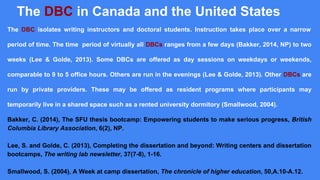
The DBC isolates writing instructors and doctoral students. Instruction takes place over a narrow
period of time. The time period of virtually all DBCs ranges from a few days (Bakker, 2014, NP) to two
weeks (Lee & Golde, 2013). Some DBCs are offered as day sessions on weekdays or weekends,
comparable to 9 to 5 office hours. Others are run in the evenings (Lee & Golde, 2013). Other DBCs are
run by private providers. These may be offered as resident programs where participants may
temporarily live in a shared space such as a rented university dormitory (Smallwood, 2004).
Bakker, C. (2014), The SFU thesis bootcamp: Empowering students to make serious progress, British
Columbia Library Association, 6(2), NP.
Lee, S. and Golde, C. (2013), Completing the dissertation and beyond: Writing centers and dissertation
bootcamps, The writing lab newsletter, 37(7-8), 1-16.
Smallwood, S. (2004), A Week at camp dissertation, The chronicle of higher education, 50,A.10-A.12.
The DBC in Canada and the United States
Stanford University case study
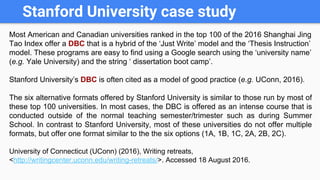
Most American and Canadian universities ranked in the top 100 of the 2016 Shanghai Jing
Tao Index offer a DBC that is a hybrid of the ‘Just Write’ model and the ‘Thesis Instruction’
model. These programs are easy to find using a Google search using the ‘university name’
(e.g. Yale University) and the string ‘ dissertation boot camp’.
Stanford University’s DBC is often cited as a model of good practice (e.g. UConn, 2016).
The six alternative formats offered by Stanford University is similar to those run by most of
these top 100 universities. In most cases, the DBC is offered as an intense course that is
conducted outside of the normal teaching semester/trimester such as during Summer
School. In contrast to Stanford University, most of these universities do not offer multiple
formats, but offer one format similar to the the six options (1A, 1B, 1C, 2A, 2B, 2C).
University of Connecticut (UConn) (2016), Writing retreats,
<http://writingcenter.uconn.edu/writing-retreats/>. Accessed 18 August 2016.
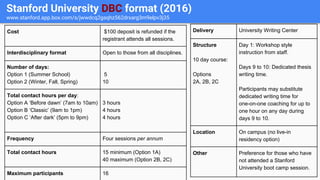
Stanford University DBC format (2016)
www.stanford.app.box.com/s/jwwdcq2gsqhz562drxarg3m9elpv3j35
Cost $100 deposit is refunded if the
registrant attends all sessions.
Interdisciplinary format Open to those from all disciplines.
Number of days:
Option 1 (Summer School)
Option 2 (Winter, Fall, Spring)
5
10
Total contact hours per day:
Option A ‘Before dawn’ (7am to 10am)
Option B ‘Classic’ (9am to 1pm)
Option C ‘After dark’ (5pm to 9pm)
3 hours
4 hours
4 hours
Frequency Four sessions per annum
Total contact hours 15 minimum (Option 1A)
40 maximum (Option 2B, 2C)
Maximum participants 16
Delivery University Writing Center
Structure
10 day course:
Options
2A, 2B, 2C
Day 1: Workshop style
instruction from staff.
Days 9 to 10: Dedicated thesis
writing time.
Participants may substitute
dedicated writing time for
one-on-one coaching for up to
one hour on any day during
days 9 to 10.
Location On campus (no live-in
residency option)
Other Preference for those who have
not attended a Stanford
University boot camp session.
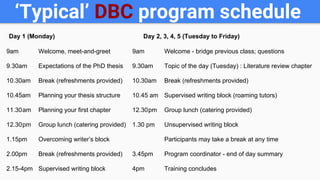
‘Typical’ DBC program schedule
9am Welcome, meet-and-greet
9.30am Expectations of the PhD thesis
10.30am Break (refreshments provided)
10.45am Planning your thesis structure
11.30am Planning your first chapter
12.30pm Group lunch (catering provided)
1.15pm Overcoming writer’s block
2.00pm Break (refreshments provided)
2.15-4pm Supervised writing block
9am Welcome - bridge previous class; questions
9.30am Topic of the day (Tuesday) : Literature review chapter
10.30am Break (refreshments provided)
10.45 am Supervised writing block (roaming tutors)
12.30pm Group lunch (catering provided)
1.30 pm Unsupervised writing block
Participants may take a break at any time
3.45pm Program coordinator - end of day summary
4pm Training concludes
Day 1 (Monday) Day 2, 3, 4, 5 (Tuesday to Friday)
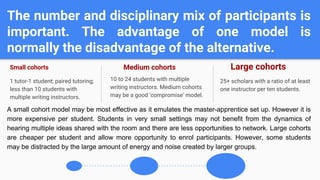
The number and disciplinary mix of participants is
important. The advantage of one model is
normally the disadvantage of the alternative.
Small cohorts
1 tutor-1 student; paired tutoring;
less than 10 students with
multiple writing instructors.
Medium cohorts
10 to 24 students with multiple
writing instructors. Medium cohorts
may be a good ‘compromise’ model.
Large cohorts
25+ scholars with a ratio of at least
one instructor per ten students.
A small cohort model may be most effective as it emulates the master-apprentice set up. However it is
more expensive per student. Students in very small settings may not benefit from the dynamics of
hearing multiple ideas shared with the room and there are less opportunities to network. Large cohorts
are cheaper per student and allow more opportunity to enrol participants. However, some students
may be distracted by the large amount of energy and noise created by larger groups.
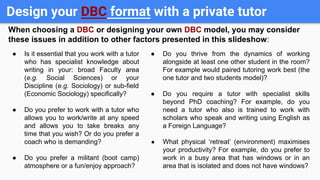
Design your DBC format with a private tutor
When choosing a DBC or designing your own DBC model, you may consider
these issues in addition to other factors presented in this slideshow:
● Is it essential that you work with a tutor
who has specialist knowledge about
writing in your: broad Faculty area
(e.g. Social Sciences) or your
Discipline (e.g. Sociology) or sub-field
(Economic Sociology) specifically?
● Do you prefer to work with a tutor who
allows you to work/write at any speed
and allows you to take breaks any
time that you wish? Or do you prefer a
coach who is demanding?
● Do you prefer a militant (boot camp)
atmosphere or a fun/enjoy approach?
● Do you thrive from the dynamics of working
alongside at least one other student in the room?
For example would paired tutoring work best (the
one tutor and two students model)?
● Do you require a tutor with specialist skills
beyond PhD coaching? For example, do you
need a tutor who also is trained to work with
scholars who speak and writing using English as
a Foreign Language?
● What physical ‘retreat’ (environment) maximises
your productivity? For example, do you prefer to
work in a busy area that has windows or in an
area that is isolated and does not have windows?
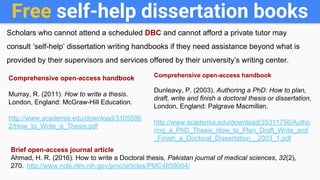
Free self-help dissertation books
Scholars who cannot attend a scheduled DBC and cannot afford a private tutor may
consult ‘self-help’ dissertation writing handbooks if they need assistance beyond what is
provided by their supervisors and services offered by their university’s writing center.
Comprehensive open-access handbook
Murray, R. (2011). How to write a thesis.
London, England: McGraw-Hill Education.
http://www.academia.edu/download/3105596
2/How_to_Write_a_Thesis.pdf
Comprehensive open-access handbook
Dunleavy, P. (2003). Authoring a PhD: How to plan,
draft, write and finish a doctoral thesis or dissertation,
London, England: Palgrave Macmillan.
http://www.academia.edu/download/35311756/Autho
ring_a_PhD_Thesis_How_to_Plan_Draft_Write_and
_Finish_a_Doctoral_Dissertation__2003_1.pdf
Brief open-access journal article
Ahmad, H. R. (2016). How to write a Doctoral thesis, Pakistan journal of medical sciences, 32(2),
270. http://www.ncbi.nlm.nih.gov/pmc/articles/PMC4859004/
Dissertation boot camps offered by universities
The following university pages offer comprehensive details about their DBC.
Stanford University (2016b), Dissertation boot camp:
https://undergrad.stanford.edu/tutoring-support/hume-center/writing/graduate-students/dissertation-bo
ot-camp see also https://stanford.app.box.com/s/jwwdcq2gsqhz562drxarg3m9elpv3j35
University of North Carolina at Chapel Hill (2016), What is dissertation boot camp?,
http://writingcenter.unc.edu/about/dissertation-boot-camp/
University of Regina (2006), Thesis boot camp,
http://www.uregina.ca/gradstudies/current-students/thesisbootcamp.html
http://www.uregina.ca/gradstudies/assets/docs/pdf/Thesis_Boot_Camp-Daily_Schedule.pdf
University of Toronto (2016), ELWS writing intensives (Dissertation Boot Camp: August 23 - 25,
2016), https://www.sgs.utoronto.ca/currentstudents/Pages/ELWS-Writing-Intensives.aspx
Scholarly readings: the dissertation boot camp
Simpson, S. (2012), The problem of graduate-level writing support: Building a
cross-campus graduate writing initiative, Writing program administration journal,
36(1), 95-118. http://www.wpacouncil.org/archives/36n1/36n1all.pdf#page=96
Simpson, S. et al. (2015), Creating a culture of communication: A graduate-level
STEM communication fellows program at a Science and Engineering University,
Across the disciplines, 12(3), NP.
http://wac.colostate.edu/ATD/graduate_wac/simpsonetal2015.cfm
Sundstrom, C. (2014), The graduate writing program at the University of Kansas: An
inter-disciplinary, rhetorical genre-based approach to developing professional
identities, Composition forum, 29, NP. http://files.eric.ed.gov/fulltext/EJ1022020.pdf
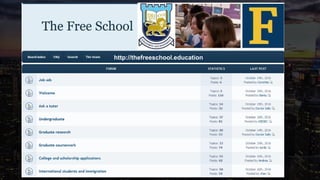
http://thefreeschool.education

Dissertation boot camp / bootcamp

  • 1.
    Choosing your dissertationboot camp format and tutor free@thefreeschool.education www.thefreeschool.education
  • 2.
    Objective: This presentation overviewsthe history of the dissertation boot camp (DBC). It also discusses alternative formats and objectives of the dissertation boot camp and the pedagogical rationale that underpins their design. The information in this presentation may assist you to choose the most suitable DBC if you are a graduate research candidate. The information in this presentation is also useful for those who wish to draw on evidence-based practice to design a DBC that is most suitable for their educational institution and the scholars whom they support.
  • 3.
    What is a bootcamp and a DBC? The core traits of a traditional boot camp teaching model is the rigid format imposed on those who participate. Scholars are subjected to a regime that is identical or near-identical to their colleagues. Students may pursue a specialist area of instruction in the latter stages of the training course (Bhattachan, 1996, p. 8). Bhattachan, K. (1996), Teaching and learning process in social sciences at Tribhuvan University: A need to move from a boot-camp to a bazaar Model, Studies in Nepali History and Society, 1(1), 247-254. Ness, R. (2016), The rhetoric of composition: How we talk when we talk about dissertations, <http://writing.wisc.edu/blog/?p=6580>. The DBC draws parallels from the concept of the indoctrination system imposed on military recruits - a point that has been made by scholars who have written about the DBC over the past decade. The use of the term ‘boot camp’ refers to the highly structured and managed environment imposed on participants. It is also suggestive that the thesis writing process is an unpleasant chore that can only be surmounted with high levels of self-discipline (e.g. Ness, 2016).
  • 4.
    Low doctoral thesiscompletion rates are a global phenomenon. The Dissertation Boot Camp (DBC) is seen as a way to manage ‘at risk’ students who struggle to write a doctoral thesis to completion. If you struggle to work alone and experience ‘writer’s-block’ then you should enrol in a DBC. Selected data sources: cgsnet.org/cgs-occasional-paper-series/university-georgia/chapter-1 chronicle.com/article/PhD-Attrition-How-Much-Is/140045/ www.universityaffairs.ca/opinion/margin-notes/phd-completion-rates- and-times-to-completion-in-canada/ Jiranek, V. (2010), Potential predictors of timely completion among dissertation research Students at an Australian Faculty of Sciences, International Journal of Doctoral Studies, 5, 1-13. Canada USA Australia UK Estimated PhD non- completion rates 40% 43% 44% 50%
  • 5.
    History of thedissertation boot camp (DBC) University of Pennsylvania’s Writing Center offers the first university administered DBC. Council of Graduate Schools (2008) issues a report that recommends dissertation retreats (i.e. DBCs) as a model of best practice to maximise the quality and quantity of doctoral theses passed for examination. Between 2011 and 2015, there is rapid growth in the number of American and Canadian universities that offer the DBC. Prior to 2011, less than 5% of universities offered a free DBC program. The figure is now around 50% in these countries. 2005 2008 2013 2016 The origins of the DBC are traceable to the creation of a privately owned thesis writing retreat that conducted its first session on campus at Colorado Christian University in 1997. Most of America’s and Canada’s top-ranked universities offer a free boot camp course. Private providers also offer flexible design commercial boot camp services that have a strong customer-service orientation. For a good discussion of the history of the DBC in North America, see Steve Simpson (2016): New frontiers in graduate writing support and program design, University of Michigan Press, <www.press.umich.edu/pdf/9780472036684-intro.pdf>.
  • 6.
    One size neverfits all. There are numerous boot camps formats. The content and teaching styles varies widely between camps. Program leaders usually try to accommodate participant’s preferences to the maximum extent possible. Tina Turnitin Tina works best when she has maximum direction from staff and no choices about when to write. She prefers to collaborate with other students as much as possible. Anthony Bull Beatrice Queen Ant works best when he has maximum choice. His productivity is maximised when he is not working with other students. He prefers maximum one tutor-one student engagement. Bea has no expectations about content and format. She has a ‘teaching staff knows best’ attitude. She always follows tutors’ directions ‘to the letter’. Justin Beaver Justin prefers an unstructured program that has maximum flexibility so that it can constantly adapt in real-time depending on the energy, skills and needs of the cohort.
  • 7.
    Just write format Lee& Golde (2013, p. 2) argue that there are “two models” of the DBC. The first focuses on the “Just Write” process. Participants focus solely or mostly on engaging in long writing blocks. They may request assistance from staff when they encounter problems. Most DBCs allocate most of their program schedule to the ‘just write’ process. Procrastination and writer’s block are among the most common problems that inhibit thesis completion. The ‘just write’ process is the best model to address this problem. Lee, S. and Golde, C. (2013), Completing the dissertation and beyond: Writing centers and dissertation bootcamps, The writing lab newsletter, 37(7-8), 1-16. <https://wlnjournal.org/archives/v37/37.7-8.pdf>. Accessed 18 August 2016.
  • 8.
    Thesis instruction format Theother DBC format is the “Writing Process” model. Under this structure, a suitably qualified instructor offers formal tuition about dissertation writing skills. This includes topics such as how to structure your: manuscript, chapters, paragraphs and sentences. In many cases, the lecturer offers structured tuition via the workshop format where they stand out the front and use PowerPoint slides to offer a presentation to around 15 scholars. In some instances, the ‘just write’, format and the ‘thesis instruction format’ may overlap. For example, if a doctoral candidate experiences writer’s block during unsupervised writing time, they may request a tutor to sit with them and offer thesis writing advice that may aid them to surmount this hurdle.
  • 9.
    Comprehensive format Some DBCsoffer a comprehensive format includes a ‘just write’ component, a ‘thesis instruction format’ in addition to other topics related to doctoral and post-doctoral candidature, such as those in this list: ● English for Academic Purposes ● Spelling, grammar, editing ● Academic networking ● Writing journal articles ● Presenting at conferences ● Preparing for your viva voce ● Time-management skills ● General study skills ● Library database search skills ● Working with your supervisor ● Applying for a research grant ● Looking after your health ● Applying for scholarships ● Academic referencing ● Copyright laws and Intellectual property The author is this presentation takes the view that the DBC normally works best when the format includes the ‘thesis instruction’ component followed by multiple extended ‘just write’ formats. For most doctoral candidates, completing a research thesis is a monumental task that requires intense focus and much practice. I argue that DBCs that engage in other topics distract from the core focus of the DBC. Furthermore, most of these skills can be gained by consulting other professionals such as the graduate student union, the university health center, university librarians and self-help resources such as YouTube presentations and scholarly handbooks.
  • 10.
    Best Practice Most DBCscommence with formal instruction so that participants can be briefed about the basic requirements involved in writing a PhD. Most DBCs offer blocks of dedicated writing after this writing instruction. These blocks of time are usually much longer in duration than writing instruction lessons. Writers may usually request one-on-one assistance when they experience ‘writer’s-block’. Welcome: Course introduction and objectives Free writing time Audit and Evaluation writing instruction Dedicated writing time
  • 11.
    The DBC isolateswriting instructors and doctoral students. Instruction takes place over a narrow period of time. The time period of virtually all DBCs ranges from a few days (Bakker, 2014, NP) to two weeks (Lee & Golde, 2013). Some DBCs are offered as day sessions on weekdays or weekends, comparable to 9 to 5 office hours. Others are run in the evenings (Lee & Golde, 2013). Other DBCs are run by private providers. These may be offered as resident programs where participants may temporarily live in a shared space such as a rented university dormitory (Smallwood, 2004). Bakker, C. (2014), The SFU thesis bootcamp: Empowering students to make serious progress, British Columbia Library Association, 6(2), NP. Lee, S. and Golde, C. (2013), Completing the dissertation and beyond: Writing centers and dissertation bootcamps, The writing lab newsletter, 37(7-8), 1-16. Smallwood, S. (2004), A Week at camp dissertation, The chronicle of higher education, 50,A.10-A.12. The DBC in Canada and the United States
  • 12.
    Stanford University casestudy Most American and Canadian universities ranked in the top 100 of the 2016 Shanghai Jing Tao Index offer a DBC that is a hybrid of the ‘Just Write’ model and the ‘Thesis Instruction’ model. These programs are easy to find using a Google search using the ‘university name’ (e.g. Yale University) and the string ‘ dissertation boot camp’. Stanford University’s DBC is often cited as a model of good practice (e.g. UConn, 2016). The six alternative formats offered by Stanford University is similar to those run by most of these top 100 universities. In most cases, the DBC is offered as an intense course that is conducted outside of the normal teaching semester/trimester such as during Summer School. In contrast to Stanford University, most of these universities do not offer multiple formats, but offer one format similar to the the six options (1A, 1B, 1C, 2A, 2B, 2C). University of Connecticut (UConn) (2016), Writing retreats, <http://writingcenter.uconn.edu/writing-retreats/>. Accessed 18 August 2016.
  • 13.
    Stanford University DBCformat (2016) www.stanford.app.box.com/s/jwwdcq2gsqhz562drxarg3m9elpv3j35 Cost $100 deposit is refunded if the registrant attends all sessions. Interdisciplinary format Open to those from all disciplines. Number of days: Option 1 (Summer School) Option 2 (Winter, Fall, Spring) 5 10 Total contact hours per day: Option A ‘Before dawn’ (7am to 10am) Option B ‘Classic’ (9am to 1pm) Option C ‘After dark’ (5pm to 9pm) 3 hours 4 hours 4 hours Frequency Four sessions per annum Total contact hours 15 minimum (Option 1A) 40 maximum (Option 2B, 2C) Maximum participants 16 Delivery University Writing Center Structure 10 day course: Options 2A, 2B, 2C Day 1: Workshop style instruction from staff. Days 9 to 10: Dedicated thesis writing time. Participants may substitute dedicated writing time for one-on-one coaching for up to one hour on any day during days 9 to 10. Location On campus (no live-in residency option) Other Preference for those who have not attended a Stanford University boot camp session.
  • 14.
    ‘Typical’ DBC programschedule 9am Welcome, meet-and-greet 9.30am Expectations of the PhD thesis 10.30am Break (refreshments provided) 10.45am Planning your thesis structure 11.30am Planning your first chapter 12.30pm Group lunch (catering provided) 1.15pm Overcoming writer’s block 2.00pm Break (refreshments provided) 2.15-4pm Supervised writing block 9am Welcome - bridge previous class; questions 9.30am Topic of the day (Tuesday) : Literature review chapter 10.30am Break (refreshments provided) 10.45 am Supervised writing block (roaming tutors) 12.30pm Group lunch (catering provided) 1.30 pm Unsupervised writing block Participants may take a break at any time 3.45pm Program coordinator - end of day summary 4pm Training concludes Day 1 (Monday) Day 2, 3, 4, 5 (Tuesday to Friday)
  • 15.
    The number anddisciplinary mix of participants is important. The advantage of one model is normally the disadvantage of the alternative. Small cohorts 1 tutor-1 student; paired tutoring; less than 10 students with multiple writing instructors. Medium cohorts 10 to 24 students with multiple writing instructors. Medium cohorts may be a good ‘compromise’ model. Large cohorts 25+ scholars with a ratio of at least one instructor per ten students. A small cohort model may be most effective as it emulates the master-apprentice set up. However it is more expensive per student. Students in very small settings may not benefit from the dynamics of hearing multiple ideas shared with the room and there are less opportunities to network. Large cohorts are cheaper per student and allow more opportunity to enrol participants. However, some students may be distracted by the large amount of energy and noise created by larger groups.
  • 16.
    Design your DBCformat with a private tutor When choosing a DBC or designing your own DBC model, you may consider these issues in addition to other factors presented in this slideshow: ● Is it essential that you work with a tutor who has specialist knowledge about writing in your: broad Faculty area (e.g. Social Sciences) or your Discipline (e.g. Sociology) or sub-field (Economic Sociology) specifically? ● Do you prefer to work with a tutor who allows you to work/write at any speed and allows you to take breaks any time that you wish? Or do you prefer a coach who is demanding? ● Do you prefer a militant (boot camp) atmosphere or a fun/enjoy approach? ● Do you thrive from the dynamics of working alongside at least one other student in the room? For example would paired tutoring work best (the one tutor and two students model)? ● Do you require a tutor with specialist skills beyond PhD coaching? For example, do you need a tutor who also is trained to work with scholars who speak and writing using English as a Foreign Language? ● What physical ‘retreat’ (environment) maximises your productivity? For example, do you prefer to work in a busy area that has windows or in an area that is isolated and does not have windows?
  • 17.
    Free self-help dissertationbooks Scholars who cannot attend a scheduled DBC and cannot afford a private tutor may consult ‘self-help’ dissertation writing handbooks if they need assistance beyond what is provided by their supervisors and services offered by their university’s writing center. Comprehensive open-access handbook Murray, R. (2011). How to write a thesis. London, England: McGraw-Hill Education. http://www.academia.edu/download/3105596 2/How_to_Write_a_Thesis.pdf Comprehensive open-access handbook Dunleavy, P. (2003). Authoring a PhD: How to plan, draft, write and finish a doctoral thesis or dissertation, London, England: Palgrave Macmillan. http://www.academia.edu/download/35311756/Autho ring_a_PhD_Thesis_How_to_Plan_Draft_Write_and _Finish_a_Doctoral_Dissertation__2003_1.pdf Brief open-access journal article Ahmad, H. R. (2016). How to write a Doctoral thesis, Pakistan journal of medical sciences, 32(2), 270. http://www.ncbi.nlm.nih.gov/pmc/articles/PMC4859004/
  • 18.
    Dissertation boot campsoffered by universities The following university pages offer comprehensive details about their DBC. Stanford University (2016b), Dissertation boot camp: https://undergrad.stanford.edu/tutoring-support/hume-center/writing/graduate-students/dissertation-bo ot-camp see also https://stanford.app.box.com/s/jwwdcq2gsqhz562drxarg3m9elpv3j35 University of North Carolina at Chapel Hill (2016), What is dissertation boot camp?, http://writingcenter.unc.edu/about/dissertation-boot-camp/ University of Regina (2006), Thesis boot camp, http://www.uregina.ca/gradstudies/current-students/thesisbootcamp.html http://www.uregina.ca/gradstudies/assets/docs/pdf/Thesis_Boot_Camp-Daily_Schedule.pdf University of Toronto (2016), ELWS writing intensives (Dissertation Boot Camp: August 23 - 25, 2016), https://www.sgs.utoronto.ca/currentstudents/Pages/ELWS-Writing-Intensives.aspx
  • 19.
    Scholarly readings: thedissertation boot camp Simpson, S. (2012), The problem of graduate-level writing support: Building a cross-campus graduate writing initiative, Writing program administration journal, 36(1), 95-118. http://www.wpacouncil.org/archives/36n1/36n1all.pdf#page=96 Simpson, S. et al. (2015), Creating a culture of communication: A graduate-level STEM communication fellows program at a Science and Engineering University, Across the disciplines, 12(3), NP. http://wac.colostate.edu/ATD/graduate_wac/simpsonetal2015.cfm Sundstrom, C. (2014), The graduate writing program at the University of Kansas: An inter-disciplinary, rhetorical genre-based approach to developing professional identities, Composition forum, 29, NP. http://files.eric.ed.gov/fulltext/EJ1022020.pdf
  • 20.