RESEARCH BY DESIGN
Lorie Kloda, MLIS, PhD, AHIP
Associate University Librarian, Planning & Community Relations
Concordia University
MLA / CHLA / ICLC
Toronto, May 13, 2016
Introductions
• Name
• Position title
• Institution/hospital
• City
• Experience with research
Today’s outline
8:15 Research plan objectives
8:30 Overview of research plan elements
9:00 The research topic, problem, and objective
9:30 The literature review
10:00 BREAK!
10:15 Methods
11:00 Resources and costs
11:30 Wrap up and further resources
11:45 Evaluation
BURNING QUESTION
Warm-up Activity
Why do I need a plan/proposal?
Some (good) reasons:
• Organize your research project
• Convince prospective supporters of its value
• Obtain funding
• Find supervisor or collaborators (colleagues)
• Ethics approval
• Requires you to focus your thoughts and decide what to
do
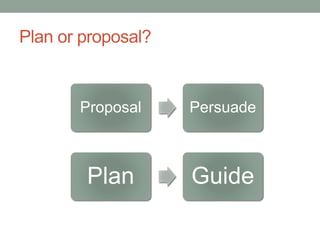
Plan or proposal?
Plan Guide
Proposal Persuade
What should I include in my plan?
• Title
• Abstract/summary
• Background, context, rationale
• Purpose of the study
• Literature review
• Research design and methods
• Ethical issues
• Work plan/Timetable
• Anticipated results
• Dissemination, deliverables
• Resources and costs
• References
Exemplar 1: Mobile devices in medicine
Boruff, J. T., & Storie, D. (2014). Mobile devices in
medicine: A survey of how medical students, residents, and
faculty use smartphones and other mobile devices to find
information. Journal of the Medical Library Association,
102(1), 22-30. doi: 10.3163/1536-5050.102.1.006
http://www.ncbi.nlm.nih.gov/pmc/articles/PMC3878932/
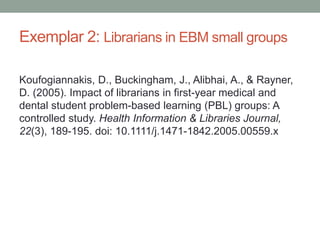
Exemplar 2: Librarians in EBM small groups
Koufogiannakis, D., Buckingham, J., Alibhai, A., & Rayner,
D. (2005). Impact of librarians in first-year medical and
dental student problem-based learning (PBL) groups: A
controlled study. Health Information & Libraries Journal,
22(3), 189-195. doi: 10.1111/j.1471-1842.2005.00559.x
Topic, problem, & objective
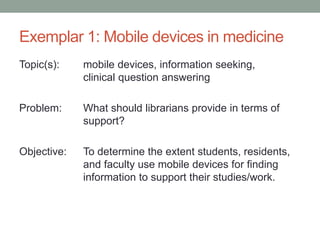
Exemplar 1: Mobile devices in medicine
Topic(s): mobile devices, information seeking,
clinical question answering
Problem: What should librarians provide in terms of
support?
Objective: To determine the extent students, residents,
and faculty use mobile devices for finding
information to support their studies/work.
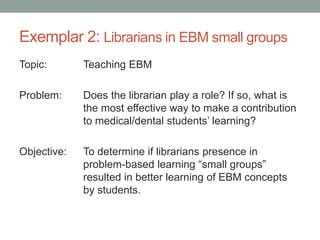
Exemplar 2: Librarians in EBM small groups
Topic: Teaching EBM
Problem: Does the librarian play a role? If so, what is
the most effective way to make a contribution
to medical/dental students’ learning?
Objective: To determine if librarians presence in
problem-based learning “small groups”
resulted in better learning of EBM concepts
by students.
IDENTIFY YOUR
RESEARCH OBJECTIVE
Activity 1
Literature review
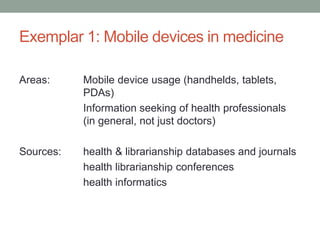
Exemplar 1: Mobile devices in medicine
Areas: Mobile device usage (handhelds, tablets,
PDAs)
Information seeking of health professionals
(in general, not just doctors)
Sources: health & librarianship databases and journals
health librarianship conferences
health informatics
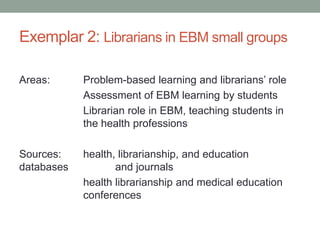
Exemplar 2: Librarians in EBM small groups
Areas: Problem-based learning and librarians’ role
Assessment of EBM learning by students
Librarian role in EBM, teaching students in
the health professions
Sources: health, librarianship, and education
databases and journals
health librarianship and medical education
conferences
LITERATURE REVIEW:
TOPICS & SOURCES
Activity 2
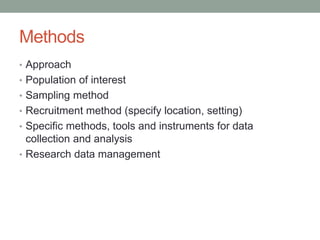
Methods
• Approach
• Population of interest
• Sampling method
• Recruitment method (specify location, setting)
• Specific methods, tools and instruments for data
collection and analysis
• Research data management
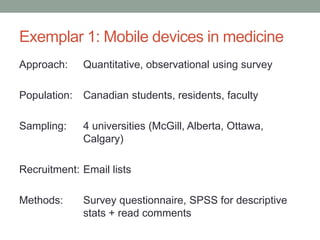
Exemplar 1: Mobile devices in medicine
Approach: Quantitative, observational using survey
Population: Canadian students, residents, faculty
Sampling: 4 universities (McGill, Alberta, Ottawa,
Calgary)
Recruitment: Email lists
Methods: Survey questionnaire, SPSS for descriptive
stats + read comments
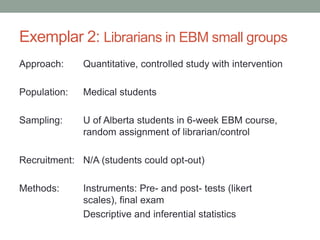
Exemplar 2: Librarians in EBM small groups
Approach: Quantitative, controlled study with intervention
Population: Medical students
Sampling: U of Alberta students in 6-week EBM course,
random assignment of librarian/control
Recruitment: N/A (students could opt-out)
Methods: Instruments: Pre- and post- tests (likert
scales), final exam
Descriptive and inferential statistics
CHOOSE A METHOD
Activity 3
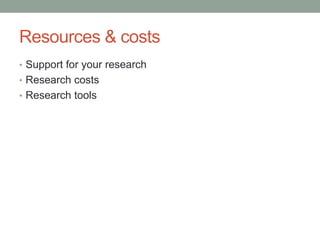
Resources & costs
• Support for your research
• Research costs
• Research tools
IDENTIFY RESOURCES
Activity 4
Wrap-Up
NEXT STEPS
Wrap-Up Activity

Research by Design

  • 1.
    RESEARCH BY DESIGN LorieKloda, MLIS, PhD, AHIP Associate University Librarian, Planning & Community Relations Concordia University MLA / CHLA / ICLC Toronto, May 13, 2016
  • 2.
    Introductions • Name • Positiontitle • Institution/hospital • City • Experience with research
  • 3.
    Today’s outline 8:15 Researchplan objectives 8:30 Overview of research plan elements 9:00 The research topic, problem, and objective 9:30 The literature review 10:00 BREAK! 10:15 Methods 11:00 Resources and costs 11:30 Wrap up and further resources 11:45 Evaluation
  • 4.
  • 5.
    Why do Ineed a plan/proposal? Some (good) reasons: • Organize your research project • Convince prospective supporters of its value • Obtain funding • Find supervisor or collaborators (colleagues) • Ethics approval • Requires you to focus your thoughts and decide what to do
  • 6.
    Plan or proposal? PlanGuide Proposal Persuade
  • 7.
    What should Iinclude in my plan? • Title • Abstract/summary • Background, context, rationale • Purpose of the study • Literature review • Research design and methods • Ethical issues • Work plan/Timetable • Anticipated results • Dissemination, deliverables • Resources and costs • References
  • 8.
    Exemplar 1: Mobiledevices in medicine Boruff, J. T., & Storie, D. (2014). Mobile devices in medicine: A survey of how medical students, residents, and faculty use smartphones and other mobile devices to find information. Journal of the Medical Library Association, 102(1), 22-30. doi: 10.3163/1536-5050.102.1.006 http://www.ncbi.nlm.nih.gov/pmc/articles/PMC3878932/
  • 9.
    Exemplar 2: Librariansin EBM small groups Koufogiannakis, D., Buckingham, J., Alibhai, A., & Rayner, D. (2005). Impact of librarians in first-year medical and dental student problem-based learning (PBL) groups: A controlled study. Health Information & Libraries Journal, 22(3), 189-195. doi: 10.1111/j.1471-1842.2005.00559.x
  • 10.
  • 11.
    Exemplar 1: Mobiledevices in medicine Topic(s): mobile devices, information seeking, clinical question answering Problem: What should librarians provide in terms of support? Objective: To determine the extent students, residents, and faculty use mobile devices for finding information to support their studies/work.
  • 12.
    Exemplar 2: Librariansin EBM small groups Topic: Teaching EBM Problem: Does the librarian play a role? If so, what is the most effective way to make a contribution to medical/dental students’ learning? Objective: To determine if librarians presence in problem-based learning “small groups” resulted in better learning of EBM concepts by students.
  • 13.
  • 14.
  • 15.
    Exemplar 1: Mobiledevices in medicine Areas: Mobile device usage (handhelds, tablets, PDAs) Information seeking of health professionals (in general, not just doctors) Sources: health & librarianship databases and journals health librarianship conferences health informatics
  • 16.
    Exemplar 2: Librariansin EBM small groups Areas: Problem-based learning and librarians’ role Assessment of EBM learning by students Librarian role in EBM, teaching students in the health professions Sources: health, librarianship, and education databases and journals health librarianship and medical education conferences
  • 17.
    LITERATURE REVIEW: TOPICS &SOURCES Activity 2
  • 18.
    Methods • Approach • Populationof interest • Sampling method • Recruitment method (specify location, setting) • Specific methods, tools and instruments for data collection and analysis • Research data management
  • 19.
    Exemplar 1: Mobiledevices in medicine Approach: Quantitative, observational using survey Population: Canadian students, residents, faculty Sampling: 4 universities (McGill, Alberta, Ottawa, Calgary) Recruitment: Email lists Methods: Survey questionnaire, SPSS for descriptive stats + read comments
  • 20.
    Exemplar 2: Librariansin EBM small groups Approach: Quantitative, controlled study with intervention Population: Medical students Sampling: U of Alberta students in 6-week EBM course, random assignment of librarian/control Recruitment: N/A (students could opt-out) Methods: Instruments: Pre- and post- tests (likert scales), final exam Descriptive and inferential statistics
  • 21.
  • 22.
    Resources & costs •Support for your research • Research costs • Research tools
  • 23.
  • 24.
  • 25.