Needs Analysis
Kam Marvel
St. Thomas University
EDT 610
Need Analysis
• Morrison, Ross and Kemp suggest a needs assessment when designing
learning for a new project (Brown & Green, 2016).
• A needs assessment can be divided into four phases:
• Planning
• Collecting data
• Analyzing the data
• Compiling a report
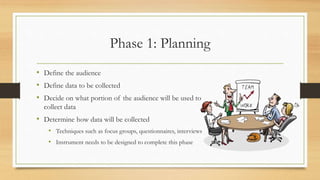
Phase 1: Planning
• Define the audience
• Define data to be collected
• Decide on what portion of the audience will be used to
collect data
• Determine how data will be collected
• Techniques such as focus groups, questionnaires, interviews
• Instrument needs to be designed to complete this phase
Phase 2: Collecting Data
• Define sample size
• Ideally, the entire group would be selected
• In the common event that the entire group is
unrealistic, a sample size reflective of sound
statistical principles should be used.
Phase 3: Analyzing the Data
• Identification of needs falls into six categories (Marosszweky, et.al., 2006)
• Normative ( group has a deficiency)
• Comparative (one group has assets another lacks)
• Felt (feel or desire to improve)
• Expressed ( based on action)
• Anticipated (what will be)
• Critical incident ( after a failure)
Phase 3: Analyzing the Data (cont.)
• Identified needs are prioritized based on:
• Cost or value
• Number of people impacted
• Frequency needs are identified
• Ranking system
Phase 4: Compiling a Final Report
• Four sections included:
• Summary of the purpose
• Summary of the process
• Summary of the results
(quantitative and qualitative)
• Recommendations
Work Completed
• San Jacinto College Adult Education and Literacy
program work related to converting all face-to-face
classes to live, online instruction
• Compressed timeline of one calendar week
• Following slides detail each phase of the needs
assessment including recommended steps
Phase 1: Planning
• Audience: Full time staff, instructors, adult learners
(students)
• Data to be collected: Physical technology assets, skills,
comfort, desire
• Portion of the audience: All would be surveyed
• Determine how data will be collected
• Technique: Online survey disseminated through email
• Instrument: Survey Monkey created by leadership
Phase 2: Collecting Data
• Sample size: 100% of staff and students would be surveyed
• Included six full time staff, seventeen instructors, roughly 450 students
• Survey Monkey with questions:
• Demographic data (Name, phone, secondary email)
• Technology assessment (Do you have a smart phone, laptop, tablet, internet, etc.)
• Online learning (Have you participated in online learning? Comfortable with
technology?)
• Desire to continue (Do you wish to continue classes? Barrier in your home?)
Phase 3: Analyzing the Data
• Summary of data:
• 100% of full-time staff and instructors completed survey.
• One full-time staff had tech need to be addressed by institution
• 14 of 17 instructors wanted to work in new environment
• 253 of roughly 450 students responded
• 247 stated they would be willing to continue
• 240 stated they were willing and had the technology needed
Phase 4: Final Report
• Summary of the purpose – The intent of the needs assessment was to determine the
feasibility of converting all adult education classes at San Jacinto College in the
Spring 2020 semester to remote learning with live instruction.
• Summary of the process: Online surveys were disseminated via email four times;
Data was disaggregated and duplicate respondents were removed, defaulting initial
responses; Data was analyzed statistically based on sub-group.
• Results: 100% of full-time staff and 82% of instructors are willing to commit to the
project. More than 50% of students responded that they are willing and have the
infrastructure to commit to classes in the new environment.
Phase 4: Final Report (cont.)
• Recommendations:
1. Proceed with creation of classes;
2. Develop training for both staff and students;
3. Distribute needed tech resources for staff;
4. Procure online-friendly curriculum;
5. Offer to all students regardless of response;
6. Begin 3/23/2020
References
• Brown, A. H., & Green, T. D. (2016). The essentials of instructional design: Connecting fundamental
principles with process and practice (3rd ed.). Routledge.
https://bookshelf.vitalsource.com/#/books/9781138797055/cfi/61!/4/4@0.00:66.2
• Marosszweky, N., Rix, M., and Owen, A. (2006). Knowing what you need to know about needs
assessment. Retrieved from
https://ro.uow.edu.au/cgi/viewcontent.cgi?referer=https://www.google.com/&httpsredir=
1&article=1088&context=gsbpapers

Needs Analysis in Instructional Design

  • 1.
    Needs Analysis Kam Marvel St.Thomas University EDT 610
  • 2.
    Need Analysis • Morrison,Ross and Kemp suggest a needs assessment when designing learning for a new project (Brown & Green, 2016). • A needs assessment can be divided into four phases: • Planning • Collecting data • Analyzing the data • Compiling a report
  • 3.
    Phase 1: Planning •Define the audience • Define data to be collected • Decide on what portion of the audience will be used to collect data • Determine how data will be collected • Techniques such as focus groups, questionnaires, interviews • Instrument needs to be designed to complete this phase
  • 4.
    Phase 2: CollectingData • Define sample size • Ideally, the entire group would be selected • In the common event that the entire group is unrealistic, a sample size reflective of sound statistical principles should be used.
  • 5.
    Phase 3: Analyzingthe Data • Identification of needs falls into six categories (Marosszweky, et.al., 2006) • Normative ( group has a deficiency) • Comparative (one group has assets another lacks) • Felt (feel or desire to improve) • Expressed ( based on action) • Anticipated (what will be) • Critical incident ( after a failure)
  • 6.
    Phase 3: Analyzingthe Data (cont.) • Identified needs are prioritized based on: • Cost or value • Number of people impacted • Frequency needs are identified • Ranking system
  • 7.
    Phase 4: Compilinga Final Report • Four sections included: • Summary of the purpose • Summary of the process • Summary of the results (quantitative and qualitative) • Recommendations
  • 8.
    Work Completed • SanJacinto College Adult Education and Literacy program work related to converting all face-to-face classes to live, online instruction • Compressed timeline of one calendar week • Following slides detail each phase of the needs assessment including recommended steps
  • 9.
    Phase 1: Planning •Audience: Full time staff, instructors, adult learners (students) • Data to be collected: Physical technology assets, skills, comfort, desire • Portion of the audience: All would be surveyed • Determine how data will be collected • Technique: Online survey disseminated through email • Instrument: Survey Monkey created by leadership
  • 10.
    Phase 2: CollectingData • Sample size: 100% of staff and students would be surveyed • Included six full time staff, seventeen instructors, roughly 450 students • Survey Monkey with questions: • Demographic data (Name, phone, secondary email) • Technology assessment (Do you have a smart phone, laptop, tablet, internet, etc.) • Online learning (Have you participated in online learning? Comfortable with technology?) • Desire to continue (Do you wish to continue classes? Barrier in your home?)
  • 11.
    Phase 3: Analyzingthe Data • Summary of data: • 100% of full-time staff and instructors completed survey. • One full-time staff had tech need to be addressed by institution • 14 of 17 instructors wanted to work in new environment • 253 of roughly 450 students responded • 247 stated they would be willing to continue • 240 stated they were willing and had the technology needed
  • 12.
    Phase 4: FinalReport • Summary of the purpose – The intent of the needs assessment was to determine the feasibility of converting all adult education classes at San Jacinto College in the Spring 2020 semester to remote learning with live instruction. • Summary of the process: Online surveys were disseminated via email four times; Data was disaggregated and duplicate respondents were removed, defaulting initial responses; Data was analyzed statistically based on sub-group. • Results: 100% of full-time staff and 82% of instructors are willing to commit to the project. More than 50% of students responded that they are willing and have the infrastructure to commit to classes in the new environment.
  • 13.
    Phase 4: FinalReport (cont.) • Recommendations: 1. Proceed with creation of classes; 2. Develop training for both staff and students; 3. Distribute needed tech resources for staff; 4. Procure online-friendly curriculum; 5. Offer to all students regardless of response; 6. Begin 3/23/2020
  • 14.
    References • Brown, A.H., & Green, T. D. (2016). The essentials of instructional design: Connecting fundamental principles with process and practice (3rd ed.). Routledge. https://bookshelf.vitalsource.com/#/books/9781138797055/cfi/61!/4/4@0.00:66.2 • Marosszweky, N., Rix, M., and Owen, A. (2006). Knowing what you need to know about needs assessment. Retrieved from https://ro.uow.edu.au/cgi/viewcontent.cgi?referer=https://www.google.com/&httpsredir= 1&article=1088&context=gsbpapers