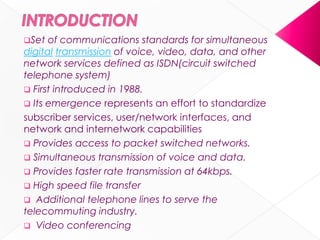
Set of communications standards for simultaneous
digital transmission of voice, video, data, and other
network services defined as ISDN(circuit switched
telephone system)
 First introduced in 1988.
 Its emergence represents an effort to standardize
subscriber services, user/network interfaces, and
network and internetwork capabilities
 Provides access to packet switched networks.
 Simultaneous transmission of voice and data.
 Provides faster rate transmission at 64kbps.
 High speed file transfer
 Additional telephone lines to serve the
telecommuting industry.
 Video conferencing
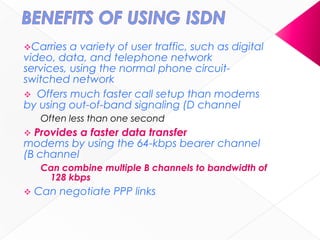
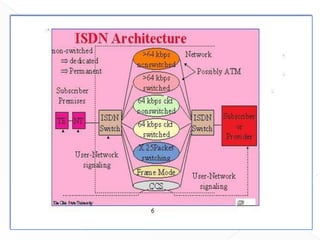
Carries a variety of user traffic, such as digital
video, data, and telephone network
services, using the normal phone circuit-
switched network
 Offers much faster call setup than modems
by using out-of-band signaling (D channel)
Often less than one second
 Provides a faster data transfer rate than
modems by using the 64-kbps bearer channel
(B channel)
Can combine multiple B channels to bandwidth of
128 kbps
 Can negotiate PPP links
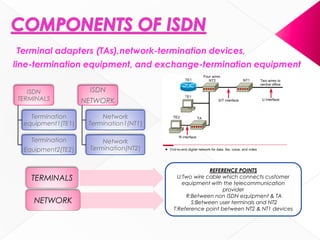
Terminal adapters (TAs),network-termination devices,
line-termination equipment, and exchange-termination equipment.
ISDN
TERMINALS
Termination
equipment1(TE1)
Termination
Equipment2(TE2)
ISDN
NETWORK
Network
Termination1(NT1)
Network
Termination(NT2)
TERMINALS
NETWORK
REFERENCE POINTS
U:Two wire cable which connects customer
equipment with the telecommunication
provider
R:Between non ISDN equipment & TA
S:Between user terminals and NT2
T:Reference point between NT2 & NT1 devices
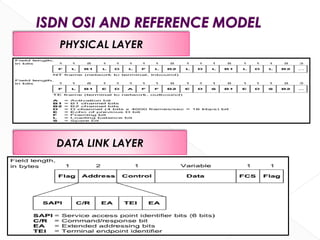
DATA LINK LAYER
PHYSICAL LAYER
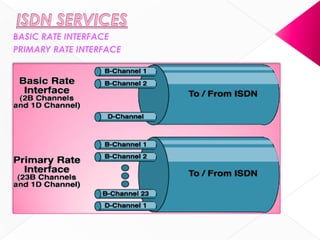
BASIC RATE INTERFACE
PRIMARY RATE INTERFACE
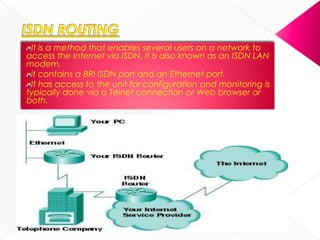
It is a method that enables several users on a network to
access the Internet via ISDN. It is also known as an ISDN LAN
modem.
it contains a BRI ISDN port and an Ethernet port.
It has access to the unit for configuration and monitoring is
typically done via a Telnet connection or Web browser or
both.
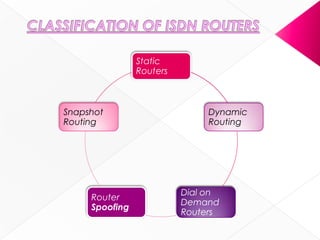
Static
Routers
Dynamic
Routing
Dial on
Demand
Routers
Router
Spoofing
Snapshot
Routing
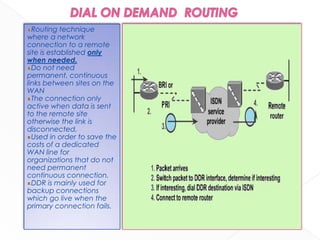
Routing technique
where a network
connection to a remote
site is established only
when needed.
Do not need
permanent, continuous
links between sites on the
WAN
The connection only
active when data is sent
to the remote site
otherwise the link is
disconnected.
Used in order to save the
costs of a dedicated
WAN line for
organizations that do not
need permanent
continuous connection.
DDR is mainly used for
backup connections
which go live when the
primary connection fails.
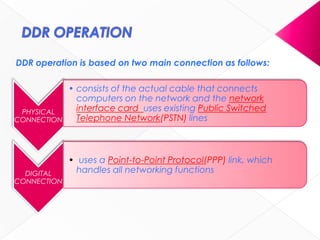
DDR operation is based on two main connection as follows:
PHYSICAL
CONNECTION
• consists of the actual cable that connects
computers on the network and the network
interface card uses existing Public Switched
Telephone Network(PSTN) lines
DIGITAL
CONNECTION
• uses a Point-to-Point Protocol(PPP) link, which
handles all networking functions
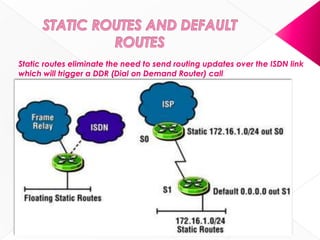
Static routes eliminate the need to send routing updates over the ISDN link
which will trigger a DDR (Dial on Demand Router) call.
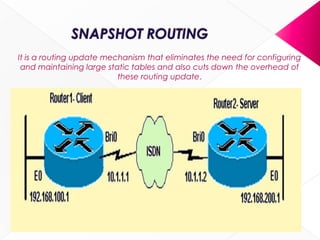
It is a routing update mechanism that eliminates the need for configuring
and maintaining large static tables and also cuts down the overhead of
these routing update.
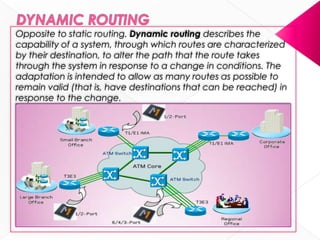
Opposite to static routing. Dynamic routing describes the
capability of a system, through which routes are characterized
by their destination, to alter the path that the route takes
through the system in response to a change in conditions. The
adaptation is intended to allow as many routes as possible to
remain valid (that is, have destinations that can be reached) in
response to the change.
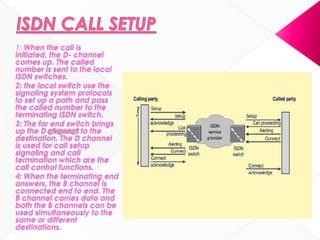
1: When the call is
initiated, the D- channel
comes up. The called
number is sent to the local
ISDN switches.
2: the local switch use the
signaling system protocols
to set up a path and pass
the called number to the
terminating ISDN switch.
3: The far end switch brings
up the D to the
destination. The D channel
is used for call setup
signaling and call
termination which are the
call control functions.
4: When the terminating end
answers, the B channel is
connected end to end. The
B channel carries data and
both the B channels can be
used simultaneously to the
same or different
destinations.
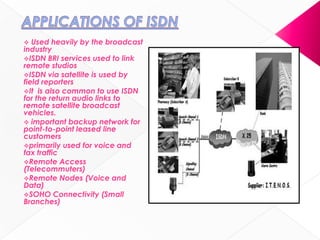
 Used heavily by the broadcast
industry
ISDN BRI services used to link
remote studios
ISDN via satellite is used by
field reporters
It is also common to use ISDN
for the return audio links to
remote satellite broadcast
vehicles.
 important backup network for
point-to-point leased line
customers
primarily used for voice and
fax traffic
Remote Access
(Telecommuters)
Remote Nodes (Voice and
Data)
SOHO Connectivity (Small
Branches)
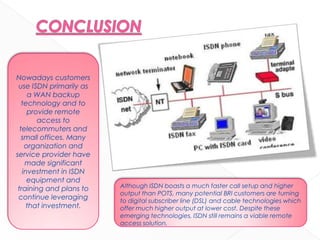
Nowadays customers
use ISDN primarily as
a WAN backup
technology and to
provide remote
access to
telecommuters and
small offices. Many
organization and
service provider have
made significant
investment in ISDN
equipment and
training and plans to
continue leveraging
that investment.
Although ISDN boasts a much faster call setup and higher
output than POTS, many potential BRI customers are turning
to digital subscriber line (DSL) and cable technologies which
offer much higher output at lower cost. Despite these
emerging technologies, ISDN still remains a viable remote
access solution.
Isdn routing

Isdn routing

  • 2.
    Set of communicationsstandards for simultaneous digital transmission of voice, video, data, and other network services defined as ISDN(circuit switched telephone system)  First introduced in 1988.  Its emergence represents an effort to standardize subscriber services, user/network interfaces, and network and internetwork capabilities  Provides access to packet switched networks.  Simultaneous transmission of voice and data.  Provides faster rate transmission at 64kbps.  High speed file transfer  Additional telephone lines to serve the telecommuting industry.  Video conferencing
  • 3.
    Carries a varietyof user traffic, such as digital video, data, and telephone network services, using the normal phone circuit- switched network  Offers much faster call setup than modems by using out-of-band signaling (D channel) Often less than one second  Provides a faster data transfer rate than modems by using the 64-kbps bearer channel (B channel) Can combine multiple B channels to bandwidth of 128 kbps  Can negotiate PPP links
  • 4.
    Terminal adapters (TAs),network-terminationdevices, line-termination equipment, and exchange-termination equipment. ISDN TERMINALS Termination equipment1(TE1) Termination Equipment2(TE2) ISDN NETWORK Network Termination1(NT1) Network Termination(NT2) TERMINALS NETWORK REFERENCE POINTS U:Two wire cable which connects customer equipment with the telecommunication provider R:Between non ISDN equipment & TA S:Between user terminals and NT2 T:Reference point between NT2 & NT1 devices
  • 6.
  • 8.
  • 9.
    It is amethod that enables several users on a network to access the Internet via ISDN. It is also known as an ISDN LAN modem. it contains a BRI ISDN port and an Ethernet port. It has access to the unit for configuration and monitoring is typically done via a Telnet connection or Web browser or both.
  • 10.
  • 11.
    Routing technique where anetwork connection to a remote site is established only when needed. Do not need permanent, continuous links between sites on the WAN The connection only active when data is sent to the remote site otherwise the link is disconnected. Used in order to save the costs of a dedicated WAN line for organizations that do not need permanent continuous connection. DDR is mainly used for backup connections which go live when the primary connection fails.
  • 12.
    DDR operation isbased on two main connection as follows: PHYSICAL CONNECTION • consists of the actual cable that connects computers on the network and the network interface card uses existing Public Switched Telephone Network(PSTN) lines DIGITAL CONNECTION • uses a Point-to-Point Protocol(PPP) link, which handles all networking functions
  • 13.
    Static routes eliminatethe need to send routing updates over the ISDN link which will trigger a DDR (Dial on Demand Router) call.
  • 14.
    It is arouting update mechanism that eliminates the need for configuring and maintaining large static tables and also cuts down the overhead of these routing update.
  • 15.
    Opposite to staticrouting. Dynamic routing describes the capability of a system, through which routes are characterized by their destination, to alter the path that the route takes through the system in response to a change in conditions. The adaptation is intended to allow as many routes as possible to remain valid (that is, have destinations that can be reached) in response to the change.
  • 16.
    1: When thecall is initiated, the D- channel comes up. The called number is sent to the local ISDN switches. 2: the local switch use the signaling system protocols to set up a path and pass the called number to the terminating ISDN switch. 3: The far end switch brings up the D to the destination. The D channel is used for call setup signaling and call termination which are the call control functions. 4: When the terminating end answers, the B channel is connected end to end. The B channel carries data and both the B channels can be used simultaneously to the same or different destinations.
  • 17.
     Used heavilyby the broadcast industry ISDN BRI services used to link remote studios ISDN via satellite is used by field reporters It is also common to use ISDN for the return audio links to remote satellite broadcast vehicles.  important backup network for point-to-point leased line customers primarily used for voice and fax traffic Remote Access (Telecommuters) Remote Nodes (Voice and Data) SOHO Connectivity (Small Branches)
  • 18.
    Nowadays customers use ISDNprimarily as a WAN backup technology and to provide remote access to telecommuters and small offices. Many organization and service provider have made significant investment in ISDN equipment and training and plans to continue leveraging that investment. Although ISDN boasts a much faster call setup and higher output than POTS, many potential BRI customers are turning to digital subscriber line (DSL) and cable technologies which offer much higher output at lower cost. Despite these emerging technologies, ISDN still remains a viable remote access solution.

Editor's Notes

  • #5 i) Terminal Equipment 1 (TE1): It is designed as a device which is compatible with ISDN network and also understands ISDN signaling standards. ii) Terminal Equipment 2 (TE2): It is designed as a device which is not compatible with ISDN network and also does not understand ISDN signaling standards. iii) Network Terminator 1 (NT-1):A small connection box that physically connects 4-wire ISDN subscriber wiring to the conventional 2-wire local loop facility. v) Network Terminator 2 (NT-2):This is an intelligent device which performs switching and concentrating.vi) Terminal Adapter:It is a converter device which converts standard electrical signals into the form used by ISDN. This device allows non-ISDN devices to operate on an ISDN network [5]. 1: U – It is a two wire cable which connects the customer’s equipment to the telecommunications provider.2: R – It connects non-ISDN equipment (TE2) and the Terminal Adapter (TA) via a standard physical layer interface.3: S – It is a four-wire cable from Terminal Equipment 1TE1 or TA to the NT1 or NT2. It connects the terminals to the ISDN network.4: T – It is located between NT1 and NT2 (or between NT 1 and TE 1 or TA if there is no NT 2 device) [6]. 
  • #7 ISDN physical layer (Layer1) frame format depends on whether the frame is outbound (from terminal to network) or inbound (from network to terminal). The frames are 48 bits long out of which 36 bits represent data. The bits of an ISDN physical layer frame are as follows:-F- It provides synchronizationL- It adjust the average bit valueE- It ensure contention resolution when several terminals on a passive bus contend for a channelA- It activates the deviceS-UnassignedB1, B2 and D- Handle user data. Layer 2 (data link) protocol for the D channel(called Link Access Procedure-D) is used to convey messages over common D channel. The LAPD and higher layer protocols handle the handshaking(commands and responses), signaling, and control for all of the voice and data calls that are setup through the ISDN D channel. The opening and closing flags are used for frame synchronization,, multiple logical data links, the data link address is divided into the Service Access Point Identifier (SAPI) and the Terminal End point Identifier (TEI). The control field determines the type of LAPD frame being transmitted as well as containing the sequence numbers for the acknowledged information transfer service. The frame check sequence(FCS) provides the detection by the receiver of any errors that may have occurred during the transmission of a frame.
  • #8 Two Layer 3 specifications are used for ISDN signaling: ITU-T (formerly CCITT) I.450 (also known as ITU-T Q.930) and ITU-T I.451 (also known as ITU-T Q.931).Together, these protocols support user-to-user,circuit- switched and packet-switch connections
  • #9 1: Basic Rate Interface or BRI: It consists of two B-channels (Bearer channels) that can carry voice or data at a rate of 64 kbps and one D-channel (Delta channels) which carries control and signaling information at a rate of 16 Kbps and 48 Kbps worth of framing and synchronization. The available databandwidth: 128 Kbps (2 x 64 Kbps) and User bandwidth: 144 Kbps (128 Kbps + a 16 Kbps D channel).Total linecapacity: 192 Kbps (144 Kbps + 48 Kbps framing). 2: Primary Rate Interface or PRI:It consists of 23 B-channels and one D-channel in North America and Japan, yielding a total bit rate of 1.544 Mbps. Each B channel is to be used for separate applications including voice, data and internet. PRI service is generally transmitted through a T-1 line. PRI is intended for users with greater capacity requirements and mainly used in large businesses.