ISA-75.01.01-2007 Notes
ISA-75.01.01-2007 includes equations for predicting the flow coefficient of compressible and
incompressible fluids through control valves.
The equations for incompressible flow are based on standard hydrodynamic equations for
Newtonian incompressible fluids. They are not intended for use when non-Newtonian fluids,
fluid mixtures, slurries, or liquid-solid conveyance systems are encountered.
1. Valve Style Modifier Fd
The ratio of the hydraulic diameter of a single flow passage to the diameter of a circular
orifice, the area of which is equivalent to the sum of areas of all identical flow passages at a
given travel
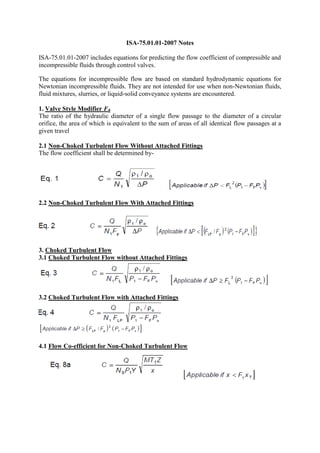
2.1 Non-Choked Turbulent Flow Without Attached Fittings
The flow coefficient shall be determined by-
2.2 Non-Choked Turbulent Flow With Attached Fittings
3. Choked Turbulent Flow
3.1 Choked Turbulent Flow without Attached Fittings
3.2 Choked Turbulent Flow with Attached Fittings
4.1 Flow Co-efficient for Non-Choked Turbulent Flow
4.2 Non-Choked Turbulent Flow with Attached Fittings
5.1 Choked Turbulent Flow without Attached Fittings
5.2 Choked Turbulent Flow with Attached Fittings
6. Piping Geometry Factor Fp
The piping geometry factor FP is necessary to account for fittings attached upstream and/or
downstream to a control valve body. The FP factor is the ratio of the flow rate through a
control valve installed with attached fittings to the flow rate that would result if the control
valve was installed without attached fittings and tested under identical conditions which will
not produce choked flow in either installation.
When estimated values are permissible, the following equation shall be used:
In this equation, the factor Σζ is the algebraic sum of all of the effective velocity head loss
coefficients of all fittings attached to the control valve. The velocity head loss coefficient of
the control valve itself is not included.
In cases where the piping diameters approaching and leaving the control valve are different,
the ζ B
coefficients are calculated as follows:
If the inlet and outlet fittings are short-length, commercially available, concentric reducers,
the ζ 1 and ζ 2 coefficients may be approximated as follows:
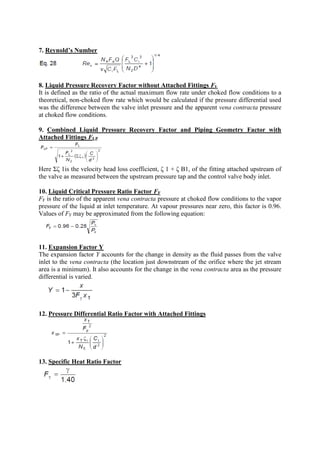
7. Reynold’s Number
8. Liquid Pressure Recovery Factor without Attached Fittings FL
It is defined as the ratio of the actual maximum flow rate under choked flow conditions to a
theoretical, non-choked flow rate which would be calculated if the pressure differential used
was the difference between the valve inlet pressure and the apparent vena contracta pressure
at choked flow conditions.
9. Combined Liquid Pressure Recovery Factor and Piping Geometry Factor with
Attached Fittings FLP
Here Σζ 1is the velocity head loss coefficient, ζ 1 + ζ B1, of the fitting attached upstream of
the valve as measured between the upstream pressure tap and the control valve body inlet.
10. Liquid Critical Pressure Ratio Factor FF
FF is the ratio of the apparent vena contracta pressure at choked flow conditions to the vapor
pressure of the liquid at inlet temperature. At vapour pressures near zero, this factor is 0.96.
Values of FF may be approximated from the following equation:
11. Expansion Factor Y
The expansion factor Y accounts for the change in density as the fluid passes from the valve
inlet to the vena contracta (the location just downstream of the orifice where the jet stream
area is a minimum). It also accounts for the change in the vena contracta area as the pressure
differential is varied.
12. Pressure Differential Ratio Factor with Attached Fittings
13. Specific Heat Ratio Factor

ISA 75.01.01-2007 notes

  • 1.
    ISA-75.01.01-2007 Notes ISA-75.01.01-2007 includesequations for predicting the flow coefficient of compressible and incompressible fluids through control valves. The equations for incompressible flow are based on standard hydrodynamic equations for Newtonian incompressible fluids. They are not intended for use when non-Newtonian fluids, fluid mixtures, slurries, or liquid-solid conveyance systems are encountered. 1. Valve Style Modifier Fd The ratio of the hydraulic diameter of a single flow passage to the diameter of a circular orifice, the area of which is equivalent to the sum of areas of all identical flow passages at a given travel 2.1 Non-Choked Turbulent Flow Without Attached Fittings The flow coefficient shall be determined by- 2.2 Non-Choked Turbulent Flow With Attached Fittings 3. Choked Turbulent Flow 3.1 Choked Turbulent Flow without Attached Fittings 3.2 Choked Turbulent Flow with Attached Fittings 4.1 Flow Co-efficient for Non-Choked Turbulent Flow
  • 2.
    4.2 Non-Choked TurbulentFlow with Attached Fittings 5.1 Choked Turbulent Flow without Attached Fittings 5.2 Choked Turbulent Flow with Attached Fittings 6. Piping Geometry Factor Fp The piping geometry factor FP is necessary to account for fittings attached upstream and/or downstream to a control valve body. The FP factor is the ratio of the flow rate through a control valve installed with attached fittings to the flow rate that would result if the control valve was installed without attached fittings and tested under identical conditions which will not produce choked flow in either installation. When estimated values are permissible, the following equation shall be used: In this equation, the factor Σζ is the algebraic sum of all of the effective velocity head loss coefficients of all fittings attached to the control valve. The velocity head loss coefficient of the control valve itself is not included. In cases where the piping diameters approaching and leaving the control valve are different, the ζ B coefficients are calculated as follows: If the inlet and outlet fittings are short-length, commercially available, concentric reducers, the ζ 1 and ζ 2 coefficients may be approximated as follows:
  • 3.
    7. Reynold’s Number 8.Liquid Pressure Recovery Factor without Attached Fittings FL It is defined as the ratio of the actual maximum flow rate under choked flow conditions to a theoretical, non-choked flow rate which would be calculated if the pressure differential used was the difference between the valve inlet pressure and the apparent vena contracta pressure at choked flow conditions. 9. Combined Liquid Pressure Recovery Factor and Piping Geometry Factor with Attached Fittings FLP Here Σζ 1is the velocity head loss coefficient, ζ 1 + ζ B1, of the fitting attached upstream of the valve as measured between the upstream pressure tap and the control valve body inlet. 10. Liquid Critical Pressure Ratio Factor FF FF is the ratio of the apparent vena contracta pressure at choked flow conditions to the vapor pressure of the liquid at inlet temperature. At vapour pressures near zero, this factor is 0.96. Values of FF may be approximated from the following equation: 11. Expansion Factor Y The expansion factor Y accounts for the change in density as the fluid passes from the valve inlet to the vena contracta (the location just downstream of the orifice where the jet stream area is a minimum). It also accounts for the change in the vena contracta area as the pressure differential is varied. 12. Pressure Differential Ratio Factor with Attached Fittings 13. Specific Heat Ratio Factor