UCH 2504- Process Instrumentation,
Dynamics and Control
Characteristics of Control valve
Dr.B.Chitra
Associate Professor
Department of Chemical Engineering
Dr.B.Chitra
Control Valve
• One of the basic components of any control system is the final control
element, which comes in a variety of forms depending on the specific control
application.
• The most common type of final control element in chemical processing is the
pneumatic control valve, which regulates the flow of fluids.
• Some other types include the variable-speed pump and the power controller
(used in electrical heating).
• Since the pneumatic control valve is so widely used in chemical processing,
the types and flow-coefficient of control valve will be studied.
• The control valve is essentially a variable resistance to the flow of a fluid in
which the resistance, and therefore the flow, can be changed by a signal from
a process controller.
Control Valve Construction
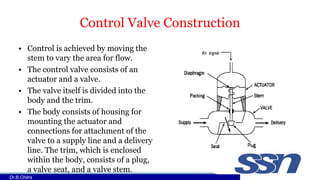
• Control is achieved by moving the
stem to vary the area for flow.
• The control valve consists of an
actuator and a valve.
• The valve itself is divided into the
body and the trim.
• The body consists of housing for
mounting the actuator and
connections for attachment of the
valve to a supply line and a delivery
line. The trim, which is enclosed
within the body, consists of a plug,
a valve seat, and a valve stem.
Dr.B.Chitra
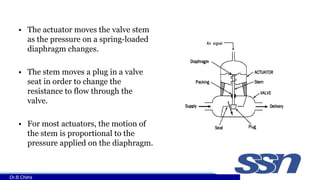
• The actuator moves the valve stem
as the pressure on a spring-loaded
diaphragm changes.
• The stem moves a plug in a valve
seat in order to change the
resistance to flow through the
valve.
• For most actuators, the motion of
the stem is proportional to the
pressure applied on the diaphragm.
Dr.B.Chitra
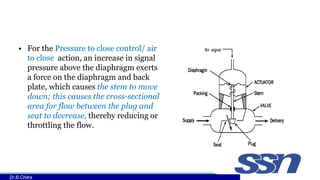
• For the Pressure to close control/ air
to close action, an increase in signal
pressure above the diaphragm exerts
a force on the diaphragm and back
plate, which causes the stem to move
down; this causes the cross-sectional
area for flow between the plug and
seat to decrease, thereby reducing or
throttling the flow.
Dr.B.Chitra
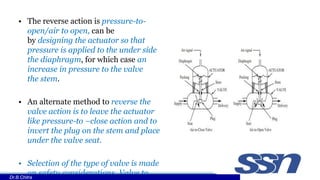
• The reverse action is pressure-to-
open/air to open, can be
by designing the actuator so that
pressure is applied to the under side
the diaphragm, for which case an
increase in pressure to the valve
the stem.
• An alternate method to reverse the
valve action is to leave the actuator
like pressure-to –close action and to
invert the plug on the stem and place
under the valve seat.
• Selection of the type of valve is made
on safety considerations. Valve to
Dr.B.Chitra
Valve Sizing
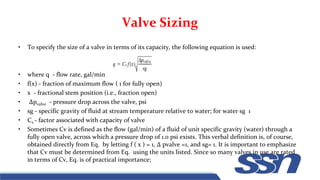
• To specify the size of a valve in terms of its capacity, the following equation is used:
• where q - flow rate, gal/min
• f(x) - fraction of maximum flow ( 1 for fully open)
• x - fractional stem position (i.e., fraction open)
• ∆pvalve - pressure drop across the valve, psi
• sg - specific gravity of fluid at stream temperature relative to water; for water sg 1
• Cv - factor associated with capacity of valve
• Sometimes Cv is defined as the flow (gal/min) of a fluid of unit specific gravity (water) through a
fully open valve, across which a pressure drop of 1.0 psi exists. This verbal definition is, of course,
obtained directly from Eq. by letting f ( x ) = 1, ∆ pvalve =1, and sg= 1. It is important to emphasize
that Cv must be determined from Eq. using the units listed. Since so many valves in use are rated
in terms of Cv, Eq. is of practical importance;
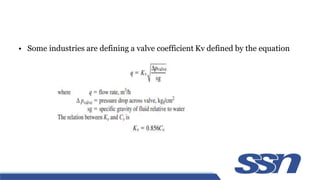
• Some industries are defining a valve coefficient Kv defined by the equation
Valve Characteristics
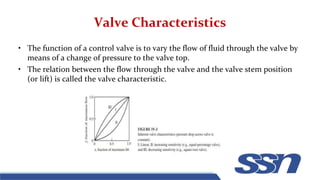
• The function of a control valve is to vary the flow of fluid through the valve by
means of a change of pressure to the valve top.
• The relation between the flow through the valve and the valve stem position
(or lift) is called the valve characteristic.
THEORY
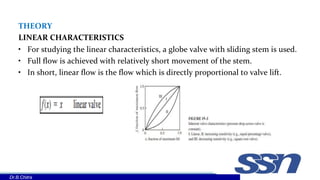
LINEAR CHARACTERISTICS
• For studying the linear characteristics, a globe valve with sliding stem is used.
• Full flow is achieved with relatively short movement of the stem.
• In short, linear flow is the flow which is directly proportional to valve lift.
Dr.B.Chitra
THEORY
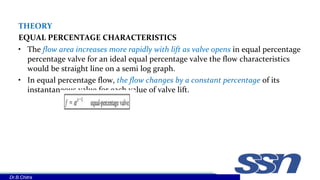
EQUAL PERCENTAGE CHARACTERISTICS
• The flow area increases more rapidly with lift as valve opens in equal percentage
percentage valve for an ideal equal percentage valve the flow characteristics
would be straight line on a semi log graph.
• In equal percentage flow, the flow changes by a constant percentage of its
instantaneous value for each value of valve lift.
Dr.B.Chitra
THEORY
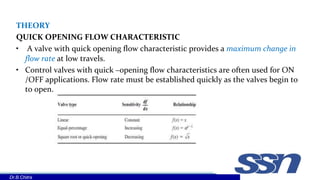
QUICK OPENING FLOW CHARACTERISTIC
• A valve with quick opening flow characteristic provides a maximum change in
flow rate at low travels.
• Control valves with quick –opening flow characteristics are often used for ON
/OFF applications. Flow rate must be established quickly as the valves begin to
to open.
Dr.B.Chitra

Control valve characteristics.pptx

  • 1.
    UCH 2504- ProcessInstrumentation, Dynamics and Control Characteristics of Control valve Dr.B.Chitra Associate Professor Department of Chemical Engineering Dr.B.Chitra
  • 2.
    Control Valve • Oneof the basic components of any control system is the final control element, which comes in a variety of forms depending on the specific control application. • The most common type of final control element in chemical processing is the pneumatic control valve, which regulates the flow of fluids. • Some other types include the variable-speed pump and the power controller (used in electrical heating). • Since the pneumatic control valve is so widely used in chemical processing, the types and flow-coefficient of control valve will be studied. • The control valve is essentially a variable resistance to the flow of a fluid in which the resistance, and therefore the flow, can be changed by a signal from a process controller.
  • 3.
    Control Valve Construction •Control is achieved by moving the stem to vary the area for flow. • The control valve consists of an actuator and a valve. • The valve itself is divided into the body and the trim. • The body consists of housing for mounting the actuator and connections for attachment of the valve to a supply line and a delivery line. The trim, which is enclosed within the body, consists of a plug, a valve seat, and a valve stem. Dr.B.Chitra
  • 4.
    • The actuatormoves the valve stem as the pressure on a spring-loaded diaphragm changes. • The stem moves a plug in a valve seat in order to change the resistance to flow through the valve. • For most actuators, the motion of the stem is proportional to the pressure applied on the diaphragm. Dr.B.Chitra
  • 5.
    • For thePressure to close control/ air to close action, an increase in signal pressure above the diaphragm exerts a force on the diaphragm and back plate, which causes the stem to move down; this causes the cross-sectional area for flow between the plug and seat to decrease, thereby reducing or throttling the flow. Dr.B.Chitra
  • 6.
    • The reverseaction is pressure-to- open/air to open, can be by designing the actuator so that pressure is applied to the under side the diaphragm, for which case an increase in pressure to the valve the stem. • An alternate method to reverse the valve action is to leave the actuator like pressure-to –close action and to invert the plug on the stem and place under the valve seat. • Selection of the type of valve is made on safety considerations. Valve to Dr.B.Chitra
  • 7.
    Valve Sizing • Tospecify the size of a valve in terms of its capacity, the following equation is used: • where q - flow rate, gal/min • f(x) - fraction of maximum flow ( 1 for fully open) • x - fractional stem position (i.e., fraction open) • ∆pvalve - pressure drop across the valve, psi • sg - specific gravity of fluid at stream temperature relative to water; for water sg 1 • Cv - factor associated with capacity of valve • Sometimes Cv is defined as the flow (gal/min) of a fluid of unit specific gravity (water) through a fully open valve, across which a pressure drop of 1.0 psi exists. This verbal definition is, of course, obtained directly from Eq. by letting f ( x ) = 1, ∆ pvalve =1, and sg= 1. It is important to emphasize that Cv must be determined from Eq. using the units listed. Since so many valves in use are rated in terms of Cv, Eq. is of practical importance;
  • 8.
    • Some industriesare defining a valve coefficient Kv defined by the equation
  • 9.
    Valve Characteristics • Thefunction of a control valve is to vary the flow of fluid through the valve by means of a change of pressure to the valve top. • The relation between the flow through the valve and the valve stem position (or lift) is called the valve characteristic.
  • 10.
    THEORY LINEAR CHARACTERISTICS • Forstudying the linear characteristics, a globe valve with sliding stem is used. • Full flow is achieved with relatively short movement of the stem. • In short, linear flow is the flow which is directly proportional to valve lift. Dr.B.Chitra
  • 11.
    THEORY EQUAL PERCENTAGE CHARACTERISTICS •The flow area increases more rapidly with lift as valve opens in equal percentage percentage valve for an ideal equal percentage valve the flow characteristics would be straight line on a semi log graph. • In equal percentage flow, the flow changes by a constant percentage of its instantaneous value for each value of valve lift. Dr.B.Chitra
  • 12.
    THEORY QUICK OPENING FLOWCHARACTERISTIC • A valve with quick opening flow characteristic provides a maximum change in flow rate at low travels. • Control valves with quick –opening flow characteristics are often used for ON /OFF applications. Flow rate must be established quickly as the valves begin to to open. Dr.B.Chitra