Presented by: Dr. AISHWARYA KHARE
Topics to Be Covered
 Introduction
 History
 Objectives of irrigation
 Ideal requirements of irrigating solutions
 Factors modifying the activity of irrigating solutions
 Hydrodynamics of irrigation
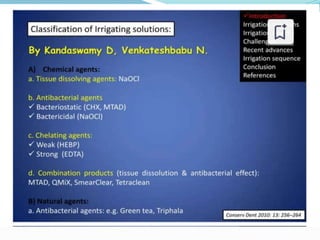
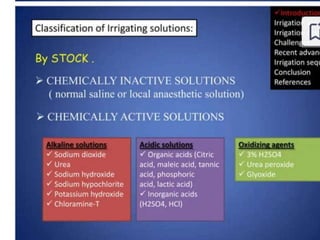
 Classification of irrigating solution
 Systems of irrigation
 Canal preparation for irrigation
 Conclusion
Introduction:
 Irrigation is defined as “ to wash out a body cavity or wound
with water or medicated fluid” and aspiration as “ the process
of removing fluids or gases from the body with suction
device.”
(by Cohen, 12th edition)
 Disinfectant, meanwhile, is defined as “ an agent that
destroys or inhibits the activity of microorganisms that cause
disease”.
History
 The concept of the germ theory of disease combined with the
development of dentistry during the latter half of the 19th century
had a direct effect on the practice of endodontics.
 The significance of root canal irrigation to endodontics
strengthened in the period between 1859 when Taft
recommended frequent syringing of the root canal to remove
"irritants“, until the mid-1940s when endodontics became a
special field within dentistry and the American Endodontic
Society was established.
 While it was widely assumed that by wiping the root canal with
disinfectants sterilization would be achieved, many of the
principles associated with cleaning the root canal published
during this period, in particular by Willoughby Dayton Miller
in the 1890s and Louis Grossman in the 1940s, remain equally
relevant in the 21st century.
OBJECTIVES OF IRRIGATION:
 Flush out debris
 Lubricate the canal
 Dissolve organic and inorganic tissue
 Prevent the formation of smear layer during instrumentation
or dissolve it once it has formed
 Detach the disrupt biofilms
Ideal requirements ….
1. Broad spectrum antimicrobial action
2. Aid in debridement of root canal system
3. Ability to dissolve necrotic tissue or debris
4. Low toxicity level
5. Good lubricant
6. Low surface tension to flow into inaccessible area
7. Ability to sterilize the canal
8. It should be able to prevent formation of smear layer during
instrumentation or dissolve the latter once it is formed
Ideal requirements ….
9. It should inactivate endotoxin.
10. Ease of use, convenience, adequate shelf life and ease
of storage.
11. When irrigants come in contact with vital tissue, they
should be systemically non-toxic, non cancerous, non-
caustic to periodontal tissue and have little potential to
cause an anaphylactic reaction.
12. Relatively inexpensive
Factors Modifying the Activity of Irrigating
Solutions
 Concentration
 Contact
 Presence of organic tissue
 Quantity
 Temperature
Hydrodynamics of irrigation:
 Irrigation dynamics refers to how irrigants flow, penetrate,
and readily exchange within the root canal walls as well as the
forces produced by them.
 Hence, in endodontic disinfection, the process of delivery is
as essential as the antibacterial characteristics of the
irrigants.
 The effectiveness of root canal irrigation in terms of debris
removal and eradication of bacteria depends on several
factors that can be controlled by the operator:-
1. Penetration depth of the needle
2. Diameter of the root canal
3. Inner and outer diameter of the needle
4. Irrigation pressure
5. Viscosity of the irrigant
6. Velocity of the irrigant at the needle tip
7. Type and orientation of the bevel.
 The size and the length of the irrigation needle- to root canal
dimension-are of outmost importance for the effectiveness of
irrigation
 The external needle diameter is of relevance for the depth of
introduction into the root canal and rigidity of the needle body, as
essential consideration for irrigation of curved canals.
 Common 27 gauge injection needles have an external diameter of
0.42mm, but smaller stainless steel irrigation tips with external
diameters of 0.32mm (30 gauge), and even 31 gauge or 0.26mm
(Navitip, ultradent, south jordan, UT, USA) are available.
 The stropko flexi tip (30 gauge) needle is fabricated from nickel
titanium to improve penetration into curved canals.
 More recently, a flexible plastic irrigation tip was introduced
(Trunatomy, Dentsply sirona).
 Apical pressure is the force applied perpendicular to the
apical wall surface.
 Internal syringe diameter determines the pressure necessary
for moving the syringe plunger.
 Speed of the plunger determines the velocity with which
irrigant extruded.
 Fine needles require more pressure onto the plunger and
extrude the irrigant with the higher velocity than larger
needle sizes, which extrude significantly greater amounts of
irrigants but for safety reasons cannot be introduced as
deeply.
 To improve the safety of irrigation and prevent extrusion of
the irrigant through the apical foramen, some needle types
release the solution via lateral openings and have a closed,
safe-ended tip.
 Side vented and double side vented needles led to maximum
shear stress concentration on the wall facing the outlet.
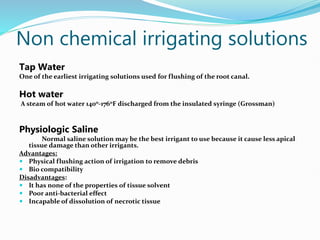
Non chemical irrigating solutions
Tap Water
One of the earliest irrigating solutions used for flushing of the root canal.
Hot water
A steam of hot water 1400-1760F discharged from the insulated syringe (Grossman)
Physiologic Saline
Normal saline solution may be the best irrigant to use because it cause less apical
tissue damage than other irrigants.
Advantages:
 Physical flushing action of irrigation to remove debris
 Bio compatibility
Disadvantages:
 It has none of the properties of tissue solvent
 Poor anti-bacterial effect
 Incapable of dissolution of necrotic tissue
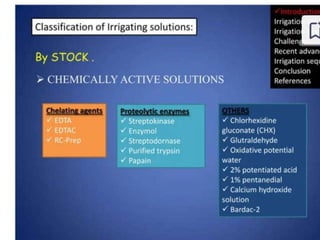
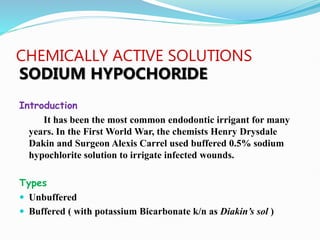
CHEMICALLY ACTIVE SOLUTIONS
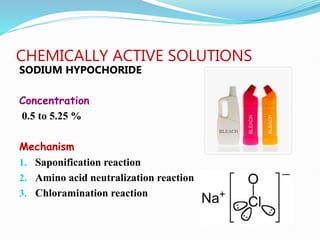
SODIUM HYPOCHORIDE
Introduction
It has been the most common endodontic irrigant for many
years. In the First World War, the chemists Henry Drysdale
Dakin and Surgeon Alexis Carrel used buffered 0.5% sodium
hypochlorite solution to irrigate infected wounds.
Types
 Unbuffered
 Buffered ( with potassium Bicarbonate k/n as Diakin’s sol )
CHEMICALLY ACTIVE SOLUTIONS
SODIUM HYPOCHORIDE
Concentration
0.5 to 5.25 %
Mechanism
1. Saponification reaction
2. Amino acid neutralization reaction
3. Chloramination reaction
 NaOcl acts as an organic and fat solvent that degrades fatty
acids and transforms them into fatty acid salts (soap) and
glycerol (alcohol), reducing the surface tension of remaining
solution
 Sodium hypochlorite neutralizes amino acids and forming
water and salt. With the exit of hydroxyl ions, the pH is
reduced
 NaOCl also acts as solvent, releasing chlorine that combine
with protein amino groups (NH) to forms chloramines.
 Chloramines impede cell metabolism; chlorine is a strong
oxidant and inhibits essential bacterial enzymes by
irreversible oxidation of sulphydryl group.
CHEMICALLY ACTIVE SOLUTIONS
SODIUM HYPOCHORIDE
Methods by which we can increase the efficacy of
sodium hypochlorite
 Time
 Heat
 Specialized irrigating syringes
 Ultrasonic activation of NaOCl
CHEMICALLY ACTIVE SOLUTIONS
SODIUM HYPOCHORIDE
Drawbacks….
1. Decreased surface tension
2. Increased dentin permeability
3. Toxic to the periradicular tissues
4. Free Radicle formation
5. Unpleasant taste
6. Lack of ability to remove smear layer
CHEMICALLY ACTIVE SOLUTIONS
CHLORHEXIDINE
Introduction
Chlorhexidine in the form of a salt (gluconate acetate
hydrochlorate) has been used since 1950 in different conc. as
an oral antiseptic in the form of a mouthwash.
Types
• Water based solution
• Gel ( with Natrosol)
• Liquid mixture with surface active agents
CHEMICALLY ACTIVE SOLUTIONS
CHLORHEXIDINE
Concentration
0.5 to 2%
Mechanism
The antimicrobial mechanism of chlorhexidine is related to
its cationic bisbiquanide molecular structure. The cationic
molecule is absorbed to negatively charged inner cell
membrane and cause leakage of intercellular components.
CHEMICALLY ACTIVE SOLUTIONS
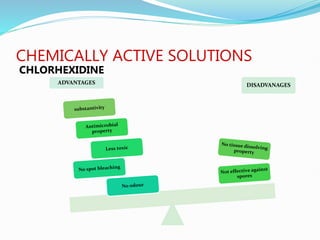
CHLORHEXIDINE
ADVANTAGES DISADVANAGES
CHEMICALLY ACTIVE SOLUTIONS
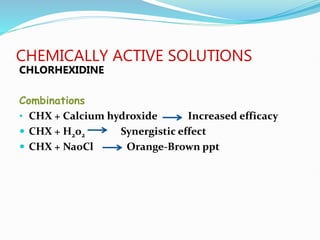
CHLORHEXIDINE
Combinations
• CHX + Calcium hydroxide Increased efficacy
 CHX + H2o2 Synergistic effect
 CHX + NaoCl Orange-Brown ppt
CHEMICALLY ACTIVE SOLUTIONS
HYDROGEN PEROXIDE
Introduction
It is a biocide. Not very popular
Concentration
1 – 30% ( Superoxol)
Mechanism
Hydroxyl free radicles (HO) Bacterial DNA and protein
CHEMICALLY ACTIVE SOLUTIONS
HYDROGEN PEROXIDE
Mechanism
 It causes oxidation of bacterial sulfhydryl group of enzymes
and thus interferes with bacterial metabolism.
 The rapid release of nascent oxygen on contact with
organic tissues results in effervescence of bubbling action
which is thought to aid in mechanical debridement by
dislodging particles of necrotic tissue and dentinal debris
and floating them to the surface.
CHEMICALLY ACTIVE SOLUTIONS
HYDROGEN PEROXIDE
Combinations
1. H2O2 + CHX Strong synergism
2. H2O2 ( 3%) + NaOCl ( 5.25 %) Beneficial
H2O2 = bubbles out debris into pulp chamber through
least resistant orifice.
NaOCl = Tissue dissolving property
Both = Bleaching
CHEMICALLY ACTIVE SOLUTIONS
GLY-OXIDE
It is a 10% solution of carbamide peroxide in anhyderous
glycerol.
Action
 It provides lubrication without softening dentin.
 It has antimicrobial activity more than 3% H2O2.
 It produces transient energetic effervescence that
mechanically forces debris and microorganism out of canal
when used with NaOCl, alternatively.
Limitation
 It does not remove smear layer.
CHEMICALLY ACTIVE SOLUTIONS
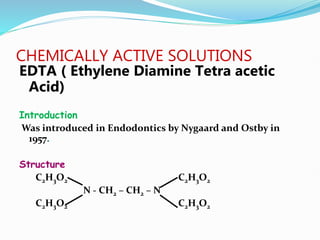
EDTA ( Ethylene Diamine Tetra acetic
Acid)
Introduction
Was introduced in Endodontics by Nygaard and Ostby in
1957.
Structure
C2H3O2 C2H3O2
N - CH2 – CH2 – N
C2H3O2 C2H3O2
CHEMICALLY ACTIVE SOLUTIONS
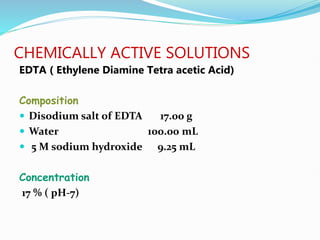
EDTA ( Ethylene Diamine Tetra acetic Acid)
Composition
 Disodium salt of EDTA 17.00 g
 Water 100.00 mL
 5 M sodium hydroxide 9.25 mL
Concentration
17 % ( pH-7)
CHEMICALLY ACTIVE SOLUTIONS
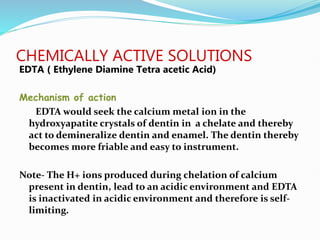
EDTA ( Ethylene Diamine Tetra acetic Acid)
Mechanism of action
EDTA would seek the calcium metal ion in the
hydroxyapatite crystals of dentin in a chelate and thereby
act to demineralize dentin and enamel. The dentin thereby
becomes more friable and easy to instrument.
Note- The H+ ions produced during chelation of calcium
present in dentin, lead to an acidic environment and EDTA
is inactivated in acidic environment and therefore is self-
limiting.
CHEMICALLY ACTIVE SOLUTIONS
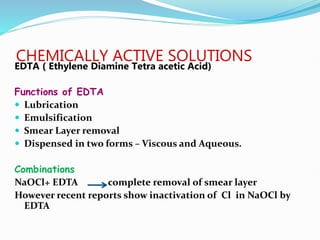
EDTA ( Ethylene Diamine Tetra acetic Acid)
Functions of EDTA
 Lubrication
 Emulsification
 Smear Layer removal
 Dispensed in two forms – Viscous and Aqueous.
Combinations
NaOCl+ EDTA complete removal of smear layer
However recent reports show inactivation of Cl in NaOCl by
EDTA
CHEMICALLY ACTIVE SOLUTIONS
EDTA ( Ethylene Diamine Tetra acetic Acid)
Combinations
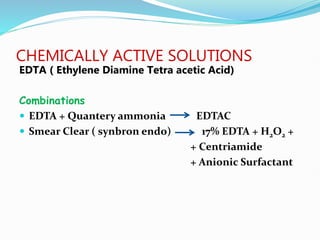
 EDTA + Quantery ammonia EDTAC
 Smear Clear ( synbron endo) 17% EDTA + H2O2 +
+ Centriamide
+ Anionic Surfactant
CHEMICALLY ACTIVE SOLUTIONS
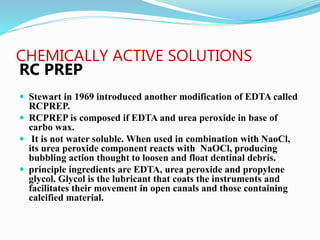
RC PREP
 Stewart in 1969 introduced another modification of EDTA called
RCPREP.
 RCPREP is composed if EDTA and urea peroxide in base of
carbo wax.
 It is not water soluble. When used in combination with NaoCl,
its urea peroxide component reacts with NaOCl, producing
bubbling action thought to loosen and float dentinal debris.
 principle ingredients are EDTA, urea peroxide and propylene
glycol. Glycol is the lubricant that coats the instruments and
facilitates their movement in open canals and those containing
calcified material.
CHEMICALLY ACTIVE SOLUTIONS
EGTA [ Ethylene gylcol bis-(beta-
aminoethyl ether)-N- tetraacetic acid
 Recently a new chelating agent has been introduced. It is
structurally quite similar to EDTA. EDTA is under evaluation to
be used individually and in combination with other irrigants.
 EGTA removed the smear layer without inducing a corrosive
action
 EGTA and NaOCl did not remove the superficial smear layer in
the apical third and some of the tubular orifices were clogged.
Thus EGTA was not found to be as effective as EDTA.
CHEMICALLY ACTIVE SOLUTIONS
Calcinase
17% sodium edetate +sodium hydroxide as a stabilizer and purified
water.
REDTA
17% EDTA solution + 0.84 g Cetyl-trimethyl ammonium bromide
(Cetrimide) + 9.25 mL 5 M sodium hydroxide and 100 mL
distilled water.
EDTAC and DTPAC
EDTA (15%) + diethyl-triamine-penta acetic acid (DTPA) at pH 8.
EDTA-T
17% EDTA + sodium lauryl ether sulfate (Tergentol).
CHEMICALLY ACTIVE SOLUTIONS
CDTA
1 % solution of cyclohexane-1,2-diaminetetraacetic acid .
Largal Ultra
15% EDTA + 0.75% Cetyl-tri-methyl ammonium bromide
(Cetrimide) + sodium hydroxide.
Decal
5.3 % oxyl-acetate + 4.6% ammonium oxyl-acetate + 0.06% Cetyl-
tri-methyl ammonium bromide (Cetrimide) - pH value of 3.4 .
Tubulicid Plus
1.5 g Amphoteric-2 (38%) + 0.5 g benzalkonichloride + 3 g
disodium EDTA dihydrate + phosphate buffer solution + 100 g
distilled water + 50% citric acid.
CHEMICALLY ACTIVE SOLUTIONS
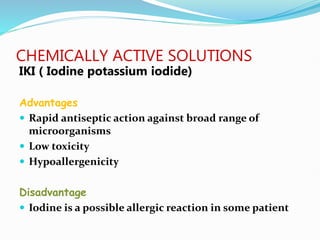
IKI ( Iodine potassium iodide)
Introduction
Oldest disinfectant and is still actively used. It is best
known for their use on skin, surface and operation field
Concentration
2%
Composition
Iodine 2 gms
KI 4 gms
Water 94ml
CHEMICALLY ACTIVE SOLUTIONS
IKI ( Iodine potassium iodide)
Storage
Poor stability in aqueous solution, led to the development of …
 Iodophor ‘ iodine carrier’
 Povidone-iodine
 Poloxamer-iodine
Iodophors less active against spores and some yeasts than
tincture iodine.
Mechanism
Oxidizing agent that reacts with sulfhydrl groups of bacterial
enzymes, clearing the disulphide bonds.
CHEMICALLY ACTIVE SOLUTIONS
IKI ( Iodine potassium iodide)
Advantages
 Rapid antiseptic action against broad range of
microorganisms
 Low toxicity
 Hypoallergenicity
Disadvantage
 Iodine is a possible allergic reaction in some patient
CHEMICALLY ACTIVE SOLUTIONS
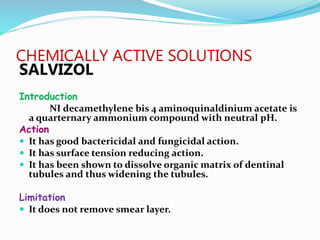
SALVIZOL
Introduction
NI decamethylene bis 4 aminoquinaldinium acetate is
a quarternary ammonium compound with neutral pH.
Action
 It has good bactericidal and fungicidal action.
 It has surface tension reducing action.
 It has been shown to dissolve organic matrix of dentinal
tubules and thus widening the tubules.
Limitation
 It does not remove smear layer.
CHEMICALLY ACTIVE SOLUTIONS
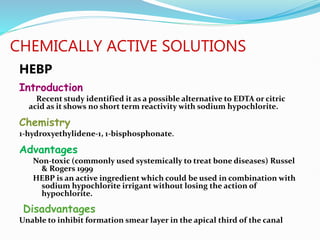
HEBP
Introduction
Recent study identified it as a possible alternative to EDTA or citric
acid as it shows no short term reactivity with sodium hypochlorite.
Chemistry
1-hydroxyethylidene-1, 1-bisphosphonate.
Advantages
Non-toxic (commonly used systemically to treat bone diseases) Russel
& Rogers 1999
HEBP is an active ingredient which could be used in combination with
sodium hypochlorite irrigant without losing the action of
hypochlorite.
Disadvantages
Unable to inhibit formation smear layer in the apical third of the canal
CHEMICALLY ACTIVE SOLUTIONS
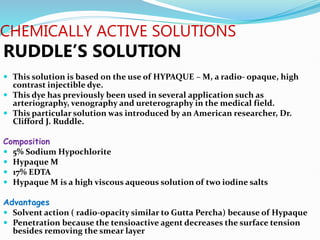
RUDDLE’S SOLUTION
 This solution is based on the use of HYPAQUE – M, a radio- opaque, high
contrast injectible dye.
 This dye has previously been used in several application such as
arteriography, venography and ureterography in the medical field.
 This particular solution was introduced by an American researcher, Dr.
Clifford J. Ruddle.
Composition
 5% Sodium Hypochlorite
 Hypaque M
 17% EDTA
 Hypaque M is a high viscous aqueous solution of two iodine salts
Advantages
 Solvent action ( radio-opacity similar to Gutta Percha) because of Hypaque
 Penetration because the tensioactive agent decreases the surface tension
besides removing the smear layer
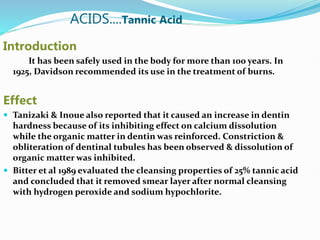
ACIDS....Tannic Acid
Introduction
It has been safely used in the body for more than 100 years. In
1925, Davidson recommended its use in the treatment of burns.
Effect
 Tanizaki & Inoue also reported that it caused an increase in dentin
hardness because of its inhibiting effect on calcium dissolution
while the organic matter in dentin was reinforced. Constriction &
obliteration of dentinal tubules has been observed & dissolution of
organic matter was inhibited.
 Bitter et al 1989 evaluated the cleansing properties of 25% tannic acid
and concluded that it removed smear layer after normal cleansing
with hydrogen peroxide and sodium hypochlorite.
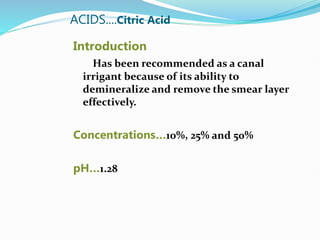
ACIDS....Citric Acid
Introduction
Has been recommended as a canal
irrigant because of its ability to
demineralize and remove the smear layer
effectively.
Concentrations…10%, 25% and 50%
pH…1.28
Antibiotic containing…
TETRACYCLINE
 Tetracycline was tried as irrigant in root canal due to its antibacterial
and chelating action.
 Tetracycline as hydrocycline hydrochloride salt has low pH (pH value
2) so it effectively removes smear layer.
 The tetracycline hydrochloride and doxycycline hydrochloride were
tested in concentration ranging from 25 mg/ml to 100 mg/ml. The
efficacy in removing smear layer was found to be more in 25 mg/ml
strength solutions.
Antibiotic containing…
DOXYCYCLINE HYDROCHLORIDE
• A hydroxyl derivative of tetracycline, Doxycycline hydrochloride has been
tried as an irrigant.
• The lower concentrations of doxycycline-HCl were significantly more
effective in the presence of sodium hypochlorite than when used with saline
. This raises the possibility that a combination of doxycycline-HCl and
sodium hypochlorite could be a more effective irrigant. Higher doses of
doxycycline are toxic and inhibit fibroblast adherence and spread along a
substratum. The doxycycline-HCl solution is an effective irrigant in
combination with sodium hypochlorite and has potential in root canal
treatment procedures. The solution is easily delivered to the root canal
system and adheres to the canal wall.
Advantage
The dentin surface is capable of acting as a reservoir by adsorbing
and slowly releasing antibacterial levels of doxycycline into the
adjacent environment for several days following topical application
of this antibiotic solution.
Antibiotic Containing…
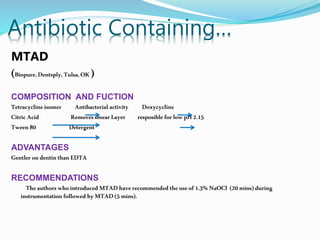
MTAD
(Biopure,Dentsply,Tulsa,OK )
COMPOSITION AND FUCTION
Tetracycline isomer Antibacterial activity Doxycycline
Citric Acid RemovessmearLayer resposible forlow pH2.15
Tween 80 Detergent
ADVANTAGES
Gentler ondentin thanEDTA
RECOMMENDATIONS
Theauthors whointroduced MTAD have recommended theuseof1.3% NaOCl (20mins)during
instrumentation followed byMTAD(5 mins).
Antibiotic containing…
CYTOTOXITY..
StudybyZhanget alin2003
TheresultsshowedMTADtobeless cytotoxic thaneugenol,3percent H2O2,Ca(OH)2 paste,5.25 percent
NaOCl,Peridex, andEDTA.
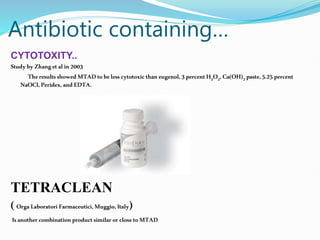
TETRACLEAN
(Orga Laboratori Farmaceutici,Muggio,Italy)
Isanothercombination product similar or closeto MTAD
Antibiotic containing…
TITANIUM – TETRAFLUORIDE
 Titanium tetra fluoride is a latest advancement in smear layer
management. It does not remove the smear layer but modifies it.
 Titanium is a non toxic element and has a remarkable and complex
binding capacity with fluoride, enamel and dentin.
 When TiF4 is dissolved in water; it hydrolyses to give a low pH to the
solution. Despite its highly acidic pH, it produces only a partial
demineralization limited to the outermost 8 – 10 µ of the root
surface. This non ionized compound penetrates more easily into the
hydroxyl-apatite lattice in the tooth surface. Thus titanium and
fluoride uptake is increased in root surfaces.
Antibiotic containing…
TITANIUM – TETRAFLUORIDE
• Titanium tetra-fluoride is used in a 4% solution. After its application a
tenacious titanium rich coating is readily formed. This coating may
involve organometallic complexes; its formation favored by the rich
organic matrix of the root tissues the thickness of the coating, may be as
high as 1-5µ of the root canal wall, when smear layer is present.
• When the TiF4 modified smear layer is treated with NaOCl and EDTA, no
change was observed, indicating its stability. The modified smear layer
and smear plugs in the dentinal tubules present a mechanically and
chemically interlocked layer occluding all dentinal tubules permanently.
Researchers suggest a possible formation of titanium dioxide coating as
a alternative mode of action to organic complex formation.
• The modified smear may contribute adhesive forces to reduce
microleakage by preventing further disintegration of the smear layer.
Recent Developments…
OZONATED WATER
• Ozone is a powerful oxidizing agent.
• When it dissolves in water, it becomes highly unstable
and rapidly decomposes through a complex series of
chain reactions. As a result, hydroxyl radicals are
generated.
• Ozone reacts with various chemical compounds in
aqueous systems in 2 different and coexisting modes:
– Involving direct reactions of molecular ozone
– Free radical mediated reaction
• Both may be involved in destruction of bacteria by ozone.
• Ozonated water is powerful antimicrobial.
Recent Developments…
OZONATED WATER
• Ozone in aqueous or gaseous phases has a strong
oxidizing power with reliable anti-microbial effects.
• Ozone destroys cell walls & cytoplasmic membranes of
bacteria & fungi
– Membrane is damaged by oxidation, its permeability
increases and ozone molecules can readily enter the
cell, causing microoraganism to die
• Stability of ozone in water is low. Gaseous ozone has no
significant antibacterial effect on biofilms. Effectiveness
of ozone is highest in solution.
Recent Developments…
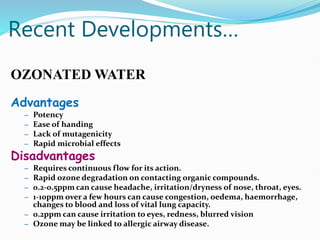
OZONATED WATER
Advantages
– Potency
– Ease of handing
– Lack of mutagenicity
– Rapid microbial effects
Disadvantages
– Requires continuous flow for its action.
– Rapid ozone degradation on contacting organic compounds.
– 0.2-0.5ppm can cause headache, irritation/dryness of nose, throat, eyes.
– 1-10ppm over a few hours can cause congestion, oedema, haemorrhage,
changes to blood and loss of vital lung capacity.
– 0.2ppm can cause irritation to eyes, redness, blurred vision
– Ozone may be linked to allergic airway disease.
Recent Developments…
ELECTROCHEMICALLYACTIVATED
Introduction
 Developed by Russian Scientists at the All-Russian Institute for
Medical Engineering (Moscow, Russia CIS).
 ECA solutions are produced from tap water and low concentration
salt solutions such as saline by a special unit that houses a unique
flow-through electrolytic module (FEM)
ECA involves 2 processes
 Chemical processes
 Electrical process ( done without additives)
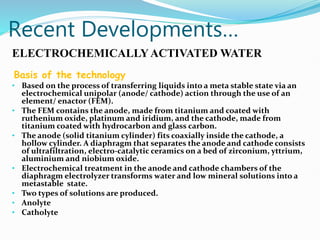
Recent Developments…
ELECTROCHEMICALLYACTIVATED WATER
Basis of the technology
• Based on the process of transferring liquids into a meta stable state via an
electrochemical unipolar (anode/ cathode) action through the use of an
element/ enactor (FEM).
• The FEM contains the anode, made from titanium and coated with
ruthenium oxide, platinum and iridium, and the cathode, made from
titanium coated with hydrocarbon and glass carbon.
• The anode (solid titanium cylinder) fits coaxially inside the cathode, a
hollow cylinder. A diaphragm that separates the anode and cathode consists
of ultrafiltration, electro-catalytic ceramics on a bed of zirconium, yttrium,
aluminium and niobium oxide.
• Electrochemical treatment in the anode and cathode chambers of the
diaphragm electrolyzer transforms water and low mineral solutions into a
metastable state.
• Two types of solutions are produced.
• Anolyte
• Catholyte
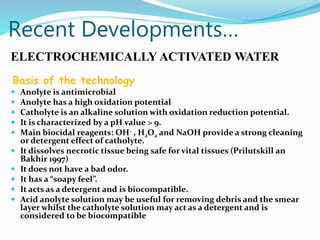
Recent Developments…
ELECTROCHEMICALLY ACTIVATED WATER
Basis of the technology
 Anolyte is antimicrobial
 Anolyte has a high oxidation potential
 Catholyte is an alkaline solution with oxidation reduction potential.
 It is characterized by a pH value > 9.
 Main biocidal reagents: OH- , H2O2 and NaOH provide a strong cleaning
or detergent effect of catholyte.
 It dissolves necrotic tissue being safe for vital tissues (Prilutskill an
Bakhir 1997)
 It does not have a bad odor.
 It has a “soapy feel”.
 It acts as a detergent and is biocompatible.
 Acid anolyte solution may be useful for removing debris and the smear
layer whilst the catholyte solution may act as a detergent and is
considered to be biocompatible
Recent Developments…
ELECTROCHEMICALLYACTIVATED WATER
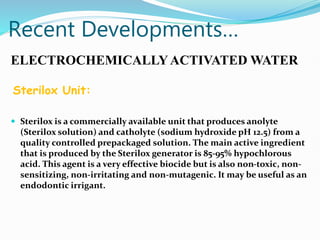
Sterilox Unit:
 Sterilox is a commercially available unit that produces anolyte
(Sterilox solution) and catholyte (sodium hydroxide pH 12.5) from a
quality controlled prepackaged solution. The main active ingredient
that is produced by the Sterilox generator is 85-95% hypochlorous
acid. This agent is a very effective biocide but is also non-toxic, non-
sensitizing, non-irritating and non-mutagenic. It may be useful as an
endodontic irrigant.
Recent Developments…
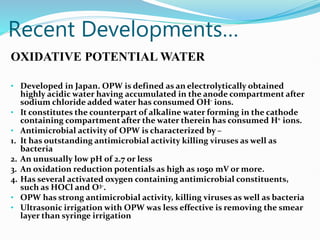
OXIDATIVE POTENTIAL WATER
• Developed in Japan. OPW is defined as an electrolytically obtained
highly acidic water having accumulated in the anode compartment after
sodium chloride added water has consumed OH- ions.
• It constitutes the counterpart of alkaline water forming in the cathode
containing compartment after the water therein has consumed H+ ions.
• Antimicrobial activity of OPW is characterized by –
1. It has outstanding antimicrobial activity killing viruses as well as
bacteria
2. An unusually low pH of 2.7 or less
3. An oxidation reduction potentials as high as 1050 mV or more.
4. Has several activated oxygen containing antimicrobial constituents,
such as HOCl and O3-.
• OPW has strong antimicrobial activity, killing viruses as well as bacteria
• Ultrasonic irrigation with OPW was less effective is removing the smear
layer than syringe irrigation
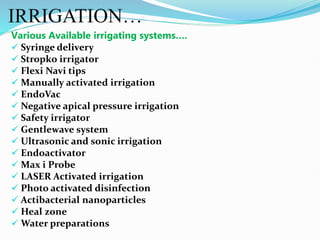
IRRIGATION…
Various Available irrigating systems….
 Syringe delivery
 Stropko irrigator
 Flexi Navi tips
 Manually activated irrigation
 EndoVac
 Negative apical pressure irrigation
 Safety irrigator
 Gentlewave system
 Ultrasonic and sonic irrigation
 Endoactivator
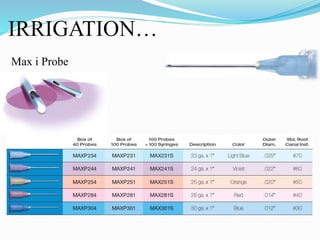
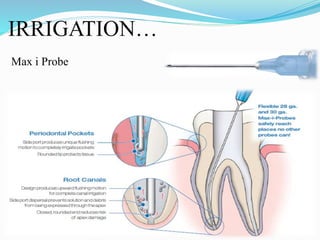
 Max i Probe
 LASER Activated irrigation
 Photo activated disinfection
 Actibacterial nanoparticles
 Heal zone
 Water preparations
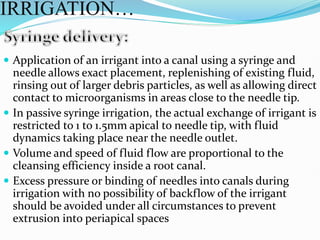
 Application of an irrigant into a canal using a syringe and
needle allows exact placement, replenishing of existing fluid,
rinsing out of larger debris particles, as well as allowing direct
contact to microorganisms in areas close to the needle tip.
 In passive syringe irrigation, the actual exchange of irrigant is
restricted to 1 to 1.5mm apical to needle tip, with fluid
dynamics taking place near the needle outlet.
 Volume and speed of fluid flow are proportional to the
cleansing efficiency inside a root canal.
 Excess pressure or binding of needles into canals during
irrigation with no possibility of backflow of the irrigant
should be avoided under all circumstances to prevent
extrusion into periapical spaces
IRRIGATION…
IRRIGATION…
Max i Probe
IRRIGATION…
Max i Probe
IRRIGATION…
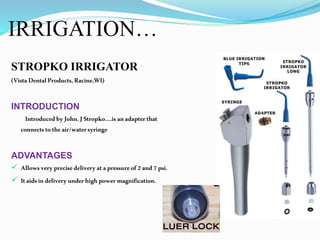
STROPKO IRRIGATOR
(VistaDentalProducts,Racine,WI)
INTRODUCTION
IntroducedbyJohn.JStropko….is anadapterthat
connectstotheair/watersyringe
ADVANTAGES
 Allowsveryprecisedeliveryatapressureof2and7psi.
 Itaidsindeliveryunderhighpowermagnification.
IRRIGATION…
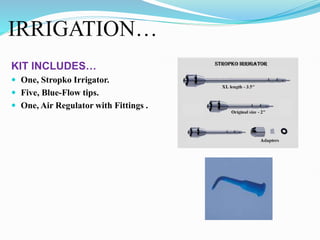
KIT INCLUDES…
 One, Stropko Irrigator.
 Five, Blue-Flow tips.
 One, Air Regulator with Fittings .
IRRIGATION…
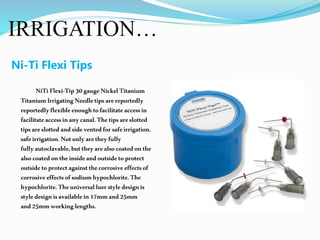
Ni-Ti Flexi Tips
NiTiFlexi-Tip30gaugeNickelTitanium
TitaniumIrrigatingNeedletipsarereportedly
reportedlyflexibleenoughtofacilitateaccessin
facilitateaccessinanycanal.Thetipsareslotted
tipsareslotted andsideventedforsafeirrigation.
safeirrigation.Notonlyaretheyfully
fullyautoclavable,buttheyarealsocoatedonthe
alsocoatedontheinsideandoutsidetoprotect
outsidetoprotectagainstthecorrosiveeffectsof
corrosiveeffectsofsodiumhypochlorite.The
hypochlorite.Theuniversalluerstyledesignis
styledesignisavailablein17mmand25mm
and25mmworkinglengths.
 Liquid placed inside the root canal more effectively reaches
crevices and mechanically untouched areas if it is agitated
inside the root canal.
 Corono-apical movements of the irrigation needle, stirring
movements with small endodontic instruments, and manual
push pull movements using a fitted master gutta percha cone
have been recommended.
IRRIGATION…
IRRIGATION…
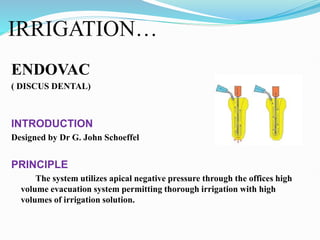
ENDOVAC
( DISCUS DENTAL)
INTRODUCTION
Designed by Dr G. John Schoeffel
PRINCIPLE
The system utilizes apical negative pressure through the offices high
volume evacuation system permitting thorough irrigation with high
volumes of irrigation solution.
IRRIGATION…
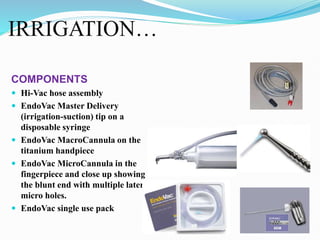
COMPONENTS
 Hi-Vac hose assembly
 EndoVac Master Delivery
(irrigation-suction) tip on a
disposable syringe
 EndoVac MacroCannula on the
titanium handpiece
 EndoVac MicroCannula in the
fingerpiece and close up showing
the blunt end with multiple lateral
micro holes.
 EndoVac single use pack
 Irrigant is delivered into the access chamber, and a very fine
needle connected to the dental unit’s suction device is placed
into the root canal.
 Excess irrigant from the access cavity is then transported
apically and ultimately removed via suction.
 Commercially available:- (EndoVac, Discuss dental),
 In a recent study, apical negative pressure mode of irrigation
generated the lowest wall shear stress.
 Another device:- RinsEndo system (Durr Dental, Bietigheim
Bissingen, Germany).
 It aspirates the delivered rinsing solution into an irrigation
needle that is placed close to WL and at the same time
activates the needle with oscillations of 1.6 Hz amplitude.
IRRIGATION…
 The safety irrigator (Vista Dental Products) is an
irrigation/evacuation system that apically delivers the
irrigant under positive pressure through a thin needle
containing a lateral opening and evacuates the solution
through a large needle at the root canal orifice.
 The safety irrigation irrigator features a large coronal
evacuation tube, enabling the user to irrigate and evacuate
simultaneously safely.
 These techniques produced better cleaning efficacy than
syringe irrigation (P<0.005) but significantly worse than
manually dynamic activation (MDA) with tapered cone
(P<0.05).
IRRIGATION…
 The GentleWave system (GW) (Sonendo Inc, Laguna Hills,
CA) was introduced in the united states in 2016.
 The device is composed of a console, a so called procedure
instrument, which is a single use tip attached to a handpiece,
and a central unit that contains three individual irrigation
solution containers, one waste canister, a degassing system,
and a pressure generator.
 The system delivers an energized flow of irrigation solutions
from the central unit to the procedural instrument.
 According to the manufacturer, the fluid stream entering the
tooth creates a shear force, which in turn causes
hydrodynamic cavitation.

IRRIGATION…
 The implosion of micro-bubbles then creates an acoustic
field of broadband frequencies, which travels through the
fluid into the root canal system.
 The programmed irrigation regimen begin with 3% NaOCL
followed by 8% EDTA, with a rinse of distilled water in
between and completion.
 The fluid within the root canal space is continuously
collected and removed from the chamber through a five
point vented suction system built in the sealing lid of the
procedural instrument.
 A sealed environment is needed between the tooth and the
GW procedure instrument to allow for constant refreshing of
degassed procedure fluids and simultaneous evacuation of
debris.
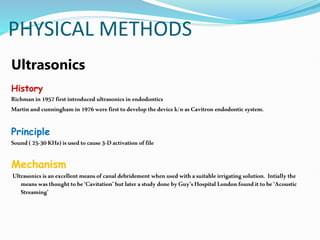
PHYSICAL METHODS
Ultrasonics
History
Richmanin1957firstintroduced ultrasonics inendodontics
Martin andcunninghamin1976were firsttodevelop thedevicek/n as Cavitron endodontic system.
Principle
Sound(25-30KHz) isusedto cause3-Dactivation offile
Mechanism
Ultrasonicsisanexcellentmeansofcanaldebridement when usedwith asuitable irrigating solution. Intiallythe
meanswasthoughtto be ‘Cavitation’ butlater astudydone byGuy’sHospital Londonfounditto be‘Acoustic
Streaming’
IRRIGATION…
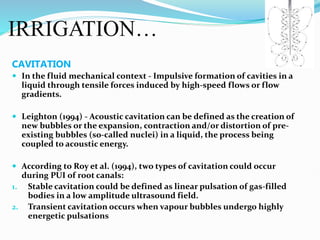
CAVITATION
 In the fluid mechanical context - Impulsive formation of cavities in a
liquid through tensile forces induced by high-speed flows or flow
gradients.
 Leighton (1994) - Acoustic cavitation can be defined as the creation of
new bubbles or the expansion, contraction and/or distortion of pre-
existing bubbles (so-called nuclei) in a liquid, the process being
coupled to acoustic energy.
 According to Roy et al. (1994), two types of cavitation could occur
during PUI of root canals:
1. Stable cavitation could be defined as linear pulsation of gas-filled
bodies in a low amplitude ultrasound field.
2. Transient cavitation occurs when vapour bubbles undergo highly
energetic pulsations
IRRIGATION…
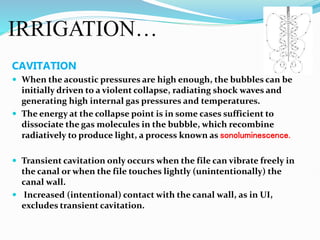
CAVITATION
 When the acoustic pressures are high enough, the bubbles can be
initially driven to a violent collapse, radiating shock waves and
generating high internal gas pressures and temperatures.
 The energy at the collapse point is in some cases sufficient to
dissociate the gas molecules in the bubble, which recombine
radiatively to produce light, a process known as sonoluminescence.
 Transient cavitation only occurs when the file can vibrate freely in
the canal or when the file touches lightly (unintentionally) the
canal wall.
 Increased (intentional) contact with the canal wall, as in UI,
excludes transient cavitation.
IRRIGATION…
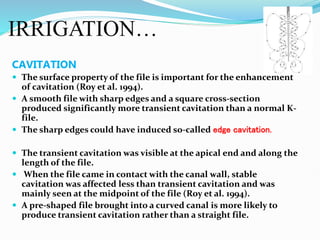
CAVITATION
 The surface property of the file is important for the enhancement
of cavitation (Roy et al. 1994).
 A smooth file with sharp edges and a square cross-section
produced significantly more transient cavitation than a normal K-
file.
 The sharp edges could have induced so-called edge cavitation.
 The transient cavitation was visible at the apical end and along the
length of the file.
 When the file came in contact with the canal wall, stable
cavitation was affected less than transient cavitation and was
mainly seen at the midpoint of the file (Roy et al. 1994).
 A pre-shaped file brought into a curved canal is more likely to
produce transient cavitation rather than a straight file.
IRRIGATION…
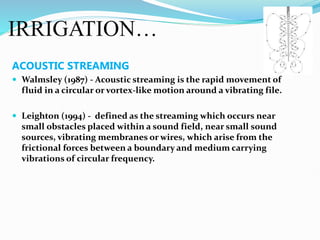
ACOUSTIC STREAMING
 Walmsley (1987) - Acoustic streaming is the rapid movement of
fluid in a circular or vortex-like motion around a vibrating file.
 Leighton (1994) - defined as the streaming which occurs near
small obstacles placed within a sound field, near small sound
sources, vibrating membranes or wires, which arise from the
frictional forces between a boundary and medium carrying
vibrations of circular frequency.
IRRIGATION…
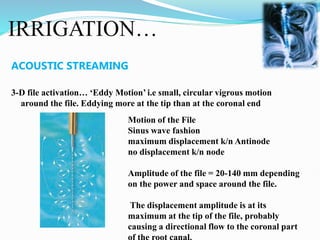
ACOUSTIC STREAMING
3-D file activation… ‘Eddy Motion’ i.e small, circular vigrous motion
around the file. Eddying more at the tip than at the coronal end
Motion of the File
Sinus wave fashion
maximum displacement k/n Antinode
no displacement k/n node
Amplitude of the file = 20-140 mm depending
on the power and space around the file.
The displacement amplitude is at its
maximum at the tip of the file, probably
causing a directional flow to the coronal part
IRRIGATION…
ACOUSTIC STREAMING
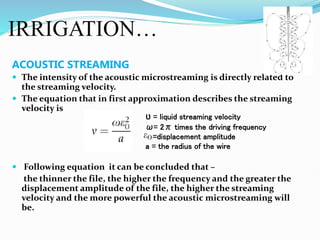
 The intensity of the acoustic microstreaming is directly related to
the streaming velocity.
 The equation that in first approximation describes the streaming
velocity is
 Following equation it can be concluded that –
the thinner the file, the higher the frequency and the greater the
displacement amplitude of the file, the higher the streaming
velocity and the more powerful the acoustic microstreaming will
be.
Ʋ = liquid streaming velocity
ω= 2π times the driving frequency
=displacement amplitude
a = the radius of the wire
IRRIGATION…
PRE-REQUISITES
 Canal must be enlarged to size 30 to 40 atleast for the space required for
the motion of the file, as the narrow canal will dampen the motion and
therefore rendering it ineffective.
 Use of proper irrigant such as NaOCl
 Smaller file---- Greater Amplitude-----Greater Acoustic Streaming
COMPLICATIONS
 Straightening of canal ( transportation)
 Perforation
 Extrusion of infectious material beyond apex
IRRIGATION…
 Passive ultrasonic irrigation was first described by Weller et al.
(1980).
 The term ‘passive’ does not adequately describe the process, as it
is in fact active; however, when it was first introduced the term
‘passive’ related to the ‘noncutting’ action of the ultrasonically
activated file.
 PUI relies on the transmission of acoustic energy from an
oscillating file or smooth wire to an irrigant in the root canal. The
energy is transmitted by means of ultrasonic waves and can induce
acoustic streaming and cavitation of the irrigant.
IRRIGATION…
 Two types of ultrasonic irrigation have been described:
1. one where irrigation is combined with simultaneous ultrasonic
instrumentation (UI)
2. without simultaneous instrumentation, so called passive
ultrasonic irrigation (PUI).
 During UI the file is intentionally brought into contact with the
root canal wall.
 UI has been shown to be less effective in removing simulated pulp
tissue from the root canal system or smear layer from the root
canal wall than PUI
 UI could result in uncontrolled cutting of the root canal wall
without effective cleaning.
IRRIGATION…
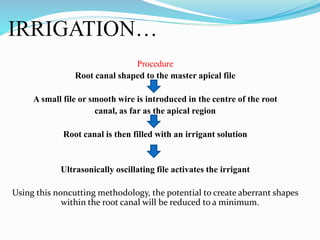
Procedure
Root canal shaped to the master apical file
A small file or smooth wire is introduced in the centre of the root
canal, as far as the apical region
Root canal is then filled with an irrigant solution
Ultrasonically oscillating file activates the irrigant
Using this noncutting methodology, the potential to create aberrant shapes
within the root canal will be reduced to a minimum.
IRRIGATION…
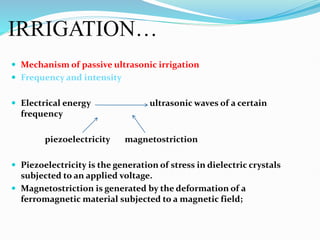
 Mechanism of passive ultrasonic irrigation
 Frequency and intensity
 Electrical energy ultrasonic waves of a certain
frequency
piezoelectricity magnetostriction
 Piezoelectricity is the generation of stress in dielectric crystals
subjected to an applied voltage.
 Magnetostriction is generated by the deformation of a
ferromagnetic material subjected to a magnetic field;
IRRIGATION…
 Frequency of the oscillating instrument, in dental practice, is fixed
at 30 kHz.
 The intensity or energy flux, expressed in units of Watt cm-2, of the
oscillating instrument can be adjusted by the power setting.
 A higher frequency should in principle result in a higher streaming
velocity of the irrigant. This in turn results in a more powerful
acoustic streaming.

 Increasing the intensity does not result in a linear increase of the
displacement amplitude of the oscillating file.
IRRIGATION…
 The effects and use of PUI (passive ultrasonic irrigation)
 PUI versus syringe irrigation –
 From the studies where PUI and syringe irrigation were compared,
it can be concluded that PUI is more effective in removing
remnants of pulp tissue and dentine debris.
 Removal of the smear layer –
 When 3% NaOCl was used complete removal of smear layer with 3
and 5 min and after 20 s with 5.25% NaOCl using PUI.
 Did not enhance the removal of the smear layer when EDTA or a
combination of EDTA and NaOCl was but significantly improved
the smear layer removal of Savlon (0.03% chlorhexidine, 0.3%
cetrimide)
IRRIGATION…
 The effects and use of PUI
 PUI with NaOCl as irrigant –
 During PUI, NaOCl removes significantly more smear layer or
bacteria from artificial smear layer, pulp tissue or dentine debris
from the root canal than water.
 Heating of irrigant and root surface during PUI
 A rise of the intracanal temperature from 37 to 45°C close to the tip
of the instrument and 37°C away from the tip when the irrigant was
ultrasonically activated for 30 s without replenishment.
 A cooling effect from 37 to 29°C was recorded when the irrigant was
replenished with a continuous flow of irrigant.
IRRIGATION…
 The effects and use of PUI
 Ultrasonic versus sonic irrigation –
 Sonic irrigation is different from ultrasonic irrigation because it
operates at a lower frequency. For sonic application the
frequencies ranges from 1000 to 6000 Hz.
 Consequently, following previous equation, the streaming velocity
of the irrigant will be lower.
 Moreover, the oscillating patterns of the sonic instruments are
different. They have one node near the attachment of the file and
one antinode at the tip of the file. When the movement of the
sonic file is constrained, the sideway movement will disappear, but
will result in a longitudinal vibration.
 The positive relationship between streaming velocity and
frequency can explain the higher efficiency of PUI versus sonic
irrigation.
IRRIGATION…
 PUI parameters
 Taper of the file and diameter of the root canal –
 greater the taper the more dentine debris can be removed.
 Application of irrigant during PUI
 Two flushing methods can be used during PUI, namely -
1. a continuous flush of irrigant from the ultrasonic handpiece
2. an intermittent flush method using syringe delivery (Cameron
1988).
 In the intermittent flush method, the irrigant is injected into the
root canal by a syringe, and replenished several times after each
ultrasonic activation.
 Both flushing methods were equally effective in removing dentine
debris.
IRRIGATION…
 PUI parameters
 Irrigation time
 3 – 5 mins
 PUI with a smooth wire
 A smooth wire is as effective as a normal cutting file in dentine
debris removal during PUI.
 It seems preferable to use a smooth wire during PUI because it
does not intentionally cut into the root canal wall and it may,
therefore, prevent aberrant root canal shapes or perforation of the
(apical) root.
IRRIGATION…
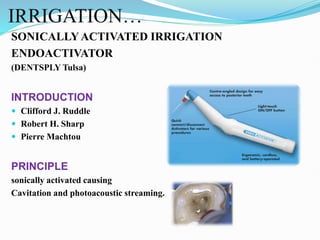
SONICALLYACTIVATED IRRIGATION
ENDOACTIVATOR
(DENTSPLY Tulsa)
INTRODUCTION
 Clifford J. Ruddle
 Robert H. Sharp
 Pierre Machtou
PRINCIPLE
sonically activated causing
Cavitation and photoacoustic streaming.
IRRIGATION…
DESIGN
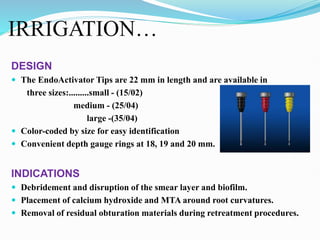
 The EndoActivator Tips are 22 mm in length and are available in
three sizes:.........small - (15/02)
medium - (25/04)
large -(35/04)
 Color-coded by size for easy identification
 Convenient depth gauge rings at 18, 19 and 20 mm.
INDICATIONS
 Debridement and disruption of the smear layer and biofilm.
 Placement of calcium hydroxide and MTA around root curvatures.
 Removal of residual obturation materials during retreatment procedures.
 The Er: YAG laser wavelength (2940nm) has the highest
absorption in water and high affinity to hydroxyapatite.
 Laser energy may be used to activate irrigant solutions in
different ways for example., at molecular level,
photoactivated disinfection, or bulk flow level as in laser
activated irrigation.
 Several studies indicated that laser activated irrigation is
promising in removing smear layer and dentin debris in less
time than PUI.
 The mechanism of action is based on the generation of
secondary cavitation effect with expansion and the successive
implosion of fluids.
IRRIGATION…
 Antimicrobial photodynamic therapy is a 2 step procedure
that involves the introduction of a photo sensitizer followed
by illumination of the sensitized tissue, which would
generate a toxic photochemistry on the target cell, leading to
cell lysis.
 Each of these elements used independently will not have any
action, but together they have synergism effect of producing
antibacterial action
IRRIGATION…
 The Nanoparticles evaluated in endodontics includes
Chitosan (CS-np), zinc oxide (ZnO-np), and silver (Ag_np)
nanoparticles.
 CS-np effective against mono species (E. Faecalis) and
multispecies biofilms , even in the presence of tissue
inhibitor , and it has been attributed to their ability to
disrupt the cell wall.
 Silver nanoparticles are evaluated for use as root canal
disinfecting agents. In gel and liquid form, such
nanoparticles have been shown to be able to kill and disrupt
E. Faecalis biofilm.
IRRIGATION…
REFERENCES:
 Sedgley C. Root canal irrigation--a historical
perspective. J Hist Dent. 2004 Jul;52(2):61-5. PMID:
15293717.
 Cohen 12th edition
IRRIGATION protocol , uses and procedure

IRRIGATION protocol , uses and procedure

  • 1.
    Presented by: Dr.AISHWARYA KHARE
  • 2.
    Topics to BeCovered  Introduction  History  Objectives of irrigation  Ideal requirements of irrigating solutions  Factors modifying the activity of irrigating solutions  Hydrodynamics of irrigation  Classification of irrigating solution  Systems of irrigation  Canal preparation for irrigation  Conclusion
  • 3.
    Introduction:  Irrigation isdefined as “ to wash out a body cavity or wound with water or medicated fluid” and aspiration as “ the process of removing fluids or gases from the body with suction device.” (by Cohen, 12th edition)  Disinfectant, meanwhile, is defined as “ an agent that destroys or inhibits the activity of microorganisms that cause disease”.
  • 4.
    History  The conceptof the germ theory of disease combined with the development of dentistry during the latter half of the 19th century had a direct effect on the practice of endodontics.  The significance of root canal irrigation to endodontics strengthened in the period between 1859 when Taft recommended frequent syringing of the root canal to remove "irritants“, until the mid-1940s when endodontics became a special field within dentistry and the American Endodontic Society was established.  While it was widely assumed that by wiping the root canal with disinfectants sterilization would be achieved, many of the principles associated with cleaning the root canal published during this period, in particular by Willoughby Dayton Miller in the 1890s and Louis Grossman in the 1940s, remain equally relevant in the 21st century.
  • 5.
    OBJECTIVES OF IRRIGATION: Flush out debris  Lubricate the canal  Dissolve organic and inorganic tissue  Prevent the formation of smear layer during instrumentation or dissolve it once it has formed  Detach the disrupt biofilms
  • 6.
    Ideal requirements …. 1.Broad spectrum antimicrobial action 2. Aid in debridement of root canal system 3. Ability to dissolve necrotic tissue or debris 4. Low toxicity level 5. Good lubricant 6. Low surface tension to flow into inaccessible area 7. Ability to sterilize the canal 8. It should be able to prevent formation of smear layer during instrumentation or dissolve the latter once it is formed
  • 7.
    Ideal requirements …. 9.It should inactivate endotoxin. 10. Ease of use, convenience, adequate shelf life and ease of storage. 11. When irrigants come in contact with vital tissue, they should be systemically non-toxic, non cancerous, non- caustic to periodontal tissue and have little potential to cause an anaphylactic reaction. 12. Relatively inexpensive
  • 8.
    Factors Modifying theActivity of Irrigating Solutions  Concentration  Contact  Presence of organic tissue  Quantity  Temperature
  • 9.
    Hydrodynamics of irrigation: Irrigation dynamics refers to how irrigants flow, penetrate, and readily exchange within the root canal walls as well as the forces produced by them.  Hence, in endodontic disinfection, the process of delivery is as essential as the antibacterial characteristics of the irrigants.  The effectiveness of root canal irrigation in terms of debris removal and eradication of bacteria depends on several factors that can be controlled by the operator:- 1. Penetration depth of the needle 2. Diameter of the root canal 3. Inner and outer diameter of the needle 4. Irrigation pressure 5. Viscosity of the irrigant
  • 10.
    6. Velocity ofthe irrigant at the needle tip 7. Type and orientation of the bevel.  The size and the length of the irrigation needle- to root canal dimension-are of outmost importance for the effectiveness of irrigation  The external needle diameter is of relevance for the depth of introduction into the root canal and rigidity of the needle body, as essential consideration for irrigation of curved canals.  Common 27 gauge injection needles have an external diameter of 0.42mm, but smaller stainless steel irrigation tips with external diameters of 0.32mm (30 gauge), and even 31 gauge or 0.26mm (Navitip, ultradent, south jordan, UT, USA) are available.  The stropko flexi tip (30 gauge) needle is fabricated from nickel titanium to improve penetration into curved canals.  More recently, a flexible plastic irrigation tip was introduced (Trunatomy, Dentsply sirona).
  • 11.
     Apical pressureis the force applied perpendicular to the apical wall surface.  Internal syringe diameter determines the pressure necessary for moving the syringe plunger.  Speed of the plunger determines the velocity with which irrigant extruded.  Fine needles require more pressure onto the plunger and extrude the irrigant with the higher velocity than larger needle sizes, which extrude significantly greater amounts of irrigants but for safety reasons cannot be introduced as deeply.  To improve the safety of irrigation and prevent extrusion of the irrigant through the apical foramen, some needle types release the solution via lateral openings and have a closed, safe-ended tip.  Side vented and double side vented needles led to maximum shear stress concentration on the wall facing the outlet.
  • 15.
    Non chemical irrigatingsolutions Tap Water One of the earliest irrigating solutions used for flushing of the root canal. Hot water A steam of hot water 1400-1760F discharged from the insulated syringe (Grossman) Physiologic Saline Normal saline solution may be the best irrigant to use because it cause less apical tissue damage than other irrigants. Advantages:  Physical flushing action of irrigation to remove debris  Bio compatibility Disadvantages:  It has none of the properties of tissue solvent  Poor anti-bacterial effect  Incapable of dissolution of necrotic tissue
  • 16.
    CHEMICALLY ACTIVE SOLUTIONS SODIUMHYPOCHORIDE Introduction It has been the most common endodontic irrigant for many years. In the First World War, the chemists Henry Drysdale Dakin and Surgeon Alexis Carrel used buffered 0.5% sodium hypochlorite solution to irrigate infected wounds. Types  Unbuffered  Buffered ( with potassium Bicarbonate k/n as Diakin’s sol )
  • 17.
    CHEMICALLY ACTIVE SOLUTIONS SODIUMHYPOCHORIDE Concentration 0.5 to 5.25 % Mechanism 1. Saponification reaction 2. Amino acid neutralization reaction 3. Chloramination reaction
  • 18.
     NaOcl actsas an organic and fat solvent that degrades fatty acids and transforms them into fatty acid salts (soap) and glycerol (alcohol), reducing the surface tension of remaining solution  Sodium hypochlorite neutralizes amino acids and forming water and salt. With the exit of hydroxyl ions, the pH is reduced  NaOCl also acts as solvent, releasing chlorine that combine with protein amino groups (NH) to forms chloramines.  Chloramines impede cell metabolism; chlorine is a strong oxidant and inhibits essential bacterial enzymes by irreversible oxidation of sulphydryl group.
  • 19.
    CHEMICALLY ACTIVE SOLUTIONS SODIUMHYPOCHORIDE Methods by which we can increase the efficacy of sodium hypochlorite  Time  Heat  Specialized irrigating syringes  Ultrasonic activation of NaOCl
  • 20.
    CHEMICALLY ACTIVE SOLUTIONS SODIUMHYPOCHORIDE Drawbacks…. 1. Decreased surface tension 2. Increased dentin permeability 3. Toxic to the periradicular tissues 4. Free Radicle formation 5. Unpleasant taste 6. Lack of ability to remove smear layer
  • 21.
    CHEMICALLY ACTIVE SOLUTIONS CHLORHEXIDINE Introduction Chlorhexidinein the form of a salt (gluconate acetate hydrochlorate) has been used since 1950 in different conc. as an oral antiseptic in the form of a mouthwash. Types • Water based solution • Gel ( with Natrosol) • Liquid mixture with surface active agents
  • 22.
    CHEMICALLY ACTIVE SOLUTIONS CHLORHEXIDINE Concentration 0.5to 2% Mechanism The antimicrobial mechanism of chlorhexidine is related to its cationic bisbiquanide molecular structure. The cationic molecule is absorbed to negatively charged inner cell membrane and cause leakage of intercellular components.
  • 23.
  • 24.
    CHEMICALLY ACTIVE SOLUTIONS CHLORHEXIDINE Combinations •CHX + Calcium hydroxide Increased efficacy  CHX + H2o2 Synergistic effect  CHX + NaoCl Orange-Brown ppt
  • 25.
    CHEMICALLY ACTIVE SOLUTIONS HYDROGENPEROXIDE Introduction It is a biocide. Not very popular Concentration 1 – 30% ( Superoxol) Mechanism Hydroxyl free radicles (HO) Bacterial DNA and protein
  • 26.
    CHEMICALLY ACTIVE SOLUTIONS HYDROGENPEROXIDE Mechanism  It causes oxidation of bacterial sulfhydryl group of enzymes and thus interferes with bacterial metabolism.  The rapid release of nascent oxygen on contact with organic tissues results in effervescence of bubbling action which is thought to aid in mechanical debridement by dislodging particles of necrotic tissue and dentinal debris and floating them to the surface.
  • 27.
    CHEMICALLY ACTIVE SOLUTIONS HYDROGENPEROXIDE Combinations 1. H2O2 + CHX Strong synergism 2. H2O2 ( 3%) + NaOCl ( 5.25 %) Beneficial H2O2 = bubbles out debris into pulp chamber through least resistant orifice. NaOCl = Tissue dissolving property Both = Bleaching
  • 28.
    CHEMICALLY ACTIVE SOLUTIONS GLY-OXIDE Itis a 10% solution of carbamide peroxide in anhyderous glycerol. Action  It provides lubrication without softening dentin.  It has antimicrobial activity more than 3% H2O2.  It produces transient energetic effervescence that mechanically forces debris and microorganism out of canal when used with NaOCl, alternatively. Limitation  It does not remove smear layer.
  • 29.
    CHEMICALLY ACTIVE SOLUTIONS EDTA( Ethylene Diamine Tetra acetic Acid) Introduction Was introduced in Endodontics by Nygaard and Ostby in 1957. Structure C2H3O2 C2H3O2 N - CH2 – CH2 – N C2H3O2 C2H3O2
  • 30.
    CHEMICALLY ACTIVE SOLUTIONS EDTA( Ethylene Diamine Tetra acetic Acid) Composition  Disodium salt of EDTA 17.00 g  Water 100.00 mL  5 M sodium hydroxide 9.25 mL Concentration 17 % ( pH-7)
  • 31.
    CHEMICALLY ACTIVE SOLUTIONS EDTA( Ethylene Diamine Tetra acetic Acid) Mechanism of action EDTA would seek the calcium metal ion in the hydroxyapatite crystals of dentin in a chelate and thereby act to demineralize dentin and enamel. The dentin thereby becomes more friable and easy to instrument. Note- The H+ ions produced during chelation of calcium present in dentin, lead to an acidic environment and EDTA is inactivated in acidic environment and therefore is self- limiting.
  • 32.
    CHEMICALLY ACTIVE SOLUTIONS EDTA( Ethylene Diamine Tetra acetic Acid) Functions of EDTA  Lubrication  Emulsification  Smear Layer removal  Dispensed in two forms – Viscous and Aqueous. Combinations NaOCl+ EDTA complete removal of smear layer However recent reports show inactivation of Cl in NaOCl by EDTA
  • 33.
    CHEMICALLY ACTIVE SOLUTIONS EDTA( Ethylene Diamine Tetra acetic Acid) Combinations  EDTA + Quantery ammonia EDTAC  Smear Clear ( synbron endo) 17% EDTA + H2O2 + + Centriamide + Anionic Surfactant
  • 34.
    CHEMICALLY ACTIVE SOLUTIONS RCPREP  Stewart in 1969 introduced another modification of EDTA called RCPREP.  RCPREP is composed if EDTA and urea peroxide in base of carbo wax.  It is not water soluble. When used in combination with NaoCl, its urea peroxide component reacts with NaOCl, producing bubbling action thought to loosen and float dentinal debris.  principle ingredients are EDTA, urea peroxide and propylene glycol. Glycol is the lubricant that coats the instruments and facilitates their movement in open canals and those containing calcified material.
  • 35.
    CHEMICALLY ACTIVE SOLUTIONS EGTA[ Ethylene gylcol bis-(beta- aminoethyl ether)-N- tetraacetic acid  Recently a new chelating agent has been introduced. It is structurally quite similar to EDTA. EDTA is under evaluation to be used individually and in combination with other irrigants.  EGTA removed the smear layer without inducing a corrosive action  EGTA and NaOCl did not remove the superficial smear layer in the apical third and some of the tubular orifices were clogged. Thus EGTA was not found to be as effective as EDTA.
  • 36.
    CHEMICALLY ACTIVE SOLUTIONS Calcinase 17%sodium edetate +sodium hydroxide as a stabilizer and purified water. REDTA 17% EDTA solution + 0.84 g Cetyl-trimethyl ammonium bromide (Cetrimide) + 9.25 mL 5 M sodium hydroxide and 100 mL distilled water. EDTAC and DTPAC EDTA (15%) + diethyl-triamine-penta acetic acid (DTPA) at pH 8. EDTA-T 17% EDTA + sodium lauryl ether sulfate (Tergentol).
  • 37.
    CHEMICALLY ACTIVE SOLUTIONS CDTA 1% solution of cyclohexane-1,2-diaminetetraacetic acid . Largal Ultra 15% EDTA + 0.75% Cetyl-tri-methyl ammonium bromide (Cetrimide) + sodium hydroxide. Decal 5.3 % oxyl-acetate + 4.6% ammonium oxyl-acetate + 0.06% Cetyl- tri-methyl ammonium bromide (Cetrimide) - pH value of 3.4 . Tubulicid Plus 1.5 g Amphoteric-2 (38%) + 0.5 g benzalkonichloride + 3 g disodium EDTA dihydrate + phosphate buffer solution + 100 g distilled water + 50% citric acid.
  • 38.
    CHEMICALLY ACTIVE SOLUTIONS IKI( Iodine potassium iodide) Introduction Oldest disinfectant and is still actively used. It is best known for their use on skin, surface and operation field Concentration 2% Composition Iodine 2 gms KI 4 gms Water 94ml
  • 39.
    CHEMICALLY ACTIVE SOLUTIONS IKI( Iodine potassium iodide) Storage Poor stability in aqueous solution, led to the development of …  Iodophor ‘ iodine carrier’  Povidone-iodine  Poloxamer-iodine Iodophors less active against spores and some yeasts than tincture iodine. Mechanism Oxidizing agent that reacts with sulfhydrl groups of bacterial enzymes, clearing the disulphide bonds.
  • 40.
    CHEMICALLY ACTIVE SOLUTIONS IKI( Iodine potassium iodide) Advantages  Rapid antiseptic action against broad range of microorganisms  Low toxicity  Hypoallergenicity Disadvantage  Iodine is a possible allergic reaction in some patient
  • 41.
    CHEMICALLY ACTIVE SOLUTIONS SALVIZOL Introduction NIdecamethylene bis 4 aminoquinaldinium acetate is a quarternary ammonium compound with neutral pH. Action  It has good bactericidal and fungicidal action.  It has surface tension reducing action.  It has been shown to dissolve organic matrix of dentinal tubules and thus widening the tubules. Limitation  It does not remove smear layer.
  • 42.
    CHEMICALLY ACTIVE SOLUTIONS HEBP Introduction Recentstudy identified it as a possible alternative to EDTA or citric acid as it shows no short term reactivity with sodium hypochlorite. Chemistry 1-hydroxyethylidene-1, 1-bisphosphonate. Advantages Non-toxic (commonly used systemically to treat bone diseases) Russel & Rogers 1999 HEBP is an active ingredient which could be used in combination with sodium hypochlorite irrigant without losing the action of hypochlorite. Disadvantages Unable to inhibit formation smear layer in the apical third of the canal
  • 43.
    CHEMICALLY ACTIVE SOLUTIONS RUDDLE’SSOLUTION  This solution is based on the use of HYPAQUE – M, a radio- opaque, high contrast injectible dye.  This dye has previously been used in several application such as arteriography, venography and ureterography in the medical field.  This particular solution was introduced by an American researcher, Dr. Clifford J. Ruddle. Composition  5% Sodium Hypochlorite  Hypaque M  17% EDTA  Hypaque M is a high viscous aqueous solution of two iodine salts Advantages  Solvent action ( radio-opacity similar to Gutta Percha) because of Hypaque  Penetration because the tensioactive agent decreases the surface tension besides removing the smear layer
  • 44.
    ACIDS....Tannic Acid Introduction It hasbeen safely used in the body for more than 100 years. In 1925, Davidson recommended its use in the treatment of burns. Effect  Tanizaki & Inoue also reported that it caused an increase in dentin hardness because of its inhibiting effect on calcium dissolution while the organic matter in dentin was reinforced. Constriction & obliteration of dentinal tubules has been observed & dissolution of organic matter was inhibited.  Bitter et al 1989 evaluated the cleansing properties of 25% tannic acid and concluded that it removed smear layer after normal cleansing with hydrogen peroxide and sodium hypochlorite.
  • 45.
    ACIDS....Citric Acid Introduction Has beenrecommended as a canal irrigant because of its ability to demineralize and remove the smear layer effectively. Concentrations…10%, 25% and 50% pH…1.28
  • 46.
    Antibiotic containing… TETRACYCLINE  Tetracyclinewas tried as irrigant in root canal due to its antibacterial and chelating action.  Tetracycline as hydrocycline hydrochloride salt has low pH (pH value 2) so it effectively removes smear layer.  The tetracycline hydrochloride and doxycycline hydrochloride were tested in concentration ranging from 25 mg/ml to 100 mg/ml. The efficacy in removing smear layer was found to be more in 25 mg/ml strength solutions.
  • 47.
    Antibiotic containing… DOXYCYCLINE HYDROCHLORIDE •A hydroxyl derivative of tetracycline, Doxycycline hydrochloride has been tried as an irrigant. • The lower concentrations of doxycycline-HCl were significantly more effective in the presence of sodium hypochlorite than when used with saline . This raises the possibility that a combination of doxycycline-HCl and sodium hypochlorite could be a more effective irrigant. Higher doses of doxycycline are toxic and inhibit fibroblast adherence and spread along a substratum. The doxycycline-HCl solution is an effective irrigant in combination with sodium hypochlorite and has potential in root canal treatment procedures. The solution is easily delivered to the root canal system and adheres to the canal wall. Advantage The dentin surface is capable of acting as a reservoir by adsorbing and slowly releasing antibacterial levels of doxycycline into the adjacent environment for several days following topical application of this antibiotic solution.
  • 48.
    Antibiotic Containing… MTAD (Biopure,Dentsply,Tulsa,OK ) COMPOSITIONAND FUCTION Tetracycline isomer Antibacterial activity Doxycycline Citric Acid RemovessmearLayer resposible forlow pH2.15 Tween 80 Detergent ADVANTAGES Gentler ondentin thanEDTA RECOMMENDATIONS Theauthors whointroduced MTAD have recommended theuseof1.3% NaOCl (20mins)during instrumentation followed byMTAD(5 mins).
  • 49.
    Antibiotic containing… CYTOTOXITY.. StudybyZhanget alin2003 TheresultsshowedMTADtobelesscytotoxic thaneugenol,3percent H2O2,Ca(OH)2 paste,5.25 percent NaOCl,Peridex, andEDTA. TETRACLEAN (Orga Laboratori Farmaceutici,Muggio,Italy) Isanothercombination product similar or closeto MTAD
  • 50.
    Antibiotic containing… TITANIUM –TETRAFLUORIDE  Titanium tetra fluoride is a latest advancement in smear layer management. It does not remove the smear layer but modifies it.  Titanium is a non toxic element and has a remarkable and complex binding capacity with fluoride, enamel and dentin.  When TiF4 is dissolved in water; it hydrolyses to give a low pH to the solution. Despite its highly acidic pH, it produces only a partial demineralization limited to the outermost 8 – 10 µ of the root surface. This non ionized compound penetrates more easily into the hydroxyl-apatite lattice in the tooth surface. Thus titanium and fluoride uptake is increased in root surfaces.
  • 51.
    Antibiotic containing… TITANIUM –TETRAFLUORIDE • Titanium tetra-fluoride is used in a 4% solution. After its application a tenacious titanium rich coating is readily formed. This coating may involve organometallic complexes; its formation favored by the rich organic matrix of the root tissues the thickness of the coating, may be as high as 1-5µ of the root canal wall, when smear layer is present. • When the TiF4 modified smear layer is treated with NaOCl and EDTA, no change was observed, indicating its stability. The modified smear layer and smear plugs in the dentinal tubules present a mechanically and chemically interlocked layer occluding all dentinal tubules permanently. Researchers suggest a possible formation of titanium dioxide coating as a alternative mode of action to organic complex formation. • The modified smear may contribute adhesive forces to reduce microleakage by preventing further disintegration of the smear layer.
  • 52.
    Recent Developments… OZONATED WATER •Ozone is a powerful oxidizing agent. • When it dissolves in water, it becomes highly unstable and rapidly decomposes through a complex series of chain reactions. As a result, hydroxyl radicals are generated. • Ozone reacts with various chemical compounds in aqueous systems in 2 different and coexisting modes: – Involving direct reactions of molecular ozone – Free radical mediated reaction • Both may be involved in destruction of bacteria by ozone. • Ozonated water is powerful antimicrobial.
  • 53.
    Recent Developments… OZONATED WATER •Ozone in aqueous or gaseous phases has a strong oxidizing power with reliable anti-microbial effects. • Ozone destroys cell walls & cytoplasmic membranes of bacteria & fungi – Membrane is damaged by oxidation, its permeability increases and ozone molecules can readily enter the cell, causing microoraganism to die • Stability of ozone in water is low. Gaseous ozone has no significant antibacterial effect on biofilms. Effectiveness of ozone is highest in solution.
  • 54.
    Recent Developments… OZONATED WATER Advantages –Potency – Ease of handing – Lack of mutagenicity – Rapid microbial effects Disadvantages – Requires continuous flow for its action. – Rapid ozone degradation on contacting organic compounds. – 0.2-0.5ppm can cause headache, irritation/dryness of nose, throat, eyes. – 1-10ppm over a few hours can cause congestion, oedema, haemorrhage, changes to blood and loss of vital lung capacity. – 0.2ppm can cause irritation to eyes, redness, blurred vision – Ozone may be linked to allergic airway disease.
  • 55.
    Recent Developments… ELECTROCHEMICALLYACTIVATED Introduction  Developedby Russian Scientists at the All-Russian Institute for Medical Engineering (Moscow, Russia CIS).  ECA solutions are produced from tap water and low concentration salt solutions such as saline by a special unit that houses a unique flow-through electrolytic module (FEM) ECA involves 2 processes  Chemical processes  Electrical process ( done without additives)
  • 56.
    Recent Developments… ELECTROCHEMICALLYACTIVATED WATER Basisof the technology • Based on the process of transferring liquids into a meta stable state via an electrochemical unipolar (anode/ cathode) action through the use of an element/ enactor (FEM). • The FEM contains the anode, made from titanium and coated with ruthenium oxide, platinum and iridium, and the cathode, made from titanium coated with hydrocarbon and glass carbon. • The anode (solid titanium cylinder) fits coaxially inside the cathode, a hollow cylinder. A diaphragm that separates the anode and cathode consists of ultrafiltration, electro-catalytic ceramics on a bed of zirconium, yttrium, aluminium and niobium oxide. • Electrochemical treatment in the anode and cathode chambers of the diaphragm electrolyzer transforms water and low mineral solutions into a metastable state. • Two types of solutions are produced. • Anolyte • Catholyte
  • 57.
    Recent Developments… ELECTROCHEMICALLY ACTIVATEDWATER Basis of the technology  Anolyte is antimicrobial  Anolyte has a high oxidation potential  Catholyte is an alkaline solution with oxidation reduction potential.  It is characterized by a pH value > 9.  Main biocidal reagents: OH- , H2O2 and NaOH provide a strong cleaning or detergent effect of catholyte.  It dissolves necrotic tissue being safe for vital tissues (Prilutskill an Bakhir 1997)  It does not have a bad odor.  It has a “soapy feel”.  It acts as a detergent and is biocompatible.  Acid anolyte solution may be useful for removing debris and the smear layer whilst the catholyte solution may act as a detergent and is considered to be biocompatible
  • 58.
    Recent Developments… ELECTROCHEMICALLYACTIVATED WATER SteriloxUnit:  Sterilox is a commercially available unit that produces anolyte (Sterilox solution) and catholyte (sodium hydroxide pH 12.5) from a quality controlled prepackaged solution. The main active ingredient that is produced by the Sterilox generator is 85-95% hypochlorous acid. This agent is a very effective biocide but is also non-toxic, non- sensitizing, non-irritating and non-mutagenic. It may be useful as an endodontic irrigant.
  • 59.
    Recent Developments… OXIDATIVE POTENTIALWATER • Developed in Japan. OPW is defined as an electrolytically obtained highly acidic water having accumulated in the anode compartment after sodium chloride added water has consumed OH- ions. • It constitutes the counterpart of alkaline water forming in the cathode containing compartment after the water therein has consumed H+ ions. • Antimicrobial activity of OPW is characterized by – 1. It has outstanding antimicrobial activity killing viruses as well as bacteria 2. An unusually low pH of 2.7 or less 3. An oxidation reduction potentials as high as 1050 mV or more. 4. Has several activated oxygen containing antimicrobial constituents, such as HOCl and O3-. • OPW has strong antimicrobial activity, killing viruses as well as bacteria • Ultrasonic irrigation with OPW was less effective is removing the smear layer than syringe irrigation
  • 61.
    IRRIGATION… Various Available irrigatingsystems….  Syringe delivery  Stropko irrigator  Flexi Navi tips  Manually activated irrigation  EndoVac  Negative apical pressure irrigation  Safety irrigator  Gentlewave system  Ultrasonic and sonic irrigation  Endoactivator  Max i Probe  LASER Activated irrigation  Photo activated disinfection  Actibacterial nanoparticles  Heal zone  Water preparations
  • 62.
     Application ofan irrigant into a canal using a syringe and needle allows exact placement, replenishing of existing fluid, rinsing out of larger debris particles, as well as allowing direct contact to microorganisms in areas close to the needle tip.  In passive syringe irrigation, the actual exchange of irrigant is restricted to 1 to 1.5mm apical to needle tip, with fluid dynamics taking place near the needle outlet.  Volume and speed of fluid flow are proportional to the cleansing efficiency inside a root canal.  Excess pressure or binding of needles into canals during irrigation with no possibility of backflow of the irrigant should be avoided under all circumstances to prevent extrusion into periapical spaces IRRIGATION…
  • 63.
  • 64.
  • 65.
  • 66.
    IRRIGATION… KIT INCLUDES…  One,Stropko Irrigator.  Five, Blue-Flow tips.  One, Air Regulator with Fittings .
  • 67.
    IRRIGATION… Ni-Ti Flexi Tips NiTiFlexi-Tip30gaugeNickelTitanium TitaniumIrrigatingNeedletipsarereportedly reportedlyflexibleenoughtofacilitateaccessin facilitateaccessinanycanal.Thetipsareslotted tipsareslottedandsideventedforsafeirrigation. safeirrigation.Notonlyaretheyfully fullyautoclavable,buttheyarealsocoatedonthe alsocoatedontheinsideandoutsidetoprotect outsidetoprotectagainstthecorrosiveeffectsof corrosiveeffectsofsodiumhypochlorite.The hypochlorite.Theuniversalluerstyledesignis styledesignisavailablein17mmand25mm and25mmworkinglengths.
  • 68.
     Liquid placedinside the root canal more effectively reaches crevices and mechanically untouched areas if it is agitated inside the root canal.  Corono-apical movements of the irrigation needle, stirring movements with small endodontic instruments, and manual push pull movements using a fitted master gutta percha cone have been recommended. IRRIGATION…
  • 69.
    IRRIGATION… ENDOVAC ( DISCUS DENTAL) INTRODUCTION Designedby Dr G. John Schoeffel PRINCIPLE The system utilizes apical negative pressure through the offices high volume evacuation system permitting thorough irrigation with high volumes of irrigation solution.
  • 70.
    IRRIGATION… COMPONENTS  Hi-Vac hoseassembly  EndoVac Master Delivery (irrigation-suction) tip on a disposable syringe  EndoVac MacroCannula on the titanium handpiece  EndoVac MicroCannula in the fingerpiece and close up showing the blunt end with multiple lateral micro holes.  EndoVac single use pack
  • 71.
     Irrigant isdelivered into the access chamber, and a very fine needle connected to the dental unit’s suction device is placed into the root canal.  Excess irrigant from the access cavity is then transported apically and ultimately removed via suction.  Commercially available:- (EndoVac, Discuss dental),  In a recent study, apical negative pressure mode of irrigation generated the lowest wall shear stress.  Another device:- RinsEndo system (Durr Dental, Bietigheim Bissingen, Germany).  It aspirates the delivered rinsing solution into an irrigation needle that is placed close to WL and at the same time activates the needle with oscillations of 1.6 Hz amplitude. IRRIGATION…
  • 72.
     The safetyirrigator (Vista Dental Products) is an irrigation/evacuation system that apically delivers the irrigant under positive pressure through a thin needle containing a lateral opening and evacuates the solution through a large needle at the root canal orifice.  The safety irrigation irrigator features a large coronal evacuation tube, enabling the user to irrigate and evacuate simultaneously safely.  These techniques produced better cleaning efficacy than syringe irrigation (P<0.005) but significantly worse than manually dynamic activation (MDA) with tapered cone (P<0.05). IRRIGATION…
  • 73.
     The GentleWavesystem (GW) (Sonendo Inc, Laguna Hills, CA) was introduced in the united states in 2016.  The device is composed of a console, a so called procedure instrument, which is a single use tip attached to a handpiece, and a central unit that contains three individual irrigation solution containers, one waste canister, a degassing system, and a pressure generator.  The system delivers an energized flow of irrigation solutions from the central unit to the procedural instrument.  According to the manufacturer, the fluid stream entering the tooth creates a shear force, which in turn causes hydrodynamic cavitation.  IRRIGATION…
  • 74.
     The implosionof micro-bubbles then creates an acoustic field of broadband frequencies, which travels through the fluid into the root canal system.  The programmed irrigation regimen begin with 3% NaOCL followed by 8% EDTA, with a rinse of distilled water in between and completion.  The fluid within the root canal space is continuously collected and removed from the chamber through a five point vented suction system built in the sealing lid of the procedural instrument.  A sealed environment is needed between the tooth and the GW procedure instrument to allow for constant refreshing of degassed procedure fluids and simultaneous evacuation of debris.
  • 75.
    PHYSICAL METHODS Ultrasonics History Richmanin1957firstintroduced ultrasonicsinendodontics Martin andcunninghamin1976were firsttodevelop thedevicek/n as Cavitron endodontic system. Principle Sound(25-30KHz) isusedto cause3-Dactivation offile Mechanism Ultrasonicsisanexcellentmeansofcanaldebridement when usedwith asuitable irrigating solution. Intiallythe meanswasthoughtto be ‘Cavitation’ butlater astudydone byGuy’sHospital Londonfounditto be‘Acoustic Streaming’
  • 76.
    IRRIGATION… CAVITATION  In thefluid mechanical context - Impulsive formation of cavities in a liquid through tensile forces induced by high-speed flows or flow gradients.  Leighton (1994) - Acoustic cavitation can be defined as the creation of new bubbles or the expansion, contraction and/or distortion of pre- existing bubbles (so-called nuclei) in a liquid, the process being coupled to acoustic energy.  According to Roy et al. (1994), two types of cavitation could occur during PUI of root canals: 1. Stable cavitation could be defined as linear pulsation of gas-filled bodies in a low amplitude ultrasound field. 2. Transient cavitation occurs when vapour bubbles undergo highly energetic pulsations
  • 77.
    IRRIGATION… CAVITATION  When theacoustic pressures are high enough, the bubbles can be initially driven to a violent collapse, radiating shock waves and generating high internal gas pressures and temperatures.  The energy at the collapse point is in some cases sufficient to dissociate the gas molecules in the bubble, which recombine radiatively to produce light, a process known as sonoluminescence.  Transient cavitation only occurs when the file can vibrate freely in the canal or when the file touches lightly (unintentionally) the canal wall.  Increased (intentional) contact with the canal wall, as in UI, excludes transient cavitation.
  • 78.
    IRRIGATION… CAVITATION  The surfaceproperty of the file is important for the enhancement of cavitation (Roy et al. 1994).  A smooth file with sharp edges and a square cross-section produced significantly more transient cavitation than a normal K- file.  The sharp edges could have induced so-called edge cavitation.  The transient cavitation was visible at the apical end and along the length of the file.  When the file came in contact with the canal wall, stable cavitation was affected less than transient cavitation and was mainly seen at the midpoint of the file (Roy et al. 1994).  A pre-shaped file brought into a curved canal is more likely to produce transient cavitation rather than a straight file.
  • 79.
    IRRIGATION… ACOUSTIC STREAMING  Walmsley(1987) - Acoustic streaming is the rapid movement of fluid in a circular or vortex-like motion around a vibrating file.  Leighton (1994) - defined as the streaming which occurs near small obstacles placed within a sound field, near small sound sources, vibrating membranes or wires, which arise from the frictional forces between a boundary and medium carrying vibrations of circular frequency.
  • 80.
    IRRIGATION… ACOUSTIC STREAMING 3-D fileactivation… ‘Eddy Motion’ i.e small, circular vigrous motion around the file. Eddying more at the tip than at the coronal end Motion of the File Sinus wave fashion maximum displacement k/n Antinode no displacement k/n node Amplitude of the file = 20-140 mm depending on the power and space around the file. The displacement amplitude is at its maximum at the tip of the file, probably causing a directional flow to the coronal part
  • 81.
    IRRIGATION… ACOUSTIC STREAMING  Theintensity of the acoustic microstreaming is directly related to the streaming velocity.  The equation that in first approximation describes the streaming velocity is  Following equation it can be concluded that – the thinner the file, the higher the frequency and the greater the displacement amplitude of the file, the higher the streaming velocity and the more powerful the acoustic microstreaming will be. Ʋ = liquid streaming velocity ω= 2π times the driving frequency =displacement amplitude a = the radius of the wire
  • 82.
    IRRIGATION… PRE-REQUISITES  Canal mustbe enlarged to size 30 to 40 atleast for the space required for the motion of the file, as the narrow canal will dampen the motion and therefore rendering it ineffective.  Use of proper irrigant such as NaOCl  Smaller file---- Greater Amplitude-----Greater Acoustic Streaming COMPLICATIONS  Straightening of canal ( transportation)  Perforation  Extrusion of infectious material beyond apex
  • 83.
    IRRIGATION…  Passive ultrasonicirrigation was first described by Weller et al. (1980).  The term ‘passive’ does not adequately describe the process, as it is in fact active; however, when it was first introduced the term ‘passive’ related to the ‘noncutting’ action of the ultrasonically activated file.  PUI relies on the transmission of acoustic energy from an oscillating file or smooth wire to an irrigant in the root canal. The energy is transmitted by means of ultrasonic waves and can induce acoustic streaming and cavitation of the irrigant.
  • 84.
    IRRIGATION…  Two typesof ultrasonic irrigation have been described: 1. one where irrigation is combined with simultaneous ultrasonic instrumentation (UI) 2. without simultaneous instrumentation, so called passive ultrasonic irrigation (PUI).  During UI the file is intentionally brought into contact with the root canal wall.  UI has been shown to be less effective in removing simulated pulp tissue from the root canal system or smear layer from the root canal wall than PUI  UI could result in uncontrolled cutting of the root canal wall without effective cleaning.
  • 85.
    IRRIGATION… Procedure Root canal shapedto the master apical file A small file or smooth wire is introduced in the centre of the root canal, as far as the apical region Root canal is then filled with an irrigant solution Ultrasonically oscillating file activates the irrigant Using this noncutting methodology, the potential to create aberrant shapes within the root canal will be reduced to a minimum.
  • 86.
    IRRIGATION…  Mechanism ofpassive ultrasonic irrigation  Frequency and intensity  Electrical energy ultrasonic waves of a certain frequency piezoelectricity magnetostriction  Piezoelectricity is the generation of stress in dielectric crystals subjected to an applied voltage.  Magnetostriction is generated by the deformation of a ferromagnetic material subjected to a magnetic field;
  • 87.
    IRRIGATION…  Frequency ofthe oscillating instrument, in dental practice, is fixed at 30 kHz.  The intensity or energy flux, expressed in units of Watt cm-2, of the oscillating instrument can be adjusted by the power setting.  A higher frequency should in principle result in a higher streaming velocity of the irrigant. This in turn results in a more powerful acoustic streaming.  Increasing the intensity does not result in a linear increase of the displacement amplitude of the oscillating file.
  • 88.
    IRRIGATION…  The effectsand use of PUI (passive ultrasonic irrigation)  PUI versus syringe irrigation –  From the studies where PUI and syringe irrigation were compared, it can be concluded that PUI is more effective in removing remnants of pulp tissue and dentine debris.  Removal of the smear layer –  When 3% NaOCl was used complete removal of smear layer with 3 and 5 min and after 20 s with 5.25% NaOCl using PUI.  Did not enhance the removal of the smear layer when EDTA or a combination of EDTA and NaOCl was but significantly improved the smear layer removal of Savlon (0.03% chlorhexidine, 0.3% cetrimide)
  • 89.
    IRRIGATION…  The effectsand use of PUI  PUI with NaOCl as irrigant –  During PUI, NaOCl removes significantly more smear layer or bacteria from artificial smear layer, pulp tissue or dentine debris from the root canal than water.  Heating of irrigant and root surface during PUI  A rise of the intracanal temperature from 37 to 45°C close to the tip of the instrument and 37°C away from the tip when the irrigant was ultrasonically activated for 30 s without replenishment.  A cooling effect from 37 to 29°C was recorded when the irrigant was replenished with a continuous flow of irrigant.
  • 90.
    IRRIGATION…  The effectsand use of PUI  Ultrasonic versus sonic irrigation –  Sonic irrigation is different from ultrasonic irrigation because it operates at a lower frequency. For sonic application the frequencies ranges from 1000 to 6000 Hz.  Consequently, following previous equation, the streaming velocity of the irrigant will be lower.  Moreover, the oscillating patterns of the sonic instruments are different. They have one node near the attachment of the file and one antinode at the tip of the file. When the movement of the sonic file is constrained, the sideway movement will disappear, but will result in a longitudinal vibration.  The positive relationship between streaming velocity and frequency can explain the higher efficiency of PUI versus sonic irrigation.
  • 91.
    IRRIGATION…  PUI parameters Taper of the file and diameter of the root canal –  greater the taper the more dentine debris can be removed.  Application of irrigant during PUI  Two flushing methods can be used during PUI, namely - 1. a continuous flush of irrigant from the ultrasonic handpiece 2. an intermittent flush method using syringe delivery (Cameron 1988).  In the intermittent flush method, the irrigant is injected into the root canal by a syringe, and replenished several times after each ultrasonic activation.  Both flushing methods were equally effective in removing dentine debris.
  • 92.
    IRRIGATION…  PUI parameters Irrigation time  3 – 5 mins  PUI with a smooth wire  A smooth wire is as effective as a normal cutting file in dentine debris removal during PUI.  It seems preferable to use a smooth wire during PUI because it does not intentionally cut into the root canal wall and it may, therefore, prevent aberrant root canal shapes or perforation of the (apical) root.
  • 93.
    IRRIGATION… SONICALLYACTIVATED IRRIGATION ENDOACTIVATOR (DENTSPLY Tulsa) INTRODUCTION Clifford J. Ruddle  Robert H. Sharp  Pierre Machtou PRINCIPLE sonically activated causing Cavitation and photoacoustic streaming.
  • 94.
    IRRIGATION… DESIGN  The EndoActivatorTips are 22 mm in length and are available in three sizes:.........small - (15/02) medium - (25/04) large -(35/04)  Color-coded by size for easy identification  Convenient depth gauge rings at 18, 19 and 20 mm. INDICATIONS  Debridement and disruption of the smear layer and biofilm.  Placement of calcium hydroxide and MTA around root curvatures.  Removal of residual obturation materials during retreatment procedures.
  • 95.
     The Er:YAG laser wavelength (2940nm) has the highest absorption in water and high affinity to hydroxyapatite.  Laser energy may be used to activate irrigant solutions in different ways for example., at molecular level, photoactivated disinfection, or bulk flow level as in laser activated irrigation.  Several studies indicated that laser activated irrigation is promising in removing smear layer and dentin debris in less time than PUI.  The mechanism of action is based on the generation of secondary cavitation effect with expansion and the successive implosion of fluids. IRRIGATION…
  • 96.
     Antimicrobial photodynamictherapy is a 2 step procedure that involves the introduction of a photo sensitizer followed by illumination of the sensitized tissue, which would generate a toxic photochemistry on the target cell, leading to cell lysis.  Each of these elements used independently will not have any action, but together they have synergism effect of producing antibacterial action IRRIGATION…
  • 97.
     The Nanoparticlesevaluated in endodontics includes Chitosan (CS-np), zinc oxide (ZnO-np), and silver (Ag_np) nanoparticles.  CS-np effective against mono species (E. Faecalis) and multispecies biofilms , even in the presence of tissue inhibitor , and it has been attributed to their ability to disrupt the cell wall.  Silver nanoparticles are evaluated for use as root canal disinfecting agents. In gel and liquid form, such nanoparticles have been shown to be able to kill and disrupt E. Faecalis biofilm. IRRIGATION…
  • 98.
    REFERENCES:  Sedgley C.Root canal irrigation--a historical perspective. J Hist Dent. 2004 Jul;52(2):61-5. PMID: 15293717.  Cohen 12th edition

Editor's Notes

  • #27 It is highly unstable and easily decomposed by heat and light. It rapidly dissociates into H2O+ [O] (water and nascent oxygen). While on contact with tissue enzymes catalase and peroxidase, the liberated [O] has bactericidal effect but this effect is transient and diminishes in presence of organic debris.
  • #45 It has astringent properties causing surface coagulation by precipitation of proteins. It is also known to possess antimicrobial properties.
  • #46 It has astringent properties causing surface coagulation by precipitation of proteins. It is also known to possess antimicrobial properties.
  • #47 With every new product we are always concerned about the cytotoxicity to the underlying tissue and the effect it may have on the strength of dentin
  • #48 With every new product we are always concerned about the cytotoxicity to the underlying tissue and the effect it may have on the strength of dentin
  • #49 Studies have shown the effectiveness of EDTA in removing up to 70 percent of the inorganic material in dentin.  The major difference between the actions of these solutions is a high binding affinity of the doxycycline present in MTAD for the dentin. (Beltz et al J Endod 2003) 
  • #50 With every new product we are always concerned about the cytotoxicity to the underlying tissue and the effect it may have on the strength of dentin
  • #51 With every new product we are always concerned about the cytotoxicity to the underlying tissue and the effect it may have on the strength of dentin
  • #52 With every new product we are always concerned about the cytotoxicity to the underlying tissue and the effect it may have on the strength of dentin
  • #53 With every new product we are always concerned about the cytotoxicity to the underlying tissue and the effect it may have on the strength of dentin
  • #54 With every new product we are always concerned about the cytotoxicity to the underlying tissue and the effect it may have on the strength of dentin
  • #55 With every new product we are always concerned about the cytotoxicity to the underlying tissue and the effect it may have on the strength of dentin
  • #56 With every new product we are always concerned about the cytotoxicity to the underlying tissue and the effect it may have on the strength of dentin
  • #57 With every new product we are always concerned about the cytotoxicity to the underlying tissue and the effect it may have on the strength of dentin
  • #58 With every new product we are always concerned about the cytotoxicity to the underlying tissue and the effect it may have on the strength of dentin
  • #59 With every new product we are always concerned about the cytotoxicity to the underlying tissue and the effect it may have on the strength of dentin
  • #60 With every new product we are always concerned about the cytotoxicity to the underlying tissue and the effect it may have on the strength of dentin
  • #66 Accepts the standard luer lock needle tips for pinpoint irrigation or aeration.
  • #67 Accepts the standard luer lock needle tips for pinpoint irrigation or aeration.
  • #68 17 and 25mm
  • #92 When the irrigant is injected in the root canal by a syringe, the amount of irrigant flowing through the apical region of the canal can be controlled because both volume and depth of syringe penetration are known, this is not possible using the continuous flush from the handpiece. The apical flow is important because frequent replenishment of NaOCl is essential.
  • #93 When the irrigant is injected in the root canal by a syringe, the amount of irrigant flowing through the apical region of the canal can be controlled because both volume and depth of syringe penetration are known, this is not possible using the continuous flush from the handpiece. The apical flow is important because frequent replenishment of NaOCl is essential.