ROOT CANAL
IRRIGANTS
REVATHY M NAIR
CONTENTS
‡ INTRODUCTION
‡ HISTORY
‡ DEFINITION OF IRRIGATION
‡ BENEFITS OF IRRIGATION
‡ PROPERTIES OF AN IDEAL IRRIGANT
‡ CLASSIFICATION OF ROOT CANAL IRRIGANTS
‡ TAP WATER
‡ UREA AND UREA PEROXIDE
‡ PHYSIOLOGIC SALINE
‡ SODIUM HYPOCHLORITE
‡ CHLORHEXIDINE
‡ HYDROGEN PEROXIDE
‡ EDTA
‡ HEBP
‡ MTAD AND TETRACLEAN
‡ QMIX
‡ PERACETIC ACID
‡ CITRIC ACID
‡ MALEIC ACID
‡ IODINE POTASSIUM IODIDE
‡ SILVER DIAMINE FLUORIDE
‡ CARISOLV
‡ NEWER ROOT CANAL IRRIGANTS
 ELECTROCHEMICALLY ACTIVATED WATER
 OZONATED WATER
 HERBAL PRODUCTS
 ANTIBACTERIAL NANOPARTICLES
 BIOACTIVE GLASS
 NANOBUBBLE TECHNOLOGY
‡ DISINFECTION PROTOCOLS
‡ CHALLENGES OF IRRIGATION
‡ CONCLUSION
‡ REFERENCES
INTRODUCTION
The effectiveness of endodontic files, rotary instrumentation, irrigating solutions and chelating agents
to clean, shape and disinfect the root canals underpins the success, longevity and reliability of modern
endodontic treatments
The chances of favourable outcome with root canal treatment are significantly higher if infection is
eradicated before the root canal is obturated
Numerous measure have been described to reduce the number of microorganisms in the root canal
including the use of various instrumentation techniques, irrigation regimens and intracanal
medicaments
Despite meticulous cleaning and
shaping of root canals,
Atleast 35% of root canal surfaces still
remain uninstrumented
- Peters 2001
The use of chemical agents during instrumentation to completely clean all aspects of the root
canal system is central to successful endodontic treatment
Irrigation is complementary to instrumentation in facilitating the removal of pulpal tissues
and/or microorganisms.
Irrigation dynamics plays an important role and its effectiveness depends on working
mechanism of the irrigant and the ability to bring the irrigant in contact with microorganisms
and tissue debris in the root canal
HISTORY
• 1748 – 1822 - Potassium hypochlorite was the first chemically produced aqueous chlorine solution,
invented in France by Bertholiet
• First use of Hypochlorite was as bleaching agents
• 1777-1850 - Sodium Hypochlorite was recommended by Labarraque to be used for treating childhood
diseases and other infections (Labaraque’s solution, a solution containing 4% NaOCl
• The use of sodium hypochlorite as an antimicrobial solution began at the end of the 18th century, with
the “Water of Javele” a solution containing sodium hypochlorite and potassium hypochlorite
1859 - The first listed literature about the need for frequent irrigation of root canal was advocated
by Taft. He recommended the use of ‘deodorizing agent’ like sodium chloride
1893 – Schreir introduced potassium and sodium metals into the canals for removing necrotic
pulp
1894- Callahan introduced 20.5% aq solution of H2SO4 applied on a cotton pledget and sealed
into the root canal for 24-48 hours. Saturated solution of bicarbonate soda was then
introduced into the canal which produced effervescence and forces debris out of the canal
Based on studies by Koch and Pasteur, hypochlorite then gained wide acceptance as a disinfectant
by the end of 19th century
• During World War II, the chemist Henry Drysdale Dakin and the surgeon Alexis Carrel extended
the use of buffered 0.5% NaOCl solution to the irrigation of infected wounds. It was sold under the
trade name “Dakins solution”
• Bactericidal, sporadicidal, virudal and tissue dissolving property of sodium hypochlorite prompted
its use in endodontics as early in 1920
• Coolidge is the first person who introduced NaOCl as endodontic root canal irrigant
• Prior to 1940s – Water was used as irrigant for lubrication and removal of debris from the canal
• During 1940s – Proteolytic enzyme like streptokinase, papain were used as they had tissue
dissolving property
1941- Grossmann and Meiman introduced combination of 5.25% NaOCl and 3% H2O2 to
remove debris from the canal system by effervescent action
1957 – Nygaard and Ostby introduced chelating agents like EDTA as an aid for preparation of
narrow and calcified canals
1978 – Spanberg introduced quarternary ammonium solutions as root canal irrigants
1979 – Wayman used phosphoric acid, citric acid and lactic acid for removing smear layer from
root canals
1980 – Electrochemically activated water was used by Russians as root canal irrigant
DEFINITION
According to Cohen,
Irrigation dynamics refers to how irrigants flow, penetrate, and readily exchange within the
root canal system as well as the forces they produce.
Irrigation is defined as “to wash out a body cavity or wound with water or a medicated fluid”
Disinfectant, meanwhile, is defined as “an agent that destroys or inhibits the activity of
microorganisms that cause disease.”
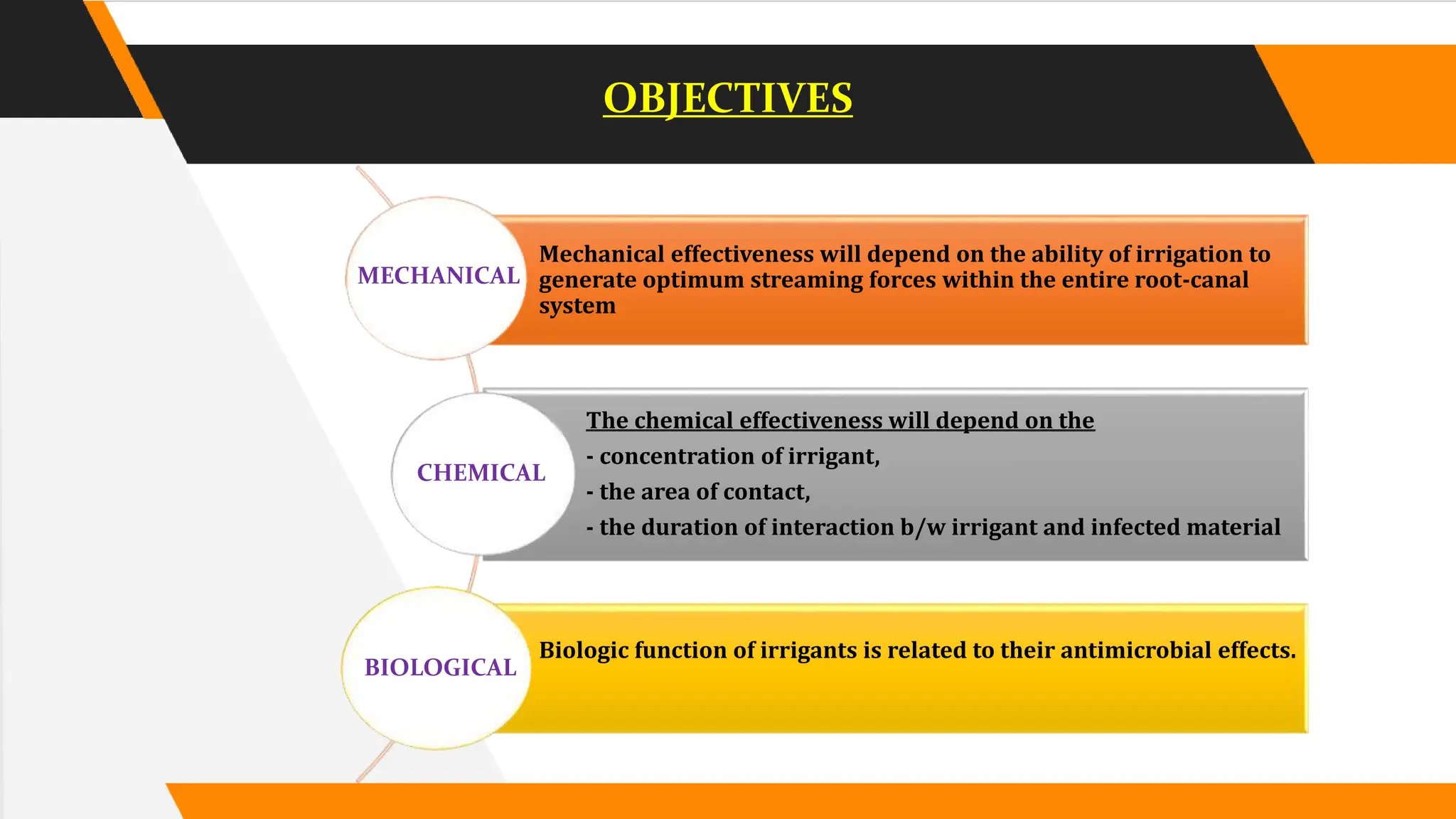
Mechanical effectiveness will depend on the ability of irrigation to
generate optimum streaming forces within the entire root-canal
system
The chemical effectiveness will depend on the
- concentration of irrigant,
- the area of contact,
- the duration of interaction b/w irrigant and infected material
Biologic function of irrigants is related to their antimicrobial effects.
MECHANICAL
CHEMICAL
BIOLOGICAL
OBJECTIVES
The Mechanical and Chemical objectives are as follows:
 flush out debris,
 lubricate the canal,
 dissolve organic and inorganic tissue
 prevent the formation of a smear layer during instrumentation or dissolve it once it has formed.
Biological objectives
 Have a high efficacy against anaerobic and facultative microorganisms in their
planktonic state and in biofilms
 Inactivate endotoxin
 Be nontoxic when they come in contact with vital tissues
 Not cause an anaphylactic reaction.
Efficiency of root
canal irrigation in
terms of debris
removal and
eradication of
bacteria depends
on factors such as:
Penetration depth of the needle,
Diameter of the root canal,
Inner and outer diameter of the needle,
Irrigation pressure, viscosity of the irrigant,
Velocity of the irrigant at the needle tip,
Type and orientation of the needle bevel
Cohens Pathways of Pulp. 11th edition
Penetration Depth of the Needle
The size and length of the irrigation needle—in relation to root canal dimensions—is of
utmost importance for the effectiveness of irrigation.
In the past, large needles (21–25G) were commonly employed for irrigant delivery
Such needles could hardly penetrate beyond the coronal third of the root canal, even in wide root
canals.
More recently, the use of finer diameter needles (28G, 30G or 31G) has been advocated, mainly
because they can reach farther into the canal, even to WL
Diameter of the Root Canal
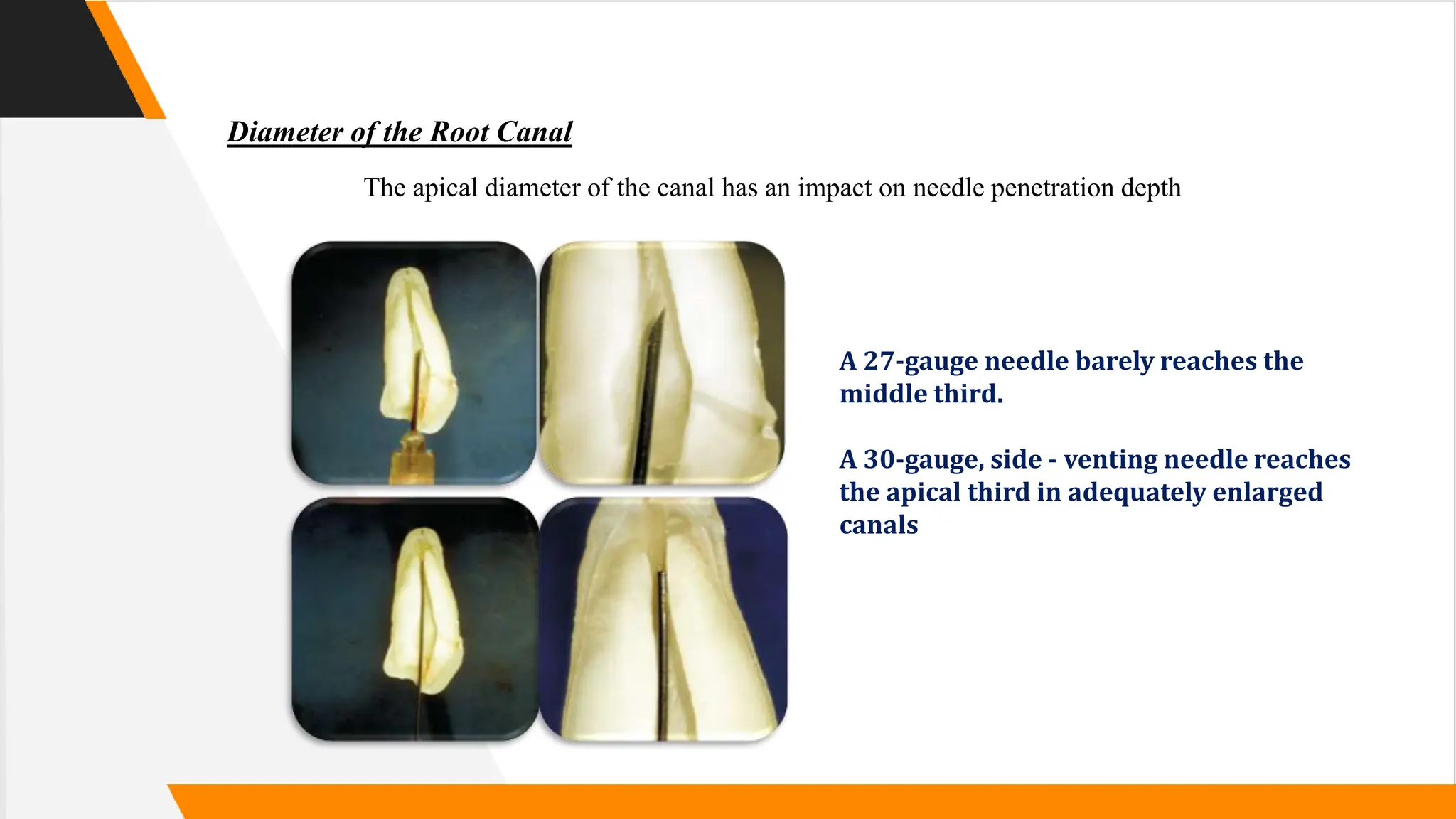
The apical diameter of the canal has an impact on needle penetration depth
A 27-gauge needle barely reaches the
middle third.
A 30-gauge, side - venting needle reaches
the apical third in adequately enlarged
canals
Inner and Outer Diameter of the Needle
 The external needle diameter is of relevance for the depth of introduction into the root canal and for
rigidity of the tip, an important consideration for irrigation of curved canals.
 Common 27 gauge injection needles have an external diameter of 0.42 mm, but smaller irrigation
tips with external diameters of 0.32 mm (30 gauge) are available.
 The Stropko Flexi-Tip (30 gauge) needle is fabricated from nickel-titanium to improve penetration
into curved root canals.
Stropko Flexi tip needles
Irrigation Pressure
 The internal diameter determines the pressure necessary for moving the syringe plunger.
 The speed of the plunger determines the velocity with which the irrigant is extruded.
 Narrow needles require more pressure onto the plunger and extrude the irrigant with higher
velocity than large needle sizes, which extrude greater amounts of irrigants but cannot be
introduced as deep.
 Syringe can be used to reach flow rates at least up to 0.20– 0.25 mL/s even when combined with
fine irrigation needles.
Type and Orientation of the Bevel of the Needle
 To improve safety of irrigation and prevent extrusion of the irrigant through the apical foramen,
some needles release the solution via lateral openings and have a closed, safe-ended tip.
 The orientation of the bevel is crucial to produce a turbulence effect on the dentinal wall of the
canal.
 Side-vented and double side-vented needles lead to maximum shear stress concentrated on the wall
facing the outlet
B. Closed end, side vented
needles
A. Open end needles
Benefits of Using Irrigants in Root Canal Treatment
- Cohen, 11th ed
 Removal of particulate debris and wetting of the canal walls
 Destruction of microorganisms
 Dissolution of organic debris
 Opening of dentinal tubules by removal of the smear layer
 Disinfection and cleaning of areas inaccessible to endodontic instrument
Properties of an Ideal Irrigant for Root Canal Treatment
- Cohen 11th ed
◆ Be an effective germicide and fungicide
◆ Be nonirritating to the periapical tissues
◆ Remain stable in solution
◆ Have a prolonged antimicrobial effect
◆ Be active in the presence of blood, serum, and protein derivatives of tissue
◆ Have low surface tension
◆ Not interfere with repair of periapical tissues
◆ Not stain tooth structure
◆ Be capable of inactivation in a culture medium
◆ Not induce a cell-mediated immune response
◆ Be able to completely remove the smear layer, and be able to disinfect the underlying
dentin and its tubules
◆ Be nonantigenic, nontoxic, and noncarcinogenic to tissue cells surrounding the tooth
◆ Have no adverse effects on the physical properties of exposed dentin
◆ Have no adverse effects on the sealing ability of filling materials
◆ Have a convenient application
◆ Be relatively inexpensive
CLASSIFICATION
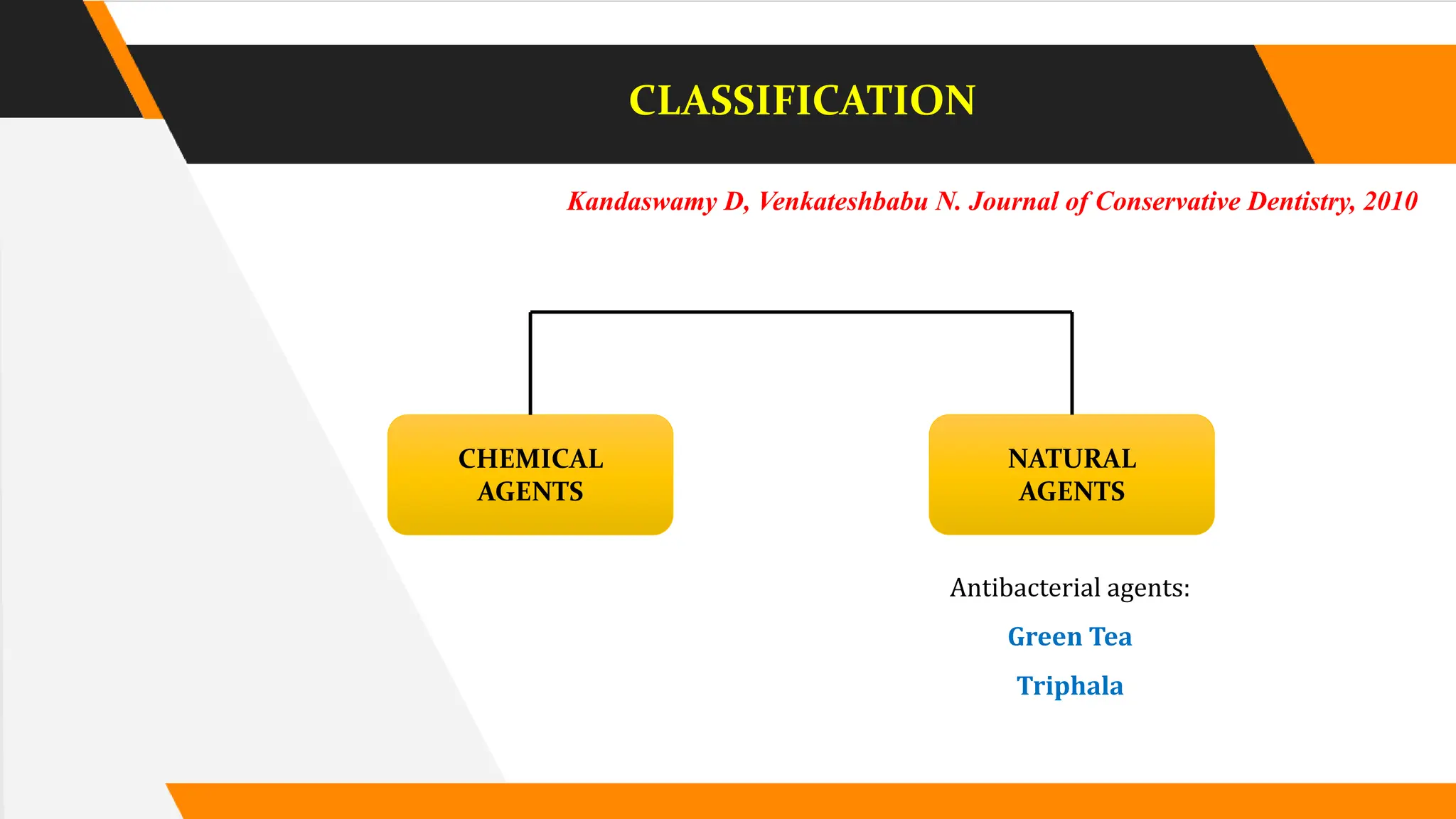
Kandaswamy D, Venkateshbabu N. Journal of Conservative Dentistry, 2010
CHEMICAL
AGENTS
NATURAL
AGENTS
Antibacterial agents:
Green Tea
Triphala
Chemical agents
• Tissue dissolving agents
(e.g., NaOCl, ClO2)
• Antibacterial agents
1) Bactericidal (e.g., NaOCl, CHX)
2) Bacteriostatic (e.g., MTAD)
• Chelating agents
1) Mild pH (e.g., HEBP)
2) Strong pH (e.g., EDTA)
• Combination Products (tissue dissolution + antibacterial property)
MTAD, QMIX, SMEARCLEAN, TETRACLEAN
CHEMICALLY
INACTIVE
SOLUTIONS
CHEMICALLY
ACTIVE
SOLUTIONS
CLASSIFICATION BY STOCK
 Normal saline
 Local anaesthetic solutions
Chemically active solutions
Alkaline solutions:
• Sodium dioxide
• Urea
• Sodium hydroxide
• Sodium hypocholorite
• Potassium dioxide
• Chloramine-T
Acidic solutions:
• Organic acids( citric acids, maleic acid, tannic acid, phosphoric acid, lactic acid)
• Inorganic acids(H2SO4, HCL)
Oxidizing agents:
• 3% H2SO4
• Urea peroxide
• Glyoxide
Proteolytic enzymes:
• Streptokinase
• Enzymol
• Streptodornase
• Purified trypsin
• papain
Chelating agents:
• EDTA
• EDTAC
• RC-PREP
Others:
• Chlorhexidine gluconate(CHX)
• Glutraldehyde
• Oxidative potential water
• 1% pentanedial
• Calcium hydroxide solution
TAP WATER
One of the early irrigating solutions used for flushing root canals
Studies performed in 1955 by Lorixzy et al showed periapical bone regeneration where tap water was
used as an irrigating solution after mechanical instrumentation
Its not used nowadays as it does not fulfill the requirements of
an ideal root canal irrigant
- No antibacterial action
- Does not remove smear layer
UREA
• White, odorless crystalline powder
• In 1951 – Blechman and Cohen suggested the use of
30% urea solution as root canal irrigant
• It has mild solvent action against necrotic tissue and pulp
Mechanism of action:
 Denaturation of proteins by destroying bonds of secondary structure resulting in loss of
functional activity of proteins
 Chemically debrides the wound by softening underlying substrate of fibrin
Disadvanatage:
Lacks antibacterial action
UREA PEROXIDE
White crystalline powder with slight odor
Soluble in water, alcohol and glycerine
UREA PEROXIDE UREA + HYDROGEN PEROXIDE
Mechanism of action
• Antibacterial action is because of the release of hydrogen peroxide
• The peroxide breaks down and liberates large quantities of oxygen that causes bubbling
effect. This action helps in flushing out the debris from the canal.
In Brazil, the trade name of Urea Peroxide is Endo-PTC (10% Urea Peroxide, 15% Tween
80 and 75% Carbowax).
International literature points out that Urea Peroxide is marked as GlyOxide commercial brand.
GLYOXIDE
10% Carbamide peroxide peroxide with anhydrous glycerol
Introduced by Steward et al in 1961
Glycerol
• Increases stability of urea/carbamide peroxide solution
• Increases its shelf life
• Lubricant action
Advantages:-
• It is better tolerated by periapical tissue than NaOCl
• Has greater solvent action and is more germicidal than H2O2. therefore it is an excellent irrigant
for treating canals with normal periapical tissue and wide apex, in which more irritating solution
may cause severe inflammation if extruded out of the apex
• Facilitates negotiation of fine tortuous canal (utilizing the slippery effect of glycerol)
• Whereas chelating agents react with dentin and may cause root perforations or ledging in the
softened wall, this action will not occur with glyoxide
According to Weine, Glyoxide can be used as a main irrigant in small canals until the size 20 is
reached and then switch to NaOCl
Local anesthetics come in sterile packaging and can be dispensed
easily through very small gauge needles
Advantages:
• Easy to use
• Readily available
• Safe to use
Disadvantages:
No role in managing infected root canals as they have no
bactericidal action
LOCAL ANESTHETIC SOLUTION
PHYSIOLOGIC SALINE
From biological point of view, Sterile normal saline is considered to be
one of the best irrigant to use because it causes:
• Least apical tissue irritation or damage
• Biocompatible
• Least amount of cell lysis
Saline accomplishes gross debridement and lubrication
It was demonstrated in one study that saline is able to flush debris from
the canals as thoroughly as sodium hypochlorite
Cohen 7th ed
.
Disadvantages:-
• Does not remove smear layer but merely flushes out superficial debris from the
root canal system
• Has poor antibacterial properties
 Therefore, It should not be used alone as root canal irrigant.
 It should be used as an adjunct to the chemical disinfectant where the chemical irrigant provides
disinfection and the dissolution properties, while saline helps in mechanical debridement
 It can also be used as a final flush of the root canal to remove any chemical irrigant left inside the
root canal – maintains pH and does not allow interactions/reactions between the chemical irrigants
or against the canal wall
Sadaf, Ahmad MZ, Onakpoya IJ.
Journal of Endodontics, 2020
Cold application (Cryotherapy) produces 3 basic physiological tissue responses: decreased
metabolic activity, decreased blood flow, and inhibition of neural receptors in the skin and
subcutaneous tissues
Thus, cryotherapy slows down neural signals and reduces the release of chemical mediators
responsible for pain reduction
Recently, the use of cryotherapy, in the form of COLD SALINE IRRIGATION, in root
canal treatment has been examined in several randomized controlled trials (RCTs)
Studies have shown that intracanal cryotherapy using cold saline at 2.5⁰C for 5 minutes
significantly reduced the intensity of postoperative pain at 6 and 24 hours after the
procedure. But no significant effect on pain between 48 hours and 7 days after the procedure
Studies also reported significant lesser analgesic use with intracanal cryotherapy
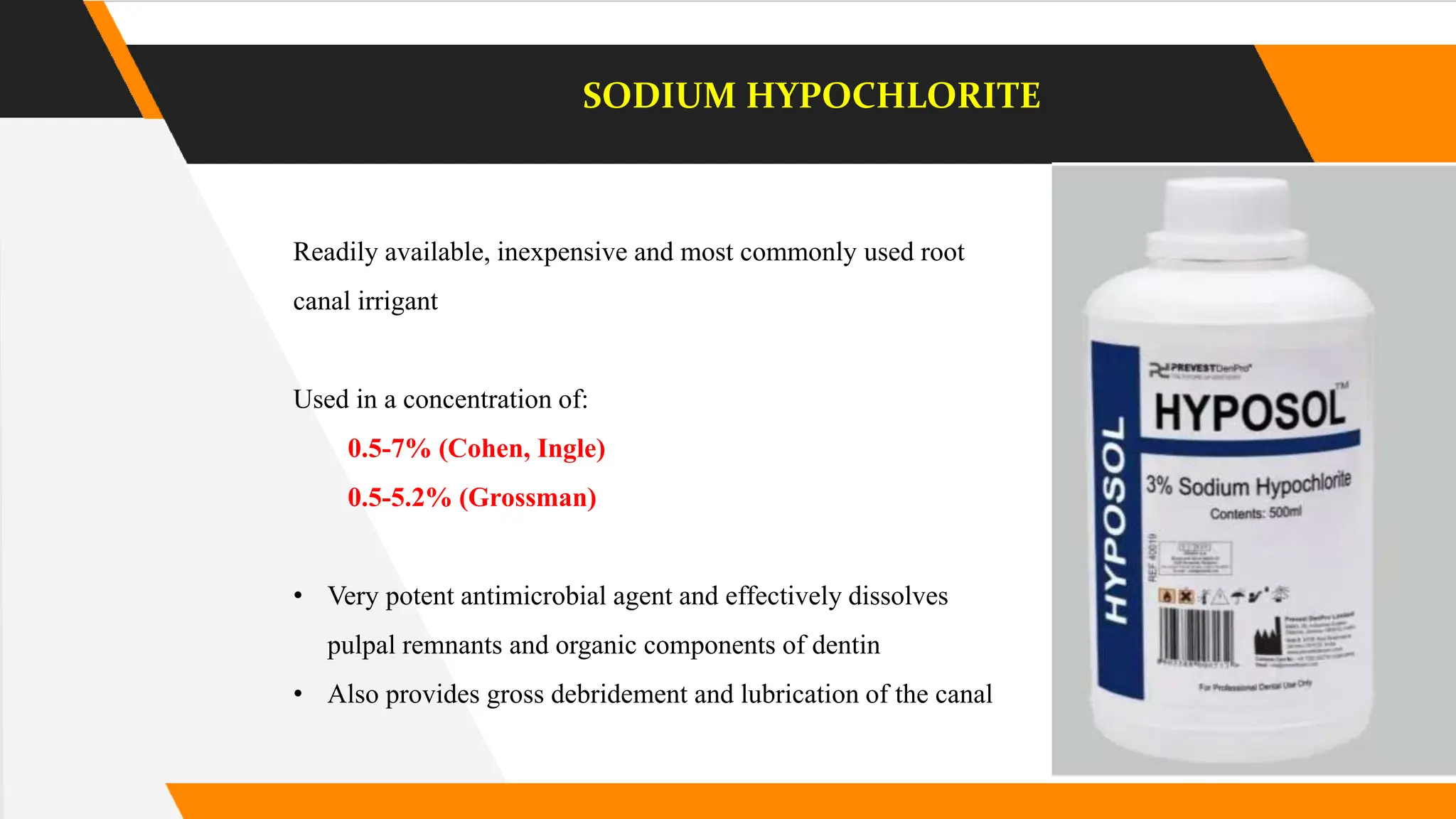
SODIUM HYPOCHLORITE
Readily available, inexpensive and most commonly used root
canal irrigant
Used in a concentration of:
0.5-7% (Cohen, Ingle)
0.5-5.2% (Grossman)
• Very potent antimicrobial agent and effectively dissolves
pulpal remnants and organic components of dentin
• Also provides gross debridement and lubrication of the canal
Ingle 6th ed
It is used both as an unbuffered solution at pH 11 in higher concentrations and
buffered with a bicarbonate buffer (pH 9.0)
Cohen 10th ed
Commercially available hypochlorite (5-6%) has high alkaline pH (11.5) and is
hypertonic. Some authors recommend dilution of commercially available NaOCl with
1% bicarbonate to adjust the pH to a lower level (around 9)
It can also be diluted in 1:1 or 1:3 ratios with water to produce a 2.5% or 1% solution
respectively for endodontic purposes
Buffering reduced tissue dissolving activity but no effect was seen in antibacterial property- Zhender et al
Mechanism of action
 When sodium hypochlorite contacts tissue proteins - nitrogen, formaldehyde, and
acetaldehyde are formed.
 Peptide links are fragmented and proteins disintegrate, permitting hydrogen in the amino
groups (-NH-) to be replaced by chlorine (-NCl-) forming chloramines; this plays an
important role for the antimicrobial effectiveness.
 Necrotic tissue and pus are dissolved and the antimicrobial agent can better reach and clean
the infected areas.
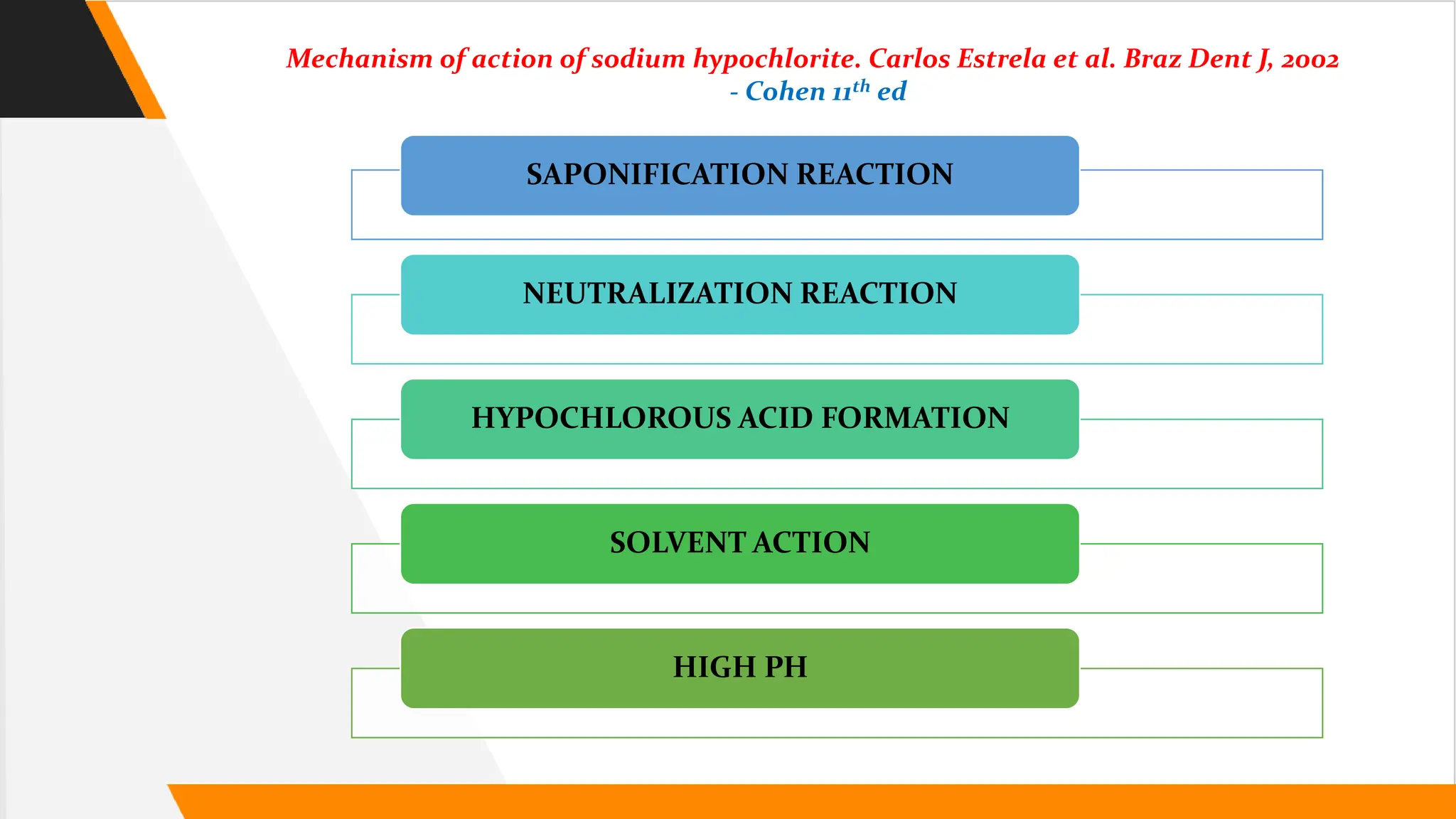
Mechanism of action of sodium hypochlorite. Carlos Estrela et al. Braz Dent J, 2002
- Cohen 11th ed
SAPONIFICATION REACTION
NEUTRALIZATION REACTION
HYPOCHLOROUS ACID FORMATION
SOLVENT ACTION
HIGH PH
1. Saponification reaction:
Sodium hypochlorite acts as an organic and fat solvent that degrades fatty acids and
transforms them into fatty acid salts (soap) and glycerol (alcohol), reducing the surface
tension of the remaining solution.
2. Neutralization reaction:
Sodium hypochlorite neutralizes amino acids by forming water and salt.
With the exit of hydroxyl ions, the pH is reduced
3. Hypochlorous acid formation:
When chlorine dissolves in water and it is in contact with organic matter, it forms
hypochlorous acid ((HOCl−) that acts as an oxidizer.
• Hypochlorous acid (HOCl−) and hypochlorite ions (OCl−) lead to amino acid degradation and
hydrolysis. HOCl is considered to be a stronger oxidant than the hypochlorite ion.
• The HOCl molecule is responsible for the Strong Chlorinating action and Oxidizing action
on tissue and microorganisms.
4. Solvent action:
• NaOCl is the only commonly used irrigating solution that dissolves organic matter. This
is an important function, as it is crucial to dissolve and remove all necrotic tissue
remnants from the canal.
• Otherwise, such tissue could serve as nutrients to residual microbes in the canal system.
Tissue remnants would also have a negative impact on the quality of seal by the root
filling
• Sodium hypochlorite acts well on necrotic tissue whereas the effect on vital tissue is
weaker
Haapasalo M et al. Ingles endodontics, 7th ed
 The dissolving efficacy of sodium hypochlorite is influenced by the structural integrity of
the connective tissue components of the pulp.
 If the pulp is already decomposed, it won't take long to dissolve the remaining soft tissue
remnants.
 If the pulp is vital and little structural degeneration has occurred, it will take longer for
NaOCl to dissolve the remnants.
 In this respect, cleaning procedures should not be hurried, especially when the pulpal tissues
are still supported by circulation.
John D. West James B. Roane Albert C. Goerig
Cohen 6th ed
• Solvent action of NaOCl has been attributed to its high alkalinity
• It releases chlorine that combines with protein amino groups (NH) to form chloramines
(chloramination reaction).
• Chloramines impede cell metabolism; chlorine is a strong oxidant and inhibits essential
bacterial enzymes by irreversible oxidation of SH groups (sulfydryl group).
• Grossman and Meiman reported that 5% sodium hypochlorite dissolves pulp tissue in
20 min to 2 hours
• Several studies have shown that the tissue dissolving ability of NaOCl is dependent on its
concentration.
• Using NaOCl in low concentration (below 2.5%) predictably eliminates infection but does
not consistently dissolve pulpal remnants – Cohen 7th ed
• The higher concentration, the faster soft tissue dissolution.
• Agitation, by sonic or ultrasonic means, and increased temperature also contribute to
faster dissolution of tissue.
• It has been reported that continuous agitation of 2% NaOCl dissolves soft tissue as fast as
non-agitated 6% NaOCl solution. Similarly, heating the solution from 45°C to 60°C speeds
up the dissolution.
Stojicic S, Zivkovic S, Qian W, et al. J Endod 2010
After 30 min
After 10 minutes
5. High pH:
• Sodium hypochlorite is a strong base (pH > 11).
• This high pH is responsible for its antimicrobial effectiveness
• Hydroxyl ion released interferes in cytoplasmic membrane integrity due to irreversible
enzymatic inhibition, biosynthetic alterations in cellular metabolism, and phospholipid
degradation observed in lipidic peroxidation – Cohen 10th ed
• Between pH 4 and 7, chlorine exists predominantly as HClO, the active moiety, whereas
above pH 9, OCl– predominates. It is the hypochlorous acid that is responsible for bacteria
inactivation - it disrupts oxidative phosphorylation and other membrane-associated activities
as well as DNA synthesis - Ingle (6th ed)
TEMPERATURE
TIME
COMBINED WITH
OTHER
IRRIGANTS
IRRIGANT
ACTIVATION
CONCENTRATION METHODS TO
INCREASE THE
EFFICACY OF
NAOCL
Cohen 11th ed
TEMPERATURE
(Effect of temperature on sodium hypochlorite short term stability, pulp dissolution and antimicrobial
efficacy. JOE, 2005)
• Increasing the temperature of low-concentration NaOCl solutions improves their immediate
tissue-dissolution capacity and antimicrobial activity
• Heated NaOCl removes organic debris more efficiently
• Recent studies have shown that temperature rise of 25°C increases NaOCl efficacy by 100
times
• Another study have shown that NaOCl at boiling temperature is able to disintegrate pulp
tissue 210 times higher than the solution at room temperature
 Heating to 50-60°C is recommended
0.5% NaOCl heated to 45 ° C dissolved pulp tissue similar to 5.25% NaOCl at 20 °C.
And when heated to 60 ° C, there was almost complete dissolution of pulp
Sirtes G, Waltimo T, Schaetzle M, Zehnder M. J Endod 2005
Similar result was also seen with 1% NaOCl heated at 45 ° C
Paragliola R, Franco V, Fabiani C. J Endod 2010
 Various devices are available for heating syringes filled with sodium hypochlorite before use.
E.g: System B Heat sources (Analytical Endo, CA)
Device for heating syringes filled
with irrigation solution (e.g.,
sodium hypochlorite) before use
 However, it was demonstrated that as soon as the irrigant touches the root canal system, the
temperature reaches the body temperature. (Zeltner M, Peters OA, Paque F: J Endod, 2009).
 Therefore, some authors recommend in situ heating of NaOCl.
 This can be done by activating ultrasonic or sonic tips to the NaOCl inside the root canal for a
couple of minutes.
 Macedo and colleagues stated that a 10° C temperature rise was seen during ultrasonic
activation which is insufficient to increase the reaction rate
Macedo R, Verhaagen B, Rivas DF, et al. J Endod, 2014
 NaOCl can also be heated in the canal using a Touch n Heat XF electric heat carrier
(Analytic Endodontics, Orange, CA), attached to a System B unit
CONCENTRATIONS
• Some in vitro studies have shown that NaOCl in higher concentrations is more effective against
Enterococcus faecalis and Candida albicans but is cytotoxic
(Radcliffe CE, Potouridou L, Qureshi R, et al. Int Endod J 2004.)
• In contrast, clinical studies have indicated both low and high concentrations to be equally effective in
reducing bacteria from the root canal system
• Rosenfield et al demonstrated that 5.25% sodium hypochlorite dissolves vital tissue in addition to
necrotic tissue and was found to be significantly better than 2.6%, 1%, or 0.5%
Rosenfeld EF, James GA, Burch BS. JOE 1978
Cohen 11th ed
They commented that “The effectiveness of low concentrations of NaOCl may be improved by
using larger volumes of irrigant or by the presence of replenished irrigant in the canals for
longer periods of time.”
On the other hand, a higher concentration of sodium hypochlorite might be equally effective in
shorter periods of time
Similar result was also suggested by Siqueira et al. J Endod. 2000
0.5% NaOCl concentration is more biocompatible but less stable, allowing us to
understand that if open and ex-posed to intense bright or not stored under refrigeration
(6 °C), it becomes inappropriate for use.
1% NaOCl has stabilizers (sodium chloride) which makes its use more viable at long
term
Marion JJC, Manhães FC, Bajo H, Duque TM. Dental Press Endod. 2012
2.5% NaOCl proved to be a better solution than 0.5% and 1% concentrations and has
lower cytotoxicity than 5.25% concentration. It is capable to inhibit 100% of the E faecalis
in 5 min, eliminating the pain of a patient with faster inhibition of bacteria and the shorter
time for root canal sanitization.
Regarding 5.25% NaOCl solution, its high concentration of hypochlorous acid leads to
the death of the root canal bacteria within 2 minutes but is highly cytotoxic
According to Ingle 6th ed, Cohen 10th ed
The fear of toxic and chemical complications is the main reason for that low concentrations
0.5 to 1% NaOCl solutions are used for canal irrigation instead of the 5.25% solution in
many countries.
However, more in vivo studies on persistent endodontic infections and retreatment are
necessary for a deeper understanding of the relationship between NaOCl concentration and
its antimicrobial activity against specific microorganisms, before final conclusions can be
drawn regarding the optimal NaOCl concentration.
• A higher concentration of NaOCl has been found to have better antibacterial efficacy and
biofilm disruption and removal, also better tissue dissolving properties.
• However, studies have shown that lower concentrations can have similar effects when used in
larger volumes and more frequent intervals. (20 ml/canal for 2.5%)
• Higher concentrations of NaOCl are more toxic than lower concentrations, and if
accidentally extruded beyond the root canal, the tissues’ reaction could be worse than the
lower concentration.
• Gladly, due to the confined anatomy of the root canal system, these incidents are rare.
• Therefore, higher concentrations can be used during root canal treatment, with a low
incidence of mishaps.
TIME
 There is conflicting evidence regarding the time course of the antibacterial effect of NaOCl.
 Such differences are likely a result of several factors: presence of organic matter, inflammatory
exudate, tissue remnants and microbial biomass, could weaken the antibacterial effect of NaOCl
solution.
 Haapasalo and colleagues in 2010 showed that the presence of dentin caused marked delays in
the killing of Enterococcus faecalis by 1% NaOCl.
 In vivo the presence of organic matter (inflammatory exudate, tissue remnants, and microbial
biomass) consumes NaOCl and weakens its effect.
Haapasalo M, Shen Y, Qian W, Gao Y: Irrigation in endodontics, Dent Clin North Am 54:291, 2010.
 Continuous replenishing of irrigation solution and allowing sufficient contact time are
important factors for the effectiveness of NaOCl.
 The chlorine ion, which is responsible for the dissolving and antibacterial capacity of NaOCl, is
unstable and consumed rapidly during the first phase of tissue dissolution, probably within 2
minutes, which provides another reason for continuous replenishment.
 Therefore, Freshly prepared NaOCl should be used as they have better tissue dissolving property
and antimicrobial effect
 The optimal time that a hypochlorite irrigant at a given concentration needs to remain in the
canal system is an issue yet to be resolved.
Zehnder M: Root canal irrigants, J Endod 32:389, 2006
Gomes et al (2010) gave similar findings on the time taken for NaOCl to kill the Efaecalis species
They stated that
Percentage
5.25 %
2.5%
1%
0.5%
Contact time
0.5 min
10 min
20 min
30 min
Of these, 2.5% of NaOCl irrigation for 10 min was found to be more effective with less toxicity
According to AAE guidelines, 2021
 NaOCl, when left in contact with dentin for an extended period of time, may have an
unfavorable effect on dentin.
 5.25% sodium hypochlorite reduces the flexural strength and elastic modulus of dentin.
 As a result, on one hand, more exposure time of the irrigation with the canal walls is needed to
eliminate biofilm; on the other hand, this increased time could be harmful to dentin.
 Therefore, clinicians must consider all these factors when using the different irrigants in a
clinical case to enhance their favorable properties while mitigating the adverse effects.
IRRIGANT ACTIVATION
 Ultrasonic activation with small file in canals filled with NaOCl
 these devices increase the tissue-dissolving capabilities of NaOCl via temperature elevation
thereby increasing efficacy
 Yet another reason for using ultrasonic devices might be enhancement of canal débridement
 Movement of NaOCl with GP or files causes sufficient hydrodynamic effect making the irrigant
penetrate even narrowest spaces. This does not improve reaction rate but increases surface
contact with canal walls and also reduces vapor lock
Mario Dioguardi et al. Endodontic irrigants: Different methods to improve efficacy and related
problems. Eur J Dent. 2018
COMBINING WITH OTHER IRRIGANTS
 There is increasing evidence that the efficacy of NaOCl, as an antibacterial agent, is increased
when it is used in combination with other solutions, such as calcium hydroxide, EDTAC, or
chlorhexidine – Ingle 5th ed
 Combining with EDTA is the most widely used method of irrigation as this combination
dissolves both organic and inorganic matters
 Incorporating silver nanoparticles – greater surface area and density of nanoparticles enabled
them to interact to a greater extent. This have enhanced antimicrobial activity as it easily
penetrates the cell walls disturbing bacterial cell function
Modifications and methods to improve efficiency of NaOCl as root canal irrigant. Adv Dent Surg, 2020)
Prada I et al. Update of therapeutic planning of irrigation and intracanal medication in root canal
treatment. A literature review. J Clin Exp Dent. 2019
The most adequate irrigation protocol consists of using 2.5% NaOCl
activated with ultrasound followed by a final rinse with 17% EDTA,
7% malic acid or 0.2 % Cetrimide combined with 2% Chlorhexidine.
Synergism between Ca(OH)2 and NaOCl
 Some controversies have been reported regarding the synergistic effects of Ca(OH)2 and NaOCl.
 Ca(OH)2 paste has the ability of tissue dissolving after 12 days. They also showed an increase in
tissue dissolving of NaOCl after pretreatment with Ca(OH)2 for 30 minutes up to 7 days.
Hasselgren G et al. J endod 1988
 Metzler and Montgomery concluded that pretreatment with a hard-setting Ca(OH)2 paste for 7
days followed by irrigation with NaOCl can clean canal isthmuses better than hand mechanical
preparation alone.
Metzler R.S., Montgomery S. J Endod, 1989
 On the other hand, some researches have shown that Ca(OH)2may be ineffective for
pulpal tissue dissolving.
 In summary, it seems that pretreatment with Ca(OH)2 medicament may increase the
tissue dissolving effect of NaOCl.
Antibacterial Activity
• NaOCl has wide spectrum of antimicrobial activity
• They can actively kill vegetative forms of bacteria, spore forming bacteria, fungi as well as
viruses
• The bactericidal activity is because of the hypochlorous acid(HOCL-) released when in
contact with the organic debris. Chloramines also interfere with cell metabolism leading to
cell death
They kill bacteria by 2 mechanisms:
1. By penetration into the bacterial cell
2. Or by chemical combination with the protoplasm of bacterial cell
• NaOCl kills bacteria very rapidly even at low concentrations.
• The resistant microorganism, Candida albicans, was killed in vitro in 30 seconds by both
5% and 0.5% NaOCl
Waltimo TM et al. Int Endod J 1999
Radcliffe CE et al. Int Endod J 2004
• Enterococcus faecalis was killed within 30 seconds by the 5.25% solution, while 10 and 30
minutes was required for killing all bacteria by 2.5 and 0.5% solutions, respectively
Gomes et al. Int Endod J 2001
• Gram-negative anaerobic rods P.gingivalis, P.endodontalis, and Prevotella intermedia, often
isolated from apical periodontitis, were killed within 15 seconds with 0.5 to 5%
concentrations of NaOCl
Vienna ME et al, 2004
Oxidative action on
sulfhydryl grps of
bacterial enzymes
Disrupts
• Oxidative
phosphorylation
• DNA synthesis
• Membrane
associated activities
Death of bacterial
cells
HYPOCHLOROUS ACID
Effect on dentin
 NaOCl solutions may affect mechanical dentin properties via the degradation of organic
dentin components.
 Presence of dentin debris, dentin matrix in the root canal may reduce the activity of 1%
NaOCl but does not abolish it
Haapasalo HK et al. Int Endod J 2000
Depth of Penetration
 The depth of NaOCl penetration varied between 77 to 330 μm, and it depends on
concentration, time, and temperature
Influence of NaOCl on bond strength:
Bond Strength Enhancement
• The enhancement in dentin bond strength observed after NaOCl treatment has been related to its
“deproteinizing action”
• NaOCl has the ability to dissolve and remove the exposed dentinal collagen, produced by acid
etching, and provide a fresh mineralized dentin surface to which the adhesive resin can be applied.
• According to Prati et al., NaOCl produced an unusual new mechanism of micromechanical retention
of resin into mineralized dentin, called “reverse hybrid layer formation” .
Tariq S Abuhaimed and Ensanya A Abou Neel. Sodium hypochlorite irrigation and its effect on Bond strength of
dentin. BioMed Research International. 2017
HYBRID LAYER
ACID ETCHING EXPOSED COLLAGEN FIBRES RESIN INFILTRATES EXPOSED FIBRILS
RESIN
INFILTRATED
COLLAGEN
REVERSE HYBRID LAYER
NAOCL REMOVES EXPOSED COLLAGEN SOLUBILIZES UNDERLYING MINERAL MATRIX
RESIN INFILTRATED MINERALIZED MATRIX
The application of NaOCl after acid etching and before the adhesive resin
 Remove the exposed collagen, produced by acid etching
 Also solubilize the fibrils of the underlying mineralized matrix creating submicron porosities
within the mineral phase.
The adhesive resin will therefore infiltrate within the mineralized matrix filling these
submicron porosities (i.e., creating a layer of resin-infiltrated mineralized matrix).
 The use of NaOCl also produced an acid-base resistant zone under the hybrid layer; this zone
could help in resisting secondary caries around restorations
 Furthermore, the removal of exposed collagen does not only reduce the bonding technique
sensitivity but also produce a more porous surface (i.e., an increase in size of dentinal
tubules with the presence of an extensive labyrinth of lateral tubules that open on
intertubular and/or peritubular dentin) and larger resin tags that would produce
interfaces with high bond strength.
Bond Strength Reduction
Removal of organic matrix by NaOCl results in leaving behind less
receptive bonding surface
Dissolution of collagen fibrils from dentin by breakdown of the bonds
between carbon atoms and disorganization of the primary structure of
collagen impedes the formation of a consistent hybrid layer
The presence of protein chloramine-derived radicals in NaOCl-treated
dentin could result in premature chain termination - interferes with the
free radical polymerization of the resin cement at the resin-dentin
interface
Residual irrigants or their products may contaminate dentin surface,
interfere with the penetration of resin adhesive into the dentin or the
polymerization of resin monomer .
Reduction in both Ca2+ and PO4- in dentin -- reduction in dentin
strength and elasticity
The deterioration effect of sodium hypochlorite on structural, chemical, and mechanical properties of dentin is
concentration-dependent. For example, 1% NaOCl had no significant adverse effect on carbon and nitrogen
content as well as elasticity and flexural strength of dentin in contrast to 5 and 9%
Reversing The Adverse Action Of Sodium Hypochlorite On Dentin Bond Strength
Natural Antioxidants:
 Ascorbic acid or Sodium Ascorbate
 Sodium thiosulfate
 Rosmarinic acid
 Green tea extracts
 Proanthocyanidin (Grape seed extract)
• These could improve the bond strength to NaOcl treated dentin and stabilize the
resin-dentin interface due to their antioxidative properties
• They also remove the remnant of NaOCl by oxidation-reduction
• They restore the altered redox potential of the oxidized bonding substrate by
allowing free-radical polymerization of the adhesive to proceed without premature
termination
Tissue dissolution
Antibacterial action
Lubrication of canals
Economical
Easily available
Unpleasant taste and odour
Inability to remove smear layer
Corrosive to metals
Bleach clothes
Irritation to the eyes
It may cause discoloration
When NaOCl is used as a final
rinse, bonding of the sealer to
the dentin may be altered
Toxicity - 5.25% is more toxic
than 1% and 0.5%
ADVANTAGES
DISADVANATGES
Damages clothing
• Most common incident during NaOCl irrigation
• Due to bleaching action of hypochlorite
Damages eye
• Reacts with lipid in corneal epithelial cells forming soap bubbles that penetrate
corneal stroma and anterior chamber causing necrosis - Endolphalmitis
• Contact with eyes causes immediate pain, burning sensation, profuse watering
and erythema
• Managed by immediate ocular irrigation with water or saline
Damage to oral mucosa
• Reacts with proteins and fats of oral mucosa and cause tissue necrosis –
may lead to secondary infections
NaOCl Toxicity
• Sodium hypochlorite is a cytotoxic agent (Gatot et al 1991)(Gernhardt et al 2004)
• It has pH of 11-12 and causes injury primarily by oxidation of proteins (Koufman and Keila
1989)(Gatot et al 1991)(Serper et al 2004)
When it comes into contact with vital tissue, it causes
• Hemolysis
• Ulceration
• Inhibits neutrophil migration
• Damages endothelial and fibroblast cells
HYPOCHLORITE ACCIDENT
If inadvertently NaOCl is extruded through the apex, severe accidents may occur, It is important to
recognize the symptoms and act accordingly.
Causes
 Teeth with wide apex
 Apical constriction destroyed during excessive RC preparation
 Extreme pressure during irrigation
 Binding of needle tip in the RC
 Not determining WL accurately
Symptoms
• Immediate severe pain.
• Immediate oedema of neighbouring soft tissues.
• Possible extension of oedema over the injured half side of the
face, upper lip, infraorbital region.
• Profuse bleeding from the root canal.
• Profuse interstitial bleeding with haemorrhage of the skin and
mucosa (ecchymosis).
• Chlorine taste and irritation of the throat after injection into the
maxillary sinus.
• Secondary infection possible.
• Reversible anaesthesia or paraesthesia possible.
Toxic effect of sodium hypochlorite
on periradicular tissues.
Osteonecrosis was evident after
3weeks
Management:
• Remain calm and inform the patient
• Pain control: local anaesthesia, analgesics
• Application of extraoral cold compresses for reduction of swelling
• After 1 day: warm compresses and frequent warm mouth rinses for stimulation of local systemic
circulation
• Irrigate with normal saline immediately to decrease soft tissue irritation
• Daily recall for control of recovery
• Antibiotics: not obligatory. Only in cases of high risk or evidence of secondary infection
• Antihistamine: not obligatory
• Corticosteroids: controversial
• Further endodontic therapy with sterile saline or chlorhexidine as root canal irrigants.
Referral to a hospital in case of worsening symptoms were suggested.
Prevention of Hypochlorite accident
 Rubber dam isolation
 A good proper straight line access cavity design with adequate coronal preparation
 Preoperative periapical radiograph to access root canal anatomy
 Use of luer lock needles – secured attachment and prevent accidental separation from
syringes
 Use of side vented needles
 Passive irrigation of the canal (never force irrigants into the canal with pressure)
 Irrigation needle to be placed atleast 2mm short of working length
HYPOCLEAN
• Introduced by Giardino
• New NaOCl based endodontic irrigant composed of 5.25% NaOCl and 2
detergents
• It is found that Hypoclean offers substantivity upto 4 weeks
• Hypoclean is more effective against C. albicans, P. aeroginosa, and L. casei than
NaOCl, CHX, Tetraclean, and Chlor-XTRA (6% NaOCl + surfactant)
• However, has low antibacterial activity when compared to Tetraclean
Zahed Mohammadi et al. Med Oral Pathol Oral Cir Bucal 2011
• The surface tension of Hypoclean was lower than Chlor-Xtra and 5.25 % NaOCl
Palazzi et al. Int Endod J, 2011
OCTENIDINE-BASED SOLUTION
• Octenisept (OCT) is an antimicrobial/antibiofilm agent can be potentially
combined with NaOCl during root canal treatment.
• A recent study showed that the whitish precipitate formed with the
NaOCl-OCT mixture was identified as phenoxyethanol, a compound
already present in OCT, and it may occlude dentinal tubules
• They showed greater antimicrobial activity of NaOCl against E. faecalis
compared with OCT. OCT was more effective than CHX.
A Review Over Benefits and Drawbacks of Combining Sodium Hypochlorite with Other Endodontic Material.
Open Dent J 2017
• Milton sterilizing fluid (Proctor & Gamble, Weybridge, Surrey, UK)
and Parcan (Septodont) is a stabilized 3% sodium hypochlorite
solution and can be used as a root canal irrigant without
dilution
• Milton stabilized with 16% NaCl
• Parcan stabilized with NaCl and NaHCO3
BIS-DEQUALINIUM ACETATE (BDA)
Introduced by Kauffman
Commercially marketed as Salvizol (5% aminoqualindinium acetate + propylene glycol)
Properties :
 Low toxicity
 Lubrication action
 Disinfecting ability
 Low surface tension
 Chelating properties
In one of the study, it was rated superior to NaOCl in débriding the apical third.
Ingle 6th ed
• Another study showed a remarkable decrease in postoperative pain and swelling
when BDA was used.
• They attributed these results to the chelation properties of BDA in removing the
smear layer as well as the surfactant properties that allow BDA “to penetrate into
areas inaccessible to instruments.
• BDA is recommended as an excellent substitute for sodium hypochlorite in those
patients who are allergic to the latter
CHLORHEXIDINE
Available in a concentration of 0.12-2%
History:
 Chlorhexidine (CHX) was developed in the UK and first marketed as
an antiseptic cream.
 It has been used for general disinfection purposes and the treatment of
skin, eye, and throat infections in both humans and animals.
 It has been used as an irrigant and medicament in endodontics for
more than a decade.
Molecular Structure
• CHX is a strongly basic molecule with a pH between 5.5 and 7 that belongs to the polybiguanide
group and consists of two symmetric four-chlorophenyl rings and two bisbiguanide groups
connected by a central hexamethylene chain.
• CHX digluconate salt is easily soluble in water and very stable
Mechanism of action
• CHX is a positively charged hydrophobic and lipophilic molecule that interacts with
negatively charged phosphate groups on microbial cell walls, which alters the cells osmotic
equilibrium.
• This increases the permeability of the cell wall, allowing the CHX molecule to penetrate into
the bacteria.
• Damage to this delicate membrane is followed by leakage of intracellular constituents,
particularly phosphate entities such as adenosine triphosphate and nucleic acids.
• As a consequence, the cytoplasm becomes congealed, with resultant reduction in leakage;
thus, there is a biphasic effect on membrane permeability.
SUBSTANTIVITY
• Because of the cationic nature of the CHX molecule, it can be absorbed by anionic substrates such
as the oral mucosa and tooth structure.
• CHX is readily adsorbed onto hydroxyapatite and teeth. Studies have shown that the uptake of
CHX onto teeth is reversible.
• This reversible reaction of uptake and release of CHX leads to substantive antimicrobial activity
and is referred to as substantivity.
• This effect depends on the concentration of CHX.
 At low concentrations of 0.005% to 0.01%, only a constant monolayer of
CHX is adsorbed on the tooth surface.
 But at higher concentrations (>0.02%), a multilayer of CHX is formed on
the surface, providing a reservoir of CHX that can rapidly release the excess
into the environment as the concentration of CHX in the surrounding
environment decreases.
• Komorowski and colleagues suggested that a 5-minute application of CHX did not induce
substantivity, so dentin should be treated with CHX for 7 days.
Komorowski et al. JOE, 2000
• Substantivity of CHX lasted for 12 weeks.
Khademi et al. J Res Pharm Pract. 2014
• The dicationic CHX molecule attaches to the tooth surface by one cation and to the
bacteria colonizing the tooth surface through the other cation. This is called Pin- Cushion
Effect. This prolongs its activity.
Antimicrobial activity
CHX antimicrobial activity is concentration dependant,
• At high concentration, it acts as detergent and exerts its bactericidal effect by
coagulation of intercellular components, damaging cell membrane and
precipitating cytoplasm
• At low concentrations, bacteriostatic causing low molecular weight substances
(K, PO4) to leak out without the cell being permanently damaged
Zahed Mohammadi. Chlorhexidne gluconate, its properties and applications in endodontics. Iranian
Endodontic Journal. 2008
• It has been demonstrated that 2% CHX has a better antibacterial efficacy than 0.12% CHX in
vitro.
• CHX is a better irrigant when compared to saline
• 2% CHX as an adjunct irrigant to NaOCl was associated with superior periapical healing.
• CHX is effective against both Gram-positive and Gram-negative bacteria, although activity against
Gram-negative bacteria is not as good as against Gram-positive bacteria.
• Mycobacteria and bacterial spores are resistant to CHX. Therefore, CHX is not as suited to
chairside sterilization of gutta-percha cones as NaOCl
Ingle 6th ed
• Gomes et al and Vienna et al investigated invitro antimicrobial activity of 3 concentrations of CHX
(0.2%, 1% and 2%) against endodontic pathogens.
(Gomes et al. Int Endod J. 2001)(Vianna et al. 2004)
 Both 2% gel and liquid form of CHX eliminated staphylococcus aureus and candida albicans in 1
min
 Gel form of CHX killed E.faecalis in 1min
 Also eliminated periodontal pathogens in 15 sec
The time required for 1% and 2% CHX to eliminate all microorganisms was the same required for
5.25% NaOCl
M S Clegg et al. the effect of exposure to irrigant solutions on apical dentin biofilms invitro. J
Endod. 2006
• Clegg et al. evaluated the ex vivo effectiveness against apical dentine biofilms of three
concentrations of NaOCl (6%, 3%, and 1%), 2% CHX, and Mixture of Tetracycline acid and
detergents (MTAD).
• They reported that the 6% NaOCl and 3% NaOCl were capable of disrupting and removing
the biofilm. 1% NaOCl and the MTAD were capable of disrupting the biofilm but did not
eliminate the bacteria, and
• The 2% CHX was not capable of disrupting the biofilm.
Chlorhexidine (2%) has been advocated as a final rinse irrigant owing to its substantivity, which
allows binding to dentin and sustained antimicrobial activity,
especially in Endodontic Retreatment
Cohen 10th ed
Interaction of CHX and NaOCl - Cohen 11th ed
• The reaction between NaOCl and CHX produces an orange red precipitate as CHX is not soluble in
NaOCl
• Orange red precipitate is an insoluble neutral salt formed by the acid-base reaction between NaOCl
and CHX - Parachloroanaline (PCA).
• Leaching of PCA from the insoluble precipitate formed is of concern because it has been shown to
be cytotoxic in rats and possibly carcinogenic in humans.
The higher the concentration of
NaOCl, the larger the precipitate
is if 2 % CHX is used
• PCA has been shown to be toxic in humans with short-term exposure, resulting in cyanosis,
which is a manifestation of methemoglobin formation.
The interaction should be avoided by using EDTA or other irrigants after NaOCl and before
CHX or alternatively, the canals can be dried using paper points before the final rinse
Coats the
canal
surface
Occludes
dentinal
tubules
Seals the
root canal
May cause
staining of
tooth
• NaOCl was more effective in the reduction of gram-negative bacterial endotoxin than CHX.
However equally effective against gram positive organisms
• Even though there is still controversy regarding the efficacy of CHX and NaOCl, both the
irrigants can be used as the main canal irrigant owing to their different mechanism of action
• Considering the toxicity of NaOCl, CHX can be safely used for root canal irrigation as it is
less toxic and does not cause periapical irritation if extruded beyond the apex
Ruksakiet et al. J Endod. 2020.
• The combination of CHX and NaOCl may be recommended for endodontic irrigation,
as it showed increased effectiveness than when used alone
• But due to the formation of cytotoxic product, the consecutive application of NaOCl
and CHX with intermediate flushes between each irrigant is needed
Interaction of CHX and EDTA
• The combination produces a white precipitate rather than
undergoing a chemical reaction
• Some studies have shown that the ability of EDTA to remove
the smear layer was reduced by this combination
Interaction of CHX and Ca(OH)2
 Good antimicrobial activity
 pH of calcium hydroxide not affected by addition of CHX
 this did not reduce more bacteria when compared to 1% NaOCl
 usefulness of this combination still remains controversial
Interaction of CHX and Hydrogen peroxide
 Completely irradiated Efaecalis in concentration lower than required when they were used
alone
 CHX makes bacterial membrane permeable which promotes H2O2 to penetrate causing
damage to intracellular organelles
Heling I et al. Int Endod J 1999
• The effect of CHX-H2O2 was weaker than that of EDTA-H2O2 and CHX–EDTA
combinations – Ingle 7th ed
Chlorhexidine and Dentin Bonding
• Studies have concluded that autodegradation of collagen matrices can occur in resin-
infiltrated dentin, but this may be prevented by the application of a synthetic protease
inhibitor such as CHX.
• Because of its broad-spectrum matrix metalloproteinase (MMP)-inhibitory effect, CHX
may significantly improve resin-dentin bond stability.
Carrilho MR, Carvalho RM, de Goes MF, et al: Chlorhexidine preserves dentin bond in vitro, J Dent Res 86:90, 2007
ADVANTAGES AND DISADVANTAGES OF CHLORHEXIDINE
Advantages
 No bad smell or taste
 Not irritating to periapical tissues
 Does not cause spot bleaching of clothes
Disadvantages:
 Lacks tissue dissolving ability
 Not effective against mycobacteria, spores , viruses
 Minimum effect on biofilms
 Activity of CHX dependent on pH and is reduced or delayed in the presence of dentin,
bovine serum album, inflammatory exudate, heat killed microbes etc
 Cytotoxic to some lines of human fibroblast.
 Allergic and anaphylactic reactions to CHX is rare and were reported in only a few
articles.
 Several studies have reported the sensitization rate to be approximately 2%. There are no
reports of reactions following root canal irrigation with CHX.
 Some allergic reactions such as anaphylaxis, contact dermatitis, and urticaria have been
reported following direct contact to mucosal tissue or open wound
 It is important to mention that patients that are allergic to NaOCl may be also allergic to
CHX.
Ingle’s Endodontics – 6th ed
HYDROGEN PEROXIDE
• Used in dentistry in concentrations varying from 1% to 30%.
• Relatively stable solution
• H2O2 is nonproblematic from an environmental point of view because it degrades into water and
oxygen.
 Use of H2O2 in endodontics has been based on its antimicrobial and cleansing
properties.
 30% H2O2 (Superoxol) has been recommended as the first step in tooth surface
disinfection after mechanical cleaning.
 It acts on the organic matter on the tooth making other disinfectants, such as iodine,
more effective.
 It has been widely used earlier for cleaning the pulp chamber from blood and tissue
remnants.
 It has also been used in canal irrigation, but evidence supporting the effectiveness of
H2O2 as a root canal irrigant is scarce
Ingle 6th ed
Antibacterial activity
 H2O2 produces hydroxyl-free radicals (HO. ) that attack microbial components such as
proteins and DNA.
 H2O2 has antimicrobial activity against various microorganisms including viruses, bacteria,
yeasts, and even bacterial spores. It is more effective against Gram-positive than Gram-
negative bacteria.
 Studies reported that a combination of NaOCl and H2O2 gave no advantage over NaOCl
alone against E. faecalis
 Whereas a combination of H2O2 and CHX was far more effective in sterilizing dentin than
these or any other medicament alone
Ingle 6th ed
Interaction with NaOCl
 When irrigated into a canal flooded with sodium hypochlorite. an effervescent action takes
place, wherein the two chemicals actively release nascent oxygen and cause a strong agitation
of the canal contents.
 Bubbling oxygen rising to the access opening tends to carry loose debris along.
 Both chemicals produce some tissue dissolution and bacterial destruction
Cohen 7th ed
Disadvantage:
 It has not been shown to reduce bacterial load in canals significantly.
 There is the rare but potential danger of effervescence with H2O2 and seepage into the
tissues may lead to air emphysema.
 Patient may experience mild pain and swelling in the affected area
Massive swelling of the right face
after air emphysema during root
canal treatment of a right
maxillary first molar
Air emphysema:
• Further accidents during endodontic therapy may occur when the root canal is dried with
compressed air, which may be expressed through the apical constriction into the periapical
tissues.
• Shovelton et al presented 13 cases that had signs of emphysema of the face, the suborbital region,
and neck.
• The main symptom is a crepitus of the swelling.
• In most cases emphysema during root canal treatment does not require antibiotics or any other
therapy; the emphysema in most cases resolves after few days.
Smear layer
A surface film of debris retained on dentin or another surface after instrumentation with either rotary
instruments or endodontic files; it consists of dentin particles, remnants of vital or necrotic pulp tissue,
bacterial components, and retained irrigants.
Glossary of Endodontic terms, AAE 2003
DECALCIFYING AGENTS
Some researchers focused on keeping the smear layer as a protection for bacterial invasion, apical and
coronal micro leakage, bacterial penetration of the tubules, and the adaptation of root canal materials
On the other hand, other researchers emphasize the importance on removing the smear layer to
allow irrigants, medications, and sealers to penetrate dentinal tubules and improve disinfection
Smear layer contains necrotic debris, bacteria and their byproducts. They act as reservoir for
microorganism to survive and proliferate. They also seal the dentinal tubules from the action of
disinfecting agents. And also prevent sealer penetration into the tubules during obturation
Ingles Endodontics – 6th ed
Decalcifying agents such as EDTA, citric acid, maleic acid, peracetic acid etc create a
stable calcium complex with dentin mud, smear layers, or calcific deposits along the canal
walls. This may help prevent apical blockage and aid disinfection by improving access of
solutions through removal of the smear layer.
Cohen 10th ed
ETHYLENEDIAMINE TETRA-ACETIC ACID (EDTA)
• It is a polyaminocarboxylic acid with the formula
[CH2N(CH2CO2H)2]2.
• It is usually used in a concentration between 10%- 17%, and to
increase its chelating effectiveness, its pH was modified from 4
to a value between 7 and 8
• The optimal pH for the demineralizing efficacy of EDTA on
dentin was shown by Valdrighi to be between 5.0 and 6.0.
HISTORY
• The compound was first described in 1935 by Ferdinand Munz, who prepared the compound from
ethylenediamine and chloroacetic acid.
• Chelating agents were introduced into endodontics as an aid for the preparation of narrow and
calcified root canals in 1957 by Nygaard-Østby
• Today, EDTA is mainly synthesized from ethylenediamine(1,2- diaminoethane), formaldehyde
(methanal), and sodium cyanide.
MODE OF ACTION
• It has weak antibacterial activity. However, on direct exposure for
extended time, EDTA extracts bacterial surface proteins by
combining with metal ions from the cell envelope, which can
eventually lead to bacterial death.
• It has also been shown that removal of the smear layer by EDTA
improves the antibacterial effect of locally used disinfecting agents
in deeper layers of dentin - Ingle 6th ed
• Combination of NaOCl and EDTA showed significant reduction in
intracanal biofilm and also increased removal of debris and smear
layer, than when used alone - Ozdenmir. J Endod 2010
Complete smear
removal in the
instrumented RC wall
after irrigation with 5%
NaOCl & 17% EDTA for
5min
• Potent chelating agent - Its prominence as a chelating agent arises from its ability to
sequester di- and tricationic metal ions such as Ca2+ and Fe3+
• Forms a stable complex with calcium. When all available ions have been bound, equilibrium
is formed and no further dissolution takes place; Therefore, EDTA is self-limiting.
• Goldberg and Spielberg have shown that the optimal working time of EDTA is 15
minutes, after which time no more chelating action can be expected. Therefore, EDTA
solutions should perhaps be renewed in the canal each 15 minutes.
• EDTA can decalcify to a depth of approximately 50 µm
Hulsmann et al. Int Endod J 2003
APPLICATIONS IN ENDODONTICS
• EDTA alone normally cannot remove the smear layer effectively; a proteolytic component,
such as NaOCl, must be added to remove the organic components of the smear layer.
• 17% EDTA can remove the smear layers when in direct contact with the root canal wall for
less than 1 minute.
• In addition to their cleaning ability, chelators may detach biofilms adhering to root canal
walls.
• This may explain why an EDTA irrigant proved to be highly superior to saline in reducing
intracanal microbiota despite the fact that its antiseptic capacity is relatively limited.
Cohen 11th ed
• Antiseptics such as quaternary ammonium compounds (EDTAC) or tetracycline antibiotics
(MTAD) have been added to EDTA and citric acid irrigants, respectively, to increase their
antimicrobial capacity.
• The effect of chelators in negotiating narrow, tortuous, calcified canals to establish patency
depends on both canal width and the amount of active substance available, since the
demineralization process continues until all chelators have formed complexes with calcium
Interaction of EDTA and NaOCl
 EDTA removed smear layer when combined with NaOCl by acting on inorganic content
 More debris removal was seen when irrigated with EDTA followed by NaOCl than when
they were used alone
 EDTA retained its calcium-complex ability when mixed with NaOCl, but EDTA caused
NaOCl to lose its tissue-dissolving capacity, with virtually no free chlorine detected in the
combinations. Clinically, this suggests that EDTA and NaOCl should be used separately
• A continuous rinse with 5 ml of 17% EDTA, as a final rinse for 3 min efficiently removes the
smear layer from root canal walls.
EDTA with ultrasonics
 A 1-min application of 17% EDTA combined with ultrasonics is efficient for smear layer
and debris removal in the apical region of the root canal
 EDTA performed significantly better than NaCl and NaOCl in smear layer removal and
dentinal tubule opening
Kuah HG, Lui JN, Tseng PS, Chen NN. The Effect of EDTA with and without Ultrasonics on Removal of
the Smear Layer. J Endod 2009;35:393-6.
Disadvantages:
• It results in excessive erosion of peritubular and intertubular dentine that decreases
microhardness of root dentine
• It also interacts with NaOCl decreasing its antimicrobial effect through reducing the free
available chlorine
• It also reduces tissue dissolving ability of NaOCl
• EDTA when used as a final irrigant leaves the collagen matrix on root canal surface
contributing to bacterial adherence and recontamination.
MODIFICATIONS OF EDTA
EDTAC = EDTA + CETAVLON (0.84g)
o Addition of quaternary ammonium bromide increased the
action of EDTA by reducing surface tension because EDTA
acts only through direct contact with substance
o Disadvantage: caustic. May cause inflammatory reaction
EDTAR = 17% EDTA + CETRIMIDE (0.84g)
Cetrimide has good antibacterial activity and act as cationic
surfactant - Reduces surface tension
They have strong ability in reducing bacterial adhesion
EGTA = Ethylene glycol bis-N, tetra-acetic acid
Efficient in smear layer removal without inducing dentin
erosion as caused by EDTA
EDTAT = 17% EDTA + SODIUM LAURYL SULFATE
also reduces surface tension
LARGAL ULTRA (SEPTODONT)
15% EDAT + cetrimide + NaOH to adjust pH
RC-PREP = 10% UREA PEROXIDE + 15% EDTA + GLYCOL
 Developed by Stewart and others in 1969
 Helps in removal of calcification
 Lubrication of canal to permit efficient instrumentation
 Urea peroxide has the antimicrobial effect
 Glycol is the lubricant. Also prevents oxidation of EDTA by
urea peroxide
 Its popularity, in combination with NaOCl, is enhanced by
the interaction of the urea peroxide in RC-Prep with NaOCl
producing a bubbling action that loosen and help float out
dentinal debris
Ingle 5th ed
ENDO-PREP = 15% EDTA + 10% Carbamide Peroxide
• This combination has good chelating property and also helped float debris from the root
canal so that it could be removed easily (similar to RC-Prep)
• They alter the surface of the dentin enabling better penetration of irrigants
RUDDLES SOLUTION = 5% NaOCl +17% EDTA + Hypaque
• Intended to visualize complexity of root canal system and combine dissolving potential of
EDTA and NaOCl
• Hypaque is water soluble, radioopaque contrast dye containing iodide salts – used to visualize
root canal system anatomy, monitor remaining wall thickness etc
• When combined with NaOCl, the solvent action of NaOCl clears the debris from the root canal
and enables iodides to flow into the root canal spaces
Ruddles solution can be helpful for improving diagnostic accuracy, treatment planning,
management of procedural mishaps but further studies are needed to prove its efficacy as root
canal irrigant
Combinations and Solutions with Detergents
SmearClear
EDTA + detergents
CHX-Plus
CHX + detergents
Chlor-XTRA
NaOCl + detergents
• Surface modifiers also called as surfactants or surface active agents reduce the surface
tension of irrigants and enhance their microbial effectiveness and improve clinical
performance when added to them
• Irrigants with low surface tension have better wettabilty, and it is assumed that they may
penetrate better in dentinal tubules and anatomic irregularities.
• Studies have also shown that presence of surfactants improved tissue dissolving ability of
NaOCl. Combination of 2% CHX and 0.2% CTR showed increased biofilm inhibition than
when used alone
Zahed Mohammadi et al. Effect of Surfactants on the Efficacy of Root Canal Irrigants. 2017
• Surfactants such as Cetrimide may alter the structure of hydroxyapatite nanorods in a
concentration dependent manner.
• 0.5% cetrimide was shown to reduce dentin microhardness to a similar extent as 5% EDTA.
Change in microhardness of dentine could even compromise the maintenance of original root
canal path which could lead to canal transportation.
• However, Siddiq Ahmed et al in his study shown that instrumentation using irrigating
solutions added with surfactant like 1% cetrimide maintained the canal curvature well.
Siddiq Ahmed et al . Effect of Irrigants with or without Surfactant on Root Canal Transportation by Cone Beam Computed
Tomography–An In vitro Study. J Clinic Diag Res. 2017
LARGAL ULTRA (SEPTODONT)
15% EDAT + cetrimide + NaOH to adjust pH
RUDDLES SOLUTION= 5% NaOCl +17% EDTA + Hypaque
• Intended to visualize complexity of root canal system and combine dissolving potential of
EDTA and NaOCl
• Hypaque is water soluble, radioopaque, contrast solution made up of iodide salts
• They are used to visualize root canal anatomy, monitor remaining wall thickness during root
canal preparation, detect pathological changes and manage iatrogenic defects
• HEBP (1-hydroxyethylidene-1, 1-bisphosphonate) is a non- toxic, weak
chelator
• Neutral pH
• HEBP has constant calcium-binding capacity so its chelation effects depend
on its concentration
• 18% Etidronic acid and 17% EDTA showed similar efficacy in smear layer
removal
Yadav HK, Eur Dent J 2015. Bharathi S et al, IJDOS 2020.
HEBP (ETIDRONIC ACID)
 HEBP being a weak chelator causes less dentinal erosion than EDTA
 It had showed least decrease in Ca/P ratio than EDTA and Citric acid
Cobankara FK et al., (2011)
 HEBP treated root dentin showed the highest microhardness.
 Thus, it increased the bond strength of resin based sealer to root canal dentin than EDTA and
MTAD. This could be due to the larger intertubular dentin area available for hybridisation and
the partial depletion of surface Ca++
Dinesh Kumar MK et al, J Conserv Dent, 2012
 It is a non-toxic biocompatible chelator, when used in combination with NaOCl does not
interfering with its proteolytic or disinfecting properties
Samah Samir Bedir et al. Etidronate as A Weak Chelating Agent on Root Canal Dentin: An Update Review. J
Clinc Diag Res, 2017
Disadvantage:
• Weak decalcifying agent so cannot be used as a mere final rinse
• Does not have tissue solvent action
So to overcome these disadvantages, it should be used with other irrigating solutions such as NaOCl
MTAD AND TETRACLEAN
Singla et al. MTAD in endodontics: An update review. 2011
• MTAD (Mixture of Tetracycline, Acid and Detergent)
• Introduced by Torabinejad and Johnson at Loma Linda University in 2003
• It is mixed as a liquid and powder prior to use.
• MTAD has been recommended in clinical practice as a final rinse after completion of
conventional chemomechanical preparation
3%
DOXYCYCLINE
4.25%
citric acid
• Bactericidal
• Removes smear layer
0.5%
polysorbate
80
detergent
(Tween 80)
• Bacteriostatic
• Broad spectrum antibiotic
• Removes smear layer
• Promotes healing
• Decreases surface tension
• Increases penetrability
• Tetraclean (Ogna Laboratori Farmaceutici, Muggio, Italy) is a combination product
similar to MTAD.
• The two irrigants differ in the concentration of antibiotics and the kind of detergent
 50 mg/5 ml of doxycycline is used for Tetraclean (150 mg/ 5 ml for MTAD)
 Polypropylene glycol is used for Tetraclean (Tween 80 for MTAD)
MODE OF ACTION
 Tetracyclines inhibit protein synthesis by reversibly binding to the 30S subunit of bacterial
ribosome in susceptible bacteria.
 It is effective against Aa. capnocytophaga, P. gingivalis, and P. intermedia and affects both
gram-positive and gram-negative (more gram negative effect) types.
Antibacterial Efficacy
• Shabahang and Torabinejad (J Endod 2003) recommended the use of 1.3% NaOCl during
instrumentation, followed by 1 ml of MTAD for 5min to remove the smear layer. This
combination effectively eradicated E.faecalis. However, 1.3% NaOCl may not be strong enough to
completely clean the uninstrumented parts of the root canal
 Although MTAD has 3 times more concentration of doxycycline than Tetraclean, it showed less
biofilm eradication than Tetraclean
 The antibacterial effect of MTAD and Tetraclean based not only on the antibiotic component
(doxycycline) but also on the combined effect of doxycycline and the other ingredients (Tween 80,
citric acid) on the integrity and stability of the microbial cell wall – Ingle 6th ed
Smear Layer removal
 The citric acid component in MTAD effectively removed smear layer
 Both MTAD and Tetraclean performed better than EDTA in cleaning dentinal tubules of
debris and removing the smear layer in the apical third of root canals
 BioPure MTAD was more aggressive in eroding dentin than EDTA.
- Cohen 10th ed
 MTAD and Tetraclean did not alter the physical properties of dentin. Also, both created
less dentinal erosion than EDTA in the coronal and middle thirds of root
Effect of MTAD on flexural strength and modulus of elasticity. JOE 2003
Ozgur et al. effect of different irrigants on dentin microhardness and erosion. Aust Dnt J 2013
Use of these irrigants is also controversial because of the emergence of increasingly
resistant strains of bacteria (e.g., therapy resistant enterococci), which may be due to over-
prescription of antibiotics in general.
Q- MIX
• QMiX was introduced in 2011
• It contains
 CHX analog, Triclosan, (N –cetyl N ,N ,N –trimethyl
ammonium bromide)
 EDTA as a decalcifying agent
• 5ml of Qmix is recommended to be used as a final rinse at the end
of instrumentation, after NaOCl irrigation. Saline can be used to
rinse out NaOCl to prevent the formation of PCA.
Antibacterial Efficacy and Effect on Biofilms
• Using multispecies anaerobically grown biofilms of oral bacteria, the authors showed that QMiX
and 2% NaOCl killed up to 12 times more biofilm bacteria than 1% NaOCl, 2% CHX and MTAD.
Pappen F. Int Endod J. 2010
• Ordinola-Zapata et al. found that several endodontic irrigants such as chlorhexidine, QMiX,
cetrimide, maleic acid, iodine compounds, or MTAD lacked an effective antibiofilm activity, With
the exception of sodium hypochlorite and 4% peracetic acid which significantly reduced the number
of live bacteria and provided a clean dentinal surface
Ordinola-Zapata et al . Acta Odontol Scand. 2013
Smear layer removal
• Its efficacy in smear layer removal has been shown to be equal to or better than 17%
EDTA
• While dentin microhardness studies have shown that QMiX reduced dentin
microhardness less compared to 17% EDTA or 2.25% paracetic acid.
Stojicic et al. Int Endod J, 2012
Advantages:
• Low surface tension- Grossman
• Superior antibacterial efficacy
• Ready to use solution
• Rapid action
• Less demineralisation than EDTA
Disadvantages:
• QMix™ is toxic and can induce an inflammatory response but less cytotoxic than NaOCl
Ingle 7th ed
• Qmix is toxic to human bone marrow MSC and also causes cellular damage similar to
NaOCl. The QMix™ solution, which induces slow cell death, seems to be more
biocompatible than the NaOCl solution
Ahmad Alkahtani. BMC oral Health, 2014
Grossman 13th ed
International Endodontic Journal, 2019
Sodium hypochlorite irrigation without activation - 445.8 µm
Manual dynamic activation - 775.0 µm
PUI - 823.8 µm
Laser irrigation with PIPS - 961.5 µm
Sonic activation - 985.5 µm
At coronal third,
Laser (427 µm) > ultrasonic (374 µm) > MDA (155µm)
At middle third
Laser (208 µm) > ultrasonic (168 µm) > MDA (91µm)
At apical third
Laser (122 µm) > ultrasonic (85 µm) > MDA (55µm)
PERACETIC ACID (PAA)
• PAA is a peroxygen that, at concentrations lower than 0.5%, presents with sporicidal,
bactericidal, fungicidal and virucidal action, even in the presence of proteins.
• When it is used, PAA is decomposed into safe by-products, such as acetic acid and oxygen. The
fact that acetic acid is released or found in PAA solutions highlights the possibility of this
substance being used after instrumentation as a final irrigant to dissolve the smear layer and
contribute to the antisepsis of the root canal system
• Is a chelating agent that when mixed or in contact with NaOCl does not interfere with its
properties
Mechanism of action
• This substance has fast broad-spectrum antimicrobial action, which acts within 5 minutes or
less.
• The explanation for this property is in its oxidizing action which leads to denaturing of
proteins, cell membrane rupture, sulfhydryl oxidation, and the formation of sulfur bonds in
proteins, enzymes and other metabolites along with microbial death
Antibacterial property
• When the dentin was infected intraorally. 4 % peracetic acid and 2.5–5.25 % sodium
hypochlorite decreased significantly the number of live bacteria in biofilms, providing also
cleaner dentin surfaces
Ordinola-Zapata et al . Acta Odontol Scand. 2013
• 2% PAA can be used for gutta-percha disinfection, as it achieved better results than NaOCl,
CHX and povidone iodine
Subha N et al. 2013
• 0.5% and 1% PAA for 60 seconds, has also shown to be long enough to promote removal of
smear layer without causing significant changes in the dentinal structure.
CITRIC ACID
Similar to EDTA, complete removal of smear layer requires also irrigation with NaOCl before or
after citric acid irrigation
Concentrations ranging from 1 to 50% have been used – Ingle 6th ed
Antibacterial efficacy
The use of 25% citric acid was found to be ineffective in eradication of biofilms of E faecalis
after 1, 5, and 10 min of exposure
Moliz MT, Luque CM, García ME, Baca P. Enterococcus faecalis Biofilms eradication by root canal
irrigants. J Endod 2009.
Smear layer removal
10% citric acid is more effective than 1% citric acid which is more effective than EDTA in
dentin demineralization
Machado-Silveiro LF. Int Endod J 2004
The use of 10% citric acid for 60sec as final irrigation has shown good results in smear layer
removal.
Reis C et al. Dent Mater 2008
Biocompatibility of Citric acid
• 10% citric acid showed high cell viability
• According to the findings by Marins et al, NaOCl, EDTA and Citric acid showed
dose dependent cytotoxicity with no genotoxicity
Effect on Ca(OH)2 removal
10% citric acid is more effective for removal of Ca(OH)2 combined with 2%
CHX from the root canal than those of 17% EDTA and 1% NaOCl
• Maleic acid is a mild organic acid used as an acid conditioner in adhesive dentistry.
• Used in a concentration of 7%
• When Maleic acid is used in a concentration more than 7% - it may cause damage to the
intertubular dentin
Prabhu SG et al. Journal of Endodontology. 2003
MALEIC ACID
7% Maleic acid has minimal tissue dissolution than NaOCl
Ballal NV et al. Int Endod J 2011
Maleic acid demineralizes the root dentin with most calcium and phosphates extracted durin
the first 5min compared to EDTA.
Ballal NV. Oral Surg Oral Med Oral Pathol Oral Radiol Endod 2011
According to Kuruvilla et al, final rinse with 7% Maleic acid for 1 min may be more effective
than 17% EDTA and 18% etidronic acid in smear layer removal from apical area
Kuruvilla A et al. J conserve Dent 2015
Antibacterial activity
Final irrigation with 7% MA combined with 2% CHX or 2% CHX+ 0.2% Cetrimide can improve the
disinfection of the canal
Ferrer – Luque CM et al. J Endod 2010
Inhibition of E.faecalis biofilm was 100% with 2.5% NaOCl and 0.2% Cetrimide followed by 7% MA,
2% CHX and finally 17% EDTA
Baca P et al. J Endod 2011
Effect on Dentin
Increase in roughness of the root canal was greater with Maleic acid than EDTA
There was no significant difference between EDTA and MA in reduction of microhardness
IODINE POTASSIUM IODIDE
• Used in concentrations from 2% to 5%.
• Molecular form, I2, is the active antimicrobial component
• Iodine acts as an oxidizing agent by reacting with free sulfhydryl groups of bacterial
enzymes, cleaving disulfide bonds.
• Iodine penetrates rapidly into the microorganisms and causes cell death by attacking the
proteins, nucleotides, and other key molecules of the cell.
Cohen 10th ed
• Iodine is less reactive than the chlorine in hypochlorite. 10% iodine was seen to be less
effective than 2.5% NaOCl. However, it kills rapidly and has bactericidal, fungicidal,
tuberculocidal, virucidal, and even sporicidal activity- Ingle 6th ed
• Irrigation with 5% IKI before Ca(OH)2 medication did not have an effect on the overall
antimicrobial power
Molander et al. Endod Dent Traumatol 1999
• IKI was able to eliminate E. faecalis from bovine root dentin when used with a 15-minute
contact time.
Baker Neet al. Oral Surg Oral Med Oral Pathol Oral Radiol Endod 98:359, 2004.
Disadvantage:
• An obvious disadvantage of iodine is a possible allergic reaction in some patients.
• Presence of dentin matrix (mostly dentin collagen) and heat-killed cells of E. faecalis
and C. albicans inhibit the antibacterial activity of IKI.
Inactivation of iodine compounds may be one factor explaining the difficulty in
obtaining sterile root canals
Ingle 6th ed
• A 3.8% w/v silver diamine fluoride (Ag[NH3]2F) solution has been developed for
intracanal irrigation..
SILVER DIAMINE FLUORIDE
• 3.8% Ag(NH3)2F against a E faecalis biofilm model concluded that Ag(NH3)2F has potential for
use as an antimicrobial root canal irrigant or interappointment medicament to reduce bacterial
loads.
• E faecalis was completely killed by Ag(NH3)2F after exposure to these agents for 60 min.
• The silver deposits were found to occlude tubular orifices after removal of the smear layer.
Hiraishi Net al. J Endod 2010
CARISOLV
Ramachandra JA et al. Root canal irrigants in primary teeth. World J Dent, 2015
• Contains 0.5% NaOCl along with amino acids
• Degrades denatured collagen
• It is said to be effective in the removal of smear layer and thus can
be used as root canal irrigant
Parul Singhal et al evaluated the effectiveness of Carisolv, 1% NaOCl gel and 1% NaOCl solution
for irrigating root canals
Carisolv showed better cleaning of root canals than NaOCl gel but not better than NaOCl solution.
Therefore, it is concluded that carisolv can be used as an adjunct root canal irrigant after tooth
preparation
Parul Singhal et al. Indian Journal of Dental Research, 2012
NEWER ROOT CANAL IRRIGANTS
• Also called electrochemically activated water or oxidative potential
water
• It is basically saline that has been electrolyzed to form superoxidized
water, hypochlorous acid, and free chlorine radicals.
• It is commercially available as Sterilox (Sterilox Technologies, PA)
• This solution is nontoxic to biologic tissues yet able to kill
microorganisms
• It has the ability to debride root canals and remove smear layer
SUPEROXIDISED WATER
• Electrochemically activated water (ECA) is nothing more than tap water, salt and electricity by
the use of some unique technology
• Two kinds of ECA can be produced - The first is an antimicrobial anolyte with pH ranging
between 2 and 9 and the latter is a catholyte that can act as an alkaline detergent (pH of 12-13)
• The ECA water is presented in a metastable state and contains some kinds of free radicals and
also biocidal agents such as sodium chloride (anolyte) and sodium hydroxide (catholyte)
Zahed Mohammed et al. unusual root canal irrigation solutions. J Contemp Dent Pract. 2017
CATHOLYTE
ANOLYTE
• They have shown cleaned root canal wall with better removal of smear layer, exposing
dentinal tubules(as seen by Scanning Electron Microscopy)
• The fact that collagen fibres and even collagen fibrils underneath was exposed suggest that
the dentine was decalcified to some extent
• In this study, the cleaning efficacy of electrochemically activated water was superior to
NaOCl.
J T Marais. Cleaning efficacy of a new root canal irrigation solution: A preliminary evaluation.
International Endodontic Journal. 2000
Elimination of debris is equal for electrochemically activated solution and NaOCl
Solovyeva AM and Dummer PM. Int Endod J 2000
Helme et al showed that ECA anolyte solution is more effective than NaOCl for disinfection
Helme et. Br J Biomed Sci 2010
Gulabivala et al assessed effectiveness of ECA aqueous solution in the debridement of E.faecalis biofilms
and found that these solutions are much weaker than NaOCl
Gulabivala et al. Int Endod J 2004
Rossi – Fedele G et al – NaOCl was the only solution which is able to consistently eradicate Efaecalis
biofilm from the root canals and is considered to be superior to superoxidised water
Rossi-Fedele G et al. J Appl Oral Sci 2010
OZONATED WATER
Ozone is a chemical compound consisting of three oxygen atoms
(O3) – a higher energetic form than normal atmospheric oxygen (O2)
Ozone is a powerful antibacterial agent
Ozone at low concentration, 0.1 ppm is sufficient to inactivate
bacterial cells including spores
Broadwater WT et al. J Appl Micro. 1973
Mechanism of action
Ozonated Water Have High Oxidating Potential
Death of
microrganism
Ozone
molecules
enters the cell
Increased
membrane
permeability
Destruction
of cell walls
of bacteria
Destruction
of
cytoplasmic
membrane
Nagayoshi et al found that killing ability of ozonated water and 2.5% of NaOCl was almost
comparable when the specimens were irrigated with sonication
Nagayoshi M et al. J Endod 2004
Hems et al found that NaOCl was superior to ozonated water in killing E.faecalis in broth
culture and in biofilm
Hems RS et al. Int Endod J 2005
Ibrahim and abdulla stated that 1.3% NaOCl might allow passage of oxidation of ozonated
water, thus increasing their antibacterial effect compared to 1.3% NaOCl or ozonated water
used alone
Ibrahim NZ, Abdullah M. annals of Dentistry 2008
HERBAL PRODUCTS
Recent advances in root canal disinfection. Int J of App Dent Sci, 2020
Plant derived material or preparation which contains raw or processed
ingredients from or plants with therapeutic values - WHO
 Antibacterial property
 Antiinflammatory
 Antioxidant
 Biocompatible
 Natural plant extracts takes advantage of the antibacterial activity of polyphenolic molecules.
 These compounds have a poor antibacterial efficacy, but a little significant ability to reduce
the formation of biofilms
 The major advantages of using herbal alternatives are easy availability, cost-effectiveness,
longer shelf life, low toxicity, and lack of microbial resistance.
Triphala:
• Triphala kills 100% of E. faecalis within 6 min.
• When used at different rates, its effects can be increased synergistically.
• Triphala contains fruits that are rich in citric acid, which may aid in removal of the smear layer.
Green Tea Polyphenols (GTP):
• Green tea polyphenols, is prepared from the young shoots of the tea plant Camellia sinensis.
• Green tea polyphenols showed statistically significant antibacterial activity against E faecalis
biofilm formed on tooth substrate.
• It takes 6 min to achieve 100% killing of E faecalis
(Prabhakar J et al. . J Endod 2010)
Uncaria Tomentosa
• It offers an antiinflammatory, antiviral, antibacterical, antioxidant, and immunomodulating
action.
• Its toxicity is low when used correctly
• U. Tomentosa contains triterpens, vegetal steroids and glycoides, these compounds may be
related to its antimicrobial activity
Propolis
• Resinous beehive product
• Propolis presents anti-inflammatory, antioxidant and
antimicrobial actions. (Nara A et al, 2010)
• Duarte et al. showed its influence in the reduction of acid
production by S. mutans in the dental biofilm
• Propolis when evaluated against endodontic microflora, showed
effective against E.faecalis and candida albicans
Jolly M et al, 2013
Castor Oil Detergent (Ricinus communis)
• Castor oil detergent has shown antimicrobial activity and
biocompatibility, non-toxic results and detergent
properties which are important requirements for an
irrigant solution.
• Endodontic irrigation with castor oil extract is capable of
removing debris, showing similar results to 1% NaOCl.
• Root canal irrigation with castor oil reduces the number
of Escherichia coli and E. faecalis during biomechanical
preparation.
Morinda citrifolia
It has a broad range of therapeutic effects, including
• Antibacterial
• Antiviral
• Antifungal
• Antitumor
• Anti-helmintic
• Analgesic
• Hypotensive
• anti-inflammatory, and
• Immune-enhancing effects.
• Murray et al. proved that, it can be used as an intracanal irrigant to remove the smear layer,
the efficacy of 6% MCJ was similar to that of 6% NaOCl in conjunction with EDTA.
• The use of MCJ as an irrigant might be advantageous because it is a biocompatible
antioxidant.
• Recently, the bioactive glass or bioactive glass-ceramics have been the object of considerable
interest for endodontic disinfection due to their antibacterial properties, but with conflicting
results
• BAGs in micro-and nanoforms have been tested to improve root canal disinfection.
• As alkalinity is considered the primary antimicrobial mechanism, Bioglass® 45S5 is
considered more effective
BIOACTIVE GLASS
Bioactive glass applications in dentistry. Int. J. Mol. Sci. 2019
• BAG containing Propolis have shown efficacy against E.faecalis
• But it was shown to be less effective than sodium hypochlorite
Choudhary et al. JCDR 2020
• Additionally, BAGs can incorporate hydrophilic as well as hydrophobic compounds into their
structure suggesting several undiscovered combinations of compounds may be achievable to
increase antimicrobial efficiency, strengthening a future antimicrobial role of bioactive glass in
dental applications
• Nanoparticles are microscopic particles with one or more dimensions in the range of 1 to
100 nm.
• Antibacterial nanoparticles have been found to have a broad spectrum of antimicrobial
activity and a far lower propensity to induce microbial resistance than antibiotics.
• The successful application of nanoparticles in endodontics will depend on both the
effectiveness of antimicrobial nanoparticles and the delivery method used to disperse these
particles into the anatomic complexities of the root canal system
ANTIBACTERIAL NANOPARTICLES
Chitosan Nano particles
• Nanoparticles of chitosan has been developed for its antibacterial and drug delivery
application.
• They have excellent antibacterial, antiviral and antifungal properties.
• Gram positive bacteria are more susceptible.
• Use of chitosan nanoparticles with chlorhexidine can eliminate E.faecalis with potential
application towards tissue regeneration using membrane barrier in periapical surgery.
Silver Nanoparticles
• Silver is known to produce an antibacterial effect by acting on
multiple targets starting from interaction with the sulfhydryl groups
of proteins and DNA, alter the hydrogen bonding/respiratory chain,
unwind DNA, and interfere with cell wall synthesis/cell division.
• Ag-NPs are known to further destabilize the bacterial membrane and increase permeability, leading
to leakage of cell constituents.
• Ag-NPs with significant antibacterial activity could be used for root canal disinfection. However,
the prolonged interaction time required by Ag-NPs for effective bacterial killing needs to be
considered, and its use ideally should be limited to medicament rather than as an irrigant
The objective of this study was to determine the bactericidal effect of silver nanoparticles, 2.25%
NaOCl and EDTA + nanoparticle mixture
The bactericidal effects of silver nanoparticles and the sodium hypochlorite at 2.25% had no
significant difference between them
Silver nanoparticles also presented a good effect in the removal of the smear layer leaving the
dentinal tubules open without dentin erosion.
Silver nanoparticles are capable of penetrating the dentinal tubules and they are not
deactivated with organic tissues as seen with NaOCl.
Apart from bactericidal activity, the ability of smear layer removal is the major advantage of
nanoparticles over hypochlorite
NANOBUBBLE TECHNOLOGY
Nanobubbles (NBs) are gas-filled or vapor-filled cavities within the liquid with a diameter that
ranges between 1 and 200 nm
Because of their small size, these bubbles will not burst quickly after formation at the liquid surface,
but rather they remain in the liquid and burst in it.
They are also very stable and can maintain their size in liquid for months and not burst out all at
once
• NB water was produced by using a nanobubble generator, Foamest (Nac Corp, Seki, Japan).
• The NB generator consisted of a casing for supplying pressurized gas, a nanoporous
polypropylene film (MONOTORAN film [Nac Corp]), and water flowing outside them.
• The film had several nanometers pores that allow gas to pass through
• The gas ejected from the film is crushed by the spreading force of water flowing outside the film,
which eventually leads to the formation of NB water
The hypotheses of the irrigation mechanism of NB are as follows.
1. One is the “jack up phenomenon”. NBs adhered to solid materials coalesce to become
microbubbles, which could act as a wedge
2. The other is that NBs containing pressurized air could cause pressure waves to remove
fine particles on the surface of solid materials.
3. Furthermore, NBs can increase the wettability and decrease the surface tension of the
liquid
- Journal of Endodontics, 2020
In regenerative endodontics, its necessary to achieve maximum disinfection of the root canals
with minimal toxicity to stem cells.
Using low concentration of 1.5% NaOCl has been advocated. Although such concentration is
appropriate for the viability of stem cells, it may not be as effective in controlling the bacterial
biofilm
Hassan Shawli et al investigated the properties of Nanobubble (NB) water and its effect on
smear layer removal and strengthening the efficiency of disinfecting agents used in regenerative
endodontic treatment
Teeth were divided into 5 groups:
1. Standard needle irrigation (SNI) with 5.25% NaOCl
2. SNI with 1.5% NaOCl
3. 5.25% NaOCl with ultrasonication (US)
4. 5.25% NaOCl 1 XP finisher (XP)
5. SNI with 1.5% NaOCl in NB water
Results:
• Nano Bubble water completely exposed all the dentinal tubules.
• NB water also enhanced delivery of autofluorescent tetracycline into dentinal tubules over
1 mm in depth
• In addition, the NB water irrigation did not alter the dentinal microhardness
• Disinfection capacity of 1.5% NaOCl in NB water was superior to 1.5% NaOCl and
comparable to 5.25% NaOCl with or without irrigation activation (Ultrasonic and XP) at the
coronal, middle, and apical root segments
Disinfection Protocol Suggested
Recommended irrigation protocol for root canal treatment:
 2.5–5 % NaOCl throughout the instrumentation procedure until final shape of the canal is achieved
(adequate size and taper)
 Heating of the fresh NaOCl for approx. 30 sec with fresh solution per canal can be used or
 NaOCl should be activated (by ultrasonic, sonic or laser activation) to promote flow of fresh solution
into the untouched areas and to allow irrigants to interact with the walls and reach the apex. Apical
negative pressure devices are optional to enhance apical irrigation without extrusion (ex. Endovac)
Smear layer removal (EDTA, Citric acid, etc.) for approx. 1min. Research shows that, in general,
around 2 minutes is needed to eliminate the smear layer, but for the elimination of thicker layers,
longer exposure time is needed.
Due to dentinal erosion by EDTA and the disadvantage of reducing the tissue dissolving ability of
NaOCl , Combinations of lower concentration of NaOCl with “soft” chelators like HEBP was
preferred. This combination thus helps in keeping the desired antimicrobial and proteolytic effects
of NaOCl while adding an element of decalcification to the mixture.
- Ingle
Final rinse options:
a. Fresh NaOCl for approx. 1 min or
b. CHX, QMiX, MTAD or
c. Dry with paper points and obturate
Its preferrable to use physiological saline or distilled water as a final flush of the root canal
to remove any chemical irrigant left inside the root canal
- Cohen
Vital teeth
 Irrigation done with 2ml of sodium hypochlorite(5.25percent) at 60°C or activation of sodium
hypochlorite
 This step has to be preceded by an abundant irrigation with distilled water in order to eliminate
the first mixture present in the access cavity.
 Once the preparation of the canal has begun, EDTA or HEBP can be used to lubricate the canal
while instrumentation. This will also eliminate the mineral layer before its inside the canal
systems which will close the entrances of lateral and accessory canals and dentinal tubules.
 Chlorehexidine can be used for a total elimination of the bacteria inside the canal.
 Distilled water is used between each irrigating solution in order to prevent an acid/ base
reaction, between the irrigants and for a more efficient action of the chemicals on the tissues
A maximum neutralization of all the chemical agents must be done by the end of the preparation
and before the fitting of the guttapercha cones so that the master cone does not push any of the
chemicals outside the canal that might cause an inflammation
Nonvital teeth
 Irrigation will be initiated with either sodium hypochlorite (5.25% for 3-5min) for its
bacterial effect or with chlorohexidine (0.2%) (10 minutes) for the elimination of various
bacterial types present in the root canals and dentinal tubuli.
 Use distilled water to neutralize the effect of these irrigants.
 The EDTA( in liquid form), by eliminating the smear layer and opening the dentinal
tubuli will permit an easy flow of NaOCl or chlorhexidine for a better disinfection of the
endodontic system.
 at the end of preparation, distilled water or normal saline in order to eliminate the
chemical agents or to neutralize their effects
Resorptions
• When we suspect an internal resorption, the irrigation sequence is the same that was described
for vital teeth.
• But this sequence will be followed by the use of 90% aqueous solution of Trichloroacetic
acid or 50% citric acid (10 minutes)
• Trichloracetic acid causes coagulation necrosis of the resorptive tissue without damaging the
periodontal tissue. The acid also penetrates and treats small channels of resorption that are not
accessible to mechanical instrumentation
• The acid is eliminated by abundant irrigation with NaOCl and distilled water.
Cohen 10th ed
Weeping canal
• Irrigation done with normal saline
• Then canal is irrigated with chlorhexidine
• Calcium hydroxide placed as intracanal medicament
Abscess
• Irrigation done by using 2.5% sodium hypochlorite with open 30- gauge needle at 2mm from
working length
Jesus Alejandro Quinones Pedraza et al 2017
• Then canal is irrigated with normal saline
Calcified canals
• Use of chelating agents with instruments is of paramount importance in negotiating the
canal
• Once the canal has been established, sodium hypochlorite is used for effective debris
removal as well as because of its tissue dissolving property.
• Use of distilled water or saline is required in between the irrigants
• Glyoxide also facilitates negotiation of fine tortuous canal. It is better tolerated by
periapical tissues than NaOCl. Also, it does not affect dentinal properties as seen in the
case of EDTA
Open apex/ Regenerative Procedures
 Copious, gentle irrigation with 20ml NaOCl using an irrigation system that minimizes the
possibility of extrusion of irrigants into the periapical space
 Lower concentrations of NaOCl are advised [1.5% NaOCl (20mL/canal, 5 min) and then
irrigated with saline or EDTA (20 mL/canal, 5 min), with irrigating needle positioned about 1
mm from root end, to minimize cytotoxicity to stem cells in the apical tissues.
AAE guidelines 2013
• Combination of H2O2 + CHX can also be used for irrigation
• Care should be taken to prevent apical extrusion of irrigation solution
Miriam Graziele Magro et al 2017
CHALLENGES OF IRRIGATION
Smear Layer
• Relying on EDTA alone or other irrigants with activity against the inorganic matter only, however,
results in incomplete removal of the layer. Therefore, use of hypochlorite during instrumentation cannot
be omitted.
• The smear layer is created only on areas touched by the instruments. Delivery of irrigants to these areas
is usually unproblematic, with the possible exception of the most apical canal, depending on canal
morphology and the techniques/equipment used for irrigation.
• Needles introduced only to the coronal and middle parts of the root canal, is likely to result in
incomplete removal of the smear layer in the apical root canal.
Hapaasalo et al. Irrigation in Endodontics. Dent Clin N Am, 2009
Dentin Erosion
• One of the goals of endodontic treatment is to protect the tooth
structure so that the physical procedures and chemical treatments do
not cause weakening of the dentin/ root
• Decalcifying agents such as EDTA, MTAD have shown increased
dentinal erosion than Qmix
• Other studies have shown that even short-term irrigation with
hypochlorite after EDTA or CA at the end of chemomechanical
preparation causes strong erosion of the canal-wall surface dentin
• CHX on the other hand does not affect root dentinal properties
Considerable erosion of
canal-wall dentin
occurs when
hypochlorite is used
after EDTA or CA.
 Microhardness – most of the irrigating solutions (NaOCl, EDTA and its combinations MTAD,
Qmix) exhibited reduction in microhardness, which increased with increase in concentrations
 Flexural strength – NaOCl was found to alter the resistance to fracture when used in increased
concentration and for longer periods
 Modulus of elasticity – 17% EDTA for 3 min did not affect the elastic modulus. But increasing
the time of contact reduced the elasticity
 Roughness – EDTA caused most roughness on the dentin surface
The lowest NaOCl concentrations capable of altering the mechanical properties were 1% for
microhardness, 0.5% for flexural strength, and 0.6% for elastic modulus.
Mechanical Properties
Dotto L et al. Effect of Root Canal Irrigants on the Mechanical Properties of Endodontically Treated Teeth.
J Endod 2020
Cleaning of Uninstrumented Parts of the Root-canal System
• Cleaning and removing of necrotic tissue, debris, and biofilms from untouched areas rely
completely on chemical means, and sufficient use of sodium hypochlorite is the key factor in
obtaining the desired results in these areas.
• A recent study showed that untouched areas, in particular anastomoses between canals, are
frequently packed with debris during instrumentation.
• Although at present it is not known how these debris can best be removed (if at all), it is likely
that physical agitation (eg, ultrasound) and the use of demineralizing agents are needed in addition
to hypochlorite
- Ingle 6th ed
Biofilm
• Biofilm can be removed or eliminated through the following methods: mechanical removal
by instruments; dissolution by hypochlorite; and detachment by ultrasonic energy.
• Other chemical means, such as chlorhexidine, can kill biofilm bacteria if allowed a long
enough contact time. However, as they lack tissue-dissolving ability, the dead microbial
biomass stays in the canal if not removed mechanically or dissolved by hypochlorite.
• Any remaining organic matter, microbes, or vital or necrotic tissue jeopardizes the integrity
of the seal of the root filling.
• Therefore the goal of the treatment is not only to kill the microbes in the root canal but also
to remove them as completely as possible
Safety versus Effectiveness in the Apical Root Canal
• Irrigation must maintain a balance between 2 important goals: safety and effectiveness.
• This point is particularly true with the most important irrigant, sodium hypochlorite, but other
irrigants can also cause pain and other problems if they gain access to the periapical tissues.
• Effectiveness is often jeopardized in the apical root canal by restricting anatomy and valid
safety concerns.
• However, the eradication of the microbes in the apical canal should be of key importance to the
success of endodontic treatment.
Ingle 7th ed
• Sufficient exchange of hypochlorite and other irrigants in this area while keeping the
apical pressure of the solutions minimal is the obvious goal of irrigation of the apical
root canal.
• A better understanding of fluid dynamics and the development of new needle designs
and equipment for irrigant delivery are the 2 important areas to deal with in the
challenges of irrigating the most apical part of the canal.
CONCLUSION
 Irrigation has a key role in successful endodontic treatment.
 Although hypochlorite is the most important irrigating solution, no single irrigant can
accomplish all the tasks required by irrigation.
 Detailed understanding of the mode of action of various solutions is important for
optimal irrigation.
 Factors such as concentration and exposure time should be considered to mitigate
deleterious effects, without interfering with antibacterial properties
 In addition, it is necessary to know the characteristics of each solution to decide
which is the more suitable, ensuring the success of endodontic treatment and
causing minimal mechanical damage
 Therefore, newer developments in the root canal irrigants as well as more clinical
studies in this aspect is required for safer and effective irrigation
REFERENCES
 Ingles Endodontics. 5th , 6th , 7th edition
 Pathways of pulp- Cohen. 6th, 7th, 10th, 11th edition
 Textbook of irrigation in endodontics. Basrani et al
 Recent updates in irrigation – AAE guidelines 2021
 Kandaswamy D, Venkateshbabu N. Journal of Conservative Dentistry, 2010
 Mechanism of action of sodium hypochlorite. Carlos Estrela et al. Braz Dent J, 2002
 Haapasalo M, Shen Y, Qian W, Gao Y: Irrigation in endodontics, Dent Clin North
Am 54:291, 2010.
 Prada I et al. Update of therapeutic planning of irrigation and intracanal medication
in root canal treatment. A literature review. J Clin Exp Dent. 2019
 Tariq S Abuhaimed and Ensanya A Abou Neel. Sodium hypochlorite irrigation and its
effect on Bond strength of dentin. BioMed Research International. 2017
 Zahed Mohammadi. Chlorhexidne gluconate, its properties and applications in
endodontics. Iranian Endodontic Journal. 2008
 Kuah HG, Lui JN, Tseng PS, Chen NN. The Effect of EDTA with and without Ultrasonics
on Removal of the Smear Layer. J Endod 2009;35:393-6
 Singla et al. MTAD in endodontics: An update review. 2011
 Mario Dioguardi et al. Endodontic irrigants: Different methods to improve efficacy and
related problems. Eur J Dent. 2018
 Moliz MT, Luque CM, García ME, Baca P. Enterococcus faecalis Biofilms eradication by
root canal irrigants. J Endod 2009;35:711-4.
 Zahed Mohammed et al. unusual root canal irrigation solutions. Journal of
Contemporary Dental Practice. 2017
 Recent advances in root canal disinfection. Int J of App Dent Sci, 2020
 Bioactive glass applications in dentistry. Int. J. Mol. Sci. 2019
VARIOUS ROOT CANAL IRRIGANTS IN ENDODONTICS

VARIOUS ROOT CANAL IRRIGANTS IN ENDODONTICS

  • 1.
  • 2.
    CONTENTS ‡ INTRODUCTION ‡ HISTORY ‡DEFINITION OF IRRIGATION ‡ BENEFITS OF IRRIGATION ‡ PROPERTIES OF AN IDEAL IRRIGANT ‡ CLASSIFICATION OF ROOT CANAL IRRIGANTS ‡ TAP WATER ‡ UREA AND UREA PEROXIDE ‡ PHYSIOLOGIC SALINE ‡ SODIUM HYPOCHLORITE
  • 3.
    ‡ CHLORHEXIDINE ‡ HYDROGENPEROXIDE ‡ EDTA ‡ HEBP ‡ MTAD AND TETRACLEAN ‡ QMIX ‡ PERACETIC ACID ‡ CITRIC ACID ‡ MALEIC ACID ‡ IODINE POTASSIUM IODIDE ‡ SILVER DIAMINE FLUORIDE ‡ CARISOLV
  • 4.
    ‡ NEWER ROOTCANAL IRRIGANTS  ELECTROCHEMICALLY ACTIVATED WATER  OZONATED WATER  HERBAL PRODUCTS  ANTIBACTERIAL NANOPARTICLES  BIOACTIVE GLASS  NANOBUBBLE TECHNOLOGY ‡ DISINFECTION PROTOCOLS ‡ CHALLENGES OF IRRIGATION ‡ CONCLUSION ‡ REFERENCES
  • 5.
    INTRODUCTION The effectiveness ofendodontic files, rotary instrumentation, irrigating solutions and chelating agents to clean, shape and disinfect the root canals underpins the success, longevity and reliability of modern endodontic treatments The chances of favourable outcome with root canal treatment are significantly higher if infection is eradicated before the root canal is obturated Numerous measure have been described to reduce the number of microorganisms in the root canal including the use of various instrumentation techniques, irrigation regimens and intracanal medicaments
  • 6.
    Despite meticulous cleaningand shaping of root canals, Atleast 35% of root canal surfaces still remain uninstrumented - Peters 2001
  • 7.
    The use ofchemical agents during instrumentation to completely clean all aspects of the root canal system is central to successful endodontic treatment Irrigation is complementary to instrumentation in facilitating the removal of pulpal tissues and/or microorganisms. Irrigation dynamics plays an important role and its effectiveness depends on working mechanism of the irrigant and the ability to bring the irrigant in contact with microorganisms and tissue debris in the root canal
  • 8.
    HISTORY • 1748 –1822 - Potassium hypochlorite was the first chemically produced aqueous chlorine solution, invented in France by Bertholiet • First use of Hypochlorite was as bleaching agents • 1777-1850 - Sodium Hypochlorite was recommended by Labarraque to be used for treating childhood diseases and other infections (Labaraque’s solution, a solution containing 4% NaOCl • The use of sodium hypochlorite as an antimicrobial solution began at the end of the 18th century, with the “Water of Javele” a solution containing sodium hypochlorite and potassium hypochlorite
  • 9.
    1859 - Thefirst listed literature about the need for frequent irrigation of root canal was advocated by Taft. He recommended the use of ‘deodorizing agent’ like sodium chloride 1893 – Schreir introduced potassium and sodium metals into the canals for removing necrotic pulp 1894- Callahan introduced 20.5% aq solution of H2SO4 applied on a cotton pledget and sealed into the root canal for 24-48 hours. Saturated solution of bicarbonate soda was then introduced into the canal which produced effervescence and forces debris out of the canal Based on studies by Koch and Pasteur, hypochlorite then gained wide acceptance as a disinfectant by the end of 19th century
  • 10.
    • During WorldWar II, the chemist Henry Drysdale Dakin and the surgeon Alexis Carrel extended the use of buffered 0.5% NaOCl solution to the irrigation of infected wounds. It was sold under the trade name “Dakins solution” • Bactericidal, sporadicidal, virudal and tissue dissolving property of sodium hypochlorite prompted its use in endodontics as early in 1920 • Coolidge is the first person who introduced NaOCl as endodontic root canal irrigant • Prior to 1940s – Water was used as irrigant for lubrication and removal of debris from the canal • During 1940s – Proteolytic enzyme like streptokinase, papain were used as they had tissue dissolving property
  • 11.
    1941- Grossmann andMeiman introduced combination of 5.25% NaOCl and 3% H2O2 to remove debris from the canal system by effervescent action 1957 – Nygaard and Ostby introduced chelating agents like EDTA as an aid for preparation of narrow and calcified canals 1978 – Spanberg introduced quarternary ammonium solutions as root canal irrigants 1979 – Wayman used phosphoric acid, citric acid and lactic acid for removing smear layer from root canals 1980 – Electrochemically activated water was used by Russians as root canal irrigant
  • 12.
    DEFINITION According to Cohen, Irrigationdynamics refers to how irrigants flow, penetrate, and readily exchange within the root canal system as well as the forces they produce. Irrigation is defined as “to wash out a body cavity or wound with water or a medicated fluid” Disinfectant, meanwhile, is defined as “an agent that destroys or inhibits the activity of microorganisms that cause disease.”
  • 13.
    Mechanical effectiveness willdepend on the ability of irrigation to generate optimum streaming forces within the entire root-canal system The chemical effectiveness will depend on the - concentration of irrigant, - the area of contact, - the duration of interaction b/w irrigant and infected material Biologic function of irrigants is related to their antimicrobial effects. MECHANICAL CHEMICAL BIOLOGICAL OBJECTIVES
  • 14.
    The Mechanical andChemical objectives are as follows:  flush out debris,  lubricate the canal,  dissolve organic and inorganic tissue  prevent the formation of a smear layer during instrumentation or dissolve it once it has formed.
  • 15.
    Biological objectives  Havea high efficacy against anaerobic and facultative microorganisms in their planktonic state and in biofilms  Inactivate endotoxin  Be nontoxic when they come in contact with vital tissues  Not cause an anaphylactic reaction.
  • 16.
    Efficiency of root canalirrigation in terms of debris removal and eradication of bacteria depends on factors such as: Penetration depth of the needle, Diameter of the root canal, Inner and outer diameter of the needle, Irrigation pressure, viscosity of the irrigant, Velocity of the irrigant at the needle tip, Type and orientation of the needle bevel Cohens Pathways of Pulp. 11th edition
  • 17.
    Penetration Depth ofthe Needle The size and length of the irrigation needle—in relation to root canal dimensions—is of utmost importance for the effectiveness of irrigation. In the past, large needles (21–25G) were commonly employed for irrigant delivery Such needles could hardly penetrate beyond the coronal third of the root canal, even in wide root canals. More recently, the use of finer diameter needles (28G, 30G or 31G) has been advocated, mainly because they can reach farther into the canal, even to WL
  • 18.
    Diameter of theRoot Canal The apical diameter of the canal has an impact on needle penetration depth A 27-gauge needle barely reaches the middle third. A 30-gauge, side - venting needle reaches the apical third in adequately enlarged canals
  • 19.
    Inner and OuterDiameter of the Needle  The external needle diameter is of relevance for the depth of introduction into the root canal and for rigidity of the tip, an important consideration for irrigation of curved canals.  Common 27 gauge injection needles have an external diameter of 0.42 mm, but smaller irrigation tips with external diameters of 0.32 mm (30 gauge) are available.  The Stropko Flexi-Tip (30 gauge) needle is fabricated from nickel-titanium to improve penetration into curved root canals. Stropko Flexi tip needles
  • 20.
    Irrigation Pressure  Theinternal diameter determines the pressure necessary for moving the syringe plunger.  The speed of the plunger determines the velocity with which the irrigant is extruded.  Narrow needles require more pressure onto the plunger and extrude the irrigant with higher velocity than large needle sizes, which extrude greater amounts of irrigants but cannot be introduced as deep.  Syringe can be used to reach flow rates at least up to 0.20– 0.25 mL/s even when combined with fine irrigation needles.
  • 21.
    Type and Orientationof the Bevel of the Needle  To improve safety of irrigation and prevent extrusion of the irrigant through the apical foramen, some needles release the solution via lateral openings and have a closed, safe-ended tip.  The orientation of the bevel is crucial to produce a turbulence effect on the dentinal wall of the canal.  Side-vented and double side-vented needles lead to maximum shear stress concentrated on the wall facing the outlet B. Closed end, side vented needles A. Open end needles
  • 22.
    Benefits of UsingIrrigants in Root Canal Treatment - Cohen, 11th ed  Removal of particulate debris and wetting of the canal walls  Destruction of microorganisms  Dissolution of organic debris  Opening of dentinal tubules by removal of the smear layer  Disinfection and cleaning of areas inaccessible to endodontic instrument
  • 23.
    Properties of anIdeal Irrigant for Root Canal Treatment - Cohen 11th ed ◆ Be an effective germicide and fungicide ◆ Be nonirritating to the periapical tissues ◆ Remain stable in solution ◆ Have a prolonged antimicrobial effect ◆ Be active in the presence of blood, serum, and protein derivatives of tissue ◆ Have low surface tension ◆ Not interfere with repair of periapical tissues ◆ Not stain tooth structure
  • 24.
    ◆ Be capableof inactivation in a culture medium ◆ Not induce a cell-mediated immune response ◆ Be able to completely remove the smear layer, and be able to disinfect the underlying dentin and its tubules ◆ Be nonantigenic, nontoxic, and noncarcinogenic to tissue cells surrounding the tooth ◆ Have no adverse effects on the physical properties of exposed dentin ◆ Have no adverse effects on the sealing ability of filling materials ◆ Have a convenient application ◆ Be relatively inexpensive
  • 25.
    CLASSIFICATION Kandaswamy D, VenkateshbabuN. Journal of Conservative Dentistry, 2010 CHEMICAL AGENTS NATURAL AGENTS Antibacterial agents: Green Tea Triphala
  • 26.
    Chemical agents • Tissuedissolving agents (e.g., NaOCl, ClO2) • Antibacterial agents 1) Bactericidal (e.g., NaOCl, CHX) 2) Bacteriostatic (e.g., MTAD) • Chelating agents 1) Mild pH (e.g., HEBP) 2) Strong pH (e.g., EDTA) • Combination Products (tissue dissolution + antibacterial property) MTAD, QMIX, SMEARCLEAN, TETRACLEAN
  • 27.
  • 28.
    Chemically active solutions Alkalinesolutions: • Sodium dioxide • Urea • Sodium hydroxide • Sodium hypocholorite • Potassium dioxide • Chloramine-T Acidic solutions: • Organic acids( citric acids, maleic acid, tannic acid, phosphoric acid, lactic acid) • Inorganic acids(H2SO4, HCL)
  • 29.
    Oxidizing agents: • 3%H2SO4 • Urea peroxide • Glyoxide Proteolytic enzymes: • Streptokinase • Enzymol • Streptodornase • Purified trypsin • papain
  • 30.
    Chelating agents: • EDTA •EDTAC • RC-PREP Others: • Chlorhexidine gluconate(CHX) • Glutraldehyde • Oxidative potential water • 1% pentanedial • Calcium hydroxide solution
  • 31.
    TAP WATER One ofthe early irrigating solutions used for flushing root canals Studies performed in 1955 by Lorixzy et al showed periapical bone regeneration where tap water was used as an irrigating solution after mechanical instrumentation Its not used nowadays as it does not fulfill the requirements of an ideal root canal irrigant - No antibacterial action - Does not remove smear layer
  • 32.
    UREA • White, odorlesscrystalline powder • In 1951 – Blechman and Cohen suggested the use of 30% urea solution as root canal irrigant • It has mild solvent action against necrotic tissue and pulp
  • 33.
    Mechanism of action: Denaturation of proteins by destroying bonds of secondary structure resulting in loss of functional activity of proteins  Chemically debrides the wound by softening underlying substrate of fibrin Disadvanatage: Lacks antibacterial action
  • 34.
    UREA PEROXIDE White crystallinepowder with slight odor Soluble in water, alcohol and glycerine UREA PEROXIDE UREA + HYDROGEN PEROXIDE Mechanism of action • Antibacterial action is because of the release of hydrogen peroxide • The peroxide breaks down and liberates large quantities of oxygen that causes bubbling effect. This action helps in flushing out the debris from the canal.
  • 35.
    In Brazil, thetrade name of Urea Peroxide is Endo-PTC (10% Urea Peroxide, 15% Tween 80 and 75% Carbowax). International literature points out that Urea Peroxide is marked as GlyOxide commercial brand.
  • 36.
    GLYOXIDE 10% Carbamide peroxideperoxide with anhydrous glycerol Introduced by Steward et al in 1961 Glycerol • Increases stability of urea/carbamide peroxide solution • Increases its shelf life • Lubricant action
  • 37.
    Advantages:- • It isbetter tolerated by periapical tissue than NaOCl • Has greater solvent action and is more germicidal than H2O2. therefore it is an excellent irrigant for treating canals with normal periapical tissue and wide apex, in which more irritating solution may cause severe inflammation if extruded out of the apex • Facilitates negotiation of fine tortuous canal (utilizing the slippery effect of glycerol) • Whereas chelating agents react with dentin and may cause root perforations or ledging in the softened wall, this action will not occur with glyoxide According to Weine, Glyoxide can be used as a main irrigant in small canals until the size 20 is reached and then switch to NaOCl
  • 38.
    Local anesthetics comein sterile packaging and can be dispensed easily through very small gauge needles Advantages: • Easy to use • Readily available • Safe to use Disadvantages: No role in managing infected root canals as they have no bactericidal action LOCAL ANESTHETIC SOLUTION
  • 39.
    PHYSIOLOGIC SALINE From biologicalpoint of view, Sterile normal saline is considered to be one of the best irrigant to use because it causes: • Least apical tissue irritation or damage • Biocompatible • Least amount of cell lysis Saline accomplishes gross debridement and lubrication It was demonstrated in one study that saline is able to flush debris from the canals as thoroughly as sodium hypochlorite Cohen 7th ed
  • 40.
    . Disadvantages:- • Does notremove smear layer but merely flushes out superficial debris from the root canal system • Has poor antibacterial properties
  • 41.
     Therefore, Itshould not be used alone as root canal irrigant.  It should be used as an adjunct to the chemical disinfectant where the chemical irrigant provides disinfection and the dissolution properties, while saline helps in mechanical debridement  It can also be used as a final flush of the root canal to remove any chemical irrigant left inside the root canal – maintains pH and does not allow interactions/reactions between the chemical irrigants or against the canal wall
  • 42.
    Sadaf, Ahmad MZ,Onakpoya IJ. Journal of Endodontics, 2020 Cold application (Cryotherapy) produces 3 basic physiological tissue responses: decreased metabolic activity, decreased blood flow, and inhibition of neural receptors in the skin and subcutaneous tissues Thus, cryotherapy slows down neural signals and reduces the release of chemical mediators responsible for pain reduction
  • 43.
    Recently, the useof cryotherapy, in the form of COLD SALINE IRRIGATION, in root canal treatment has been examined in several randomized controlled trials (RCTs) Studies have shown that intracanal cryotherapy using cold saline at 2.5⁰C for 5 minutes significantly reduced the intensity of postoperative pain at 6 and 24 hours after the procedure. But no significant effect on pain between 48 hours and 7 days after the procedure Studies also reported significant lesser analgesic use with intracanal cryotherapy
  • 44.
    SODIUM HYPOCHLORITE Readily available,inexpensive and most commonly used root canal irrigant Used in a concentration of: 0.5-7% (Cohen, Ingle) 0.5-5.2% (Grossman) • Very potent antimicrobial agent and effectively dissolves pulpal remnants and organic components of dentin • Also provides gross debridement and lubrication of the canal
  • 45.
    Ingle 6th ed Itis used both as an unbuffered solution at pH 11 in higher concentrations and buffered with a bicarbonate buffer (pH 9.0) Cohen 10th ed Commercially available hypochlorite (5-6%) has high alkaline pH (11.5) and is hypertonic. Some authors recommend dilution of commercially available NaOCl with 1% bicarbonate to adjust the pH to a lower level (around 9) It can also be diluted in 1:1 or 1:3 ratios with water to produce a 2.5% or 1% solution respectively for endodontic purposes Buffering reduced tissue dissolving activity but no effect was seen in antibacterial property- Zhender et al
  • 46.
    Mechanism of action When sodium hypochlorite contacts tissue proteins - nitrogen, formaldehyde, and acetaldehyde are formed.  Peptide links are fragmented and proteins disintegrate, permitting hydrogen in the amino groups (-NH-) to be replaced by chlorine (-NCl-) forming chloramines; this plays an important role for the antimicrobial effectiveness.  Necrotic tissue and pus are dissolved and the antimicrobial agent can better reach and clean the infected areas.
  • 47.
    Mechanism of actionof sodium hypochlorite. Carlos Estrela et al. Braz Dent J, 2002 - Cohen 11th ed SAPONIFICATION REACTION NEUTRALIZATION REACTION HYPOCHLOROUS ACID FORMATION SOLVENT ACTION HIGH PH
  • 48.
    1. Saponification reaction: Sodiumhypochlorite acts as an organic and fat solvent that degrades fatty acids and transforms them into fatty acid salts (soap) and glycerol (alcohol), reducing the surface tension of the remaining solution.
  • 49.
    2. Neutralization reaction: Sodiumhypochlorite neutralizes amino acids by forming water and salt. With the exit of hydroxyl ions, the pH is reduced
  • 50.
    3. Hypochlorous acidformation: When chlorine dissolves in water and it is in contact with organic matter, it forms hypochlorous acid ((HOCl−) that acts as an oxidizer. • Hypochlorous acid (HOCl−) and hypochlorite ions (OCl−) lead to amino acid degradation and hydrolysis. HOCl is considered to be a stronger oxidant than the hypochlorite ion. • The HOCl molecule is responsible for the Strong Chlorinating action and Oxidizing action on tissue and microorganisms.
  • 51.
    4. Solvent action: •NaOCl is the only commonly used irrigating solution that dissolves organic matter. This is an important function, as it is crucial to dissolve and remove all necrotic tissue remnants from the canal. • Otherwise, such tissue could serve as nutrients to residual microbes in the canal system. Tissue remnants would also have a negative impact on the quality of seal by the root filling • Sodium hypochlorite acts well on necrotic tissue whereas the effect on vital tissue is weaker Haapasalo M et al. Ingles endodontics, 7th ed
  • 52.
     The dissolvingefficacy of sodium hypochlorite is influenced by the structural integrity of the connective tissue components of the pulp.  If the pulp is already decomposed, it won't take long to dissolve the remaining soft tissue remnants.  If the pulp is vital and little structural degeneration has occurred, it will take longer for NaOCl to dissolve the remnants.  In this respect, cleaning procedures should not be hurried, especially when the pulpal tissues are still supported by circulation. John D. West James B. Roane Albert C. Goerig Cohen 6th ed
  • 53.
    • Solvent actionof NaOCl has been attributed to its high alkalinity • It releases chlorine that combines with protein amino groups (NH) to form chloramines (chloramination reaction). • Chloramines impede cell metabolism; chlorine is a strong oxidant and inhibits essential bacterial enzymes by irreversible oxidation of SH groups (sulfydryl group). • Grossman and Meiman reported that 5% sodium hypochlorite dissolves pulp tissue in 20 min to 2 hours
  • 54.
    • Several studieshave shown that the tissue dissolving ability of NaOCl is dependent on its concentration. • Using NaOCl in low concentration (below 2.5%) predictably eliminates infection but does not consistently dissolve pulpal remnants – Cohen 7th ed • The higher concentration, the faster soft tissue dissolution. • Agitation, by sonic or ultrasonic means, and increased temperature also contribute to faster dissolution of tissue. • It has been reported that continuous agitation of 2% NaOCl dissolves soft tissue as fast as non-agitated 6% NaOCl solution. Similarly, heating the solution from 45°C to 60°C speeds up the dissolution. Stojicic S, Zivkovic S, Qian W, et al. J Endod 2010
  • 55.
  • 56.
    5. High pH: •Sodium hypochlorite is a strong base (pH > 11). • This high pH is responsible for its antimicrobial effectiveness • Hydroxyl ion released interferes in cytoplasmic membrane integrity due to irreversible enzymatic inhibition, biosynthetic alterations in cellular metabolism, and phospholipid degradation observed in lipidic peroxidation – Cohen 10th ed • Between pH 4 and 7, chlorine exists predominantly as HClO, the active moiety, whereas above pH 9, OCl– predominates. It is the hypochlorous acid that is responsible for bacteria inactivation - it disrupts oxidative phosphorylation and other membrane-associated activities as well as DNA synthesis - Ingle (6th ed)
  • 57.
  • 58.
    TEMPERATURE (Effect of temperatureon sodium hypochlorite short term stability, pulp dissolution and antimicrobial efficacy. JOE, 2005) • Increasing the temperature of low-concentration NaOCl solutions improves their immediate tissue-dissolution capacity and antimicrobial activity • Heated NaOCl removes organic debris more efficiently • Recent studies have shown that temperature rise of 25°C increases NaOCl efficacy by 100 times • Another study have shown that NaOCl at boiling temperature is able to disintegrate pulp tissue 210 times higher than the solution at room temperature  Heating to 50-60°C is recommended
  • 59.
    0.5% NaOCl heatedto 45 ° C dissolved pulp tissue similar to 5.25% NaOCl at 20 °C. And when heated to 60 ° C, there was almost complete dissolution of pulp Sirtes G, Waltimo T, Schaetzle M, Zehnder M. J Endod 2005 Similar result was also seen with 1% NaOCl heated at 45 ° C Paragliola R, Franco V, Fabiani C. J Endod 2010
  • 60.
     Various devicesare available for heating syringes filled with sodium hypochlorite before use. E.g: System B Heat sources (Analytical Endo, CA) Device for heating syringes filled with irrigation solution (e.g., sodium hypochlorite) before use  However, it was demonstrated that as soon as the irrigant touches the root canal system, the temperature reaches the body temperature. (Zeltner M, Peters OA, Paque F: J Endod, 2009).
  • 61.
     Therefore, someauthors recommend in situ heating of NaOCl.  This can be done by activating ultrasonic or sonic tips to the NaOCl inside the root canal for a couple of minutes.  Macedo and colleagues stated that a 10° C temperature rise was seen during ultrasonic activation which is insufficient to increase the reaction rate Macedo R, Verhaagen B, Rivas DF, et al. J Endod, 2014  NaOCl can also be heated in the canal using a Touch n Heat XF electric heat carrier (Analytic Endodontics, Orange, CA), attached to a System B unit
  • 62.
    CONCENTRATIONS • Some invitro studies have shown that NaOCl in higher concentrations is more effective against Enterococcus faecalis and Candida albicans but is cytotoxic (Radcliffe CE, Potouridou L, Qureshi R, et al. Int Endod J 2004.) • In contrast, clinical studies have indicated both low and high concentrations to be equally effective in reducing bacteria from the root canal system • Rosenfield et al demonstrated that 5.25% sodium hypochlorite dissolves vital tissue in addition to necrotic tissue and was found to be significantly better than 2.6%, 1%, or 0.5% Rosenfeld EF, James GA, Burch BS. JOE 1978 Cohen 11th ed
  • 63.
    They commented that“The effectiveness of low concentrations of NaOCl may be improved by using larger volumes of irrigant or by the presence of replenished irrigant in the canals for longer periods of time.” On the other hand, a higher concentration of sodium hypochlorite might be equally effective in shorter periods of time Similar result was also suggested by Siqueira et al. J Endod. 2000
  • 64.
    0.5% NaOCl concentrationis more biocompatible but less stable, allowing us to understand that if open and ex-posed to intense bright or not stored under refrigeration (6 °C), it becomes inappropriate for use. 1% NaOCl has stabilizers (sodium chloride) which makes its use more viable at long term Marion JJC, Manhães FC, Bajo H, Duque TM. Dental Press Endod. 2012
  • 65.
    2.5% NaOCl provedto be a better solution than 0.5% and 1% concentrations and has lower cytotoxicity than 5.25% concentration. It is capable to inhibit 100% of the E faecalis in 5 min, eliminating the pain of a patient with faster inhibition of bacteria and the shorter time for root canal sanitization. Regarding 5.25% NaOCl solution, its high concentration of hypochlorous acid leads to the death of the root canal bacteria within 2 minutes but is highly cytotoxic
  • 66.
    According to Ingle6th ed, Cohen 10th ed The fear of toxic and chemical complications is the main reason for that low concentrations 0.5 to 1% NaOCl solutions are used for canal irrigation instead of the 5.25% solution in many countries. However, more in vivo studies on persistent endodontic infections and retreatment are necessary for a deeper understanding of the relationship between NaOCl concentration and its antimicrobial activity against specific microorganisms, before final conclusions can be drawn regarding the optimal NaOCl concentration.
  • 67.
    • A higherconcentration of NaOCl has been found to have better antibacterial efficacy and biofilm disruption and removal, also better tissue dissolving properties. • However, studies have shown that lower concentrations can have similar effects when used in larger volumes and more frequent intervals. (20 ml/canal for 2.5%)
  • 68.
    • Higher concentrationsof NaOCl are more toxic than lower concentrations, and if accidentally extruded beyond the root canal, the tissues’ reaction could be worse than the lower concentration. • Gladly, due to the confined anatomy of the root canal system, these incidents are rare. • Therefore, higher concentrations can be used during root canal treatment, with a low incidence of mishaps.
  • 69.
    TIME  There isconflicting evidence regarding the time course of the antibacterial effect of NaOCl.  Such differences are likely a result of several factors: presence of organic matter, inflammatory exudate, tissue remnants and microbial biomass, could weaken the antibacterial effect of NaOCl solution.  Haapasalo and colleagues in 2010 showed that the presence of dentin caused marked delays in the killing of Enterococcus faecalis by 1% NaOCl.  In vivo the presence of organic matter (inflammatory exudate, tissue remnants, and microbial biomass) consumes NaOCl and weakens its effect. Haapasalo M, Shen Y, Qian W, Gao Y: Irrigation in endodontics, Dent Clin North Am 54:291, 2010.
  • 70.
     Continuous replenishingof irrigation solution and allowing sufficient contact time are important factors for the effectiveness of NaOCl.  The chlorine ion, which is responsible for the dissolving and antibacterial capacity of NaOCl, is unstable and consumed rapidly during the first phase of tissue dissolution, probably within 2 minutes, which provides another reason for continuous replenishment.  Therefore, Freshly prepared NaOCl should be used as they have better tissue dissolving property and antimicrobial effect  The optimal time that a hypochlorite irrigant at a given concentration needs to remain in the canal system is an issue yet to be resolved. Zehnder M: Root canal irrigants, J Endod 32:389, 2006
  • 71.
    Gomes et al(2010) gave similar findings on the time taken for NaOCl to kill the Efaecalis species They stated that Percentage 5.25 % 2.5% 1% 0.5% Contact time 0.5 min 10 min 20 min 30 min Of these, 2.5% of NaOCl irrigation for 10 min was found to be more effective with less toxicity
  • 72.
    According to AAEguidelines, 2021  NaOCl, when left in contact with dentin for an extended period of time, may have an unfavorable effect on dentin.  5.25% sodium hypochlorite reduces the flexural strength and elastic modulus of dentin.  As a result, on one hand, more exposure time of the irrigation with the canal walls is needed to eliminate biofilm; on the other hand, this increased time could be harmful to dentin.  Therefore, clinicians must consider all these factors when using the different irrigants in a clinical case to enhance their favorable properties while mitigating the adverse effects.
  • 73.
    IRRIGANT ACTIVATION  Ultrasonicactivation with small file in canals filled with NaOCl  these devices increase the tissue-dissolving capabilities of NaOCl via temperature elevation thereby increasing efficacy  Yet another reason for using ultrasonic devices might be enhancement of canal débridement  Movement of NaOCl with GP or files causes sufficient hydrodynamic effect making the irrigant penetrate even narrowest spaces. This does not improve reaction rate but increases surface contact with canal walls and also reduces vapor lock Mario Dioguardi et al. Endodontic irrigants: Different methods to improve efficacy and related problems. Eur J Dent. 2018
  • 74.
    COMBINING WITH OTHERIRRIGANTS  There is increasing evidence that the efficacy of NaOCl, as an antibacterial agent, is increased when it is used in combination with other solutions, such as calcium hydroxide, EDTAC, or chlorhexidine – Ingle 5th ed  Combining with EDTA is the most widely used method of irrigation as this combination dissolves both organic and inorganic matters  Incorporating silver nanoparticles – greater surface area and density of nanoparticles enabled them to interact to a greater extent. This have enhanced antimicrobial activity as it easily penetrates the cell walls disturbing bacterial cell function Modifications and methods to improve efficiency of NaOCl as root canal irrigant. Adv Dent Surg, 2020)
  • 75.
    Prada I etal. Update of therapeutic planning of irrigation and intracanal medication in root canal treatment. A literature review. J Clin Exp Dent. 2019 The most adequate irrigation protocol consists of using 2.5% NaOCl activated with ultrasound followed by a final rinse with 17% EDTA, 7% malic acid or 0.2 % Cetrimide combined with 2% Chlorhexidine.
  • 76.
    Synergism between Ca(OH)2and NaOCl  Some controversies have been reported regarding the synergistic effects of Ca(OH)2 and NaOCl.  Ca(OH)2 paste has the ability of tissue dissolving after 12 days. They also showed an increase in tissue dissolving of NaOCl after pretreatment with Ca(OH)2 for 30 minutes up to 7 days. Hasselgren G et al. J endod 1988  Metzler and Montgomery concluded that pretreatment with a hard-setting Ca(OH)2 paste for 7 days followed by irrigation with NaOCl can clean canal isthmuses better than hand mechanical preparation alone. Metzler R.S., Montgomery S. J Endod, 1989
  • 77.
     On theother hand, some researches have shown that Ca(OH)2may be ineffective for pulpal tissue dissolving.  In summary, it seems that pretreatment with Ca(OH)2 medicament may increase the tissue dissolving effect of NaOCl.
  • 78.
    Antibacterial Activity • NaOClhas wide spectrum of antimicrobial activity • They can actively kill vegetative forms of bacteria, spore forming bacteria, fungi as well as viruses • The bactericidal activity is because of the hypochlorous acid(HOCL-) released when in contact with the organic debris. Chloramines also interfere with cell metabolism leading to cell death They kill bacteria by 2 mechanisms: 1. By penetration into the bacterial cell 2. Or by chemical combination with the protoplasm of bacterial cell
  • 79.
    • NaOCl killsbacteria very rapidly even at low concentrations. • The resistant microorganism, Candida albicans, was killed in vitro in 30 seconds by both 5% and 0.5% NaOCl Waltimo TM et al. Int Endod J 1999 Radcliffe CE et al. Int Endod J 2004 • Enterococcus faecalis was killed within 30 seconds by the 5.25% solution, while 10 and 30 minutes was required for killing all bacteria by 2.5 and 0.5% solutions, respectively Gomes et al. Int Endod J 2001 • Gram-negative anaerobic rods P.gingivalis, P.endodontalis, and Prevotella intermedia, often isolated from apical periodontitis, were killed within 15 seconds with 0.5 to 5% concentrations of NaOCl Vienna ME et al, 2004
  • 80.
    Oxidative action on sulfhydrylgrps of bacterial enzymes Disrupts • Oxidative phosphorylation • DNA synthesis • Membrane associated activities Death of bacterial cells HYPOCHLOROUS ACID
  • 81.
    Effect on dentin NaOCl solutions may affect mechanical dentin properties via the degradation of organic dentin components.  Presence of dentin debris, dentin matrix in the root canal may reduce the activity of 1% NaOCl but does not abolish it Haapasalo HK et al. Int Endod J 2000 Depth of Penetration  The depth of NaOCl penetration varied between 77 to 330 μm, and it depends on concentration, time, and temperature
  • 82.
    Influence of NaOClon bond strength: Bond Strength Enhancement • The enhancement in dentin bond strength observed after NaOCl treatment has been related to its “deproteinizing action” • NaOCl has the ability to dissolve and remove the exposed dentinal collagen, produced by acid etching, and provide a fresh mineralized dentin surface to which the adhesive resin can be applied. • According to Prati et al., NaOCl produced an unusual new mechanism of micromechanical retention of resin into mineralized dentin, called “reverse hybrid layer formation” . Tariq S Abuhaimed and Ensanya A Abou Neel. Sodium hypochlorite irrigation and its effect on Bond strength of dentin. BioMed Research International. 2017
  • 83.
    HYBRID LAYER ACID ETCHINGEXPOSED COLLAGEN FIBRES RESIN INFILTRATES EXPOSED FIBRILS RESIN INFILTRATED COLLAGEN REVERSE HYBRID LAYER NAOCL REMOVES EXPOSED COLLAGEN SOLUBILIZES UNDERLYING MINERAL MATRIX RESIN INFILTRATED MINERALIZED MATRIX
  • 84.
    The application ofNaOCl after acid etching and before the adhesive resin  Remove the exposed collagen, produced by acid etching  Also solubilize the fibrils of the underlying mineralized matrix creating submicron porosities within the mineral phase. The adhesive resin will therefore infiltrate within the mineralized matrix filling these submicron porosities (i.e., creating a layer of resin-infiltrated mineralized matrix).  The use of NaOCl also produced an acid-base resistant zone under the hybrid layer; this zone could help in resisting secondary caries around restorations
  • 85.
     Furthermore, theremoval of exposed collagen does not only reduce the bonding technique sensitivity but also produce a more porous surface (i.e., an increase in size of dentinal tubules with the presence of an extensive labyrinth of lateral tubules that open on intertubular and/or peritubular dentin) and larger resin tags that would produce interfaces with high bond strength.
  • 86.
    Bond Strength Reduction Removalof organic matrix by NaOCl results in leaving behind less receptive bonding surface Dissolution of collagen fibrils from dentin by breakdown of the bonds between carbon atoms and disorganization of the primary structure of collagen impedes the formation of a consistent hybrid layer The presence of protein chloramine-derived radicals in NaOCl-treated dentin could result in premature chain termination - interferes with the free radical polymerization of the resin cement at the resin-dentin interface
  • 87.
    Residual irrigants ortheir products may contaminate dentin surface, interfere with the penetration of resin adhesive into the dentin or the polymerization of resin monomer . Reduction in both Ca2+ and PO4- in dentin -- reduction in dentin strength and elasticity The deterioration effect of sodium hypochlorite on structural, chemical, and mechanical properties of dentin is concentration-dependent. For example, 1% NaOCl had no significant adverse effect on carbon and nitrogen content as well as elasticity and flexural strength of dentin in contrast to 5 and 9%
  • 88.
    Reversing The AdverseAction Of Sodium Hypochlorite On Dentin Bond Strength Natural Antioxidants:  Ascorbic acid or Sodium Ascorbate  Sodium thiosulfate  Rosmarinic acid  Green tea extracts  Proanthocyanidin (Grape seed extract)
  • 89.
    • These couldimprove the bond strength to NaOcl treated dentin and stabilize the resin-dentin interface due to their antioxidative properties • They also remove the remnant of NaOCl by oxidation-reduction • They restore the altered redox potential of the oxidized bonding substrate by allowing free-radical polymerization of the adhesive to proceed without premature termination
  • 90.
    Tissue dissolution Antibacterial action Lubricationof canals Economical Easily available Unpleasant taste and odour Inability to remove smear layer Corrosive to metals Bleach clothes Irritation to the eyes It may cause discoloration When NaOCl is used as a final rinse, bonding of the sealer to the dentin may be altered Toxicity - 5.25% is more toxic than 1% and 0.5% ADVANTAGES DISADVANATGES
  • 91.
    Damages clothing • Mostcommon incident during NaOCl irrigation • Due to bleaching action of hypochlorite Damages eye • Reacts with lipid in corneal epithelial cells forming soap bubbles that penetrate corneal stroma and anterior chamber causing necrosis - Endolphalmitis • Contact with eyes causes immediate pain, burning sensation, profuse watering and erythema • Managed by immediate ocular irrigation with water or saline Damage to oral mucosa • Reacts with proteins and fats of oral mucosa and cause tissue necrosis – may lead to secondary infections
  • 92.
    NaOCl Toxicity • Sodiumhypochlorite is a cytotoxic agent (Gatot et al 1991)(Gernhardt et al 2004) • It has pH of 11-12 and causes injury primarily by oxidation of proteins (Koufman and Keila 1989)(Gatot et al 1991)(Serper et al 2004) When it comes into contact with vital tissue, it causes • Hemolysis • Ulceration • Inhibits neutrophil migration • Damages endothelial and fibroblast cells
  • 93.
    HYPOCHLORITE ACCIDENT If inadvertentlyNaOCl is extruded through the apex, severe accidents may occur, It is important to recognize the symptoms and act accordingly. Causes  Teeth with wide apex  Apical constriction destroyed during excessive RC preparation  Extreme pressure during irrigation  Binding of needle tip in the RC  Not determining WL accurately
  • 94.
    Symptoms • Immediate severepain. • Immediate oedema of neighbouring soft tissues. • Possible extension of oedema over the injured half side of the face, upper lip, infraorbital region. • Profuse bleeding from the root canal. • Profuse interstitial bleeding with haemorrhage of the skin and mucosa (ecchymosis). • Chlorine taste and irritation of the throat after injection into the maxillary sinus. • Secondary infection possible. • Reversible anaesthesia or paraesthesia possible. Toxic effect of sodium hypochlorite on periradicular tissues. Osteonecrosis was evident after 3weeks
  • 95.
    Management: • Remain calmand inform the patient • Pain control: local anaesthesia, analgesics • Application of extraoral cold compresses for reduction of swelling • After 1 day: warm compresses and frequent warm mouth rinses for stimulation of local systemic circulation • Irrigate with normal saline immediately to decrease soft tissue irritation • Daily recall for control of recovery • Antibiotics: not obligatory. Only in cases of high risk or evidence of secondary infection • Antihistamine: not obligatory • Corticosteroids: controversial • Further endodontic therapy with sterile saline or chlorhexidine as root canal irrigants. Referral to a hospital in case of worsening symptoms were suggested.
  • 96.
    Prevention of Hypochloriteaccident  Rubber dam isolation  A good proper straight line access cavity design with adequate coronal preparation  Preoperative periapical radiograph to access root canal anatomy  Use of luer lock needles – secured attachment and prevent accidental separation from syringes  Use of side vented needles  Passive irrigation of the canal (never force irrigants into the canal with pressure)  Irrigation needle to be placed atleast 2mm short of working length
  • 97.
    HYPOCLEAN • Introduced byGiardino • New NaOCl based endodontic irrigant composed of 5.25% NaOCl and 2 detergents • It is found that Hypoclean offers substantivity upto 4 weeks • Hypoclean is more effective against C. albicans, P. aeroginosa, and L. casei than NaOCl, CHX, Tetraclean, and Chlor-XTRA (6% NaOCl + surfactant) • However, has low antibacterial activity when compared to Tetraclean Zahed Mohammadi et al. Med Oral Pathol Oral Cir Bucal 2011 • The surface tension of Hypoclean was lower than Chlor-Xtra and 5.25 % NaOCl Palazzi et al. Int Endod J, 2011
  • 98.
    OCTENIDINE-BASED SOLUTION • Octenisept(OCT) is an antimicrobial/antibiofilm agent can be potentially combined with NaOCl during root canal treatment. • A recent study showed that the whitish precipitate formed with the NaOCl-OCT mixture was identified as phenoxyethanol, a compound already present in OCT, and it may occlude dentinal tubules • They showed greater antimicrobial activity of NaOCl against E. faecalis compared with OCT. OCT was more effective than CHX. A Review Over Benefits and Drawbacks of Combining Sodium Hypochlorite with Other Endodontic Material. Open Dent J 2017
  • 99.
    • Milton sterilizingfluid (Proctor & Gamble, Weybridge, Surrey, UK) and Parcan (Septodont) is a stabilized 3% sodium hypochlorite solution and can be used as a root canal irrigant without dilution • Milton stabilized with 16% NaCl • Parcan stabilized with NaCl and NaHCO3
  • 100.
    BIS-DEQUALINIUM ACETATE (BDA) Introducedby Kauffman Commercially marketed as Salvizol (5% aminoqualindinium acetate + propylene glycol) Properties :  Low toxicity  Lubrication action  Disinfecting ability  Low surface tension  Chelating properties In one of the study, it was rated superior to NaOCl in débriding the apical third. Ingle 6th ed
  • 101.
    • Another studyshowed a remarkable decrease in postoperative pain and swelling when BDA was used. • They attributed these results to the chelation properties of BDA in removing the smear layer as well as the surfactant properties that allow BDA “to penetrate into areas inaccessible to instruments. • BDA is recommended as an excellent substitute for sodium hypochlorite in those patients who are allergic to the latter
  • 102.
    CHLORHEXIDINE Available in aconcentration of 0.12-2% History:  Chlorhexidine (CHX) was developed in the UK and first marketed as an antiseptic cream.  It has been used for general disinfection purposes and the treatment of skin, eye, and throat infections in both humans and animals.  It has been used as an irrigant and medicament in endodontics for more than a decade.
  • 103.
    Molecular Structure • CHXis a strongly basic molecule with a pH between 5.5 and 7 that belongs to the polybiguanide group and consists of two symmetric four-chlorophenyl rings and two bisbiguanide groups connected by a central hexamethylene chain. • CHX digluconate salt is easily soluble in water and very stable
  • 104.
    Mechanism of action •CHX is a positively charged hydrophobic and lipophilic molecule that interacts with negatively charged phosphate groups on microbial cell walls, which alters the cells osmotic equilibrium. • This increases the permeability of the cell wall, allowing the CHX molecule to penetrate into the bacteria. • Damage to this delicate membrane is followed by leakage of intracellular constituents, particularly phosphate entities such as adenosine triphosphate and nucleic acids. • As a consequence, the cytoplasm becomes congealed, with resultant reduction in leakage; thus, there is a biphasic effect on membrane permeability.
  • 106.
    SUBSTANTIVITY • Because ofthe cationic nature of the CHX molecule, it can be absorbed by anionic substrates such as the oral mucosa and tooth structure. • CHX is readily adsorbed onto hydroxyapatite and teeth. Studies have shown that the uptake of CHX onto teeth is reversible. • This reversible reaction of uptake and release of CHX leads to substantive antimicrobial activity and is referred to as substantivity.
  • 107.
    • This effectdepends on the concentration of CHX.  At low concentrations of 0.005% to 0.01%, only a constant monolayer of CHX is adsorbed on the tooth surface.  But at higher concentrations (>0.02%), a multilayer of CHX is formed on the surface, providing a reservoir of CHX that can rapidly release the excess into the environment as the concentration of CHX in the surrounding environment decreases.
  • 108.
    • Komorowski andcolleagues suggested that a 5-minute application of CHX did not induce substantivity, so dentin should be treated with CHX for 7 days. Komorowski et al. JOE, 2000 • Substantivity of CHX lasted for 12 weeks. Khademi et al. J Res Pharm Pract. 2014 • The dicationic CHX molecule attaches to the tooth surface by one cation and to the bacteria colonizing the tooth surface through the other cation. This is called Pin- Cushion Effect. This prolongs its activity.
  • 109.
    Antimicrobial activity CHX antimicrobialactivity is concentration dependant, • At high concentration, it acts as detergent and exerts its bactericidal effect by coagulation of intercellular components, damaging cell membrane and precipitating cytoplasm • At low concentrations, bacteriostatic causing low molecular weight substances (K, PO4) to leak out without the cell being permanently damaged Zahed Mohammadi. Chlorhexidne gluconate, its properties and applications in endodontics. Iranian Endodontic Journal. 2008
  • 110.
    • It hasbeen demonstrated that 2% CHX has a better antibacterial efficacy than 0.12% CHX in vitro. • CHX is a better irrigant when compared to saline • 2% CHX as an adjunct irrigant to NaOCl was associated with superior periapical healing. • CHX is effective against both Gram-positive and Gram-negative bacteria, although activity against Gram-negative bacteria is not as good as against Gram-positive bacteria. • Mycobacteria and bacterial spores are resistant to CHX. Therefore, CHX is not as suited to chairside sterilization of gutta-percha cones as NaOCl Ingle 6th ed
  • 111.
    • Gomes etal and Vienna et al investigated invitro antimicrobial activity of 3 concentrations of CHX (0.2%, 1% and 2%) against endodontic pathogens. (Gomes et al. Int Endod J. 2001)(Vianna et al. 2004)  Both 2% gel and liquid form of CHX eliminated staphylococcus aureus and candida albicans in 1 min  Gel form of CHX killed E.faecalis in 1min  Also eliminated periodontal pathogens in 15 sec The time required for 1% and 2% CHX to eliminate all microorganisms was the same required for 5.25% NaOCl
  • 112.
    M S Clegget al. the effect of exposure to irrigant solutions on apical dentin biofilms invitro. J Endod. 2006 • Clegg et al. evaluated the ex vivo effectiveness against apical dentine biofilms of three concentrations of NaOCl (6%, 3%, and 1%), 2% CHX, and Mixture of Tetracycline acid and detergents (MTAD). • They reported that the 6% NaOCl and 3% NaOCl were capable of disrupting and removing the biofilm. 1% NaOCl and the MTAD were capable of disrupting the biofilm but did not eliminate the bacteria, and • The 2% CHX was not capable of disrupting the biofilm.
  • 113.
    Chlorhexidine (2%) hasbeen advocated as a final rinse irrigant owing to its substantivity, which allows binding to dentin and sustained antimicrobial activity, especially in Endodontic Retreatment Cohen 10th ed
  • 114.
    Interaction of CHXand NaOCl - Cohen 11th ed • The reaction between NaOCl and CHX produces an orange red precipitate as CHX is not soluble in NaOCl • Orange red precipitate is an insoluble neutral salt formed by the acid-base reaction between NaOCl and CHX - Parachloroanaline (PCA). • Leaching of PCA from the insoluble precipitate formed is of concern because it has been shown to be cytotoxic in rats and possibly carcinogenic in humans. The higher the concentration of NaOCl, the larger the precipitate is if 2 % CHX is used
  • 115.
    • PCA hasbeen shown to be toxic in humans with short-term exposure, resulting in cyanosis, which is a manifestation of methemoglobin formation. The interaction should be avoided by using EDTA or other irrigants after NaOCl and before CHX or alternatively, the canals can be dried using paper points before the final rinse Coats the canal surface Occludes dentinal tubules Seals the root canal May cause staining of tooth
  • 116.
    • NaOCl wasmore effective in the reduction of gram-negative bacterial endotoxin than CHX. However equally effective against gram positive organisms • Even though there is still controversy regarding the efficacy of CHX and NaOCl, both the irrigants can be used as the main canal irrigant owing to their different mechanism of action • Considering the toxicity of NaOCl, CHX can be safely used for root canal irrigation as it is less toxic and does not cause periapical irritation if extruded beyond the apex Ruksakiet et al. J Endod. 2020.
  • 117.
    • The combinationof CHX and NaOCl may be recommended for endodontic irrigation, as it showed increased effectiveness than when used alone • But due to the formation of cytotoxic product, the consecutive application of NaOCl and CHX with intermediate flushes between each irrigant is needed
  • 118.
    Interaction of CHXand EDTA • The combination produces a white precipitate rather than undergoing a chemical reaction • Some studies have shown that the ability of EDTA to remove the smear layer was reduced by this combination
  • 119.
    Interaction of CHXand Ca(OH)2  Good antimicrobial activity  pH of calcium hydroxide not affected by addition of CHX  this did not reduce more bacteria when compared to 1% NaOCl  usefulness of this combination still remains controversial
  • 120.
    Interaction of CHXand Hydrogen peroxide  Completely irradiated Efaecalis in concentration lower than required when they were used alone  CHX makes bacterial membrane permeable which promotes H2O2 to penetrate causing damage to intracellular organelles Heling I et al. Int Endod J 1999 • The effect of CHX-H2O2 was weaker than that of EDTA-H2O2 and CHX–EDTA combinations – Ingle 7th ed
  • 121.
    Chlorhexidine and DentinBonding • Studies have concluded that autodegradation of collagen matrices can occur in resin- infiltrated dentin, but this may be prevented by the application of a synthetic protease inhibitor such as CHX. • Because of its broad-spectrum matrix metalloproteinase (MMP)-inhibitory effect, CHX may significantly improve resin-dentin bond stability. Carrilho MR, Carvalho RM, de Goes MF, et al: Chlorhexidine preserves dentin bond in vitro, J Dent Res 86:90, 2007
  • 122.
    ADVANTAGES AND DISADVANTAGESOF CHLORHEXIDINE Advantages  No bad smell or taste  Not irritating to periapical tissues  Does not cause spot bleaching of clothes Disadvantages:  Lacks tissue dissolving ability  Not effective against mycobacteria, spores , viruses  Minimum effect on biofilms  Activity of CHX dependent on pH and is reduced or delayed in the presence of dentin, bovine serum album, inflammatory exudate, heat killed microbes etc
  • 123.
     Cytotoxic tosome lines of human fibroblast.  Allergic and anaphylactic reactions to CHX is rare and were reported in only a few articles.  Several studies have reported the sensitization rate to be approximately 2%. There are no reports of reactions following root canal irrigation with CHX.  Some allergic reactions such as anaphylaxis, contact dermatitis, and urticaria have been reported following direct contact to mucosal tissue or open wound  It is important to mention that patients that are allergic to NaOCl may be also allergic to CHX. Ingle’s Endodontics – 6th ed
  • 124.
    HYDROGEN PEROXIDE • Usedin dentistry in concentrations varying from 1% to 30%. • Relatively stable solution • H2O2 is nonproblematic from an environmental point of view because it degrades into water and oxygen.
  • 125.
     Use ofH2O2 in endodontics has been based on its antimicrobial and cleansing properties.  30% H2O2 (Superoxol) has been recommended as the first step in tooth surface disinfection after mechanical cleaning.  It acts on the organic matter on the tooth making other disinfectants, such as iodine, more effective.  It has been widely used earlier for cleaning the pulp chamber from blood and tissue remnants.  It has also been used in canal irrigation, but evidence supporting the effectiveness of H2O2 as a root canal irrigant is scarce Ingle 6th ed
  • 126.
    Antibacterial activity  H2O2produces hydroxyl-free radicals (HO. ) that attack microbial components such as proteins and DNA.  H2O2 has antimicrobial activity against various microorganisms including viruses, bacteria, yeasts, and even bacterial spores. It is more effective against Gram-positive than Gram- negative bacteria.  Studies reported that a combination of NaOCl and H2O2 gave no advantage over NaOCl alone against E. faecalis  Whereas a combination of H2O2 and CHX was far more effective in sterilizing dentin than these or any other medicament alone Ingle 6th ed
  • 127.
    Interaction with NaOCl When irrigated into a canal flooded with sodium hypochlorite. an effervescent action takes place, wherein the two chemicals actively release nascent oxygen and cause a strong agitation of the canal contents.  Bubbling oxygen rising to the access opening tends to carry loose debris along.  Both chemicals produce some tissue dissolution and bacterial destruction Cohen 7th ed
  • 128.
    Disadvantage:  It hasnot been shown to reduce bacterial load in canals significantly.  There is the rare but potential danger of effervescence with H2O2 and seepage into the tissues may lead to air emphysema.  Patient may experience mild pain and swelling in the affected area Massive swelling of the right face after air emphysema during root canal treatment of a right maxillary first molar
  • 129.
    Air emphysema: • Furtheraccidents during endodontic therapy may occur when the root canal is dried with compressed air, which may be expressed through the apical constriction into the periapical tissues. • Shovelton et al presented 13 cases that had signs of emphysema of the face, the suborbital region, and neck. • The main symptom is a crepitus of the swelling. • In most cases emphysema during root canal treatment does not require antibiotics or any other therapy; the emphysema in most cases resolves after few days.
  • 130.
    Smear layer A surfacefilm of debris retained on dentin or another surface after instrumentation with either rotary instruments or endodontic files; it consists of dentin particles, remnants of vital or necrotic pulp tissue, bacterial components, and retained irrigants. Glossary of Endodontic terms, AAE 2003 DECALCIFYING AGENTS Some researchers focused on keeping the smear layer as a protection for bacterial invasion, apical and coronal micro leakage, bacterial penetration of the tubules, and the adaptation of root canal materials
  • 131.
    On the otherhand, other researchers emphasize the importance on removing the smear layer to allow irrigants, medications, and sealers to penetrate dentinal tubules and improve disinfection Smear layer contains necrotic debris, bacteria and their byproducts. They act as reservoir for microorganism to survive and proliferate. They also seal the dentinal tubules from the action of disinfecting agents. And also prevent sealer penetration into the tubules during obturation Ingles Endodontics – 6th ed
  • 132.
    Decalcifying agents suchas EDTA, citric acid, maleic acid, peracetic acid etc create a stable calcium complex with dentin mud, smear layers, or calcific deposits along the canal walls. This may help prevent apical blockage and aid disinfection by improving access of solutions through removal of the smear layer. Cohen 10th ed
  • 133.
    ETHYLENEDIAMINE TETRA-ACETIC ACID(EDTA) • It is a polyaminocarboxylic acid with the formula [CH2N(CH2CO2H)2]2. • It is usually used in a concentration between 10%- 17%, and to increase its chelating effectiveness, its pH was modified from 4 to a value between 7 and 8 • The optimal pH for the demineralizing efficacy of EDTA on dentin was shown by Valdrighi to be between 5.0 and 6.0.
  • 134.
    HISTORY • The compoundwas first described in 1935 by Ferdinand Munz, who prepared the compound from ethylenediamine and chloroacetic acid. • Chelating agents were introduced into endodontics as an aid for the preparation of narrow and calcified root canals in 1957 by Nygaard-Østby • Today, EDTA is mainly synthesized from ethylenediamine(1,2- diaminoethane), formaldehyde (methanal), and sodium cyanide.
  • 135.
    MODE OF ACTION •It has weak antibacterial activity. However, on direct exposure for extended time, EDTA extracts bacterial surface proteins by combining with metal ions from the cell envelope, which can eventually lead to bacterial death. • It has also been shown that removal of the smear layer by EDTA improves the antibacterial effect of locally used disinfecting agents in deeper layers of dentin - Ingle 6th ed • Combination of NaOCl and EDTA showed significant reduction in intracanal biofilm and also increased removal of debris and smear layer, than when used alone - Ozdenmir. J Endod 2010 Complete smear removal in the instrumented RC wall after irrigation with 5% NaOCl & 17% EDTA for 5min
  • 136.
    • Potent chelatingagent - Its prominence as a chelating agent arises from its ability to sequester di- and tricationic metal ions such as Ca2+ and Fe3+ • Forms a stable complex with calcium. When all available ions have been bound, equilibrium is formed and no further dissolution takes place; Therefore, EDTA is self-limiting. • Goldberg and Spielberg have shown that the optimal working time of EDTA is 15 minutes, after which time no more chelating action can be expected. Therefore, EDTA solutions should perhaps be renewed in the canal each 15 minutes. • EDTA can decalcify to a depth of approximately 50 µm Hulsmann et al. Int Endod J 2003
  • 137.
    APPLICATIONS IN ENDODONTICS •EDTA alone normally cannot remove the smear layer effectively; a proteolytic component, such as NaOCl, must be added to remove the organic components of the smear layer. • 17% EDTA can remove the smear layers when in direct contact with the root canal wall for less than 1 minute. • In addition to their cleaning ability, chelators may detach biofilms adhering to root canal walls. • This may explain why an EDTA irrigant proved to be highly superior to saline in reducing intracanal microbiota despite the fact that its antiseptic capacity is relatively limited. Cohen 11th ed
  • 138.
    • Antiseptics suchas quaternary ammonium compounds (EDTAC) or tetracycline antibiotics (MTAD) have been added to EDTA and citric acid irrigants, respectively, to increase their antimicrobial capacity. • The effect of chelators in negotiating narrow, tortuous, calcified canals to establish patency depends on both canal width and the amount of active substance available, since the demineralization process continues until all chelators have formed complexes with calcium
  • 139.
    Interaction of EDTAand NaOCl  EDTA removed smear layer when combined with NaOCl by acting on inorganic content  More debris removal was seen when irrigated with EDTA followed by NaOCl than when they were used alone  EDTA retained its calcium-complex ability when mixed with NaOCl, but EDTA caused NaOCl to lose its tissue-dissolving capacity, with virtually no free chlorine detected in the combinations. Clinically, this suggests that EDTA and NaOCl should be used separately • A continuous rinse with 5 ml of 17% EDTA, as a final rinse for 3 min efficiently removes the smear layer from root canal walls.
  • 140.
    EDTA with ultrasonics A 1-min application of 17% EDTA combined with ultrasonics is efficient for smear layer and debris removal in the apical region of the root canal  EDTA performed significantly better than NaCl and NaOCl in smear layer removal and dentinal tubule opening Kuah HG, Lui JN, Tseng PS, Chen NN. The Effect of EDTA with and without Ultrasonics on Removal of the Smear Layer. J Endod 2009;35:393-6.
  • 141.
    Disadvantages: • It resultsin excessive erosion of peritubular and intertubular dentine that decreases microhardness of root dentine • It also interacts with NaOCl decreasing its antimicrobial effect through reducing the free available chlorine • It also reduces tissue dissolving ability of NaOCl • EDTA when used as a final irrigant leaves the collagen matrix on root canal surface contributing to bacterial adherence and recontamination.
  • 142.
    MODIFICATIONS OF EDTA EDTAC= EDTA + CETAVLON (0.84g) o Addition of quaternary ammonium bromide increased the action of EDTA by reducing surface tension because EDTA acts only through direct contact with substance o Disadvantage: caustic. May cause inflammatory reaction EDTAR = 17% EDTA + CETRIMIDE (0.84g) Cetrimide has good antibacterial activity and act as cationic surfactant - Reduces surface tension They have strong ability in reducing bacterial adhesion
  • 143.
    EGTA = Ethyleneglycol bis-N, tetra-acetic acid Efficient in smear layer removal without inducing dentin erosion as caused by EDTA EDTAT = 17% EDTA + SODIUM LAURYL SULFATE also reduces surface tension LARGAL ULTRA (SEPTODONT) 15% EDAT + cetrimide + NaOH to adjust pH
  • 144.
    RC-PREP = 10%UREA PEROXIDE + 15% EDTA + GLYCOL  Developed by Stewart and others in 1969  Helps in removal of calcification  Lubrication of canal to permit efficient instrumentation  Urea peroxide has the antimicrobial effect  Glycol is the lubricant. Also prevents oxidation of EDTA by urea peroxide  Its popularity, in combination with NaOCl, is enhanced by the interaction of the urea peroxide in RC-Prep with NaOCl producing a bubbling action that loosen and help float out dentinal debris Ingle 5th ed
  • 145.
    ENDO-PREP = 15%EDTA + 10% Carbamide Peroxide • This combination has good chelating property and also helped float debris from the root canal so that it could be removed easily (similar to RC-Prep) • They alter the surface of the dentin enabling better penetration of irrigants
  • 146.
    RUDDLES SOLUTION =5% NaOCl +17% EDTA + Hypaque • Intended to visualize complexity of root canal system and combine dissolving potential of EDTA and NaOCl • Hypaque is water soluble, radioopaque contrast dye containing iodide salts – used to visualize root canal system anatomy, monitor remaining wall thickness etc • When combined with NaOCl, the solvent action of NaOCl clears the debris from the root canal and enables iodides to flow into the root canal spaces Ruddles solution can be helpful for improving diagnostic accuracy, treatment planning, management of procedural mishaps but further studies are needed to prove its efficacy as root canal irrigant
  • 147.
    Combinations and Solutionswith Detergents SmearClear EDTA + detergents CHX-Plus CHX + detergents Chlor-XTRA NaOCl + detergents
  • 148.
    • Surface modifiersalso called as surfactants or surface active agents reduce the surface tension of irrigants and enhance their microbial effectiveness and improve clinical performance when added to them • Irrigants with low surface tension have better wettabilty, and it is assumed that they may penetrate better in dentinal tubules and anatomic irregularities. • Studies have also shown that presence of surfactants improved tissue dissolving ability of NaOCl. Combination of 2% CHX and 0.2% CTR showed increased biofilm inhibition than when used alone Zahed Mohammadi et al. Effect of Surfactants on the Efficacy of Root Canal Irrigants. 2017
  • 149.
    • Surfactants suchas Cetrimide may alter the structure of hydroxyapatite nanorods in a concentration dependent manner. • 0.5% cetrimide was shown to reduce dentin microhardness to a similar extent as 5% EDTA. Change in microhardness of dentine could even compromise the maintenance of original root canal path which could lead to canal transportation. • However, Siddiq Ahmed et al in his study shown that instrumentation using irrigating solutions added with surfactant like 1% cetrimide maintained the canal curvature well. Siddiq Ahmed et al . Effect of Irrigants with or without Surfactant on Root Canal Transportation by Cone Beam Computed Tomography–An In vitro Study. J Clinic Diag Res. 2017
  • 150.
    LARGAL ULTRA (SEPTODONT) 15%EDAT + cetrimide + NaOH to adjust pH RUDDLES SOLUTION= 5% NaOCl +17% EDTA + Hypaque • Intended to visualize complexity of root canal system and combine dissolving potential of EDTA and NaOCl • Hypaque is water soluble, radioopaque, contrast solution made up of iodide salts • They are used to visualize root canal anatomy, monitor remaining wall thickness during root canal preparation, detect pathological changes and manage iatrogenic defects • HEBP (1-hydroxyethylidene-1, 1-bisphosphonate) is a non- toxic, weak chelator • Neutral pH • HEBP has constant calcium-binding capacity so its chelation effects depend on its concentration • 18% Etidronic acid and 17% EDTA showed similar efficacy in smear layer removal Yadav HK, Eur Dent J 2015. Bharathi S et al, IJDOS 2020. HEBP (ETIDRONIC ACID)
  • 151.
     HEBP beinga weak chelator causes less dentinal erosion than EDTA  It had showed least decrease in Ca/P ratio than EDTA and Citric acid Cobankara FK et al., (2011)  HEBP treated root dentin showed the highest microhardness.  Thus, it increased the bond strength of resin based sealer to root canal dentin than EDTA and MTAD. This could be due to the larger intertubular dentin area available for hybridisation and the partial depletion of surface Ca++ Dinesh Kumar MK et al, J Conserv Dent, 2012  It is a non-toxic biocompatible chelator, when used in combination with NaOCl does not interfering with its proteolytic or disinfecting properties Samah Samir Bedir et al. Etidronate as A Weak Chelating Agent on Root Canal Dentin: An Update Review. J Clinc Diag Res, 2017
  • 152.
    Disadvantage: • Weak decalcifyingagent so cannot be used as a mere final rinse • Does not have tissue solvent action So to overcome these disadvantages, it should be used with other irrigating solutions such as NaOCl
  • 153.
    MTAD AND TETRACLEAN Singlaet al. MTAD in endodontics: An update review. 2011 • MTAD (Mixture of Tetracycline, Acid and Detergent) • Introduced by Torabinejad and Johnson at Loma Linda University in 2003 • It is mixed as a liquid and powder prior to use. • MTAD has been recommended in clinical practice as a final rinse after completion of conventional chemomechanical preparation
  • 154.
    3% DOXYCYCLINE 4.25% citric acid • Bactericidal •Removes smear layer 0.5% polysorbate 80 detergent (Tween 80) • Bacteriostatic • Broad spectrum antibiotic • Removes smear layer • Promotes healing • Decreases surface tension • Increases penetrability
  • 155.
    • Tetraclean (OgnaLaboratori Farmaceutici, Muggio, Italy) is a combination product similar to MTAD. • The two irrigants differ in the concentration of antibiotics and the kind of detergent  50 mg/5 ml of doxycycline is used for Tetraclean (150 mg/ 5 ml for MTAD)  Polypropylene glycol is used for Tetraclean (Tween 80 for MTAD)
  • 156.
    MODE OF ACTION Tetracyclines inhibit protein synthesis by reversibly binding to the 30S subunit of bacterial ribosome in susceptible bacteria.  It is effective against Aa. capnocytophaga, P. gingivalis, and P. intermedia and affects both gram-positive and gram-negative (more gram negative effect) types.
  • 157.
    Antibacterial Efficacy • Shabahangand Torabinejad (J Endod 2003) recommended the use of 1.3% NaOCl during instrumentation, followed by 1 ml of MTAD for 5min to remove the smear layer. This combination effectively eradicated E.faecalis. However, 1.3% NaOCl may not be strong enough to completely clean the uninstrumented parts of the root canal  Although MTAD has 3 times more concentration of doxycycline than Tetraclean, it showed less biofilm eradication than Tetraclean  The antibacterial effect of MTAD and Tetraclean based not only on the antibiotic component (doxycycline) but also on the combined effect of doxycycline and the other ingredients (Tween 80, citric acid) on the integrity and stability of the microbial cell wall – Ingle 6th ed
  • 158.
    Smear Layer removal The citric acid component in MTAD effectively removed smear layer  Both MTAD and Tetraclean performed better than EDTA in cleaning dentinal tubules of debris and removing the smear layer in the apical third of root canals  BioPure MTAD was more aggressive in eroding dentin than EDTA. - Cohen 10th ed  MTAD and Tetraclean did not alter the physical properties of dentin. Also, both created less dentinal erosion than EDTA in the coronal and middle thirds of root Effect of MTAD on flexural strength and modulus of elasticity. JOE 2003 Ozgur et al. effect of different irrigants on dentin microhardness and erosion. Aust Dnt J 2013
  • 159.
    Use of theseirrigants is also controversial because of the emergence of increasingly resistant strains of bacteria (e.g., therapy resistant enterococci), which may be due to over- prescription of antibiotics in general.
  • 160.
    Q- MIX • QMiXwas introduced in 2011 • It contains  CHX analog, Triclosan, (N –cetyl N ,N ,N –trimethyl ammonium bromide)  EDTA as a decalcifying agent • 5ml of Qmix is recommended to be used as a final rinse at the end of instrumentation, after NaOCl irrigation. Saline can be used to rinse out NaOCl to prevent the formation of PCA.
  • 161.
    Antibacterial Efficacy andEffect on Biofilms • Using multispecies anaerobically grown biofilms of oral bacteria, the authors showed that QMiX and 2% NaOCl killed up to 12 times more biofilm bacteria than 1% NaOCl, 2% CHX and MTAD. Pappen F. Int Endod J. 2010 • Ordinola-Zapata et al. found that several endodontic irrigants such as chlorhexidine, QMiX, cetrimide, maleic acid, iodine compounds, or MTAD lacked an effective antibiofilm activity, With the exception of sodium hypochlorite and 4% peracetic acid which significantly reduced the number of live bacteria and provided a clean dentinal surface Ordinola-Zapata et al . Acta Odontol Scand. 2013
  • 162.
    Smear layer removal •Its efficacy in smear layer removal has been shown to be equal to or better than 17% EDTA • While dentin microhardness studies have shown that QMiX reduced dentin microhardness less compared to 17% EDTA or 2.25% paracetic acid. Stojicic et al. Int Endod J, 2012
  • 163.
    Advantages: • Low surfacetension- Grossman • Superior antibacterial efficacy • Ready to use solution • Rapid action • Less demineralisation than EDTA Disadvantages: • QMix™ is toxic and can induce an inflammatory response but less cytotoxic than NaOCl Ingle 7th ed • Qmix is toxic to human bone marrow MSC and also causes cellular damage similar to NaOCl. The QMix™ solution, which induces slow cell death, seems to be more biocompatible than the NaOCl solution Ahmad Alkahtani. BMC oral Health, 2014
  • 164.
  • 165.
    International Endodontic Journal,2019 Sodium hypochlorite irrigation without activation - 445.8 µm Manual dynamic activation - 775.0 µm PUI - 823.8 µm Laser irrigation with PIPS - 961.5 µm Sonic activation - 985.5 µm
  • 166.
    At coronal third, Laser(427 µm) > ultrasonic (374 µm) > MDA (155µm) At middle third Laser (208 µm) > ultrasonic (168 µm) > MDA (91µm) At apical third Laser (122 µm) > ultrasonic (85 µm) > MDA (55µm)
  • 167.
    PERACETIC ACID (PAA) •PAA is a peroxygen that, at concentrations lower than 0.5%, presents with sporicidal, bactericidal, fungicidal and virucidal action, even in the presence of proteins. • When it is used, PAA is decomposed into safe by-products, such as acetic acid and oxygen. The fact that acetic acid is released or found in PAA solutions highlights the possibility of this substance being used after instrumentation as a final irrigant to dissolve the smear layer and contribute to the antisepsis of the root canal system • Is a chelating agent that when mixed or in contact with NaOCl does not interfere with its properties
  • 168.
    Mechanism of action •This substance has fast broad-spectrum antimicrobial action, which acts within 5 minutes or less. • The explanation for this property is in its oxidizing action which leads to denaturing of proteins, cell membrane rupture, sulfhydryl oxidation, and the formation of sulfur bonds in proteins, enzymes and other metabolites along with microbial death
  • 169.
    Antibacterial property • Whenthe dentin was infected intraorally. 4 % peracetic acid and 2.5–5.25 % sodium hypochlorite decreased significantly the number of live bacteria in biofilms, providing also cleaner dentin surfaces Ordinola-Zapata et al . Acta Odontol Scand. 2013 • 2% PAA can be used for gutta-percha disinfection, as it achieved better results than NaOCl, CHX and povidone iodine Subha N et al. 2013 • 0.5% and 1% PAA for 60 seconds, has also shown to be long enough to promote removal of smear layer without causing significant changes in the dentinal structure.
  • 170.
    CITRIC ACID Similar toEDTA, complete removal of smear layer requires also irrigation with NaOCl before or after citric acid irrigation Concentrations ranging from 1 to 50% have been used – Ingle 6th ed Antibacterial efficacy The use of 25% citric acid was found to be ineffective in eradication of biofilms of E faecalis after 1, 5, and 10 min of exposure Moliz MT, Luque CM, García ME, Baca P. Enterococcus faecalis Biofilms eradication by root canal irrigants. J Endod 2009.
  • 171.
    Smear layer removal 10%citric acid is more effective than 1% citric acid which is more effective than EDTA in dentin demineralization Machado-Silveiro LF. Int Endod J 2004 The use of 10% citric acid for 60sec as final irrigation has shown good results in smear layer removal. Reis C et al. Dent Mater 2008
  • 172.
    Biocompatibility of Citricacid • 10% citric acid showed high cell viability • According to the findings by Marins et al, NaOCl, EDTA and Citric acid showed dose dependent cytotoxicity with no genotoxicity Effect on Ca(OH)2 removal 10% citric acid is more effective for removal of Ca(OH)2 combined with 2% CHX from the root canal than those of 17% EDTA and 1% NaOCl
  • 173.
    • Maleic acidis a mild organic acid used as an acid conditioner in adhesive dentistry. • Used in a concentration of 7% • When Maleic acid is used in a concentration more than 7% - it may cause damage to the intertubular dentin Prabhu SG et al. Journal of Endodontology. 2003 MALEIC ACID
  • 174.
    7% Maleic acidhas minimal tissue dissolution than NaOCl Ballal NV et al. Int Endod J 2011 Maleic acid demineralizes the root dentin with most calcium and phosphates extracted durin the first 5min compared to EDTA. Ballal NV. Oral Surg Oral Med Oral Pathol Oral Radiol Endod 2011 According to Kuruvilla et al, final rinse with 7% Maleic acid for 1 min may be more effective than 17% EDTA and 18% etidronic acid in smear layer removal from apical area Kuruvilla A et al. J conserve Dent 2015
  • 175.
    Antibacterial activity Final irrigationwith 7% MA combined with 2% CHX or 2% CHX+ 0.2% Cetrimide can improve the disinfection of the canal Ferrer – Luque CM et al. J Endod 2010 Inhibition of E.faecalis biofilm was 100% with 2.5% NaOCl and 0.2% Cetrimide followed by 7% MA, 2% CHX and finally 17% EDTA Baca P et al. J Endod 2011
  • 176.
    Effect on Dentin Increasein roughness of the root canal was greater with Maleic acid than EDTA There was no significant difference between EDTA and MA in reduction of microhardness
  • 177.
    IODINE POTASSIUM IODIDE •Used in concentrations from 2% to 5%. • Molecular form, I2, is the active antimicrobial component • Iodine acts as an oxidizing agent by reacting with free sulfhydryl groups of bacterial enzymes, cleaving disulfide bonds. • Iodine penetrates rapidly into the microorganisms and causes cell death by attacking the proteins, nucleotides, and other key molecules of the cell. Cohen 10th ed
  • 178.
    • Iodine isless reactive than the chlorine in hypochlorite. 10% iodine was seen to be less effective than 2.5% NaOCl. However, it kills rapidly and has bactericidal, fungicidal, tuberculocidal, virucidal, and even sporicidal activity- Ingle 6th ed • Irrigation with 5% IKI before Ca(OH)2 medication did not have an effect on the overall antimicrobial power Molander et al. Endod Dent Traumatol 1999 • IKI was able to eliminate E. faecalis from bovine root dentin when used with a 15-minute contact time. Baker Neet al. Oral Surg Oral Med Oral Pathol Oral Radiol Endod 98:359, 2004.
  • 179.
    Disadvantage: • An obviousdisadvantage of iodine is a possible allergic reaction in some patients. • Presence of dentin matrix (mostly dentin collagen) and heat-killed cells of E. faecalis and C. albicans inhibit the antibacterial activity of IKI. Inactivation of iodine compounds may be one factor explaining the difficulty in obtaining sterile root canals Ingle 6th ed
  • 180.
    • A 3.8%w/v silver diamine fluoride (Ag[NH3]2F) solution has been developed for intracanal irrigation.. SILVER DIAMINE FLUORIDE
  • 181.
    • 3.8% Ag(NH3)2Fagainst a E faecalis biofilm model concluded that Ag(NH3)2F has potential for use as an antimicrobial root canal irrigant or interappointment medicament to reduce bacterial loads. • E faecalis was completely killed by Ag(NH3)2F after exposure to these agents for 60 min. • The silver deposits were found to occlude tubular orifices after removal of the smear layer. Hiraishi Net al. J Endod 2010
  • 182.
    CARISOLV Ramachandra JA etal. Root canal irrigants in primary teeth. World J Dent, 2015 • Contains 0.5% NaOCl along with amino acids • Degrades denatured collagen • It is said to be effective in the removal of smear layer and thus can be used as root canal irrigant
  • 183.
    Parul Singhal etal evaluated the effectiveness of Carisolv, 1% NaOCl gel and 1% NaOCl solution for irrigating root canals Carisolv showed better cleaning of root canals than NaOCl gel but not better than NaOCl solution. Therefore, it is concluded that carisolv can be used as an adjunct root canal irrigant after tooth preparation Parul Singhal et al. Indian Journal of Dental Research, 2012
  • 184.
  • 185.
    • Also calledelectrochemically activated water or oxidative potential water • It is basically saline that has been electrolyzed to form superoxidized water, hypochlorous acid, and free chlorine radicals. • It is commercially available as Sterilox (Sterilox Technologies, PA) • This solution is nontoxic to biologic tissues yet able to kill microorganisms • It has the ability to debride root canals and remove smear layer SUPEROXIDISED WATER
  • 186.
    • Electrochemically activatedwater (ECA) is nothing more than tap water, salt and electricity by the use of some unique technology • Two kinds of ECA can be produced - The first is an antimicrobial anolyte with pH ranging between 2 and 9 and the latter is a catholyte that can act as an alkaline detergent (pH of 12-13) • The ECA water is presented in a metastable state and contains some kinds of free radicals and also biocidal agents such as sodium chloride (anolyte) and sodium hydroxide (catholyte) Zahed Mohammed et al. unusual root canal irrigation solutions. J Contemp Dent Pract. 2017
  • 187.
  • 188.
    • They haveshown cleaned root canal wall with better removal of smear layer, exposing dentinal tubules(as seen by Scanning Electron Microscopy) • The fact that collagen fibres and even collagen fibrils underneath was exposed suggest that the dentine was decalcified to some extent • In this study, the cleaning efficacy of electrochemically activated water was superior to NaOCl. J T Marais. Cleaning efficacy of a new root canal irrigation solution: A preliminary evaluation. International Endodontic Journal. 2000
  • 189.
    Elimination of debrisis equal for electrochemically activated solution and NaOCl Solovyeva AM and Dummer PM. Int Endod J 2000 Helme et al showed that ECA anolyte solution is more effective than NaOCl for disinfection Helme et. Br J Biomed Sci 2010 Gulabivala et al assessed effectiveness of ECA aqueous solution in the debridement of E.faecalis biofilms and found that these solutions are much weaker than NaOCl Gulabivala et al. Int Endod J 2004 Rossi – Fedele G et al – NaOCl was the only solution which is able to consistently eradicate Efaecalis biofilm from the root canals and is considered to be superior to superoxidised water Rossi-Fedele G et al. J Appl Oral Sci 2010
  • 190.
    OZONATED WATER Ozone isa chemical compound consisting of three oxygen atoms (O3) – a higher energetic form than normal atmospheric oxygen (O2) Ozone is a powerful antibacterial agent Ozone at low concentration, 0.1 ppm is sufficient to inactivate bacterial cells including spores Broadwater WT et al. J Appl Micro. 1973
  • 191.
    Mechanism of action OzonatedWater Have High Oxidating Potential Death of microrganism Ozone molecules enters the cell Increased membrane permeability Destruction of cell walls of bacteria Destruction of cytoplasmic membrane
  • 192.
    Nagayoshi et alfound that killing ability of ozonated water and 2.5% of NaOCl was almost comparable when the specimens were irrigated with sonication Nagayoshi M et al. J Endod 2004 Hems et al found that NaOCl was superior to ozonated water in killing E.faecalis in broth culture and in biofilm Hems RS et al. Int Endod J 2005 Ibrahim and abdulla stated that 1.3% NaOCl might allow passage of oxidation of ozonated water, thus increasing their antibacterial effect compared to 1.3% NaOCl or ozonated water used alone Ibrahim NZ, Abdullah M. annals of Dentistry 2008
  • 193.
    HERBAL PRODUCTS Recent advancesin root canal disinfection. Int J of App Dent Sci, 2020 Plant derived material or preparation which contains raw or processed ingredients from or plants with therapeutic values - WHO  Antibacterial property  Antiinflammatory  Antioxidant  Biocompatible
  • 194.
     Natural plantextracts takes advantage of the antibacterial activity of polyphenolic molecules.  These compounds have a poor antibacterial efficacy, but a little significant ability to reduce the formation of biofilms  The major advantages of using herbal alternatives are easy availability, cost-effectiveness, longer shelf life, low toxicity, and lack of microbial resistance.
  • 195.
    Triphala: • Triphala kills100% of E. faecalis within 6 min. • When used at different rates, its effects can be increased synergistically. • Triphala contains fruits that are rich in citric acid, which may aid in removal of the smear layer.
  • 196.
    Green Tea Polyphenols(GTP): • Green tea polyphenols, is prepared from the young shoots of the tea plant Camellia sinensis. • Green tea polyphenols showed statistically significant antibacterial activity against E faecalis biofilm formed on tooth substrate. • It takes 6 min to achieve 100% killing of E faecalis (Prabhakar J et al. . J Endod 2010)
  • 197.
    Uncaria Tomentosa • Itoffers an antiinflammatory, antiviral, antibacterical, antioxidant, and immunomodulating action. • Its toxicity is low when used correctly • U. Tomentosa contains triterpens, vegetal steroids and glycoides, these compounds may be related to its antimicrobial activity
  • 198.
    Propolis • Resinous beehiveproduct • Propolis presents anti-inflammatory, antioxidant and antimicrobial actions. (Nara A et al, 2010) • Duarte et al. showed its influence in the reduction of acid production by S. mutans in the dental biofilm • Propolis when evaluated against endodontic microflora, showed effective against E.faecalis and candida albicans Jolly M et al, 2013
  • 199.
    Castor Oil Detergent(Ricinus communis) • Castor oil detergent has shown antimicrobial activity and biocompatibility, non-toxic results and detergent properties which are important requirements for an irrigant solution. • Endodontic irrigation with castor oil extract is capable of removing debris, showing similar results to 1% NaOCl. • Root canal irrigation with castor oil reduces the number of Escherichia coli and E. faecalis during biomechanical preparation.
  • 200.
    Morinda citrifolia It hasa broad range of therapeutic effects, including • Antibacterial • Antiviral • Antifungal • Antitumor • Anti-helmintic • Analgesic • Hypotensive • anti-inflammatory, and • Immune-enhancing effects.
  • 201.
    • Murray etal. proved that, it can be used as an intracanal irrigant to remove the smear layer, the efficacy of 6% MCJ was similar to that of 6% NaOCl in conjunction with EDTA. • The use of MCJ as an irrigant might be advantageous because it is a biocompatible antioxidant.
  • 202.
    • Recently, thebioactive glass or bioactive glass-ceramics have been the object of considerable interest for endodontic disinfection due to their antibacterial properties, but with conflicting results • BAGs in micro-and nanoforms have been tested to improve root canal disinfection. • As alkalinity is considered the primary antimicrobial mechanism, Bioglass® 45S5 is considered more effective BIOACTIVE GLASS Bioactive glass applications in dentistry. Int. J. Mol. Sci. 2019
  • 203.
    • BAG containingPropolis have shown efficacy against E.faecalis • But it was shown to be less effective than sodium hypochlorite Choudhary et al. JCDR 2020 • Additionally, BAGs can incorporate hydrophilic as well as hydrophobic compounds into their structure suggesting several undiscovered combinations of compounds may be achievable to increase antimicrobial efficiency, strengthening a future antimicrobial role of bioactive glass in dental applications
  • 204.
    • Nanoparticles aremicroscopic particles with one or more dimensions in the range of 1 to 100 nm. • Antibacterial nanoparticles have been found to have a broad spectrum of antimicrobial activity and a far lower propensity to induce microbial resistance than antibiotics. • The successful application of nanoparticles in endodontics will depend on both the effectiveness of antimicrobial nanoparticles and the delivery method used to disperse these particles into the anatomic complexities of the root canal system ANTIBACTERIAL NANOPARTICLES
  • 205.
    Chitosan Nano particles •Nanoparticles of chitosan has been developed for its antibacterial and drug delivery application. • They have excellent antibacterial, antiviral and antifungal properties. • Gram positive bacteria are more susceptible. • Use of chitosan nanoparticles with chlorhexidine can eliminate E.faecalis with potential application towards tissue regeneration using membrane barrier in periapical surgery.
  • 206.
    Silver Nanoparticles • Silveris known to produce an antibacterial effect by acting on multiple targets starting from interaction with the sulfhydryl groups of proteins and DNA, alter the hydrogen bonding/respiratory chain, unwind DNA, and interfere with cell wall synthesis/cell division. • Ag-NPs are known to further destabilize the bacterial membrane and increase permeability, leading to leakage of cell constituents. • Ag-NPs with significant antibacterial activity could be used for root canal disinfection. However, the prolonged interaction time required by Ag-NPs for effective bacterial killing needs to be considered, and its use ideally should be limited to medicament rather than as an irrigant
  • 207.
    The objective ofthis study was to determine the bactericidal effect of silver nanoparticles, 2.25% NaOCl and EDTA + nanoparticle mixture The bactericidal effects of silver nanoparticles and the sodium hypochlorite at 2.25% had no significant difference between them Silver nanoparticles also presented a good effect in the removal of the smear layer leaving the dentinal tubules open without dentin erosion.
  • 208.
    Silver nanoparticles arecapable of penetrating the dentinal tubules and they are not deactivated with organic tissues as seen with NaOCl. Apart from bactericidal activity, the ability of smear layer removal is the major advantage of nanoparticles over hypochlorite
  • 209.
    NANOBUBBLE TECHNOLOGY Nanobubbles (NBs)are gas-filled or vapor-filled cavities within the liquid with a diameter that ranges between 1 and 200 nm
  • 210.
    Because of theirsmall size, these bubbles will not burst quickly after formation at the liquid surface, but rather they remain in the liquid and burst in it. They are also very stable and can maintain their size in liquid for months and not burst out all at once
  • 211.
    • NB waterwas produced by using a nanobubble generator, Foamest (Nac Corp, Seki, Japan). • The NB generator consisted of a casing for supplying pressurized gas, a nanoporous polypropylene film (MONOTORAN film [Nac Corp]), and water flowing outside them. • The film had several nanometers pores that allow gas to pass through • The gas ejected from the film is crushed by the spreading force of water flowing outside the film, which eventually leads to the formation of NB water
  • 212.
    The hypotheses ofthe irrigation mechanism of NB are as follows. 1. One is the “jack up phenomenon”. NBs adhered to solid materials coalesce to become microbubbles, which could act as a wedge 2. The other is that NBs containing pressurized air could cause pressure waves to remove fine particles on the surface of solid materials. 3. Furthermore, NBs can increase the wettability and decrease the surface tension of the liquid
  • 213.
    - Journal ofEndodontics, 2020 In regenerative endodontics, its necessary to achieve maximum disinfection of the root canals with minimal toxicity to stem cells. Using low concentration of 1.5% NaOCl has been advocated. Although such concentration is appropriate for the viability of stem cells, it may not be as effective in controlling the bacterial biofilm Hassan Shawli et al investigated the properties of Nanobubble (NB) water and its effect on smear layer removal and strengthening the efficiency of disinfecting agents used in regenerative endodontic treatment
  • 214.
    Teeth were dividedinto 5 groups: 1. Standard needle irrigation (SNI) with 5.25% NaOCl 2. SNI with 1.5% NaOCl 3. 5.25% NaOCl with ultrasonication (US) 4. 5.25% NaOCl 1 XP finisher (XP) 5. SNI with 1.5% NaOCl in NB water Results: • Nano Bubble water completely exposed all the dentinal tubules. • NB water also enhanced delivery of autofluorescent tetracycline into dentinal tubules over 1 mm in depth
  • 215.
    • In addition,the NB water irrigation did not alter the dentinal microhardness • Disinfection capacity of 1.5% NaOCl in NB water was superior to 1.5% NaOCl and comparable to 5.25% NaOCl with or without irrigation activation (Ultrasonic and XP) at the coronal, middle, and apical root segments
  • 216.
    Disinfection Protocol Suggested Recommendedirrigation protocol for root canal treatment:  2.5–5 % NaOCl throughout the instrumentation procedure until final shape of the canal is achieved (adequate size and taper)  Heating of the fresh NaOCl for approx. 30 sec with fresh solution per canal can be used or  NaOCl should be activated (by ultrasonic, sonic or laser activation) to promote flow of fresh solution into the untouched areas and to allow irrigants to interact with the walls and reach the apex. Apical negative pressure devices are optional to enhance apical irrigation without extrusion (ex. Endovac)
  • 217.
    Smear layer removal(EDTA, Citric acid, etc.) for approx. 1min. Research shows that, in general, around 2 minutes is needed to eliminate the smear layer, but for the elimination of thicker layers, longer exposure time is needed. Due to dentinal erosion by EDTA and the disadvantage of reducing the tissue dissolving ability of NaOCl , Combinations of lower concentration of NaOCl with “soft” chelators like HEBP was preferred. This combination thus helps in keeping the desired antimicrobial and proteolytic effects of NaOCl while adding an element of decalcification to the mixture. - Ingle
  • 218.
    Final rinse options: a.Fresh NaOCl for approx. 1 min or b. CHX, QMiX, MTAD or c. Dry with paper points and obturate Its preferrable to use physiological saline or distilled water as a final flush of the root canal to remove any chemical irrigant left inside the root canal - Cohen
  • 219.
    Vital teeth  Irrigationdone with 2ml of sodium hypochlorite(5.25percent) at 60°C or activation of sodium hypochlorite  This step has to be preceded by an abundant irrigation with distilled water in order to eliminate the first mixture present in the access cavity.  Once the preparation of the canal has begun, EDTA or HEBP can be used to lubricate the canal while instrumentation. This will also eliminate the mineral layer before its inside the canal systems which will close the entrances of lateral and accessory canals and dentinal tubules.
  • 220.
     Chlorehexidine canbe used for a total elimination of the bacteria inside the canal.  Distilled water is used between each irrigating solution in order to prevent an acid/ base reaction, between the irrigants and for a more efficient action of the chemicals on the tissues A maximum neutralization of all the chemical agents must be done by the end of the preparation and before the fitting of the guttapercha cones so that the master cone does not push any of the chemicals outside the canal that might cause an inflammation
  • 221.
    Nonvital teeth  Irrigationwill be initiated with either sodium hypochlorite (5.25% for 3-5min) for its bacterial effect or with chlorohexidine (0.2%) (10 minutes) for the elimination of various bacterial types present in the root canals and dentinal tubuli.  Use distilled water to neutralize the effect of these irrigants.  The EDTA( in liquid form), by eliminating the smear layer and opening the dentinal tubuli will permit an easy flow of NaOCl or chlorhexidine for a better disinfection of the endodontic system.  at the end of preparation, distilled water or normal saline in order to eliminate the chemical agents or to neutralize their effects
  • 222.
    Resorptions • When wesuspect an internal resorption, the irrigation sequence is the same that was described for vital teeth. • But this sequence will be followed by the use of 90% aqueous solution of Trichloroacetic acid or 50% citric acid (10 minutes) • Trichloracetic acid causes coagulation necrosis of the resorptive tissue without damaging the periodontal tissue. The acid also penetrates and treats small channels of resorption that are not accessible to mechanical instrumentation • The acid is eliminated by abundant irrigation with NaOCl and distilled water. Cohen 10th ed
  • 223.
    Weeping canal • Irrigationdone with normal saline • Then canal is irrigated with chlorhexidine • Calcium hydroxide placed as intracanal medicament Abscess • Irrigation done by using 2.5% sodium hypochlorite with open 30- gauge needle at 2mm from working length Jesus Alejandro Quinones Pedraza et al 2017 • Then canal is irrigated with normal saline
  • 224.
    Calcified canals • Useof chelating agents with instruments is of paramount importance in negotiating the canal • Once the canal has been established, sodium hypochlorite is used for effective debris removal as well as because of its tissue dissolving property. • Use of distilled water or saline is required in between the irrigants • Glyoxide also facilitates negotiation of fine tortuous canal. It is better tolerated by periapical tissues than NaOCl. Also, it does not affect dentinal properties as seen in the case of EDTA
  • 225.
    Open apex/ RegenerativeProcedures  Copious, gentle irrigation with 20ml NaOCl using an irrigation system that minimizes the possibility of extrusion of irrigants into the periapical space  Lower concentrations of NaOCl are advised [1.5% NaOCl (20mL/canal, 5 min) and then irrigated with saline or EDTA (20 mL/canal, 5 min), with irrigating needle positioned about 1 mm from root end, to minimize cytotoxicity to stem cells in the apical tissues. AAE guidelines 2013 • Combination of H2O2 + CHX can also be used for irrigation • Care should be taken to prevent apical extrusion of irrigation solution Miriam Graziele Magro et al 2017
  • 226.
    CHALLENGES OF IRRIGATION SmearLayer • Relying on EDTA alone or other irrigants with activity against the inorganic matter only, however, results in incomplete removal of the layer. Therefore, use of hypochlorite during instrumentation cannot be omitted. • The smear layer is created only on areas touched by the instruments. Delivery of irrigants to these areas is usually unproblematic, with the possible exception of the most apical canal, depending on canal morphology and the techniques/equipment used for irrigation. • Needles introduced only to the coronal and middle parts of the root canal, is likely to result in incomplete removal of the smear layer in the apical root canal. Hapaasalo et al. Irrigation in Endodontics. Dent Clin N Am, 2009
  • 227.
    Dentin Erosion • Oneof the goals of endodontic treatment is to protect the tooth structure so that the physical procedures and chemical treatments do not cause weakening of the dentin/ root • Decalcifying agents such as EDTA, MTAD have shown increased dentinal erosion than Qmix • Other studies have shown that even short-term irrigation with hypochlorite after EDTA or CA at the end of chemomechanical preparation causes strong erosion of the canal-wall surface dentin • CHX on the other hand does not affect root dentinal properties Considerable erosion of canal-wall dentin occurs when hypochlorite is used after EDTA or CA.
  • 228.
     Microhardness –most of the irrigating solutions (NaOCl, EDTA and its combinations MTAD, Qmix) exhibited reduction in microhardness, which increased with increase in concentrations  Flexural strength – NaOCl was found to alter the resistance to fracture when used in increased concentration and for longer periods  Modulus of elasticity – 17% EDTA for 3 min did not affect the elastic modulus. But increasing the time of contact reduced the elasticity  Roughness – EDTA caused most roughness on the dentin surface The lowest NaOCl concentrations capable of altering the mechanical properties were 1% for microhardness, 0.5% for flexural strength, and 0.6% for elastic modulus. Mechanical Properties Dotto L et al. Effect of Root Canal Irrigants on the Mechanical Properties of Endodontically Treated Teeth. J Endod 2020
  • 229.
    Cleaning of UninstrumentedParts of the Root-canal System • Cleaning and removing of necrotic tissue, debris, and biofilms from untouched areas rely completely on chemical means, and sufficient use of sodium hypochlorite is the key factor in obtaining the desired results in these areas. • A recent study showed that untouched areas, in particular anastomoses between canals, are frequently packed with debris during instrumentation. • Although at present it is not known how these debris can best be removed (if at all), it is likely that physical agitation (eg, ultrasound) and the use of demineralizing agents are needed in addition to hypochlorite - Ingle 6th ed
  • 230.
    Biofilm • Biofilm canbe removed or eliminated through the following methods: mechanical removal by instruments; dissolution by hypochlorite; and detachment by ultrasonic energy. • Other chemical means, such as chlorhexidine, can kill biofilm bacteria if allowed a long enough contact time. However, as they lack tissue-dissolving ability, the dead microbial biomass stays in the canal if not removed mechanically or dissolved by hypochlorite. • Any remaining organic matter, microbes, or vital or necrotic tissue jeopardizes the integrity of the seal of the root filling. • Therefore the goal of the treatment is not only to kill the microbes in the root canal but also to remove them as completely as possible
  • 231.
    Safety versus Effectivenessin the Apical Root Canal • Irrigation must maintain a balance between 2 important goals: safety and effectiveness. • This point is particularly true with the most important irrigant, sodium hypochlorite, but other irrigants can also cause pain and other problems if they gain access to the periapical tissues. • Effectiveness is often jeopardized in the apical root canal by restricting anatomy and valid safety concerns. • However, the eradication of the microbes in the apical canal should be of key importance to the success of endodontic treatment. Ingle 7th ed
  • 232.
    • Sufficient exchangeof hypochlorite and other irrigants in this area while keeping the apical pressure of the solutions minimal is the obvious goal of irrigation of the apical root canal. • A better understanding of fluid dynamics and the development of new needle designs and equipment for irrigant delivery are the 2 important areas to deal with in the challenges of irrigating the most apical part of the canal.
  • 233.
    CONCLUSION  Irrigation hasa key role in successful endodontic treatment.  Although hypochlorite is the most important irrigating solution, no single irrigant can accomplish all the tasks required by irrigation.  Detailed understanding of the mode of action of various solutions is important for optimal irrigation.  Factors such as concentration and exposure time should be considered to mitigate deleterious effects, without interfering with antibacterial properties
  • 234.
     In addition,it is necessary to know the characteristics of each solution to decide which is the more suitable, ensuring the success of endodontic treatment and causing minimal mechanical damage  Therefore, newer developments in the root canal irrigants as well as more clinical studies in this aspect is required for safer and effective irrigation
  • 235.
    REFERENCES  Ingles Endodontics.5th , 6th , 7th edition  Pathways of pulp- Cohen. 6th, 7th, 10th, 11th edition  Textbook of irrigation in endodontics. Basrani et al  Recent updates in irrigation – AAE guidelines 2021  Kandaswamy D, Venkateshbabu N. Journal of Conservative Dentistry, 2010  Mechanism of action of sodium hypochlorite. Carlos Estrela et al. Braz Dent J, 2002  Haapasalo M, Shen Y, Qian W, Gao Y: Irrigation in endodontics, Dent Clin North Am 54:291, 2010.
  • 236.
     Prada Iet al. Update of therapeutic planning of irrigation and intracanal medication in root canal treatment. A literature review. J Clin Exp Dent. 2019  Tariq S Abuhaimed and Ensanya A Abou Neel. Sodium hypochlorite irrigation and its effect on Bond strength of dentin. BioMed Research International. 2017  Zahed Mohammadi. Chlorhexidne gluconate, its properties and applications in endodontics. Iranian Endodontic Journal. 2008  Kuah HG, Lui JN, Tseng PS, Chen NN. The Effect of EDTA with and without Ultrasonics on Removal of the Smear Layer. J Endod 2009;35:393-6  Singla et al. MTAD in endodontics: An update review. 2011
  • 237.
     Mario Dioguardiet al. Endodontic irrigants: Different methods to improve efficacy and related problems. Eur J Dent. 2018  Moliz MT, Luque CM, García ME, Baca P. Enterococcus faecalis Biofilms eradication by root canal irrigants. J Endod 2009;35:711-4.  Zahed Mohammed et al. unusual root canal irrigation solutions. Journal of Contemporary Dental Practice. 2017  Recent advances in root canal disinfection. Int J of App Dent Sci, 2020  Bioactive glass applications in dentistry. Int. J. Mol. Sci. 2019

Editor's Notes

  • #7 Effects of 4 Niti prep tech on root canal geometry assessed by micro – CT. IEJ K files, lightspeed, profile, GT
  • #9 Labarraque soln also contans 1% NaOH or Na2CO3 as stabilizer
  • #10 Deoderizing means to remove offensive odour – sodium hydroxide, hypo- buffering action
  • #14 Optimal streming forces for syringe – 0.20 to 0.25 ml/sec
  • #18 25G – pink, orange 27G – grey 30G - yellow
  • #37 Endo PTC gel (urea peroxide 10%, Tween 80 15% and carbopol) or Endo PTC cream (urea peroxide 10%, Tween 80 15%, and carbowax) Urea peroxide – antibacterial action, smear layer removal Tween – reduce surface tension Carbowax- vehicle- polyethylene glycol – solvents for making gels- lower viscosity than carbopol Carbopol – emulsifying or thickening agents
  • #45 To measure the intensity of pain – visual analog scale and Heft-Parker scale ( Pain at 6hrs, 24hrs, 48hrs, 7 days evaluataed
  • #46 An optimal dosage and duration of intracanal cryotherapy have not been determined; however, most studies in our systematic review used 20 mL cold saline at 2.5C for 5 minutes17,18,39,41–44. Compared with 20 minutes of cold application, which is recommended for areas with deep tissues, such as the hips, 3–5 minutes of application is considered adequate for areas with minimal fat or muscle, such as the fingers55. However, extrapolating such results to root canal therapy could be conjectural at best. Therefore, further research investigating the optimal dose and duration should be a priority. No adverse event outcomes were reported in any study;
  • #47 Studies by Zender et al -
  • #48 Chlorox – 6.15%
  • #54 Study published in JOE, 2010 – comparing the concentration, temperature and activation on tissue dissolution. Higher conc (5%) increased dissolution. Activation of irrigants had more effect on tissue dissolution than temp increase Weak action on vital tissues - This is good with regard to protection of vital tissue, for example, at perforation sites in the pulp chamber and in accidental or resorption perforations from the root canal to surrounding soft tissue or bone. The full concentration NaOCl can thus be used to disinfect pulp perforation sites before pulp capping. For more details, see Chapter 27. However, because of the limited effect on vital tissue, NaOCl may require more time in pulpitis treatments for the chemical cleaning of those areas of the root canal that are not mechanically cleaned. JCD 2014, comparing 2% and 5% , 5% dissolved tissue in 30 min while 60min for 2.5%
  • #57 Ingle 7th
  • #58 Cohen 6th ed - A drop of 3% sodium hypochlorite is placed on the pulp and photographed. D, Ten minutes later, digestion of the organic matrix is evident. E, At 30 minutes, organic material is essentially in solution. F, After 45 minutes, all organic material is dissolved, leaving remaining denticles and calcifications.
  • #59 HCLO = HYPOCHLORITE IONS HOCL = HYPOCHLOROUS IONS Ph 11 – unbuffered solution (0.5-7%) pH 9 = buffered with sodium bicarbonate (0.5 dakins soln or 1%)
  • #61 JCD 2020 (ex vivo study)– heated NaOcl have shown increased antibacterial property. Exhibited better activity than sonic and ultrasonic activation.
  • #64 root surface did not exceed 47°C at which the periodontal tissues could be damaged (size 0.30 mm and 0.04 mm/mm taper) heat carrier
  • #65 Researchers do not agree on the precise concentration of sodium hypochlorite that is advisable to use.- ingle 5th ed
  • #66 5.25%, 2.5%, and 1.0% solutions of sodium hypochlorite completely removed pulpal remnants and predentin from uninstrumented surfaces of single-canal premolars.
  • #73 Du et al.89 reported that while 5% NaOCl killed 53% of E. faecalis cells in dentin during the first three minutes of exposure, the killing rate greatly reduced after that, and after 10 minutes almost no additional killing occurred despite refreshing the NaOCl (Figure 21-7). The explanation may be that unlike planktonic cells, biofilm contains sensitive areas and resistant areas. During the first few minutes bacteria in the sensitive areas are killed and after this time achieving more bacteria deaths becomes much more difficult.- ingle 7th
  • #92 Rosemarinic acid – polyphenol constituent of herbs such as rosemary, mint and basil Ascorbic acid- vit C, sodium ascorbate- sodium salt of ascorbic acid
  • #97 More common In females – lesss thickness and density of bone Mostly in maxillary posteriors – due to its proximity to buccal tisues
  • #101 Surfactants – reduce surface tension, improves wetting property Chlor xtra - It is completely soluble in water with a chlorine-like odour. It is 2.6 times more digestive than regular NaOCl. Furthermore, its wetting ability is 2.5 times greater than regular NaOCl
  • #102 Antiseptic used for wound
  • #103 Milton stabilized with 16% sodium chloride Parcan stabilized with sodum chloride and sodium carbonate – 100g
  • #106 CHX is presently marketed as a water-based solution, as a gel (with Natrosol), and as a liquid mixture with surface-active agents.
  • #108 Congealed – semisolid state
  • #113 with the optimal range being 5.5–0.7.
  • #115 Gel form of CHX took longer time to kill efaecalis than liquid form
  • #118 Atomic absorption spectrophotometry indicated that the precipitate contained iron which may be the reason for the color.
  • #127 CHX is presently marketed as a waterbased solution, as a gel (with Natrosol- hydroxymethyl cellulose), and as a liquid mixture with surface active agents
  • #137 By adding buffer
  • #143 When EDTA is heated from 20° to 90°, the calcium binding capacity decreases.
  • #146 Cetrimide {cetyltriethyl ammonium bromide (CTAB)} It also elongates the hydroxyapatite nanorods, thereby the length diameter ratio of these nanorods decreases when the content of CTAB increases potentially altering the physical properties of dentin [34]. It was previously reported that a 0.5% cetrimide solution decreased dentin microhardness to a similar extent as 5% EDTA [24]. Change in microhardness of dentine could even compromise the maintenance of original root canal path which could lead to canal transportation.
  • #147 Tubulicid (38% benzalkonium chloride, EDTA, 50% citric acid)
  • #148 Zubriggen et al., however, reported that a residue of RC-Prep remains in the canals in spite of further irrigation and cleansing.292 This led to the question of the effect of RC-Prep residue on apical seal. Cooke et al. showed that RC-Prep allowed maximum leakage into filled canals—over 2.6 times the leakage of the controls.29
  • #151 SmearClear (Sybron Endo, Orange, CA) is a combination of 17% EDTA, cetrimide, polyoxyethylene iso-octylcyclohexyl ether and water.
  • #154 It is nontoxic, and it is used in medicine to treat bone diseases
  • #160 MTAD is less cytotoxic than eugenol, 3% H2O2, Ca(OH)2 paste, 5.25% NaOCl and EDTA, but more cytotoxic than 2.63% NaOCl.
  • #161 rinsing it with an additional 4 ml of MTAD as the final rinse
  • #164 2% CHX and 17% EDTa
  • #166 para-chloroaniline was present in the mixture of chlorhexidine and NaOCl. However, the mixture of QMiX and NaOCl did not result in para-chloroaniline formation In another study, the same author showed that QMiX did not weaken the bonding strength of glass fiber posts cemented with a selfadhesive resin cement to root dentin.173
  • #167 CHX is a toxic agent that binds to the cell’s plasma membrane and increases its permeability, allowing the leakage of lysosomal enzymes [36]. EDTA, which is the second QMix™ component, is also known to be cytotoxic, perhaps due to its chelating effect and the accentuated drop in pH that it causes [11].
  • #170 Rhodamine dye – confocal laser scanning microscope
  • #172 being able to inactivate gram-positive and gram-negative bacteria, fungi and yeasts
  • #176  Effect on fracture resistance 50% citric acid for 10 min and 10% citric acid for 1 min demonstrated highest and lowest fracture resistance respectively
  • #180 Effect on Apical Seal Postobturation apical seal following irrigation with 7% MA and 17% EDTA using dye leakage under vacuum method revealed that MA improved apical seal better than EDTA Ballal NV. Oral Surg Oral Med Oral Pathol Oral Radiol Endod 2010
  • #184 This represents a 1:10 dilution of the original 38% (Ag(NH3)2F) solution used for root canal infection
  • #202 CATS CLAW – woody wine
  • #214 Although, CHX and 5% NaOCl showed better results than other irrigants, the antimicrobial efficacy of Nanoparticle solution was almost similar to these conventional irrigants. There was no statistically significant difference between them in eradicating Efaecalis biofilm
  • #221 Autoflourescent tetracycline was added to the irrigants to view its penetration into the dentinal tubules by fluorescent streomicrope
  • #222 whereas irrigation with 17% EDTA significantly reduced microhardness at a depth of 100 mm
  • #223 EDTA, would be recommended to eliminate the inorganic matter. Research shows that, in general, around 2 minutes is needed to eliminate the smear layer, but for the elimination of thicker layers, longer exposure time is needed.
  • #224 EDTA, would be recommended to eliminate the inorganic matter. Research shows that, in general, around 2 minutes is needed to eliminate the smear layer, but for the elimination of thicker layers, longer exposure time is needed.
  • #231 Pulp polyp Irrigation done with 5ml of 5% sodium hypochlorite solution Kanakamedala Anilkumar et al.2016 Followed by irrigation with normal saline
  • #236 NaOCl causes irregular surface erosive pattern of the peritubular and intertubular dentin – called corroded surfaces Higher conc results in severe alterations ofd dentinmatrix peripherally >3% conc for 15min degrade inorganic matrix embedded collagen fibres