Download to read offline
![International Research Journal of Engineering and Technology (IRJET) e-ISSN: 2395 -0056
Volume: 02 Issue: 01 | Apr-2015 www.irjet.net p-ISSN: 2395-0072
© 2015, IRJET.NET- All Rights Reserved Page 435
Fixed Bed Column Study for Removal of Hexavalent Chromium From
Aqueous Solution by using Denolix Regia Pods (Flamboyant Pods)
Subitha V ¹, Vanathi M ²
¹PG student, Civil Engineering, DR MGR University, Tamil Nadu, India
²Assitant Professor, Civil Engineering, DR MGR University, Tamil Nadu, India
-----------------------------------------------------------------***-------------------------------------------------------------------
Abstract - The contamination of chromium (VI) in
water posed severe health issues throughout the world.
Several methods are available to remove chromium
from aqueous environment but they are not feasible in
all places and conditions due to various reasons. Some
of the processes are electrochemical precipitation, ion
exchange, solvent extraction, reverse osmosis, etc from
contaminated water. The development of low cost
adsorbent is essential for benefit of the society. In
present work, the study on performance of low cost
adsorbent such as Denolix regia pods were used in
removal of toxic heavy metal hexavalent chromium
from aqueous solution was performed. The adsorbent
material adopted was found to be efficient media for
removal of Chromium (VI) using fixed bed column
which was having the total column height of 40cm,
diameter of 7cm and a bed height of 30cm. The removal
percentage has achieved 49% at optimum condition
with the initial concentration of Cr (VI) as 500 mg/ml.
The extend of adsorption was investigated as a function
of pH, contact time, adsorbent dosage and adsorption of
Cr (VI) was found to be time and concentration
dependent.
Keywords: Adsorption, Chromium (VI), denolix regia pods,
optimum pH, adsorbent dosage.
1. INTRODUCTION
Chromium usually exists in both trivalent and hexavalent
form in aqueous systems. The two oxidation states of
chromium have different chemical, biological and chemical
characteristics [9]. Cr (III) is relatively insoluble and
required by microorganisms in small quantities as a
essential trace metal nutrient [2], while Cr (VI) is a great
concern because of its toxicity. Cr (VI) is reported to be a
primary contaminant humans, animals, plants and
microorganisms and it is known to be carcinogenic [1,5,7].
Sources of chromium waste leading to water pollution
includes electroplating, steel fabrication, paints and
pigments, leather tanning, textile dyeing, aluminum
conversion coating operations, plants producing industrial
inorganic chemicals and wood treatment units [3,4,6]. One of
the cost effective method for removal of chromium is by
adsorption using economic adsorbents. The advantage of
this technique is that adsorbed substance can be recovered
in the same form in which they present[8]. In this project we
have studied the efficiency of denolix regia pods powder
(locally known as flamboyant tree pods) in removal of
hexavalent chromium from aqueous solution.
2. MATERIALS AND METHODS
2.1 Preparation of adsorbent
The pods of denolix regia were collected from
local area, chennai. Pods were cut into pieces, sun-dried
for 5 days and further dried in a hot air oven at 60°c for 24
hours. The completely dried material was powdered well,
chemically activated by treating with the concentrated
sulphuric acid with constant stirring kept for 24 hours.
The obtained material was washed well with water several
times to remove excess acid and dried at 105-110°c for 24
hours. The material was ground well and sieved through
mesh to get uniform size and stored in airtight container
for the future use.
2.2 e 2.2 Preparation of adsorbate solution
The stock solutions of Cr (VI) was prepared by
dissolving 14.14 grams of analytical grade of K₂Cr₂O₇
(potassium dichromate) in 100ml of RO double distilled
water. The stock solution was further diluted with RO
distilled water to get desired concentration for absorbance
measurements
2.3 Measurement of Cr (VI) in aqueous solution
There are some components within the denolix regia pods
that may reduce the Cr(VI)to Cr(III). Therefore, oxidation of](https://image.slidesharecdn.com/irjet-v2i178-150511141956-lva1-app6892/85/IRJET-Fixed-Bed-Column-Study-for-Removal-of-Hexavalent-Chromium-From-Aqueous-Solution-by-using-Denolix-Regia-Pods-Flamboyant-Pods-1-320.jpg)
![International Research Journal of Engineering and Technology (IRJET) e-ISSN: 2395 -0056
Volume: 02 Issue: 01 | Apr-2015 www.irjet.net p-ISSN: 2395-0072
© 2015, IRJET.NET- All Rights Reserved Page 435
Fixed Bed Column Study for Removal of Hexavalent Chromium From
Aqueous Solution by using Denolix Regia Pods (Flamboyant Pods)
Subitha V ¹, Vanathi M ²
¹PG student, Civil Engineering, DR MGR University, Tamil Nadu, India
²Assitant Professor, Civil Engineering, DR MGR University, Tamil Nadu, India
-----------------------------------------------------------------***-------------------------------------------------------------------
Abstract - The contamination of chromium (VI) in
water posed severe health issues throughout the world.
Several methods are available to remove chromium
from aqueous environment but they are not feasible in
all places and conditions due to various reasons. Some
of the processes are electrochemical precipitation, ion
exchange, solvent extraction, reverse osmosis, etc from
contaminated water. The development of low cost
adsorbent is essential for benefit of the society. In
present work, the study on performance of low cost
adsorbent such as Denolix regia pods were used in
removal of toxic heavy metal hexavalent chromium
from aqueous solution was performed. The adsorbent
material adopted was found to be efficient media for
removal of Chromium (VI) using fixed bed column
which was having the total column height of 40cm,
diameter of 7cm and a bed height of 30cm. The removal
percentage has achieved 49% at optimum condition
with the initial concentration of Cr (VI) as 500 mg/ml.
The extend of adsorption was investigated as a function
of pH, contact time, adsorbent dosage and adsorption of
Cr (VI) was found to be time and concentration
dependent.
Keywords: Adsorption, Chromium (VI), denolix regia pods,
optimum pH, adsorbent dosage.
1. INTRODUCTION
Chromium usually exists in both trivalent and hexavalent
form in aqueous systems. The two oxidation states of
chromium have different chemical, biological and chemical
characteristics [9]. Cr (III) is relatively insoluble and
required by microorganisms in small quantities as a
essential trace metal nutrient [2], while Cr (VI) is a great
concern because of its toxicity. Cr (VI) is reported to be a
primary contaminant humans, animals, plants and
microorganisms and it is known to be carcinogenic [1,5,7].
Sources of chromium waste leading to water pollution
includes electroplating, steel fabrication, paints and
pigments, leather tanning, textile dyeing, aluminum
conversion coating operations, plants producing industrial
inorganic chemicals and wood treatment units [3,4,6]. One of
the cost effective method for removal of chromium is by
adsorption using economic adsorbents. The advantage of
this technique is that adsorbed substance can be recovered
in the same form in which they present[8]. In this project we
have studied the efficiency of denolix regia pods powder
(locally known as flamboyant tree pods) in removal of
hexavalent chromium from aqueous solution.
2. MATERIALS AND METHODS
2.1 Preparation of adsorbent
The pods of denolix regia were collected from
local area, chennai. Pods were cut into pieces, sun-dried
for 5 days and further dried in a hot air oven at 60°c for 24
hours. The completely dried material was powdered well,
chemically activated by treating with the concentrated
sulphuric acid with constant stirring kept for 24 hours.
The obtained material was washed well with water several
times to remove excess acid and dried at 105-110°c for 24
hours. The material was ground well and sieved through
mesh to get uniform size and stored in airtight container
for the future use.
2.2 e 2.2 Preparation of adsorbate solution
The stock solutions of Cr (VI) was prepared by
dissolving 14.14 grams of analytical grade of K₂Cr₂O₇
(potassium dichromate) in 100ml of RO double distilled
water. The stock solution was further diluted with RO
distilled water to get desired concentration for absorbance
measurements
2.3 Measurement of Cr (VI) in aqueous solution
There are some components within the denolix regia pods
that may reduce the Cr(VI)to Cr(III). Therefore, oxidation of](https://image.slidesharecdn.com/irjet-v2i178-150511141956-lva1-app6892/75/IRJET-Fixed-Bed-Column-Study-for-Removal-of-Hexavalent-Chromium-From-Aqueous-Solution-by-using-Denolix-Regia-Pods-Flamboyant-Pods-1-2048.jpg)
![International Research Journal of Engineering and Technology (IRJET) e-ISSN: 2395 -0056
Volume: 02 Issue: 01 | Apr-2015 www.irjet.net p-ISSN: 2395-0072
© 2015, IRJET.NET- All Rights Reserved Page 437
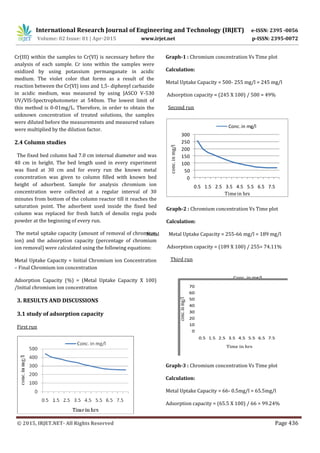
3.2 Study of effect of pH
The study was carried out by taking known cconcentration
of chromium ion solution 10 mg/l and pH ranges between
2 to10 to know the maximum chromium adsorption with
the effect of pH. The maximum adsorption was found to be
at the pH of 4.
Graph-4: Effect of pH on Cr (VI) removal % of denolix regia
pods
3.3 Study of effect of adsorbent dosage
The varying adsorbent dosage of 0.1 to 1 grams were carried
to know the optimum dosage and in the study it was found to
be 0.8 gram/100 ml with a percentage of 60% and it started
to decrease after that.
0
10
20
30
40
50
60
70
0.1 0.2 0.3 0.4 0.5 0.6 0.7 0.8 0.9 1
%ofCr(VI)removal
Adsorbent dose g/ml
10 mg/ml
Graph-5: Effect of adsorbent dosage on Cr(VI) removal % of
denolix regia pods
4. CONCLUSIONS
The study indicated the suitability of the adsorbent
for removal of Chromium (VI) from aqueous solution. The
selected adsorbent may be viewed as useful material while
considering economic aspects of waste water treatment. The
obtained results are summarized as follows:
The adsorbents of 3 fresh batches of fixed bed
columns were used for each run (8 hours) for removal of
Chromium (VI) ion from 500 mg/l to a value of 0.5 mg/l. The
Metal uptake capacity and removal efficiency was found to
be 49% at an optimum pH of 4. To know the optimum
dosage of adsorbent the known concentration of Cr (VI) was
taken and it attains 0.8 gm/100 ml , which shows the
adsorbent is best suitable for lower concentration of
chromium (VI) .
These experimental studies on specified
adsorbent would be quite useful in developing an
appropriate technology for the removal of Cr (VI) ions from
contaminated industrial effluents.
REFERENCES
[1] C Raji, TS Anirudhan, Batch Cr (VI) removal by
polyacrylamide-grafted sawdust : kinetics and
thermodynamics, water res. 32 (1998) 3772-3780.
[2] G Saner, Chromium in nutrition and disease, Alan R Liss
Inc.,New York,1980.
[3] JO Nriagu , E Nieboer, Chromium in the natural and
human environment ,Wiley, New York ,1998
[4] LJ Casarett, J Doul, Toxicology the basic science of
poisons, 1980.
[5]M Cieslak-golonka, Toxic and mutagenic effects of
chromium (VI) , polyhedron 15 (1995) 3667-3689.
[6] MJ Udy, Chromium , Reinhold Publishing Corporation,
1956.
[7] US Department of Health and Human Services,
Toxicological profile for chromium, Public Health services
agency for toxic substances and diseases registry, 1991.
[8] VP Kudesia, water pollution Pragathi Prakashan
Publications 1998,(20), 8-10.
[9]World Health Organization, Environmental health
criteria 61, Chromium, WHO, 1988.](https://image.slidesharecdn.com/irjet-v2i178-150511141956-lva1-app6892/85/IRJET-Fixed-Bed-Column-Study-for-Removal-of-Hexavalent-Chromium-From-Aqueous-Solution-by-using-Denolix-Regia-Pods-Flamboyant-Pods-3-320.jpg)

This study investigates the use of Denolix Regia pods as a low-cost adsorbent for the removal of hexavalent chromium (Cr(VI)) from aqueous solutions. The experiments demonstrated a maximum removal efficiency of 49% at an optimal pH of 4, with the best adsorbent dosage found to be 0.8 grams per 100 ml of solution. The findings indicate the potential of using this natural adsorbent in wastewater treatment for eliminating toxic chromium ions from industrial effluents.


![Payal phd slides final1 [autosaved]](https://cdn.slidesharecdn.com/ss_thumbnails/payalphdslidesfinal1autosaved-210827172458-thumbnail.jpg?width=640&height=640&fit=bounds)


