International Research Journal of Engineering and Technology (IRJET) e-ISSN: 2395-0056
Volume: 05 Issue: 04 | Apr-2018 www.irjet.net p-ISSN: 2395-0072
© 2018, IRJET | Impact Factor value: 6.171 | ISO 9001:2008 Certified Journal | Page 843
SECURING E-MEDICAL DOCUMENTS USING QR CODE
B. Madhushree1, M. Manimegalai2, G. Malini3
1, 2, 3 B.E. Scholars, Department of Computer Science and Engineering, R.M.K. Engineering College, Tamil Nadu,
India
---------------------------------------------------------------------***---------------------------------------------------------------------
Abstract - The project is a medical related data sharing
between two parts: One part is the hospital management
treated as the admin part and then patient side to be treated
as the user part. The admin uploads the medical record (Data
and patient ID) in a cloud platform which can then be
searched using the particular patient ID. The medical
document reference ID automatically converts to the QR code
using QRDroid function, and then we can download the
particular document. The user Registration module here
includes the OTP system .The main advantages of this project
is more secure transaction between two sides, more flexible,
easy access , finally paper free report. In existing system, RFID
technology was used, which is not suitable for more sensible
data storing and it is not compatible in all sectors.
Key Words: Android, Encryption, Internet, Decryption,
QR Code.
1. INTRODUCTION
Today is the world of android phones and their applications
have now become an integral part of almost all sectors such
as health, entertainment, office, college, banking etc. With
the increase of android devices, many problemslikeprivacy
leakages have also increased. The user’sprivate information
can be accessed easily. In many applications,theuseraccepts
the terms and conditions but they are unaware about that
their private information can be leaked by certain
applications without permission. There is an android
permission system which controls the admittance of
resources of the mobile device. Hence permissions can be
misused deliberately so imposing permissions isnotenough
to prevent from permission violations. Android’s
enforcement of the permissions is at the level of individual
apps, allowing multiple malevolent apps to collude and
combine their permissions or to trick vulnerable apps to
execute actions on their behalf that are beyond their
individual rights.
2. QR Code Format
The structure of a QR code consists of a 2D matrix where
each cell is of 1pixel area. In general, QR code consists of
square black modules on a white background where the
black square defines 0 in binary and the white square
defines 1 in binary. In practice, the whole part of a QR code
isn’t used for only storing information, rather it consists of
different sections. In this section we will review the sections
in a QR Code
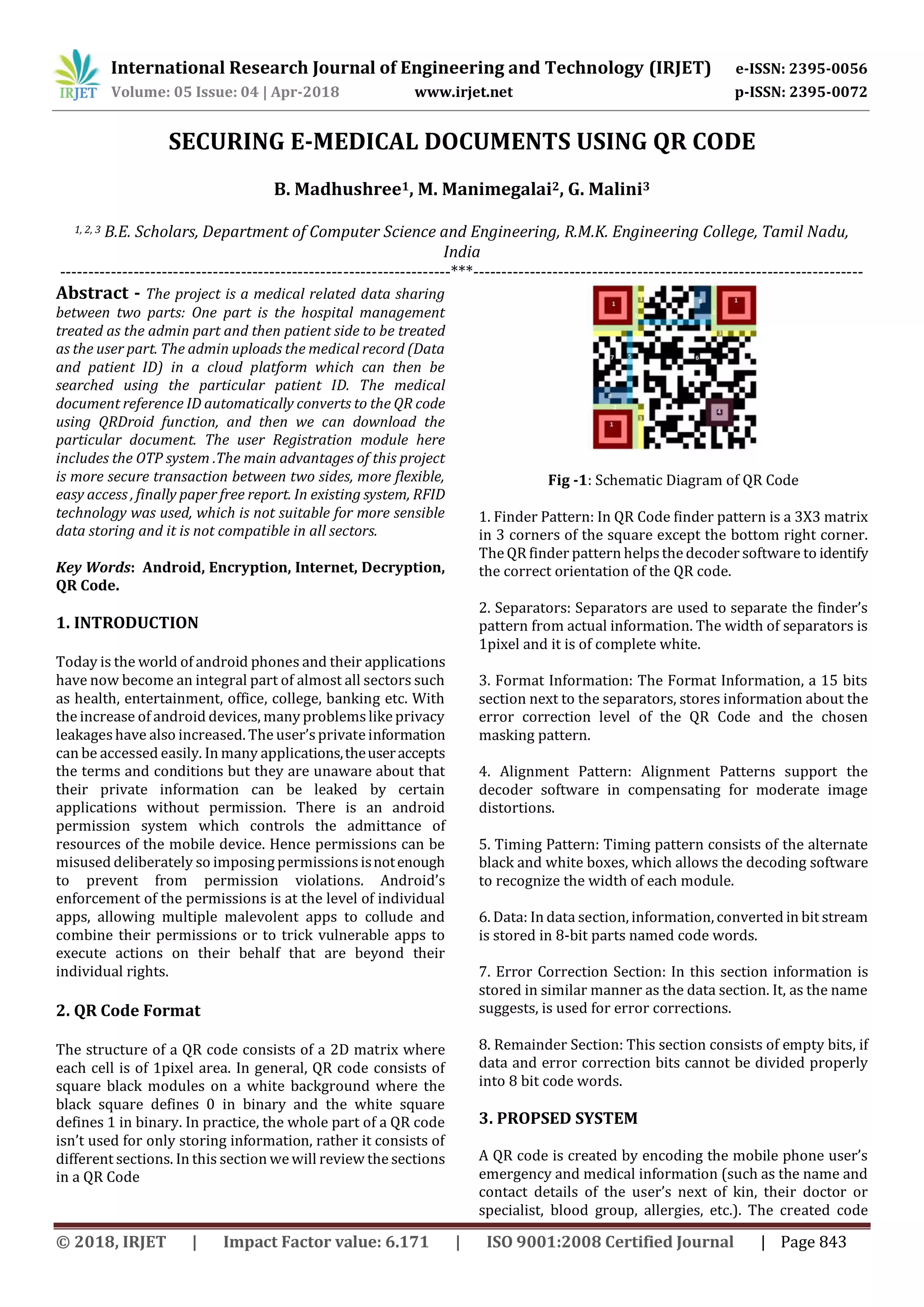
Fig -1: Schematic Diagram of QR Code
1. Finder Pattern: In QR Code finder pattern is a 3X3 matrix
in 3 corners of the square except the bottom right corner.
The QR finder pattern helpsthe decoder software to identify
the correct orientation of the QR code.
2. Separators: Separators are used to separate the finder’s
pattern from actual information. The width of separators is
1pixel and it is of complete white.
3. Format Information: The Format Information, a 15 bits
section next to the separators, stores information about the
error correction level of the QR Code and the chosen
masking pattern.
4. Alignment Pattern: Alignment Patterns support the
decoder software in compensating for moderate image
distortions.
5. Timing Pattern: Timing pattern consists of the alternate
black and white boxes, which allows the decoding software
to recognize the width of each module.
6. Data: In data section, information, converted in bit stream
is stored in 8-bit parts named code words.
7. Error Correction Section: In this section information is
stored in similar manner as the data section. It, as the name
suggests, is used for error corrections.
8. Remainder Section: This section consists of empty bits, if
data and error correction bits cannot be divided properly
into 8 bit code words.
3. PROPSED SYSTEM
A QR code is created by encoding the mobile phone user’s
emergency and medical information (such as the name and
contact details of the user’s next of kin, their doctor or
specialist, blood group, allergies, etc.). The created code
International Research Journal of Engineering and Technology (IRJET) e-ISSN: 2395-0056
Volume: 05 Issue: 04 | Apr-2018 www.irjet.net p-ISSN: 2395-0072
© 2018, IRJET | Impact Factor value: 6.171 | ISO 9001:2008 Certified Journal | Page 844
image is then used as wallpaper on the phone. This allows
anyone to scan the code without unlocking the phone.
Scanning and decoding the QR code can be accomplished
with any standard QR Code reader, but when read with
Qrdroid, additional information is retrieved and revealed.
This helps emergency medical respondersby enablingthem
to provide medical care with a more informed base. QR
codescould minimise the chancesof these errorsby offering
accurate information to first responderswho can easilyread
this information by using a QR code scanner on their
smartphones. In this research, QR codesholdingthepatient’s
information are tattooed onto an area easily reachable by
first responders. The information would also provide
accountability when a treatment does not go the way it was
planned. Many of these medical errors are preventable
through an increase in communication between healthcare
providers, improved patient identification, and consumer
knowledge.
Laboratory PC
Application
Medical Patient Mobile Doctor PC App
Document Application
Fig -1: Schematic interactions between the modules in the
System Model. Arrows indicate data flow direction.
QR code readers can be downloaded for free from the
internet which another advantage of the proposed solution.
QR codes can handle information in a variety offormatssuch
as URLs, contact information, SMS and plain text among
others.
4. SYSTEM MODEL
There are five modules in this procedure:
1) Login and Registration
2) Database Creation
3) QR code generator
4) Scanner
5) File Upload
6) File Download
4.1 Login and Registration
In this module we design to develop login and signupscreen.
Android used xml to develop classical screens in the
application. The modulesdescribe signup page thatcontains
email id or user name, password and confirm password and
these details should be stored in database. Login screen
contains email id or username and password when the user
can login into the app and it should retrieve the data to the
database and combine the results based on user input if it
matches user name and password then allow into the app.
Otherwise alert the user by showing an error message tothe
user.
4.2 Database Creation
User email id or user name and password have been stored
after registration. Android uses MySql database for storing
and fetching user application details.
4.3 QR Code generator
This module is used to generate the QR code for the user
Enter Key and additionally what kind of data like text or
image is to be scanned.
4.4 Scanner
Additionally one type of application name as used in this
project is QRdroid is used to scan the any kind of User QR
code. Initially, User1 generate the QR code and after that QR
code is sent to the User 2. Then User2 Scan the QR code and
get the key.
4.5 File Upload
In this module, the user1 knowing the key, can decide what
data must be uploaded to server. Finally the data and key is
uploaded to the server.
4.6 File Download
In this Module, after getting the Key from User2 then enter
the key in Download process and get the file from server.
5. CONCLUSIONS
Secure Message passing and file sharing technique is
important to provide more security on an android
smartphones. QR Code message passing is more secure
because in general, we believe that QR codes have great
potential in business media. QR codes are problematic
because you cannot tidy out the bad from the goodbysimply
observing at the code. So in our system, we used the RSA
encrypt and decrypt the message to check its integrity. Thus
the secure message passing and file sharing by using QR
Code is more secure.
International Research Journal of Engineering and Technology (IRJET) e-ISSN: 2395-0056
Volume: 05 Issue: 04 | Apr-2018 www.irjet.net p-ISSN: 2395-0072
© 2018, IRJET | Impact Factor value: 6.171 | ISO 9001:2008 Certified Journal | Page 845
REFERENCES
[1] Saurabh Prabhune, IndrajeetSharma,SachinBayas,Prof.
T.B.Mane, “Android Mobile Security: Application for
Data Transmission using Encryption Methods via
Information Security”, IJESC, 2014.
[2] Li Li, Alexandre Bartel, Tegawende F. Bissyand,“IccTA:
Detecting InterComponent Privacy Leaks in Android
Apps”, 37th International Conference on Software
Engineering (ICSE 2015), ITALY,2015.
[3] Alexios Mylonas, Marianthi Theoharidou, and Dimitris
Gritzalis, “Assessing Privacy Risks in Android: A User-
Centric Approach”, DOI: Springer International
Publishing Switzerland 2014.
[4] G. Hamid Bagheri, Alireza Sadeghi, Joshua Garcia and
Sam Malek, “COVERT: Compositional Analysis of
Android InterApp Permission Leakage”, IEEE
TRANSACTIONS ON SOFTWARE ENGINEERING, 2015.
[5] Parvez Faruki, Ammar Bharmal, Vijay Laxmi, Vijay
Ganmoor, Manoj Singh Gaur, “Android Security: A
Survey of Issues, Malware Penetration, and Defenses”,
QR- Code Scan MD5 to check integrityGetEncryptedFile
Decryption (by RSA) Original File Show Get URL Get
Data IEEE Communication Surveys & Tutorials, Vol. 4,
No. 2, 2015.
[6] Chang, J. H.; An introduction to using QR codes in
scholarly journals; 12th EASE General Assembly and
Conference, Split, Croatia, July 12-13, 2014.
[7] Li-Chuan Chu, Chen-Lin Lee, Chang-Jer Wu, “ Applying
QR Code Technology to Facilitate Hospital Medical
Equipment Repair Management”, 2012 International
Conference on Control Engineering andCommunication
Technology.

IRJET- Securing E-Medical Documents using QR Code

  • 1.
    International Research Journalof Engineering and Technology (IRJET) e-ISSN: 2395-0056 Volume: 05 Issue: 04 | Apr-2018 www.irjet.net p-ISSN: 2395-0072 © 2018, IRJET | Impact Factor value: 6.171 | ISO 9001:2008 Certified Journal | Page 843 SECURING E-MEDICAL DOCUMENTS USING QR CODE B. Madhushree1, M. Manimegalai2, G. Malini3 1, 2, 3 B.E. Scholars, Department of Computer Science and Engineering, R.M.K. Engineering College, Tamil Nadu, India ---------------------------------------------------------------------***--------------------------------------------------------------------- Abstract - The project is a medical related data sharing between two parts: One part is the hospital management treated as the admin part and then patient side to be treated as the user part. The admin uploads the medical record (Data and patient ID) in a cloud platform which can then be searched using the particular patient ID. The medical document reference ID automatically converts to the QR code using QRDroid function, and then we can download the particular document. The user Registration module here includes the OTP system .The main advantages of this project is more secure transaction between two sides, more flexible, easy access , finally paper free report. In existing system, RFID technology was used, which is not suitable for more sensible data storing and it is not compatible in all sectors. Key Words: Android, Encryption, Internet, Decryption, QR Code. 1. INTRODUCTION Today is the world of android phones and their applications have now become an integral part of almost all sectors such as health, entertainment, office, college, banking etc. With the increase of android devices, many problemslikeprivacy leakages have also increased. The user’sprivate information can be accessed easily. In many applications,theuseraccepts the terms and conditions but they are unaware about that their private information can be leaked by certain applications without permission. There is an android permission system which controls the admittance of resources of the mobile device. Hence permissions can be misused deliberately so imposing permissions isnotenough to prevent from permission violations. Android’s enforcement of the permissions is at the level of individual apps, allowing multiple malevolent apps to collude and combine their permissions or to trick vulnerable apps to execute actions on their behalf that are beyond their individual rights. 2. QR Code Format The structure of a QR code consists of a 2D matrix where each cell is of 1pixel area. In general, QR code consists of square black modules on a white background where the black square defines 0 in binary and the white square defines 1 in binary. In practice, the whole part of a QR code isn’t used for only storing information, rather it consists of different sections. In this section we will review the sections in a QR Code Fig -1: Schematic Diagram of QR Code 1. Finder Pattern: In QR Code finder pattern is a 3X3 matrix in 3 corners of the square except the bottom right corner. The QR finder pattern helpsthe decoder software to identify the correct orientation of the QR code. 2. Separators: Separators are used to separate the finder’s pattern from actual information. The width of separators is 1pixel and it is of complete white. 3. Format Information: The Format Information, a 15 bits section next to the separators, stores information about the error correction level of the QR Code and the chosen masking pattern. 4. Alignment Pattern: Alignment Patterns support the decoder software in compensating for moderate image distortions. 5. Timing Pattern: Timing pattern consists of the alternate black and white boxes, which allows the decoding software to recognize the width of each module. 6. Data: In data section, information, converted in bit stream is stored in 8-bit parts named code words. 7. Error Correction Section: In this section information is stored in similar manner as the data section. It, as the name suggests, is used for error corrections. 8. Remainder Section: This section consists of empty bits, if data and error correction bits cannot be divided properly into 8 bit code words. 3. PROPSED SYSTEM A QR code is created by encoding the mobile phone user’s emergency and medical information (such as the name and contact details of the user’s next of kin, their doctor or specialist, blood group, allergies, etc.). The created code
  • 2.
    International Research Journalof Engineering and Technology (IRJET) e-ISSN: 2395-0056 Volume: 05 Issue: 04 | Apr-2018 www.irjet.net p-ISSN: 2395-0072 © 2018, IRJET | Impact Factor value: 6.171 | ISO 9001:2008 Certified Journal | Page 844 image is then used as wallpaper on the phone. This allows anyone to scan the code without unlocking the phone. Scanning and decoding the QR code can be accomplished with any standard QR Code reader, but when read with Qrdroid, additional information is retrieved and revealed. This helps emergency medical respondersby enablingthem to provide medical care with a more informed base. QR codescould minimise the chancesof these errorsby offering accurate information to first responderswho can easilyread this information by using a QR code scanner on their smartphones. In this research, QR codesholdingthepatient’s information are tattooed onto an area easily reachable by first responders. The information would also provide accountability when a treatment does not go the way it was planned. Many of these medical errors are preventable through an increase in communication between healthcare providers, improved patient identification, and consumer knowledge. Laboratory PC Application Medical Patient Mobile Doctor PC App Document Application Fig -1: Schematic interactions between the modules in the System Model. Arrows indicate data flow direction. QR code readers can be downloaded for free from the internet which another advantage of the proposed solution. QR codes can handle information in a variety offormatssuch as URLs, contact information, SMS and plain text among others. 4. SYSTEM MODEL There are five modules in this procedure: 1) Login and Registration 2) Database Creation 3) QR code generator 4) Scanner 5) File Upload 6) File Download 4.1 Login and Registration In this module we design to develop login and signupscreen. Android used xml to develop classical screens in the application. The modulesdescribe signup page thatcontains email id or user name, password and confirm password and these details should be stored in database. Login screen contains email id or username and password when the user can login into the app and it should retrieve the data to the database and combine the results based on user input if it matches user name and password then allow into the app. Otherwise alert the user by showing an error message tothe user. 4.2 Database Creation User email id or user name and password have been stored after registration. Android uses MySql database for storing and fetching user application details. 4.3 QR Code generator This module is used to generate the QR code for the user Enter Key and additionally what kind of data like text or image is to be scanned. 4.4 Scanner Additionally one type of application name as used in this project is QRdroid is used to scan the any kind of User QR code. Initially, User1 generate the QR code and after that QR code is sent to the User 2. Then User2 Scan the QR code and get the key. 4.5 File Upload In this module, the user1 knowing the key, can decide what data must be uploaded to server. Finally the data and key is uploaded to the server. 4.6 File Download In this Module, after getting the Key from User2 then enter the key in Download process and get the file from server. 5. CONCLUSIONS Secure Message passing and file sharing technique is important to provide more security on an android smartphones. QR Code message passing is more secure because in general, we believe that QR codes have great potential in business media. QR codes are problematic because you cannot tidy out the bad from the goodbysimply observing at the code. So in our system, we used the RSA encrypt and decrypt the message to check its integrity. Thus the secure message passing and file sharing by using QR Code is more secure.
  • 3.
    International Research Journalof Engineering and Technology (IRJET) e-ISSN: 2395-0056 Volume: 05 Issue: 04 | Apr-2018 www.irjet.net p-ISSN: 2395-0072 © 2018, IRJET | Impact Factor value: 6.171 | ISO 9001:2008 Certified Journal | Page 845 REFERENCES [1] Saurabh Prabhune, IndrajeetSharma,SachinBayas,Prof. T.B.Mane, “Android Mobile Security: Application for Data Transmission using Encryption Methods via Information Security”, IJESC, 2014. [2] Li Li, Alexandre Bartel, Tegawende F. Bissyand,“IccTA: Detecting InterComponent Privacy Leaks in Android Apps”, 37th International Conference on Software Engineering (ICSE 2015), ITALY,2015. [3] Alexios Mylonas, Marianthi Theoharidou, and Dimitris Gritzalis, “Assessing Privacy Risks in Android: A User- Centric Approach”, DOI: Springer International Publishing Switzerland 2014. [4] G. Hamid Bagheri, Alireza Sadeghi, Joshua Garcia and Sam Malek, “COVERT: Compositional Analysis of Android InterApp Permission Leakage”, IEEE TRANSACTIONS ON SOFTWARE ENGINEERING, 2015. [5] Parvez Faruki, Ammar Bharmal, Vijay Laxmi, Vijay Ganmoor, Manoj Singh Gaur, “Android Security: A Survey of Issues, Malware Penetration, and Defenses”, QR- Code Scan MD5 to check integrityGetEncryptedFile Decryption (by RSA) Original File Show Get URL Get Data IEEE Communication Surveys & Tutorials, Vol. 4, No. 2, 2015. [6] Chang, J. H.; An introduction to using QR codes in scholarly journals; 12th EASE General Assembly and Conference, Split, Croatia, July 12-13, 2014. [7] Li-Chuan Chu, Chen-Lin Lee, Chang-Jer Wu, “ Applying QR Code Technology to Facilitate Hospital Medical Equipment Repair Management”, 2012 International Conference on Control Engineering andCommunication Technology.