International Research Journal of Engineering and Technology (IRJET) e-ISSN: 2395 -0056
Volume: 04 Issue: 03 | Mar -2017 www.irjet.net p-ISSN: 2395-0072
© 2017, IRJET | Impact Factor value: 5.181 | ISO 9001:2008 Certified Journal | Page 1329
BASIC OFFICE ADMINISTRATION
Hirdekar Suyog1, Khan Riyaz2, Gawde Ganpat3, Prof. Mayank Mangal4
1.2.3 under Graduate Department of Computer Engineering, Alamuri Ratnamala Institute Of Engineering
And Technology, Maharashtra, India.
4 M. Tech Professor Mayank Mangal Department of Computer Engineering, Alamuri Ratnamala Institute Of
Engineering And Technology, Maharashtra, India.
-----------------------------------------------------------***-----------------------------------------------------------
Abstract:The rapid growth of android app is created a
great impact on our lives. In the rapid growth of
technologies, service industry sector is still lagging behind.
The aim of this QR (Quick Response) code based effective
employee maintenance system is to automate the employee
monitoring process in the company. This application
enhances the organizational growth of the company. In this
system there are two parts, in the first part, the employee
scans his QR code based identity card and server system
enables some services like car parking slot allocation,
canteen services, etc. In the second part, the employee scans
his same unique QR code based identity card then
attendance of employee will be marked in the database and
start his personal computer with help of wake on LAN
(WOL) protocol. The prospective system also takes care of
restricting unapproved attendance registration using multi-
factor authentication. Employee profile can be maintained
in the mobile android application. The aim of this system is
to save time and work in a better manner. It helps the
employee to concentrate only on their duties. Also, it helps
the system to grow their business.
KEY WORDS: QR (Quick Response), Wake on LAN (Local
Area Network), LAN, Car Parking, Attendance.
1. INTRODUCTION
As we know in this modern world, time is a very
important aspect and its value is more important in any
organization. QR code has been practiced in many ways
from retailing products, locating promotional items on
shelves, finding stores and etc. In this system, we will
provide QR code based identity card to each employee so
authorization, as well as authentication, will be
maintained. An employee scans the QR-based identity card
with QR code scanner by decoding and verifying the
identity of the employee. Almost 70% people have the
android smartphone so we developed one android
application and with the help of this application, the
employee can manage services like car parking, attendance
management, and canteen schedule. Also, this application
helps in maintaining employee profile. Every employee
will be having a card that contains a unique QR code. Each
QR code represents a unique id for all employees.
On the basis of QR code based identity card employees
personal computer will start using wake on LAN (WOL)
protocol. This will help the employee to save a time to start
computer as well as authentication will be maintaining in
the system. The rapid growth of android applications is
created a great impact on our lives.
The aim of this QR (Quick Response) code based
effective employee maintenance system, is to automate the
employee monitoring process in the company. This
application improves the organizational growth of the
company.
2. LITERATURE REVIEW
There are many existing systems available in the
market for authentication. In some organization, biometric
devices are used, since biometric is a concern with the
measurement of unique human behavioral characteristics.
The technology had been used to verify the identity of the
user. Another option is a facial recognition technique; a
neural network-based algorithm was implemented to
carry out face detection and Eigenface method to perform
facial recognition. The experimental result establishes the
feasibility of user verification for high-level security
information system. It is a complicated process as well as
very expensive. As one more technique is available,
manual registration of each employee. It is very time to
consume as well as the hectic task to manage all these
International Research Journal of Engineering and Technology (IRJET) e-ISSN: 2395 -0056
Volume: 04 Issue: 03 | Mar -2017 www.irjet.net p-ISSN: 2395-0072
© 2017, IRJET | Impact Factor value: 5.181 | ISO 9001:2008 Certified Journal | Page 1330
things. So to overcome this problem we proposed a system
which totally works on QR code based identity card.
3. PROPOSED SYSTEM
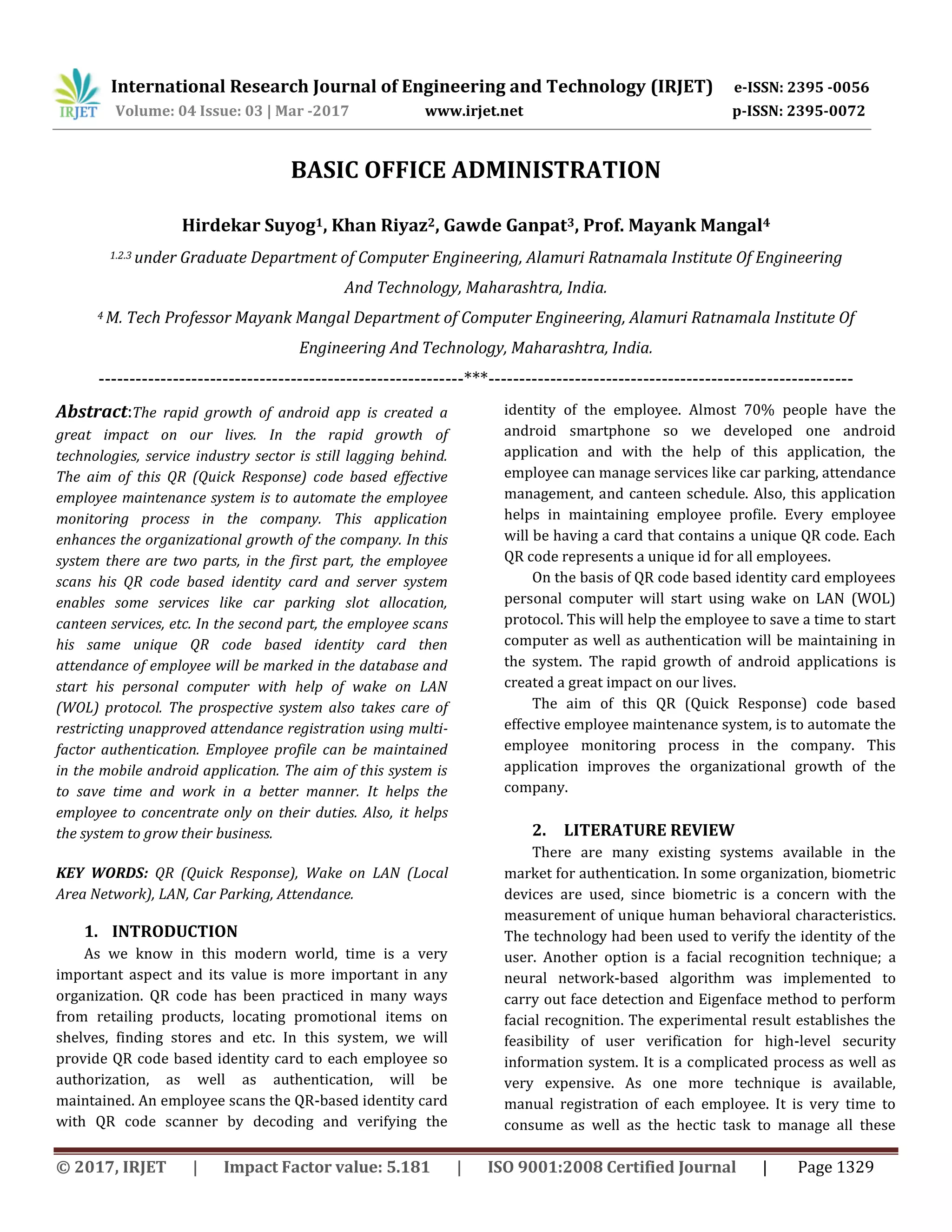
i. QR code based active employee maintenance
system contains two scanners which are scanning
the employee QR code identity card. In this
system, the employee has only one QR code based
identity card which scans by both scanners. After
scanning, the first scanner enables the two
services such as car parking and canteen menu
display. In the car parking activity sending an alert
of the empty slot to the employee. In the canteen
menu activity, the employee can able to see
today's menu list.
ii. After scanning the QR code based identity card
with second scanner employee attendance will be
updated in the database, the display name of the
employee who is currently absent in the absent
employee list and employees.
iii. Personal computer will be started with the help of
Wake on LAN (WOL).
fig.1: Architecture of QR code Based Office Administration.
4. METHODOLOGY
i. The Magic Packets:
WOL has to enabled arrive computers
that include essentially NIC’ wait MAC for a magic
packet address in it. These magic packets are sent
out by professional software, but can also be sent
by routers and internet-based websites. The
common ports used for WOL magic packets are
UDP 7 and 9.Because computers have actively
listened for a packet.
ii. The Wake on Local Area Network FUNCTION:
Wake-on-LAN is an industry typical protocol
for waking computers up from a very low power
mode remotely. The definition of low power mode
has changed a bit over time, but we can take it to
mean while the computer has off and has access to
a power source. The protocol also allows for an
auxiliary WOL has Wake-on-Wireless-LAN ability
as well. Wake-on-LAN has depends on two things:
motherboard and net card. The motherboard must
be hooked up to an ATX-compatible power supply
it has most computers in the past decade. Ethernet
card must also support this functionality. The
WOL function is a helpful tool for the network
administrators. It allows them to perform
maintenance on systems even if these were
powered down by their users. Revise can be done
remotely. Today, WOL is implemented in most of
the network controllers. It requires that an
alternative power supply exists for the network
controller and this remains active even if the
whole system is powered down. The WOL
function must be active in BIOS, at the Power
Management section. It must also be activated by
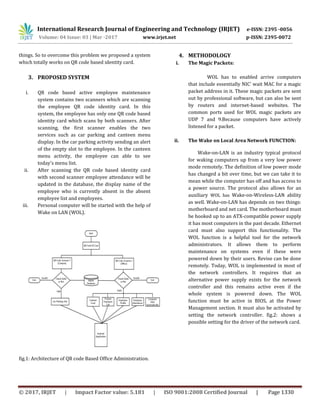
setting the network controller. fig.2: shows a
possible setting for the driver of the network card.
International Research Journal of Engineering and Technology (IRJET) e-ISSN: 2395 -0056
Volume: 04 Issue: 03 | Mar -2017 www.irjet.net p-ISSN: 2395-0072
© 2017, IRJET | Impact Factor value: 5.181 | ISO 9001:2008 Certified Journal | Page 1331
fig. 2: A possible setting for the WOL function.
iii. QR Code Based specification:
Various specification of QR Code are as
follows: Received data, size, char set-source,
charset target, bgcolor, color, margin, zone, format
parameters. In data parameters, minimal and
maximal char count, best practice and the size
specification contain the format of QR code,
maximal and minimal size of QR code.
fig.3: QR Code.
5. SYSTEM DESIGN
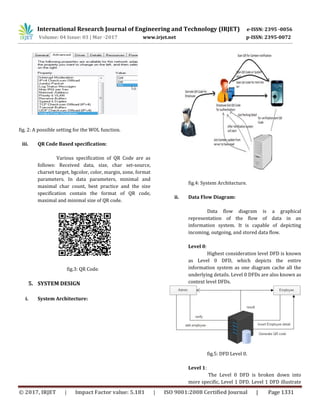
i. System Architecture:
fig.4: System Architecture.
ii. Data Flow Diagram:
Data flow diagram is a graphical
representation of the flow of data in an
information system. It is capable of depicting
incoming, outgoing, and stored data flow.
Level 0:
Highest consideration level DFD is known
as Level 0 DFD, which depicts the entire
information system as one diagram cache all the
underlying details. Level 0 DFDs are also known as
context level DFDs.
fig.5: DFD Level 0.
Level 1:
The Level 0 DFD is broken down into
more specific, Level 1 DFD. Level 1 DFD illustrate
International Research Journal of Engineering and Technology (IRJET) e-ISSN: 2395 -0056
Volume: 04 Issue: 03 | Mar -2017 www.irjet.net p-ISSN: 2395-0072
© 2017, IRJET | Impact Factor value: 5.181 | ISO 9001:2008 Certified Journal | Page 1332
basic modules in the system and flow of data
among various modules. Level 1 DFD also
mentions basic processes and sources of
information.
fig.6: DFD Level 1.
6. SYSTEM IMPLEMENTATION
Modules Description:
i. Admin:
In this module, the admin will verify the
user.
ii. User:
In this module, the user will create an
account, Modify his account, Log in to his
account.
iii. Develop android application:
Develop an android application for the
Admin and User panel. In admin panel will
maintain employee attendance. The
application provides various utility to the
employee such as car parking slot, canteen
menu, and absent list of the employee.
iv. Scanning the QR code:
Same QR code will be going to scan two
times. After scanning the QR code the first-
time employee will get services like car
parking slot number and canteen menu. After
scanning the QR code second-time employee
will get services like absent list of employee
and attendance.
v. Sending notification:
In this system, notifications are sent to
the valid employee. In the first part, it will
send notification of empty slot for car parking.
vi. Start employee computer:
WOL enabled computers essentially wait
for a magic packet to arrive includes the NIC’s
MAC address in it. Wake-on-LAN is an
industry standard protocol for waked
computers up from a very low power mode
remotely.
7. CONCLUSION
In this system, we are achieving the new
generation employee monitoring system to meet the
organization requirements. The proposed system will help
to reduce the time required to search parking slots. Using
this system, the employee can concentrate on his work.
With the help of QR code, authentication can be done. In
future, we will implement the module where admin can
see ongoing user activities on the client machine.
8. ACKNOWLEDGEMENT
We would like to express our sincere gratitude
towards our guide, PROF. MAYANK MANGAL, for the help,
guidance, and encouragement. This work would not have
been possible without his valuable time, patience and
motivation. They supported us with scientific guidance,
advice, and inspiration, they were always helpful and
passionate and this inspired us in our work.
9. REFERENCES
[1] Ganassi m., pure v., sauna d., Scott f., "scalable
distributed biometric systems-advanced
approach for security and safety",
instrumentation & measurement magazine,
IEEE, on the page(s): 21 - 28 volume: 9.
[2] Fakhreddine Karray, Jamil Abou-Saleh, Mo
Hours Arab and Milad Alemzadeh, Multi-
Modal Biometric Systems: A State of the Art
study, Pattern Analysis and Machine
Intelligence Laboratory, University of
Waterloo, Waterloo, CanadaR. Nicole, Title of
International Research Journal of Engineering and Technology (IRJET) e-ISSN: 2395 -0056
Volume: 04 Issue: 03 | Mar -2017 www.irjet.net p-ISSN: 2395-0072
© 2017, IRJET | Impact Factor value: 5.181 | ISO 9001:2008 Certified Journal | Page 1333
paper with only first word capitalized, J. Name
Stand. Abbrev., in press.
[3] Ching-yin Law, Simon so, QR Codes in
Education, Hong Kong Institute of Education,
Hong Kong.
[4] Kalyani Bhagwat, Priyanka Salunkhe, Shamal
Bangar, Employee Monitoring System Using
Android SmartPhone.
[5] Phanuphong Hathaiwichian, Android
Application for Event Management and
Information Propagation, Mahidol University,
Nakhonpathom, Thailand.
[6] Ricciardi S., Santos-Boada G., Careglio D.,
Palmieri., Evaluating energy savings in WOL-
enabled networks of PCs, U.Industrial
Electronics (ISIE), 2013 IEEE International
Symposium on Year: 2013.
[7] Yilmaz, Y.S., Aydin, B.I., Google cloud
messaging (GCM): An evaluation
Communications.
[8] Popa, M., Slavic, T., Embedded server with
Wake on LAN function T.EUROCON 2009,
EUROCON '09. IEEE Year: 2009.
[9] Whatisaqrcode.co.uk, "What is a QR Code?"
Whatisaqrcode.co.uk. Available at
http://www.whatisaqrcode.co.uk./
[10] Fadi Masalha, New Hirzallah, A Student
Attendance System Using QR Code, Applied
Science University.
[11] Dictionary Reference.2013.ID card. 2012.
Available from: [Accessed August 14 2012].

Basic Office Administration

  • 1.
    International Research Journalof Engineering and Technology (IRJET) e-ISSN: 2395 -0056 Volume: 04 Issue: 03 | Mar -2017 www.irjet.net p-ISSN: 2395-0072 © 2017, IRJET | Impact Factor value: 5.181 | ISO 9001:2008 Certified Journal | Page 1329 BASIC OFFICE ADMINISTRATION Hirdekar Suyog1, Khan Riyaz2, Gawde Ganpat3, Prof. Mayank Mangal4 1.2.3 under Graduate Department of Computer Engineering, Alamuri Ratnamala Institute Of Engineering And Technology, Maharashtra, India. 4 M. Tech Professor Mayank Mangal Department of Computer Engineering, Alamuri Ratnamala Institute Of Engineering And Technology, Maharashtra, India. -----------------------------------------------------------***----------------------------------------------------------- Abstract:The rapid growth of android app is created a great impact on our lives. In the rapid growth of technologies, service industry sector is still lagging behind. The aim of this QR (Quick Response) code based effective employee maintenance system is to automate the employee monitoring process in the company. This application enhances the organizational growth of the company. In this system there are two parts, in the first part, the employee scans his QR code based identity card and server system enables some services like car parking slot allocation, canteen services, etc. In the second part, the employee scans his same unique QR code based identity card then attendance of employee will be marked in the database and start his personal computer with help of wake on LAN (WOL) protocol. The prospective system also takes care of restricting unapproved attendance registration using multi- factor authentication. Employee profile can be maintained in the mobile android application. The aim of this system is to save time and work in a better manner. It helps the employee to concentrate only on their duties. Also, it helps the system to grow their business. KEY WORDS: QR (Quick Response), Wake on LAN (Local Area Network), LAN, Car Parking, Attendance. 1. INTRODUCTION As we know in this modern world, time is a very important aspect and its value is more important in any organization. QR code has been practiced in many ways from retailing products, locating promotional items on shelves, finding stores and etc. In this system, we will provide QR code based identity card to each employee so authorization, as well as authentication, will be maintained. An employee scans the QR-based identity card with QR code scanner by decoding and verifying the identity of the employee. Almost 70% people have the android smartphone so we developed one android application and with the help of this application, the employee can manage services like car parking, attendance management, and canteen schedule. Also, this application helps in maintaining employee profile. Every employee will be having a card that contains a unique QR code. Each QR code represents a unique id for all employees. On the basis of QR code based identity card employees personal computer will start using wake on LAN (WOL) protocol. This will help the employee to save a time to start computer as well as authentication will be maintaining in the system. The rapid growth of android applications is created a great impact on our lives. The aim of this QR (Quick Response) code based effective employee maintenance system, is to automate the employee monitoring process in the company. This application improves the organizational growth of the company. 2. LITERATURE REVIEW There are many existing systems available in the market for authentication. In some organization, biometric devices are used, since biometric is a concern with the measurement of unique human behavioral characteristics. The technology had been used to verify the identity of the user. Another option is a facial recognition technique; a neural network-based algorithm was implemented to carry out face detection and Eigenface method to perform facial recognition. The experimental result establishes the feasibility of user verification for high-level security information system. It is a complicated process as well as very expensive. As one more technique is available, manual registration of each employee. It is very time to consume as well as the hectic task to manage all these
  • 2.
    International Research Journalof Engineering and Technology (IRJET) e-ISSN: 2395 -0056 Volume: 04 Issue: 03 | Mar -2017 www.irjet.net p-ISSN: 2395-0072 © 2017, IRJET | Impact Factor value: 5.181 | ISO 9001:2008 Certified Journal | Page 1330 things. So to overcome this problem we proposed a system which totally works on QR code based identity card. 3. PROPOSED SYSTEM i. QR code based active employee maintenance system contains two scanners which are scanning the employee QR code identity card. In this system, the employee has only one QR code based identity card which scans by both scanners. After scanning, the first scanner enables the two services such as car parking and canteen menu display. In the car parking activity sending an alert of the empty slot to the employee. In the canteen menu activity, the employee can able to see today's menu list. ii. After scanning the QR code based identity card with second scanner employee attendance will be updated in the database, the display name of the employee who is currently absent in the absent employee list and employees. iii. Personal computer will be started with the help of Wake on LAN (WOL). fig.1: Architecture of QR code Based Office Administration. 4. METHODOLOGY i. The Magic Packets: WOL has to enabled arrive computers that include essentially NIC’ wait MAC for a magic packet address in it. These magic packets are sent out by professional software, but can also be sent by routers and internet-based websites. The common ports used for WOL magic packets are UDP 7 and 9.Because computers have actively listened for a packet. ii. The Wake on Local Area Network FUNCTION: Wake-on-LAN is an industry typical protocol for waking computers up from a very low power mode remotely. The definition of low power mode has changed a bit over time, but we can take it to mean while the computer has off and has access to a power source. The protocol also allows for an auxiliary WOL has Wake-on-Wireless-LAN ability as well. Wake-on-LAN has depends on two things: motherboard and net card. The motherboard must be hooked up to an ATX-compatible power supply it has most computers in the past decade. Ethernet card must also support this functionality. The WOL function is a helpful tool for the network administrators. It allows them to perform maintenance on systems even if these were powered down by their users. Revise can be done remotely. Today, WOL is implemented in most of the network controllers. It requires that an alternative power supply exists for the network controller and this remains active even if the whole system is powered down. The WOL function must be active in BIOS, at the Power Management section. It must also be activated by setting the network controller. fig.2: shows a possible setting for the driver of the network card.
  • 3.
    International Research Journalof Engineering and Technology (IRJET) e-ISSN: 2395 -0056 Volume: 04 Issue: 03 | Mar -2017 www.irjet.net p-ISSN: 2395-0072 © 2017, IRJET | Impact Factor value: 5.181 | ISO 9001:2008 Certified Journal | Page 1331 fig. 2: A possible setting for the WOL function. iii. QR Code Based specification: Various specification of QR Code are as follows: Received data, size, char set-source, charset target, bgcolor, color, margin, zone, format parameters. In data parameters, minimal and maximal char count, best practice and the size specification contain the format of QR code, maximal and minimal size of QR code. fig.3: QR Code. 5. SYSTEM DESIGN i. System Architecture: fig.4: System Architecture. ii. Data Flow Diagram: Data flow diagram is a graphical representation of the flow of data in an information system. It is capable of depicting incoming, outgoing, and stored data flow. Level 0: Highest consideration level DFD is known as Level 0 DFD, which depicts the entire information system as one diagram cache all the underlying details. Level 0 DFDs are also known as context level DFDs. fig.5: DFD Level 0. Level 1: The Level 0 DFD is broken down into more specific, Level 1 DFD. Level 1 DFD illustrate
  • 4.
    International Research Journalof Engineering and Technology (IRJET) e-ISSN: 2395 -0056 Volume: 04 Issue: 03 | Mar -2017 www.irjet.net p-ISSN: 2395-0072 © 2017, IRJET | Impact Factor value: 5.181 | ISO 9001:2008 Certified Journal | Page 1332 basic modules in the system and flow of data among various modules. Level 1 DFD also mentions basic processes and sources of information. fig.6: DFD Level 1. 6. SYSTEM IMPLEMENTATION Modules Description: i. Admin: In this module, the admin will verify the user. ii. User: In this module, the user will create an account, Modify his account, Log in to his account. iii. Develop android application: Develop an android application for the Admin and User panel. In admin panel will maintain employee attendance. The application provides various utility to the employee such as car parking slot, canteen menu, and absent list of the employee. iv. Scanning the QR code: Same QR code will be going to scan two times. After scanning the QR code the first- time employee will get services like car parking slot number and canteen menu. After scanning the QR code second-time employee will get services like absent list of employee and attendance. v. Sending notification: In this system, notifications are sent to the valid employee. In the first part, it will send notification of empty slot for car parking. vi. Start employee computer: WOL enabled computers essentially wait for a magic packet to arrive includes the NIC’s MAC address in it. Wake-on-LAN is an industry standard protocol for waked computers up from a very low power mode remotely. 7. CONCLUSION In this system, we are achieving the new generation employee monitoring system to meet the organization requirements. The proposed system will help to reduce the time required to search parking slots. Using this system, the employee can concentrate on his work. With the help of QR code, authentication can be done. In future, we will implement the module where admin can see ongoing user activities on the client machine. 8. ACKNOWLEDGEMENT We would like to express our sincere gratitude towards our guide, PROF. MAYANK MANGAL, for the help, guidance, and encouragement. This work would not have been possible without his valuable time, patience and motivation. They supported us with scientific guidance, advice, and inspiration, they were always helpful and passionate and this inspired us in our work. 9. REFERENCES [1] Ganassi m., pure v., sauna d., Scott f., "scalable distributed biometric systems-advanced approach for security and safety", instrumentation & measurement magazine, IEEE, on the page(s): 21 - 28 volume: 9. [2] Fakhreddine Karray, Jamil Abou-Saleh, Mo Hours Arab and Milad Alemzadeh, Multi- Modal Biometric Systems: A State of the Art study, Pattern Analysis and Machine Intelligence Laboratory, University of Waterloo, Waterloo, CanadaR. Nicole, Title of
  • 5.
    International Research Journalof Engineering and Technology (IRJET) e-ISSN: 2395 -0056 Volume: 04 Issue: 03 | Mar -2017 www.irjet.net p-ISSN: 2395-0072 © 2017, IRJET | Impact Factor value: 5.181 | ISO 9001:2008 Certified Journal | Page 1333 paper with only first word capitalized, J. Name Stand. Abbrev., in press. [3] Ching-yin Law, Simon so, QR Codes in Education, Hong Kong Institute of Education, Hong Kong. [4] Kalyani Bhagwat, Priyanka Salunkhe, Shamal Bangar, Employee Monitoring System Using Android SmartPhone. [5] Phanuphong Hathaiwichian, Android Application for Event Management and Information Propagation, Mahidol University, Nakhonpathom, Thailand. [6] Ricciardi S., Santos-Boada G., Careglio D., Palmieri., Evaluating energy savings in WOL- enabled networks of PCs, U.Industrial Electronics (ISIE), 2013 IEEE International Symposium on Year: 2013. [7] Yilmaz, Y.S., Aydin, B.I., Google cloud messaging (GCM): An evaluation Communications. [8] Popa, M., Slavic, T., Embedded server with Wake on LAN function T.EUROCON 2009, EUROCON '09. IEEE Year: 2009. [9] Whatisaqrcode.co.uk, "What is a QR Code?" Whatisaqrcode.co.uk. Available at http://www.whatisaqrcode.co.uk./ [10] Fadi Masalha, New Hirzallah, A Student Attendance System Using QR Code, Applied Science University. [11] Dictionary Reference.2013.ID card. 2012. Available from: [Accessed August 14 2012].