Project Associates
Mr Sanju GM 4JD18EE032
Mr Basavaraj N 4JD19EE009
Mr Pruthviraj R 4JD19EE027
Mr Sanjay M K 4JD19EE034
DEPARTMENT OF ELECTRICAL AND ELECTRONICS
ENGEENERING
Seminar on our project of
“Solar Wireless Electric Vehicle Charging system”
Under the guidance of
Mr.PRA
VEENAANAJI M.Tech(Phd)
Assistant Professor
 Introduction
❖ Problem identification
❖ Objectives
❖ Literature survey
❖ Methodology
❖ Advantages
❖ Limitations
❖ Applications
❖ Expected result
•Electric vehicles (EV’s), represents a new concept in the transport sector around the world. It is
expected that
the market share of EV’s will exponentially grow, comprising 24% of the u.s.
•light vehicle fleet in 2030, representing 64% light vehicle sales in this year. In this context, the EV’s
battery charging process must be regulated to preserve the power quality in the power grids.
•Nevertheless, with the proliferation of EV’s a considerable amount of energy will be stored in the
batteries, raising the opportunity of the energy flow in the opposite sense.
•In the future smart grids, the interactivity with the EV’s will be one of the key technologies,
contributing to the power grid autonomous operation.
•The concept of the on-board bidirectional charger with V2gand V2h technologies is introduced .
• Current technologies only allow electric vehicles to be charged through plug-in cable.
• However, the problem occurs when the user needs to find the charging point and the charging cable is
lost or damaged.
• This project is about designing a wireless power transfer for electric vehicles.
• The concept of this project is suitable for any electric vehicles such as bus, car and light train.
• Itisdesigned forbattery backup while outage of gridregion.
• Itisportable Outputof thisbatteryisDC form.
• I/Pof the power can be taken fromSolarpower source.
 LITERATURE SURVEY
 Supriyadi and Edi Rakhman. Demonstrate the effect of wire diameter (AWG) and a number of turns used is directly
proportional to the amount of power that can be transferred. When the number of windings increases, more the
power will be transferred. When we use the enameled copper wire of 0.5mm diameter and keep the number of turns
to 26, and apply the input frequency of 470KHz. The power efficiency obtained at a distance of 1 cm is about 1.51%.
This result can turn on 1 Watt LED lamp.
 N. UthayaBanu and U.Arunkumar. This study representing the various technologies related to Wireless Power
Transfer System, which is used to avoid the flux leakage during the transmission of power and to operate the cars
with high efficiency and improve the quality parameters. This project also shows the progress of generating power
source through renewable energy.
 Govind Yatnalkar and Husnu Narman. Present a survey of Duration of Charging of Electric Vehicles is limited.
Therefore, wireless charging is important for Electric Vehicles in order to overcome the charging duration problem.
This paper also provides a current scenario of the art in electric vehicle wireless charging and the parameters that
require for charging section. The most important parameters for electric vehicle wireless charging are the distance
between the transmission and reception coils, the position of the coils placed on Electric Vehicle, battery sizes, and
the time for charging
 Balamurugan A and Aman Bhattad. Propose a method to design an RFID based transaction system. This paper shows
how PIC Microcontroller board is interfaced with the RFID controller shield using the libraries developed for SPI
protocol. An RFID integrated campus ID card is scanned to the RFID reader in order to do the transaction and will
not be interrupted until the previous payment is complete and the card is swiped again for a new transaction. So, a
smart campus payment system is developed using the RFID controller shield.
 Norsuzila Ya’acob and AzitaLaily Yusoff. propose a method of a cashless system that helpthe students at school level
so they can use LF RFID technology and database system. Generally, this Cashless Payment Transaction is designed
to replace the use of actual cash with virtual cash and parents can monitor their spending through the transaction data
that has been uploaded to the database every time whenever a transaction took place. The system also calculates the
remaining credit left inside the card and sent a notification to their parents. Once a credit has been transferred by
parents, students can continue to do other transaction.
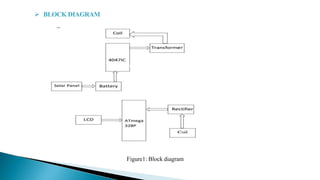
Solar power has increasingly become popular over the past year. With its uncountable improvement and
cost-effective ways, more and more people are opting to switch over to solar energy rather than their regular
form of energy. Solar charging is based on the use of solar panels for converting light energy into electrical
energy (DC). The DC voltage can be stored battery bank. There is Reverse charging protection circuit is
provided for the backflow of energy from the battery to a solar panel. The transfer coil is located at charger
side and receiver coil is placed on vehicle side. A wireless power Transfer module (WPT) is used for
transferring electric power which is generated from the solar panel to the Electric vehicle by using the principle
of Electromagnetic Induction. To measure battery voltage, a voltage sensor is used. The battery voltage will be
measured by microcontroller & showed on a 16x2 LCD. It will also display battery low status, whenever
battery voltage falls below a certain level. L239D is the motor driver which is used for movement of wheels of
that vehicle.
 BLOCK DIAGRAM
Figure1: Block diagram
.
 Reduced infrastructure costs.
 High power transfer efficiency.
 Possibility of high-speed charging (but increasing costs).
 Low maintenance requirements.
 Provides higher reliability as the charging systems are operated automatically without dependence on
people to plug, unplug, and operate.
• Drive electronics and coils used in the charging device increase the complexity and cost.
• Due to the slower charging and lower efficiency, the devices take longer to charge with the same
supplied power.
• Electric car can travel less distance.
• If BMS (Battery Management System) fails this system cannot charge the vehicle..
 Electric auto mobile charging.
 Usesinsmartphones, Tabletsand smartwatches.
 Autonomous robots.
 IReduce pollution
 Taxand financial benifits
• For using a non-conventional source of energy as a form of fuel to run a vehicle.
• To provide service at a reasonable price.
• To provide service at any place at any time.
• Battery is to charged by solar power stored in battery (DC to AC convertion is needed) should be given
to vehicle.
Solar Wireless electrical vehicle Charging System

Solar Wireless electrical vehicle Charging System

  • 1.
    Project Associates Mr SanjuGM 4JD18EE032 Mr Basavaraj N 4JD19EE009 Mr Pruthviraj R 4JD19EE027 Mr Sanjay M K 4JD19EE034 DEPARTMENT OF ELECTRICAL AND ELECTRONICS ENGEENERING Seminar on our project of “Solar Wireless Electric Vehicle Charging system” Under the guidance of Mr.PRA VEENAANAJI M.Tech(Phd) Assistant Professor
  • 2.
     Introduction ❖ Problemidentification ❖ Objectives ❖ Literature survey ❖ Methodology ❖ Advantages ❖ Limitations ❖ Applications ❖ Expected result
  • 3.
    •Electric vehicles (EV’s),represents a new concept in the transport sector around the world. It is expected that the market share of EV’s will exponentially grow, comprising 24% of the u.s. •light vehicle fleet in 2030, representing 64% light vehicle sales in this year. In this context, the EV’s battery charging process must be regulated to preserve the power quality in the power grids. •Nevertheless, with the proliferation of EV’s a considerable amount of energy will be stored in the batteries, raising the opportunity of the energy flow in the opposite sense. •In the future smart grids, the interactivity with the EV’s will be one of the key technologies, contributing to the power grid autonomous operation. •The concept of the on-board bidirectional charger with V2gand V2h technologies is introduced .
  • 4.
    • Current technologiesonly allow electric vehicles to be charged through plug-in cable. • However, the problem occurs when the user needs to find the charging point and the charging cable is lost or damaged. • This project is about designing a wireless power transfer for electric vehicles. • The concept of this project is suitable for any electric vehicles such as bus, car and light train.
  • 5.
    • Itisdesigned forbatterybackup while outage of gridregion. • Itisportable Outputof thisbatteryisDC form. • I/Pof the power can be taken fromSolarpower source.
  • 6.
     LITERATURE SURVEY Supriyadi and Edi Rakhman. Demonstrate the effect of wire diameter (AWG) and a number of turns used is directly proportional to the amount of power that can be transferred. When the number of windings increases, more the power will be transferred. When we use the enameled copper wire of 0.5mm diameter and keep the number of turns to 26, and apply the input frequency of 470KHz. The power efficiency obtained at a distance of 1 cm is about 1.51%. This result can turn on 1 Watt LED lamp.  N. UthayaBanu and U.Arunkumar. This study representing the various technologies related to Wireless Power Transfer System, which is used to avoid the flux leakage during the transmission of power and to operate the cars with high efficiency and improve the quality parameters. This project also shows the progress of generating power source through renewable energy.  Govind Yatnalkar and Husnu Narman. Present a survey of Duration of Charging of Electric Vehicles is limited. Therefore, wireless charging is important for Electric Vehicles in order to overcome the charging duration problem. This paper also provides a current scenario of the art in electric vehicle wireless charging and the parameters that require for charging section. The most important parameters for electric vehicle wireless charging are the distance between the transmission and reception coils, the position of the coils placed on Electric Vehicle, battery sizes, and the time for charging
  • 7.
     Balamurugan Aand Aman Bhattad. Propose a method to design an RFID based transaction system. This paper shows how PIC Microcontroller board is interfaced with the RFID controller shield using the libraries developed for SPI protocol. An RFID integrated campus ID card is scanned to the RFID reader in order to do the transaction and will not be interrupted until the previous payment is complete and the card is swiped again for a new transaction. So, a smart campus payment system is developed using the RFID controller shield.  Norsuzila Ya’acob and AzitaLaily Yusoff. propose a method of a cashless system that helpthe students at school level so they can use LF RFID technology and database system. Generally, this Cashless Payment Transaction is designed to replace the use of actual cash with virtual cash and parents can monitor their spending through the transaction data that has been uploaded to the database every time whenever a transaction took place. The system also calculates the remaining credit left inside the card and sent a notification to their parents. Once a credit has been transferred by parents, students can continue to do other transaction.
  • 8.
    Solar power hasincreasingly become popular over the past year. With its uncountable improvement and cost-effective ways, more and more people are opting to switch over to solar energy rather than their regular form of energy. Solar charging is based on the use of solar panels for converting light energy into electrical energy (DC). The DC voltage can be stored battery bank. There is Reverse charging protection circuit is provided for the backflow of energy from the battery to a solar panel. The transfer coil is located at charger side and receiver coil is placed on vehicle side. A wireless power Transfer module (WPT) is used for transferring electric power which is generated from the solar panel to the Electric vehicle by using the principle of Electromagnetic Induction. To measure battery voltage, a voltage sensor is used. The battery voltage will be measured by microcontroller & showed on a 16x2 LCD. It will also display battery low status, whenever battery voltage falls below a certain level. L239D is the motor driver which is used for movement of wheels of that vehicle.
  • 9.
  • 10.
    .  Reduced infrastructurecosts.  High power transfer efficiency.  Possibility of high-speed charging (but increasing costs).  Low maintenance requirements.  Provides higher reliability as the charging systems are operated automatically without dependence on people to plug, unplug, and operate.
  • 11.
    • Drive electronicsand coils used in the charging device increase the complexity and cost. • Due to the slower charging and lower efficiency, the devices take longer to charge with the same supplied power. • Electric car can travel less distance. • If BMS (Battery Management System) fails this system cannot charge the vehicle..
  • 12.
     Electric automobile charging.  Usesinsmartphones, Tabletsand smartwatches.  Autonomous robots.  IReduce pollution  Taxand financial benifits
  • 13.
    • For usinga non-conventional source of energy as a form of fuel to run a vehicle. • To provide service at a reasonable price. • To provide service at any place at any time. • Battery is to charged by solar power stored in battery (DC to AC convertion is needed) should be given to vehicle.