IPV6Spicial Subject Morten Jørgensen27 May 2011
OverviewBasic AddressHeader
Basic IPv6 founder Internet community ( IETF ) RFC 1883: Internet Protocol, Version 6 (IPv6) Specification”The original of IPv6 was “IP Next Generation (IPng)”IPv4 addr : 192.168.1.1IPv6 addr -  2001:0718:1c01:0016:020d:56ff:fe77:52a3
Address	The address length has been increased significantly to expand the available address space. The IPv6 address is 128 bits (or 16 bytes) long, Addresses are written using 32 hexadecimal digits2001:0718:1c01:0016:020d:56ff:fe77:52a3Secondly, a sequence of all-zero groups can be replaced by pair of colons loopback address 0:0:0:0:0:0:0:1 may be written as::1
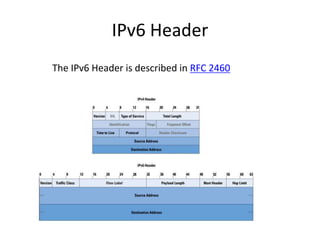
IPv6 Header The IPv6 Header is described in RFC 2460
Working on Setup IPv6 in virtual box with Linux and windows Configure Ipv6 in Cisco routers ( Packet tracer )
Quistions

Ipv6

  • 1.
    IPV6Spicial SubjectMorten Jørgensen27 May 2011
  • 2.
  • 3.
    Basic IPv6 founderInternet community ( IETF ) RFC 1883: Internet Protocol, Version 6 (IPv6) Specification”The original of IPv6 was “IP Next Generation (IPng)”IPv4 addr : 192.168.1.1IPv6 addr - 2001:0718:1c01:0016:020d:56ff:fe77:52a3
  • 4.
    Address The address lengthhas been increased significantly to expand the available address space. The IPv6 address is 128 bits (or 16 bytes) long, Addresses are written using 32 hexadecimal digits2001:0718:1c01:0016:020d:56ff:fe77:52a3Secondly, a sequence of all-zero groups can be replaced by pair of colons loopback address 0:0:0:0:0:0:0:1 may be written as::1
  • 5.
    IPv6 Header TheIPv6 Header is described in RFC 2460
  • 6.
    Working on SetupIPv6 in virtual box with Linux and windows Configure Ipv6 in Cisco routers ( Packet tracer )
  • 7.

Editor's Notes

  • #4 They came up with 2 solutions:1. Minimal: Keep the protocol intact, just increase the address length. This was the easier waypromising less pain in the deployment phase.2. Maximal: Develop an entirely new version of the protocol. Taking this approach would enableincorporating new features and enhancements in IP.
  • #5 4,3 bil ipv4 addr3,4 undcilion ( US notation ) 3,4 sextilion ( EU not )
  • #6 VersionProtocol version identification. It contains value 6 to identify IPv6.Traffic ClassIntended for the Quality of Service (QoS). It may distinguish various classes or priorities oftraffic (in combination with other header fields, e.g. source/destination addresses).Flow LabelIdentifies a flow which is a “group of related datagrams”.Payload LengthLength of the datagram payload, i.e. all the contents following the basic header (includingextension headers). It is in Bytes, so the maximum possible payload size is 64 KB.Next HeaderThe protocol header which follows. It identifies the type of following data - it may be someextension header or upper layer protocol (TCP, UDP) data.Hop LimitDatagram lifetime restriction. The sending node assigns some value to this field defining thereach of given datagram. Every forwarding node decreases the value by 1. If decremented tozero, the datagram is dropped and an ICMP message is sent to the sender. It protects the IPv6transport system against routing loops - in the case of such loop the datagram circulatesaround the loop for a limited time only.Source AddressSender identification. It contains the IPv6 address of the node who sent this datagram.Addressing is described in more detail in the next chapter.Destination AddressReceiver identification. This is the target - the datagram should be delivered to this IPv6address.