BY,
M.MELVIN DAVID
M.Sc NURSING
1ST YEAR
PIMS
Communication is the process of exchanging
or sharing ideas, feelings and information. It is a
process necessary to pave way for desired
changes in human behavior.
• Communication can be defined as the process of
transmitting information and common
understanding from one person to another.
(keyton 2011)
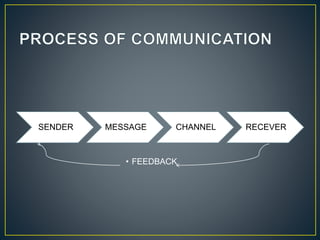
SENDER MESSAGE
• FEEDBACK
CHANNEL RECEVER
• A message is the information which the
communicator transmits to his audience to
receive, understand, accept and act upon.
• Channel is a physical bridge or media of
communication between the sender and receiver.
The communication effort is based on three
media systems:
• Interpersonal communication
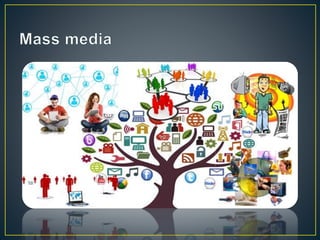
• Mass media
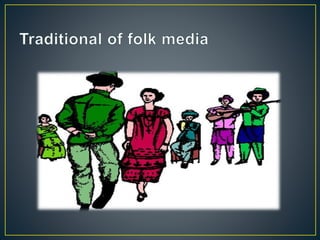
• Traditional of folk media
• It is the flow of information from the audience to
the sender. It is the reaction of the audience to
the message. The feedback provides an
opportunity to the sender to modify his message
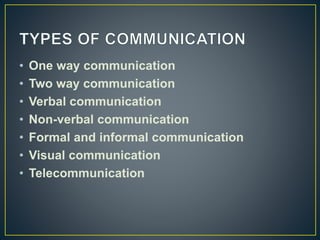
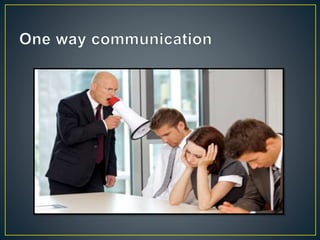
• One way communication
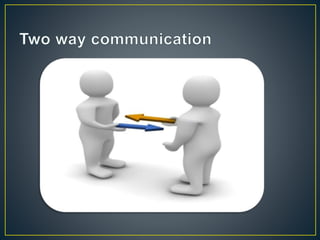
• Two way communication
• Verbal communication
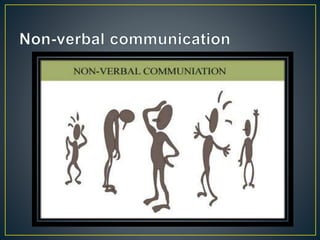
• Non-verbal communication
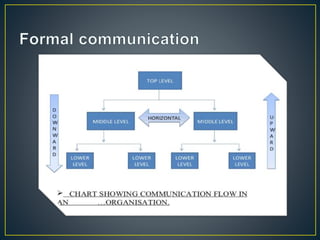
• Formal and informal communication
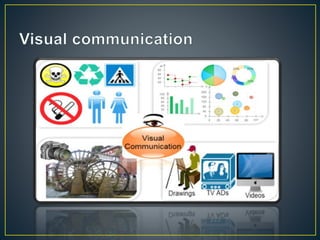
• Visual communication
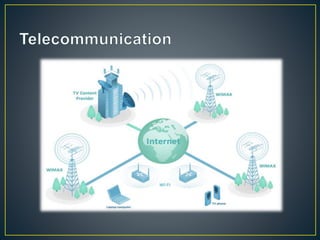
• Telecommunication
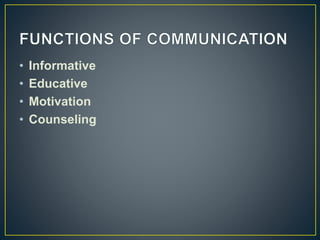
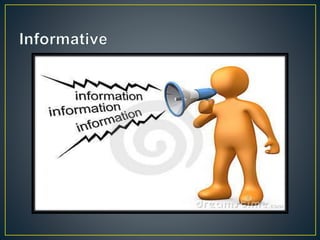
• Informative
• Educative
• Motivation
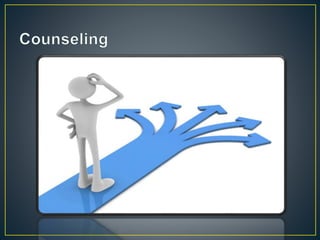
• Counseling
• Physical
• Psychological
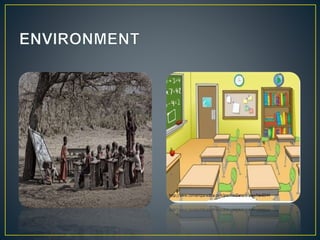
• Environmental
• Cultural
• Exactly what you want or need to the listener.
You must make sure that you have any
supporting information, background or data that
guarantees that your message and exchange will
have clarity.
• MEANING
An interpersonal relationship is a strong,
deep, or close association or acquaintances
between two or more people.
• To achieve educational or organizational objectives
• To understand and meet the individual needs
• Social exchanges between two people or group
• Pre-interaction phase
• Introductory / orientation phase
• Testing
• Building trust
• Identifying problems and goals
• Clarifying roles
• Forming contract
• Working phase
• Termination
• Loss of motivation
Loss of motivation to work on task and
becomes ineffective because lacks the desire to
produce.
• Indiscrimination opposition
A symptom of a bad relationship is
resistance to suggestions.
• Operational problems
Operation problems will occur mostly in the
group activities. If there is any conflicts among the
group members or failure of communication
between the members will leads that failure of
achieving target.
• Task distortion
Interpersonal problems are often worked out
on some aspect of the task that closely
approximates the relationship that is of concern to
the group.
• Authority problem
• Reduced effectiveness concerns of the
group or leader leads to problem.
• Nurse – patient
• Nurse – family
• Nurse – health team members
• Nurse – community
• Nurse – vulnerable groups
Communication and interpersonal relationship

Communication and interpersonal relationship

  • 1.
  • 2.
    Communication is theprocess of exchanging or sharing ideas, feelings and information. It is a process necessary to pave way for desired changes in human behavior.
  • 3.
    • Communication canbe defined as the process of transmitting information and common understanding from one person to another. (keyton 2011)
  • 4.
  • 7.
    • A messageis the information which the communicator transmits to his audience to receive, understand, accept and act upon.
  • 8.
    • Channel isa physical bridge or media of communication between the sender and receiver. The communication effort is based on three media systems: • Interpersonal communication • Mass media • Traditional of folk media
  • 12.
    • It isthe flow of information from the audience to the sender. It is the reaction of the audience to the message. The feedback provides an opportunity to the sender to modify his message
  • 14.
    • One waycommunication • Two way communication • Verbal communication • Non-verbal communication • Formal and informal communication • Visual communication • Telecommunication
  • 22.
    • Informative • Educative •Motivation • Counseling
  • 27.
    • Physical • Psychological •Environmental • Cultural
  • 30.
    • Exactly whatyou want or need to the listener. You must make sure that you have any supporting information, background or data that guarantees that your message and exchange will have clarity.
  • 34.
    • MEANING An interpersonalrelationship is a strong, deep, or close association or acquaintances between two or more people.
  • 35.
    • To achieveeducational or organizational objectives • To understand and meet the individual needs • Social exchanges between two people or group
  • 36.
    • Pre-interaction phase •Introductory / orientation phase • Testing • Building trust • Identifying problems and goals • Clarifying roles • Forming contract • Working phase • Termination
  • 37.
    • Loss ofmotivation Loss of motivation to work on task and becomes ineffective because lacks the desire to produce.
  • 38.
    • Indiscrimination opposition Asymptom of a bad relationship is resistance to suggestions.
  • 39.
    • Operational problems Operationproblems will occur mostly in the group activities. If there is any conflicts among the group members or failure of communication between the members will leads that failure of achieving target.
  • 40.
    • Task distortion Interpersonalproblems are often worked out on some aspect of the task that closely approximates the relationship that is of concern to the group.
  • 41.
    • Authority problem •Reduced effectiveness concerns of the group or leader leads to problem.
  • 42.
    • Nurse –patient • Nurse – family • Nurse – health team members • Nurse – community • Nurse – vulnerable groups