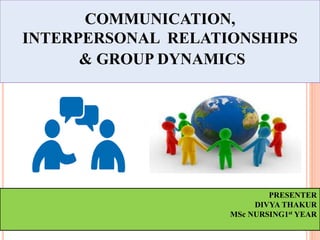
COMMUNICATION,
INTERPERSONAL RELATIONSHIPS
& GROUP DYNAMICS
PRESENTER
DIVYA THAKUR
MSc NURSING1st YEAR
INTRODUCTIONS
 The word communication originates from Greek word
Communicare meaning to share. It means to share the
thoughts, ideas, message and feelings between
communicator and receiver.
 Communication is the basic element of human interaction.
 Need of communication arise from the fact that man is a
social being and wishes to exchange information and
opinions with others so the act of doing is called
Communication.
DEFINITION
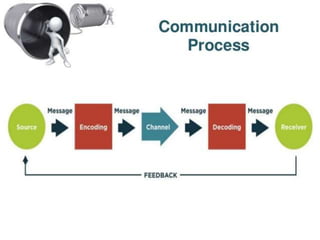
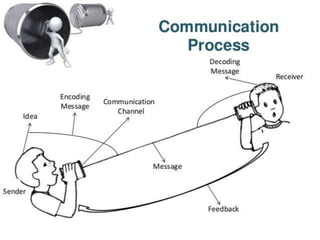
Communication is the exchange and flow of
information and ideas from one person to another;
it involves a sender transmitting an idea,
information, or feeling to a receiver."
U.S. Army
It is the process by which two or more people
exchange ideas, facts, feelings or impressions in
ways that each gains a common understanding of
meaning, intent and use of message.
Paul Leagens
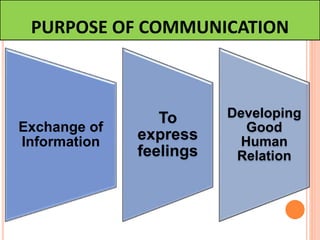
PURPOSE OF COMMUNICATION
Exchange of
Information
To
express
feelings
Developing
Good
Human
Relation
CONTD…..
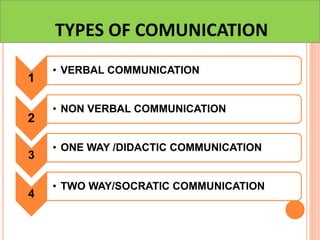
TYPES OF COMUNICATION
1
• VERBAL COMMUNICATION
2
• NON VERBAL COMMUNICATION
3
• ONE WAY /DIDACTIC COMMUNICATION
4
• TWO WAY/SOCRATIC COMMUNICATION
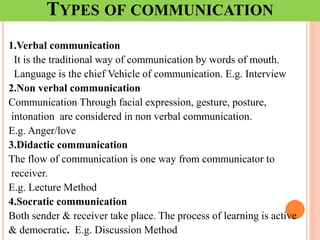
TYPES OF COMMUNICATION
1.Verbal communication
It is the traditional way of communication by words of mouth.
Language is the chief Vehicle of communication. E.g. Interview
2.Non verbal communication
Communication Through facial expression, gesture, posture,
intonation are considered in non verbal communication.
E.g. Anger/love
3.Didactic communication
The flow of communication is one way from communicator to
receiver.
E.g. Lecture Method
4.Socratic communication
Both sender & receiver take place. The process of learning is active
& democratic. E.g. Discussion Method
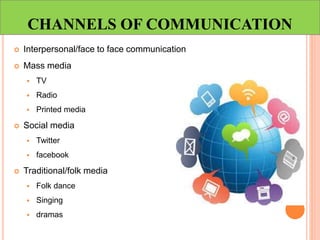
CHANNELS OF COMMUNICATION
 Interpersonal/face to face communication
 Mass media
 TV
 Radio
 Printed media
 Social media
 Twitter
 facebook
 Traditional/folk media
 Folk dance
 Singing
 dramas
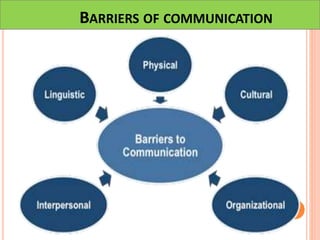
BARRIERS OF COMMUNICATION
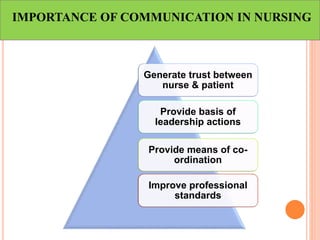
IMPORTANCE OF COMMUNICATION IN NURSING
Generate trust between
nurse & patient
Provide basis of
leadership actions
Provide means of co-
ordination
Improve professional
standards
INTER PERSONAL RELATIONSHIP
INTER PERSONAL RELATIONSHIPS
An interpersonal relationship is a strong, deep, or
close association or connection between two or
more people. This association may be based on
inference, love, solidarity, support, regular
business interactions, or some other type of social
commitment.
DEFINITION
 The interpersonal relationship is the process of interaction
between two or more individuals represents a sequence of
verbal and non verbal behaviors that are goal directed.
Imogene King
 Any or all Behavior Which a person undertake in the presence
of others.
Jourald
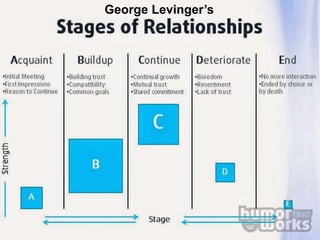
George Levinger’s
TYPES OF IPR
Social relationship: Both individual are equally
involved in the relationship & concerned with
meeting of their own goals.
Therapeutic relationship: Nurse & client work
together towards the goal of assisting the client to meet
the needs and facilitate growth.
 Intimate relationship : Relationship between two
individual committed to one another, caring for and
respecting each other.
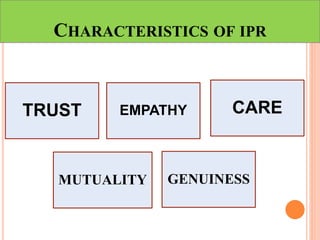
CHARACTERISTICS OF IPR
TRUST EMPATHY CARE
MUTUALITY GENUINESS
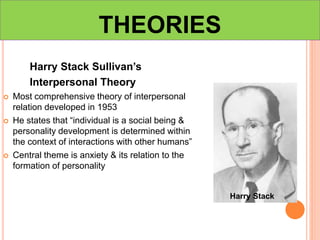
THEORIES
Harry Stack Sullivan’s
Interpersonal Theory
 Most comprehensive theory of interpersonal
relation developed in 1953
 He states that “individual is a social being &
personality development is determined within
the context of interactions with other humans”
 Central theme is anxiety & its relation to the
formation of personality
Harry Stack
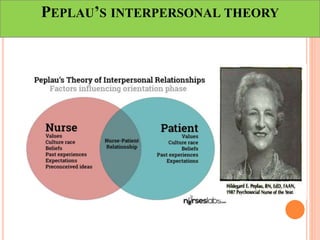
PEPLAU’S INTERPERSONAL THEORY
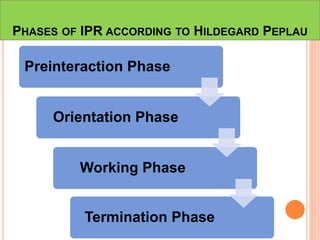
PHASES OF IPR ACCORDING TO HILDEGARD PEPLAU
Preinteraction Phase
Orientation Phase
Working Phase
Termination Phase
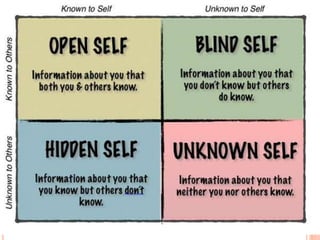
JOHARI WINDOW
 The Johari Window model
was developed by American
psychologists Joseph Luft and
Harry Ingham in1950's,
 Calling it 'Johari' after
combining their first names,
Joe and Harry
IMPORTANCE OF IPR
A single brain alone can’t take all decisions .
We need people around who can appreciate
our hard work and motivate us from time to
time.
An individual needs to get along with fellow
workers to complete assignments within the
stipulated time frame.
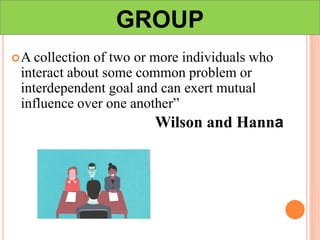
GROUP
A collection of two or more individuals who
interact about some common problem or
interdependent goal and can exert mutual
influence over one another”
Wilson and Hanna
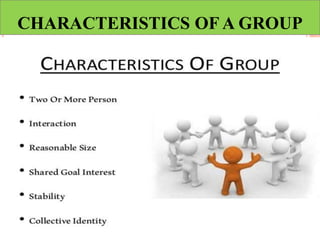
CHARACTERISTICS OF A GROUP
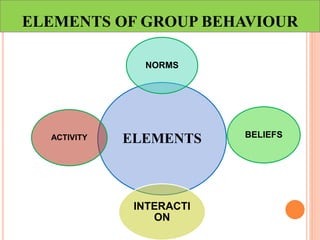
ELEMENTS OF GROUP BEHAVIOUR
ELEMENTS
NORMS
BELIEFS
INTERACTI
ON
ACTIVITY
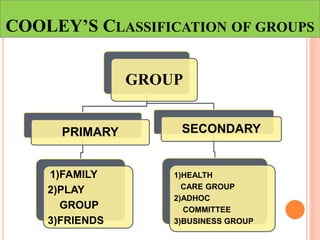
COOLEY’S CLASSIFICATION OF GROUPS
GROUP
PRIMARY
1)FAMILY
2)PLAY
GROUP
3)FRIENDS
SECONDARY
1)HEALTH
CARE GROUP
2)ADHOC
COMMITTEE
3)BUSINESS GROUP
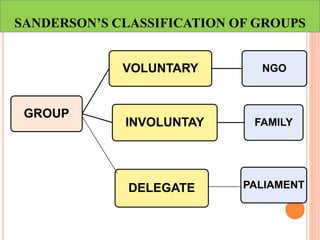
SANDERSON’S CLASSIFICATION OF GROUPS
GROUP
VOLUNTARY NGO
INVOLUNTAY FAMILY
DELEGATE PALIAMENT
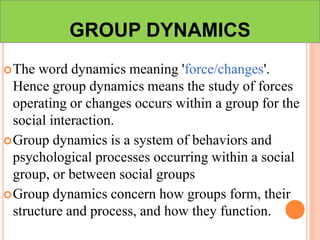
GROUP DYNAMICS
The word dynamics meaning 'force/changes'.
Hence group dynamics means the study of forces
operating or changes occurs within a group for the
social interaction.
Group dynamics is a system of behaviors and
psychological processes occurring within a social
group, or between social groups
Group dynamics concern how groups form, their
structure and process, and how they function.
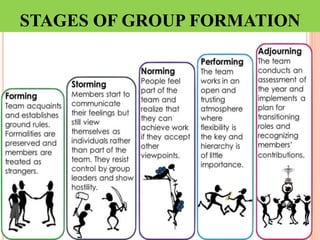
STAGES OF GROUP FORMATION
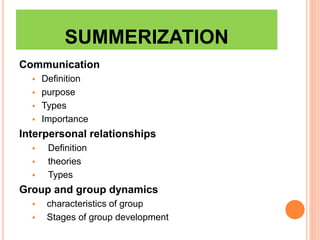
SUMMERIZATION
Communication
 Definition
 purpose
 Types
 Importance
Interpersonal relationships
 Definition
 theories
 Types
Group and group dynamics
 characteristics of group
 Stages of group development
REFERENCES
 Basheer P.Shbeer “advanced nursing practice”edition 3rd
emmess medical publishers page no.65 to 69.
 Potter A, Perry Anne. Fundamental of nursing. 7th edition. pg-
7-8
 Srarma Dinesh Kumar communication and educational
technology 1st edition lotus publishers page no 1-30.
 Http://en.wikipedia.org/wiki/Hildegard_Peplau
THANK YOU

Communication, IPR & Group Dynamics

  • 2.
    COMMUNICATION, INTERPERSONAL RELATIONSHIPS & GROUPDYNAMICS PRESENTER DIVYA THAKUR MSc NURSING1st YEAR
  • 3.
    INTRODUCTIONS  The wordcommunication originates from Greek word Communicare meaning to share. It means to share the thoughts, ideas, message and feelings between communicator and receiver.  Communication is the basic element of human interaction.  Need of communication arise from the fact that man is a social being and wishes to exchange information and opinions with others so the act of doing is called Communication.
  • 4.
    DEFINITION Communication is theexchange and flow of information and ideas from one person to another; it involves a sender transmitting an idea, information, or feeling to a receiver." U.S. Army It is the process by which two or more people exchange ideas, facts, feelings or impressions in ways that each gains a common understanding of meaning, intent and use of message. Paul Leagens
  • 5.
    PURPOSE OF COMMUNICATION Exchangeof Information To express feelings Developing Good Human Relation
  • 6.
  • 8.
    TYPES OF COMUNICATION 1 •VERBAL COMMUNICATION 2 • NON VERBAL COMMUNICATION 3 • ONE WAY /DIDACTIC COMMUNICATION 4 • TWO WAY/SOCRATIC COMMUNICATION
  • 9.
    TYPES OF COMMUNICATION 1.Verbalcommunication It is the traditional way of communication by words of mouth. Language is the chief Vehicle of communication. E.g. Interview 2.Non verbal communication Communication Through facial expression, gesture, posture, intonation are considered in non verbal communication. E.g. Anger/love 3.Didactic communication The flow of communication is one way from communicator to receiver. E.g. Lecture Method 4.Socratic communication Both sender & receiver take place. The process of learning is active & democratic. E.g. Discussion Method
  • 10.
    CHANNELS OF COMMUNICATION Interpersonal/face to face communication  Mass media  TV  Radio  Printed media  Social media  Twitter  facebook  Traditional/folk media  Folk dance  Singing  dramas
  • 11.
  • 12.
    IMPORTANCE OF COMMUNICATIONIN NURSING Generate trust between nurse & patient Provide basis of leadership actions Provide means of co- ordination Improve professional standards
  • 13.
  • 14.
    INTER PERSONAL RELATIONSHIPS Aninterpersonal relationship is a strong, deep, or close association or connection between two or more people. This association may be based on inference, love, solidarity, support, regular business interactions, or some other type of social commitment.
  • 15.
    DEFINITION  The interpersonalrelationship is the process of interaction between two or more individuals represents a sequence of verbal and non verbal behaviors that are goal directed. Imogene King  Any or all Behavior Which a person undertake in the presence of others. Jourald
  • 16.
  • 17.
    TYPES OF IPR Socialrelationship: Both individual are equally involved in the relationship & concerned with meeting of their own goals. Therapeutic relationship: Nurse & client work together towards the goal of assisting the client to meet the needs and facilitate growth.  Intimate relationship : Relationship between two individual committed to one another, caring for and respecting each other.
  • 18.
    CHARACTERISTICS OF IPR TRUSTEMPATHY CARE MUTUALITY GENUINESS
  • 19.
    THEORIES Harry Stack Sullivan’s InterpersonalTheory  Most comprehensive theory of interpersonal relation developed in 1953  He states that “individual is a social being & personality development is determined within the context of interactions with other humans”  Central theme is anxiety & its relation to the formation of personality Harry Stack
  • 20.
  • 21.
    PHASES OF IPRACCORDING TO HILDEGARD PEPLAU Preinteraction Phase Orientation Phase Working Phase Termination Phase
  • 22.
    JOHARI WINDOW  TheJohari Window model was developed by American psychologists Joseph Luft and Harry Ingham in1950's,  Calling it 'Johari' after combining their first names, Joe and Harry
  • 24.
    IMPORTANCE OF IPR Asingle brain alone can’t take all decisions . We need people around who can appreciate our hard work and motivate us from time to time. An individual needs to get along with fellow workers to complete assignments within the stipulated time frame.
  • 25.
    GROUP A collection oftwo or more individuals who interact about some common problem or interdependent goal and can exert mutual influence over one another” Wilson and Hanna
  • 26.
  • 27.
    ELEMENTS OF GROUPBEHAVIOUR ELEMENTS NORMS BELIEFS INTERACTI ON ACTIVITY
  • 28.
    COOLEY’S CLASSIFICATION OFGROUPS GROUP PRIMARY 1)FAMILY 2)PLAY GROUP 3)FRIENDS SECONDARY 1)HEALTH CARE GROUP 2)ADHOC COMMITTEE 3)BUSINESS GROUP
  • 29.
    SANDERSON’S CLASSIFICATION OFGROUPS GROUP VOLUNTARY NGO INVOLUNTAY FAMILY DELEGATE PALIAMENT
  • 30.
    GROUP DYNAMICS The worddynamics meaning 'force/changes'. Hence group dynamics means the study of forces operating or changes occurs within a group for the social interaction. Group dynamics is a system of behaviors and psychological processes occurring within a social group, or between social groups Group dynamics concern how groups form, their structure and process, and how they function.
  • 31.
    STAGES OF GROUPFORMATION
  • 33.
    SUMMERIZATION Communication  Definition  purpose Types  Importance Interpersonal relationships  Definition  theories  Types Group and group dynamics  characteristics of group  Stages of group development
  • 35.
    REFERENCES  Basheer P.Shbeer“advanced nursing practice”edition 3rd emmess medical publishers page no.65 to 69.  Potter A, Perry Anne. Fundamental of nursing. 7th edition. pg- 7-8  Srarma Dinesh Kumar communication and educational technology 1st edition lotus publishers page no 1-30.  Http://en.wikipedia.org/wiki/Hildegard_Peplau
  • 36.