SEMINAR ON
IPQC, RELEASE OF FINISHED PRODUCTS
PRESENTED BY
HUZAIFA NAAZ
H.T.NO.636217885002
M.Pharmacy I year
UNDER GUIDANCE OF
DR. SANDIP SEN
DEPARTMENT OF PHARMACEUTICAL ANALYSIS
SRIKRUPA INSTITUTE OF PHARMACEUTICAL SCIENCES
[Affiliated to Osmania university]
[Approved by PCI; AICTE]
IPQC=In process quality control
 In-process quality control tests are essential to develop
good quality products with consistent performance.
These tests are varied from dosage form to dosage
form. Inprocess quality control is a planned system to
identify the materials, equipments , process and
operators.
 IPQC is concerned with providing accurate, specific
and definite description of the procedures to be
employed from the receipt of raw materials to the
release of the finished dosage form.
IPQC is the activity performed between QC and QA
which involved:
 To control the procedure involved in manufacturing
 To maintain the quality of product.
 To monitor all features which affect the quality
 To detect errors when occurs by others.
IPQC INVOLVES:
1.Physical and chemical test:
 Identity test
 Quality test
 Purity test
 Potency test
2. Biological and microbiological test:
1.Physical and chemical test:
 Identity Test- These tests are qualitative chemical
method used to confirm the actual presence of
compound. E.g.- colour formation , precipitation.
 Quality test– These tests are physical method used to
measure accurate the characteristics properties of drug
.e.g.- absorbance, refractive index.
 Purity test- It is deigns to estimate the level of all
known and significant impurities and contamination
in the drug substances. E.g. test for clarity of solution,
acidity/alkalinity.
 Potency test- these tests always estimate the quality
of an active ingredient in drug.
2. Biological and microbiological
test:
 Biological and microbiological - It included macro
and micro biological ways and test for safety , toxicity ,
pyrogenicity , sterility, antiseptic activities and
antimicrobial preservative effectiveness test. Biological
test of drug can be qualitative or quantitative in nature
.It involves the animals preparation isolated by living
tissues.
CONDITIONS FOR DESIGNING OF IPQC:
 Identify the types of formulation (tablet , liquids,
ointments).
 Identify the critical steps involved in manufacturing
of the product.
 Identify the specification of parameters which
confirm the parameters are within control.
 Define the frequency of checking for each parameter.
PURPOSE OF IPQC
 To ensure detectable and significance human errors.
 Equipment failure
 Abnormal interpretation .
 Wrong Adoption of given procedure
IMPORTANCE OF IPQC
 To minimize human error.
 To accurate, specific, definite description of the
procedure to be employed.
 It is a planned system to identify material equipment
processes and operation.
 To detect the error.
 To enforce the flow of manufacturing and packaging
operation according to established route and practice.
 To pin point the responsibility.
 To detect any abnormality immediately.
TABLETS CAPSULES
 Wt. variation
 Hardness
 Thickness
 Friability
 Content uniformity
 Disintegration time
 Dissolution test
 Potency test
 Blister or strip sealing test
 Wt variation
 Assays
 Content uniformity
 Dissolution test
 Disintegration time
 Moisture content
 Bloom strength
 Iron test
 Hardness and flexibility of shell
 Loss on drying
 Stability testing at different
temperature
 Blister and strip sealing
IPQC TESTS IN DIFFERENT DOSAGE FORM
SOLID DOSAGE FORM
SEMISOLID DOSAGE FORM
SUSPENSIONS EMULSION
 Appearance – color , odor, taste
 Product is checked for uniform
distribution of colour absence of air
bubbles
 Clarity
 Particles size of disperse phase
 Rheology
 QC of water being used
 Sedimentation volume
 Sedimentation rate
 pH of different vehicles before and
after mixing
 Drug content
 Zeta potential mean
 stability test
 Redispersibility
 Compatibility of product and
container/closure
 Appearance-colour, odour,
taste
 Drug content
 Rheology
 Stability
 Clarity
 QC of water to be used
 pH of different vehicles
 Compatibility of
product/container/closure
 Breaking and cracking
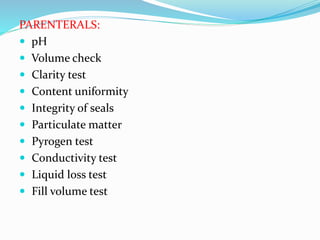
PARENTERALS:
 pH
 Volume check
 Clarity test
 Content uniformity
 Integrity of seals
 Particulate matter
 Pyrogen test
 Conductivity test
 Liquid loss test
 Fill volume test
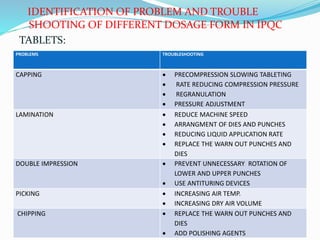
IDENTIFICATION OF PROBLEM AND TROUBLE
SHOOTING OF DIFFERENT DOSAGE FORM IN IPQC
TABLETS:
PROBLEMS TROUBLESHOOTING
CAPPING  PRECOMPRESSION SLOWING TABLETING
 RATE REDUCING COMPRESSION PRESSURE
 REGRANULATION
 PRESSURE ADJUSTMENT
LAMINATION  REDUCE MACHINE SPEED
 ARRANGMENT OF DIES AND PUNCHES
 REDUCING LIQUID APPLICATION RATE
 REPLACE THE WARN OUT PUNCHES AND
DIES
DOUBLE IMPRESSION  PREVENT UNNECESSARY ROTATION OF
LOWER AND UPPER PUNCHES
 USE ANTITURING DEVICES
PICKING  INCREASING AIR TEMP.
 INCREASING DRY AIR VOLUME
CHIPPING  REPLACE THE WARN OUT PUNCHES AND
DIES
 ADD POLISHING AGENTS
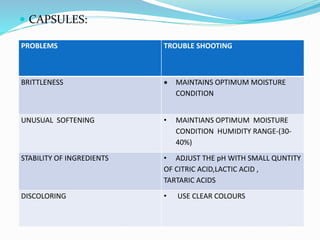
 CAPSULES:
PROBLEMS TROUBLE SHOOTING
BRITTLENESS  MAINTAINS OPTIMUM MOISTURE
CONDITION
UNUSUAL SOFTENING • MAINTIANS OPTIMUM MOISTURE
CONDITION HUMIDITY RANGE-(30-
40%)
STABILITY OF INGREDIENTS • ADJUST THE pH WITH SMALL QUNTITY
OF CITRIC ACID,LACTIC ACID ,
TARTARIC ACIDS
DISCOLORING • USE CLEAR COLOURS
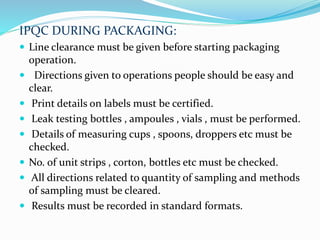
IPQC DURING PACKAGING:
 Line clearance must be given before starting packaging
operation.
 Directions given to operations people should be easy and
clear.
 Print details on labels must be certified.
 Leak testing bottles , ampoules , vials , must be performed.
 Details of measuring cups , spoons, droppers etc must be
checked.
 No. of unit strips , corton, bottles etc must be checked.
 All directions related to quantity of sampling and methods
of sampling must be cleared.
 Results must be recorded in standard formats.
RELEASE OF FINISHED PRODUCTS
Release of finished products:
 Finished product release
 WHO guidelines
 SOP on releasing of finished products
 Sampling and testing
 Quality review
 Quality audit
 Batch release document
Finished product release:
 A product in a marketable pack is classified as finished
product
 Practically a transportable pack i.e. a shipper
containing a salable pack (in retail) is considered the
finished product
WHO GUIDELINES:
 finished product should be held in quarantine until
their final release, after which they should be store as
usable stock under conditions established by the
manufacture.
 Product failing to meet the established specification or
any other relevant criteria then it should be rejected.
SOP ON RELEASING OF FINISHED PRODUCT:
Sop on releasing product should address the following
points
Who has authority to release a batch?
a) authorised person as per regulatory requirements,
b) QA head
c) any other person sutaibly authorized for this purpose
Before releasing the finished product atleast
following points to be considered:
 Test reports on releasing of finished product.
 Test reports of ipqc
 Deviation reports if any
 Sterility reports
Sampling:
 Sampling is a procedure for collecting a “sample”
MAJOR ACTIVITIES OF QC
 Acceptance sampling: it may be define as the process
of evaluating a portion of the product in a lot for the
purpose of accepting or rejecting the entire lot as
either conforming or not conforming to a quality
specification
 Sampling techniques:
1. No inspection
2. small samples
3. large samples
4. 100% inspections
Sampling risks:
 Good lots can be rejected( known as producer’s risk)
 Bad lots can be accepted ( known as consumer’s risk)
Sampling plans:
 Attributer plans: a random sample is taken from the
lot and each unit is classified as acceptable or
defective.
 Variable plans: a sample is taken and a measurement
of a specified quality characteristics is made on each
unit from lot
DOCUMENTS RELATED TO FINISHED PRODUCT RELEASE:
 Laboratory investigation and report form
 Finished good cards
 Stability data
 Master document change control form
 Retention sample log book
 Test sample log book
 QA inspection sheet
 Finished product specification & test report
 Calibration policies & related reports
 Reference substance specification report
 Laboratory work book
 Managing analytical reagent
 Stability & trail test procedure
 Laboratory waste management
 Laboratory results; out of specifications investigation reports
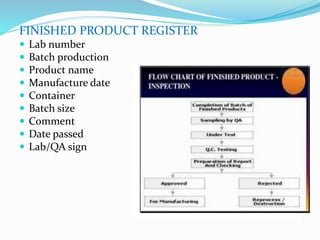
FINISHED PRODUCT REGISTER
 Lab number
 Batch production
 Product name
 Manufacture date
 Container
 Batch size
 Comment
 Date passed
 Lab/QA sign
QUALITY REVIEW
 Before a finished product is released for sale or
distribution, the complete production & control
records must be reviewed & assured satisfaction about
the entire process of production & control.
 This is consider to be the last stage in the control
process before the product moves out of the
manufacturing premises.
Quality review should be seen as a 3 phase process:
Phase 1-preparation:
 This phase precedes the actual review meeting
 It is the responsibility of the chairman & presenter to
organize the quality review & notify all those invited.
Phase 2-The review meeting:
 The central phase of the quality review process is the
review meeting itself.
 During the review meeting the emphasis should be on
error detection, in line with the criteria, & only limited
discussion of corrective action should occur.
Phase 3-The Follow-Up:
 Following the quality review meeting there should be a
follow-up period during which the errors identified at
the review that were committed to the follow-up
action list are rectified & signed off.
QUALITY AUDIT:
 It is defined as “A systematic & independent
examination to determine whether quality activities &
related results comply with planned arrangements &
whether these arrangements are implemented
effectively & are suitable to achieve objectives.
OVERVIEW OF TYPICAL AUDIT ACTIVITIES:
 Initiating the audit
 Conducting document review
 Preparing for on-site audit activities
 Conducting on-site audit activities
 Preparing, approving & distributing the audit report
 Complete the audit
 Conducting the audit follow-up
PRINCIPLES OF AUDITING:
 Ethical conduct
 Fair presentation
 Due professional care
 Independence
 Evidence based approach
TYPES OF AUDIT:
Firstly the audits may be classified as:
1. Internal auditing
2. External auditing
INTERNAL AUDITING:
 Internal quality audit will be conducted by a team of
pharmaceutical laboratory personnel drawn from all
laboratory areas.
EXTERNAL AUDITING:
 Carried out by a company on its vendors or subcontractors.
There is no legal requirement to conduct such audits, but
the need is implicit, since manufacturers are required to
have a thorough knowledge of their suppliers.
GOALS OF GMP AUDITING:
 Determine whether QA, production activities and system
comply with GMPs, regulatory agency requirements and
site requirements.
 Facilitate early detection of problems
 Help determine the depth of the identified problem in the
area as well as across the company
 Investigate and determine the root cause of the problem/
deficiency.
ROLE OF AUDITOR:
 There are two necessary components for an audit to be
successful:
1. The first is an auditor with the right skills, education
and experience.
2. The second is the audit process itself
 The auditor is a key component of the audit. To
increase the effectiveness of the audit, the auditor
must have good auditing must have good auditing
practices and techniques.
AUDIT CHECK LIST:
 documentation work
 QA/QC issues
 Sop manuals
 Building and facilities
 Failure investigation
 Process validation programme
 Master record
 Production and inprocess contol
 Packing and labeling of API and intermediates.
 Equipment processing
 Storage and distribution
 Material management
 Housekeeping facilities
BATCH RELEASE DOCUMENT:
 All relevant paper work for a particular
batch, including samples of printed cartons,
leaflet, shipper labels, line opening, line
clearance records, etc and collecting them
together
 There should be written procedure for the
distribution of each batch of the product to
facilitate recall of the product
The distribution record should include the
following data:
 Name, address and number of the customer that the
product is shipped to
 Delivery order, delivery date and number
 Name, dosage form and strength of the product
 Quantity
 Product batch number
 Expiry date
 Special storage requirements or precautionery

Qa and qc seminar

  • 1.
    SEMINAR ON IPQC, RELEASEOF FINISHED PRODUCTS PRESENTED BY HUZAIFA NAAZ H.T.NO.636217885002 M.Pharmacy I year UNDER GUIDANCE OF DR. SANDIP SEN DEPARTMENT OF PHARMACEUTICAL ANALYSIS SRIKRUPA INSTITUTE OF PHARMACEUTICAL SCIENCES [Affiliated to Osmania university] [Approved by PCI; AICTE]
  • 2.
    IPQC=In process qualitycontrol  In-process quality control tests are essential to develop good quality products with consistent performance. These tests are varied from dosage form to dosage form. Inprocess quality control is a planned system to identify the materials, equipments , process and operators.  IPQC is concerned with providing accurate, specific and definite description of the procedures to be employed from the receipt of raw materials to the release of the finished dosage form.
  • 3.
    IPQC is theactivity performed between QC and QA which involved:  To control the procedure involved in manufacturing  To maintain the quality of product.  To monitor all features which affect the quality  To detect errors when occurs by others. IPQC INVOLVES: 1.Physical and chemical test:  Identity test  Quality test  Purity test  Potency test 2. Biological and microbiological test:
  • 4.
    1.Physical and chemicaltest:  Identity Test- These tests are qualitative chemical method used to confirm the actual presence of compound. E.g.- colour formation , precipitation.  Quality test– These tests are physical method used to measure accurate the characteristics properties of drug .e.g.- absorbance, refractive index.  Purity test- It is deigns to estimate the level of all known and significant impurities and contamination in the drug substances. E.g. test for clarity of solution, acidity/alkalinity.  Potency test- these tests always estimate the quality of an active ingredient in drug.
  • 5.
    2. Biological andmicrobiological test:  Biological and microbiological - It included macro and micro biological ways and test for safety , toxicity , pyrogenicity , sterility, antiseptic activities and antimicrobial preservative effectiveness test. Biological test of drug can be qualitative or quantitative in nature .It involves the animals preparation isolated by living tissues.
  • 6.
    CONDITIONS FOR DESIGNINGOF IPQC:  Identify the types of formulation (tablet , liquids, ointments).  Identify the critical steps involved in manufacturing of the product.  Identify the specification of parameters which confirm the parameters are within control.  Define the frequency of checking for each parameter. PURPOSE OF IPQC  To ensure detectable and significance human errors.  Equipment failure  Abnormal interpretation .  Wrong Adoption of given procedure
  • 7.
    IMPORTANCE OF IPQC To minimize human error.  To accurate, specific, definite description of the procedure to be employed.  It is a planned system to identify material equipment processes and operation.  To detect the error.  To enforce the flow of manufacturing and packaging operation according to established route and practice.  To pin point the responsibility.  To detect any abnormality immediately.
  • 8.
    TABLETS CAPSULES  Wt.variation  Hardness  Thickness  Friability  Content uniformity  Disintegration time  Dissolution test  Potency test  Blister or strip sealing test  Wt variation  Assays  Content uniformity  Dissolution test  Disintegration time  Moisture content  Bloom strength  Iron test  Hardness and flexibility of shell  Loss on drying  Stability testing at different temperature  Blister and strip sealing IPQC TESTS IN DIFFERENT DOSAGE FORM SOLID DOSAGE FORM
  • 9.
    SEMISOLID DOSAGE FORM SUSPENSIONSEMULSION  Appearance – color , odor, taste  Product is checked for uniform distribution of colour absence of air bubbles  Clarity  Particles size of disperse phase  Rheology  QC of water being used  Sedimentation volume  Sedimentation rate  pH of different vehicles before and after mixing  Drug content  Zeta potential mean  stability test  Redispersibility  Compatibility of product and container/closure  Appearance-colour, odour, taste  Drug content  Rheology  Stability  Clarity  QC of water to be used  pH of different vehicles  Compatibility of product/container/closure  Breaking and cracking
  • 10.
    PARENTERALS:  pH  Volumecheck  Clarity test  Content uniformity  Integrity of seals  Particulate matter  Pyrogen test  Conductivity test  Liquid loss test  Fill volume test
  • 11.
    IDENTIFICATION OF PROBLEMAND TROUBLE SHOOTING OF DIFFERENT DOSAGE FORM IN IPQC TABLETS: PROBLEMS TROUBLESHOOTING CAPPING  PRECOMPRESSION SLOWING TABLETING  RATE REDUCING COMPRESSION PRESSURE  REGRANULATION  PRESSURE ADJUSTMENT LAMINATION  REDUCE MACHINE SPEED  ARRANGMENT OF DIES AND PUNCHES  REDUCING LIQUID APPLICATION RATE  REPLACE THE WARN OUT PUNCHES AND DIES DOUBLE IMPRESSION  PREVENT UNNECESSARY ROTATION OF LOWER AND UPPER PUNCHES  USE ANTITURING DEVICES PICKING  INCREASING AIR TEMP.  INCREASING DRY AIR VOLUME CHIPPING  REPLACE THE WARN OUT PUNCHES AND DIES  ADD POLISHING AGENTS
  • 12.
     CAPSULES: PROBLEMS TROUBLESHOOTING BRITTLENESS  MAINTAINS OPTIMUM MOISTURE CONDITION UNUSUAL SOFTENING • MAINTIANS OPTIMUM MOISTURE CONDITION HUMIDITY RANGE-(30- 40%) STABILITY OF INGREDIENTS • ADJUST THE pH WITH SMALL QUNTITY OF CITRIC ACID,LACTIC ACID , TARTARIC ACIDS DISCOLORING • USE CLEAR COLOURS
  • 13.
    IPQC DURING PACKAGING: Line clearance must be given before starting packaging operation.  Directions given to operations people should be easy and clear.  Print details on labels must be certified.  Leak testing bottles , ampoules , vials , must be performed.  Details of measuring cups , spoons, droppers etc must be checked.  No. of unit strips , corton, bottles etc must be checked.  All directions related to quantity of sampling and methods of sampling must be cleared.  Results must be recorded in standard formats.
  • 14.
  • 15.
    Release of finishedproducts:  Finished product release  WHO guidelines  SOP on releasing of finished products  Sampling and testing  Quality review  Quality audit  Batch release document
  • 16.
    Finished product release: A product in a marketable pack is classified as finished product  Practically a transportable pack i.e. a shipper containing a salable pack (in retail) is considered the finished product WHO GUIDELINES:  finished product should be held in quarantine until their final release, after which they should be store as usable stock under conditions established by the manufacture.  Product failing to meet the established specification or any other relevant criteria then it should be rejected.
  • 17.
    SOP ON RELEASINGOF FINISHED PRODUCT: Sop on releasing product should address the following points Who has authority to release a batch? a) authorised person as per regulatory requirements, b) QA head c) any other person sutaibly authorized for this purpose Before releasing the finished product atleast following points to be considered:  Test reports on releasing of finished product.  Test reports of ipqc  Deviation reports if any  Sterility reports
  • 18.
    Sampling:  Sampling isa procedure for collecting a “sample” MAJOR ACTIVITIES OF QC  Acceptance sampling: it may be define as the process of evaluating a portion of the product in a lot for the purpose of accepting or rejecting the entire lot as either conforming or not conforming to a quality specification  Sampling techniques: 1. No inspection 2. small samples 3. large samples 4. 100% inspections
  • 19.
    Sampling risks:  Goodlots can be rejected( known as producer’s risk)  Bad lots can be accepted ( known as consumer’s risk) Sampling plans:  Attributer plans: a random sample is taken from the lot and each unit is classified as acceptable or defective.  Variable plans: a sample is taken and a measurement of a specified quality characteristics is made on each unit from lot
  • 20.
    DOCUMENTS RELATED TOFINISHED PRODUCT RELEASE:  Laboratory investigation and report form  Finished good cards  Stability data  Master document change control form  Retention sample log book  Test sample log book  QA inspection sheet  Finished product specification & test report  Calibration policies & related reports  Reference substance specification report  Laboratory work book  Managing analytical reagent  Stability & trail test procedure  Laboratory waste management  Laboratory results; out of specifications investigation reports
  • 21.
    FINISHED PRODUCT REGISTER Lab number  Batch production  Product name  Manufacture date  Container  Batch size  Comment  Date passed  Lab/QA sign
  • 22.
    QUALITY REVIEW  Beforea finished product is released for sale or distribution, the complete production & control records must be reviewed & assured satisfaction about the entire process of production & control.  This is consider to be the last stage in the control process before the product moves out of the manufacturing premises. Quality review should be seen as a 3 phase process: Phase 1-preparation:  This phase precedes the actual review meeting  It is the responsibility of the chairman & presenter to organize the quality review & notify all those invited.
  • 23.
    Phase 2-The reviewmeeting:  The central phase of the quality review process is the review meeting itself.  During the review meeting the emphasis should be on error detection, in line with the criteria, & only limited discussion of corrective action should occur. Phase 3-The Follow-Up:  Following the quality review meeting there should be a follow-up period during which the errors identified at the review that were committed to the follow-up action list are rectified & signed off.
  • 24.
    QUALITY AUDIT:  Itis defined as “A systematic & independent examination to determine whether quality activities & related results comply with planned arrangements & whether these arrangements are implemented effectively & are suitable to achieve objectives. OVERVIEW OF TYPICAL AUDIT ACTIVITIES:  Initiating the audit  Conducting document review  Preparing for on-site audit activities  Conducting on-site audit activities  Preparing, approving & distributing the audit report  Complete the audit  Conducting the audit follow-up
  • 25.
    PRINCIPLES OF AUDITING: Ethical conduct  Fair presentation  Due professional care  Independence  Evidence based approach TYPES OF AUDIT: Firstly the audits may be classified as: 1. Internal auditing 2. External auditing INTERNAL AUDITING:  Internal quality audit will be conducted by a team of pharmaceutical laboratory personnel drawn from all laboratory areas.
  • 26.
    EXTERNAL AUDITING:  Carriedout by a company on its vendors or subcontractors. There is no legal requirement to conduct such audits, but the need is implicit, since manufacturers are required to have a thorough knowledge of their suppliers. GOALS OF GMP AUDITING:  Determine whether QA, production activities and system comply with GMPs, regulatory agency requirements and site requirements.  Facilitate early detection of problems  Help determine the depth of the identified problem in the area as well as across the company  Investigate and determine the root cause of the problem/ deficiency.
  • 27.
    ROLE OF AUDITOR: There are two necessary components for an audit to be successful: 1. The first is an auditor with the right skills, education and experience. 2. The second is the audit process itself  The auditor is a key component of the audit. To increase the effectiveness of the audit, the auditor must have good auditing must have good auditing practices and techniques.
  • 28.
    AUDIT CHECK LIST: documentation work  QA/QC issues  Sop manuals  Building and facilities  Failure investigation  Process validation programme  Master record  Production and inprocess contol  Packing and labeling of API and intermediates.  Equipment processing  Storage and distribution  Material management  Housekeeping facilities
  • 29.
    BATCH RELEASE DOCUMENT: All relevant paper work for a particular batch, including samples of printed cartons, leaflet, shipper labels, line opening, line clearance records, etc and collecting them together  There should be written procedure for the distribution of each batch of the product to facilitate recall of the product
  • 30.
    The distribution recordshould include the following data:  Name, address and number of the customer that the product is shipped to  Delivery order, delivery date and number  Name, dosage form and strength of the product  Quantity  Product batch number  Expiry date  Special storage requirements or precautionery