Objectives
O Discuss the forces influencing the
workplace and learning and explain how
training can help companies deal with
these forces
O Draw a figure or diagram and explain how
training, development, informal learning,
and knowledge management contribute to
business success
O Discuss various aspects of the training
design process
Copyright © 2017 McGraw-Hill Education. All rights reserved. No reproduction or distribution without the prior written consent of McGraw-Hill
Education.
Objectives
O Describe the amount and types of training
occurring in U.S. companies
O Discuss the key roles for training
professionals
O Identify appropriate resources for learning
about training research and practice
Copyright © 2017 McGraw-Hill Education. All rights reserved. No reproduction or distribution without the prior written consent of McGraw-Hill
Education.
Importance of Training
O There are many challenges and
opportunities in the workplace today
O Training equips individuals with necessary
knowledge, skills, and abilities
O Training serves to attract employees to
companies, engages, them, and promotes
retention
O Training helps to create a competitive
advantage
Copyright © 2017 McGraw-Hill Education. All rights reserved. No reproduction or distribution without the prior written consent of McGraw-Hill
Education.
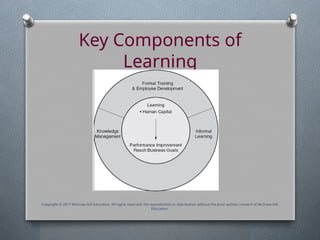
Key Components of
Learning
Copyright © 2017 McGraw-Hill Education. All rights reserved. No reproduction or distribution without the prior written consent of McGraw-Hill
Education.
Key Components of
Learning
O Learning
o Acquiring knowledge, skills,
competencies, attitudes, or behaviors
O Human Capital
o Knowledge
o Advanced skills
o System understanding and creativity
o Motivation to deliver high-quality
products and services
Copyright © 2017 McGraw-Hill Education. All rights reserved. No reproduction or distribution without the prior written consent of McGraw-Hill
Education.
Key Components of
Learning
O Training
o Facilitates learning job-related
competencies, knowledge, skills or
behavior
O Development
o Future focused—includes formal
education, job experiences, relationships,
and assessments
O Formal Training and Development
o Developed and organized by the company
Copyright © 2017 McGraw-Hill Education. All rights reserved. No reproduction or distribution without the prior written consent of McGraw-Hill
Education.
Key Components of
Learning
O Informal learning
o Learner initiated
o Occurs without a trainer or instructor
o Motivated by an intent to develop
o Does not occur in a formal learning
setting
o Breadth, depth, and timing is controlled
by the employee
Copyright © 2017 McGraw-Hill Education. All rights reserved. No reproduction or distribution without the prior written consent of McGraw-Hill
Education.
Key Components of
Learning
O Explicit Knowledge
o Well documented, easily articulated, and
easily transferred from person-to-person
o Primary focus of formal training
O Tacit Knowledge
o Personal knowledge based on individual
experiences that is difficult to codify
o Facilitated by informal learning
Copyright © 2017 McGraw-Hill Education. All rights reserved. No reproduction or distribution without the prior written consent of McGraw-Hill
Education.
Key Components of
Learning
O Knowledge Management
o Tools, processes, systems, structures,
and cultures to improve the creation,
sharing, and use of knowledge
Copyright © 2017 McGraw-Hill Education. All rights reserved. No reproduction or distribution without the prior written consent of McGraw-Hill
Education.
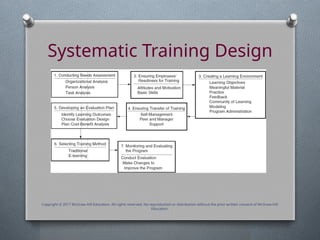
Systematic Training Design
Copyright © 2017 McGraw-Hill Education. All rights reserved. No reproduction or distribution without the prior written consent of McGraw-Hill
Education.
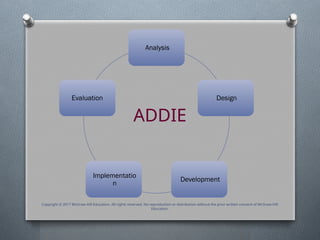
ADDIE
Copyright © 2017 McGraw-Hill Education. All rights reserved. No reproduction or distribution without the prior written consent of McGraw-Hill
Education.
Analysis
Design
Development
Implementatio
n
Evaluation
Questions
O Why is it important to systemically design
training?
O What are the limitations of the ISD and
ADDIE models?
O What should you do in practice?
Copyright © 2017 McGraw-Hill Education. All rights reserved. No reproduction or distribution without the prior written consent of McGraw-Hill
Education.
Forces Impacting Learning
O Economic cycles
O Globalization
O Value of intangible
assets and human
capital
O Focus on links to
business strategy
O Changing
demographics and
diversity
O Generational
differences
O Talent management
O Customer service and
quality emphasis
O New technology
O High-performance
models of work
systems
Copyright © 2017 McGraw-Hill Education. All rights reserved. No reproduction or distribution without the prior written
consent of McGraw-Hill Education.
Economic Cycles
O In difficult times, companies may be
tempted to reduce training expenditures
O However, doing so may be detrimental
O For example, companies that used more
selective staffing and training before the
recession of 2009 performed better and
recovered more quickly
Copyright © 2017 McGraw-Hill Education. All rights reserved. No reproduction or distribution without the prior written consent of McGraw-Hill
Education.
Globalization
O Global companies must find talented
employees
O Expatriates require training for success
O Individuals from different countries come
to the U.S. for low-skill work and highly
technical positions
O There are pros and cons of outsourcing
Copyright © 2017 McGraw-Hill Education. All rights reserved. No reproduction or distribution without the prior written consent of McGraw-Hill
Education.
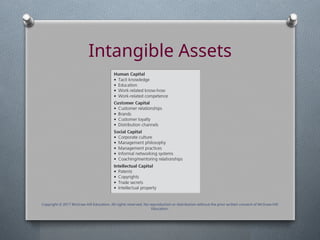
Intangible Assets
Copyright © 2017 McGraw-Hill Education. All rights reserved. No reproduction or distribution without the prior written consent of McGraw-Hill
Education.
Implications
O Knowledge workers are becoming more
important
O A greater focus on employee
engagement is needed
O There is an increasing need for
companies to become “learning
organizations”
Copyright © 2017 McGraw-Hill Education. All rights reserved. No reproduction or distribution without the prior written consent of McGraw-Hill
Education.
Links to Business Strategy
O Given the importance of intangible assets
and human capital, training has greater
strategic importance
O Training is no longer an isolated function,
but rather an integral part of business
success
O Different companies have different strategic
training needs—one size does not fit all
Copyright © 2017 McGraw-Hill Education. All rights reserved. No reproduction or distribution without the prior written consent of McGraw-Hill
Education.
Racial and Ethnic Diversity
O The U.S. labor force will continue to grow
more racially and ethnically
O The projected annual growth rates are
higher for Hispanics and “other groups”
than for African Americans
O By 2022, the workforce is projected to by
78% Caucasian
Copyright © 2017 McGraw-Hill Education. All rights reserved. No reproduction or distribution without the prior written consent of McGraw-Hill
Education.
The Aging Workforce
O Insert Figure 1.3
Copyright © 2017 McGraw-Hill Education. All rights reserved. No reproduction or distribution without the prior written consent of McGraw-Hill
Education.
Five Generations at Work in
2022
O Traditionalist
O Baby Boomers
O Generation X
O Generation Y—Millennials
O Generation Z—Digital Natives
Copyright © 2017 McGraw-Hill Education. All rights reserved. No reproduction or distribution without the prior written consent of McGraw-Hill
Education.
Managing Diversity
O Communicating effectively
O Coaching, training, and developing
O Providing performance feedback that
is free of stereotypes
O Recognizing and responding to
generational differences
O Allowing employees of all backgrounds
to be creative and innovative
Copyright © 2017 McGraw-Hill Education. All rights reserved. No reproduction or distribution without the prior written consent of McGraw-Hill
Education.
Talent Management
O Systematic, planned, and strategic effort
by a company to attract, retain, develop,
and motivate highly skilled talent
O Key components
o acquiring and assessing employees
o learning and development
o performance management and
compensation
Copyright © 2017 McGraw-Hill Education. All rights reserved. No reproduction or distribution without the prior written consent of McGraw-Hill
Education.
Talent Management
O It’s important for a number of reasons:
o Changes in demand for certain
occupations and jobs
o Cognitive and interpersonal skill
requirements
o Anticipated retirement of baby
boomers
o Developing managerial talent
Copyright © 2017 McGraw-Hill Education. All rights reserved. No reproduction or distribution without the prior written consent of McGraw-Hill
Education.
Service & Quality Emphasis
O Total Quality Management (TQM)
o Companywide effort to continuously
improve the ways people, machines,
and systems accomplish work
O Quality Standards
o Malcolm Baldrige National Quality
Award
o ISO 9000:2000
Copyright © 2017 McGraw-Hill Education. All rights reserved. No reproduction or distribution without the prior written consent of McGraw-Hill
Education.
Baldrige Award Criteria
O Leadership
O Measurement, analysis, and knowledge
management
O Strategic planning
O Workforce focus
O Operational focus
O Results
O Customer focus
Copyright © 2017 McGraw-Hill Education. All rights reserved. No reproduction or distribution without the prior written consent of McGraw-Hill
Education.
Service & Quality Emphasis
O Six Sigma
o Measuring, analyzing, improving,
and then controlling processes once
they have been brought within the
narrow six sigma quality tolerances
or standards
Copyright © 2017 McGraw-Hill Education. All rights reserved. No reproduction or distribution without the prior written consent of McGraw-Hill
Education.
New Technology
O Technology has changed how we train
O Training can occur at any time, anywhere
O Training is more consistent and more realistic
O More individuals can now be trained
O Knowledge can be shared by readily
O Trainers roles have evolved
O Many organizations used blended training
methods
Copyright © 2017 McGraw-Hill Education. All rights reserved. No reproduction or distribution without the prior written consent of McGraw-Hill
Education.
Challenges with New
Technology
O Not all trainees may be comfortable
with technology
O It may be difficult to engage trainees
and ensure compliance with training
O Some trainees may desire greater “live”
interaction with trainers
Copyright © 2017 McGraw-Hill Education. All rights reserved. No reproduction or distribution without the prior written consent of McGraw-Hill
Education.
High Performance Systems
O Work teams
o Employees interact to assemble a product
or provide a service
O Cross training
o Training employees in a range of skills to
fill roles needed to be performed
O Virtual teams
o Teams separated by time, geographic, and
organizational boundaries
Copyright © 2017 McGraw-Hill Education. All rights reserved. No reproduction or distribution without the prior written consent of McGraw-Hill
Education.
Snapshot of Training
Practices
O Direct expenditures have remained
stable
O Increased demand for specialized
learning that includes professional or
industry-specific content
O Use of technology-based learning has
increased
O Self-paced online learning is the most
common technology-based learning
Copyright © 2017 McGraw-Hill Education. All rights reserved. No reproduction or distribution without the prior written consent of McGraw-Hill
Education.
Snapshot of Training
Practices
O Technology-based learning has helped
improve learning efficiency
O Technology-based learning has
resulted in a larger employee–learning
staff member ratio
O The percentage of services distributed
by external providers has remained the
same since 2010
Copyright © 2017 McGraw-Hill Education. All rights reserved. No reproduction or distribution without the prior written consent of McGraw-Hill
Education.
O Training supports business strategy
O Visible support from top management
O Efficiency in training
O All employees with access to training
on an as-needed basis
O Variety of learning opportunities
O Measurement of training effectiveness
O Use of non-training solutions
BEST Award Winners
Copyright © 2017 McGraw-Hill Education. All rights reserved. No reproduction or distribution without the prior written consent of McGraw-Hill
Education.
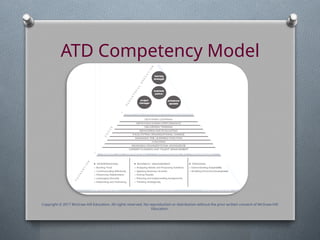
ATD Competency Model
Copyright © 2017 McGraw-Hill Education. All rights reserved. No reproduction or distribution without the prior written consent of McGraw-Hill
Education.
Training Roles
O Learning Strategist
o Determines how learning can be used
to align with business strategy
O Business Partner
o Uses business knowledge and industry
expertise to create training that
improves performance
Copyright © 2017 McGraw-Hill Education. All rights reserved. No reproduction or distribution without the prior written consent of McGraw-Hill
Education.
Training Roles
O Project Manager
o Plans and monitors delivery of
learning and performance solutions to
support the business
O Professional Specialist
o Designs, develops, delivers, and
evaluates learning and performance
systems
Copyright © 2017 McGraw-Hill Education. All rights reserved. No reproduction or distribution without the prior written consent of McGraw-Hill
Education.
Professional Associations
O Association for Talent Development (ATD)
O Academy of Human Resource Development
(AHRD)
O Society for Human Resource Management
(SHRM)
O Society for Industrial and Organizational
Psychology (SIOP)
O Academy of Management (AOM)
O International Society for Performance
Improvement (ISPI)
Copyright © 2017 McGraw-Hill Education. All rights reserved. No reproduction or distribution without the prior written consent of McGraw-Hill
Education.

Employee Induction training and Devlopment.pptx

  • 1.
    Objectives O Discuss theforces influencing the workplace and learning and explain how training can help companies deal with these forces O Draw a figure or diagram and explain how training, development, informal learning, and knowledge management contribute to business success O Discuss various aspects of the training design process Copyright © 2017 McGraw-Hill Education. All rights reserved. No reproduction or distribution without the prior written consent of McGraw-Hill Education.
  • 2.
    Objectives O Describe theamount and types of training occurring in U.S. companies O Discuss the key roles for training professionals O Identify appropriate resources for learning about training research and practice Copyright © 2017 McGraw-Hill Education. All rights reserved. No reproduction or distribution without the prior written consent of McGraw-Hill Education.
  • 3.
    Importance of Training OThere are many challenges and opportunities in the workplace today O Training equips individuals with necessary knowledge, skills, and abilities O Training serves to attract employees to companies, engages, them, and promotes retention O Training helps to create a competitive advantage Copyright © 2017 McGraw-Hill Education. All rights reserved. No reproduction or distribution without the prior written consent of McGraw-Hill Education.
  • 4.
    Key Components of Learning Copyright© 2017 McGraw-Hill Education. All rights reserved. No reproduction or distribution without the prior written consent of McGraw-Hill Education.
  • 5.
    Key Components of Learning OLearning o Acquiring knowledge, skills, competencies, attitudes, or behaviors O Human Capital o Knowledge o Advanced skills o System understanding and creativity o Motivation to deliver high-quality products and services Copyright © 2017 McGraw-Hill Education. All rights reserved. No reproduction or distribution without the prior written consent of McGraw-Hill Education.
  • 6.
    Key Components of Learning OTraining o Facilitates learning job-related competencies, knowledge, skills or behavior O Development o Future focused—includes formal education, job experiences, relationships, and assessments O Formal Training and Development o Developed and organized by the company Copyright © 2017 McGraw-Hill Education. All rights reserved. No reproduction or distribution without the prior written consent of McGraw-Hill Education.
  • 7.
    Key Components of Learning OInformal learning o Learner initiated o Occurs without a trainer or instructor o Motivated by an intent to develop o Does not occur in a formal learning setting o Breadth, depth, and timing is controlled by the employee Copyright © 2017 McGraw-Hill Education. All rights reserved. No reproduction or distribution without the prior written consent of McGraw-Hill Education.
  • 8.
    Key Components of Learning OExplicit Knowledge o Well documented, easily articulated, and easily transferred from person-to-person o Primary focus of formal training O Tacit Knowledge o Personal knowledge based on individual experiences that is difficult to codify o Facilitated by informal learning Copyright © 2017 McGraw-Hill Education. All rights reserved. No reproduction or distribution without the prior written consent of McGraw-Hill Education.
  • 9.
    Key Components of Learning OKnowledge Management o Tools, processes, systems, structures, and cultures to improve the creation, sharing, and use of knowledge Copyright © 2017 McGraw-Hill Education. All rights reserved. No reproduction or distribution without the prior written consent of McGraw-Hill Education.
  • 10.
    Systematic Training Design Copyright© 2017 McGraw-Hill Education. All rights reserved. No reproduction or distribution without the prior written consent of McGraw-Hill Education.
  • 11.
    ADDIE Copyright © 2017McGraw-Hill Education. All rights reserved. No reproduction or distribution without the prior written consent of McGraw-Hill Education. Analysis Design Development Implementatio n Evaluation
  • 12.
    Questions O Why isit important to systemically design training? O What are the limitations of the ISD and ADDIE models? O What should you do in practice? Copyright © 2017 McGraw-Hill Education. All rights reserved. No reproduction or distribution without the prior written consent of McGraw-Hill Education.
  • 13.
    Forces Impacting Learning OEconomic cycles O Globalization O Value of intangible assets and human capital O Focus on links to business strategy O Changing demographics and diversity O Generational differences O Talent management O Customer service and quality emphasis O New technology O High-performance models of work systems Copyright © 2017 McGraw-Hill Education. All rights reserved. No reproduction or distribution without the prior written consent of McGraw-Hill Education.
  • 14.
    Economic Cycles O Indifficult times, companies may be tempted to reduce training expenditures O However, doing so may be detrimental O For example, companies that used more selective staffing and training before the recession of 2009 performed better and recovered more quickly Copyright © 2017 McGraw-Hill Education. All rights reserved. No reproduction or distribution without the prior written consent of McGraw-Hill Education.
  • 15.
    Globalization O Global companiesmust find talented employees O Expatriates require training for success O Individuals from different countries come to the U.S. for low-skill work and highly technical positions O There are pros and cons of outsourcing Copyright © 2017 McGraw-Hill Education. All rights reserved. No reproduction or distribution without the prior written consent of McGraw-Hill Education.
  • 16.
    Intangible Assets Copyright ©2017 McGraw-Hill Education. All rights reserved. No reproduction or distribution without the prior written consent of McGraw-Hill Education.
  • 17.
    Implications O Knowledge workersare becoming more important O A greater focus on employee engagement is needed O There is an increasing need for companies to become “learning organizations” Copyright © 2017 McGraw-Hill Education. All rights reserved. No reproduction or distribution without the prior written consent of McGraw-Hill Education.
  • 18.
    Links to BusinessStrategy O Given the importance of intangible assets and human capital, training has greater strategic importance O Training is no longer an isolated function, but rather an integral part of business success O Different companies have different strategic training needs—one size does not fit all Copyright © 2017 McGraw-Hill Education. All rights reserved. No reproduction or distribution without the prior written consent of McGraw-Hill Education.
  • 19.
    Racial and EthnicDiversity O The U.S. labor force will continue to grow more racially and ethnically O The projected annual growth rates are higher for Hispanics and “other groups” than for African Americans O By 2022, the workforce is projected to by 78% Caucasian Copyright © 2017 McGraw-Hill Education. All rights reserved. No reproduction or distribution without the prior written consent of McGraw-Hill Education.
  • 20.
    The Aging Workforce OInsert Figure 1.3 Copyright © 2017 McGraw-Hill Education. All rights reserved. No reproduction or distribution without the prior written consent of McGraw-Hill Education.
  • 21.
    Five Generations atWork in 2022 O Traditionalist O Baby Boomers O Generation X O Generation Y—Millennials O Generation Z—Digital Natives Copyright © 2017 McGraw-Hill Education. All rights reserved. No reproduction or distribution without the prior written consent of McGraw-Hill Education.
  • 22.
    Managing Diversity O Communicatingeffectively O Coaching, training, and developing O Providing performance feedback that is free of stereotypes O Recognizing and responding to generational differences O Allowing employees of all backgrounds to be creative and innovative Copyright © 2017 McGraw-Hill Education. All rights reserved. No reproduction or distribution without the prior written consent of McGraw-Hill Education.
  • 23.
    Talent Management O Systematic,planned, and strategic effort by a company to attract, retain, develop, and motivate highly skilled talent O Key components o acquiring and assessing employees o learning and development o performance management and compensation Copyright © 2017 McGraw-Hill Education. All rights reserved. No reproduction or distribution without the prior written consent of McGraw-Hill Education.
  • 24.
    Talent Management O It’simportant for a number of reasons: o Changes in demand for certain occupations and jobs o Cognitive and interpersonal skill requirements o Anticipated retirement of baby boomers o Developing managerial talent Copyright © 2017 McGraw-Hill Education. All rights reserved. No reproduction or distribution without the prior written consent of McGraw-Hill Education.
  • 25.
    Service & QualityEmphasis O Total Quality Management (TQM) o Companywide effort to continuously improve the ways people, machines, and systems accomplish work O Quality Standards o Malcolm Baldrige National Quality Award o ISO 9000:2000 Copyright © 2017 McGraw-Hill Education. All rights reserved. No reproduction or distribution without the prior written consent of McGraw-Hill Education.
  • 26.
    Baldrige Award Criteria OLeadership O Measurement, analysis, and knowledge management O Strategic planning O Workforce focus O Operational focus O Results O Customer focus Copyright © 2017 McGraw-Hill Education. All rights reserved. No reproduction or distribution without the prior written consent of McGraw-Hill Education.
  • 27.
    Service & QualityEmphasis O Six Sigma o Measuring, analyzing, improving, and then controlling processes once they have been brought within the narrow six sigma quality tolerances or standards Copyright © 2017 McGraw-Hill Education. All rights reserved. No reproduction or distribution without the prior written consent of McGraw-Hill Education.
  • 28.
    New Technology O Technologyhas changed how we train O Training can occur at any time, anywhere O Training is more consistent and more realistic O More individuals can now be trained O Knowledge can be shared by readily O Trainers roles have evolved O Many organizations used blended training methods Copyright © 2017 McGraw-Hill Education. All rights reserved. No reproduction or distribution without the prior written consent of McGraw-Hill Education.
  • 29.
    Challenges with New Technology ONot all trainees may be comfortable with technology O It may be difficult to engage trainees and ensure compliance with training O Some trainees may desire greater “live” interaction with trainers Copyright © 2017 McGraw-Hill Education. All rights reserved. No reproduction or distribution without the prior written consent of McGraw-Hill Education.
  • 30.
    High Performance Systems OWork teams o Employees interact to assemble a product or provide a service O Cross training o Training employees in a range of skills to fill roles needed to be performed O Virtual teams o Teams separated by time, geographic, and organizational boundaries Copyright © 2017 McGraw-Hill Education. All rights reserved. No reproduction or distribution without the prior written consent of McGraw-Hill Education.
  • 31.
    Snapshot of Training Practices ODirect expenditures have remained stable O Increased demand for specialized learning that includes professional or industry-specific content O Use of technology-based learning has increased O Self-paced online learning is the most common technology-based learning Copyright © 2017 McGraw-Hill Education. All rights reserved. No reproduction or distribution without the prior written consent of McGraw-Hill Education.
  • 32.
    Snapshot of Training Practices OTechnology-based learning has helped improve learning efficiency O Technology-based learning has resulted in a larger employee–learning staff member ratio O The percentage of services distributed by external providers has remained the same since 2010 Copyright © 2017 McGraw-Hill Education. All rights reserved. No reproduction or distribution without the prior written consent of McGraw-Hill Education.
  • 33.
    O Training supportsbusiness strategy O Visible support from top management O Efficiency in training O All employees with access to training on an as-needed basis O Variety of learning opportunities O Measurement of training effectiveness O Use of non-training solutions BEST Award Winners Copyright © 2017 McGraw-Hill Education. All rights reserved. No reproduction or distribution without the prior written consent of McGraw-Hill Education.
  • 34.
    ATD Competency Model Copyright© 2017 McGraw-Hill Education. All rights reserved. No reproduction or distribution without the prior written consent of McGraw-Hill Education.
  • 35.
    Training Roles O LearningStrategist o Determines how learning can be used to align with business strategy O Business Partner o Uses business knowledge and industry expertise to create training that improves performance Copyright © 2017 McGraw-Hill Education. All rights reserved. No reproduction or distribution without the prior written consent of McGraw-Hill Education.
  • 36.
    Training Roles O ProjectManager o Plans and monitors delivery of learning and performance solutions to support the business O Professional Specialist o Designs, develops, delivers, and evaluates learning and performance systems Copyright © 2017 McGraw-Hill Education. All rights reserved. No reproduction or distribution without the prior written consent of McGraw-Hill Education.
  • 37.
    Professional Associations O Associationfor Talent Development (ATD) O Academy of Human Resource Development (AHRD) O Society for Human Resource Management (SHRM) O Society for Industrial and Organizational Psychology (SIOP) O Academy of Management (AOM) O International Society for Performance Improvement (ISPI) Copyright © 2017 McGraw-Hill Education. All rights reserved. No reproduction or distribution without the prior written consent of McGraw-Hill Education.