

GATHERING
PERFORMANCE
INFORMATION
PRESENTED TO MAM NAYAB UMER
.
INRODUCTION
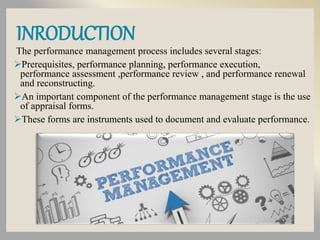
The performance management process includes several stages:
Prerequisites, performance planning, performance execution,
performance assessment ,performance review , and performance renewal
and reconstructing.
An important component of the performance management stage is the use
of appraisal forms.
These forms are instruments used to document and evaluate performance.
APPRAISAL FORMS:
At the core of any performance management system is the assessment
of performance. Information on performance is collected by using
forms, which can be filled out on paper or electronically.
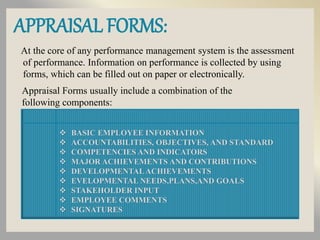
Appraisal Forms usually include a combination of the
following components:
 BASIC EMPLOYEE INFORMATION
 ACCOUNTABILITIES, OBJECTIVES, AND STANDARD
 COMPETENCIES AND INDICATORS
 MAJOR ACHIEVEMENTS AND CONTRIBUTIONS
 DEVELOPMENTALACHIEVEMENTS
 EVELOPMENTAL NEEDS,PLANS,AND GOALS
 STAKEHOLDER INPUT
 EMPLOYEE COMMENTS
 SIGNATURES
APPRAISAL FORMS COMPONENTS
1. BASIC EMPLOYEE INFORMATION:
This section of the form includes basic employee information such as JOB
TITLE, DIVISION, DEPARTMENT and OTHER WORK GROUP
INFORMATION, EMPLOYEE NUMBER, and PAY GRADE or SALARY
CLASSIFICATION.
2. ACCOUNTABILITIES, OBJECTIVES, AND
STANDARDS:
If the organization adopts a result approach, this section of the form would
include the name and description of each accountability, objectives agreed
upon by manager and employee, and the extent to which the objectives have
been achieved.
.
3. COMPETENCIES AND INDICATORS:
If the organization adopts the behavior approach, this section of the form
includes the definition of the various competencies to be assessed, together
with their behavioral indicators
4. MAJOR ACHIEVEMENTS AND
CONTRIBUTIONS:
Some forms include a section in which a rater asked to list the two or three
major accomplishments of the individual beings rated during the review period.
5. DEVELOPMENTAL ACHIEVEMENTS:
This section of the forms includes information about the extent to which the
development goals set for the review period have been achieved.
6. DEVELOPMENTAL NEEDS,PLANS,AND
GOALS:
This section of the form is future oriented and includes information about
specific goals and timetables in terms of employees development.
7. STAKEHOLDER INPUT:
Some forms include section to be filled out by other stakeholders, such as
Customers with whom the employee interacts
8. EMPLOYEE COMMENTS:
This section includes reactions to and comments provided by the employee
being rated.
9. SIGNATURES:
The final section of most forms includes a section in which the employee
being rated, the rater, and the rater's supervisor provide their signatures to
show they have seen and discussed the content of the form.
Characteristics of Appraisal forms
There are certain desirable features that make appraisal forms
particularly effective.
1. SIMPLICITY:
Forms must be easy to understand, easy to administer, quick to
complete, clear and concise.
2. RELEVANCY:
Good forms include information related directly to the tasks and
responsibility of the job, otherwise they will be regarded as an
administrative burden and not a tool for performance
improvement
3. DESCRIPTIVENESS:
Good forms require that the raters provide evidence of performance
regardless of the performance level.
4. ADAPTABILITY:
Good forms allow managers in different functions and departments
to adapt them to their particular needs and situations.
5. COMPREHENSIVENESS:
Good forms include all the major areas of performance for a
particular position for the entire review period.
6. DEFINITIONAL CLARITY:
Desirable competencies and results are clearly defined for all the
raters so that everyone evaluates the same attributes
.
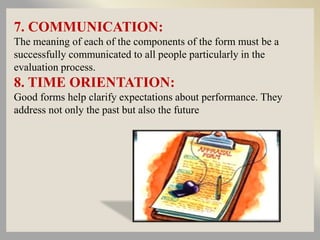
7. COMMUNICATION:
The meaning of each of the components of the form must be a
successfully communicated to all people particularly in the
evaluation process.
8. TIME ORIENTATION:
Good forms help clarify expectations about performance. They
address not only the past but also the future
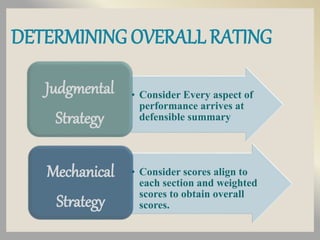
DETERMINING OVERALL RATING
• Consider Every aspect of
performance arrives at
defensible summary
Judgmental
Strategy
• Consider scores align to
each section and weighted
scores to obtain overall
scores.
Mechanical
Strategy
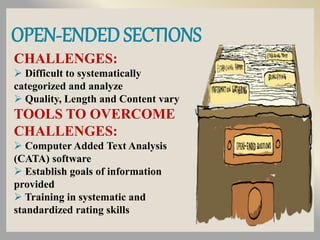
OPEN-ENDED SECTIONS
CHALLENGES:
 Difficult to systematically
categorized and analyze
 Quality, Length and Content vary
TOOLS TO OVERCOME
CHALLENGES:
 Computer Added Text Analysis
(CATA) software
 Establish goals of information
provided
 Training in systematic and
standardized rating skills
NO OF MEETINGS:
 Annual.
May not provide sufficient opportunity
for Supervisor/Employee discussions.
 Semi-Annual.
 Quarterly.
APPRAISAL period
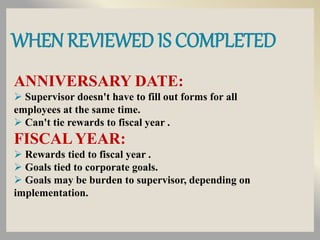
WHEN REVIEWED IS COMPLETED
ANNIVERSARY DATE:
 Supervisor doesn't have to fill out forms for all
employees at the same time.
 Can't tie rewards to fiscal year .
FISCAL YEAR:
 Rewards tied to fiscal year .
 Goals tied to corporate goals.
 Goals may be burden to supervisor, depending on
implementation.
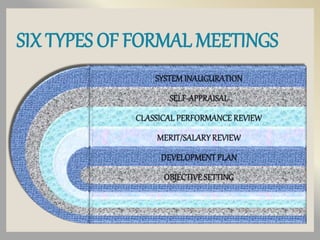
SIX TYPES OF FORMAL MEETINGS
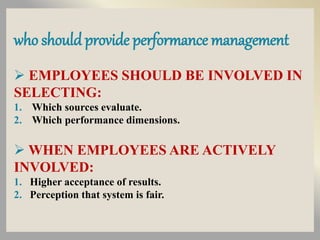
who should provide performance management
 EMPLOYEES SHOULD BE INVOLVED IN
SELECTING:
1. Which sources evaluate.
2. Which performance dimensions.
 WHEN EMPLOYEES ARE ACTIVELY
INVOLVED:
1. Higher acceptance of results.
2. Perception that system is fair.
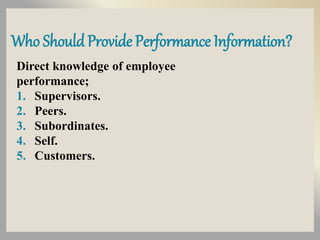
Who Should Provide Performance Information?
Direct knowledge of employee
performance;
1. Supervisors.
2. Peers.
3. Subordinates.
4. Self.
5. Customers.
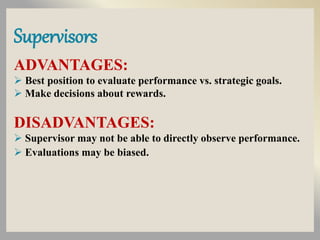
Supervisors
ADVANTAGES:
 Best position to evaluate performance vs. strategic goals.
 Make decisions about rewards.
DISADVANTAGES:
 Supervisor may not be able to directly observe performance.
 Evaluations may be biased.
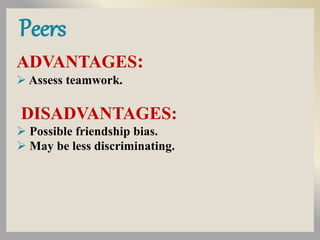
Peers
ADVANTAGES:
 Assess teamwork.
DISADVANTAGES:
 Possible friendship bias.
 May be less discriminating.
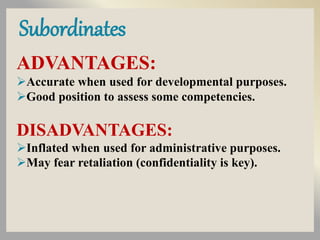
Subordinates
ADVANTAGES:
Accurate when used for developmental purposes.
Good position to assess some competencies.
DISADVANTAGES:
Inflated when used for administrative purposes.
May fear retaliation (confidentiality is key).
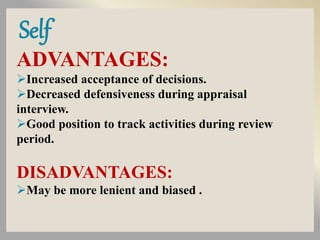
Self
ADVANTAGES:
Increased acceptance of decisions.
Decreased defensiveness during appraisal
interview.
Good position to track activities during review
period.
DISADVANTAGES:
May be more lenient and biased .
Customers (external and internal)
ADVANTAGES:
Employees become more focused on meeting customer
expectations.
DISADVANTAGES:
Time
Money
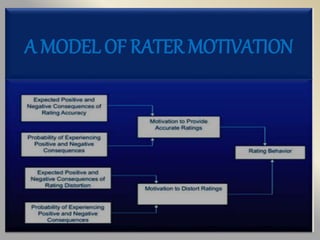
A MODEL OF RATER MOTIVATION
Types of Rating Errors
INTENTIONAL ERRORS:
 Rating inflation.
Rating deflation.
UNINTENTIONAL:
Errors Due to complexity of task
Motivations for Rating Inflation
Maximize merit raise/rewards.
Encourage employees.
 Avoid creating written record.
Avoid conflict with employees.
 Promote undesired employees out of
unit.
 Make manager look good to his/her
supervisor.
Motivations for Rating Deflation
Shock employees .
Teach a lesson.
Send a message to employee.
Build a written record of poor
performance.
1. Information.
2. Motivation.
3. Identifying, observing, recording and evaluating
performance How to interact with employees when they
receive performance information .
RATER TRAINING PROGRAMSHOULD
COVER
1.Information - how the systemworks?
Reasons for implementing the performance management
system Information on the appraisal form and system
mechanics
2.Motivation – What’s in it for me?
Motivation rater gives about how accurately an employee
rating will provide them benefits.
3.Identifying, observing, recording, and evaluatingperformance:
How to identify and rank job activities How to observe,
record, measure performance How to minimize rating errors
 How to interact with employees when they receive
performance information
How to conduct an appraisal interview How to train, counsel,
and coach

Gathering performance information

  • 1.
  • 2.
  • 3.
    INRODUCTION The performance managementprocess includes several stages: Prerequisites, performance planning, performance execution, performance assessment ,performance review , and performance renewal and reconstructing. An important component of the performance management stage is the use of appraisal forms. These forms are instruments used to document and evaluate performance.
  • 4.
    APPRAISAL FORMS: At thecore of any performance management system is the assessment of performance. Information on performance is collected by using forms, which can be filled out on paper or electronically. Appraisal Forms usually include a combination of the following components:  BASIC EMPLOYEE INFORMATION  ACCOUNTABILITIES, OBJECTIVES, AND STANDARD  COMPETENCIES AND INDICATORS  MAJOR ACHIEVEMENTS AND CONTRIBUTIONS  DEVELOPMENTALACHIEVEMENTS  EVELOPMENTAL NEEDS,PLANS,AND GOALS  STAKEHOLDER INPUT  EMPLOYEE COMMENTS  SIGNATURES
  • 5.
    APPRAISAL FORMS COMPONENTS 1.BASIC EMPLOYEE INFORMATION: This section of the form includes basic employee information such as JOB TITLE, DIVISION, DEPARTMENT and OTHER WORK GROUP INFORMATION, EMPLOYEE NUMBER, and PAY GRADE or SALARY CLASSIFICATION. 2. ACCOUNTABILITIES, OBJECTIVES, AND STANDARDS: If the organization adopts a result approach, this section of the form would include the name and description of each accountability, objectives agreed upon by manager and employee, and the extent to which the objectives have been achieved. .
  • 6.
    3. COMPETENCIES ANDINDICATORS: If the organization adopts the behavior approach, this section of the form includes the definition of the various competencies to be assessed, together with their behavioral indicators 4. MAJOR ACHIEVEMENTS AND CONTRIBUTIONS: Some forms include a section in which a rater asked to list the two or three major accomplishments of the individual beings rated during the review period. 5. DEVELOPMENTAL ACHIEVEMENTS: This section of the forms includes information about the extent to which the development goals set for the review period have been achieved.
  • 7.
    6. DEVELOPMENTAL NEEDS,PLANS,AND GOALS: Thissection of the form is future oriented and includes information about specific goals and timetables in terms of employees development. 7. STAKEHOLDER INPUT: Some forms include section to be filled out by other stakeholders, such as Customers with whom the employee interacts 8. EMPLOYEE COMMENTS: This section includes reactions to and comments provided by the employee being rated. 9. SIGNATURES: The final section of most forms includes a section in which the employee being rated, the rater, and the rater's supervisor provide their signatures to show they have seen and discussed the content of the form.
  • 8.
    Characteristics of Appraisalforms There are certain desirable features that make appraisal forms particularly effective. 1. SIMPLICITY: Forms must be easy to understand, easy to administer, quick to complete, clear and concise. 2. RELEVANCY: Good forms include information related directly to the tasks and responsibility of the job, otherwise they will be regarded as an administrative burden and not a tool for performance improvement
  • 9.
    3. DESCRIPTIVENESS: Good formsrequire that the raters provide evidence of performance regardless of the performance level. 4. ADAPTABILITY: Good forms allow managers in different functions and departments to adapt them to their particular needs and situations. 5. COMPREHENSIVENESS: Good forms include all the major areas of performance for a particular position for the entire review period. 6. DEFINITIONAL CLARITY: Desirable competencies and results are clearly defined for all the raters so that everyone evaluates the same attributes .
  • 10.
    7. COMMUNICATION: The meaningof each of the components of the form must be a successfully communicated to all people particularly in the evaluation process. 8. TIME ORIENTATION: Good forms help clarify expectations about performance. They address not only the past but also the future
  • 11.
    DETERMINING OVERALL RATING •Consider Every aspect of performance arrives at defensible summary Judgmental Strategy • Consider scores align to each section and weighted scores to obtain overall scores. Mechanical Strategy
  • 12.
    OPEN-ENDED SECTIONS CHALLENGES:  Difficultto systematically categorized and analyze  Quality, Length and Content vary TOOLS TO OVERCOME CHALLENGES:  Computer Added Text Analysis (CATA) software  Establish goals of information provided  Training in systematic and standardized rating skills
  • 13.
    NO OF MEETINGS: Annual. May not provide sufficient opportunity for Supervisor/Employee discussions.  Semi-Annual.  Quarterly. APPRAISAL period
  • 14.
    WHEN REVIEWED ISCOMPLETED ANNIVERSARY DATE:  Supervisor doesn't have to fill out forms for all employees at the same time.  Can't tie rewards to fiscal year . FISCAL YEAR:  Rewards tied to fiscal year .  Goals tied to corporate goals.  Goals may be burden to supervisor, depending on implementation.
  • 15.
    SIX TYPES OFFORMAL MEETINGS
  • 16.
    who should provideperformance management  EMPLOYEES SHOULD BE INVOLVED IN SELECTING: 1. Which sources evaluate. 2. Which performance dimensions.  WHEN EMPLOYEES ARE ACTIVELY INVOLVED: 1. Higher acceptance of results. 2. Perception that system is fair.
  • 17.
    Who Should ProvidePerformance Information? Direct knowledge of employee performance; 1. Supervisors. 2. Peers. 3. Subordinates. 4. Self. 5. Customers.
  • 18.
    Supervisors ADVANTAGES:  Best positionto evaluate performance vs. strategic goals.  Make decisions about rewards. DISADVANTAGES:  Supervisor may not be able to directly observe performance.  Evaluations may be biased.
  • 19.
    Peers ADVANTAGES:  Assess teamwork. DISADVANTAGES: Possible friendship bias.  May be less discriminating.
  • 20.
    Subordinates ADVANTAGES: Accurate when usedfor developmental purposes. Good position to assess some competencies. DISADVANTAGES: Inflated when used for administrative purposes. May fear retaliation (confidentiality is key).
  • 21.
    Self ADVANTAGES: Increased acceptance ofdecisions. Decreased defensiveness during appraisal interview. Good position to track activities during review period. DISADVANTAGES: May be more lenient and biased .
  • 22.
    Customers (external andinternal) ADVANTAGES: Employees become more focused on meeting customer expectations. DISADVANTAGES: Time Money
  • 23.
    A MODEL OFRATER MOTIVATION
  • 24.
    Types of RatingErrors INTENTIONAL ERRORS:  Rating inflation. Rating deflation. UNINTENTIONAL: Errors Due to complexity of task
  • 25.
    Motivations for RatingInflation Maximize merit raise/rewards. Encourage employees.  Avoid creating written record. Avoid conflict with employees.  Promote undesired employees out of unit.  Make manager look good to his/her supervisor.
  • 26.
    Motivations for RatingDeflation Shock employees . Teach a lesson. Send a message to employee. Build a written record of poor performance.
  • 27.
    1. Information. 2. Motivation. 3.Identifying, observing, recording and evaluating performance How to interact with employees when they receive performance information . RATER TRAINING PROGRAMSHOULD COVER
  • 28.
    1.Information - howthe systemworks? Reasons for implementing the performance management system Information on the appraisal form and system mechanics 2.Motivation – What’s in it for me? Motivation rater gives about how accurately an employee rating will provide them benefits. 3.Identifying, observing, recording, and evaluatingperformance: How to identify and rank job activities How to observe, record, measure performance How to minimize rating errors  How to interact with employees when they receive performance information How to conduct an appraisal interview How to train, counsel, and coach