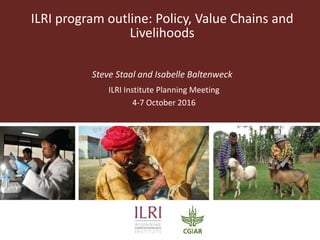
ILRI program outline: Policy, Value Chains and
Livelihoods
Steve Staal and Isabelle Baltenweck
ILRI Institute Planning Meeting
4-7 October 2016
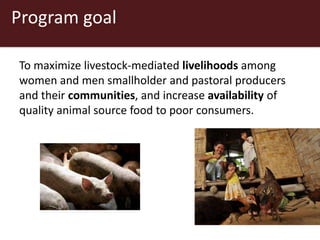
Program goal
To maximize livestock-mediated livelihoods among
women and men smallholder and pastoral producers
and their communities, and increase availability of
quality animal source food to poor consumers.
Program objectives
1. Inclusive and sustainable investments by both public and private actors
based on evidence from policy and foresight analysis, and impact
assessment within the context of dynamic and varied global and
regional livestock systems.
2. More gender equitable control of livestock assets, through gender-
transformative approaches and gender responsive technology and
innovation.
3. Improved nutrition in rural households and their communities, by
identifying, testing and facilitating livestock-mediated pathways to
better and more diverse diets.
4. Improved livelihoods and productivity of smallholder livestock keepers
through ex ante assessment of technology packages and strategies.
5. Improved performance of livestock value chains through institutional
innovation and capacity development.
Strategy
How do we achieve these objectives?
• Integrate our work with that of the other ILRI programs,
particularly around technology, livestock systems data,
innovation systems, and systems modeling
• Work closely with ILRI CapDev and others to enable partners
to utilize tools and approaches
• Joint project resource mobilization, design and
implementation with major development agencies for piloting
and action research for scaling
• Partner with high level advocates of livestock research and
development to influence policy and investment
• Leverage expertise and resources with international and
national research organizations across all program teams
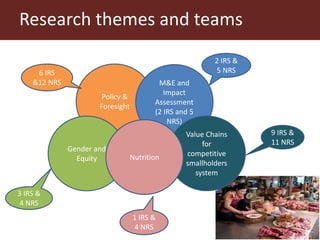
Research themes and teams
Policy &
Foresight
M&E and
Impact
Assessment
(2 IRS and 5
NRS)
Value Chains
for
competitive
smallholders
system
Gender and
Equity Nutrition
2 IRS &
5 NRS6 IRS
&12 NRS
3 IRS &
4 NRS
1 IRS &
4 NRS
9 IRS &
11 NRS
Foresight and policy
Livestock sector and
systems mapping,
and projections of
dynamics and
trends, under
different demand,
supply and
technology scenarios
National level
livestock sector
analyses (LSA),
livestock master
plans (LMP) and
investment road
maps.
Support evidence for
planning and
implementation of
agriculture sector policies
and strategies in Africa
(ReSAKSS), and support to
implementation of the
Comprehensive Africa
Agriculture Development
Programme (CAADP)
M&E and Impact Assessment
Objective: effectively assess ILRI’s and partner activities to
strengthen the quality and choice of research, its
application, uptake and impact.
Outputs :
1. The internalisation of a Theory of Change
approach in ILRI to guide strategic and
program decisions.
2. An evaluation strategy for ILRI research that
is consistent with guidelines published by
the CGIAR’s Independent Evaluation
Arrangement.
3. Rigorous ex-ante and ex-post adoption and
impact assessments to inform decision
making for specific technologies and
interventions.
Gender and Equity
Shift in focus from
ownership to
control over
benefits
Livestock hold
varied and gendered
importance
Re-negotiating
obstructive gender
norms
Synergies between
empowerment and
nutrition
Gender dimensions
of new institutional
arrangements in
value chains
Youth participation
in the livestock
sector
Outputs
• Packages of gender-responsive institutional
and technical innovations to enhance
productivity and equity
• Gender-transformative approaches
developed to address the root causes of
gender discrimination, and their
effectiveness assessed
• Gender-sensitive indicators and
methodologies developed for assessing
progress on gender strategic change
• Interventions to increase youth, and other
marginalized groups’ participation in the
livestock sector
Nutrition
Objective: adopt a whole diet and food system approach
to livestock-mediated improved nutrition that addresses
interaction between nutrition and gender, and between
households, markets and policies.
Outputs
1. Projections of ASF availability under
alternative demographic and production
scenarios.
2. New evidence on the role of ASFs in
enhancing nutrition in poor households
3. Impact pathways identified from livestock
keeping to improved nutrition in resource
poor households
4. Evidence-based options for effective
interventions in livestock-keeping
communities to improved nutrition.
Value chains for competitive smallholder
systems
Performance of livestock market
systems for products, inputs and
services analysed and key barriers
identified, value addition and equity
issues understood, and entry points
identified for improved performance
New inclusive and scalable institutional
arrangements developed and tested,
that address key needs for a) enhanced
product market and value chain
performance and b) improved delivery
of livestock inputs and services
Evidence on
mechanisms for
improved
performance and
inclusiveness in
livestock-related value
chains
Contribution to CRPs
• Play lead role in the new Livelihoods and Agrifood Systems Flagship
conducting much of the same work – Foresight & Policy, Nutrition, VC in
smallholder systems, including cross-CRP Gender, M&E and Theory of
Change
• Jointly developing the Livestock module for global IMPACT model
• Tools for VC development and analysis - Virtual VC Hub for E&SA
• Methods for assessment of post-harvest losses, new for livestock
• Food systems flagship on whole systems approaches to nutrition
• Food safety flagship on addressing food safety in ASF VCs
Cross ILRI program linkages and opportunities
Gender and breed choice (small ruminant and chicken)
Smallholder competitiveness in different systems
Delivery of bundled inputs and services
Feed and forage adoption, including gender considerations
Delivery of bundled inputs and services
ITM2Scale and vaccine adoption, including gender considerations
Food safety, nutrition and women empowerment
Delivery of bundled inputs and services
Adoption patterns, impact assessment
Adoption of climate smart technologies and gender
Livelihoods and resilience: 2 faces of the same coin?
Agricultural innovation systems
Foresight and systems analysis; trade-offs analysis
Impact assessment & adoption studies
Genetic
Feeds &
Forage
Health
BECA
SLS
Impact
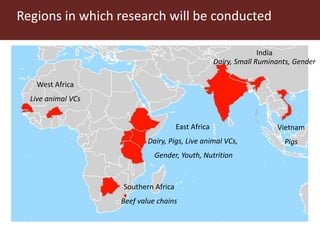
Regions in which research will be conducted
Southern Africa
Beef value chains
West Africa
Live animal VCs
East Africa
Dairy, Pigs, Live animal VCs,
Gender, Youth, Nutrition
Vietnam
Pigs
India
Dairy, Small Ruminants, Gender
Foresight & Policy
Gender & Social
Equity
Enhancing Nutrition
through Livestock
Value chains for
competitive
smallholders
systems
Gender equitable
control of assets and
resources
Improved capacity
of women and
youth to participate
in decision-making
Increased access to
diverse nutrient rich
foods
Increased livelihood
opportunities
Reduced market
barriers
Conducive Policy
Environment
Our Theory of Change…
* Livestock keepers &
their communities
* Private sector
* Development partners
* Government agencies
* Policy & decision makers
* Research partners
Research teams
(Sphere of Control)
Research & near development outcomes
(Sphere of Influence)
Sub- IDOs
(Sphere of Interest)
Monitoring,
Evaluation &
Impact Assessment
Decision
making is
based on
evidence
Demand for
livestock
(products) is
adequate
Actors are willing
& able to invest in
new approaches
Gender
transformative
approaches
translate into
lasting benefits
Nutrition
interventions
are win-win
Support service needs
Strengthen metadata of
research data
Business Development Unit
working effectively
CKM- more flexible and cost
effective solutions
Corporate services: flexibility in procurement
systems given the needs of development
projects (faster, different types of services
required)
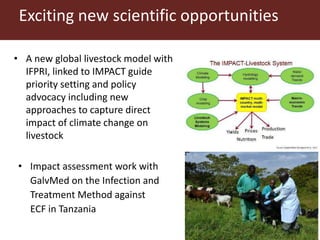
Exciting new scientific opportunities
• A new global livestock model with
IFPRI, linked to IMPACT guide
priority setting and policy
advocacy including new
approaches to capture direct
impact of climate change on
livestock
• Impact assessment work with
GalvMed on the Infection and
Treatment Method against
ECF in Tanzania
Program Name
• Policy, Value Chains and Livelihoods (PVCL?)
• Policy and Livelihoods (P&L)
• Livelihoods and Policy (L&P)
• Policy, Institutions and Livelihoods (PIL)
• Livelihoods, Institutions and Policy (LIP)
Thank you
This presentation is licensed for use under the Creative Commons Attribution 4.0 International Licence.
better lives through livestock
ilri.org
ILRI thanks all donors and organizations who globally supported its work through their contributions
to the CGIAR system

ILRI program outline: Policy, Value Chains and Livelihoods

  • 1.
    ILRI program outline:Policy, Value Chains and Livelihoods Steve Staal and Isabelle Baltenweck ILRI Institute Planning Meeting 4-7 October 2016
  • 2.
    Program goal To maximizelivestock-mediated livelihoods among women and men smallholder and pastoral producers and their communities, and increase availability of quality animal source food to poor consumers.
  • 3.
    Program objectives 1. Inclusiveand sustainable investments by both public and private actors based on evidence from policy and foresight analysis, and impact assessment within the context of dynamic and varied global and regional livestock systems. 2. More gender equitable control of livestock assets, through gender- transformative approaches and gender responsive technology and innovation. 3. Improved nutrition in rural households and their communities, by identifying, testing and facilitating livestock-mediated pathways to better and more diverse diets. 4. Improved livelihoods and productivity of smallholder livestock keepers through ex ante assessment of technology packages and strategies. 5. Improved performance of livestock value chains through institutional innovation and capacity development.
  • 4.
    Strategy How do weachieve these objectives? • Integrate our work with that of the other ILRI programs, particularly around technology, livestock systems data, innovation systems, and systems modeling • Work closely with ILRI CapDev and others to enable partners to utilize tools and approaches • Joint project resource mobilization, design and implementation with major development agencies for piloting and action research for scaling • Partner with high level advocates of livestock research and development to influence policy and investment • Leverage expertise and resources with international and national research organizations across all program teams
  • 5.
    Research themes andteams Policy & Foresight M&E and Impact Assessment (2 IRS and 5 NRS) Value Chains for competitive smallholders system Gender and Equity Nutrition 2 IRS & 5 NRS6 IRS &12 NRS 3 IRS & 4 NRS 1 IRS & 4 NRS 9 IRS & 11 NRS
  • 6.
    Foresight and policy Livestocksector and systems mapping, and projections of dynamics and trends, under different demand, supply and technology scenarios National level livestock sector analyses (LSA), livestock master plans (LMP) and investment road maps. Support evidence for planning and implementation of agriculture sector policies and strategies in Africa (ReSAKSS), and support to implementation of the Comprehensive Africa Agriculture Development Programme (CAADP)
  • 7.
    M&E and ImpactAssessment Objective: effectively assess ILRI’s and partner activities to strengthen the quality and choice of research, its application, uptake and impact. Outputs : 1. The internalisation of a Theory of Change approach in ILRI to guide strategic and program decisions. 2. An evaluation strategy for ILRI research that is consistent with guidelines published by the CGIAR’s Independent Evaluation Arrangement. 3. Rigorous ex-ante and ex-post adoption and impact assessments to inform decision making for specific technologies and interventions.
  • 8.
    Gender and Equity Shiftin focus from ownership to control over benefits Livestock hold varied and gendered importance Re-negotiating obstructive gender norms Synergies between empowerment and nutrition Gender dimensions of new institutional arrangements in value chains Youth participation in the livestock sector Outputs • Packages of gender-responsive institutional and technical innovations to enhance productivity and equity • Gender-transformative approaches developed to address the root causes of gender discrimination, and their effectiveness assessed • Gender-sensitive indicators and methodologies developed for assessing progress on gender strategic change • Interventions to increase youth, and other marginalized groups’ participation in the livestock sector
  • 9.
    Nutrition Objective: adopt awhole diet and food system approach to livestock-mediated improved nutrition that addresses interaction between nutrition and gender, and between households, markets and policies. Outputs 1. Projections of ASF availability under alternative demographic and production scenarios. 2. New evidence on the role of ASFs in enhancing nutrition in poor households 3. Impact pathways identified from livestock keeping to improved nutrition in resource poor households 4. Evidence-based options for effective interventions in livestock-keeping communities to improved nutrition.
  • 10.
    Value chains forcompetitive smallholder systems Performance of livestock market systems for products, inputs and services analysed and key barriers identified, value addition and equity issues understood, and entry points identified for improved performance New inclusive and scalable institutional arrangements developed and tested, that address key needs for a) enhanced product market and value chain performance and b) improved delivery of livestock inputs and services Evidence on mechanisms for improved performance and inclusiveness in livestock-related value chains
  • 11.
    Contribution to CRPs •Play lead role in the new Livelihoods and Agrifood Systems Flagship conducting much of the same work – Foresight & Policy, Nutrition, VC in smallholder systems, including cross-CRP Gender, M&E and Theory of Change • Jointly developing the Livestock module for global IMPACT model • Tools for VC development and analysis - Virtual VC Hub for E&SA • Methods for assessment of post-harvest losses, new for livestock • Food systems flagship on whole systems approaches to nutrition • Food safety flagship on addressing food safety in ASF VCs
  • 12.
    Cross ILRI programlinkages and opportunities Gender and breed choice (small ruminant and chicken) Smallholder competitiveness in different systems Delivery of bundled inputs and services Feed and forage adoption, including gender considerations Delivery of bundled inputs and services ITM2Scale and vaccine adoption, including gender considerations Food safety, nutrition and women empowerment Delivery of bundled inputs and services Adoption patterns, impact assessment Adoption of climate smart technologies and gender Livelihoods and resilience: 2 faces of the same coin? Agricultural innovation systems Foresight and systems analysis; trade-offs analysis Impact assessment & adoption studies Genetic Feeds & Forage Health BECA SLS Impact
  • 13.
    Regions in whichresearch will be conducted Southern Africa Beef value chains West Africa Live animal VCs East Africa Dairy, Pigs, Live animal VCs, Gender, Youth, Nutrition Vietnam Pigs India Dairy, Small Ruminants, Gender
  • 14.
    Foresight & Policy Gender& Social Equity Enhancing Nutrition through Livestock Value chains for competitive smallholders systems Gender equitable control of assets and resources Improved capacity of women and youth to participate in decision-making Increased access to diverse nutrient rich foods Increased livelihood opportunities Reduced market barriers Conducive Policy Environment Our Theory of Change… * Livestock keepers & their communities * Private sector * Development partners * Government agencies * Policy & decision makers * Research partners Research teams (Sphere of Control) Research & near development outcomes (Sphere of Influence) Sub- IDOs (Sphere of Interest) Monitoring, Evaluation & Impact Assessment Decision making is based on evidence Demand for livestock (products) is adequate Actors are willing & able to invest in new approaches Gender transformative approaches translate into lasting benefits Nutrition interventions are win-win
  • 15.
    Support service needs Strengthenmetadata of research data Business Development Unit working effectively CKM- more flexible and cost effective solutions Corporate services: flexibility in procurement systems given the needs of development projects (faster, different types of services required)
  • 16.
    Exciting new scientificopportunities • A new global livestock model with IFPRI, linked to IMPACT guide priority setting and policy advocacy including new approaches to capture direct impact of climate change on livestock • Impact assessment work with GalvMed on the Infection and Treatment Method against ECF in Tanzania
  • 17.
    Program Name • Policy,Value Chains and Livelihoods (PVCL?) • Policy and Livelihoods (P&L) • Livelihoods and Policy (L&P) • Policy, Institutions and Livelihoods (PIL) • Livelihoods, Institutions and Policy (LIP)
  • 18.
  • 19.
    This presentation islicensed for use under the Creative Commons Attribution 4.0 International Licence. better lives through livestock ilri.org ILRI thanks all donors and organizations who globally supported its work through their contributions to the CGIAR system

Editor's Notes

  • #2 There MUST be a CGIAR logo or a CRP logo. You can copy and paste the logo you need from the final slide of this presentation. Then you can delete that final slide   To replace a photo above, copy and paste this link in your browser: http://www.flickr.com/photos/ilri/sets/72157632057087650/detail/   Find a photo you like and the right size, copy and paste it in the block above.