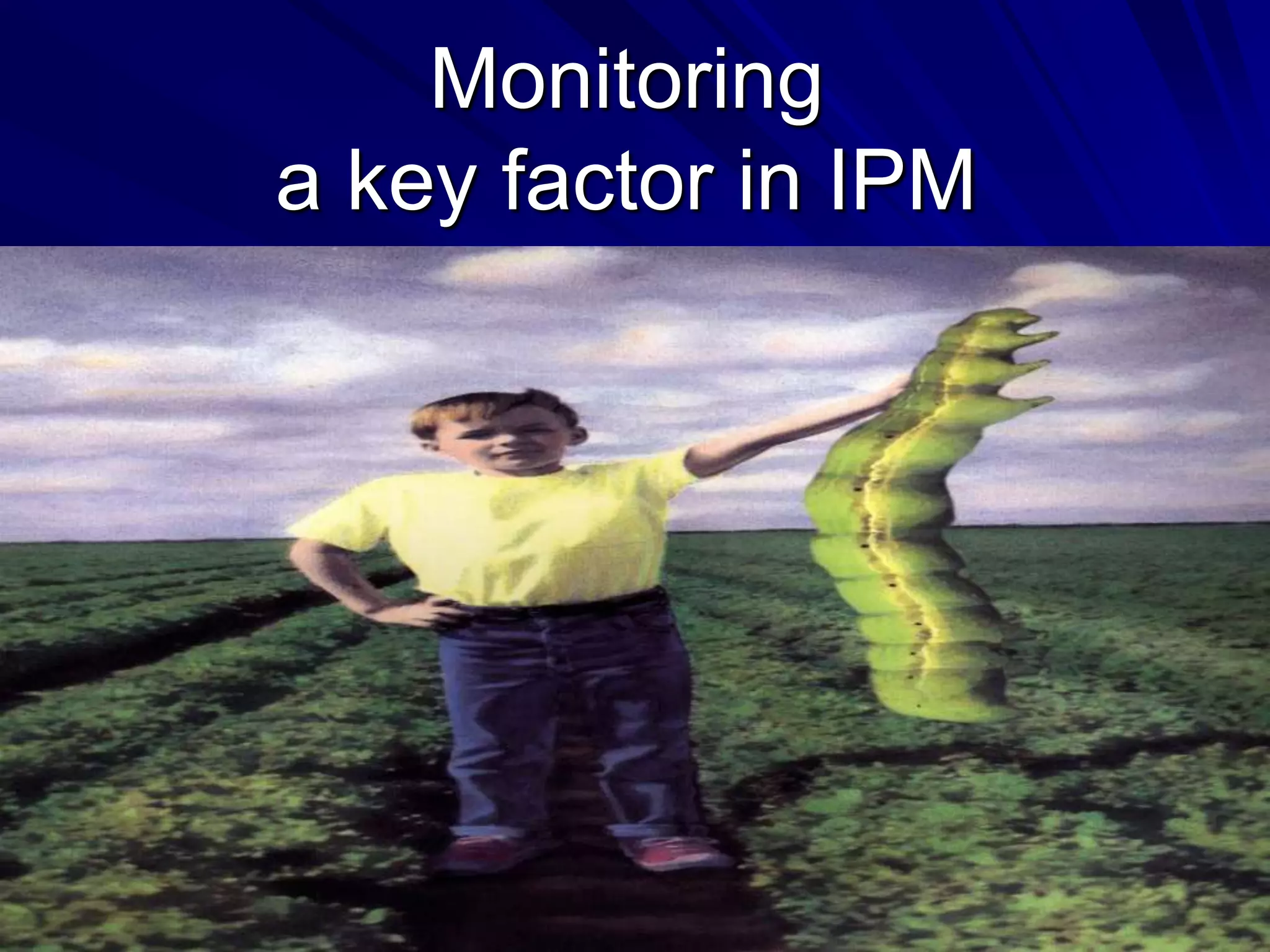
Monitoring
a key factor in IPM
Integrated Pest Management
IPM
Based on Information
– Monitoring
– Identification
– Thresholds
– Evaluation
– Action Plan
Introduction
– Monitoring is used to survey all damages
that could be caused by insects, diseases
and weeds.
– When a pest is present in an crop the
monitoring helps the grower to determine if
control measures are justified.
Monitoring purpose
– Are pests and/or beneficials present.
– Identify them.
– Which stages are present.
– Are control measures justified
Gains
Farmer Knowing his crops.
Saving money.
Use the right product at the right time.
Delayed occurence of pest resistance.
Reduced impact on environment.
Basic knolwedge
Which insects are potential pest
Knowing the signs of potential problems
Physical damage
Insect presence
Webs
Discoloration
IMPORTANCE OF MONITORING
To assess the pest situation and determine
what sort of pest activity is occurring
For decision making
To predict pest problems before they occur
MONITORING METHODS AND PROCEDURES
Monitoring Guidelines
Monitoring Methods
MONITORING GUIDELINES
WHAT TO LOOK FOR
Presence and evidence of pests
Presence of natural enemies
Evidence of damage
-nature of damage
-where the damage is found
-is the pest still present
PEST TRAPPING
–Trapping of insects can help determine
timing for field scouting.
–Trapping should not replace in-field
sampling.
–The most common insect traps attract
insects with visual ( light & colour ),
pheromones, or food odors.
COLOUR TRAPS
– The strong attraction of many insect species
to colour has been exploited in the design of
traps.
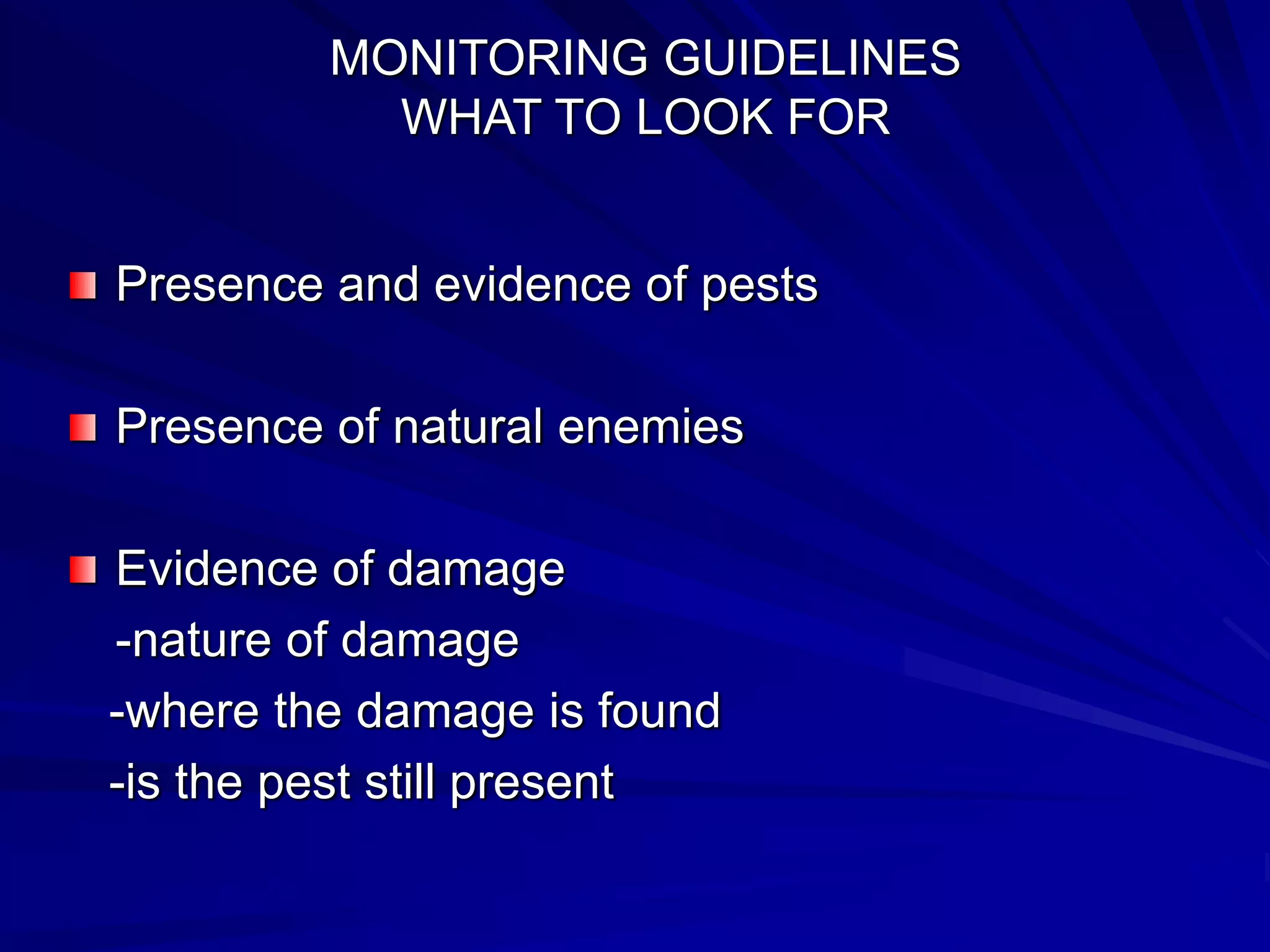
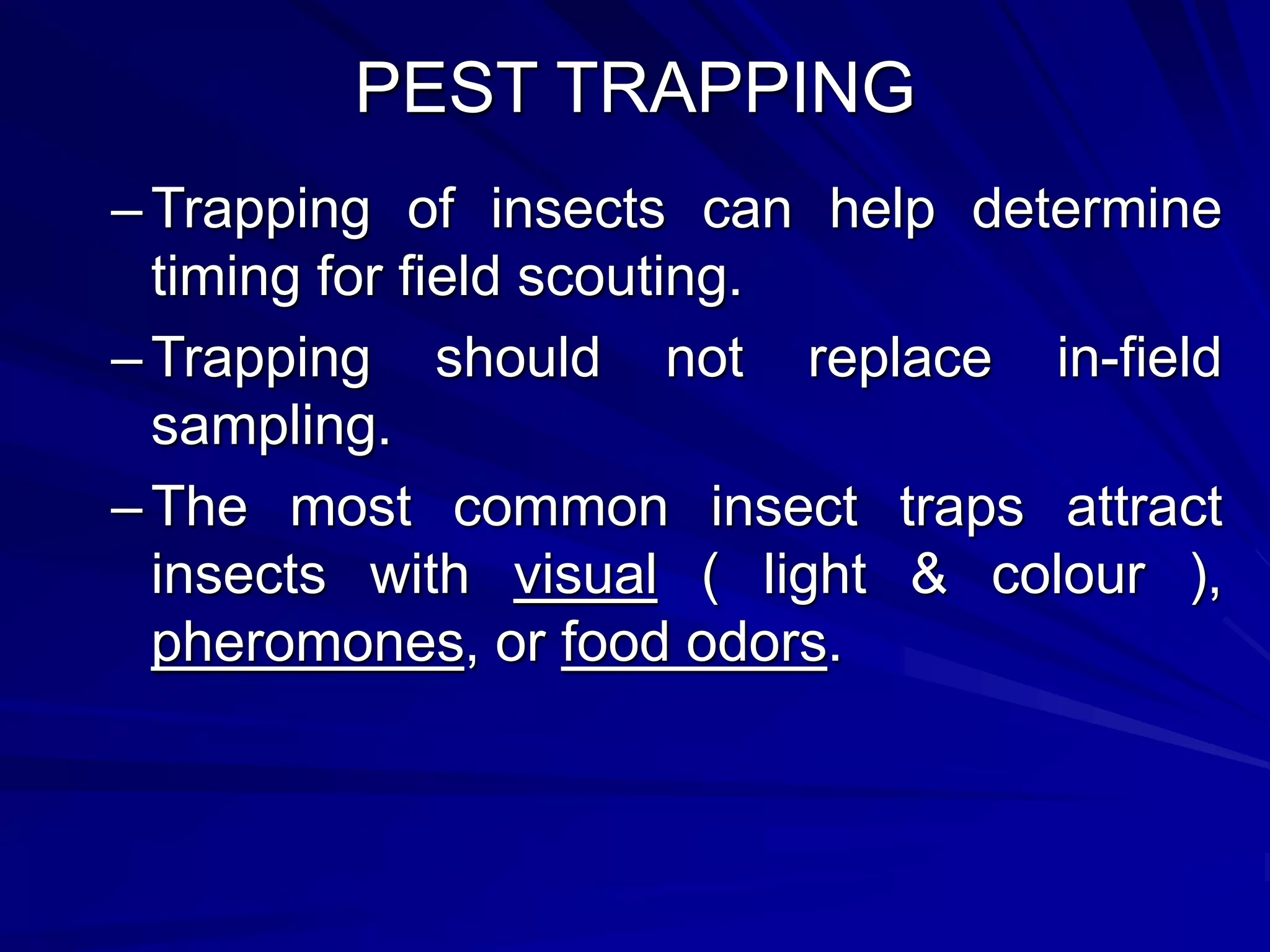
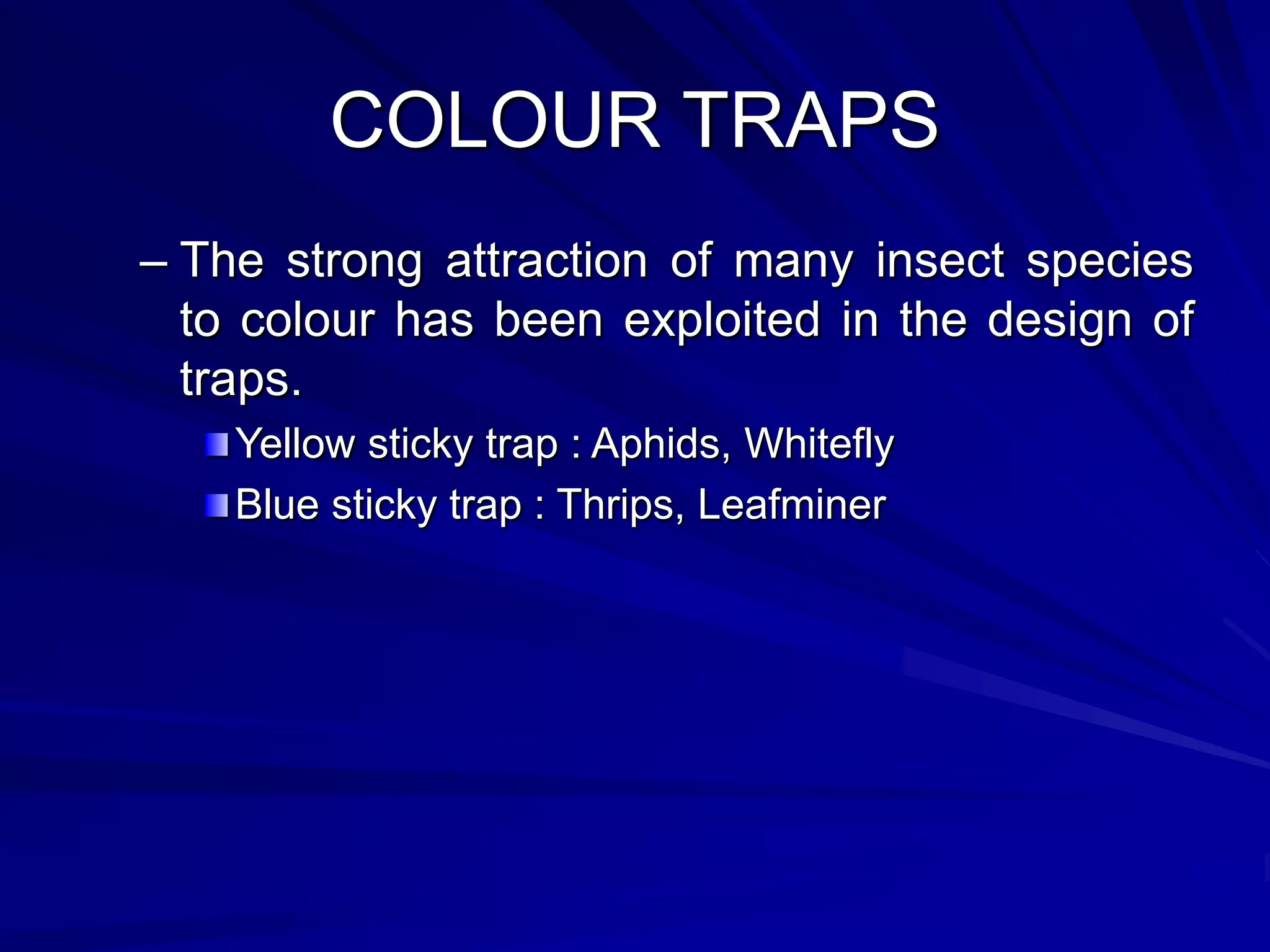
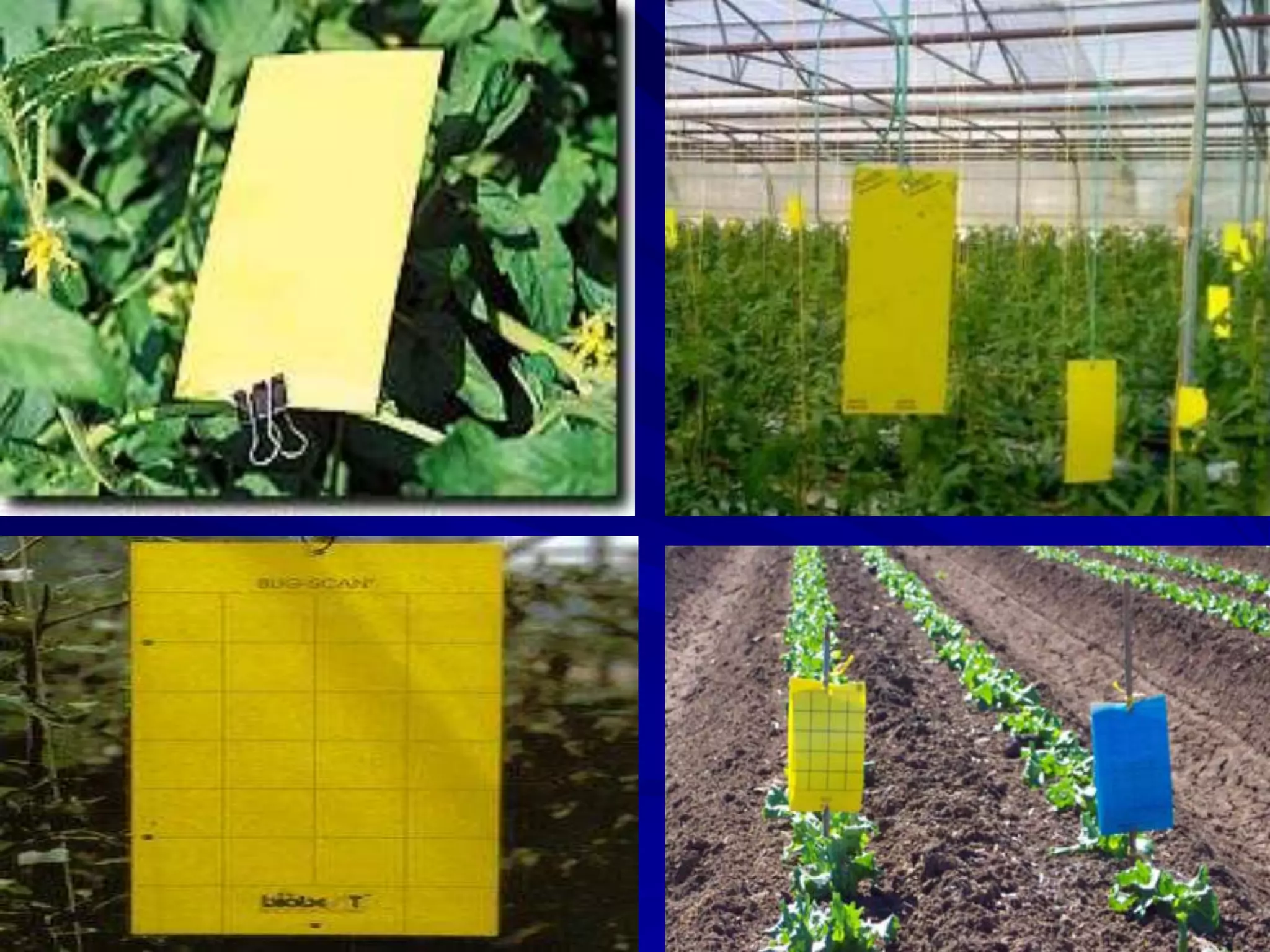
Yellow sticky trap : Aphids, Whitefly
Blue sticky trap : Thrips, Leafminer
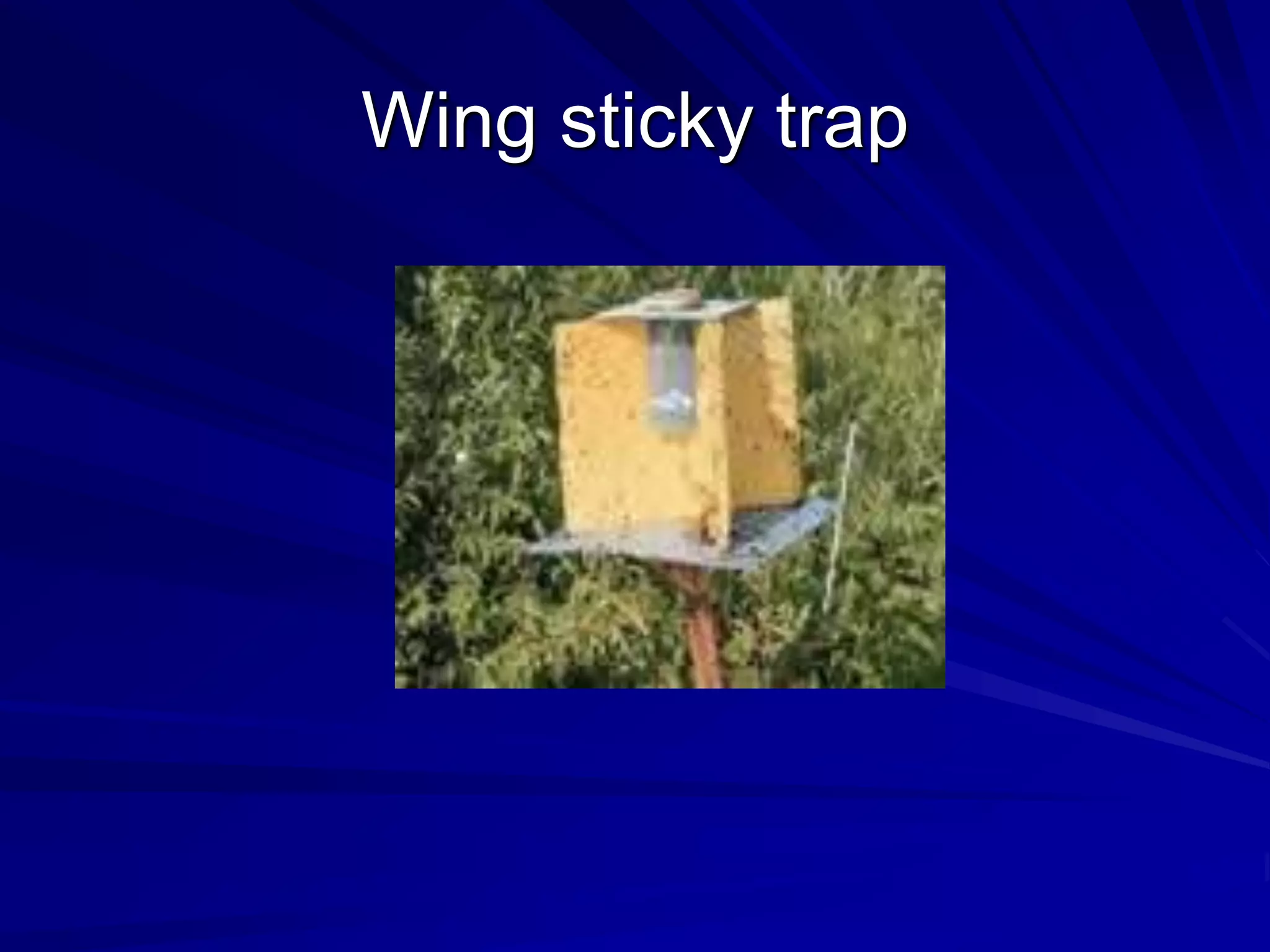
Wing sticky trap
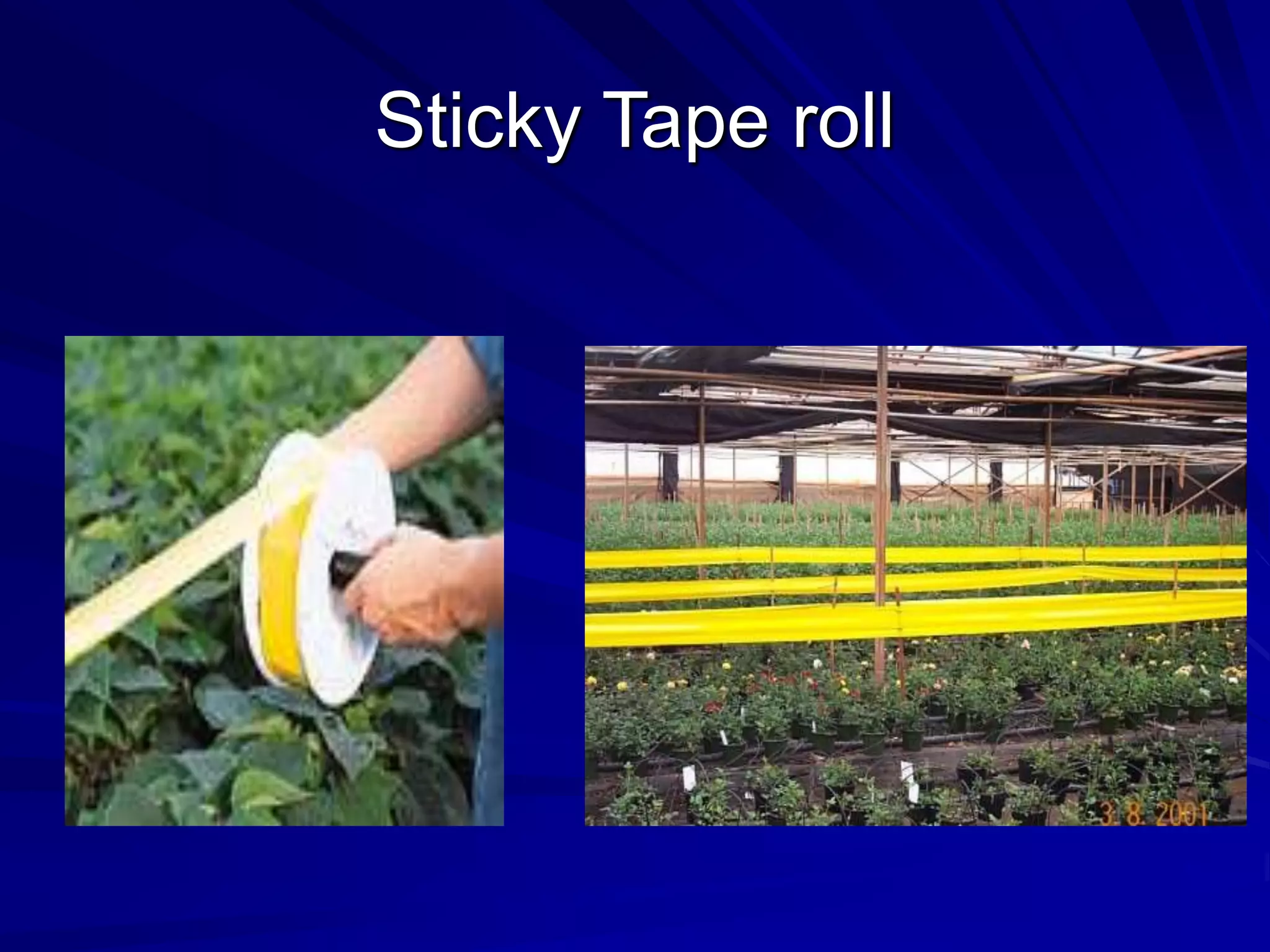
Sticky Tape roll
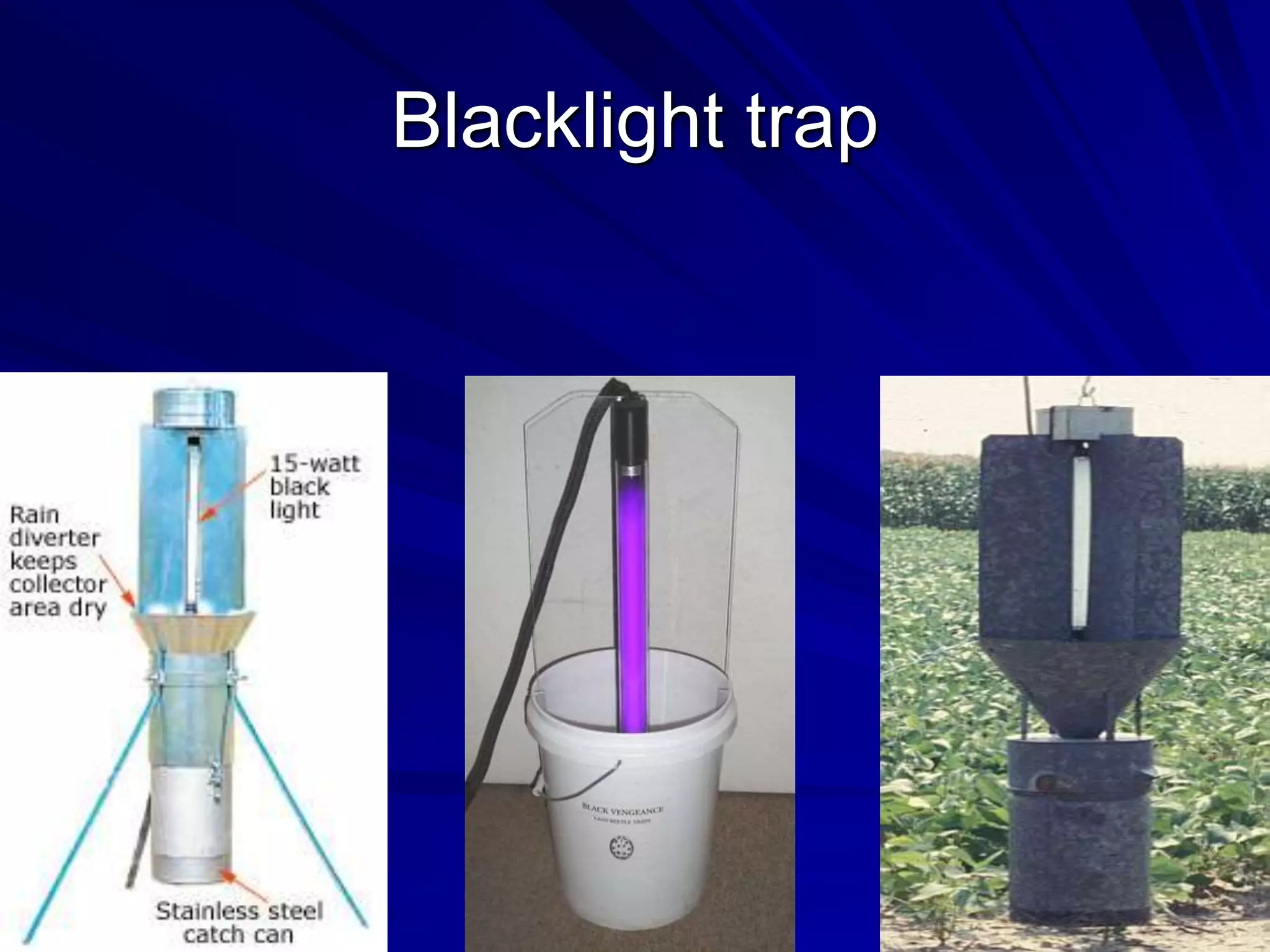
LIGHT TRAPS
Backlight captures do not provide
sampling estimates, but indicate when to
begin scouting based on initial or peak
flight. Backlight traps are labor-intensive
because they are nonselective.
Blacklight trap
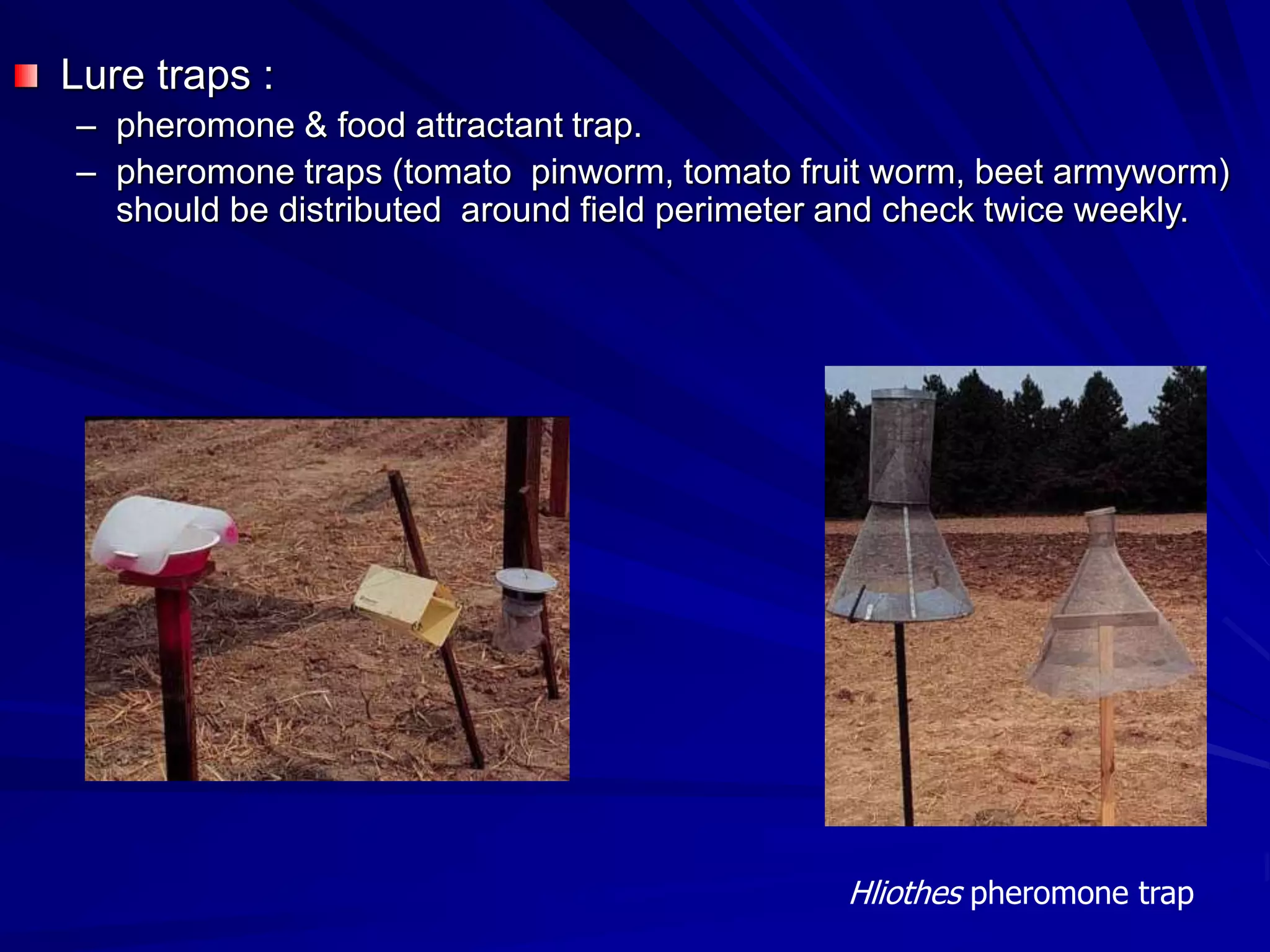
Lure traps :
– pheromone & food attractant trap.
– pheromone traps (tomato pinworm, tomato fruit worm, beet armyworm)
should be distributed around field perimeter and check twice weekly.
Hliothes pheromone trap
SCOUTING
SCOUTING
–One of the most important components of
an IPM program is the use of good scouting
methods.
–Regular and systematic field-sampling
program
–scouting provides field-specific information
on pest pressure and crop injury.
–This information is essential to the
appropriate selection and application of
pest management procedures.
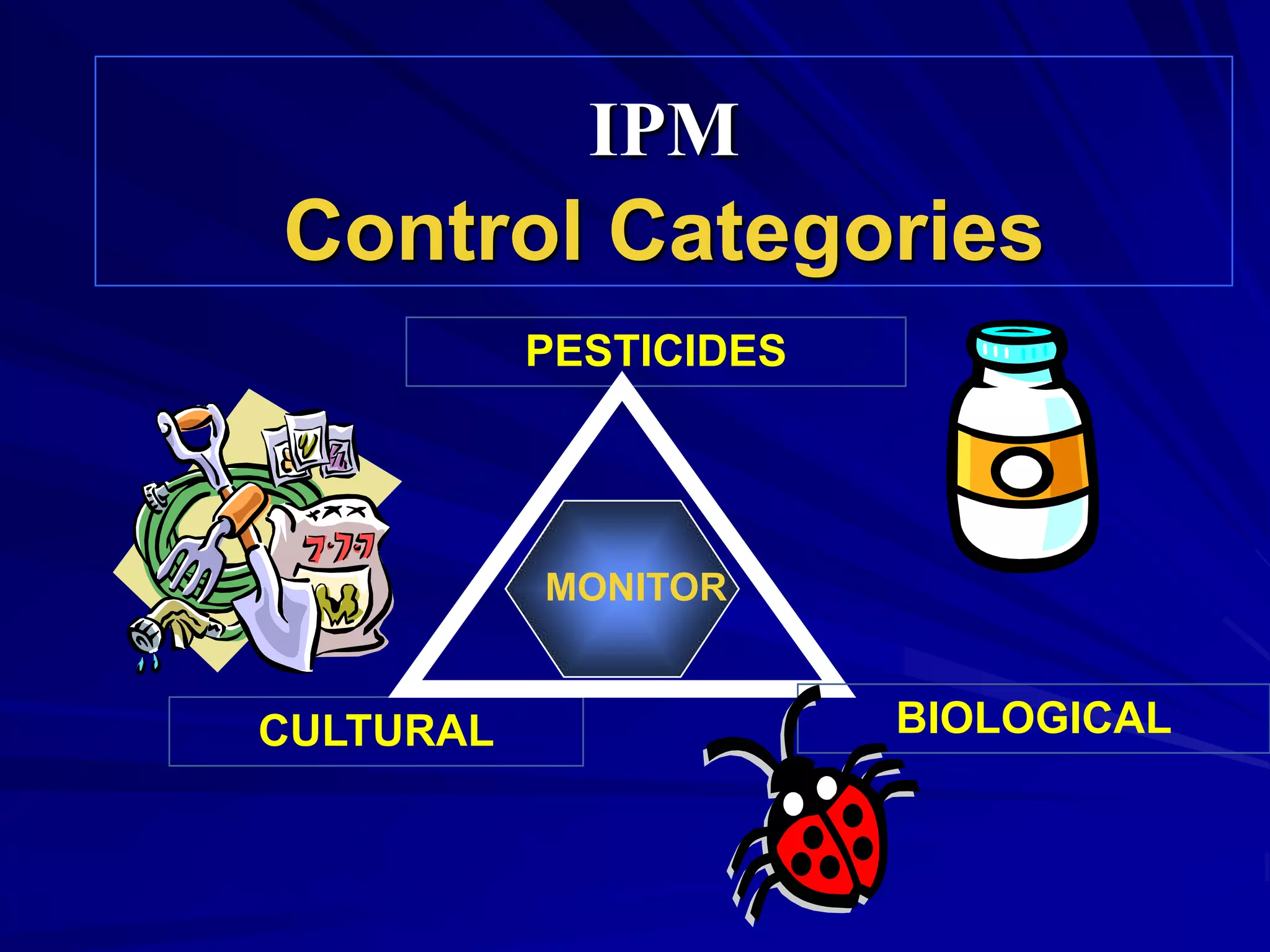
CULTURAL
PESTICIDES
MONITOR
BIOLOGICAL
IPM
Control Categories
In order to carry out a sound scouting
program, a pest management
practitioner must know:
1. When to scout.
2. The proper methods for scouting.
3. What tools to use.
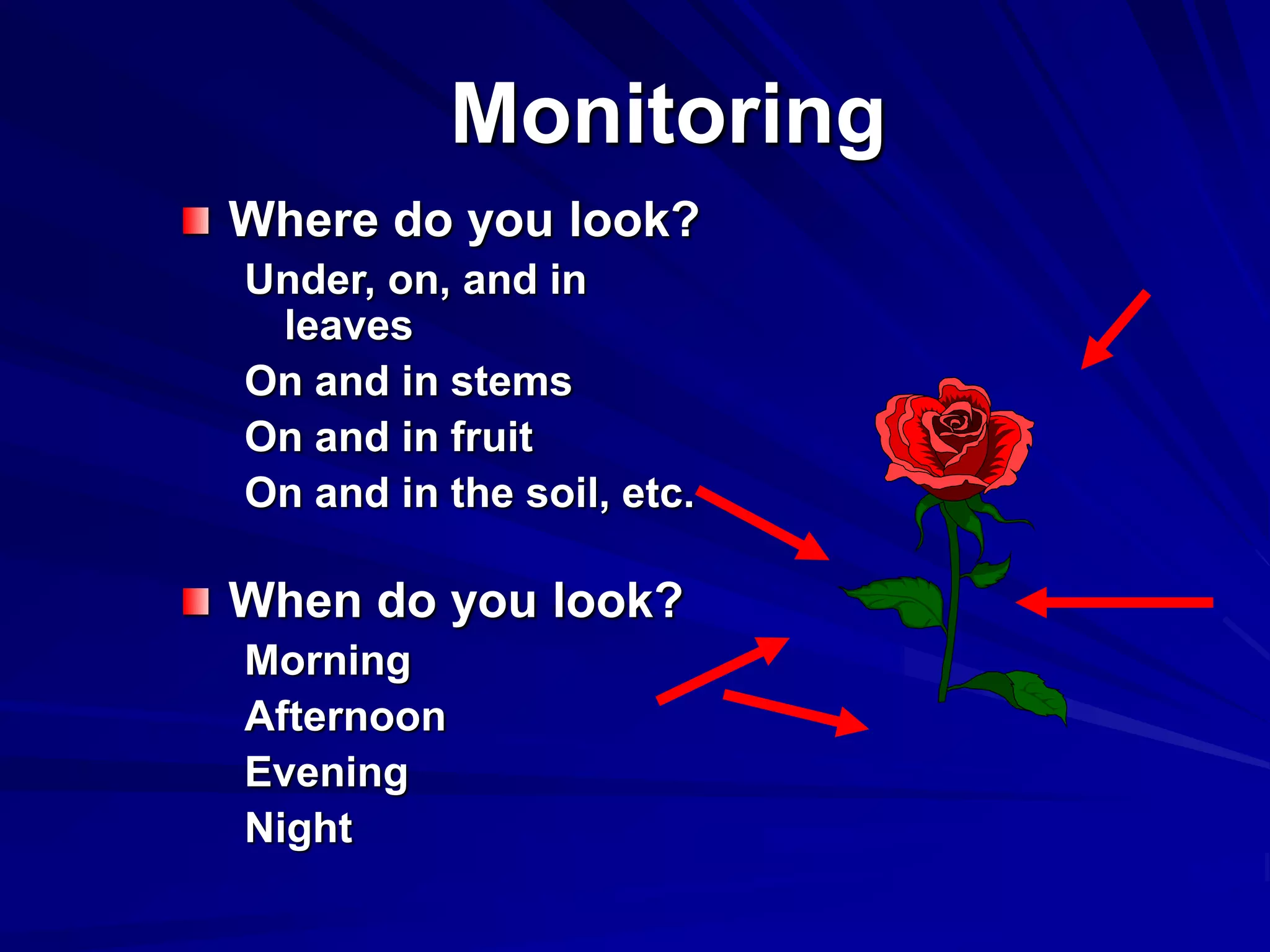
Monitoring
Where do you look?
Under, on, and in
leaves
On and in stems
On and in fruit
On and in the soil, etc.
When do you look?
Morning
Afternoon
Evening
Night
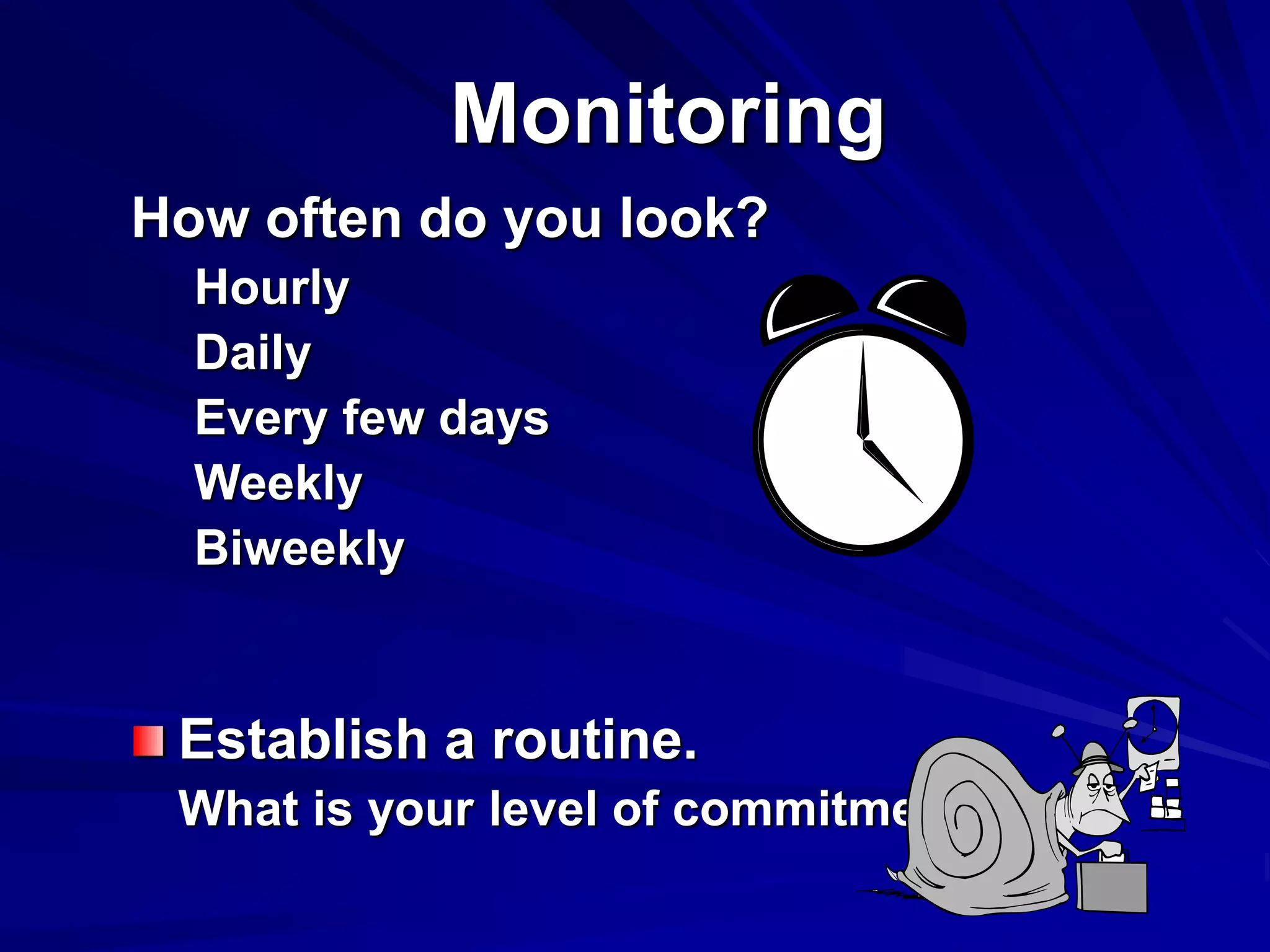
Monitoring
How often do you look?
Hourly
Daily
Every few days
Weekly
Biweekly
Establish a routine.
What is your level of commitment?
A well-designed scouting program includes
three main activities:
Sampling to provide an accurate
estimate of pest densities and crop
health.
Identification of pests or diagnosis of
the cause of crop injury based on
observable symptoms.
Comparison of observed pest pressure
or crop injury to recommended
economic injury levels or economic
thresholds.
SAMPLING PLAN
The sampling plan is the procedure for
obtaining a sample to estimate the
population of one or more pests or the
degree of crop injury in a field.
SAMPLING PLAN
It is not practical to observe every plant within
the field, so fields are sampled to estimate
the level of infestation.
The challenge of sampling is to balance the
accuracy of estimates with the time and labor
required to collect the samples.
Although the reliability of estimates increases
as sample size increases (up to a point), the
collection of too large a sample is costly and
inefficient and it wastes human resources.
Timing and frequency of sampling :
–Knowledge about pest biology and crop
growth will help determine when sampling
should begin and how frequently the field
should be visited.
–Monitoring weather conditions will help in the
prediction of both pest and crop
development.
( degree day models )
–Information included in the field history will
help focus attention on key pests.
–Information from trapping programs will also
provide information on when to scout for
specific pests.
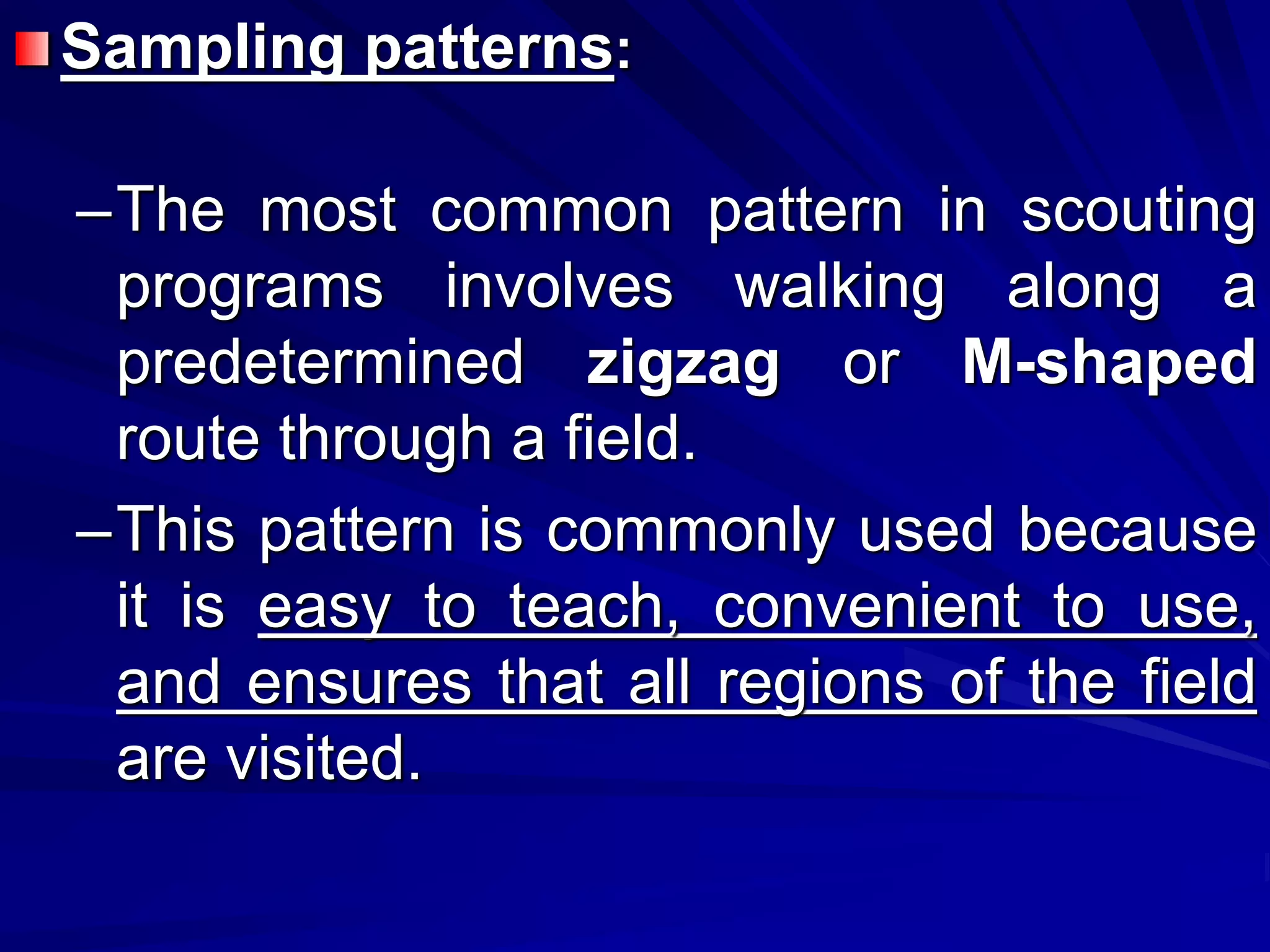
Sampling patterns:
–The most common pattern in scouting
programs involves walking along a
predetermined zigzag or M-shaped
route through a field.
–This pattern is commonly used because
it is easy to teach, convenient to use,
and ensures that all regions of the field
are visited.
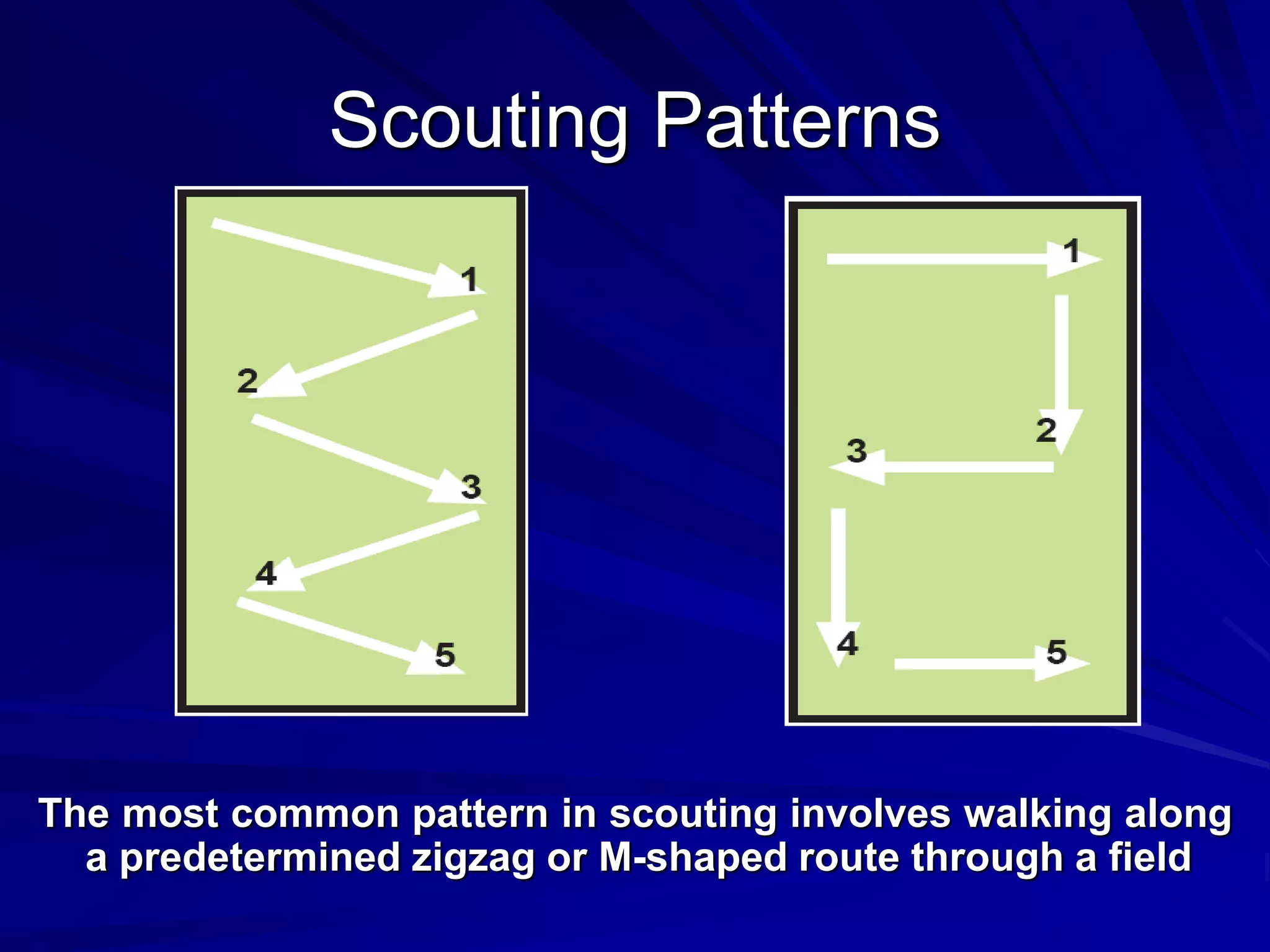
Scouting Patterns
The most common pattern in scouting involves walking along
a predetermined zigzag or M-shaped route through a field
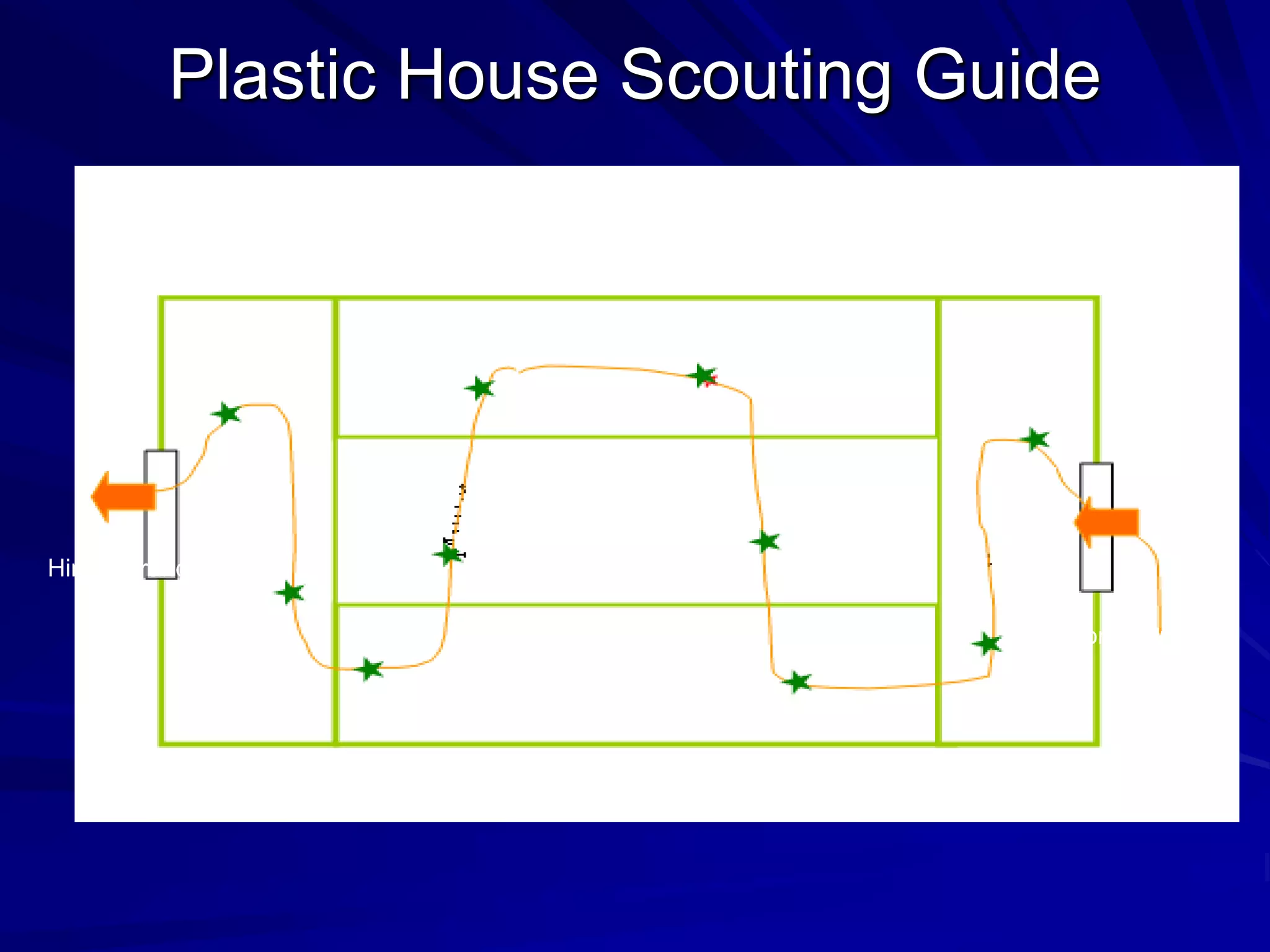
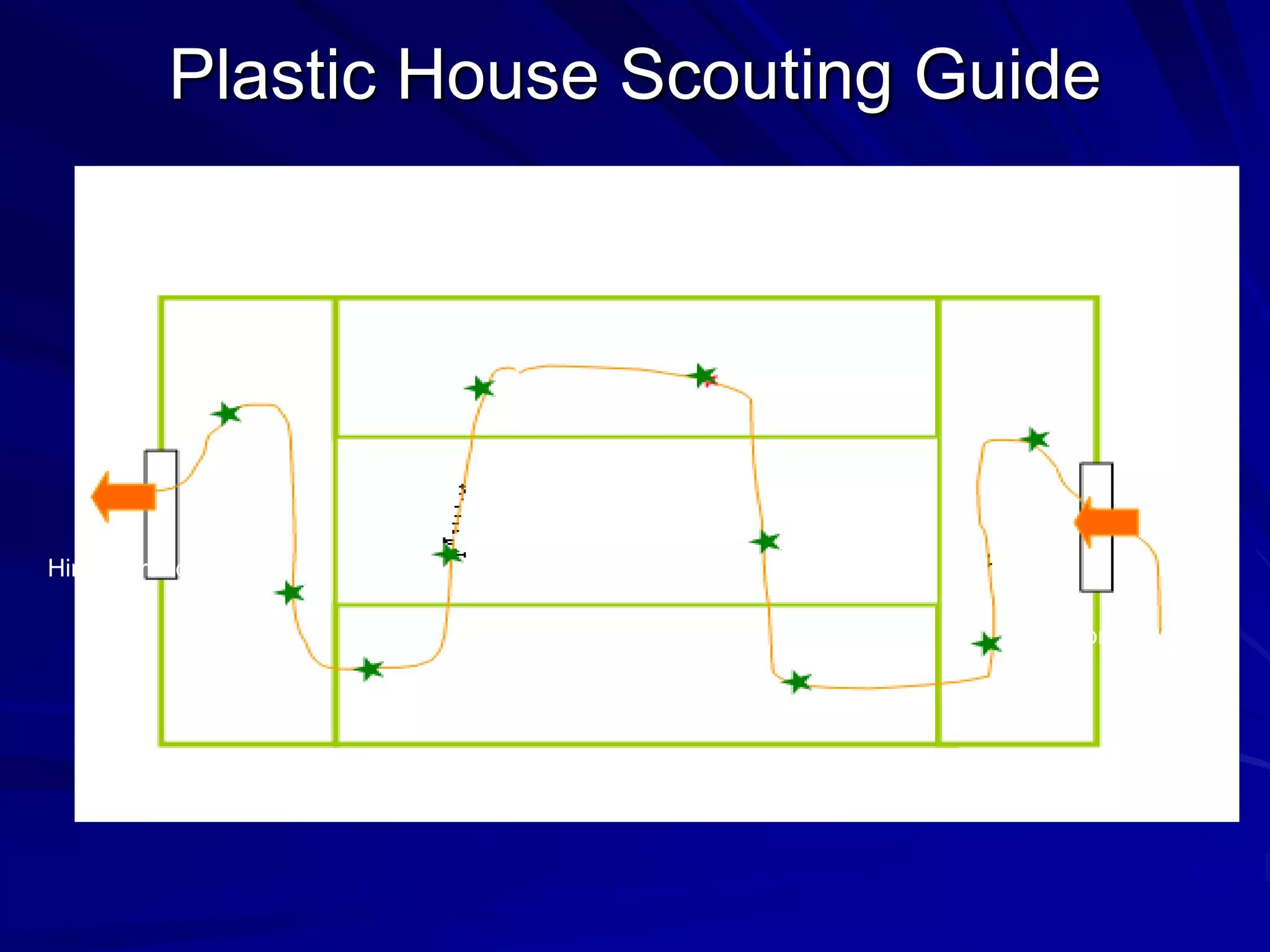
Plastic House Scouting Guide
Front entrance
Hind entrance
Middle area
Shady side
Sunny side
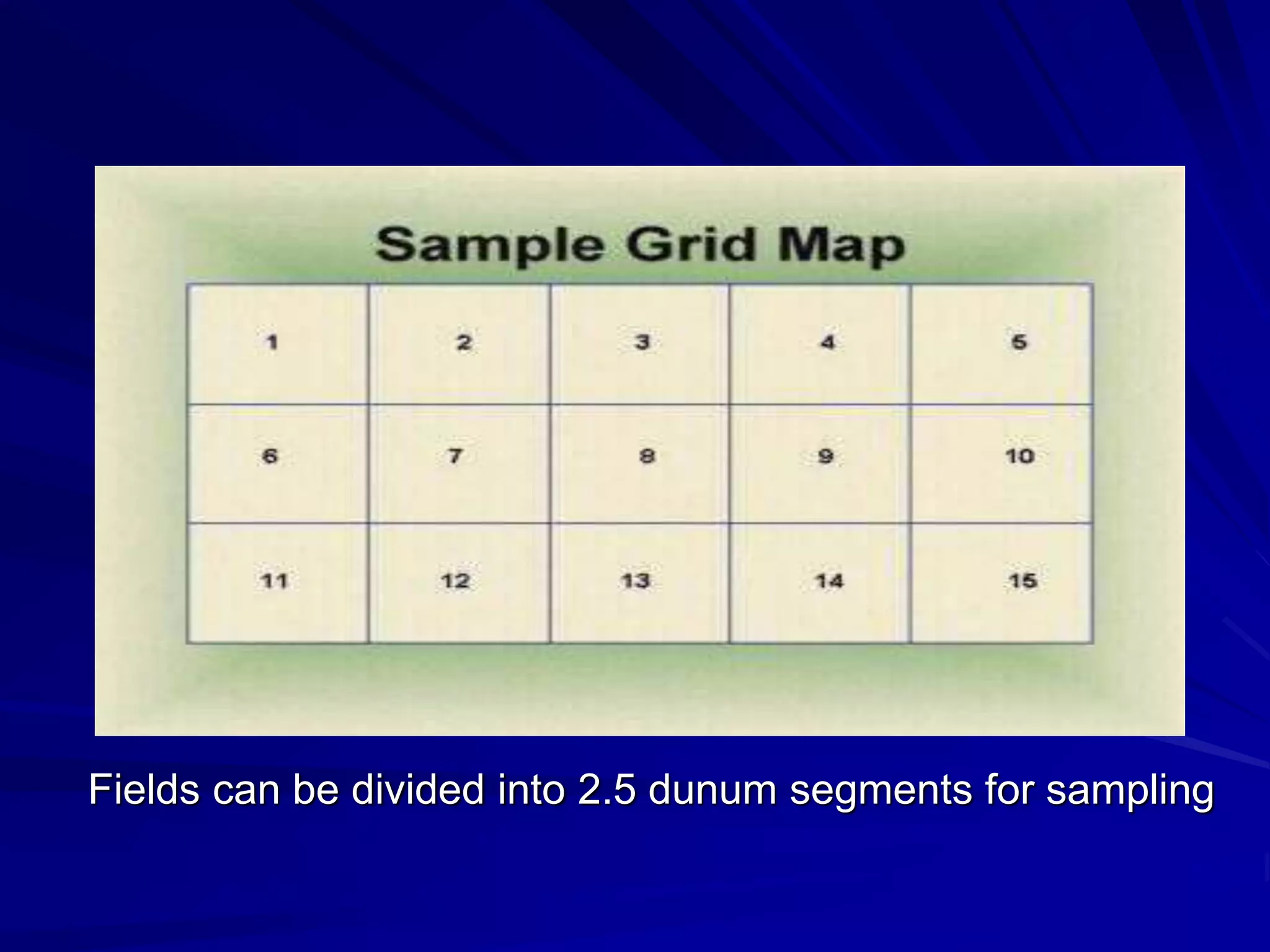
Fields can be divided into 2.5 dunum segments for sampling
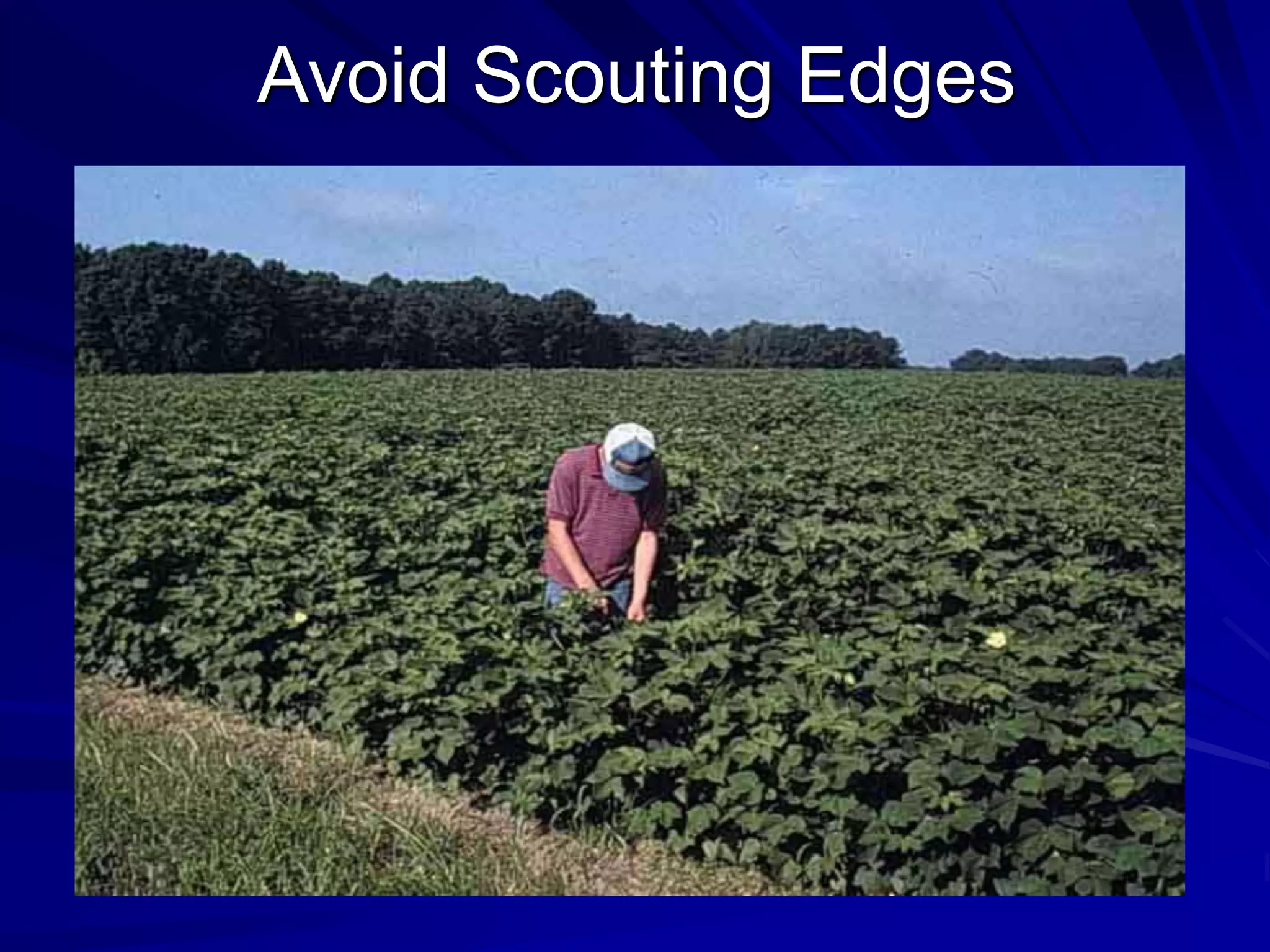
– Cover the entire field during each scouting trip.
Avoid field margins and border rows unless there
are specific reasons for monitoring the edges of the
field.
– “Edge effect “ is the tendency for several key insect
pests to cluster near the field margin. Sampling
near the edge of the field tends to overestimate the
densities of many insect pests.
– On return visits to the field, change the sampling
pattern so that all areas of the field are covered; for
example, alternate a zigzag pattern with an M-
shaped pattern.
– Avoid sampling in the same areas of the field or
always entering the field at the same point on
successive sampling visits.
Avoid Scouting Edges
Number of survey stops :
Sampling units:
– The exact number of survey stops and
sampling units inspected, counted, or
collected at each survey stop may be
influenced by the pest, its spatial dispersion,
the type of crop injury, and other factors.
Pests may be present in different dispersion patterns
within a field, affecting the success of detection.
– Composition of the sampling unit is pest
and often crop specific.
– Time and labor requirements help
determine specific protocols.
It is better to make more survey stops consisting of fewer
sampling units than smaller survey stops consisting of larger
sampling unit.
Methods of sample collection :
–Procedures for sampling methods are
varied and are often pest/host
specific.
–The recommended sampling method
for a particular pest on a crop may
differ according to the growth stage of
either the pest or the crop and even
the canopy structure of the crop.
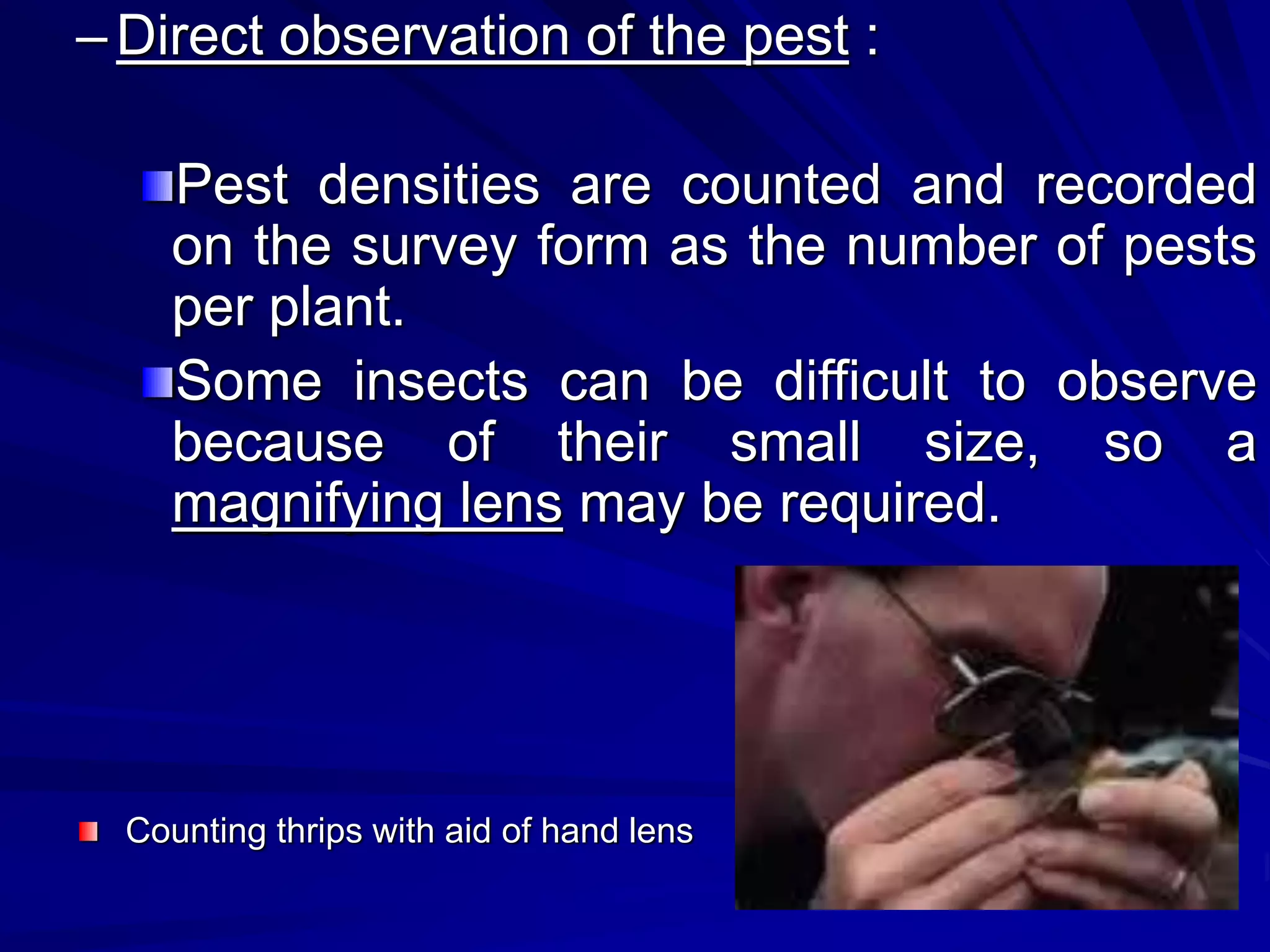
–Direct observation of the pest :
Pest densities are counted and recorded
on the survey form as the number of pests
per plant.
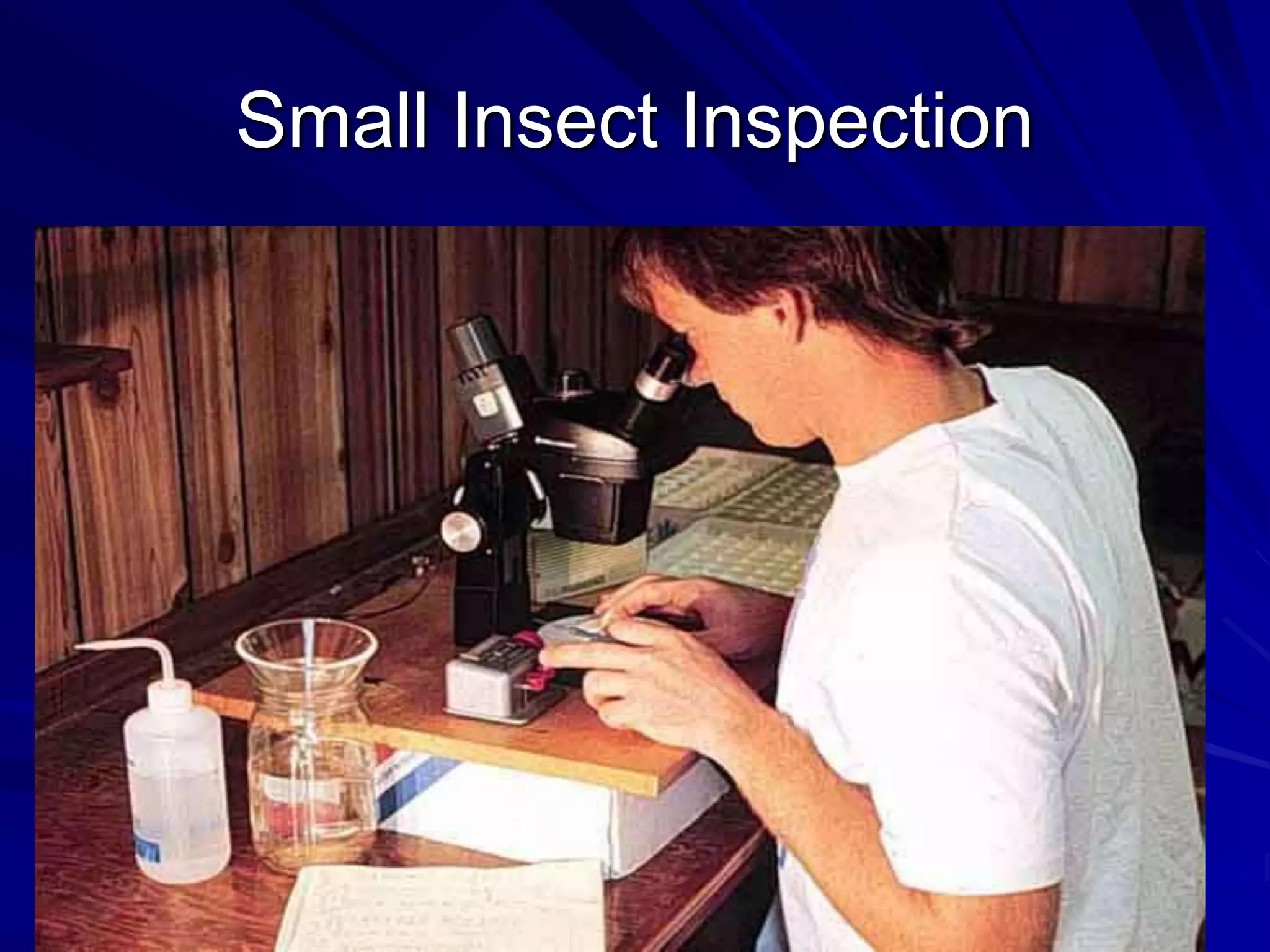
Some insects can be difficult to observe
because of their small size, so a
magnifying lens may be required.
Counting thrips with aid of hand lens
–Sometimes, only a specific portion
of the plant is examined. Insects
may be observed on a specific plant
part because the pest has a
preferred site on the plant for
feeding or egg-laying.
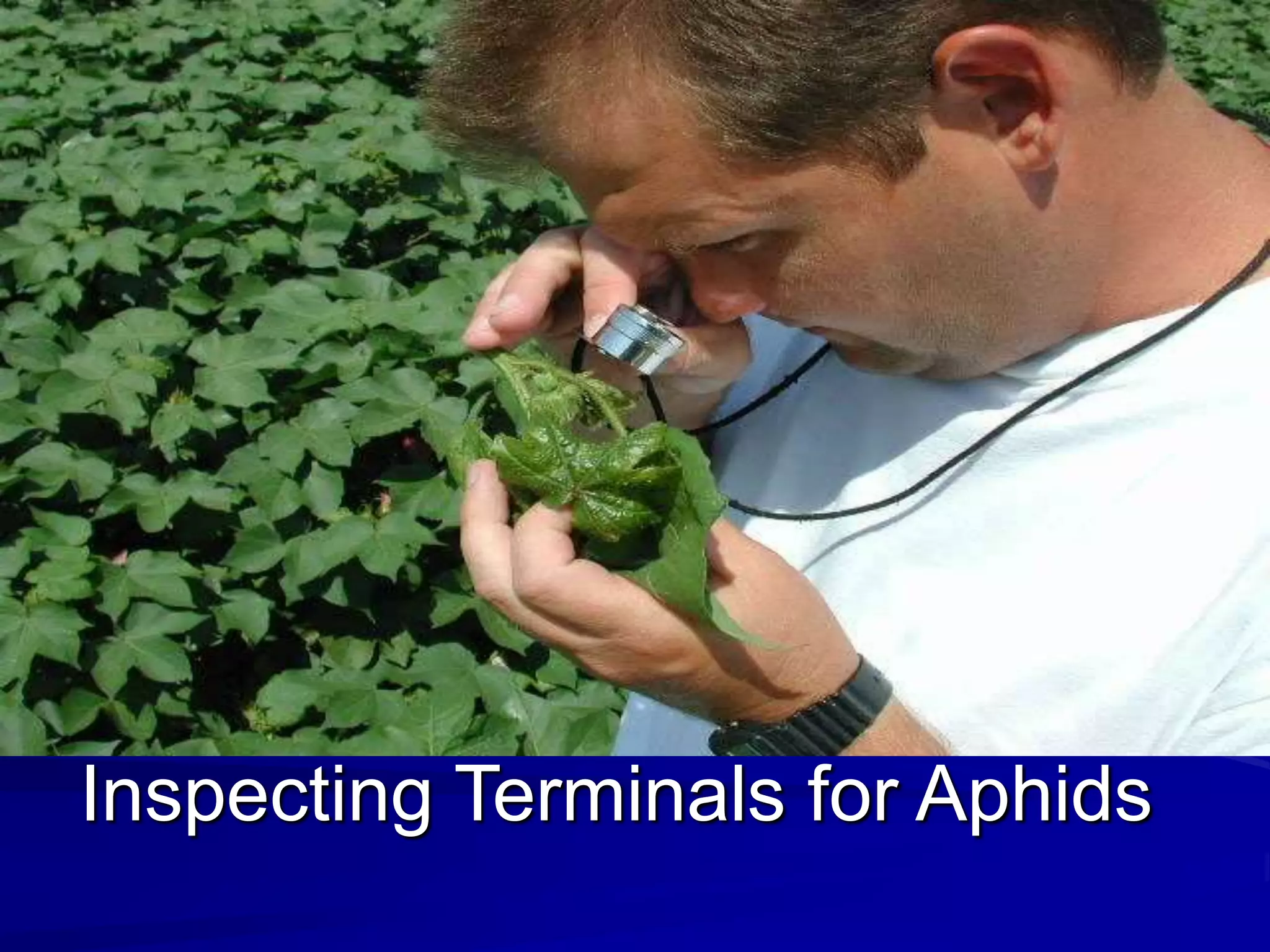
Inspecting Terminals for Aphids
Small Insect Inspection
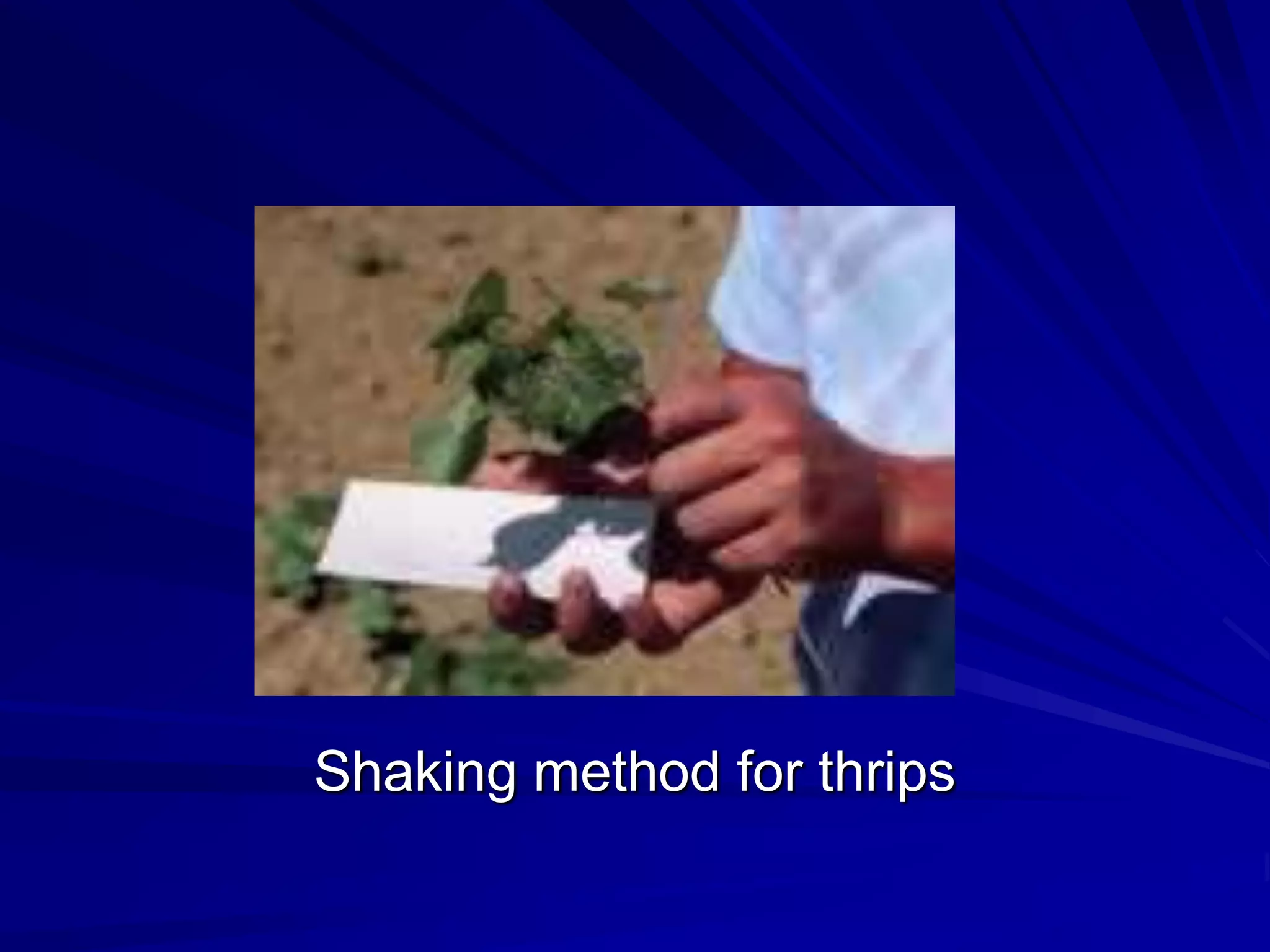
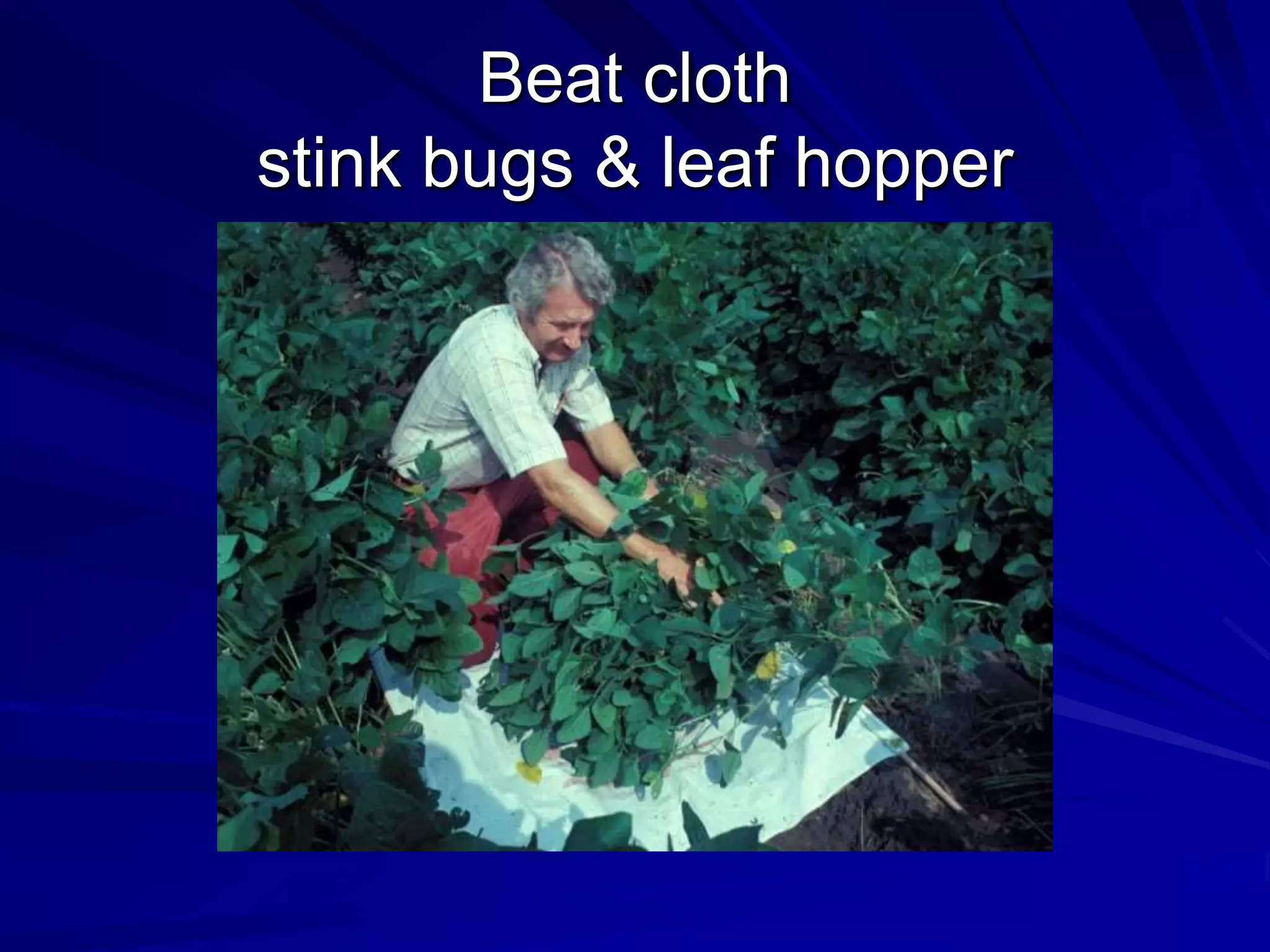
Shaking methods: Some insects are
easier to count if they are dislodged
from the plant by vigorous shaking
and allowing the insects to fall onto a
white or yellow “beat sheet.”
Shaking method for thrips
Beat cloth
stink bugs & leaf hopper
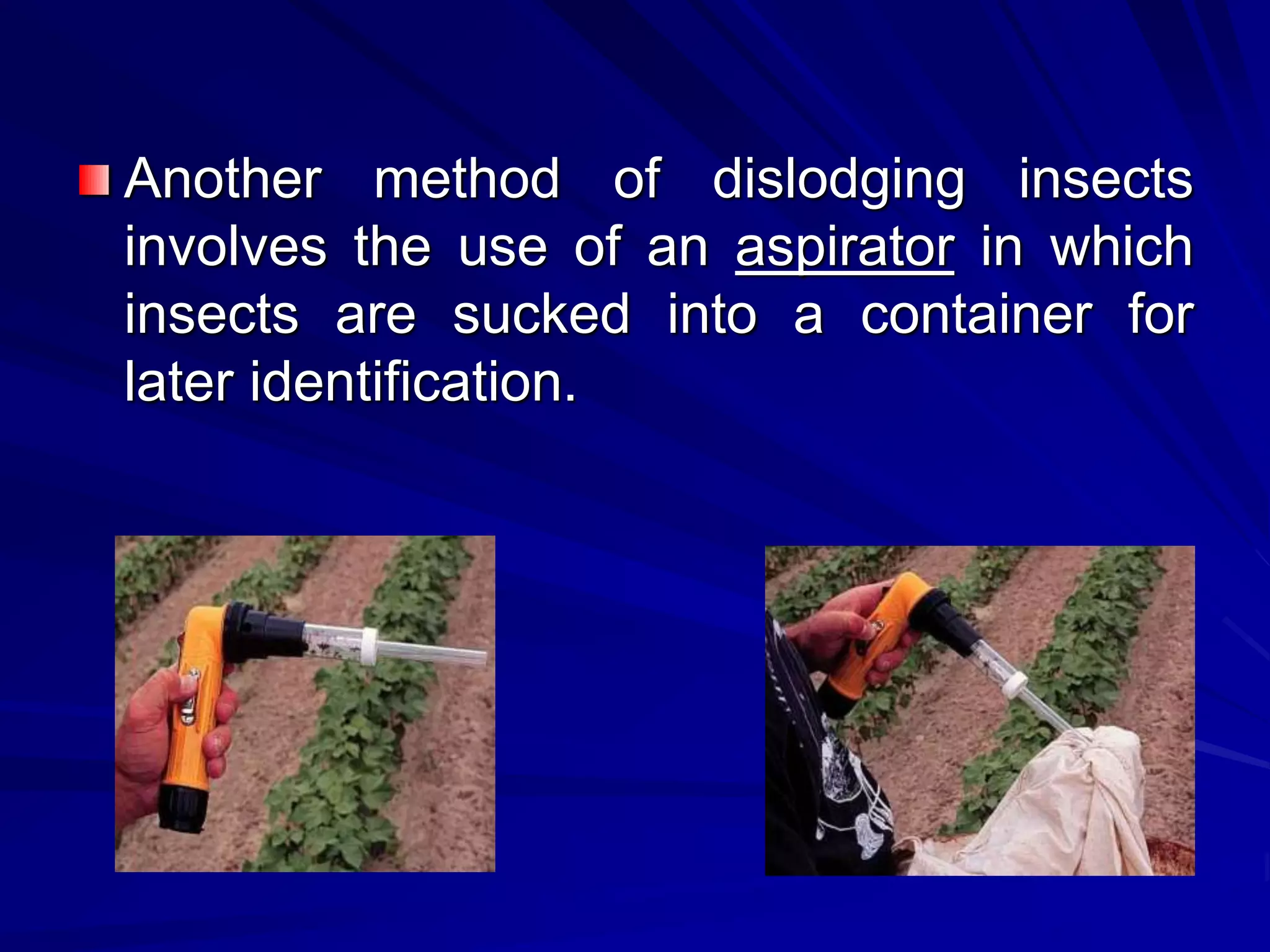
Another method of dislodging insects
involves the use of an aspirator in which
insects are sucked into a container for
later identification.
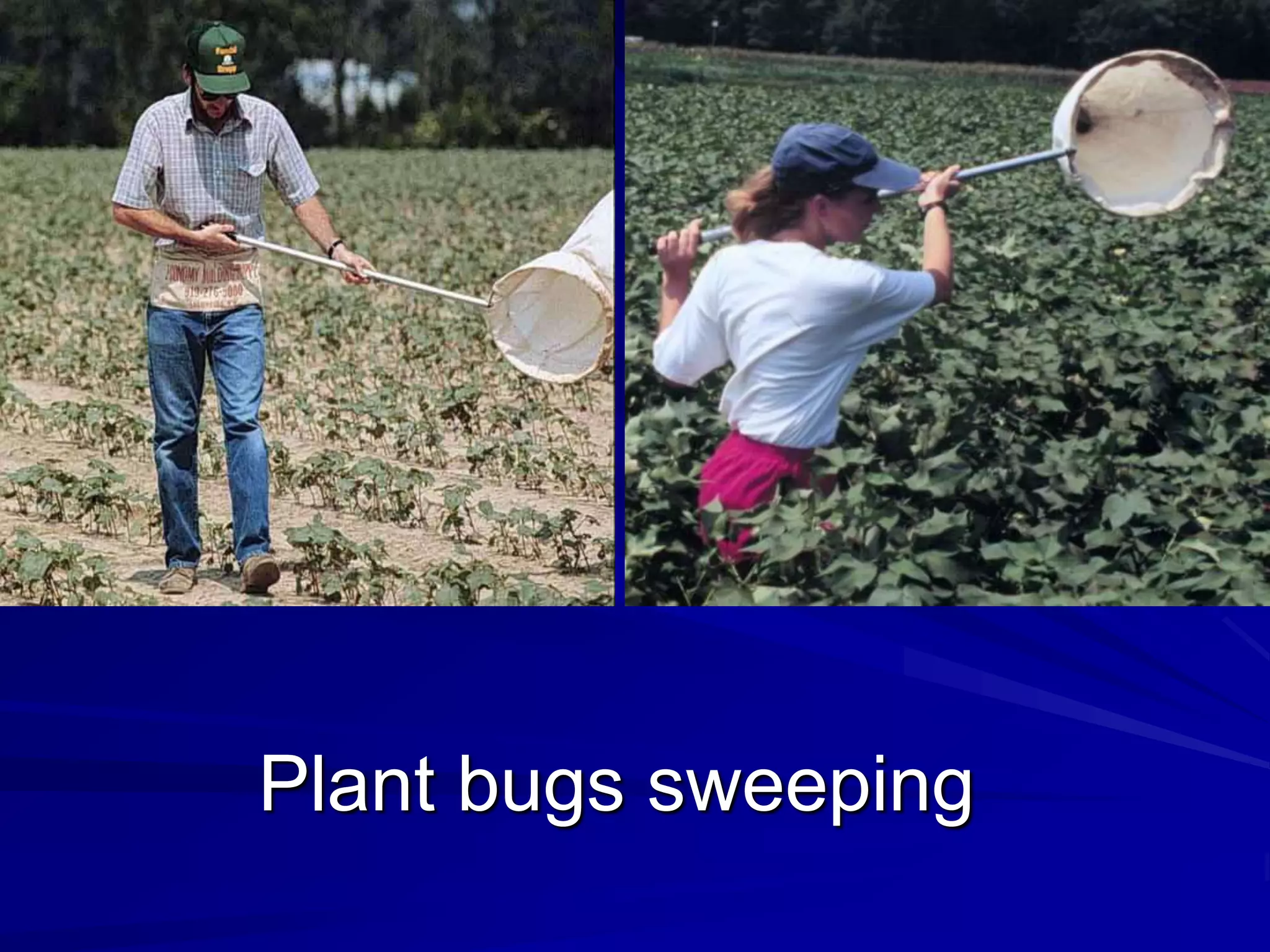
–Sweeping :
–leaf hopper, plant bugs.
–Usually 20 sweep. no. of insect/sweep
Plant bugs sweeping
–When scouting for insects, the
symptoms or signs of crop injury
are often more noticeable than
the insect pest causing them (
nocturnal insects ).
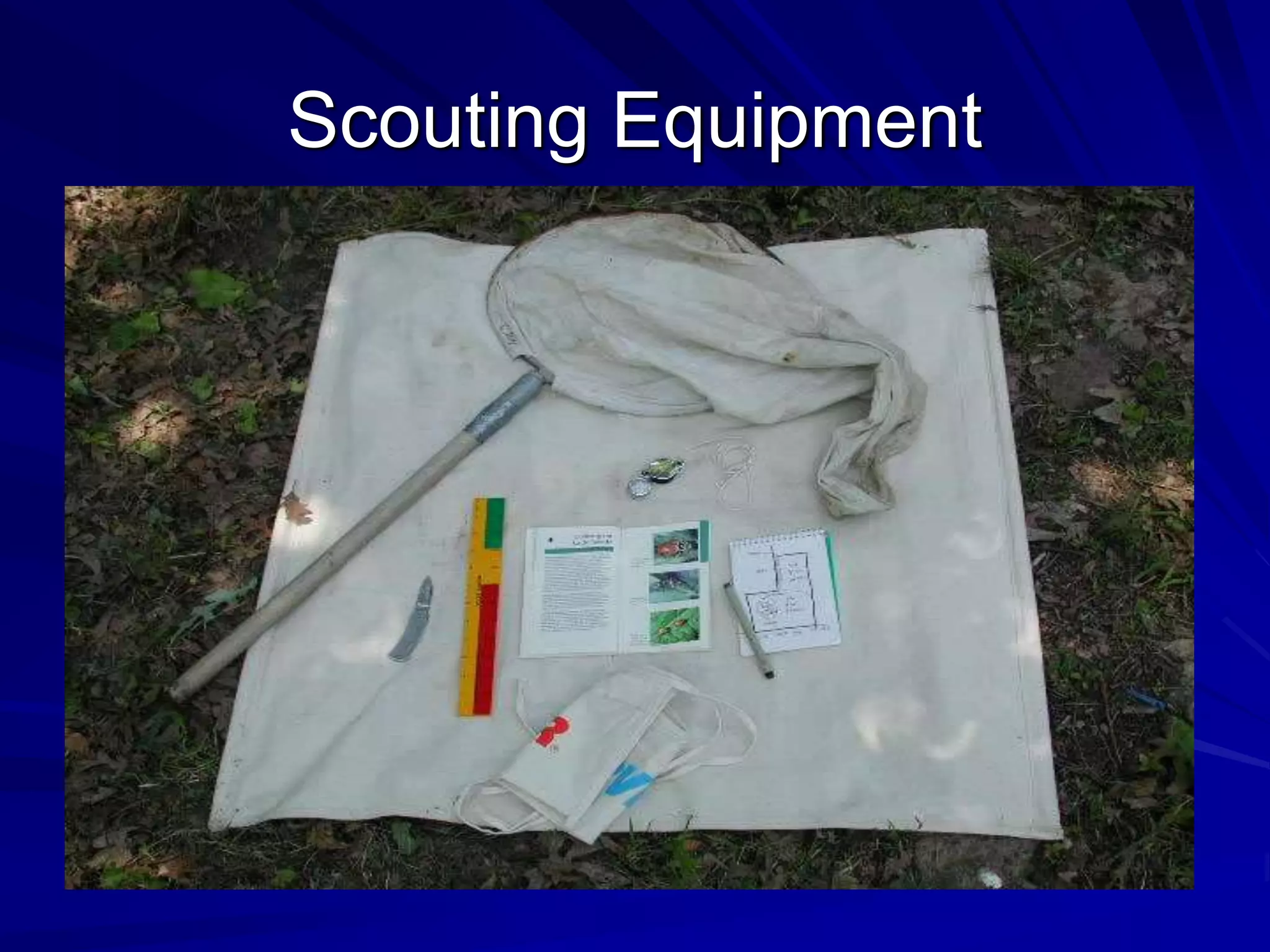
Scouting Equipment
Scouting equipment :
– Hand lens (X10 power).
– Paint brush (for collection of small insects or eggs).
– Specimen vials (for collection of unidentified
insects).
– Sample bags.
– Crop monitoring sheet.
– clipboard & pen.
– Pests I.D guides.
– Sticky traps for monitoring flying insects, pests &
Beneficial's.
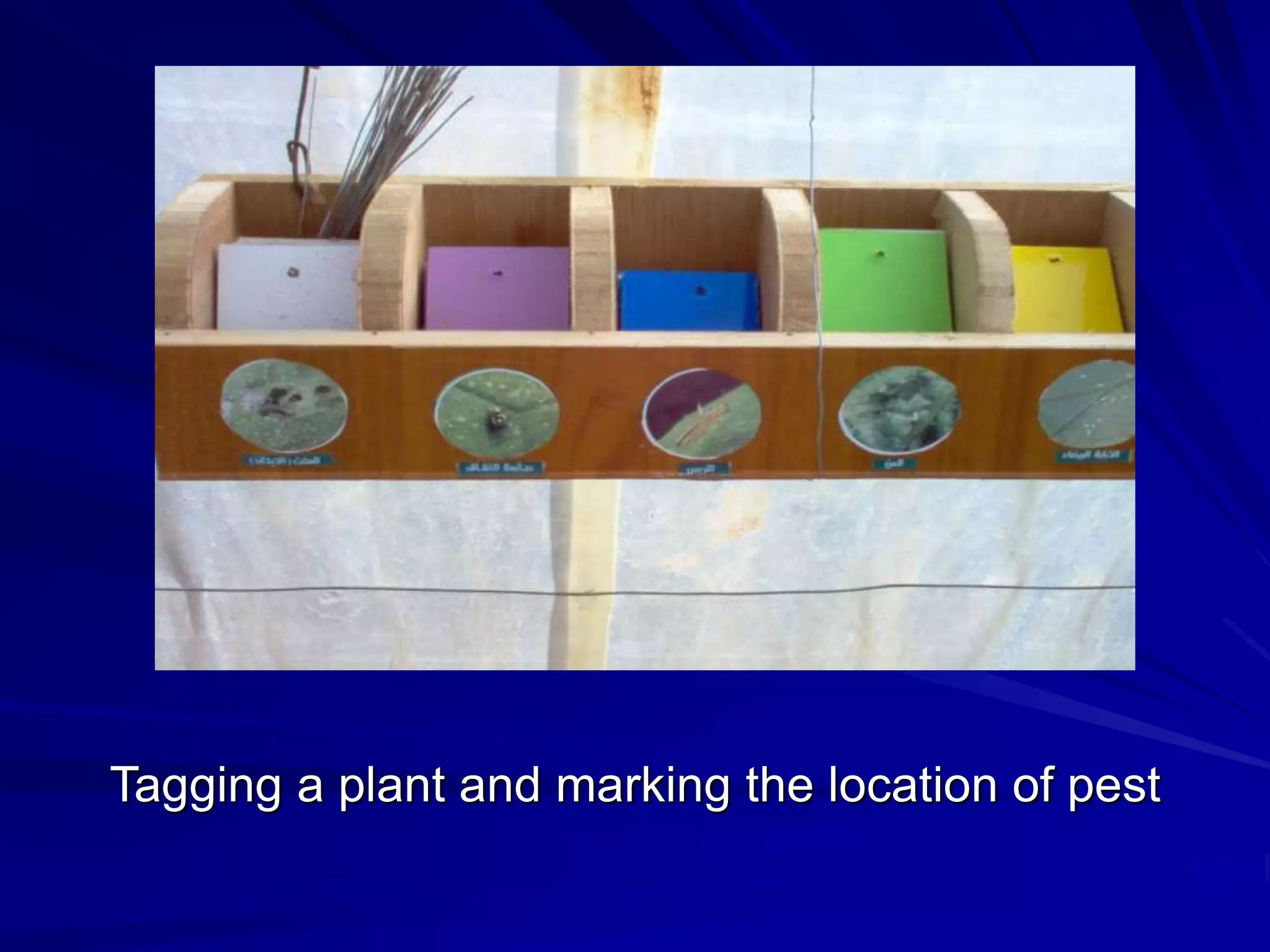
Tagging a plant and marking the location of pest
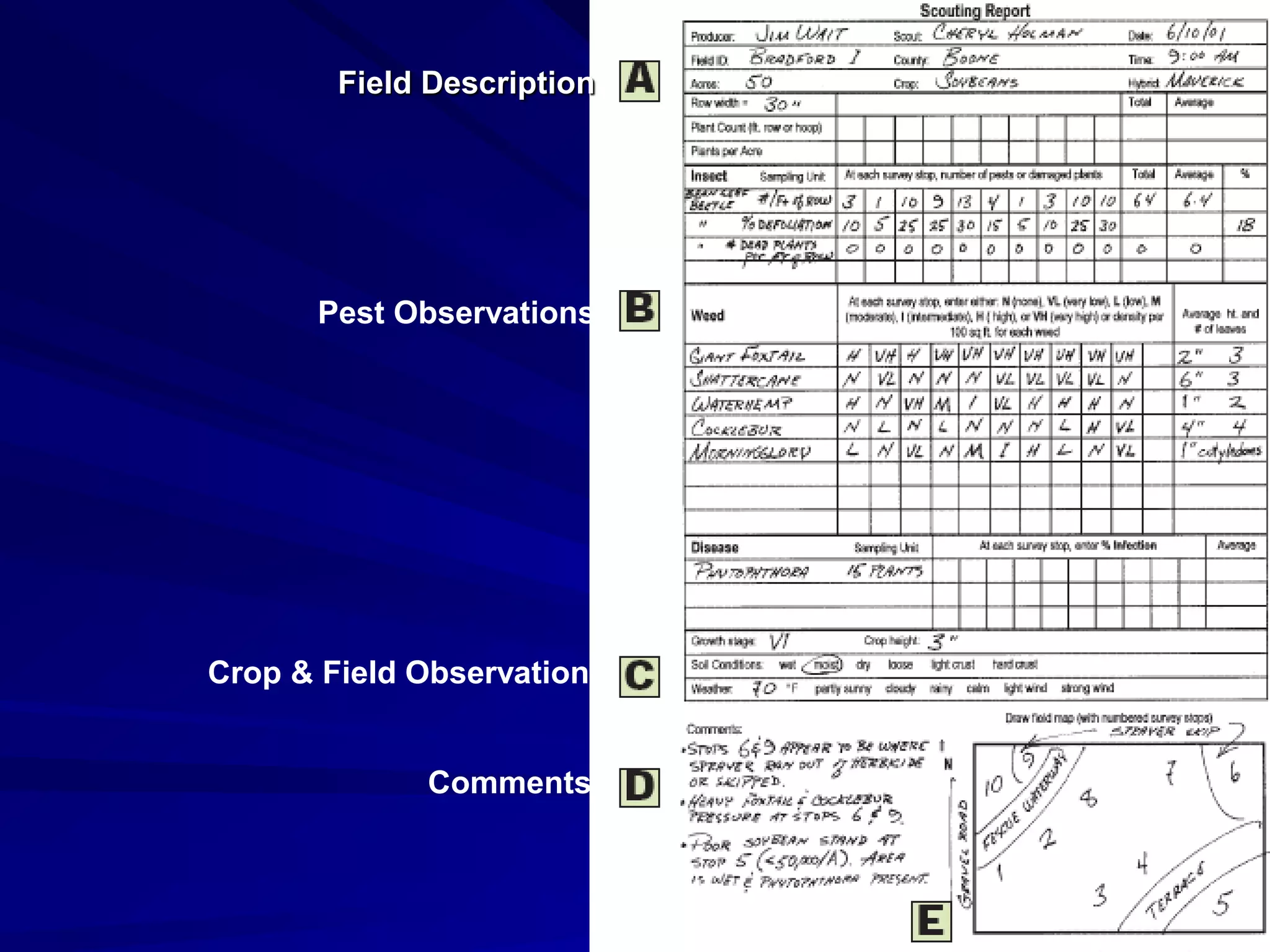
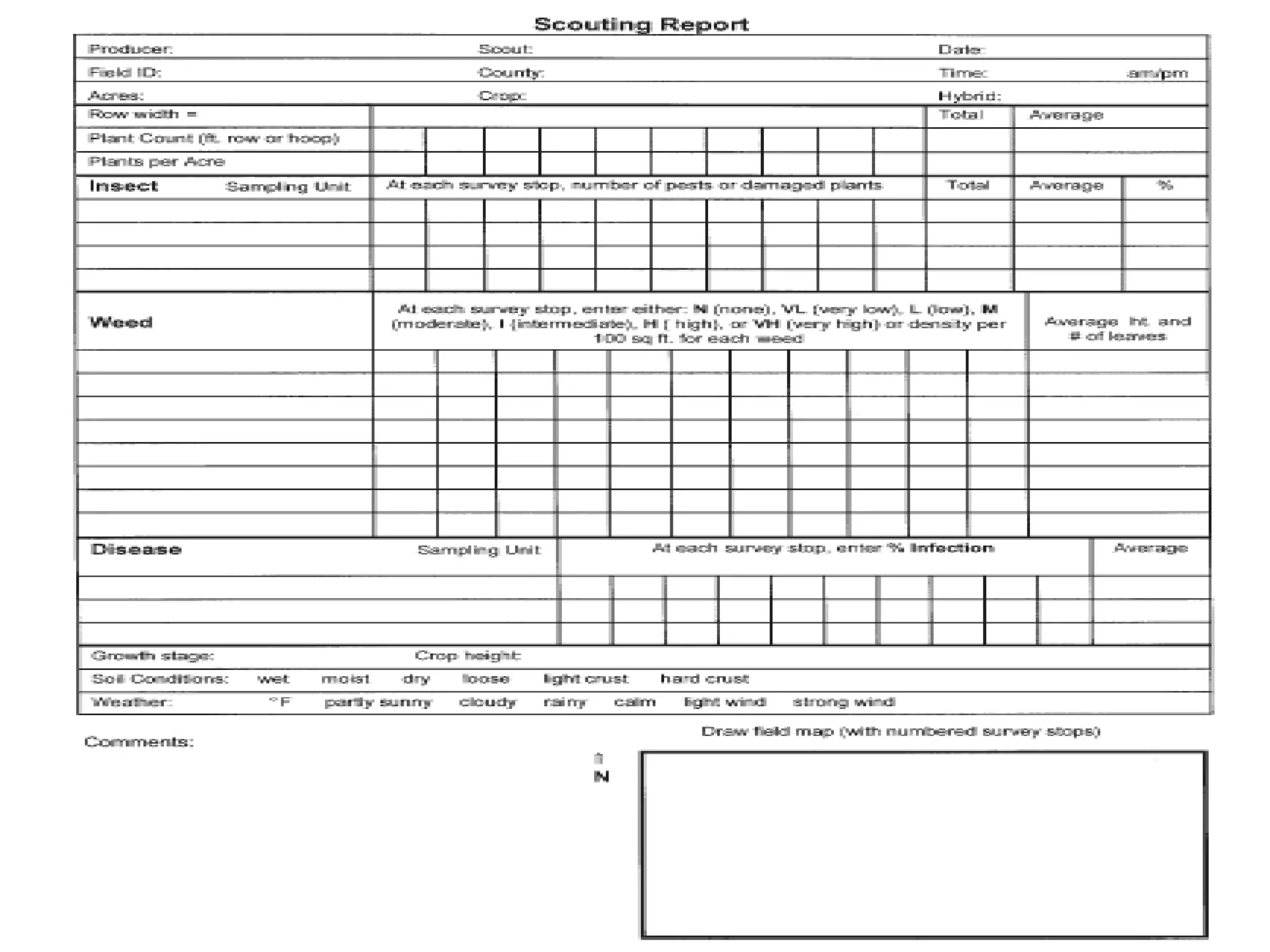
Scouting report :
– A complete and clear scouting report is the
essential “road map” guiding pest management
decisions.
– Scouting reports should include information:
Field description
Pest observations
Crop and field observations
Comments
Field map
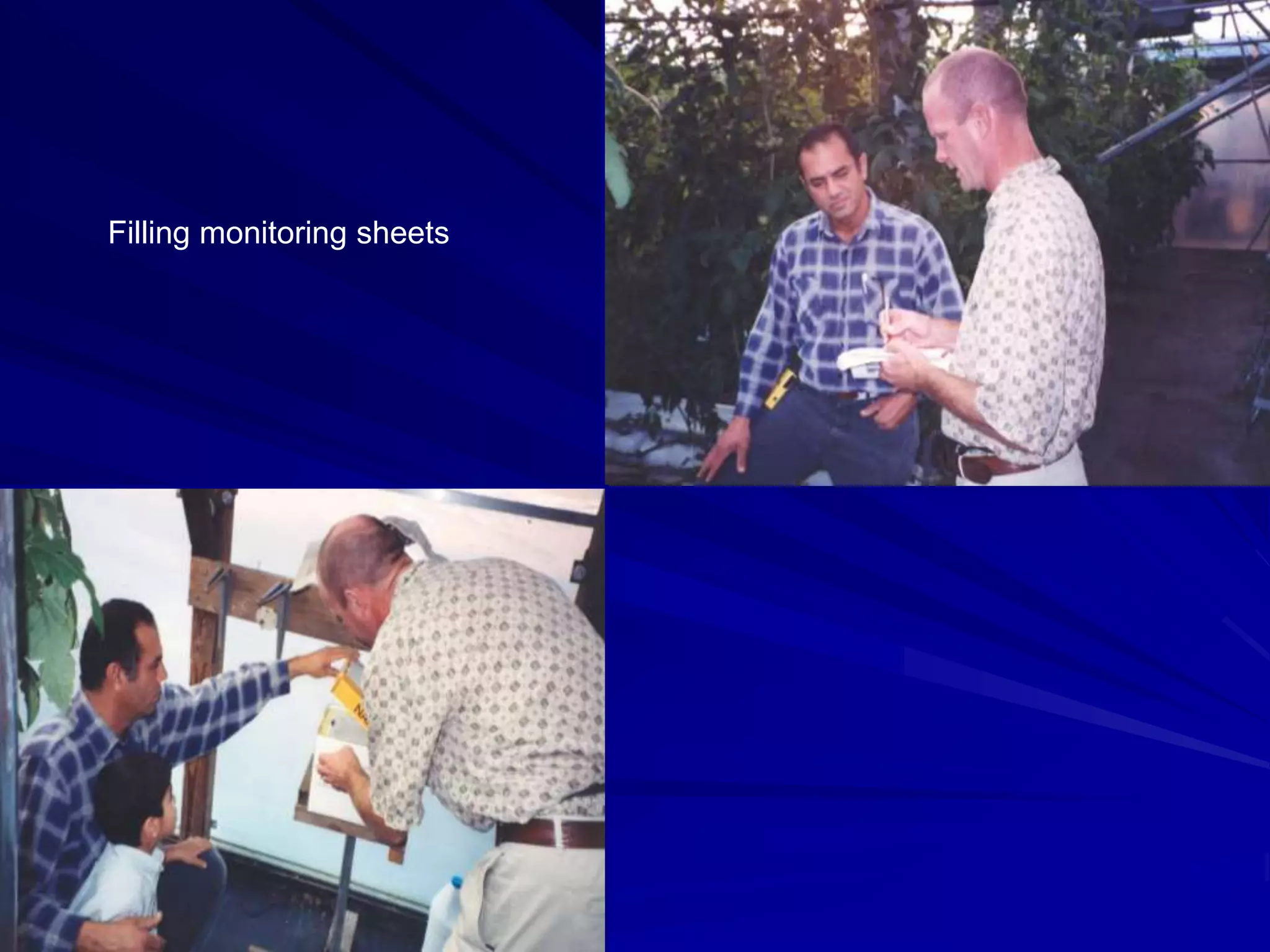
Filling monitoring sheets
Field Description
Pest Observations
Crop & Field Observations
Comments
Field Map
If we are to spend important time walking
crops, shouldn’t we make that time
productive, with as much information as
we can gather, to make informed
decisions for crop management
Plastic House Scouting Guide
Front entrance
Hind entrance
Middle area
Shady side
Sunny side
Sampling for Tomato:
1. Inspect whole plant or select terminal leaflets of
3rd or 7th leaf.
2. Count whitefly nymphs on whole on terminal
leaflet.
3. Count aphids, caterpillar eggs and leaf miner
larvae on whole plant or terminal 3 leaflets.
4. Select lower leaf and inspect for mites and count
tomato pinworm larvae.
5. Count thrips/10 flowers.
6. Inspect 10 fruit for caterpillar and true bug
damage.
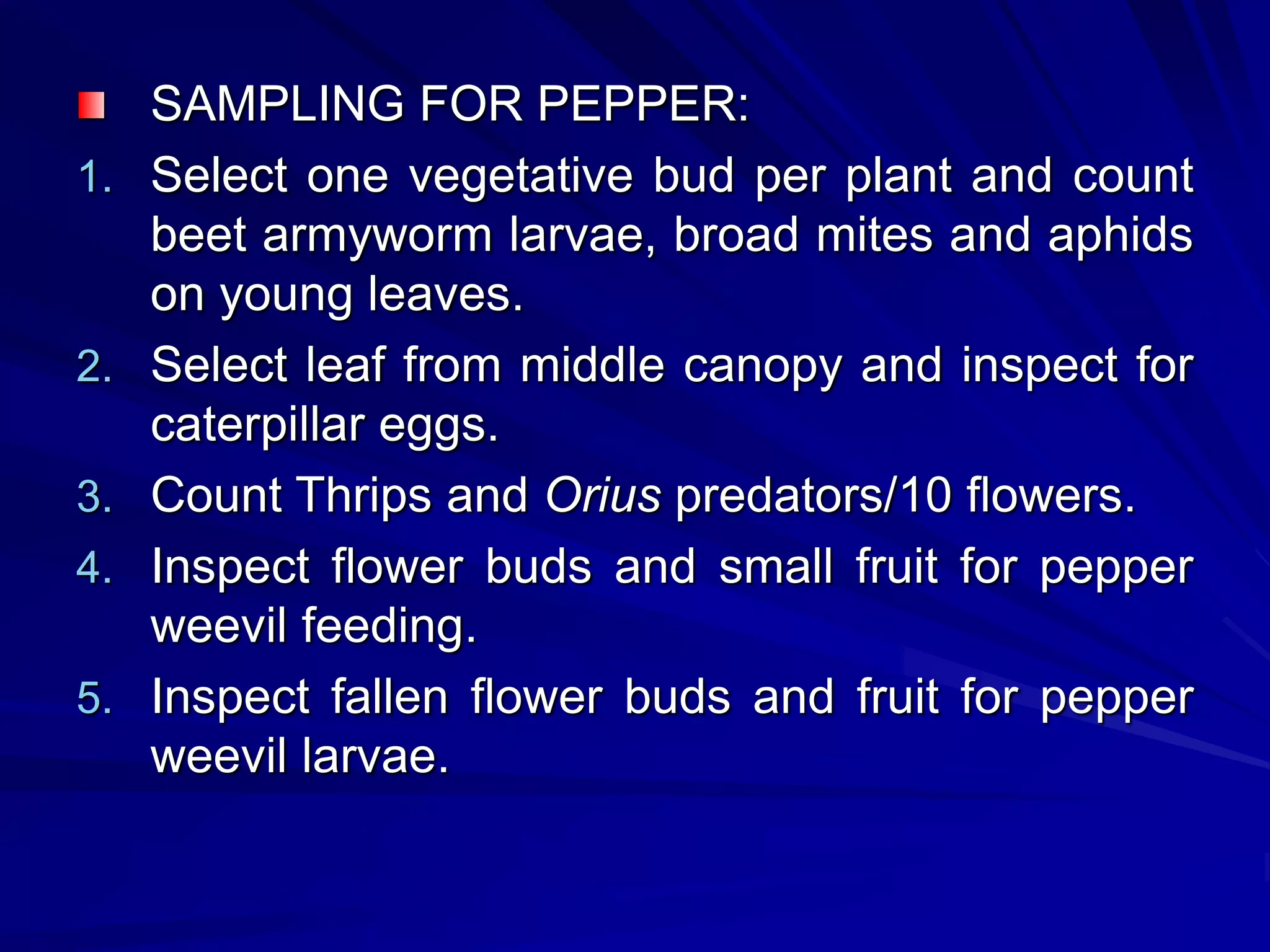
SAMPLING FOR PEPPER:
1. Select one vegetative bud per plant and count
beet armyworm larvae, broad mites and aphids
on young leaves.
2. Select leaf from middle canopy and inspect for
caterpillar eggs.
3. Count Thrips and Orius predators/10 flowers.
4. Inspect flower buds and small fruit for pepper
weevil feeding.
5. Inspect fallen flower buds and fruit for pepper
weevil larvae.
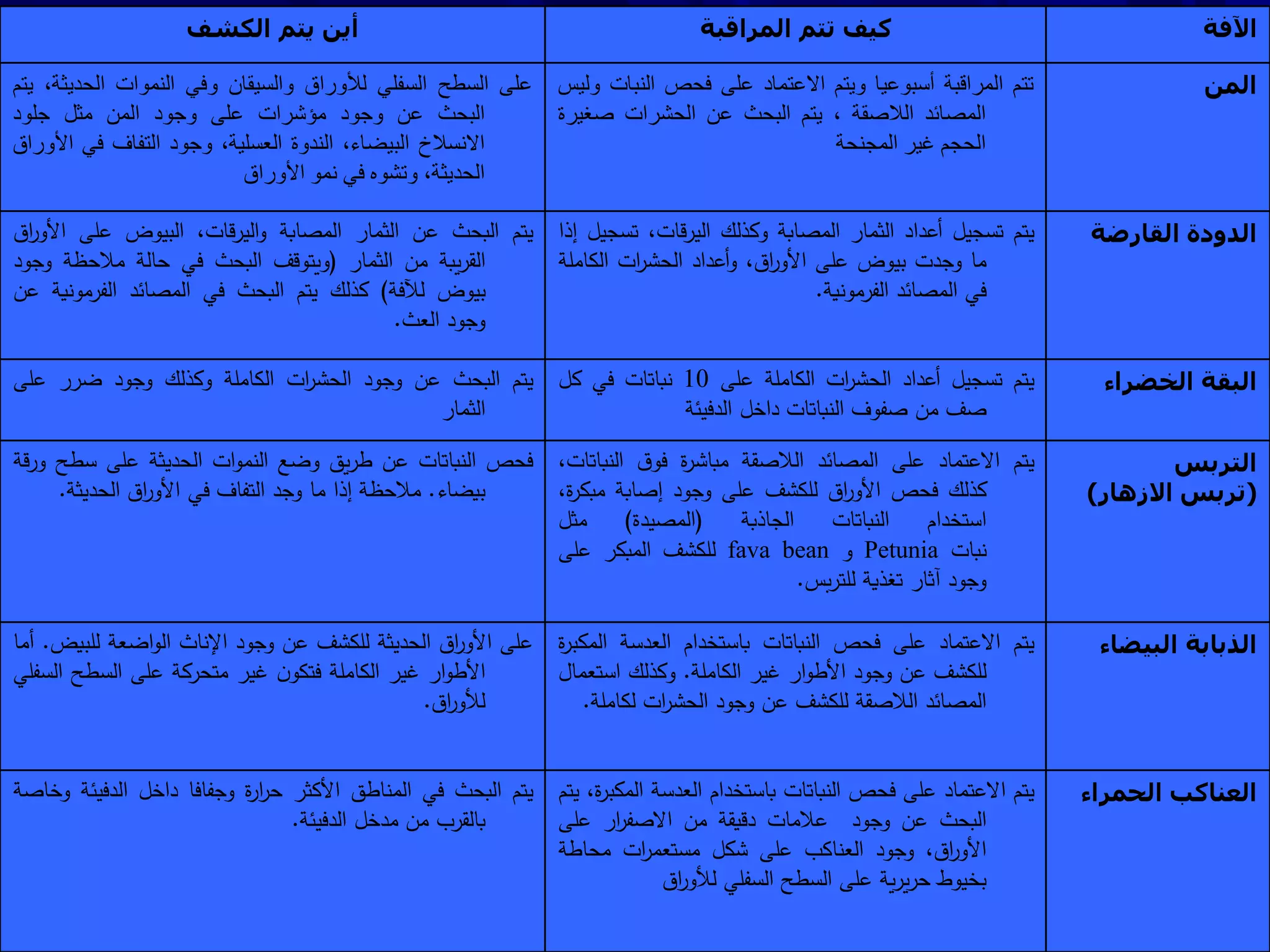
‫اآلفة‬‫المراقبة‬ ‫تتم‬ ‫كيف‬‫الكش‬ ‫يتم‬ ‫أين‬‫ف‬
‫المن‬‫تتم‬‫المراقبة‬‫أسبوعيا‬‫ويتم‬‫االعتماد‬‫على‬‫فحص‬‫النب‬‫ات‬‫وليس‬
‫المصائد‬‫الالصقة‬،‫يتم‬‫البحث‬‫عن‬‫الحشرات‬‫صغي‬‫رة‬
‫الحجم‬‫غير‬‫المجنحة‬
‫على‬‫السطح‬‫السفلي‬‫لألوراق‬‫والسيقان‬‫وفي‬‫النموات‬‫الحديث‬،‫ة‬‫يتم‬
‫البحث‬‫عن‬‫وجود‬‫مؤشرات‬‫على‬‫وجود‬‫المن‬‫مثل‬‫جلود‬
‫االنسالخ‬،‫البيضاء‬‫الندوة‬،‫العسلية‬‫وجود‬‫التفاف‬‫في‬‫ا‬‫ألوراق‬
،‫الحديثة‬‫وتشوه‬‫في‬‫نمو‬‫األوراق‬
‫القارضة‬ ‫الدودة‬‫يتم‬‫تسجيل‬‫أعداد‬‫الثمار‬‫المصابة‬‫وكذلك‬،‫قات‬‫ر‬‫الي‬‫تس‬‫جيل‬‫إذا‬
‫ما‬‫وجدت‬‫بيوض‬‫على‬،‫اق‬‫ر‬‫األو‬‫أعداد‬‫و‬‫ات‬‫ر‬‫الحش‬‫الكام‬‫لة‬
‫في‬‫المصائد‬‫الفرمونية‬.
‫يتم‬‫البحث‬‫عن‬‫الثمار‬‫المصابة‬،‫قات‬‫ر‬‫الي‬‫و‬‫البيوض‬‫على‬‫األ‬‫اق‬‫ر‬‫و‬
‫يبة‬‫ر‬‫الق‬‫من‬‫الثمار‬(‫ويتوقف‬‫البحث‬‫في‬‫حالة‬‫مالحظة‬‫و‬‫جود‬
‫بيوض‬‫لآلفة‬)‫كذلك‬‫يتم‬‫البحث‬‫في‬‫المصائد‬‫الفرمو‬‫نية‬‫عن‬
‫وجود‬‫العث‬.
‫الخضراء‬ ‫البقة‬‫يتم‬‫تسجيل‬‫أعداد‬‫ات‬‫ر‬‫الحش‬‫الكاملة‬‫على‬10‫نباتات‬‫في‬‫كل‬
‫صف‬‫من‬‫صفوف‬‫النباتات‬‫داخل‬‫الدفيئة‬
‫يتم‬‫البحث‬‫عن‬‫وجود‬‫ات‬‫ر‬‫الحش‬‫الكاملة‬‫وكذلك‬‫وجود‬‫ضرر‬‫على‬
‫الثمار‬
‫التربس‬
(‫االزهار‬ ‫تربس‬)
‫يتم‬‫االعتماد‬‫على‬‫المصائد‬‫الالصقة‬‫ة‬‫ر‬‫مباش‬‫ق‬‫فو‬‫النب‬،‫اتات‬
‫كذلك‬‫فحص‬‫اق‬‫ر‬‫األو‬‫للكشف‬‫على‬‫وجود‬‫إصابة‬‫مبك‬،‫ة‬‫ر‬
‫استخدام‬‫النباتات‬‫الجاذبة‬(‫المصيدة‬)‫مثل‬
‫نبات‬Petunia‫و‬fava bean‫للكشف‬‫المبكر‬‫على‬
‫وجود‬‫آثار‬‫تغذية‬‫بس‬‫ر‬‫للت‬.
‫فحص‬‫النباتات‬‫عن‬‫يق‬‫ر‬‫ط‬‫وضع‬‫ات‬‫و‬‫النم‬‫الحديثة‬‫على‬‫سطح‬‫قة‬‫ر‬‫و‬
‫بيضاء‬.‫مالحظة‬‫إذا‬‫ما‬‫وجد‬‫التفاف‬‫في‬‫اق‬‫ر‬‫األو‬‫الحديثة‬.
‫البيضا‬ ‫الذبابة‬‫ء‬‫يتم‬‫االعتماد‬‫على‬‫فحص‬‫النباتات‬‫باستخدام‬‫العدسة‬‫ا‬‫ة‬‫ر‬‫لمكب‬
‫للكشف‬‫عن‬‫وجود‬‫ار‬‫و‬‫األط‬‫غير‬‫الكاملة‬.‫وكذلك‬‫است‬‫عمال‬
‫المصائد‬‫الالصقة‬‫للكشف‬‫عن‬‫وجود‬‫ات‬‫ر‬‫الحش‬‫لكام‬‫لة‬.
‫على‬‫اق‬‫ر‬‫األو‬‫الحديثة‬‫للكشف‬‫عن‬‫وجود‬‫اإلناث‬‫اضعة‬‫و‬‫ال‬‫للبي‬‫ض‬.‫أما‬
‫ار‬‫و‬‫األط‬‫غير‬‫الكاملة‬‫ن‬‫فتكو‬‫غير‬‫متحركة‬‫على‬‫السطح‬‫ا‬‫لسفلي‬
‫اق‬‫ر‬‫لألو‬.
‫الحمراء‬ ‫العناكب‬‫يتم‬‫االعتماد‬‫على‬‫فحص‬‫النباتات‬‫باستخدام‬‫العدسة‬‫ا‬،‫ة‬‫ر‬‫لمكب‬‫يتم‬
‫البحث‬‫عن‬‫وجود‬‫عالمات‬‫دقيقة‬‫من‬‫ار‬‫ر‬‫االصف‬‫على‬
،‫اق‬‫ر‬‫األو‬‫وجود‬‫العناكب‬‫على‬‫شكل‬‫ات‬‫ر‬‫مستعم‬‫محاطة‬
‫بخيوط‬‫ية‬‫ر‬‫ي‬‫ر‬‫ح‬‫على‬‫السطح‬‫السفلي‬‫اق‬‫ر‬‫لألو‬
‫يتم‬‫البحث‬‫في‬‫المناطق‬‫األكثر‬‫ة‬‫ر‬‫ا‬‫ر‬‫ح‬‫وجفافا‬‫داخل‬‫الدفيئ‬‫ة‬‫وخاصة‬
‫بالقرب‬‫من‬‫مدخل‬‫الدفيئة‬.
‫الديدان‬
‫القارضة‬
‫الذبابة‬
‫البيض‬‫اء‬
‫التربس‬ ‫العناكب‬
‫الحمراء‬
‫الحلم‬
‫العريض‬
‫ذبابة‬
‫االنفاق‬
‫البقة‬
‫الخضراء‬
‫المن‬
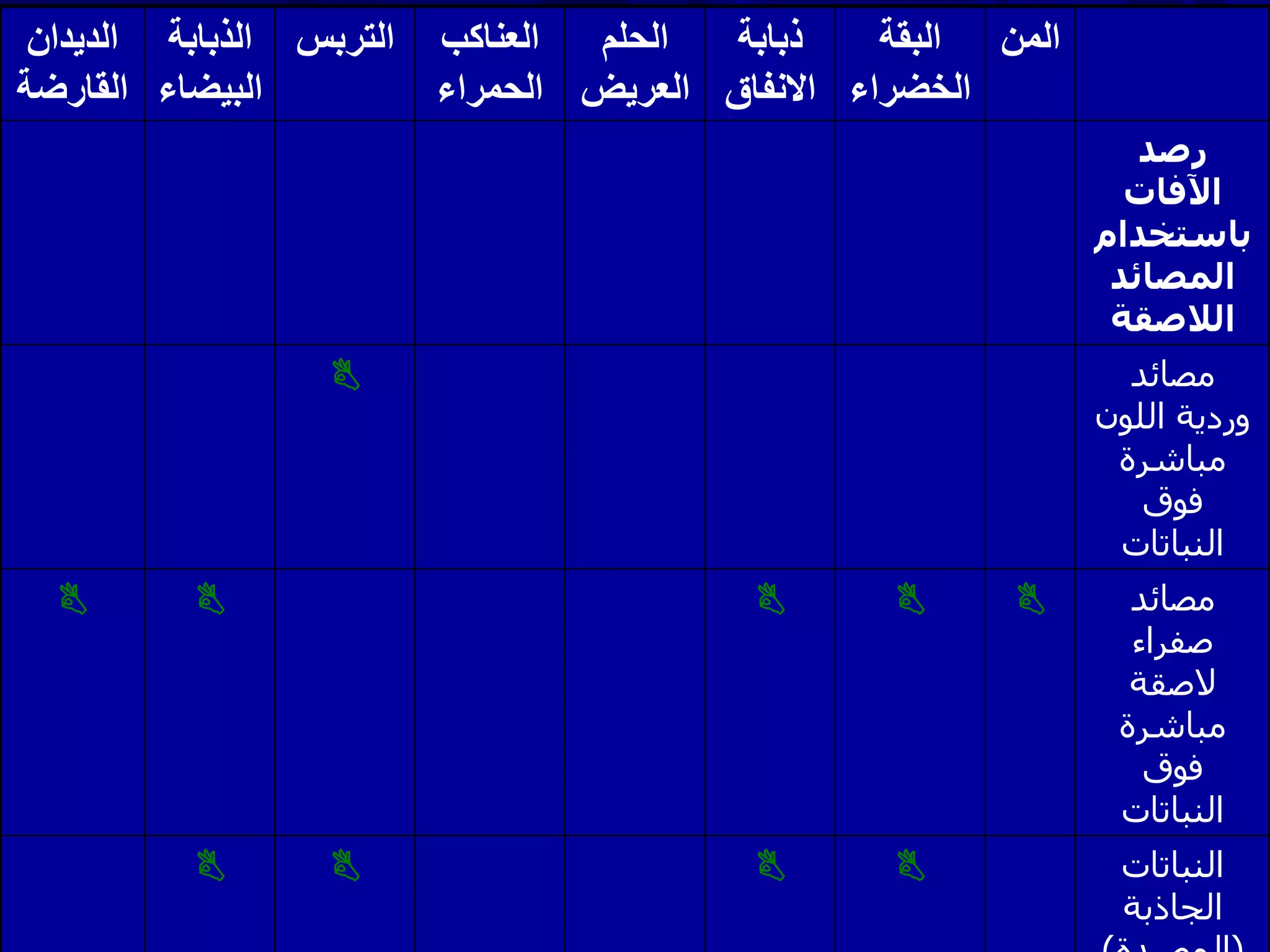
‫رصد‬
‫اآلفات‬
‫باستخدام‬
‫المصائد‬
‫الالصقة‬
 ‫مصائد‬
‫اللون‬ ‫وردية‬
‫مباشرة‬
‫فوق‬
‫النباتات‬
     ‫مصائد‬
‫صفراء‬
‫الصقة‬
‫مباشرة‬
‫فوق‬
‫النباتات‬
    ‫النباتات‬
‫الجاذبة‬
‫الديدان‬
‫القارضة‬
‫الذبابة‬
‫البيضاء‬
‫التربس‬ ‫العناكب‬
‫الحمراء‬
‫العريض‬ ‫الحلم‬ ‫االنفاق‬ ‫ذبابة‬ ‫البقة‬
‫الخضراء‬
‫المن‬ ‫النبات‬ ‫على‬ ‫اآلفات‬ ‫رصد‬
     ‫السفلي‬ ‫السطح‬ ‫على‬ ‫الكشف‬
‫لألوراق‬
  ‫تبقعا‬ ‫وجود‬ ‫عن‬ ‫الكشف‬‫فاتحة‬ ‫ت‬
‫العلوي‬ ‫السطح‬ ‫على‬ ‫اللون‬
‫لألوراق‬
 ‫داخل‬ ‫أنفاق‬ ‫وجود‬ ‫عن‬ ‫الكشف‬
‫النبات‬ ‫أنسجة‬
    ‫على‬ ‫آفات‬ ‫وجود‬ ‫عن‬ ‫الكشف‬
‫والبراعم‬ ‫الحديثة‬ ‫النموات‬
   ‫بيضاء‬ ‫ورقة‬ ‫على‬ ‫الزهرة‬ ‫هز‬
‫متحركة‬ ‫حشرات‬ ‫وجود‬ ‫ومالحظة‬
 ‫لألوراق‬ ‫السفلي‬ ‫السطح‬ ‫اضغط‬
‫وراقب‬ ‫بيضاء‬ ‫ورقة‬ ‫على‬ ‫القديمة‬
‫الورق‬ ‫على‬ ‫صغيرة‬ ‫بقع‬ ‫آثار‬ ‫وجود‬‫ة‬
 ‫ع‬ ‫اللون‬ ‫بنية‬ ‫أو‬ ‫بيضاء‬ ‫بقع‬ ‫وجود‬‫لى‬
‫االزهار‬
 ‫على‬ ‫اللون‬ ‫داكنة‬ ‫مناطق‬ ‫وجود‬
‫حديثا‬ ‫المتفتحة‬ ‫البراعم‬
‫الديدان‬
‫القارضة‬
‫الذبابة‬
‫البيضاء‬
‫التربس‬ ‫العناكب‬
‫الحمراء‬
‫العريض‬ ‫الحلم‬ ‫االنفاق‬ ‫ذبابة‬ ‫البقة‬
‫الخضراء‬
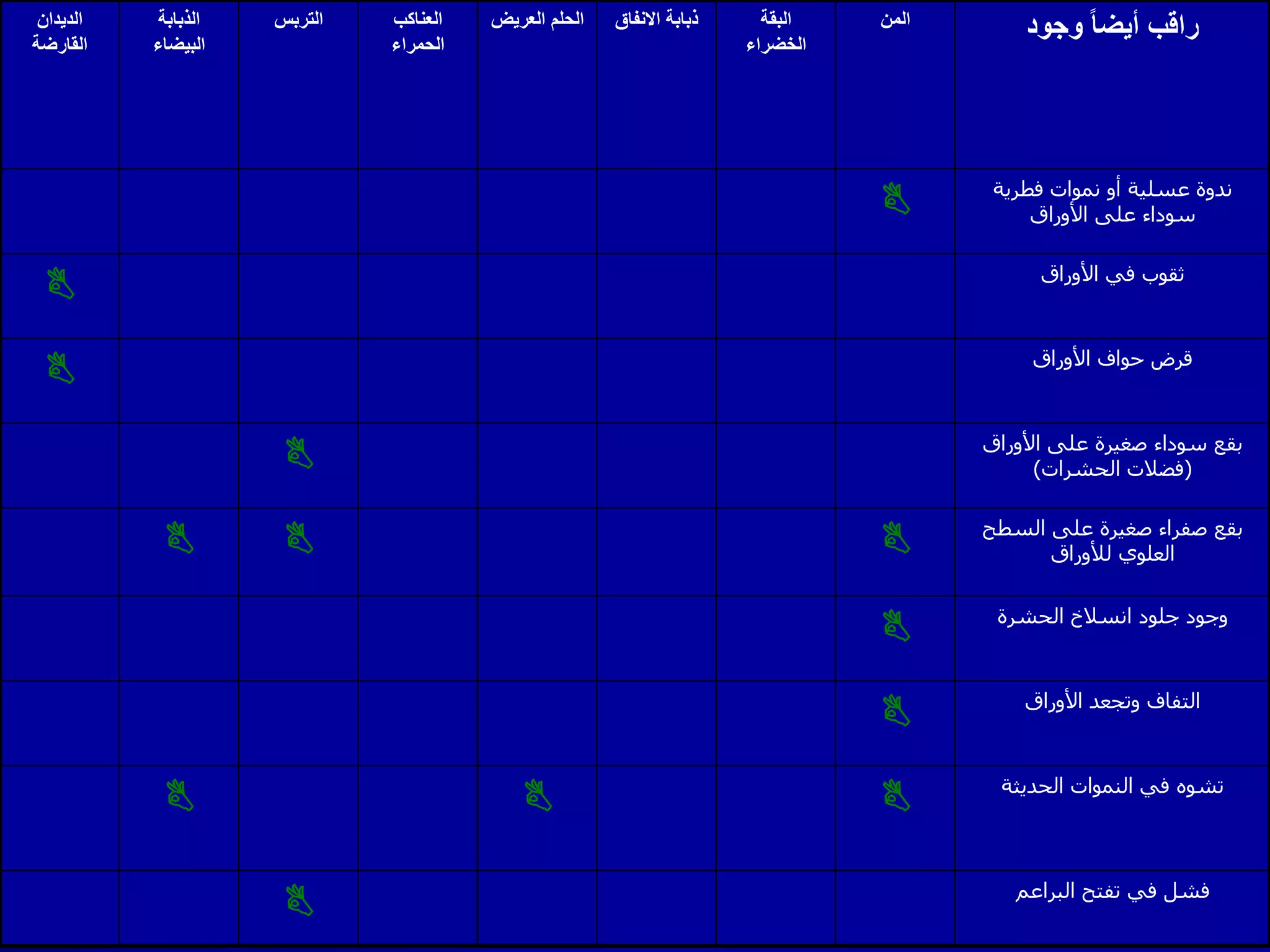
‫المن‬ ‫وجود‬ ً‫ا‬‫أيض‬ ‫راقب‬
 ‫فطرية‬ ‫نموات‬ ‫أو‬ ‫عسلية‬ ‫ندوة‬
‫األوراق‬ ‫على‬ ‫سوداء‬
 ‫األوراق‬ ‫في‬ ‫ثقوب‬
 ‫األوراق‬ ‫حواف‬ ‫قرض‬
 ‫األوراق‬ ‫على‬ ‫صغيرة‬ ‫سوداء‬ ‫بقع‬
(‫الحشرات‬ ‫فضالت‬)
   ‫السطح‬ ‫على‬ ‫صغيرة‬ ‫صفراء‬ ‫بقع‬
‫لألوراق‬ ‫العلوي‬
 ‫الحشرة‬ ‫انسالخ‬ ‫جلود‬ ‫وجود‬
 ‫األوراق‬ ‫وتجعد‬ ‫التفاف‬
   ‫الحديثة‬ ‫النموات‬ ‫في‬ ‫تشوه‬
 ‫البراعم‬ ‫تفتح‬ ‫في‬ ‫فشل‬

IPM- Monitoring

  • 1.
  • 2.
    Integrated Pest Management IPM Basedon Information – Monitoring – Identification – Thresholds – Evaluation – Action Plan
  • 3.
    Introduction – Monitoring isused to survey all damages that could be caused by insects, diseases and weeds. – When a pest is present in an crop the monitoring helps the grower to determine if control measures are justified.
  • 4.
    Monitoring purpose – Arepests and/or beneficials present. – Identify them. – Which stages are present. – Are control measures justified
  • 5.
    Gains Farmer Knowing hiscrops. Saving money. Use the right product at the right time. Delayed occurence of pest resistance. Reduced impact on environment.
  • 6.
    Basic knolwedge Which insectsare potential pest Knowing the signs of potential problems Physical damage Insect presence Webs Discoloration
  • 7.
    IMPORTANCE OF MONITORING Toassess the pest situation and determine what sort of pest activity is occurring For decision making To predict pest problems before they occur
  • 8.
    MONITORING METHODS ANDPROCEDURES Monitoring Guidelines Monitoring Methods
  • 9.
    MONITORING GUIDELINES WHAT TOLOOK FOR Presence and evidence of pests Presence of natural enemies Evidence of damage -nature of damage -where the damage is found -is the pest still present
  • 10.
    PEST TRAPPING –Trapping ofinsects can help determine timing for field scouting. –Trapping should not replace in-field sampling. –The most common insect traps attract insects with visual ( light & colour ), pheromones, or food odors.
  • 11.
    COLOUR TRAPS – Thestrong attraction of many insect species to colour has been exploited in the design of traps. Yellow sticky trap : Aphids, Whitefly Blue sticky trap : Thrips, Leafminer
  • 13.
  • 14.
  • 15.
    LIGHT TRAPS Backlight capturesdo not provide sampling estimates, but indicate when to begin scouting based on initial or peak flight. Backlight traps are labor-intensive because they are nonselective.
  • 16.
  • 17.
    Lure traps : –pheromone & food attractant trap. – pheromone traps (tomato pinworm, tomato fruit worm, beet armyworm) should be distributed around field perimeter and check twice weekly. Hliothes pheromone trap
  • 18.
  • 19.
    SCOUTING –One of themost important components of an IPM program is the use of good scouting methods. –Regular and systematic field-sampling program –scouting provides field-specific information on pest pressure and crop injury. –This information is essential to the appropriate selection and application of pest management procedures.
  • 20.
  • 21.
    In order tocarry out a sound scouting program, a pest management practitioner must know: 1. When to scout. 2. The proper methods for scouting. 3. What tools to use.
  • 22.
    Monitoring Where do youlook? Under, on, and in leaves On and in stems On and in fruit On and in the soil, etc. When do you look? Morning Afternoon Evening Night
  • 23.
    Monitoring How often doyou look? Hourly Daily Every few days Weekly Biweekly Establish a routine. What is your level of commitment?
  • 24.
    A well-designed scoutingprogram includes three main activities: Sampling to provide an accurate estimate of pest densities and crop health. Identification of pests or diagnosis of the cause of crop injury based on observable symptoms. Comparison of observed pest pressure or crop injury to recommended economic injury levels or economic thresholds.
  • 25.
    SAMPLING PLAN The samplingplan is the procedure for obtaining a sample to estimate the population of one or more pests or the degree of crop injury in a field.
  • 26.
    SAMPLING PLAN It isnot practical to observe every plant within the field, so fields are sampled to estimate the level of infestation. The challenge of sampling is to balance the accuracy of estimates with the time and labor required to collect the samples. Although the reliability of estimates increases as sample size increases (up to a point), the collection of too large a sample is costly and inefficient and it wastes human resources.
  • 27.
    Timing and frequencyof sampling : –Knowledge about pest biology and crop growth will help determine when sampling should begin and how frequently the field should be visited. –Monitoring weather conditions will help in the prediction of both pest and crop development. ( degree day models ) –Information included in the field history will help focus attention on key pests. –Information from trapping programs will also provide information on when to scout for specific pests.
  • 28.
    Sampling patterns: –The mostcommon pattern in scouting programs involves walking along a predetermined zigzag or M-shaped route through a field. –This pattern is commonly used because it is easy to teach, convenient to use, and ensures that all regions of the field are visited.
  • 29.
    Scouting Patterns The mostcommon pattern in scouting involves walking along a predetermined zigzag or M-shaped route through a field
  • 30.
    Plastic House ScoutingGuide Front entrance Hind entrance Middle area Shady side Sunny side
  • 31.
    Fields can bedivided into 2.5 dunum segments for sampling
  • 32.
    – Cover theentire field during each scouting trip. Avoid field margins and border rows unless there are specific reasons for monitoring the edges of the field. – “Edge effect “ is the tendency for several key insect pests to cluster near the field margin. Sampling near the edge of the field tends to overestimate the densities of many insect pests. – On return visits to the field, change the sampling pattern so that all areas of the field are covered; for example, alternate a zigzag pattern with an M- shaped pattern. – Avoid sampling in the same areas of the field or always entering the field at the same point on successive sampling visits.
  • 33.
  • 34.
    Number of surveystops : Sampling units: – The exact number of survey stops and sampling units inspected, counted, or collected at each survey stop may be influenced by the pest, its spatial dispersion, the type of crop injury, and other factors.
  • 35.
    Pests may bepresent in different dispersion patterns within a field, affecting the success of detection.
  • 36.
    – Composition ofthe sampling unit is pest and often crop specific. – Time and labor requirements help determine specific protocols. It is better to make more survey stops consisting of fewer sampling units than smaller survey stops consisting of larger sampling unit.
  • 37.
    Methods of samplecollection : –Procedures for sampling methods are varied and are often pest/host specific. –The recommended sampling method for a particular pest on a crop may differ according to the growth stage of either the pest or the crop and even the canopy structure of the crop.
  • 38.
    –Direct observation ofthe pest : Pest densities are counted and recorded on the survey form as the number of pests per plant. Some insects can be difficult to observe because of their small size, so a magnifying lens may be required. Counting thrips with aid of hand lens
  • 39.
    –Sometimes, only aspecific portion of the plant is examined. Insects may be observed on a specific plant part because the pest has a preferred site on the plant for feeding or egg-laying.
  • 40.
  • 41.
  • 42.
    Shaking methods: Someinsects are easier to count if they are dislodged from the plant by vigorous shaking and allowing the insects to fall onto a white or yellow “beat sheet.”
  • 43.
  • 44.
    Beat cloth stink bugs& leaf hopper
  • 45.
    Another method ofdislodging insects involves the use of an aspirator in which insects are sucked into a container for later identification.
  • 46.
    –Sweeping : –leaf hopper,plant bugs. –Usually 20 sweep. no. of insect/sweep
  • 47.
  • 48.
    –When scouting forinsects, the symptoms or signs of crop injury are often more noticeable than the insect pest causing them ( nocturnal insects ).
  • 49.
  • 50.
    Scouting equipment : –Hand lens (X10 power). – Paint brush (for collection of small insects or eggs). – Specimen vials (for collection of unidentified insects). – Sample bags. – Crop monitoring sheet. – clipboard & pen. – Pests I.D guides. – Sticky traps for monitoring flying insects, pests & Beneficial's.
  • 51.
    Tagging a plantand marking the location of pest
  • 52.
    Scouting report : –A complete and clear scouting report is the essential “road map” guiding pest management decisions. – Scouting reports should include information: Field description Pest observations Crop and field observations Comments Field map
  • 53.
  • 54.
    Field Description Pest Observations Crop& Field Observations Comments Field Map
  • 56.
    If we areto spend important time walking crops, shouldn’t we make that time productive, with as much information as we can gather, to make informed decisions for crop management
  • 57.
    Plastic House ScoutingGuide Front entrance Hind entrance Middle area Shady side Sunny side
  • 58.
    Sampling for Tomato: 1.Inspect whole plant or select terminal leaflets of 3rd or 7th leaf. 2. Count whitefly nymphs on whole on terminal leaflet. 3. Count aphids, caterpillar eggs and leaf miner larvae on whole plant or terminal 3 leaflets. 4. Select lower leaf and inspect for mites and count tomato pinworm larvae. 5. Count thrips/10 flowers. 6. Inspect 10 fruit for caterpillar and true bug damage.
  • 59.
    SAMPLING FOR PEPPER: 1.Select one vegetative bud per plant and count beet armyworm larvae, broad mites and aphids on young leaves. 2. Select leaf from middle canopy and inspect for caterpillar eggs. 3. Count Thrips and Orius predators/10 flowers. 4. Inspect flower buds and small fruit for pepper weevil feeding. 5. Inspect fallen flower buds and fruit for pepper weevil larvae.
  • 60.
    ‫اآلفة‬‫المراقبة‬ ‫تتم‬ ‫كيف‬‫الكش‬‫يتم‬ ‫أين‬‫ف‬ ‫المن‬‫تتم‬‫المراقبة‬‫أسبوعيا‬‫ويتم‬‫االعتماد‬‫على‬‫فحص‬‫النب‬‫ات‬‫وليس‬ ‫المصائد‬‫الالصقة‬،‫يتم‬‫البحث‬‫عن‬‫الحشرات‬‫صغي‬‫رة‬ ‫الحجم‬‫غير‬‫المجنحة‬ ‫على‬‫السطح‬‫السفلي‬‫لألوراق‬‫والسيقان‬‫وفي‬‫النموات‬‫الحديث‬،‫ة‬‫يتم‬ ‫البحث‬‫عن‬‫وجود‬‫مؤشرات‬‫على‬‫وجود‬‫المن‬‫مثل‬‫جلود‬ ‫االنسالخ‬،‫البيضاء‬‫الندوة‬،‫العسلية‬‫وجود‬‫التفاف‬‫في‬‫ا‬‫ألوراق‬ ،‫الحديثة‬‫وتشوه‬‫في‬‫نمو‬‫األوراق‬ ‫القارضة‬ ‫الدودة‬‫يتم‬‫تسجيل‬‫أعداد‬‫الثمار‬‫المصابة‬‫وكذلك‬،‫قات‬‫ر‬‫الي‬‫تس‬‫جيل‬‫إذا‬ ‫ما‬‫وجدت‬‫بيوض‬‫على‬،‫اق‬‫ر‬‫األو‬‫أعداد‬‫و‬‫ات‬‫ر‬‫الحش‬‫الكام‬‫لة‬ ‫في‬‫المصائد‬‫الفرمونية‬. ‫يتم‬‫البحث‬‫عن‬‫الثمار‬‫المصابة‬،‫قات‬‫ر‬‫الي‬‫و‬‫البيوض‬‫على‬‫األ‬‫اق‬‫ر‬‫و‬ ‫يبة‬‫ر‬‫الق‬‫من‬‫الثمار‬(‫ويتوقف‬‫البحث‬‫في‬‫حالة‬‫مالحظة‬‫و‬‫جود‬ ‫بيوض‬‫لآلفة‬)‫كذلك‬‫يتم‬‫البحث‬‫في‬‫المصائد‬‫الفرمو‬‫نية‬‫عن‬ ‫وجود‬‫العث‬. ‫الخضراء‬ ‫البقة‬‫يتم‬‫تسجيل‬‫أعداد‬‫ات‬‫ر‬‫الحش‬‫الكاملة‬‫على‬10‫نباتات‬‫في‬‫كل‬ ‫صف‬‫من‬‫صفوف‬‫النباتات‬‫داخل‬‫الدفيئة‬ ‫يتم‬‫البحث‬‫عن‬‫وجود‬‫ات‬‫ر‬‫الحش‬‫الكاملة‬‫وكذلك‬‫وجود‬‫ضرر‬‫على‬ ‫الثمار‬ ‫التربس‬ (‫االزهار‬ ‫تربس‬) ‫يتم‬‫االعتماد‬‫على‬‫المصائد‬‫الالصقة‬‫ة‬‫ر‬‫مباش‬‫ق‬‫فو‬‫النب‬،‫اتات‬ ‫كذلك‬‫فحص‬‫اق‬‫ر‬‫األو‬‫للكشف‬‫على‬‫وجود‬‫إصابة‬‫مبك‬،‫ة‬‫ر‬ ‫استخدام‬‫النباتات‬‫الجاذبة‬(‫المصيدة‬)‫مثل‬ ‫نبات‬Petunia‫و‬fava bean‫للكشف‬‫المبكر‬‫على‬ ‫وجود‬‫آثار‬‫تغذية‬‫بس‬‫ر‬‫للت‬. ‫فحص‬‫النباتات‬‫عن‬‫يق‬‫ر‬‫ط‬‫وضع‬‫ات‬‫و‬‫النم‬‫الحديثة‬‫على‬‫سطح‬‫قة‬‫ر‬‫و‬ ‫بيضاء‬.‫مالحظة‬‫إذا‬‫ما‬‫وجد‬‫التفاف‬‫في‬‫اق‬‫ر‬‫األو‬‫الحديثة‬. ‫البيضا‬ ‫الذبابة‬‫ء‬‫يتم‬‫االعتماد‬‫على‬‫فحص‬‫النباتات‬‫باستخدام‬‫العدسة‬‫ا‬‫ة‬‫ر‬‫لمكب‬ ‫للكشف‬‫عن‬‫وجود‬‫ار‬‫و‬‫األط‬‫غير‬‫الكاملة‬.‫وكذلك‬‫است‬‫عمال‬ ‫المصائد‬‫الالصقة‬‫للكشف‬‫عن‬‫وجود‬‫ات‬‫ر‬‫الحش‬‫لكام‬‫لة‬. ‫على‬‫اق‬‫ر‬‫األو‬‫الحديثة‬‫للكشف‬‫عن‬‫وجود‬‫اإلناث‬‫اضعة‬‫و‬‫ال‬‫للبي‬‫ض‬.‫أما‬ ‫ار‬‫و‬‫األط‬‫غير‬‫الكاملة‬‫ن‬‫فتكو‬‫غير‬‫متحركة‬‫على‬‫السطح‬‫ا‬‫لسفلي‬ ‫اق‬‫ر‬‫لألو‬. ‫الحمراء‬ ‫العناكب‬‫يتم‬‫االعتماد‬‫على‬‫فحص‬‫النباتات‬‫باستخدام‬‫العدسة‬‫ا‬،‫ة‬‫ر‬‫لمكب‬‫يتم‬ ‫البحث‬‫عن‬‫وجود‬‫عالمات‬‫دقيقة‬‫من‬‫ار‬‫ر‬‫االصف‬‫على‬ ،‫اق‬‫ر‬‫األو‬‫وجود‬‫العناكب‬‫على‬‫شكل‬‫ات‬‫ر‬‫مستعم‬‫محاطة‬ ‫بخيوط‬‫ية‬‫ر‬‫ي‬‫ر‬‫ح‬‫على‬‫السطح‬‫السفلي‬‫اق‬‫ر‬‫لألو‬ ‫يتم‬‫البحث‬‫في‬‫المناطق‬‫األكثر‬‫ة‬‫ر‬‫ا‬‫ر‬‫ح‬‫وجفافا‬‫داخل‬‫الدفيئ‬‫ة‬‫وخاصة‬ ‫بالقرب‬‫من‬‫مدخل‬‫الدفيئة‬.
  • 61.
  • 62.
    ‫الديدان‬ ‫القارضة‬ ‫الذبابة‬ ‫البيضاء‬ ‫التربس‬ ‫العناكب‬ ‫الحمراء‬ ‫العريض‬ ‫الحلم‬‫االنفاق‬ ‫ذبابة‬ ‫البقة‬ ‫الخضراء‬ ‫المن‬ ‫النبات‬ ‫على‬ ‫اآلفات‬ ‫رصد‬      ‫السفلي‬ ‫السطح‬ ‫على‬ ‫الكشف‬ ‫لألوراق‬   ‫تبقعا‬ ‫وجود‬ ‫عن‬ ‫الكشف‬‫فاتحة‬ ‫ت‬ ‫العلوي‬ ‫السطح‬ ‫على‬ ‫اللون‬ ‫لألوراق‬  ‫داخل‬ ‫أنفاق‬ ‫وجود‬ ‫عن‬ ‫الكشف‬ ‫النبات‬ ‫أنسجة‬     ‫على‬ ‫آفات‬ ‫وجود‬ ‫عن‬ ‫الكشف‬ ‫والبراعم‬ ‫الحديثة‬ ‫النموات‬    ‫بيضاء‬ ‫ورقة‬ ‫على‬ ‫الزهرة‬ ‫هز‬ ‫متحركة‬ ‫حشرات‬ ‫وجود‬ ‫ومالحظة‬  ‫لألوراق‬ ‫السفلي‬ ‫السطح‬ ‫اضغط‬ ‫وراقب‬ ‫بيضاء‬ ‫ورقة‬ ‫على‬ ‫القديمة‬ ‫الورق‬ ‫على‬ ‫صغيرة‬ ‫بقع‬ ‫آثار‬ ‫وجود‬‫ة‬  ‫ع‬ ‫اللون‬ ‫بنية‬ ‫أو‬ ‫بيضاء‬ ‫بقع‬ ‫وجود‬‫لى‬ ‫االزهار‬  ‫على‬ ‫اللون‬ ‫داكنة‬ ‫مناطق‬ ‫وجود‬ ‫حديثا‬ ‫المتفتحة‬ ‫البراعم‬
  • 63.
    ‫الديدان‬ ‫القارضة‬ ‫الذبابة‬ ‫البيضاء‬ ‫التربس‬ ‫العناكب‬ ‫الحمراء‬ ‫العريض‬ ‫الحلم‬‫االنفاق‬ ‫ذبابة‬ ‫البقة‬ ‫الخضراء‬ ‫المن‬ ‫وجود‬ ً‫ا‬‫أيض‬ ‫راقب‬  ‫فطرية‬ ‫نموات‬ ‫أو‬ ‫عسلية‬ ‫ندوة‬ ‫األوراق‬ ‫على‬ ‫سوداء‬  ‫األوراق‬ ‫في‬ ‫ثقوب‬  ‫األوراق‬ ‫حواف‬ ‫قرض‬  ‫األوراق‬ ‫على‬ ‫صغيرة‬ ‫سوداء‬ ‫بقع‬ (‫الحشرات‬ ‫فضالت‬)    ‫السطح‬ ‫على‬ ‫صغيرة‬ ‫صفراء‬ ‫بقع‬ ‫لألوراق‬ ‫العلوي‬  ‫الحشرة‬ ‫انسالخ‬ ‫جلود‬ ‫وجود‬  ‫األوراق‬ ‫وتجعد‬ ‫التفاف‬    ‫الحديثة‬ ‫النموات‬ ‫في‬ ‫تشوه‬  ‫البراعم‬ ‫تفتح‬ ‫في‬ ‫فشل‬