WHITEFLY
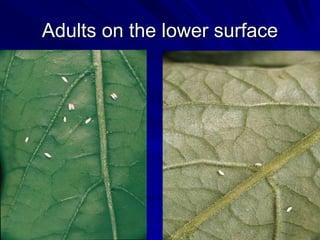
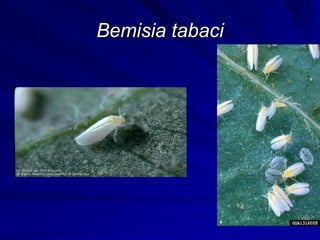
Adults on the lower surface
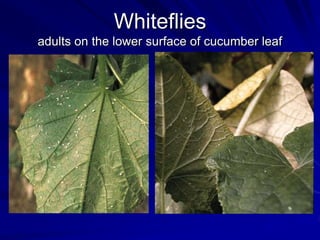
Whiteflies
adults on the lower surface of cucumber leaf
Whitefly
Order Hemiptera
Suborder Homoptera
Family Aleyrodidae
– Sweet potato whitefly, Bemisia tabaci
– Greenhouse whitefly, Trialeurodes
vaporariorum
– Silverleaf whitefly, Bemisia argentifolii
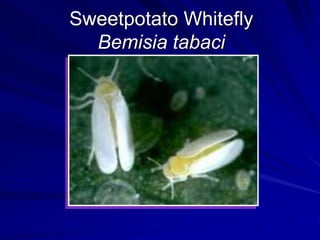
Sweetpotato Whitefly
Bemisia tabaci
Biology & Lifecycle:
– Adults prefer the undersides of leaves, especially the
upper canopy.
– Females produce about 160 eggs, on the undersides
of leaves.
– Upon hatching, the 1st instar nymph or “crawler”
moves about the leaf in search for a place to insert its
needle-like mouthparts into the plant to suck up plant
phloem.
– Large quantities of sweet liquid waste or honeydew
are excreted by nymphs which supports the growth of
black sooty mold fungi.
– Complete development takes from 2.5 to 7 weeks
depends on temperature.
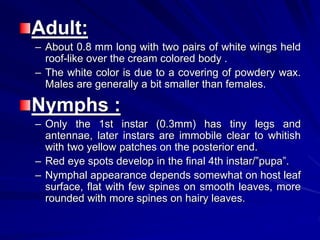
Adult:
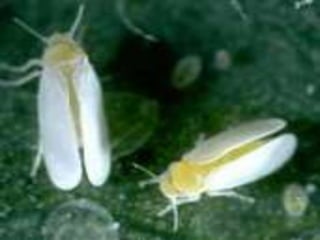
– About 0.8 mm long with two pairs of white wings held
roof-like over the cream colored body .
– The white color is due to a covering of powdery wax.
Males are generally a bit smaller than females.
Nymphs :
– Only the 1st instar (0.3mm) has tiny legs and
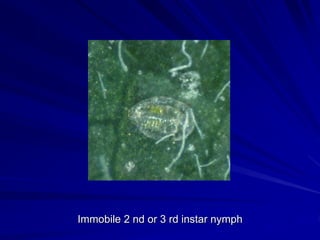
antennae, later instars are immobile clear to whitish
with two yellow patches on the posterior end.
– Red eye spots develop in the final 4th instar/”pupa”.
– Nymphal appearance depends somewhat on host leaf
surface, flat with few spines on smooth leaves, more
rounded with more spines on hairy leaves.
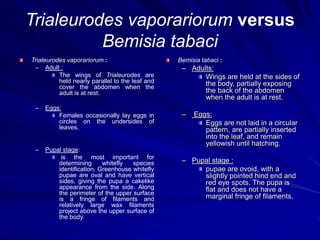
Trialeurodes vaporariorum versus
Bemisia tabaci
Trialeurodes vaporariorum :
– Adult :
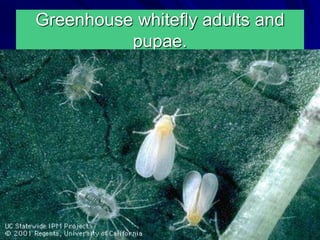
The wings of Trialeurodes are
held nearly parallel to the leaf and
cover the abdomen when the
adult is at rest.
– Eggs:
Females occasionally lay eggs in
circles on the undersides of
leaves.
– Pupal stage:
is the most important for
determining whitefly species
identification. Greenhouse whitefly
pupae are oval and have vertical
sides, giving the pupa a cakelike
appearance from the side. Along
the perimeter of the upper surface
is a fringe of filaments and
relatively large wax filaments
project above the upper surface of
the body.
Bemisia tabaci :
– Adults:
Wings are held at the sides of
the body, partially exposing
the back of the abdomen
when the adult is at rest.
– Eggs:
Eggs are not laid in a circular
pattern, are partially inserted
into the leaf, and remain
yellowish until hatching.
– Pupal stage :
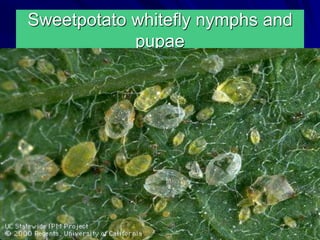
pupae are ovoid, with a
slightly pointed hind end and
red eye spots. The pupa is
flat and does not have a
marginal fringe of filaments.
Bemisia tabaci
Immobile 2 nd or 3 rd instar nymph
Sweetpotato whitefly nymphs and
pupae
Greenhouse whitefly adults and
pupae.
Host Range:
– Over 500 host plant species in over 74 plant families. including most
broadleaf agronomic and vegetable crops and many ornamentals such
as poinsettia and hibiscus.
– Pepper harbors lower populations than cucurbits & tomato or other
Solanaceae crops.
Damage:
– Heavy populations are debilitating due to sap loss and buildup of sooty
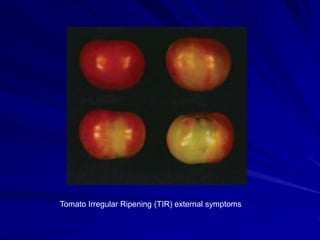
mold. Feeding by nymphs on leaves causes tomato irregular ripening
(TIR), where fruit do not color uniformly and exhibit areas of green or
white tissue internally .
– An average of 0.5 nymphs per leaf during fruit maturation may be
sufficient to induce TIR.
– The sweetpotato whitefly is the key pest of tomato, primarily as a vector
of the geminivirus, Tomato yellow leaf curl virus (TYLCV).
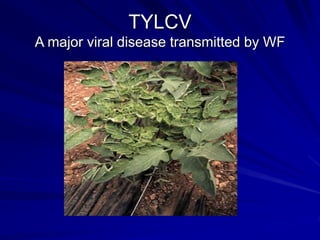
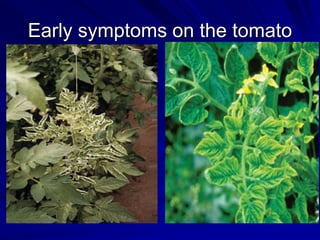
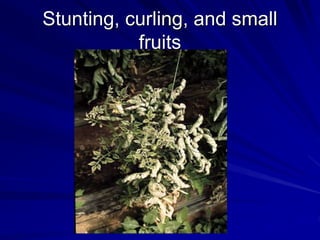
– TYLCV causes severe stunting, chlorosis, cupping and puckering of
leaves, and flower abortion. Little fruit is set above the point of initial
infection.
– The earlier the infection, the greater the impact on yield. Losses of up
to 90% may be sustained if plants show symptoms within the first month
after transplanting
TYLCV
A major viral disease transmitted by WF
Early symptoms on the tomato
Stunting, curling, and small
fruits
Tomato Irregular Ripening (TIR) external symptoms
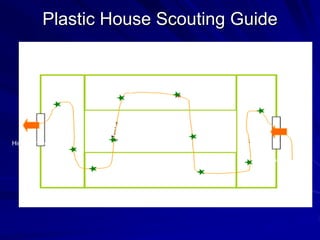
Plastic House Scouting Guide
Front entrance
Hind entrance
Middle area
Shady side
Sunny side
Monitoring
Scouting:
– Monitor incoming adults with yellow sticky
cards and by observing adults by gently
inverting upper leaves. Count nymphs on the
terminal leaflet of leaves ( tomato ) below the
6th node counting from the top.
Action Thresholds:
– 0.5 nymphs per terminal leaflet ( tomato) or 1
adult per leaf or plant for TIR.
– There is no set threshold for TYLCV because
incidence depends on the portion of adults
carrying the virus.
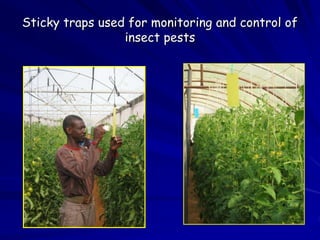
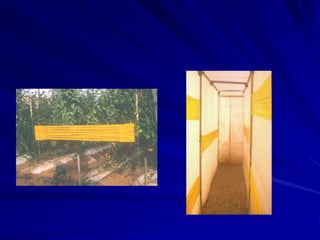
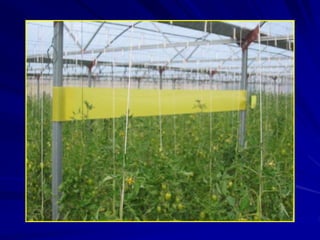
Sticky traps used for monitoring and control of
insect pests
CULTURAL CONTROLS
Start Clean:
– Transplants must be free of whiteflies and virus.
TYLCV Tolerant Varieties
Field Manipulations:
– Newly planted crops must be located distant from older plantings that may
serve as a source of virus and whiteflies.
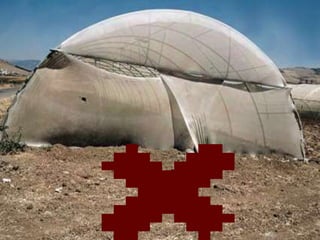
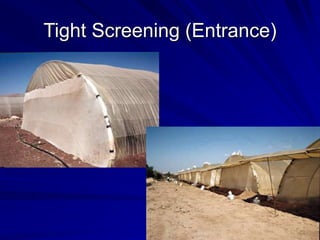
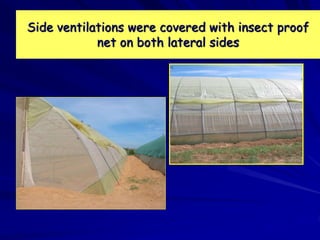
– Exclusion of winged adults can be accomplished by covering openings and
vents windows of the greenhouse with screens that have a pore width of 405
microns or smaller.
– Residues from spring crops should be removed and volunteers controlled
during at least two months prior to fall planting.
– Mulch: Reflective (aluminized) mulch may be used to repel whiteflies during
the first weeks of plant development.
– TYLCV infected plants early in the crop cycle should be removed from the
field, after being sprayed with an insecticide effective against adults, to
prevent dispersal of infected whiteflies.
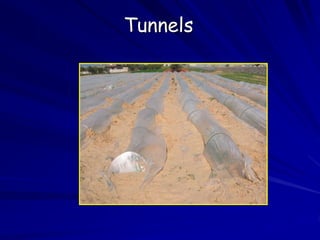
Tunnels
Tight Screening (Entrance)
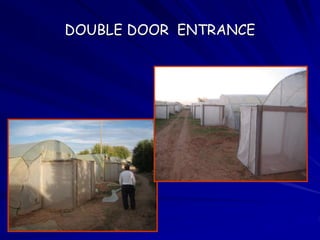
DOUBLE DOOR ENTRANCE
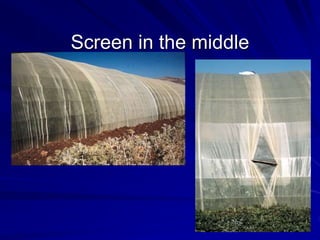
Screen in the middle
Side ventilations were covered with insect proof
net on both lateral sides
Chemical Control
– Drenches of systemic “neonicotinoid” insecticides (4A*) such as
imidacloprid (confidor ), thiamethoxam before and immediately
following transplanting provides early season control that is essential
for most tomato production .
– Foliar sprays of spiromesifen (Oberon®; ) and the insect growth
regulators buprofezin (Courier® ) and pyriproxyfen should be applied
according to the nymphal threshold.
– Soaps, oils, pymetrozine (FulFill®; 9B*) and broad spectrum
insecticides, alone or tank-mixed with products such as endosulfan
(cyclodiene).
– Organophosphates and pyrethroids Should be applied according to
the adult threshold. The latter three groups are best used toward the
end of the crop.
– Foliar applications of neonicotinoids should not be made 6 weeks
following soil drenches of the insecticides.
– Other products of different chemical classes should be rotated.
Natural Enemies
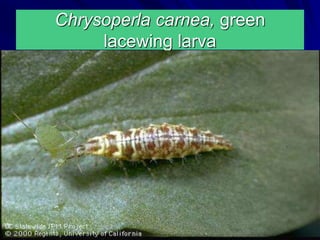
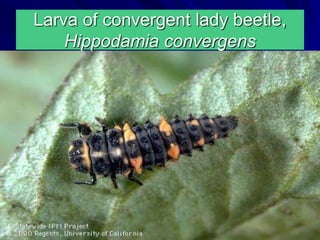
– Whiteflies have many effective natural enemies,
including parasitic wasps (Encarsia and Eretmocerus
spp.),tomato bugs (Engytatus = Cyrtopeltis spp.),
ladybeetles (Nephaspi and Delphastus
spp.),lacewings (Chrysoperla and Ceraeochrysa spp.)
and mites (Amblyseius swirskii).
– Natural enemies are responsible for the low whitefly
populations observed in weeds and can help control
whitefies in field crops if broad spectrum insecticides
are avoided.
– Mass release of certain natural enemies has also
proved effective in greenhouse crops.
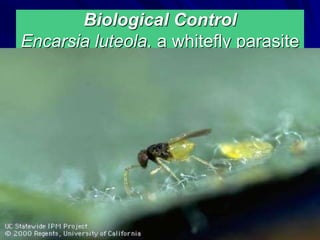
Biological Control
Encarsia luteola, a whitefly parasite
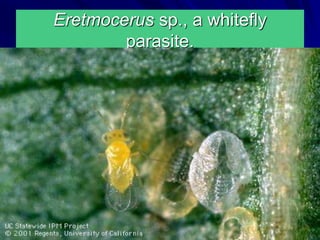
Eretmocerus sp., a whitefly
parasite.
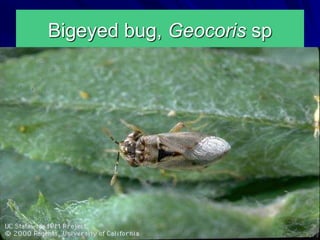
Bigeyed bug, Geocoris sp
Chrysoperla carnea, green
lacewing larva
Larva of convergent lady beetle,
Hippodamia convergens
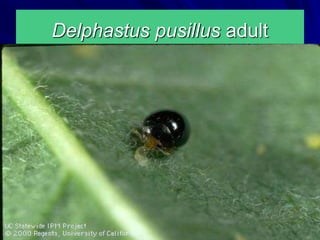
Delphastus pusillus adult

IPM - Whitefly

  • 1.
  • 3.
    Adults on thelower surface
  • 4.
    Whiteflies adults on thelower surface of cucumber leaf
  • 5.
    Whitefly Order Hemiptera Suborder Homoptera FamilyAleyrodidae – Sweet potato whitefly, Bemisia tabaci – Greenhouse whitefly, Trialeurodes vaporariorum – Silverleaf whitefly, Bemisia argentifolii
  • 6.
  • 7.
    Biology & Lifecycle: –Adults prefer the undersides of leaves, especially the upper canopy. – Females produce about 160 eggs, on the undersides of leaves. – Upon hatching, the 1st instar nymph or “crawler” moves about the leaf in search for a place to insert its needle-like mouthparts into the plant to suck up plant phloem. – Large quantities of sweet liquid waste or honeydew are excreted by nymphs which supports the growth of black sooty mold fungi. – Complete development takes from 2.5 to 7 weeks depends on temperature.
  • 8.
    Adult: – About 0.8mm long with two pairs of white wings held roof-like over the cream colored body . – The white color is due to a covering of powdery wax. Males are generally a bit smaller than females. Nymphs : – Only the 1st instar (0.3mm) has tiny legs and antennae, later instars are immobile clear to whitish with two yellow patches on the posterior end. – Red eye spots develop in the final 4th instar/”pupa”. – Nymphal appearance depends somewhat on host leaf surface, flat with few spines on smooth leaves, more rounded with more spines on hairy leaves.
  • 9.
    Trialeurodes vaporariorum versus Bemisiatabaci Trialeurodes vaporariorum : – Adult : The wings of Trialeurodes are held nearly parallel to the leaf and cover the abdomen when the adult is at rest. – Eggs: Females occasionally lay eggs in circles on the undersides of leaves. – Pupal stage: is the most important for determining whitefly species identification. Greenhouse whitefly pupae are oval and have vertical sides, giving the pupa a cakelike appearance from the side. Along the perimeter of the upper surface is a fringe of filaments and relatively large wax filaments project above the upper surface of the body. Bemisia tabaci : – Adults: Wings are held at the sides of the body, partially exposing the back of the abdomen when the adult is at rest. – Eggs: Eggs are not laid in a circular pattern, are partially inserted into the leaf, and remain yellowish until hatching. – Pupal stage : pupae are ovoid, with a slightly pointed hind end and red eye spots. The pupa is flat and does not have a marginal fringe of filaments.
  • 10.
  • 11.
    Immobile 2 ndor 3 rd instar nymph
  • 12.
  • 13.
  • 14.
    Host Range: – Over500 host plant species in over 74 plant families. including most broadleaf agronomic and vegetable crops and many ornamentals such as poinsettia and hibiscus. – Pepper harbors lower populations than cucurbits & tomato or other Solanaceae crops. Damage: – Heavy populations are debilitating due to sap loss and buildup of sooty mold. Feeding by nymphs on leaves causes tomato irregular ripening (TIR), where fruit do not color uniformly and exhibit areas of green or white tissue internally . – An average of 0.5 nymphs per leaf during fruit maturation may be sufficient to induce TIR. – The sweetpotato whitefly is the key pest of tomato, primarily as a vector of the geminivirus, Tomato yellow leaf curl virus (TYLCV). – TYLCV causes severe stunting, chlorosis, cupping and puckering of leaves, and flower abortion. Little fruit is set above the point of initial infection. – The earlier the infection, the greater the impact on yield. Losses of up to 90% may be sustained if plants show symptoms within the first month after transplanting
  • 15.
    TYLCV A major viraldisease transmitted by WF
  • 16.
  • 17.
  • 18.
    Tomato Irregular Ripening(TIR) external symptoms
  • 19.
    Plastic House ScoutingGuide Front entrance Hind entrance Middle area Shady side Sunny side
  • 20.
    Monitoring Scouting: – Monitor incomingadults with yellow sticky cards and by observing adults by gently inverting upper leaves. Count nymphs on the terminal leaflet of leaves ( tomato ) below the 6th node counting from the top. Action Thresholds: – 0.5 nymphs per terminal leaflet ( tomato) or 1 adult per leaf or plant for TIR. – There is no set threshold for TYLCV because incidence depends on the portion of adults carrying the virus.
  • 21.
    Sticky traps usedfor monitoring and control of insect pests
  • 24.
    CULTURAL CONTROLS Start Clean: –Transplants must be free of whiteflies and virus. TYLCV Tolerant Varieties Field Manipulations: – Newly planted crops must be located distant from older plantings that may serve as a source of virus and whiteflies. – Exclusion of winged adults can be accomplished by covering openings and vents windows of the greenhouse with screens that have a pore width of 405 microns or smaller. – Residues from spring crops should be removed and volunteers controlled during at least two months prior to fall planting. – Mulch: Reflective (aluminized) mulch may be used to repel whiteflies during the first weeks of plant development. – TYLCV infected plants early in the crop cycle should be removed from the field, after being sprayed with an insecticide effective against adults, to prevent dispersal of infected whiteflies.
  • 26.
  • 27.
  • 28.
  • 29.
  • 30.
    Side ventilations werecovered with insect proof net on both lateral sides
  • 31.
    Chemical Control – Drenchesof systemic “neonicotinoid” insecticides (4A*) such as imidacloprid (confidor ), thiamethoxam before and immediately following transplanting provides early season control that is essential for most tomato production . – Foliar sprays of spiromesifen (Oberon®; ) and the insect growth regulators buprofezin (Courier® ) and pyriproxyfen should be applied according to the nymphal threshold. – Soaps, oils, pymetrozine (FulFill®; 9B*) and broad spectrum insecticides, alone or tank-mixed with products such as endosulfan (cyclodiene). – Organophosphates and pyrethroids Should be applied according to the adult threshold. The latter three groups are best used toward the end of the crop. – Foliar applications of neonicotinoids should not be made 6 weeks following soil drenches of the insecticides. – Other products of different chemical classes should be rotated.
  • 32.
    Natural Enemies – Whiteflieshave many effective natural enemies, including parasitic wasps (Encarsia and Eretmocerus spp.),tomato bugs (Engytatus = Cyrtopeltis spp.), ladybeetles (Nephaspi and Delphastus spp.),lacewings (Chrysoperla and Ceraeochrysa spp.) and mites (Amblyseius swirskii). – Natural enemies are responsible for the low whitefly populations observed in weeds and can help control whitefies in field crops if broad spectrum insecticides are avoided. – Mass release of certain natural enemies has also proved effective in greenhouse crops.
  • 33.
  • 34.
    Eretmocerus sp., awhitefly parasite.
  • 36.
  • 37.
  • 38.
    Larva of convergentlady beetle, Hippodamia convergens
  • 39.