THRIPS
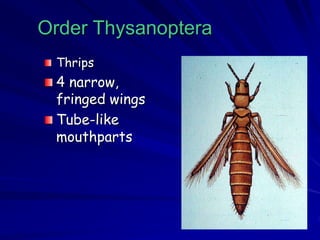
Order Thysanoptera
Thrips
4 narrow,
fringed wings
Tube-like
mouthparts
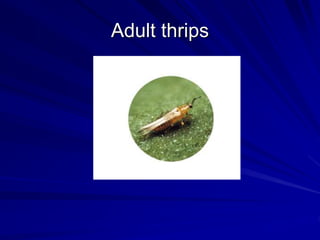
Adult thrips
Order Thysanoptera
Family Thripidae
– Western Flower Thrips Frankliniella occidentalis
– Onion thrips Thrips tabaci
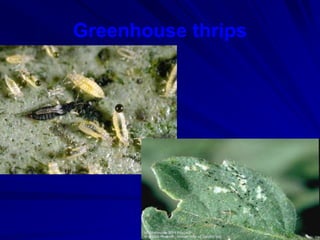
– Greenhouse thrips Heliothrips haemorrhoidalis
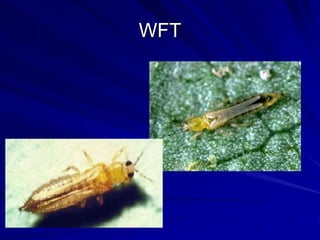
WFT
Greenhouse thrips
 Western flower thrips (WFT) has three color forms :
 Pale form that is white and yellow, except for slight brown spots or
blemishes on the top of the abdomen.
 Intermediate form with a dark orange thorax and brown abdomen.
 Dark form that is dark brown.
 Onion thrips ( Thrips tabaci ):
 darker than WFT, and smaller in size, with 7 segments in antennae
compared with 8 segments in WFT.
 Adult Greenhouse thrips :
 Adults are tiny, black, insects with whitish to translucent wings folded
back over their thorax and abdomen. Legs are also a whitish color.
 Nymphs are whitish to slightly yellowish in color and produce a globule
of fecal fluid at the tip of their abdomen.
 These globules of fluid increase in size until they fall off and another
one begins to form, resulting in a characteristic spotting of the
infestation area with black specks of fecal material.
Western Flower Thrips
Frankliniella occidentalis
Biology & Lifecycle:
– Thrips are tiny insects that have four featherlike wings, each
consisting of a thick supporting strut with fine hairs on the front
and hind edges
– Thrips insert individual eggs into the developing flower buds and
fruit pods of pepper and tomato.
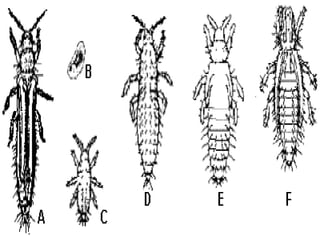
– The eggs hatch in about 6 days. Thrips go through six life stages:
egg, first instar, second instar, prepupa, pupa, and adult.
– The first two instars and adults feed by piercing and
removing contents of individual plant cells.
– Larval development in the flowers and small fruits requires 6 to 8
days depending on temperature.
– The adults live about 3 weeks and feed primarily on flower tissues
and pollen. Pollen-feeding increases fecundity 2 to 4 fold.
– Generational cycles take about 20 days in hot weather and as
long as 60 days in the winter
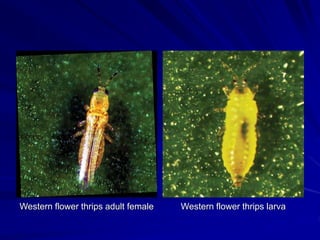
Western flower thrips adult female Western flower thrips larva
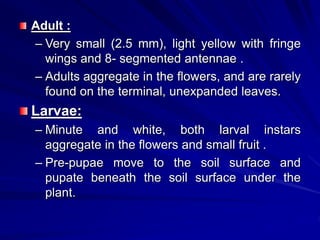
Adult :
– Very small (2.5 mm), light yellow with fringe
wings and 8- segmented antennae .
– Adults aggregate in the flowers, and are rarely
found on the terminal, unexpanded leaves.
Larvae:
– Minute and white, both larval instars
aggregate in the flowers and small fruit .
– Pre-pupae move to the soil surface and
pupate beneath the soil surface under the
plant.
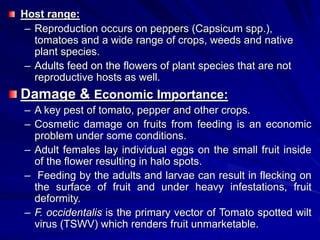
Host range:
– Reproduction occurs on peppers (Capsicum spp.),
tomatoes and a wide range of crops, weeds and native
plant species.
– Adults feed on the flowers of plant species that are not
reproductive hosts as well.
Damage & Economic Importance:
– A key pest of tomato, pepper and other crops.
– Cosmetic damage on fruits from feeding is an economic
problem under some conditions.
– Adult females lay individual eggs on the small fruit inside
of the flower resulting in halo spots.
– Feeding by the adults and larvae can result in flecking on
the surface of fruit and under heavy infestations, fruit
deformity.
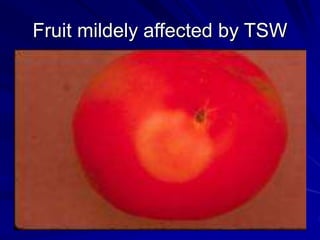
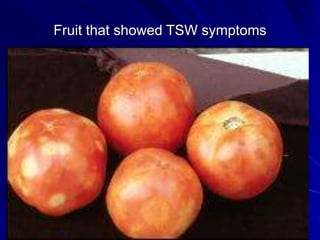
– F. occidentalis is the primary vector of Tomato spotted wilt
virus (TSWV) which renders fruit unmarketable.
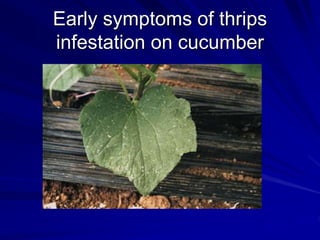
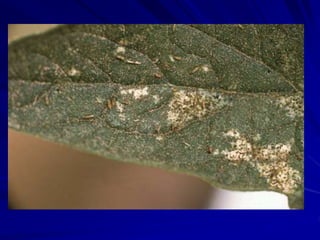
Early symptoms of thrips
infestation on cucumber
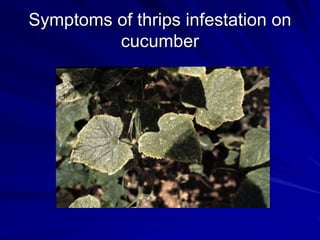
Symptoms of thrips infestation on
cucumber
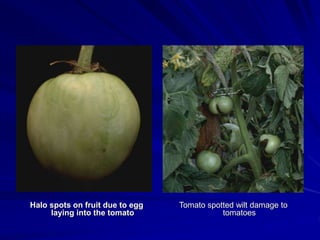
Halo spots on fruit due to egg
laying into the tomato
Tomato spotted wilt damage to
tomatoes
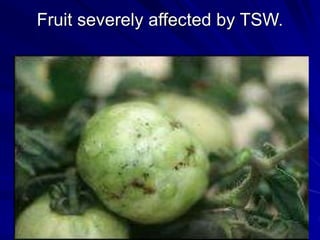
Fruit severely affected by TSW.
Fruit mildely affected by TSW
Fruit that showed TSW symptoms
Monitoring
Traps:
– Blue sticky cards are most attractive thrips. However, yellow cards
are easier to count and more commonly used for insect monitoring.
Place yellow sticky cards vertically in the crop canopy, with the lower
one-third of the trap in the leaves and the upper two-thirds above the
leaves. As the crop grows, the traps will need to be raised.
Scouting:
– Frequent monitoring of once or twice weekly is needed to assess
western flower thrips numbers and to determine the incidence of
TSWV.
– The total number of Thrips of all species can be estimated in the field
by beating individual flowers onto a white plastic board.
– Thrips must be placed in vials of alcohol and examined at 40X
magnification using a stereoscope in order to determine western
flower Thrips from the other flower Thrips species.
Action Thresholds:
– Consider treating if an average of 5 to 10 thrips per
card per week is present ( 1 trap/900 sq m)
– In tomato, > 0.5 adults per flower. If tomato spotted
wilt incidence exceeds 5% in the field, once per week
applications of an insecticide for control of the larvae
reduces spread of the disease in susceptible
cultivars.
– In pepper, 2 to 3 larvae or adults per flower is
tolerable. A reduced risk insecticide that does not
suppress natural populations of predatory minute
pirate bugs can be used to suppress adults and
larvae.
Cultural Control
– Because western flower thrips and greenhouse thrips feed on a
large variety of plant species, keep production areas free of
weeds, which can serve as hosts for thrips populations.
– Covering openings to the greenhouse & ventilation openeing
with fine screens does exclude most thrips.
– Carefully inspect plants being brought in to start a new crop to
ensure that they are free of thrips and other pests.
– Ultraviolet-Reflective Mulch: UV-reflective (aluminum) mulch
reduces the introduction of western flower thrips adults into
production fields. This is the most effective tactic to control
primary spread of TSWV (i.e. thrips acquire the virus when
developing on plant hosts outside the field).
– Do Not Over-Fertilize: Over-fertilization with nitrogen increases
the number of western flower thrips and the incidence of TSWV.
– Resistant Cultivars: Cultivars resistant to TSWV are available for
tomatoes and peppers.
– Distinguishing the adults from other flower thrips (F. bispinosa)
and the eastern flower thrips (F. tritici) is not possible using a
hand lens.
Natural Enemies
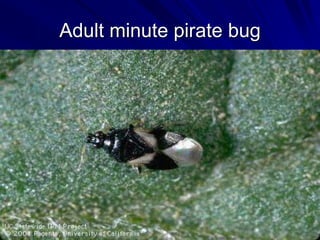
The key natural enemy capable of suppressing
populations is the minute pirate bug, Orius spp.
These predators naturally invade fields and
management programs of pepper and other
crops should be designed to conserve its
populations.
No natural enemies are important in suppressing
western flower thrips in tomato due to it’s
nutritional poor pollen grain. So, planting pepper
with tomato provide the predator appropriate
food and enhance thrips control in tomato fields.
Adult minute pirate bug
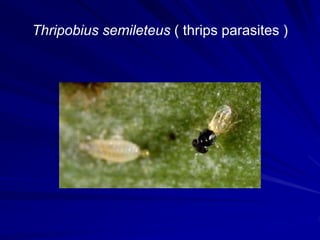
Thripobius semileteus ( thrips parasites )
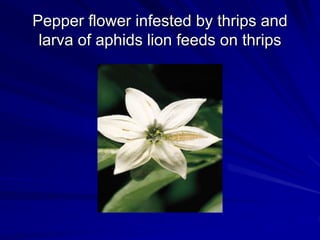
Pepper flower infested by thrips and
larva of aphids lion feeds on thrips
Chemical Control
– During periods of intense infestations,
reducing thrips numbers below the action
threshold with natural enemies is not possible.
– Spray tomatoes when numbers of adults or
larvae exceed the action threshold.
– Use reduced-risk insecticides to conserve
minute pirate bug, Orius spp, populations in
pepper. Natural Enemies typically control the
F. occidentalis for most of the production
season.
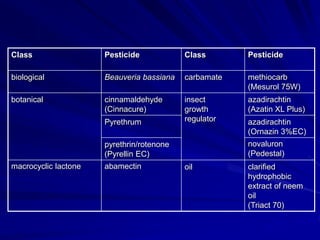
Class Pesticide Class Pesticide
biological Beauveria bassiana carbamate methiocarb
(Mesurol 75W)
botanical cinnamaldehyde
(Cinnacure)
insect
growth
regulator
azadirachtin
(Azatin XL Plus)
Pyrethrum azadirachtin
(Ornazin 3%EC)
pyrethrin/rotenone
(Pyrellin EC)
novaluron
(Pedestal)
macrocyclic lactone abamectin oil clarified
hydrophobic
extract of neem
oil
(Triact 70)
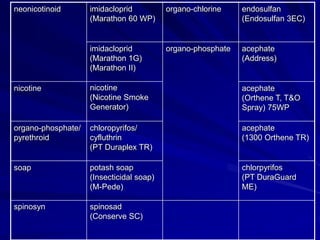
neonicotinoid imidacloprid
(Marathon 60 WP)
organo-chlorine endosulfan
(Endosulfan 3EC)
imidacloprid
(Marathon 1G)
(Marathon II)
organo-phosphate acephate
(Address)
nicotine nicotine
(Nicotine Smoke
Generator)
acephate
(Orthene T, T&O
Spray) 75WP
organo-phosphate/
pyrethroid
chloropyrifos/
cyfluthrin
(PT Duraplex TR)
acephate
(1300 Orthene TR)
soap potash soap
(Insecticidal soap)
(M-Pede)
chlorpyrifos
(PT DuraGuard
ME)
spinosyn spinosad
(Conserve SC)
Resistance Management
Few insecticides are effective in suppressing F.
occidentalis.
Resistance has developed to many products
including carbamate , organophosphate and
synthetic pyrethroid insecticides.
Resistance to neonicotinoid insecticides also is
reported.
Alternative cultural control and plant resistance
tactics are the best options to control thrips and to
avoid the development of resistance.
Rotate chemical classes, although this does not
guarantee against the development of insecticide
resistance.

IPM - Thrips

  • 1.
  • 2.
  • 3.
  • 4.
    Order Thysanoptera Family Thripidae –Western Flower Thrips Frankliniella occidentalis – Onion thrips Thrips tabaci – Greenhouse thrips Heliothrips haemorrhoidalis
  • 5.
  • 6.
  • 7.
     Western flowerthrips (WFT) has three color forms :  Pale form that is white and yellow, except for slight brown spots or blemishes on the top of the abdomen.  Intermediate form with a dark orange thorax and brown abdomen.  Dark form that is dark brown.  Onion thrips ( Thrips tabaci ):  darker than WFT, and smaller in size, with 7 segments in antennae compared with 8 segments in WFT.  Adult Greenhouse thrips :  Adults are tiny, black, insects with whitish to translucent wings folded back over their thorax and abdomen. Legs are also a whitish color.  Nymphs are whitish to slightly yellowish in color and produce a globule of fecal fluid at the tip of their abdomen.  These globules of fluid increase in size until they fall off and another one begins to form, resulting in a characteristic spotting of the infestation area with black specks of fecal material.
  • 8.
    Western Flower Thrips Frankliniellaoccidentalis Biology & Lifecycle: – Thrips are tiny insects that have four featherlike wings, each consisting of a thick supporting strut with fine hairs on the front and hind edges – Thrips insert individual eggs into the developing flower buds and fruit pods of pepper and tomato. – The eggs hatch in about 6 days. Thrips go through six life stages: egg, first instar, second instar, prepupa, pupa, and adult. – The first two instars and adults feed by piercing and removing contents of individual plant cells. – Larval development in the flowers and small fruits requires 6 to 8 days depending on temperature. – The adults live about 3 weeks and feed primarily on flower tissues and pollen. Pollen-feeding increases fecundity 2 to 4 fold. – Generational cycles take about 20 days in hot weather and as long as 60 days in the winter
  • 10.
    Western flower thripsadult female Western flower thrips larva
  • 11.
    Adult : – Verysmall (2.5 mm), light yellow with fringe wings and 8- segmented antennae . – Adults aggregate in the flowers, and are rarely found on the terminal, unexpanded leaves. Larvae: – Minute and white, both larval instars aggregate in the flowers and small fruit . – Pre-pupae move to the soil surface and pupate beneath the soil surface under the plant.
  • 12.
    Host range: – Reproductionoccurs on peppers (Capsicum spp.), tomatoes and a wide range of crops, weeds and native plant species. – Adults feed on the flowers of plant species that are not reproductive hosts as well. Damage & Economic Importance: – A key pest of tomato, pepper and other crops. – Cosmetic damage on fruits from feeding is an economic problem under some conditions. – Adult females lay individual eggs on the small fruit inside of the flower resulting in halo spots. – Feeding by the adults and larvae can result in flecking on the surface of fruit and under heavy infestations, fruit deformity. – F. occidentalis is the primary vector of Tomato spotted wilt virus (TSWV) which renders fruit unmarketable.
  • 13.
    Early symptoms ofthrips infestation on cucumber
  • 14.
    Symptoms of thripsinfestation on cucumber
  • 16.
    Halo spots onfruit due to egg laying into the tomato Tomato spotted wilt damage to tomatoes
  • 17.
  • 18.
  • 19.
    Fruit that showedTSW symptoms
  • 20.
    Monitoring Traps: – Blue stickycards are most attractive thrips. However, yellow cards are easier to count and more commonly used for insect monitoring. Place yellow sticky cards vertically in the crop canopy, with the lower one-third of the trap in the leaves and the upper two-thirds above the leaves. As the crop grows, the traps will need to be raised. Scouting: – Frequent monitoring of once or twice weekly is needed to assess western flower thrips numbers and to determine the incidence of TSWV. – The total number of Thrips of all species can be estimated in the field by beating individual flowers onto a white plastic board. – Thrips must be placed in vials of alcohol and examined at 40X magnification using a stereoscope in order to determine western flower Thrips from the other flower Thrips species.
  • 22.
    Action Thresholds: – Considertreating if an average of 5 to 10 thrips per card per week is present ( 1 trap/900 sq m) – In tomato, > 0.5 adults per flower. If tomato spotted wilt incidence exceeds 5% in the field, once per week applications of an insecticide for control of the larvae reduces spread of the disease in susceptible cultivars. – In pepper, 2 to 3 larvae or adults per flower is tolerable. A reduced risk insecticide that does not suppress natural populations of predatory minute pirate bugs can be used to suppress adults and larvae.
  • 23.
    Cultural Control – Becausewestern flower thrips and greenhouse thrips feed on a large variety of plant species, keep production areas free of weeds, which can serve as hosts for thrips populations. – Covering openings to the greenhouse & ventilation openeing with fine screens does exclude most thrips. – Carefully inspect plants being brought in to start a new crop to ensure that they are free of thrips and other pests. – Ultraviolet-Reflective Mulch: UV-reflective (aluminum) mulch reduces the introduction of western flower thrips adults into production fields. This is the most effective tactic to control primary spread of TSWV (i.e. thrips acquire the virus when developing on plant hosts outside the field). – Do Not Over-Fertilize: Over-fertilization with nitrogen increases the number of western flower thrips and the incidence of TSWV. – Resistant Cultivars: Cultivars resistant to TSWV are available for tomatoes and peppers. – Distinguishing the adults from other flower thrips (F. bispinosa) and the eastern flower thrips (F. tritici) is not possible using a hand lens.
  • 24.
    Natural Enemies The keynatural enemy capable of suppressing populations is the minute pirate bug, Orius spp. These predators naturally invade fields and management programs of pepper and other crops should be designed to conserve its populations. No natural enemies are important in suppressing western flower thrips in tomato due to it’s nutritional poor pollen grain. So, planting pepper with tomato provide the predator appropriate food and enhance thrips control in tomato fields.
  • 25.
  • 26.
    Thripobius semileteus (thrips parasites )
  • 27.
    Pepper flower infestedby thrips and larva of aphids lion feeds on thrips
  • 28.
    Chemical Control – Duringperiods of intense infestations, reducing thrips numbers below the action threshold with natural enemies is not possible. – Spray tomatoes when numbers of adults or larvae exceed the action threshold. – Use reduced-risk insecticides to conserve minute pirate bug, Orius spp, populations in pepper. Natural Enemies typically control the F. occidentalis for most of the production season.
  • 29.
    Class Pesticide ClassPesticide biological Beauveria bassiana carbamate methiocarb (Mesurol 75W) botanical cinnamaldehyde (Cinnacure) insect growth regulator azadirachtin (Azatin XL Plus) Pyrethrum azadirachtin (Ornazin 3%EC) pyrethrin/rotenone (Pyrellin EC) novaluron (Pedestal) macrocyclic lactone abamectin oil clarified hydrophobic extract of neem oil (Triact 70)
  • 30.
    neonicotinoid imidacloprid (Marathon 60WP) organo-chlorine endosulfan (Endosulfan 3EC) imidacloprid (Marathon 1G) (Marathon II) organo-phosphate acephate (Address) nicotine nicotine (Nicotine Smoke Generator) acephate (Orthene T, T&O Spray) 75WP organo-phosphate/ pyrethroid chloropyrifos/ cyfluthrin (PT Duraplex TR) acephate (1300 Orthene TR) soap potash soap (Insecticidal soap) (M-Pede) chlorpyrifos (PT DuraGuard ME) spinosyn spinosad (Conserve SC)
  • 31.
    Resistance Management Few insecticidesare effective in suppressing F. occidentalis. Resistance has developed to many products including carbamate , organophosphate and synthetic pyrethroid insecticides. Resistance to neonicotinoid insecticides also is reported. Alternative cultural control and plant resistance tactics are the best options to control thrips and to avoid the development of resistance. Rotate chemical classes, although this does not guarantee against the development of insecticide resistance.