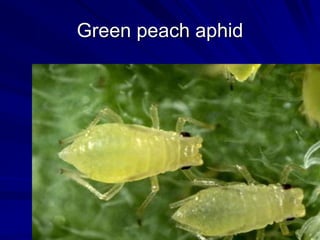
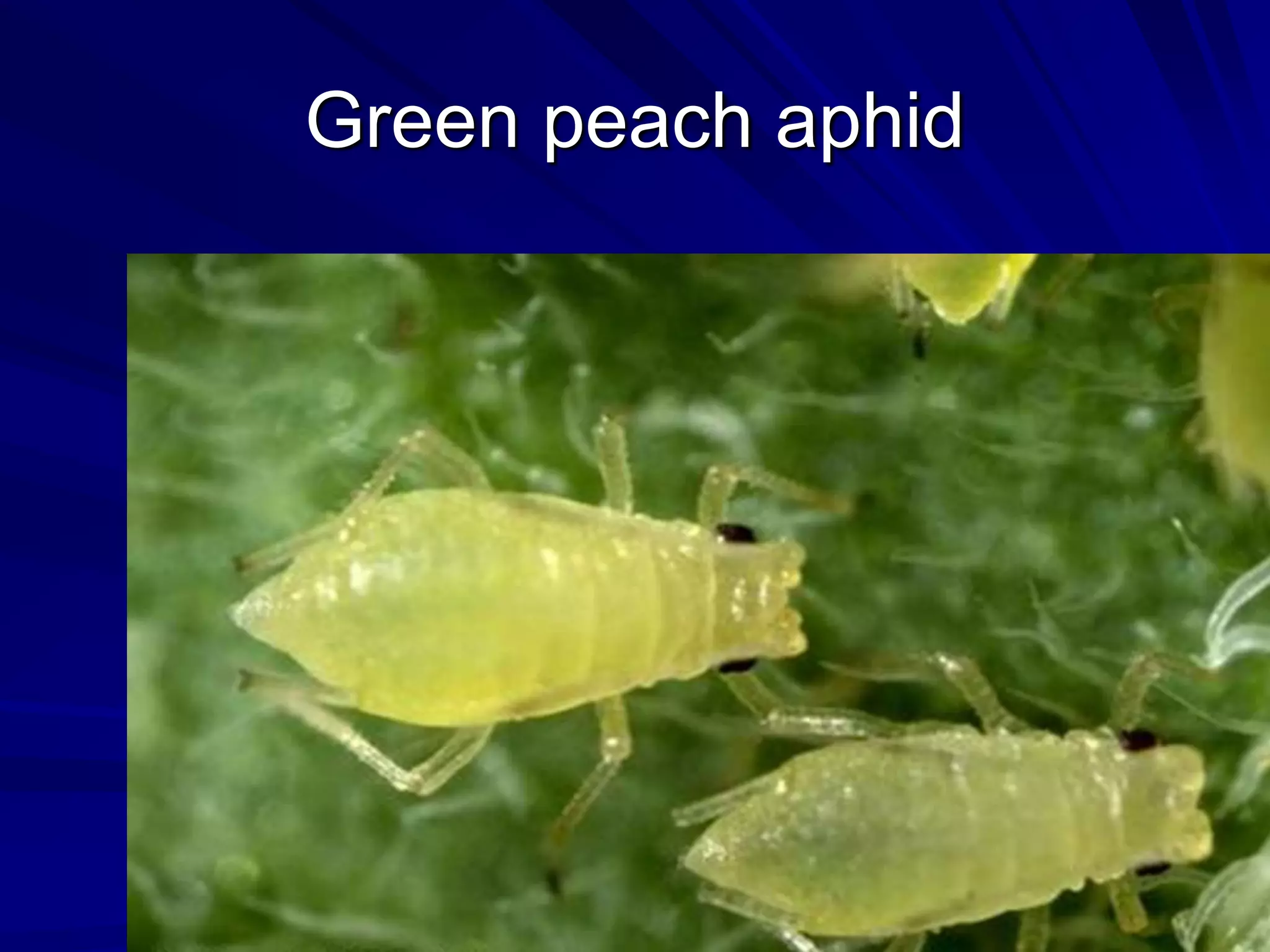
Green peach aphid
Green Peach Aphid: Myzus persicae
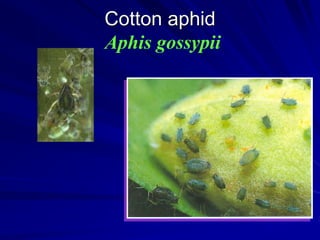
Melon/cotton aphid : Aphis gossypii
Order: Homoptera
Family: Aphidae
– Aphids are distinguished from other insects by
the presence of cornicles, tube like appendages
that protrude from the rear of the aphid.
– Adult aphids may or may not have wings.
Winged aphids are produced as a result of
crowding. Green peach aphids produce winged
adults at lower population densities than the
melon aphid.
– The two species most commonly encountered
are the green peach aphid and the cotton or
melon aphid.
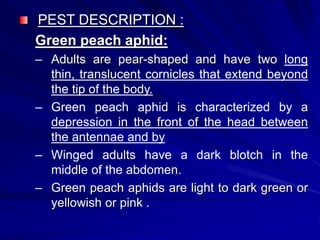
PEST DESCRIPTION :
Green peach aphid:
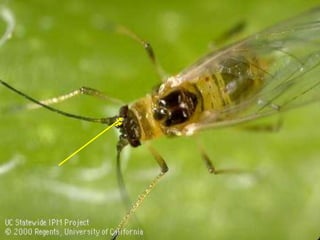
– Adults are pear-shaped and have two long
thin, translucent cornicles that extend beyond
the tip of the body.
– Green peach aphid is characterized by a
depression in the front of the head between
the antennae and by
– Winged adults have a dark blotch in the
middle of the abdomen.
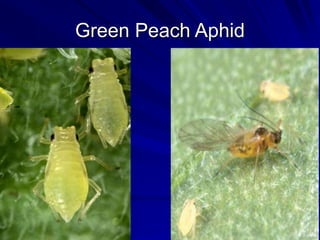
– Green peach aphids are light to dark green or
yellowish or pink .
Green Peach Aphid
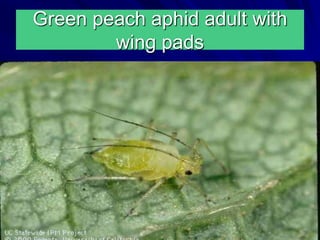
Green peach aphid adult with
wing pads
1. Melon aphids are typically dark green, but
color variations do occur frequently.
2. The cornicles (Aphis gossypii) are relatively
short, and always dark.
3. Melon aphids have red eyes and antennae
that only reach to the middle of the
abdomen.
4. Winged females are slightly smaller and
have a darker middle body section.
Melon/cotton aphid : Aphis gossypii
Cotton aphid
Aphis gossypii
Environmental Factors:
Aphids may be present year round, but are
usually more abundant during warmer
months . The insects over summer on
volunteer plants and on weeds.
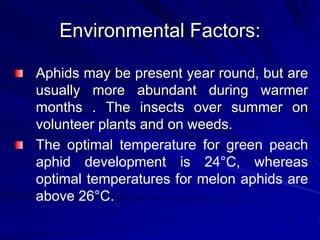
The optimal temperature for green peach
aphid development is 24°C, whereas
optimal temperatures for melon aphids are
above 26°C.
Biology & Lifecycle:
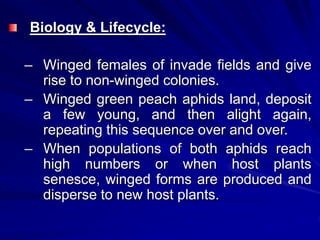
– Winged females of invade fields and give
rise to non-winged colonies.
– Winged green peach aphids land, deposit
a few young, and then alight again,
repeating this sequence over and over.
– When populations of both aphids reach
high numbers or when host plants
senesce, winged forms are produced and
disperse to new host plants.
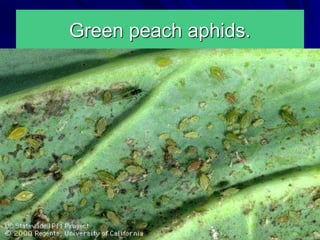
Green peach aphids.
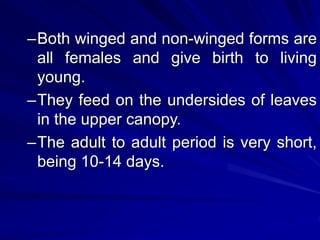
–Both winged and non-winged forms are
all females and give birth to living
young.
–They feed on the undersides of leaves
in the upper canopy.
–The adult to adult period is very short,
being 10-14 days.
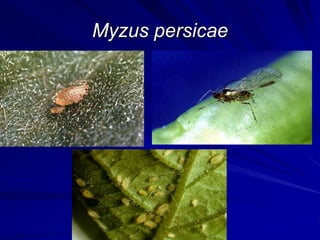
Myzus persicae
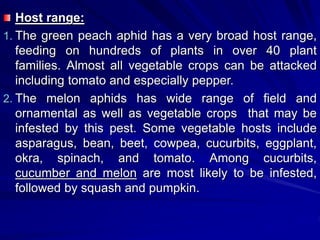
Host range:
1. The green peach aphid has a very broad host range,
feeding on hundreds of plants in over 40 plant
families. Almost all vegetable crops can be attacked
including tomato and especially pepper.
2. The melon aphids has wide range of field and
ornamental as well as vegetable crops that may be
infested by this pest. Some vegetable hosts include
asparagus, bean, beet, cowpea, cucurbits, eggplant,
okra, spinach, and tomato. Among cucurbits,
cucumber and melon are most likely to be infested,
followed by squash and pumpkin.
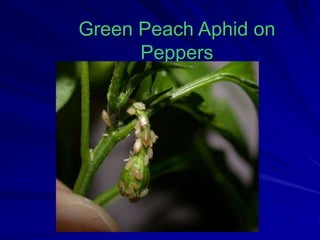
Green Peach Aphid on
Peppers
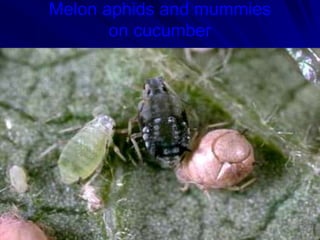
Melon aphids and mummies
on cucumber
Damage :
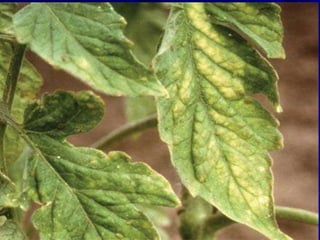
– Adults and nymphs have piercing-sucking mouthparts, and
feeding on the undersides of upper leaves produces
yellowing of the upper surfaces .
– Feeding on newly developing tissues can cause those parts
to become twisted as they grow. Leaves and stems may be
distorted.
– Aphids produce a sugary substance called honeydew, which
serves as a medium for sooty mold growth.
– Most damage is inflicted by transmitting plant viruses. Melon
aphids are known to transmit 44 plant viruses, while green
peach aphids are known to transmit more than 100 plant
viruses. such as Cucumber mosaic virus ,Potato virus Y and
Tobacco etch virus.
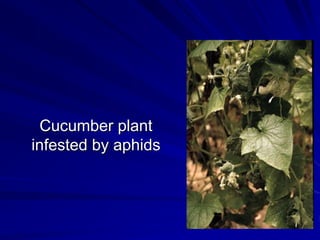
Cucumber plant
infested by aphids
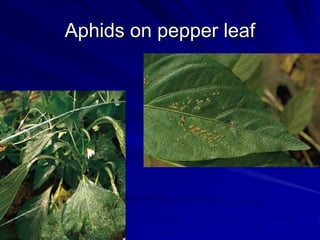
Aphids on pepper leaf
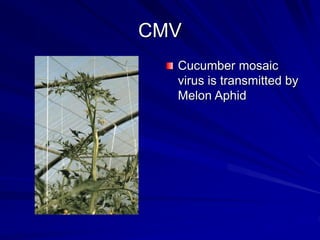
CMV
Cucumber mosaic
virus is transmitted by
Melon Aphid
Monitoring
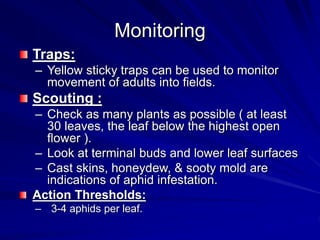
Traps:
– Yellow sticky traps can be used to monitor
movement of adults into fields.
Scouting :
– Check as many plants as possible ( at least
30 leaves, the leaf below the highest open
flower ).
– Look at terminal buds and lower leaf surfaces
– Cast skins, honeydew, & sooty mold are
indications of aphid infestation.
Action Thresholds:
– 3-4 aphids per leaf.
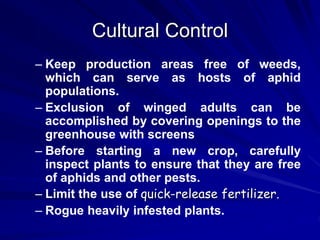
Cultural Control
– Keep production areas free of weeds,
which can serve as hosts of aphid
populations.
– Exclusion of winged adults can be
accomplished by covering openings to the
greenhouse with screens
– Before starting a new crop, carefully
inspect plants to ensure that they are free
of aphids and other pests.
– Limit the use of quick-release fertilizer.
– Rogue heavily infested plants.
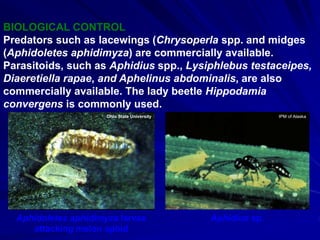
BIOLOGICAL CONTROL
Predators such as lacewings (Chrysoperla spp. and midges
(Aphidoletes aphidimyza) are commercially available.
Parasitoids, such as Aphidius spp., Lysiphlebus testaceipes,
Diaeretiella rapae, and Aphelinus abdominalis, are also
commercially available. The lady beetle Hippodamia
convergens is commonly used.
Aphidius sp.Aphidoletes aphidimyza larvae
attacking melon aphid
Ohio State University IPM of Alaska
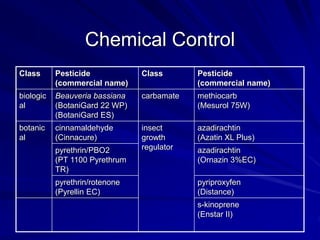
Class Pesticide
(commercial name)
Class Pesticide
(commercial name)
biologic
al
Beauveria bassiana
(BotaniGard 22 WP)
(BotaniGard ES)
carbamate methiocarb
(Mesurol 75W)
botanic
al
cinnamaldehyde
(Cinnacure)
insect
growth
regulator
azadirachtin
(Azatin XL Plus)
pyrethrin/PBO2
(PT 1100 Pyrethrum
TR)
azadirachtin
(Ornazin 3%EC)
pyrethrin/rotenone
(Pyrellin EC)
pyriproxyfen
(Distance)
s-kinoprene
(Enstar II)
Chemical Control
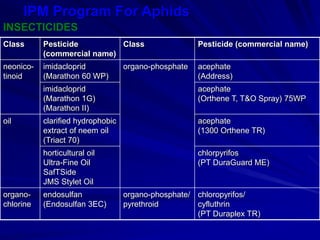
IPM Program For Aphids
INSECTICIDES
Class Pesticide
(commercial name)
Class Pesticide (commercial name)
neonico-
tinoid
imidacloprid
(Marathon 60 WP)
organo-phosphate acephate
(Address)
imidacloprid
(Marathon 1G)
(Marathon II)
acephate
(Orthene T, T&O Spray) 75WP
oil clarified hydrophobic
extract of neem oil
(Triact 70)
acephate
(1300 Orthene TR)
horticultural oil
Ultra-Fine Oil
SafTSide
JMS Stylet Oil
chlorpyrifos
(PT DuraGuard ME)
organo-
chlorine
endosulfan
(Endosulfan 3EC)
organo-phosphate/
pyrethroid
chloropyrifos/
cyfluthrin
(PT Duraplex TR)
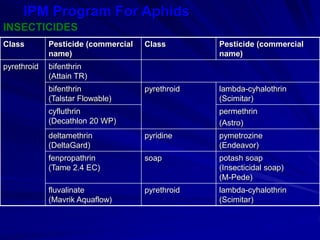
IPM Program For Aphids
INSECTICIDES
Class Pesticide (commercial
name)
Class Pesticide (commercial
name)
pyrethroid bifenthrin
(Attain TR)
bifenthrin
(Talstar Flowable)
pyrethroid lambda-cyhalothrin
(Scimitar)
cyfluthrin
(Decathlon 20 WP)
permethrin
(Astro)
deltamethrin
(DeltaGard)
pyridine pymetrozine
(Endeavor)
fenpropathrin
(Tame 2.4 EC)
soap potash soap
(Insecticidal soap)
(M-Pede)
fluvalinate
(Mavrik Aquaflow)
pyrethroid lambda-cyhalothrin
(Scimitar)
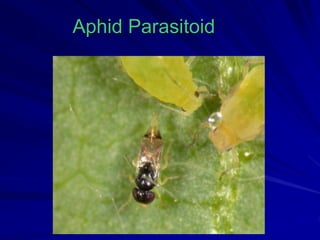
Aphid Parasitoid
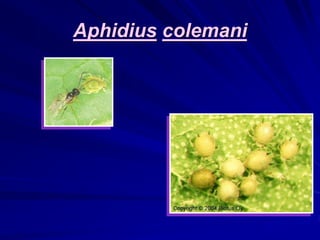
Aphidius colemani
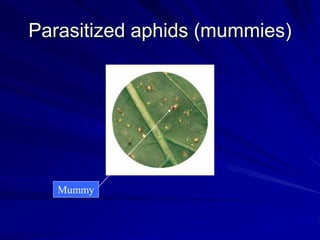
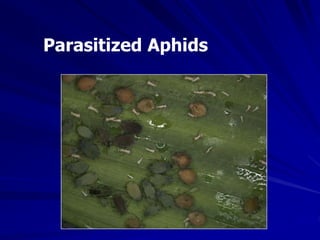
Parasitized aphids (mummies)
Mummy
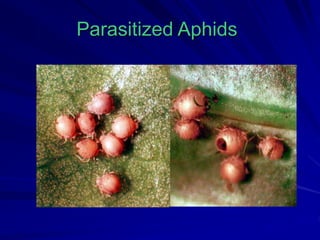
Parasitized Aphids
Parasitized Aphids
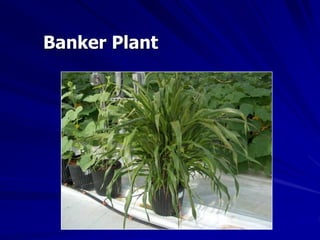
Banker Plant
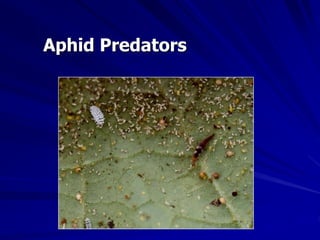
Aphid Predators
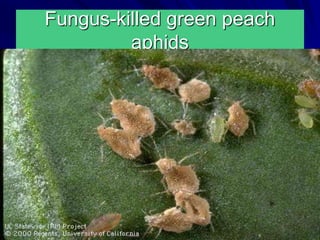
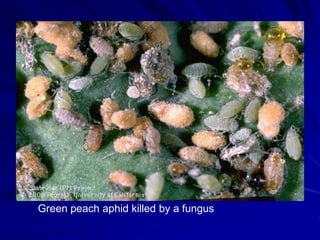
Fungus-killed green peach
aphids
Green peach aphid killed by a fungus

IPM - Aphid

  • 1.
  • 2.
    Green Peach Aphid:Myzus persicae Melon/cotton aphid : Aphis gossypii Order: Homoptera Family: Aphidae – Aphids are distinguished from other insects by the presence of cornicles, tube like appendages that protrude from the rear of the aphid. – Adult aphids may or may not have wings. Winged aphids are produced as a result of crowding. Green peach aphids produce winged adults at lower population densities than the melon aphid. – The two species most commonly encountered are the green peach aphid and the cotton or melon aphid.
  • 3.
    PEST DESCRIPTION : Greenpeach aphid: – Adults are pear-shaped and have two long thin, translucent cornicles that extend beyond the tip of the body. – Green peach aphid is characterized by a depression in the front of the head between the antennae and by – Winged adults have a dark blotch in the middle of the abdomen. – Green peach aphids are light to dark green or yellowish or pink .
  • 5.
  • 6.
    Green peach aphidadult with wing pads
  • 7.
    1. Melon aphidsare typically dark green, but color variations do occur frequently. 2. The cornicles (Aphis gossypii) are relatively short, and always dark. 3. Melon aphids have red eyes and antennae that only reach to the middle of the abdomen. 4. Winged females are slightly smaller and have a darker middle body section. Melon/cotton aphid : Aphis gossypii
  • 8.
  • 9.
    Environmental Factors: Aphids maybe present year round, but are usually more abundant during warmer months . The insects over summer on volunteer plants and on weeds. The optimal temperature for green peach aphid development is 24°C, whereas optimal temperatures for melon aphids are above 26°C.
  • 10.
    Biology & Lifecycle: –Winged females of invade fields and give rise to non-winged colonies. – Winged green peach aphids land, deposit a few young, and then alight again, repeating this sequence over and over. – When populations of both aphids reach high numbers or when host plants senesce, winged forms are produced and disperse to new host plants.
  • 11.
  • 12.
    –Both winged andnon-winged forms are all females and give birth to living young. –They feed on the undersides of leaves in the upper canopy. –The adult to adult period is very short, being 10-14 days.
  • 13.
  • 14.
    Host range: 1. Thegreen peach aphid has a very broad host range, feeding on hundreds of plants in over 40 plant families. Almost all vegetable crops can be attacked including tomato and especially pepper. 2. The melon aphids has wide range of field and ornamental as well as vegetable crops that may be infested by this pest. Some vegetable hosts include asparagus, bean, beet, cowpea, cucurbits, eggplant, okra, spinach, and tomato. Among cucurbits, cucumber and melon are most likely to be infested, followed by squash and pumpkin.
  • 15.
  • 16.
    Melon aphids andmummies on cucumber
  • 17.
    Damage : – Adultsand nymphs have piercing-sucking mouthparts, and feeding on the undersides of upper leaves produces yellowing of the upper surfaces . – Feeding on newly developing tissues can cause those parts to become twisted as they grow. Leaves and stems may be distorted. – Aphids produce a sugary substance called honeydew, which serves as a medium for sooty mold growth. – Most damage is inflicted by transmitting plant viruses. Melon aphids are known to transmit 44 plant viruses, while green peach aphids are known to transmit more than 100 plant viruses. such as Cucumber mosaic virus ,Potato virus Y and Tobacco etch virus.
  • 19.
  • 20.
  • 21.
    CMV Cucumber mosaic virus istransmitted by Melon Aphid
  • 22.
    Monitoring Traps: – Yellow stickytraps can be used to monitor movement of adults into fields. Scouting : – Check as many plants as possible ( at least 30 leaves, the leaf below the highest open flower ). – Look at terminal buds and lower leaf surfaces – Cast skins, honeydew, & sooty mold are indications of aphid infestation. Action Thresholds: – 3-4 aphids per leaf.
  • 23.
    Cultural Control – Keepproduction areas free of weeds, which can serve as hosts of aphid populations. – Exclusion of winged adults can be accomplished by covering openings to the greenhouse with screens – Before starting a new crop, carefully inspect plants to ensure that they are free of aphids and other pests. – Limit the use of quick-release fertilizer. – Rogue heavily infested plants.
  • 24.
    BIOLOGICAL CONTROL Predators suchas lacewings (Chrysoperla spp. and midges (Aphidoletes aphidimyza) are commercially available. Parasitoids, such as Aphidius spp., Lysiphlebus testaceipes, Diaeretiella rapae, and Aphelinus abdominalis, are also commercially available. The lady beetle Hippodamia convergens is commonly used. Aphidius sp.Aphidoletes aphidimyza larvae attacking melon aphid Ohio State University IPM of Alaska
  • 25.
    Class Pesticide (commercial name) ClassPesticide (commercial name) biologic al Beauveria bassiana (BotaniGard 22 WP) (BotaniGard ES) carbamate methiocarb (Mesurol 75W) botanic al cinnamaldehyde (Cinnacure) insect growth regulator azadirachtin (Azatin XL Plus) pyrethrin/PBO2 (PT 1100 Pyrethrum TR) azadirachtin (Ornazin 3%EC) pyrethrin/rotenone (Pyrellin EC) pyriproxyfen (Distance) s-kinoprene (Enstar II) Chemical Control
  • 26.
    IPM Program ForAphids INSECTICIDES Class Pesticide (commercial name) Class Pesticide (commercial name) neonico- tinoid imidacloprid (Marathon 60 WP) organo-phosphate acephate (Address) imidacloprid (Marathon 1G) (Marathon II) acephate (Orthene T, T&O Spray) 75WP oil clarified hydrophobic extract of neem oil (Triact 70) acephate (1300 Orthene TR) horticultural oil Ultra-Fine Oil SafTSide JMS Stylet Oil chlorpyrifos (PT DuraGuard ME) organo- chlorine endosulfan (Endosulfan 3EC) organo-phosphate/ pyrethroid chloropyrifos/ cyfluthrin (PT Duraplex TR)
  • 27.
    IPM Program ForAphids INSECTICIDES Class Pesticide (commercial name) Class Pesticide (commercial name) pyrethroid bifenthrin (Attain TR) bifenthrin (Talstar Flowable) pyrethroid lambda-cyhalothrin (Scimitar) cyfluthrin (Decathlon 20 WP) permethrin (Astro) deltamethrin (DeltaGard) pyridine pymetrozine (Endeavor) fenpropathrin (Tame 2.4 EC) soap potash soap (Insecticidal soap) (M-Pede) fluvalinate (Mavrik Aquaflow) pyrethroid lambda-cyhalothrin (Scimitar)
  • 28.
  • 29.
  • 30.
  • 31.
  • 32.
  • 33.
  • 34.
  • 35.
  • 36.
    Green peach aphidkilled by a fungus