Diagnosing
Plant
Problems
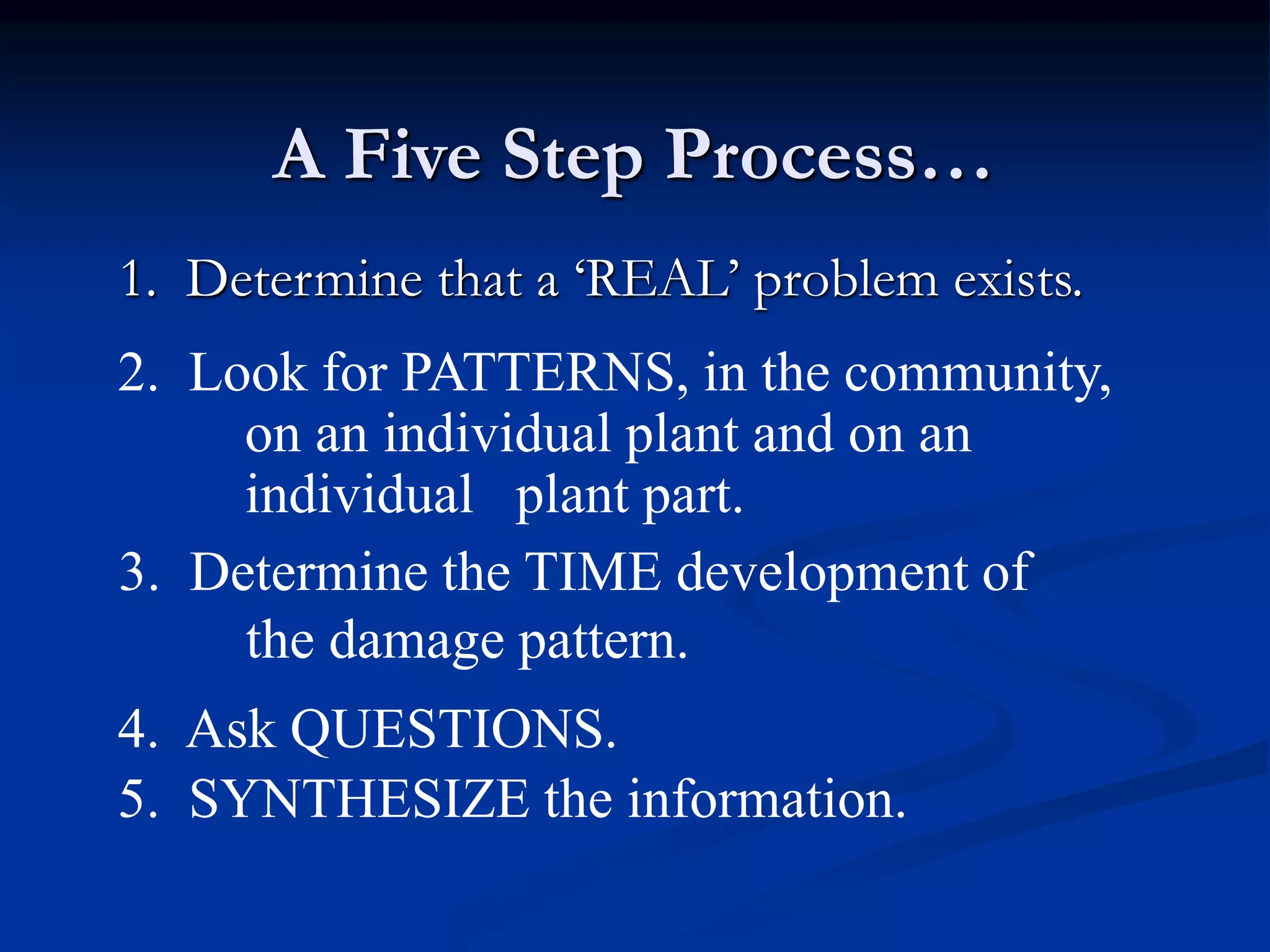
A Five Step Process…
1. Determine that a ‘REAL’ problem exists.
2. Look for PATTERNS, in the community,
on an individual plant and on an
individual plant part.
3. Determine the TIME development of
the damage pattern.
4. Ask QUESTIONS.
5. SYNTHESIZE the information.
1. Determine that a ‘REAL’ problem
exists…
 Identify the plant.
• Learn about it’s normal characteristics.
• Determine normal vs abnormal characteristics.
• Look for symptoms and signs.
– Symptoms: Changes in growth or appearance of a
plant in response to a damaging factor.
– Sign: Evidence of the damaging factor.
Symptoms and Signs
Symptoms: Changes in growth or
appearance of a plant in response
to a damaging factor.
Sign: Evidence of the damaging
factor.
Symptoms: Changes in growth or appearance of a
plant in response to a damaging factor.
Sign: Evidence of the damaging factor.
2. Look for Patterns…
 Look for patterns in the plant community.
 Is the damage on more than one plant?
 Is the damage on more than one plant species?
• Look for patterns on an individual plant.
– Is the damage on the entire plant or certain parts?
– Is the damage on certain age of growth?
• Look for patterns on an individual plant part.
Patterns of damage…
 Non-uniform, expanding damage patterns are
usually caused by living factors, because of
movement of feeding sites, life cycles, and
population increases and decreases.
• Uniform, non-expanding damage patterns are
usually caused by non-living factors such as
chemical injuries, temperature changes, and
mechanical damage.
3. Determine the TIME development of the
damage pattern…
 Progressive spread with time to other areas is
characteristic of living factors.
• Intensification of symptoms where damage first
occurred but no spread to new sites is
characteristic of non-living factors.
4. Ask QUESTIONS…
 Get a history of the problem…
• Get a history of all pesticides and fertilizers that
have been applied…
• Found out the history of the site…
• Could environmental conditions explain the
problem…
• Look for obvious symptoms and signs…
4. Ask QUESTIONS…
 Don’t ignore the roots…
• Beware of secondary insects and pathogens…
• Be patient and avoid jumping to conclusions…
5. SYNTHESIZE the information…
 Refer to literature…

Disease Problem Diagnosing

  • 1.
  • 2.
    A Five StepProcess… 1. Determine that a ‘REAL’ problem exists. 2. Look for PATTERNS, in the community, on an individual plant and on an individual plant part. 3. Determine the TIME development of the damage pattern. 4. Ask QUESTIONS. 5. SYNTHESIZE the information.
  • 3.
    1. Determine thata ‘REAL’ problem exists…  Identify the plant. • Learn about it’s normal characteristics. • Determine normal vs abnormal characteristics. • Look for symptoms and signs. – Symptoms: Changes in growth or appearance of a plant in response to a damaging factor. – Sign: Evidence of the damaging factor.
  • 4.
    Symptoms and Signs Symptoms:Changes in growth or appearance of a plant in response to a damaging factor. Sign: Evidence of the damaging factor.
  • 5.
    Symptoms: Changes ingrowth or appearance of a plant in response to a damaging factor.
  • 6.
    Sign: Evidence ofthe damaging factor.
  • 7.
    2. Look forPatterns…  Look for patterns in the plant community.  Is the damage on more than one plant?  Is the damage on more than one plant species? • Look for patterns on an individual plant. – Is the damage on the entire plant or certain parts? – Is the damage on certain age of growth? • Look for patterns on an individual plant part.
  • 8.
    Patterns of damage… Non-uniform, expanding damage patterns are usually caused by living factors, because of movement of feeding sites, life cycles, and population increases and decreases. • Uniform, non-expanding damage patterns are usually caused by non-living factors such as chemical injuries, temperature changes, and mechanical damage.
  • 9.
    3. Determine theTIME development of the damage pattern…  Progressive spread with time to other areas is characteristic of living factors. • Intensification of symptoms where damage first occurred but no spread to new sites is characteristic of non-living factors.
  • 10.
    4. Ask QUESTIONS… Get a history of the problem… • Get a history of all pesticides and fertilizers that have been applied… • Found out the history of the site… • Could environmental conditions explain the problem… • Look for obvious symptoms and signs…
  • 11.
    4. Ask QUESTIONS… Don’t ignore the roots… • Beware of secondary insects and pathogens… • Be patient and avoid jumping to conclusions…
  • 12.
    5. SYNTHESIZE theinformation…  Refer to literature…