KARTHIKEYAN, S (2015 800503)
Ph.D., Scholar,
Agricultural Entomology,
TNAU, Coimbatore.
The process of evaluating biological or other
scientific and economic evidence to determine
whether a pest should be regulated and the
strength of any phytosanitary measures to be
taken against it
 To estimate the likelihood of successful invasion
by plant pests
– Entry,
-Establishment,
-Spread Consequences / Impact
 To justify phytosanitary measures on import
 Scientific evidence in analysis of risk in the
international movement of plant products.
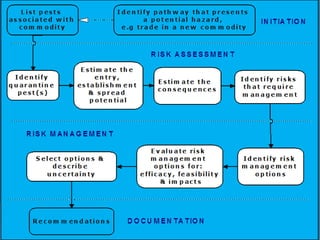
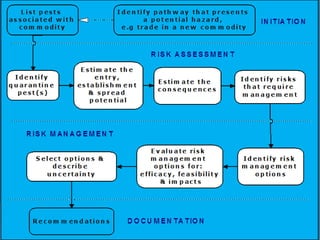
 Initiation
 Risk assessment
 Risk management
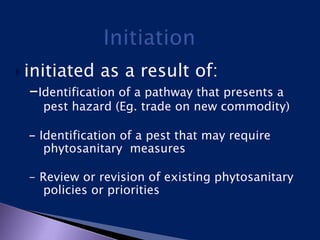
 initiated as a result of:
-Identification of a pathway that presents a
pest hazard (Eg. trade on new commodity)
- Identification of a pest that may require
phytosanitary measures
- Review or revision of existing phytosanitary
policies or priorities
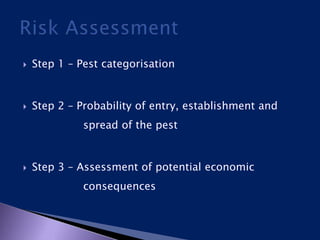
 Step 1 – Pest categorisation
 Step 2 – Probability of entry, establishment and
spread of the pest
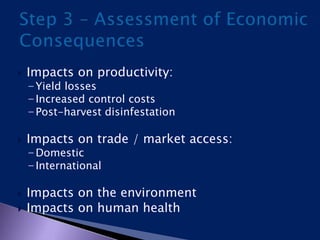
 Step 3 – Assessment of potential economic
consequences
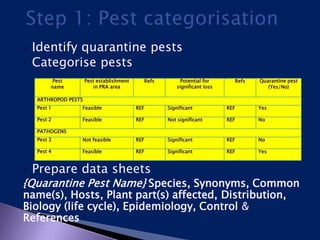
 Identify quarantine pests
 Categorise pests
 Prepare data sheets
{Quarantine Pest Name} Species, Synonyms, Common
name(s), Hosts, Plant part(s) affected, Distribution,
Biology (life cycle), Epidemiology, Control &
References
Pest
name
Pest establishment
in PRA area
Refs Potential for
significant loss
Refs Quarantine pest
(Yes/No)
ARTHROPOD PESTS
Pest 1 Feasible REF Significant REF Yes
Pest 2 Feasible REF Not significant REF No
PATHOGENS
Pest 3 Not feasible REF Significant REF No
Pest 4 Feasible REF Significant REF Yes
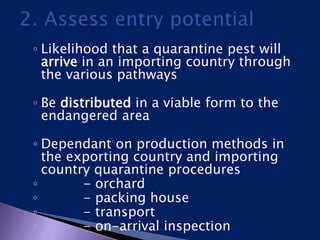
◦ Likelihood that a quarantine pest will
arrive in an importing country through
the various pathways
◦ Be distributed in a viable form to the
endangered area
◦ Dependant on production methods in
the exporting country and importing
country quarantine procedures
◦ - orchard
◦ - packing house
◦ - transport
◦ - on-arrival inspection
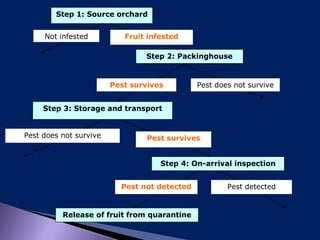
Step 1: Source orchard
Step 2: Packinghouse
Step 3: Storage and transport
Step 4: On-arrival inspection
Release of fruit from quarantine
Fruit infestedNot infested
Pest survives Pest does not survive
Pest survivesPest does not survive
Pest not detected Pest detected
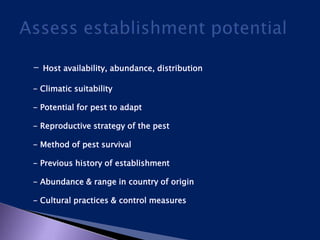
- Host availability, abundance, distribution
- Climatic suitability
- Potential for pest to adapt
- Reproductive strategy of the pest
- Method of pest survival
- Previous history of establishment
- Abundance & range in country of origin
- Cultural practices & control measures
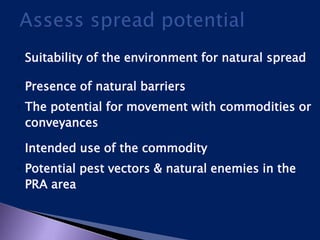
◦ Suitability of the environment for natural spread
◦ Presence of natural barriers
◦ The potential for movement with commodities or
conveyances
◦ Intended use of the commodity
◦ Potential pest vectors & natural enemies in the
PRA area
 Impacts on productivity:
–Yield losses
–Increased control costs
–Post-harvest disinfestation
 Impacts on trade / market access:
–Domestic
–International
 Impacts on the environment
 Impacts on human health
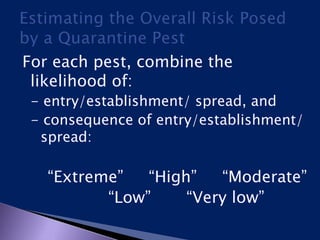
For each pest, combine the
likelihood of:
- entry/establishment/ spread, and
- consequence of entry/establishment/
spread:
“Extreme” “High” “Moderate”
“Low” “Very low”
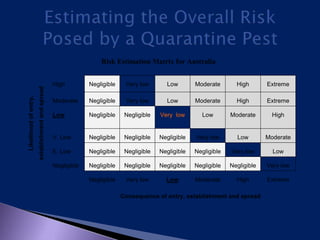
Risk Estimation Matrix for Australia
High Negligible Very low Low Moderate High Extreme
Moderate Negligible Very low Low Moderate High Extreme
Low Negligible Negligible Very low Low Moderate High
V. Low Negligible Negligible Negligible Very low Low Moderate
E. Low Negligible Negligible Negligible Negligible Very low Low
Likelihoodofentry,
establishmentandspread
Negligible Negligible Negligible Negligible Negligible Negligible Very low
Negligible Very low Low Moderate High Extreme
Consequence of entry, establishment and spread
 Risk Management measures may be
required to reduce the risk to an acceptable
level
 Identify Evaluate Select
 Pest Risk Analysis is mandatory for importing
any plant or plant materials
 The Import Permit issuing authorities shall
issue permits for commodities specified in
 Schedule-V,
 Schedule-VI and
 Schedule-VII of PQ Order, 2003 for which PRA
has already been done.
 Neither the country nor the commodity which have
not covered under these schedules the import
permit can not issued
 An Importer who intend to import a new commodity
or from a country not covered under the list shall
send a specific Pest Risk Analysis Request Form
 To
Plant Protection Adviser to the GOI,
Dte. of Plant Protection, Quarantine & Storage,
N.H.-IV., Faridabad-121 001, Haryana.
Pest risk analysis (pra)

Pest risk analysis (pra)

  • 1.
    KARTHIKEYAN, S (2015800503) Ph.D., Scholar, Agricultural Entomology, TNAU, Coimbatore.
  • 2.
    The process ofevaluating biological or other scientific and economic evidence to determine whether a pest should be regulated and the strength of any phytosanitary measures to be taken against it
  • 3.
     To estimatethe likelihood of successful invasion by plant pests – Entry, -Establishment, -Spread Consequences / Impact  To justify phytosanitary measures on import  Scientific evidence in analysis of risk in the international movement of plant products.
  • 4.
     Initiation  Riskassessment  Risk management
  • 6.
     initiated asa result of: -Identification of a pathway that presents a pest hazard (Eg. trade on new commodity) - Identification of a pest that may require phytosanitary measures - Review or revision of existing phytosanitary policies or priorities
  • 7.
     Step 1– Pest categorisation  Step 2 – Probability of entry, establishment and spread of the pest  Step 3 – Assessment of potential economic consequences
  • 8.
     Identify quarantinepests  Categorise pests  Prepare data sheets {Quarantine Pest Name} Species, Synonyms, Common name(s), Hosts, Plant part(s) affected, Distribution, Biology (life cycle), Epidemiology, Control & References Pest name Pest establishment in PRA area Refs Potential for significant loss Refs Quarantine pest (Yes/No) ARTHROPOD PESTS Pest 1 Feasible REF Significant REF Yes Pest 2 Feasible REF Not significant REF No PATHOGENS Pest 3 Not feasible REF Significant REF No Pest 4 Feasible REF Significant REF Yes
  • 9.
    ◦ Likelihood thata quarantine pest will arrive in an importing country through the various pathways ◦ Be distributed in a viable form to the endangered area ◦ Dependant on production methods in the exporting country and importing country quarantine procedures ◦ - orchard ◦ - packing house ◦ - transport ◦ - on-arrival inspection
  • 10.
    Step 1: Sourceorchard Step 2: Packinghouse Step 3: Storage and transport Step 4: On-arrival inspection Release of fruit from quarantine Fruit infestedNot infested Pest survives Pest does not survive Pest survivesPest does not survive Pest not detected Pest detected
  • 11.
    - Host availability,abundance, distribution - Climatic suitability - Potential for pest to adapt - Reproductive strategy of the pest - Method of pest survival - Previous history of establishment - Abundance & range in country of origin - Cultural practices & control measures
  • 12.
    ◦ Suitability ofthe environment for natural spread ◦ Presence of natural barriers ◦ The potential for movement with commodities or conveyances ◦ Intended use of the commodity ◦ Potential pest vectors & natural enemies in the PRA area
  • 13.
     Impacts onproductivity: –Yield losses –Increased control costs –Post-harvest disinfestation  Impacts on trade / market access: –Domestic –International  Impacts on the environment  Impacts on human health
  • 14.
    For each pest,combine the likelihood of: - entry/establishment/ spread, and - consequence of entry/establishment/ spread: “Extreme” “High” “Moderate” “Low” “Very low”
  • 15.
    Risk Estimation Matrixfor Australia High Negligible Very low Low Moderate High Extreme Moderate Negligible Very low Low Moderate High Extreme Low Negligible Negligible Very low Low Moderate High V. Low Negligible Negligible Negligible Very low Low Moderate E. Low Negligible Negligible Negligible Negligible Very low Low Likelihoodofentry, establishmentandspread Negligible Negligible Negligible Negligible Negligible Negligible Very low Negligible Very low Low Moderate High Extreme Consequence of entry, establishment and spread
  • 16.
     Risk Managementmeasures may be required to reduce the risk to an acceptable level  Identify Evaluate Select
  • 17.
     Pest RiskAnalysis is mandatory for importing any plant or plant materials  The Import Permit issuing authorities shall issue permits for commodities specified in  Schedule-V,  Schedule-VI and  Schedule-VII of PQ Order, 2003 for which PRA has already been done.
  • 18.
     Neither thecountry nor the commodity which have not covered under these schedules the import permit can not issued  An Importer who intend to import a new commodity or from a country not covered under the list shall send a specific Pest Risk Analysis Request Form  To Plant Protection Adviser to the GOI, Dte. of Plant Protection, Quarantine & Storage, N.H.-IV., Faridabad-121 001, Haryana.