

Logical Addressing
Logical addressing is a function of the Network layer of the OSI Model
(Layer-3), and provides a hierarchical structure to separate networks.
Logical addresses are never hardcoded on physical network interfaces, and
can be dynamically assigned and changed freely.
A logical address contains two components:
•Network ID – identifies which network a host belongs to.
•Host ID – uniquely identifies the host on that network.
Examples of logical addressing protocols include Internetwork Packet
Exchange (IPX) and Internet Protocol (IP). IPX was predominantly used
on Novell networks, but is now almost entirely deprecated. IP is the most
widely-used logical address, and is the backbone protocol of the Internet.
Internet Protocol (IP)
In the 1970’s, the Department of Defense developed the Transmission
Control Protocol (TCP), to provide both Network and Transport layer
functions. When this proved to be an inflexible solution, those functions
were separated - with the Internet Protocol (IP) providing Network layer
services, and TCP providing Transport layer services.
Together, TCP and IP provide the core functionality for the TCP/IP or
Internet protocol suite.
IP provides two fundamental Network layer services:
•Logical addressing – provides a unique address that identifies both
the host, and the network that host exists on.
•Routing – determines the best path to a particular destination
network, and then routes data accordingly.
IP was originally defined in RFC 760, and has been revised several times.
IP Version 4 (IPv4) was the first version to experience widespread
deployment, and is defined in RFC 791.
IPv4 employs a 32-bit address, which limits the number of possible
addresses to 4,294,967,296. IPv4 will eventually be replaced by IP Version 6
(IPv6), due to a shortage of available IPv4 addresses.
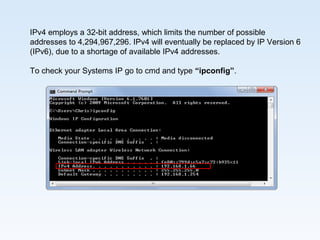
To check your Systems IP go to cmd and type “ipconfig”.
“Baap (Father) Of All Protocols is Internet Protocol IP”

logical addressing

  • 2.
    Logical Addressing Logical addressingis a function of the Network layer of the OSI Model (Layer-3), and provides a hierarchical structure to separate networks. Logical addresses are never hardcoded on physical network interfaces, and can be dynamically assigned and changed freely. A logical address contains two components: •Network ID – identifies which network a host belongs to. •Host ID – uniquely identifies the host on that network. Examples of logical addressing protocols include Internetwork Packet Exchange (IPX) and Internet Protocol (IP). IPX was predominantly used on Novell networks, but is now almost entirely deprecated. IP is the most widely-used logical address, and is the backbone protocol of the Internet.
  • 3.
    Internet Protocol (IP) Inthe 1970’s, the Department of Defense developed the Transmission Control Protocol (TCP), to provide both Network and Transport layer functions. When this proved to be an inflexible solution, those functions were separated - with the Internet Protocol (IP) providing Network layer services, and TCP providing Transport layer services. Together, TCP and IP provide the core functionality for the TCP/IP or Internet protocol suite. IP provides two fundamental Network layer services: •Logical addressing – provides a unique address that identifies both the host, and the network that host exists on. •Routing – determines the best path to a particular destination network, and then routes data accordingly. IP was originally defined in RFC 760, and has been revised several times. IP Version 4 (IPv4) was the first version to experience widespread deployment, and is defined in RFC 791.
  • 4.
    IPv4 employs a32-bit address, which limits the number of possible addresses to 4,294,967,296. IPv4 will eventually be replaced by IP Version 6 (IPv6), due to a shortage of available IPv4 addresses. To check your Systems IP go to cmd and type “ipconfig”.
  • 5.
    “Baap (Father) OfAll Protocols is Internet Protocol IP”
  • 6.
    “Baap (Father) OfAll Protocols is Internet Protocol IP”