HUAWEI TECHNOLOGIES CO., LTD.
All rights
reserved
www.huawei.com
IPv6 Basis
HUAWEI TECHNOLOGIES CO.,
LTD.
All rights
reserved
Page 2
Internet Protocol Version 6 (IPv6), also
called IP Next Generation (IPng), is in
develop and widely used. As a basis for
IPv6, the learning of IPv6 address and
IPv6 packet structure is the first step to
grasp IPv6 technology. This course
introduces the background of IPv6
addresses, IPv6 addresses, and IPv6
packet structure. It also compares IPv6
and IPv4 technologies.
HUAWEI TECHNOLOGIES CO.,
LTD.
All rights
reserved
Page 3
Upon completion of this course, the attendees will:
 Analysize the characteristics of IPv6 addresses
 Know the differences between IPv4 and IPv6
addresses
 Describe IPv6 address allocation modes
 Analyze IPv6 packet structure
 Analyze the differences between IPv6 and IPv4
packets
HUAWEI TECHNOLOGIES CO.,
LTD.
All rights
reserved
Page 4
Chapter 1 Background of IPv6 address
Chapter 2 IPv6 address introduction
Chapter 3 IPv6 packet structure
HUAWEI TECHNOLOGIES CO.,
LTD.
All rights
reserved
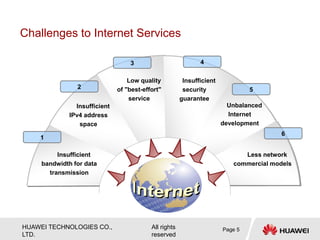
Challenges to Internet Services
1
2
3 4
5
6
Insufficient
bandwidth for data
transmission
Insufficient
IPv4 address
space
Low quality
of "best-effort"
service
Insufficient
security
guarantee
Unbalanced
Internet
development
Less network
commercial models
Page 5
HUAWEI TECHNOLOGIES CO.,
LTD.
All rights
reserved
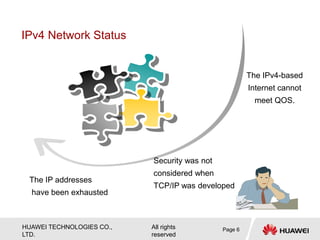
IPv4 Network Status
Page 6
The IP addresses
have been exhausted
Security was not
considered when
TCP/IP was developed
The IPv4-based
Internet cannot
meet QOS.
HUAWEI TECHNOLOGIES CO.,
LTD.
All rights
reserved
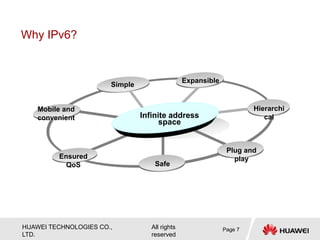
Why IPv6?
Infinite address
space
Simple
Expansible
Hierarchi
cal
Plug and
play
Ensured
QoS
Mobile and
convenient
Safe
Page 7
HUAWEI TECHNOLOGIES CO.,
LTD.
All rights
reserved
Page 8
Chapter 1 Background of IPv6 address
Chapter 2 IPv6 address introduction
Chapter 3 IPv6 packet structure
HUAWEI TECHNOLOGIES CO.,
LTD.
All rights
reserved
Page 9
Chapter 2 IPv6 address introduction
2.1 IPv6 Address Overview
2.2 IPv6 Address Type
2.3 Comparisons Between IPv6 and IPv4
Addresses
2.4 IPv6 Address Allocation and Examples
HUAWEI TECHNOLOGIES CO.,
LTD.
All rights
reserved
IPv6 Address Space(1/2)
Page 10
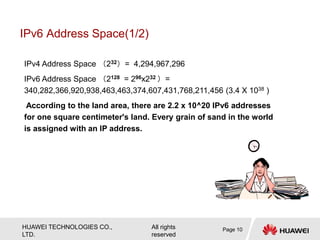
IPv4 Address Space (232)= 4,294,967,296
IPv6 Address Space (2128 = 296x232 )=
340,282,366,920,938,463,463,374,607,431,768,211,456 (3.4 X 1038 )
According to the land area, there are 2.2 x 10^20 IPv6 addresses
for one square centimeter's land. Every grain of sand in the world
is assigned with an IP address.
HUAWEI TECHNOLOGIES CO.,
LTD.
All rights
reserved
Page 11
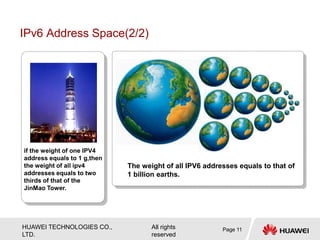
if the weight of one IPV4
address equals to 1 g,then
the weight of all ipv4
addresses equals to two
thirds of that of the
JinMao Tower.
The weight of all IPV6 addresses equals to that of
1 billion earths.
IPv6 Address Space(2/2)
HUAWEI TECHNOLOGIES CO.,
LTD.
All rights
reserved
IPv6 Address Structure(1/3)
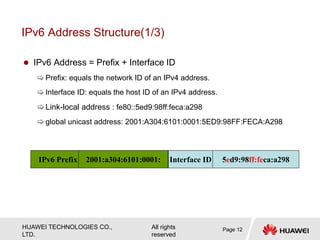
 IPv6 Address = Prefix + Interface ID
 Prefix: equals the network ID of an IPv4 address.
 Interface ID: equals the host ID of an IPv4 address.
Link-local address : fe80::5ed9:98ff:feca:a298
 global unicast address: 2001:A304:6101:0001:5ED9:98FF:FECA:A298
5ed9:98ff:feca:a298
前缀 Interface ID
IPv6 Prefix 2001:a304:6101:0001:
Page 12
HUAWEI TECHNOLOGIES CO.,
LTD.
All rights
reserved
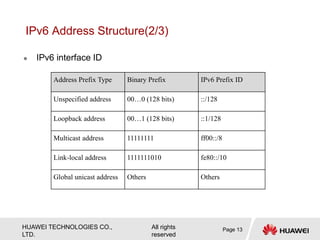
IPv6 Address Structure(2/3)
Address Prefix Type Binary Prefix IPv6 Prefix ID
Unspecified address 00…0 (128 bits) ::/128
Loopback address 00…1 (128 bits) ::1/128
Multicast address 11111111 ff00::/8
Link-local address 1111111010 fe80::/10
Global unicast address Others Others
 IPv6 interface ID
Page 13
HUAWEI TECHNOLOGIES CO.,
LTD.
All rights
reserved
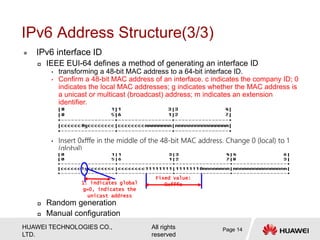
 IPv6 interface ID
 IEEE EUI-64 defines a method of generating an interface ID
• transforming a 48-bit MAC address to a 64-bit interface ID.
• Confirm a 48-bit MAC address of an interface. c indicates the company ID; 0
indicates the local MAC addresses; g indicates whether the MAC address is
a unicast or multicast (broadcast) address; m indicates an extension
identifier.
• Insert 0xfffe in the middle of the 48-bit MAC address. Change 0 (local) to 1
(global).
 Random generation
 Manual configuration
Fixed value:
0xfffe
1: indicates global
g=0, indicates the
unicast address
Page 14
IPv6 Address Structure(3/3)
HUAWEI TECHNOLOGIES CO.,
LTD.
All rights
reserved
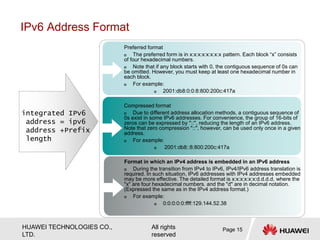
IPv6 Address Format
integrated IPv6
address = ipv6
address +Prefix
length
Format in which an IPv4 address is embedded in an IPv6 address
 During the transition from IPv4 to IPv6, IPv4/IPv6 address translation is
required. In such situation, IPv6 addresses with IPv4 addresses embedded
may be more effective. The detailed format is x:x:x:x:x:x:d.d.d.d, where the
"x" are four hexadecimal numbers. and the "d" are in decimal notation.
(Expressed the same as in the IPv4 address format.)
 For example:
 0:0:0:0:0:ffff:129.144.52.38
Compressed format
 Due to different address allocation methods, a contiguous sequence of
0s exist in some IPv6 addresses. For convenience, the group of 16-bits of
zeros can be expressed by "::", reducing the length of an IPv6 address.
Note that zero compression "::", however, can be used only once in a given
address.
 For example:
 2001:db8::8:800:200c:417a
Preferred format
 The preferred form is in x:x:x:x:x:x:x:x pattern. Each block “x” consists
of four hexadecimal numbers.
 Note that if any block starts with 0, the contiguous sequence of 0s can
be omitted. However, you must keep at least one hexadecimal number in
each block.
 For example:
 2001:db8:0:0:8:800:200c:417a
Page 15
HUAWEI TECHNOLOGIES CO.,
LTD.
All rights
reserved
Page 17
Chapter 2 IPv6 address introduction
2.1 IPv6 Address Overview
2.2 IPv6 Address Type
2.3 Comparisons Between IPv6 and IPv4
Addresses
2.4 IPv6 Address Allocation and Examples
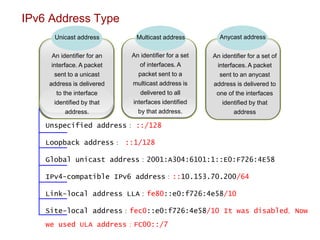
IPv6 Address Type
An identifier for a set
of interfaces. A
packet sent to a
multicast address is
delivered to all
interfaces identified
by that address.
An identifier for a set of
interfaces. A packet
sent to an anycast
address is delivered to
one of the interfaces
identified by that
address
An identifier for an
interface. A packet
sent to a unicast
address is delivered
to the interface
identified by that
address.
Unicast address Multicast address Anycast address
Unspecified address: ::/128
Loopback address: ::1/128
Global unicast address:2001:A304:6101:1::E0:F726:4E58
IPv4-compatible IPv6 address:::10.153.70.200/64
Link-local address LLA:fe80::e0:f726:4e58/10
Site-local address:fec0::e0:f726:4e58/10 It was disabled,Now
we used ULA address:FC00::/7
HUAWEI TECHNOLOGIES CO.,
LTD.
All rights
reserved
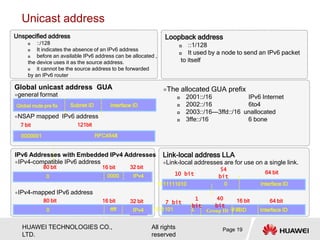
Unicast address
Unspecified address
 ::/128
 It indicates the absence of an IPv6 address
 before an available IPv6 address can be allocated ,
the device uses it as the source address.
 it cannot be the source address to be forwarded
by an IPv6 router
Loopback address
 ::1/128
 It used by a node to send an IPv6 packet
to itself
Global unicast address GUA
general format
NSAP mapped IPv6 address
Global route pre fix Subnet ID Interface ID
The allocated GUA prefix
 2001::/16 IPv6 Internet
 2002::/16 6to4
 2003::/16---3ffd::/16 unallocated
 3ffe::/16 6 bone
0000001 RFC4548
7 bit 121bit
IPv6 Addresses with Embedded IPv4 Addresses
IPv4-compatible IPv6 address
IPv4-mapped IPv6 address
Link-local address LLA
Link-local addresses are for use on a single link.
唯一本地地址:相当于IPv4网络中的私网地址ULA
0 0000 IPv4
80 bit 16 bit 32 bit
0 ffff IPv4
80 bit 16 bit 32 bit
0 Interface ID
1111111010
64 bit
L Interface ID
64 bit
1111101 子网ID
16 bit
10 bit
54
bit
7 bit
Group ID
1
bit
40
bit
Page 19
HUAWEI TECHNOLOGIES CO.,
LTD.
All rights
reserved
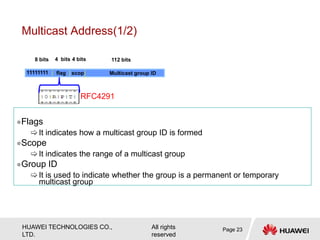
Multicast Address(1/2)
Flags
It indicates how a multicast group ID is formed
Scope
It indicates the range of a multicast group
Group ID
It is used to indicate whether the group is a permanent or temporary
multicast group
RFC4291
Page 23
11111111 scop Multicast group ID
8 bits 4 bits 112 bits
4 bits
flag
HUAWEI TECHNOLOGIES CO.,
LTD.
All rights
reserved
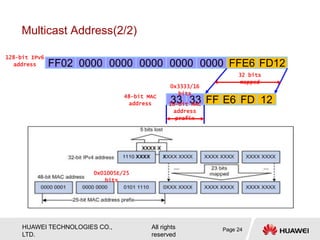
FF02 0000 0000 0000 0000 0000 FFE6 FD12
33 33 FF E6 FD 12
32 bits
mapped
128-bit IPv6
address
48-bit MAC
address
0x01005E/25
bits
16-bit MAC
address
prefix
0x3333/16
bits
Multicast Address(2/2)
Page 24
HUAWEI TECHNOLOGIES CO.,
LTD.
All rights
reserved
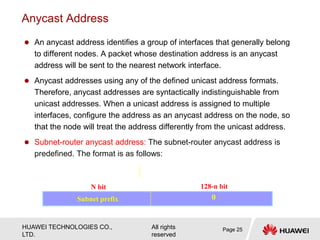
Anycast Address
 An anycast address identifies a group of interfaces that generally belong
to different nodes. A packet whose destination address is an anycast
address will be sent to the nearest network interface.
 Anycast addresses using any of the defined unicast address formats.
Therefore, anycast addresses are syntactically indistinguishable from
unicast addresses. When a unicast address is assigned to multiple
interfaces, configure the address as an anycast address on the node, so
that the node will treat the address differently from the unicast address.
 Subnet-router anycast address: The subnet-router anycast address is
predefined. The format is as follows:
Subnet prefix 0
N bit 128-n bit
Page 25
HUAWEI TECHNOLOGIES CO.,
LTD.
All rights
reserved
Page 27
Chapter 2 IPv6 address introduction
2.1 IPv6 Address Overview
2.2 IPv6 Address Type
2.3 Comparisons Between IPv6 and IPv4
Addresses
2.4 IPv6 Address Allocation and Examples
HUAWEI TECHNOLOGIES CO.,
LTD.
All rights
reserved
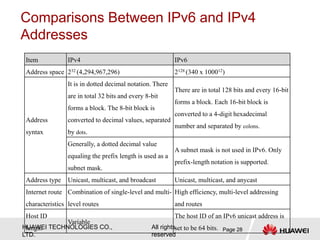
Comparisons Between IPv6 and IPv4
Addresses
Item IPv4 IPv6
Address space 232 (4,294,967,296) 2128 (340 x 100012)
Address
syntax
It is in dotted decimal notation. There
are in total 32 bits and every 8-bit
forms a block. The 8-bit block is
converted to decimal values, separated
by dots.
There are in total 128 bits and every 16-bit
forms a block. Each 16-bit block is
converted to a 4-digit hexadecimal
number and separated by colons.
Generally, a dotted decimal value
equaling the prefix length is used as a
subnet mask.
A subnet mask is not used in IPv6. Only
prefix-length notation is supported.
Address type Unicast, multicast, and broadcast Unicast, multicast, and anycast
Internet route
characteristics
Combination of single-level and multi-
level routes
High efficiency, multi-level addressing
and routes
Host ID
length
Variable
The host ID of an IPv6 unicast address is
set to be 64 bits. Page 28
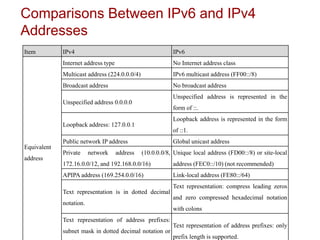
Item IPv4 IPv6
Equivalent
address
Internet address type No Internet address class
Multicast address (224.0.0.0/4) IPv6 multicast address (FF00::/8)
Broadcast address No broadcast address
Unspecified address 0.0.0.0
Unspecified address is represented in the
form of ::.
Loopback address: 127.0.0.1
Loopback address is represented in the form
of ::1.
Public network IP address Global unicast address
Private network address (10.0.0.0/8,
172.16.0.0/12, and 192.168.0.0/16)
Unique local address (FD00::/8) or site-local
address (FEC0::/10) (not recommended)
APIPA address (169.254.0.0/16) Link-local address (FE80::/64)
Text representation is in dotted decimal
notation.
Text representation: compress leading zeros
and zero compressed hexadecimal notation
with colons
Text representation of address prefixes:
subnet mask in dotted decimal notation or
Text representation of address prefixes: only
prefix length is supported.
Comparisons Between IPv6 and IPv4
Addresses
HUAWEI TECHNOLOGIES CO.,
LTD.
All rights
reserved
Page 30
Chapter 2 IPv6 address introduction
2.1 IPv6 Address Overview
2.2 IPv6 Address Type
2.3 Comparisons Between IPv6 and IPv4
Addresses
2.4 IPv6 Address Allocation and Examples
HUAWEI TECHNOLOGIES CO.,
LTD.
All rights
reserved
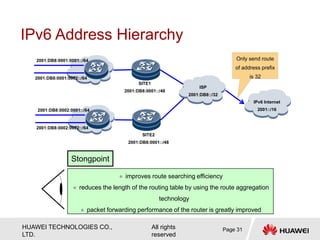
IPv6 Address Hierarchy
Stongpoint
 improves route searching efficiency
 reduces the length of the routing table by using the route aggregation
technology
 packet forwarding performance of the router is greatly improved
IPv6 Internet
2001::/16
ISP
2001:DB8::/32
SITE1
2001:DB8:0001::/48
2001:DB8:0001:0001::/64
2001:DB8:0001:0002::/64
SITE2
2001:DB8:0001::/48
2001:DB8:0002:0001::/64
2001:DB8:0002:0002::/64
Only send route
of address prefix
is 32
Page 31
HUAWEI TECHNOLOGIES CO.,
LTD.
All rights
reserved
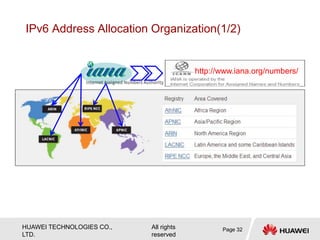
IPv6 Address Allocation Organization(1/2)
http://www.iana.org/numbers/
Page 32
HUAWEI TECHNOLOGIES CO.,
LTD.
All rights
reserved
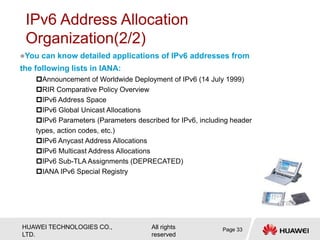
You can know detailed applications of IPv6 addresses from
the following lists in IANA:
Announcement of Worldwide Deployment of IPv6 (14 July 1999)
RIR Comparative Policy Overview
IPv6 Address Space
IPv6 Global Unicast Allocations
IPv6 Parameters (Parameters described for IPv6, including header
types, action codes, etc.)
IPv6 Anycast Address Allocations
IPv6 Multicast Address Allocations
IPv6 Sub-TLA Assignments (DEPRECATED)
IANA IPv6 Special Registry
IPv6 Address Allocation
Organization(2/2)
Page 33
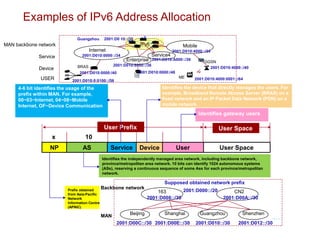
4-6 bit identifies the usage of the
prefix within MAN. For example,
00~03~Internet, 04~08~Mobile
Internet, OF~Device Communication
10 3-6 5-8 16
x y
User Space
Identifies the independently managed area network, including backbone network,
province/metropolitan area network. 10 bits can identify 1024 autonomous systems
(ASs), reserving a continuous sequence of some Ass for each province/metropolitan
network.
Prefix obtained
from Asia-Pacific
Network
Information Centre
(APNIC)
NP AS Service Device User User Space
Identifies gateway users
Identifies the device that directly manages the users. For
example, Broadband Remote Access Server (BRAS) on a
fixed network and an IP Packet Data Network (PDN) on a
mobile network.
,
Backbone network
MAN
163 CN2
Shanghai
Beijing Guangzhou Shenzhen
Supposed obtained network prefix
2001:D000::/20
2001:D008::/30 2001:D00A::/30
2001:D00C::/30 2001:D00E::/30 2001:D010::/30 2001:D012::/30
……
Internet
Mobile
MAN backbone network
Device
2001:D010:0000::/34
2001:D010:4000::/34
2001:D010:0000:/40
2001:D010:4000::/40
IPv6
Guangzhou 2001:D0 10::/30
Enterprise
2001:D010:8000::/36
Service
BRAS
2001:D010:0:0100::/56
USER
GGSN
ME
Service4
2001:D010:A000::/36
2001:D010:4000:0001::/64
2001:D010:0000:/48
User Prefix
Examples of IPv6 Address Allocation
HUAWEI TECHNOLOGIES CO.,
LTD.
All rights
reserved
Page 36
Chapter 1 Background of IPv6 address
Chapter 2 IPv6 address introduction
Chapter 3 IPv6 packet structure
HUAWEI TECHNOLOGIES CO.,
LTD.
All rights
reserved
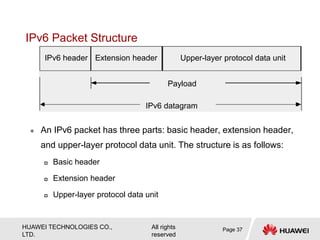
IPv6 Packet Structure
IPv6 header Extension header Upper-layer protocol data unit
Payload
IPv6 datagram
 An IPv6 packet has three parts: basic header, extension header,
and upper-layer protocol data unit. The structure is as follows:
 Basic header
 Extension header
 Upper-layer protocol data unit
Page 37
HUAWEI TECHNOLOGIES CO.,
LTD.
All rights
reserved
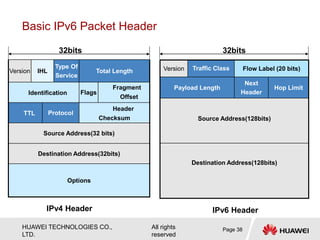
Basic IPv6 Packet Header
Page 38
Version IHL
Type Of
Service
Total Length
Identification Flags
Fragment
Offset
TTL Protocol
Header
Checksum
Source Address(32 bits)
Destination Address(32bits)
Options
32bits
IPv4 Header
Version Traffic Class Flow Label (20 bits)
Payload Length
Next
Header
Hop Limit
Source Address(128bits)
Destination Address(128bits)
32bits
IPv6 Header
HUAWEI TECHNOLOGIES CO.,
LTD.
All rights
reserved
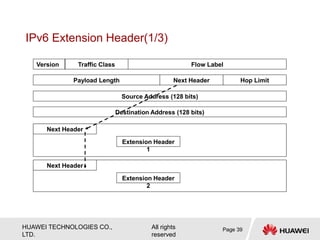
IPv6 Extension Header(1/3)
Version Flow Label
Traffic Class
Payload Length
Source Address (128 bits)
Next Header
Next Header Hop Limit
Destination Address (128 bits)
Extension Header
1
Next Header
Extension Header
2
Page 39
HUAWEI TECHNOLOGIES CO.,
LTD.
All rights
reserved
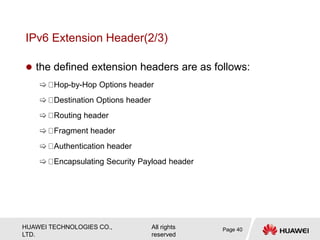
IPv6 Extension Header(2/3)
 the defined extension headers are as follows:
 Hop-by-Hop Options header
 Destination Options header
 Routing header
 Fragment header
 Authentication header
 Encapsulating Security Payload header
Page 40
HUAWEI TECHNOLOGIES CO.,
LTD.
All rights
reserved
IPv6 Extension Header(3/3)
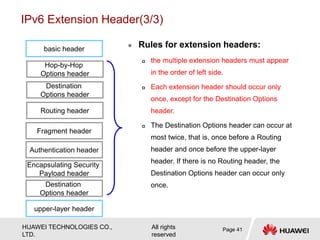
 Rules for extension headers:
 the multiple extension headers must appear
in the order of left side.
 Each extension header should occur only
once, except for the Destination Options
header.
 The Destination Options header can occur at
most twice, that is, once before a Routing
header and once before the upper-layer
header. If there is no Routing header, the
Destination Options header can occur only
once.
Hop-by-Hop
Options header
basic header
Destination
Options header
Routing header
Fragment header
Authentication header
Encapsulating Security
Payload header
Destination
Options header
upper-layer header
Page 41
HUAWEI TECHNOLOGIES CO.,
LTD.
All rights
reserved
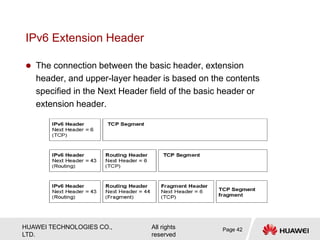
IPv6 Extension Header
 The connection between the basic header, extension
header, and upper-layer header is based on the contents
specified in the Next Header field of the basic header or
extension header.
Page 42
HUAWEI TECHNOLOGIES CO.,
LTD.
All rights
reserved
Comparisons Between IPv6 and IPv4 Packet
Structure
Page 43
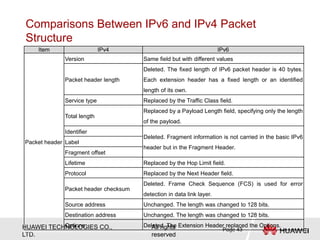
Item IPv4 IPv6
Packet header
Version Same field but with different values
Packet header length
Deleted. The fixed length of IPv6 packet header is 40 bytes.
Each extension header has a fixed length or an identified
length of its own.
Service type Replaced by the Traffic Class field.
Total length
Replaced by a Payload Length field, specifying only the length
of the payload.
Identifier
Deleted. Fragment information is not carried in the basic IPv6
header but in the Fragment Header.
Label
Fragment offset
Lifetime Replaced by the Hop Limit field.
Protocol Replaced by the Next Header field.
Packet header checksum
Deleted. Frame Check Sequence (FCS) is used for error
detection in data link layer.
Source address Unchanged. The length was changed to 128 bits.
Destination address Unchanged. The length was changed to 128 bits.
Options Deleted. The Extension Header replaced the Options.
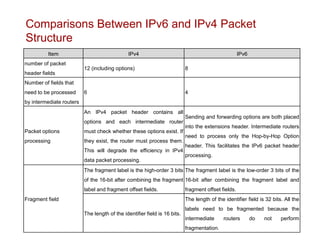
Item IPv4 IPv6
number of packet
header fields
12 (including options) 8
Number of fields that
need to be processed
by intermediate routers
6 4
Packet options
processing
An IPv4 packet header contains all
options and each intermediate router
must check whether these options exist. If
they exist, the router must process them.
This will degrade the efficiency in IPv4
data packet processing.
Sending and forwarding options are both placed
into the extensions header. Intermediate routers
need to process only the Hop-by-Hop Option
header. This facilitates the IPv6 packet header
processing.
Fragment field
The fragment label is the high-order 3 bits
of the 16-bit after combining the fragment
label and fragment offset fields.
The fragment label is the low-order 3 bits of the
16-bit after combining the fragment label and
fragment offset fields.
The length of the identifier field is 16 bits.
The length of the identifier field is 32 bits. All the
labels need to be fragmented because the
intermediate routers do not perform
fragmentation.
Comparisons Between IPv6 and IPv4 Packet
Structure
HUAWEI TECHNOLOGIES CO.,
LTD.
All rights
reserved
Page 45
Summary
 What is an IPv6 address?
 What are IPv6 address types?
 What are similarities and differences
between IPv6 and IPv4 addresses?
 What are components of an IPv6 packet
structure?
 What are similarities and differences
between IPv6 and IPv4 packets?
Thank you
www.huawei.com

IPv6 Basis Training Presentation - Huawei

  • 1.
    HUAWEI TECHNOLOGIES CO.,LTD. All rights reserved www.huawei.com IPv6 Basis
  • 2.
    HUAWEI TECHNOLOGIES CO., LTD. Allrights reserved Page 2 Internet Protocol Version 6 (IPv6), also called IP Next Generation (IPng), is in develop and widely used. As a basis for IPv6, the learning of IPv6 address and IPv6 packet structure is the first step to grasp IPv6 technology. This course introduces the background of IPv6 addresses, IPv6 addresses, and IPv6 packet structure. It also compares IPv6 and IPv4 technologies.
  • 3.
    HUAWEI TECHNOLOGIES CO., LTD. Allrights reserved Page 3 Upon completion of this course, the attendees will:  Analysize the characteristics of IPv6 addresses  Know the differences between IPv4 and IPv6 addresses  Describe IPv6 address allocation modes  Analyze IPv6 packet structure  Analyze the differences between IPv6 and IPv4 packets
  • 4.
    HUAWEI TECHNOLOGIES CO., LTD. Allrights reserved Page 4 Chapter 1 Background of IPv6 address Chapter 2 IPv6 address introduction Chapter 3 IPv6 packet structure
  • 5.
    HUAWEI TECHNOLOGIES CO., LTD. Allrights reserved Challenges to Internet Services 1 2 3 4 5 6 Insufficient bandwidth for data transmission Insufficient IPv4 address space Low quality of "best-effort" service Insufficient security guarantee Unbalanced Internet development Less network commercial models Page 5
  • 6.
    HUAWEI TECHNOLOGIES CO., LTD. Allrights reserved IPv4 Network Status Page 6 The IP addresses have been exhausted Security was not considered when TCP/IP was developed The IPv4-based Internet cannot meet QOS.
  • 7.
    HUAWEI TECHNOLOGIES CO., LTD. Allrights reserved Why IPv6? Infinite address space Simple Expansible Hierarchi cal Plug and play Ensured QoS Mobile and convenient Safe Page 7
  • 8.
    HUAWEI TECHNOLOGIES CO., LTD. Allrights reserved Page 8 Chapter 1 Background of IPv6 address Chapter 2 IPv6 address introduction Chapter 3 IPv6 packet structure
  • 9.
    HUAWEI TECHNOLOGIES CO., LTD. Allrights reserved Page 9 Chapter 2 IPv6 address introduction 2.1 IPv6 Address Overview 2.2 IPv6 Address Type 2.3 Comparisons Between IPv6 and IPv4 Addresses 2.4 IPv6 Address Allocation and Examples
  • 10.
    HUAWEI TECHNOLOGIES CO., LTD. Allrights reserved IPv6 Address Space(1/2) Page 10 IPv4 Address Space (232)= 4,294,967,296 IPv6 Address Space (2128 = 296x232 )= 340,282,366,920,938,463,463,374,607,431,768,211,456 (3.4 X 1038 ) According to the land area, there are 2.2 x 10^20 IPv6 addresses for one square centimeter's land. Every grain of sand in the world is assigned with an IP address.
  • 11.
    HUAWEI TECHNOLOGIES CO., LTD. Allrights reserved Page 11 if the weight of one IPV4 address equals to 1 g,then the weight of all ipv4 addresses equals to two thirds of that of the JinMao Tower. The weight of all IPV6 addresses equals to that of 1 billion earths. IPv6 Address Space(2/2)
  • 12.
    HUAWEI TECHNOLOGIES CO., LTD. Allrights reserved IPv6 Address Structure(1/3)  IPv6 Address = Prefix + Interface ID  Prefix: equals the network ID of an IPv4 address.  Interface ID: equals the host ID of an IPv4 address. Link-local address : fe80::5ed9:98ff:feca:a298  global unicast address: 2001:A304:6101:0001:5ED9:98FF:FECA:A298 5ed9:98ff:feca:a298 前缀 Interface ID IPv6 Prefix 2001:a304:6101:0001: Page 12
  • 13.
    HUAWEI TECHNOLOGIES CO., LTD. Allrights reserved IPv6 Address Structure(2/3) Address Prefix Type Binary Prefix IPv6 Prefix ID Unspecified address 00…0 (128 bits) ::/128 Loopback address 00…1 (128 bits) ::1/128 Multicast address 11111111 ff00::/8 Link-local address 1111111010 fe80::/10 Global unicast address Others Others  IPv6 interface ID Page 13
  • 14.
    HUAWEI TECHNOLOGIES CO., LTD. Allrights reserved  IPv6 interface ID  IEEE EUI-64 defines a method of generating an interface ID • transforming a 48-bit MAC address to a 64-bit interface ID. • Confirm a 48-bit MAC address of an interface. c indicates the company ID; 0 indicates the local MAC addresses; g indicates whether the MAC address is a unicast or multicast (broadcast) address; m indicates an extension identifier. • Insert 0xfffe in the middle of the 48-bit MAC address. Change 0 (local) to 1 (global).  Random generation  Manual configuration Fixed value: 0xfffe 1: indicates global g=0, indicates the unicast address Page 14 IPv6 Address Structure(3/3)
  • 15.
    HUAWEI TECHNOLOGIES CO., LTD. Allrights reserved IPv6 Address Format integrated IPv6 address = ipv6 address +Prefix length Format in which an IPv4 address is embedded in an IPv6 address  During the transition from IPv4 to IPv6, IPv4/IPv6 address translation is required. In such situation, IPv6 addresses with IPv4 addresses embedded may be more effective. The detailed format is x:x:x:x:x:x:d.d.d.d, where the "x" are four hexadecimal numbers. and the "d" are in decimal notation. (Expressed the same as in the IPv4 address format.)  For example:  0:0:0:0:0:ffff:129.144.52.38 Compressed format  Due to different address allocation methods, a contiguous sequence of 0s exist in some IPv6 addresses. For convenience, the group of 16-bits of zeros can be expressed by "::", reducing the length of an IPv6 address. Note that zero compression "::", however, can be used only once in a given address.  For example:  2001:db8::8:800:200c:417a Preferred format  The preferred form is in x:x:x:x:x:x:x:x pattern. Each block “x” consists of four hexadecimal numbers.  Note that if any block starts with 0, the contiguous sequence of 0s can be omitted. However, you must keep at least one hexadecimal number in each block.  For example:  2001:db8:0:0:8:800:200c:417a Page 15
  • 16.
    HUAWEI TECHNOLOGIES CO., LTD. Allrights reserved Page 17 Chapter 2 IPv6 address introduction 2.1 IPv6 Address Overview 2.2 IPv6 Address Type 2.3 Comparisons Between IPv6 and IPv4 Addresses 2.4 IPv6 Address Allocation and Examples
  • 17.
    IPv6 Address Type Anidentifier for a set of interfaces. A packet sent to a multicast address is delivered to all interfaces identified by that address. An identifier for a set of interfaces. A packet sent to an anycast address is delivered to one of the interfaces identified by that address An identifier for an interface. A packet sent to a unicast address is delivered to the interface identified by that address. Unicast address Multicast address Anycast address Unspecified address: ::/128 Loopback address: ::1/128 Global unicast address:2001:A304:6101:1::E0:F726:4E58 IPv4-compatible IPv6 address:::10.153.70.200/64 Link-local address LLA:fe80::e0:f726:4e58/10 Site-local address:fec0::e0:f726:4e58/10 It was disabled,Now we used ULA address:FC00::/7
  • 18.
    HUAWEI TECHNOLOGIES CO., LTD. Allrights reserved Unicast address Unspecified address  ::/128  It indicates the absence of an IPv6 address  before an available IPv6 address can be allocated , the device uses it as the source address.  it cannot be the source address to be forwarded by an IPv6 router Loopback address  ::1/128  It used by a node to send an IPv6 packet to itself Global unicast address GUA general format NSAP mapped IPv6 address Global route pre fix Subnet ID Interface ID The allocated GUA prefix  2001::/16 IPv6 Internet  2002::/16 6to4  2003::/16---3ffd::/16 unallocated  3ffe::/16 6 bone 0000001 RFC4548 7 bit 121bit IPv6 Addresses with Embedded IPv4 Addresses IPv4-compatible IPv6 address IPv4-mapped IPv6 address Link-local address LLA Link-local addresses are for use on a single link. 唯一本地地址:相当于IPv4网络中的私网地址ULA 0 0000 IPv4 80 bit 16 bit 32 bit 0 ffff IPv4 80 bit 16 bit 32 bit 0 Interface ID 1111111010 64 bit L Interface ID 64 bit 1111101 子网ID 16 bit 10 bit 54 bit 7 bit Group ID 1 bit 40 bit Page 19
  • 19.
    HUAWEI TECHNOLOGIES CO., LTD. Allrights reserved Multicast Address(1/2) Flags It indicates how a multicast group ID is formed Scope It indicates the range of a multicast group Group ID It is used to indicate whether the group is a permanent or temporary multicast group RFC4291 Page 23 11111111 scop Multicast group ID 8 bits 4 bits 112 bits 4 bits flag
  • 20.
    HUAWEI TECHNOLOGIES CO., LTD. Allrights reserved FF02 0000 0000 0000 0000 0000 FFE6 FD12 33 33 FF E6 FD 12 32 bits mapped 128-bit IPv6 address 48-bit MAC address 0x01005E/25 bits 16-bit MAC address prefix 0x3333/16 bits Multicast Address(2/2) Page 24
  • 21.
    HUAWEI TECHNOLOGIES CO., LTD. Allrights reserved Anycast Address  An anycast address identifies a group of interfaces that generally belong to different nodes. A packet whose destination address is an anycast address will be sent to the nearest network interface.  Anycast addresses using any of the defined unicast address formats. Therefore, anycast addresses are syntactically indistinguishable from unicast addresses. When a unicast address is assigned to multiple interfaces, configure the address as an anycast address on the node, so that the node will treat the address differently from the unicast address.  Subnet-router anycast address: The subnet-router anycast address is predefined. The format is as follows: Subnet prefix 0 N bit 128-n bit Page 25
  • 22.
    HUAWEI TECHNOLOGIES CO., LTD. Allrights reserved Page 27 Chapter 2 IPv6 address introduction 2.1 IPv6 Address Overview 2.2 IPv6 Address Type 2.3 Comparisons Between IPv6 and IPv4 Addresses 2.4 IPv6 Address Allocation and Examples
  • 23.
    HUAWEI TECHNOLOGIES CO., LTD. Allrights reserved Comparisons Between IPv6 and IPv4 Addresses Item IPv4 IPv6 Address space 232 (4,294,967,296) 2128 (340 x 100012) Address syntax It is in dotted decimal notation. There are in total 32 bits and every 8-bit forms a block. The 8-bit block is converted to decimal values, separated by dots. There are in total 128 bits and every 16-bit forms a block. Each 16-bit block is converted to a 4-digit hexadecimal number and separated by colons. Generally, a dotted decimal value equaling the prefix length is used as a subnet mask. A subnet mask is not used in IPv6. Only prefix-length notation is supported. Address type Unicast, multicast, and broadcast Unicast, multicast, and anycast Internet route characteristics Combination of single-level and multi- level routes High efficiency, multi-level addressing and routes Host ID length Variable The host ID of an IPv6 unicast address is set to be 64 bits. Page 28
  • 24.
    Item IPv4 IPv6 Equivalent address Internetaddress type No Internet address class Multicast address (224.0.0.0/4) IPv6 multicast address (FF00::/8) Broadcast address No broadcast address Unspecified address 0.0.0.0 Unspecified address is represented in the form of ::. Loopback address: 127.0.0.1 Loopback address is represented in the form of ::1. Public network IP address Global unicast address Private network address (10.0.0.0/8, 172.16.0.0/12, and 192.168.0.0/16) Unique local address (FD00::/8) or site-local address (FEC0::/10) (not recommended) APIPA address (169.254.0.0/16) Link-local address (FE80::/64) Text representation is in dotted decimal notation. Text representation: compress leading zeros and zero compressed hexadecimal notation with colons Text representation of address prefixes: subnet mask in dotted decimal notation or Text representation of address prefixes: only prefix length is supported. Comparisons Between IPv6 and IPv4 Addresses
  • 25.
    HUAWEI TECHNOLOGIES CO., LTD. Allrights reserved Page 30 Chapter 2 IPv6 address introduction 2.1 IPv6 Address Overview 2.2 IPv6 Address Type 2.3 Comparisons Between IPv6 and IPv4 Addresses 2.4 IPv6 Address Allocation and Examples
  • 26.
    HUAWEI TECHNOLOGIES CO., LTD. Allrights reserved IPv6 Address Hierarchy Stongpoint  improves route searching efficiency  reduces the length of the routing table by using the route aggregation technology  packet forwarding performance of the router is greatly improved IPv6 Internet 2001::/16 ISP 2001:DB8::/32 SITE1 2001:DB8:0001::/48 2001:DB8:0001:0001::/64 2001:DB8:0001:0002::/64 SITE2 2001:DB8:0001::/48 2001:DB8:0002:0001::/64 2001:DB8:0002:0002::/64 Only send route of address prefix is 32 Page 31
  • 27.
    HUAWEI TECHNOLOGIES CO., LTD. Allrights reserved IPv6 Address Allocation Organization(1/2) http://www.iana.org/numbers/ Page 32
  • 28.
    HUAWEI TECHNOLOGIES CO., LTD. Allrights reserved You can know detailed applications of IPv6 addresses from the following lists in IANA: Announcement of Worldwide Deployment of IPv6 (14 July 1999) RIR Comparative Policy Overview IPv6 Address Space IPv6 Global Unicast Allocations IPv6 Parameters (Parameters described for IPv6, including header types, action codes, etc.) IPv6 Anycast Address Allocations IPv6 Multicast Address Allocations IPv6 Sub-TLA Assignments (DEPRECATED) IANA IPv6 Special Registry IPv6 Address Allocation Organization(2/2) Page 33
  • 29.
    4-6 bit identifiesthe usage of the prefix within MAN. For example, 00~03~Internet, 04~08~Mobile Internet, OF~Device Communication 10 3-6 5-8 16 x y User Space Identifies the independently managed area network, including backbone network, province/metropolitan area network. 10 bits can identify 1024 autonomous systems (ASs), reserving a continuous sequence of some Ass for each province/metropolitan network. Prefix obtained from Asia-Pacific Network Information Centre (APNIC) NP AS Service Device User User Space Identifies gateway users Identifies the device that directly manages the users. For example, Broadband Remote Access Server (BRAS) on a fixed network and an IP Packet Data Network (PDN) on a mobile network. , Backbone network MAN 163 CN2 Shanghai Beijing Guangzhou Shenzhen Supposed obtained network prefix 2001:D000::/20 2001:D008::/30 2001:D00A::/30 2001:D00C::/30 2001:D00E::/30 2001:D010::/30 2001:D012::/30 …… Internet Mobile MAN backbone network Device 2001:D010:0000::/34 2001:D010:4000::/34 2001:D010:0000:/40 2001:D010:4000::/40 IPv6 Guangzhou 2001:D0 10::/30 Enterprise 2001:D010:8000::/36 Service BRAS 2001:D010:0:0100::/56 USER GGSN ME Service4 2001:D010:A000::/36 2001:D010:4000:0001::/64 2001:D010:0000:/48 User Prefix Examples of IPv6 Address Allocation
  • 30.
    HUAWEI TECHNOLOGIES CO., LTD. Allrights reserved Page 36 Chapter 1 Background of IPv6 address Chapter 2 IPv6 address introduction Chapter 3 IPv6 packet structure
  • 31.
    HUAWEI TECHNOLOGIES CO., LTD. Allrights reserved IPv6 Packet Structure IPv6 header Extension header Upper-layer protocol data unit Payload IPv6 datagram  An IPv6 packet has three parts: basic header, extension header, and upper-layer protocol data unit. The structure is as follows:  Basic header  Extension header  Upper-layer protocol data unit Page 37
  • 32.
    HUAWEI TECHNOLOGIES CO., LTD. Allrights reserved Basic IPv6 Packet Header Page 38 Version IHL Type Of Service Total Length Identification Flags Fragment Offset TTL Protocol Header Checksum Source Address(32 bits) Destination Address(32bits) Options 32bits IPv4 Header Version Traffic Class Flow Label (20 bits) Payload Length Next Header Hop Limit Source Address(128bits) Destination Address(128bits) 32bits IPv6 Header
  • 33.
    HUAWEI TECHNOLOGIES CO., LTD. Allrights reserved IPv6 Extension Header(1/3) Version Flow Label Traffic Class Payload Length Source Address (128 bits) Next Header Next Header Hop Limit Destination Address (128 bits) Extension Header 1 Next Header Extension Header 2 Page 39
  • 34.
    HUAWEI TECHNOLOGIES CO., LTD. Allrights reserved IPv6 Extension Header(2/3)  the defined extension headers are as follows:  Hop-by-Hop Options header  Destination Options header  Routing header  Fragment header  Authentication header  Encapsulating Security Payload header Page 40
  • 35.
    HUAWEI TECHNOLOGIES CO., LTD. Allrights reserved IPv6 Extension Header(3/3)  Rules for extension headers:  the multiple extension headers must appear in the order of left side.  Each extension header should occur only once, except for the Destination Options header.  The Destination Options header can occur at most twice, that is, once before a Routing header and once before the upper-layer header. If there is no Routing header, the Destination Options header can occur only once. Hop-by-Hop Options header basic header Destination Options header Routing header Fragment header Authentication header Encapsulating Security Payload header Destination Options header upper-layer header Page 41
  • 36.
    HUAWEI TECHNOLOGIES CO., LTD. Allrights reserved IPv6 Extension Header  The connection between the basic header, extension header, and upper-layer header is based on the contents specified in the Next Header field of the basic header or extension header. Page 42
  • 37.
    HUAWEI TECHNOLOGIES CO., LTD. Allrights reserved Comparisons Between IPv6 and IPv4 Packet Structure Page 43 Item IPv4 IPv6 Packet header Version Same field but with different values Packet header length Deleted. The fixed length of IPv6 packet header is 40 bytes. Each extension header has a fixed length or an identified length of its own. Service type Replaced by the Traffic Class field. Total length Replaced by a Payload Length field, specifying only the length of the payload. Identifier Deleted. Fragment information is not carried in the basic IPv6 header but in the Fragment Header. Label Fragment offset Lifetime Replaced by the Hop Limit field. Protocol Replaced by the Next Header field. Packet header checksum Deleted. Frame Check Sequence (FCS) is used for error detection in data link layer. Source address Unchanged. The length was changed to 128 bits. Destination address Unchanged. The length was changed to 128 bits. Options Deleted. The Extension Header replaced the Options.
  • 38.
    Item IPv4 IPv6 numberof packet header fields 12 (including options) 8 Number of fields that need to be processed by intermediate routers 6 4 Packet options processing An IPv4 packet header contains all options and each intermediate router must check whether these options exist. If they exist, the router must process them. This will degrade the efficiency in IPv4 data packet processing. Sending and forwarding options are both placed into the extensions header. Intermediate routers need to process only the Hop-by-Hop Option header. This facilitates the IPv6 packet header processing. Fragment field The fragment label is the high-order 3 bits of the 16-bit after combining the fragment label and fragment offset fields. The fragment label is the low-order 3 bits of the 16-bit after combining the fragment label and fragment offset fields. The length of the identifier field is 16 bits. The length of the identifier field is 32 bits. All the labels need to be fragmented because the intermediate routers do not perform fragmentation. Comparisons Between IPv6 and IPv4 Packet Structure
  • 39.
    HUAWEI TECHNOLOGIES CO., LTD. Allrights reserved Page 45 Summary  What is an IPv6 address?  What are IPv6 address types?  What are similarities and differences between IPv6 and IPv4 addresses?  What are components of an IPv6 packet structure?  What are similarities and differences between IPv6 and IPv4 packets?
  • 40.