


Md. Ariful Hoque
E-mail: arifulhoquecse@gmail.com
µIP (micro IP)
Outline
• Introduction.
• Real Life Implementation.
• Implementation.
• Operation.
• Connection Management.
• Advantage.
• Weakness.
Introduction
• µIP (micro IP) is very small TCP/IP stack.
• Open source, widely used memory-constrained embedded product.
• This protocol stack intended for use with tiny 8- and 16-bit microcontrollers.
• Developed by Adam Dunkels
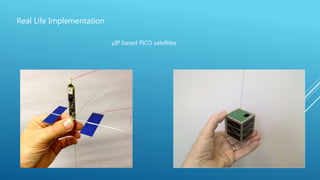
Real Life Implementation
µIP based PICO satellites
Continue …
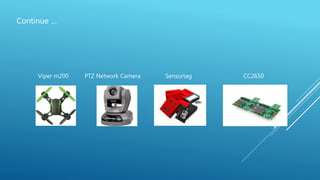
Viper m200 PTZ Network Camera Sensortag CC2650
Continue …
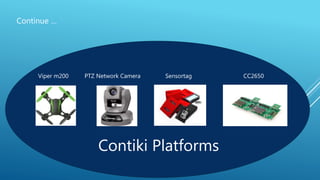
Viper m200 PTZ Network Camera Sensortag CC2650
Contiki Platforms
Implementation
• Latest version of uIPv6, are integrated with Contiki.
• An open-source operating system for the Internet of Things
• Actually uIP stack is designed for small computer system with no operating system.
Operations
• Called in a timed loop.
• Then call manages other network behavior.
• uIP calls the hardware driver to sent the packet of data.
• uIP build the packet before.
• It used packet buffer in a half-duplex way for transmission and reception.
• If needs to retransmit, its just call the application code to sent previous data.
Connection Management
• Have one task per connection
• Task communicates with a task in a distant computer on the other end.
• Connections are held in an array.
• On each call, uIP tries to serve a connection.
• Making a subroutine call to responds to, or sends data
Advantage
• Throughput speed
• Minimum RAM usage
• Minimum CPU usage
• Work with tiny 8- and 16-bit microcontrollers
• The uIP stack uses less then 10kB ROM and 2kB RAM and Contiki can easily fit in 100kB.
ROM and 10kB RAM.
Weaknesses
uIP system can start a responding packet before the PC is ready to receive it.
Conclusion
• Micro IP (µIP) is widely used TCP / IP network protocol.
• Its used for its lightness.
• Its need low memory and processing speed.
• Some micro IP device can communicate faster then normal PC.
References
1. Curtis, Paul. "Adam Dunkel's uIP on the Olimex EasyWeb2 and LPC-E2124“
2. uIP (micro IP)[online]. Available: https://en.wikipedia.org/wiki/UIP_(micro_IP)
3. Adding network support to a DSP-based embedded system [online]. Available:
http://www.drdobbs.com/inside-the-uip-stack/184405971
4. Barnett, Drew; Massa, Anthony J. (February 1, 2005). "Inside the uIP Stack.
5. FreeRTOS web site examples, 2013 [online]. Available:
http://www.freertos.org/RTOS_ports.html
6. uIP (and FreeTCPIP which is heavily based on uIP) [online]. Available :
http://www.freertos.org/embeddedtcp.html
7. Small TCP/IP stacks for micro controllers. By Lucas van der Ploeg
Thanks

µIP (micro IP)

  • 1.
    Md. Ariful Hoque E-mail:arifulhoquecse@gmail.com µIP (micro IP)
  • 2.
    Outline • Introduction. • RealLife Implementation. • Implementation. • Operation. • Connection Management. • Advantage. • Weakness.
  • 3.
    Introduction • µIP (microIP) is very small TCP/IP stack. • Open source, widely used memory-constrained embedded product. • This protocol stack intended for use with tiny 8- and 16-bit microcontrollers. • Developed by Adam Dunkels
  • 4.
    Real Life Implementation µIPbased PICO satellites
  • 5.
    Continue … Viper m200PTZ Network Camera Sensortag CC2650
  • 6.
    Continue … Viper m200PTZ Network Camera Sensortag CC2650 Contiki Platforms
  • 7.
    Implementation • Latest versionof uIPv6, are integrated with Contiki. • An open-source operating system for the Internet of Things • Actually uIP stack is designed for small computer system with no operating system.
  • 8.
    Operations • Called ina timed loop. • Then call manages other network behavior. • uIP calls the hardware driver to sent the packet of data. • uIP build the packet before. • It used packet buffer in a half-duplex way for transmission and reception. • If needs to retransmit, its just call the application code to sent previous data.
  • 9.
    Connection Management • Haveone task per connection • Task communicates with a task in a distant computer on the other end. • Connections are held in an array. • On each call, uIP tries to serve a connection. • Making a subroutine call to responds to, or sends data
  • 10.
    Advantage • Throughput speed •Minimum RAM usage • Minimum CPU usage • Work with tiny 8- and 16-bit microcontrollers • The uIP stack uses less then 10kB ROM and 2kB RAM and Contiki can easily fit in 100kB. ROM and 10kB RAM.
  • 11.
    Weaknesses uIP system canstart a responding packet before the PC is ready to receive it.
  • 12.
    Conclusion • Micro IP(µIP) is widely used TCP / IP network protocol. • Its used for its lightness. • Its need low memory and processing speed. • Some micro IP device can communicate faster then normal PC.
  • 13.
    References 1. Curtis, Paul."Adam Dunkel's uIP on the Olimex EasyWeb2 and LPC-E2124“ 2. uIP (micro IP)[online]. Available: https://en.wikipedia.org/wiki/UIP_(micro_IP) 3. Adding network support to a DSP-based embedded system [online]. Available: http://www.drdobbs.com/inside-the-uip-stack/184405971 4. Barnett, Drew; Massa, Anthony J. (February 1, 2005). "Inside the uIP Stack. 5. FreeRTOS web site examples, 2013 [online]. Available: http://www.freertos.org/RTOS_ports.html 6. uIP (and FreeTCPIP which is heavily based on uIP) [online]. Available : http://www.freertos.org/embeddedtcp.html 7. Small TCP/IP stacks for micro controllers. By Lucas van der Ploeg
  • 14.