Internet of things 2
Internet - Of -Things (Pondicherry University)
Scan to open on Studocu
Studocu is not sponsored or endorsed by any college or university
Internet of things 2
Internet - Of -Things (Pondicherry University)
Scan to open on Studocu
Studocu is not sponsored or endorsed by any college or university
Downloaded by gvn bca (gvnbca@gvncollege.edu.in)
lOMoARcPSD|20972679
UNIT 2
IoT PROTOCOLS 9
IoT Access Technologies:
Physical and MAC layers, topology and Security of IEEE 802.15.4, 802.15.4g, 802.15.4e,
1901.2a, 802.11ah and LoRaWAN – Network Layer: IP versions, Constrained Nodes and
Constrained Networks – Optimizing IP for IoT: From 6LoWPAN to 6Lo, Routing over Low
Power and Lossy Networks – Application Transport Methods: Supervisory Control and Data
Acquisition – Application Layer Protocols: CoAP and MQTT .
2. IoT Access Technologies:
The connectivity technologies for IoT involves wireless access, long range communication
and mobile IoT systems
Network technologies for IoT Connectivity are:
 Wireless Access – 3G and standard LTE.
 Long Range – LoRA based platform, Zigbee
 Mobile IoT – LTE-M, NB-IoT,
Wireless Access – Wi Fi, 3G and standard LTE
Smart TV, Video surveillance comes under this category. The main network option for this
kind of application is the home appliances. For more number of users to connect to this
network it would be expensive.
Long Range – LoRA based platform, Zigbee
Low power connectivity requirements are satisfied by this kind of IoT. This network allows
third-party devices to connect to their system.LoRAWan is chirp spread spectrum (CSS)
radio modulation technology .On the opposite approach, there is Sigfox, is a network which
is build of their own standards.Zigbee is an IEEE 802.15.4-based technology built on the
physical layer and media access control used for embedded applications.
Mobile IoT Technologies – LTE-M, NB-IoT
Smart watches, fitness trackers, and glasses have stand-alone mobile connectivity because of
the esim and NB-IoT technologies.LTE network is deployed, the IoT connectivity has good
power efficiency. The decision of which technology to adopt, deploy and finally launch IoT
services will depend on the specific application.
The IoT access technologies is explained in terms of standardisation, physical layer,mac
layer, topology and security aspects.
Downloaded by gvn bca (gvnbca@gvncollege.edu.in)
lOMoARcPSD|20972679
2.1 IEEE 802.15.4:
IEEE 802.15.4 is a standard which is designed for low-rate wireless personal area
networks (LR-WPANs). It specifies the physical layer and media access control for LR-
WPANs.Deploying these networks requires low cost and easy installation procedure. A
sensor, remote controls and industrial wireless sensor networks uses this standard. This
method adopts the frequency hopping technique. There is a problem of reliability and
unbounded latency. Problem arises due to the carrier sense multiple access.
Standardisation and Alliances:
The IEEE 802.15 Task Group 4 designed standards with low data rate with more years of
battery life with very low complexity. 802.15.4 has released many standards on various year
consecutively 2003,2006,2011,2015 .The various versions are IEEE 802.15.4 – 2003, IEEE
802.15.4 – 2006, IEEE 802.15.4a, IEEE 802.15.4c, IEEE 802.15.4d, IEEE 802.15.4e, IEEE
802.15.4f, IEEE 802.15.4g.IEE 802.15.4 provides the MAC and PHY layers standards which
is the base for the protocols. There are many protocols available namely Zigbee, 6LoWPAN,
ZigbeeIP, WirelessHART, Thread.
IEEE 802.15.4 DERIVED STANDARDS
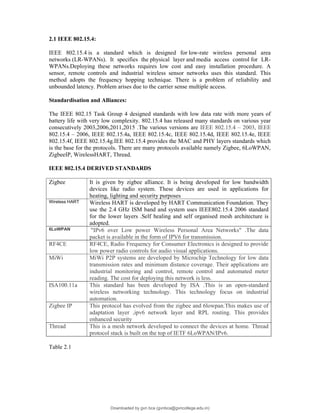
Zigbee It is given by zigbee alliance. It is being developed for low bandwidth
devices like radio system. These devices are used in applications for
heating, lighting and security purposes
Wireless HART Wireless HART is developed by HART Communication Foundation. They
use the 2.4 GHz ISM band and system uses IEEE802.15.4 2006 standard
for the lower layers .Self healing and self organised mesh architecture is
adopted.
6LoWPAN "IPv6 over Low power Wireless Personal Area Networks" .The data
packet is available in the form of IPV6 for transmission.
RF4CE RF4CE, Radio Frequency for Consumer Electronics is designed to provide
low power radio controls for audio visual applications.
MiWi MiWi P2P systems are developed by Microchip Technology for low data
transmission rates and minimum distance coverage. Their applications are
industrial monitoring and control, remote control and automated meter
reading. The cost for deploying this network is less.
ISA100.11a This standard has been developed by ISA .This is an open-standard
wireless networking technology. This technology focus on industrial
automation.
Zigbee IP This protocol has evolved from the zigbee and 6lowpan.This makes use of
adaptation layer ,ipv6 network layer and RPL routing. This provides
enhanced security
Thread This is a mesh network developed to connect the devices at home. Thread
protocol stack is built on the top of IETF 6LoWPAN/IPv6.
Table 2.1
Downloaded by gvn bca (gvnbca@gvncollege.edu.in)
lOMoARcPSD|20972679
Zigbee:
Zigbee initially started in 1990 and later upgraded in the year 2004 as IEEE 802.15.4.Many
industries collaborated with zigbee and it made it as a zigbee alliance, they started connecting
the network with the iot devices.zigbee collaborated with many vendors and started
manufacturing. The set of commands and messages which is given is termed as clusters
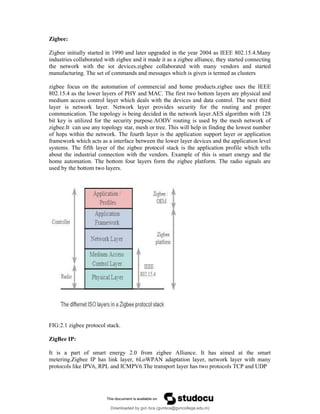
zigbee focus on the automation of commercial and home products.zigbee uses the IEEE
802.15.4 as the lower layers of PHY and MAC. The first two bottom layers are physical and
medium access control layer which deals with the devices and data control. The next third
layer is network layer. Network layer provides security for the routing and proper
communication. The topology is being decided in the network layer.AES algorithm with 128
bit key is utilized for the security purpose.AODV routing is used by the mesh network of
zigbee.It can use any topology star, mesh or tree. This will help in finding the lowest number
of hops within the network. The fourth layer is the application support layer or application
framework which acts as a interface between the lower layer devices and the application level
systems. The fifth layer of the zigbee protocol stack is the application profile which tells
about the industrial connection with the vendors. Example of this is smart energy and the
home automation. The bottom four layers form the zigbee platform. The radio signals are
used by the bottom two layers.
FIG:2.1 zigbee protocol stack.
ZigBee IP:
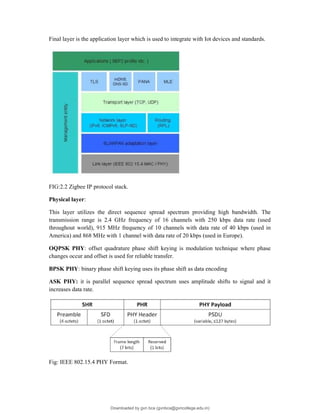
It is a part of smart energy 2.0 from zigbee Alliance. It has aimed at the smart
metering.Zigbee IP has link layer, 6LoWPAN adaptation layer, network layer with many
protocols like IPV6, RPL and ICMPV6.The transport layer has two protocols TCP and UDP
Downloaded by gvn bca (gvnbca@gvncollege.edu.in)
lOMoARcPSD|20972679
Final layer is the application layer which is used to integrate with Iot devices and standards.
FIG:2.2 Zigbee IP protocol stack.
Physical layer:
This layer utilizes the direct sequence spread spectrum providing high bandwidth. The
transmission range is 2.4 GHz frequency of 16 channels with 250 kbps data rate (used
throughout world), 915 MHz frequency of 10 channels with data rate of 40 kbps (used in
America) and 868 MHz with 1 channel with data rate of 20 kbps (used in Europe).
OQPSK PHY: offset quadrature phase shift keying is modulation technique where phase
changes occur and offset is used for reliable transfer.
BPSK PHY: binary phase shift keying uses its phase shift as data encoding
ASK PHY: it is parallel sequence spread spectrum uses amplitude shifts to signal and it
increases data rate.
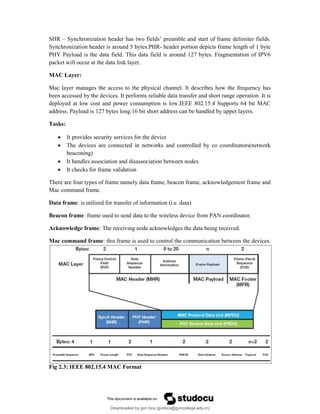
Fig: IEEE 802.15.4 PHY Format.
Downloaded by gvn bca (gvnbca@gvncollege.edu.in)
lOMoARcPSD|20972679
SHR – Synchronization header has two fields’ preamble and start of frame delimiter fields.
Synchronization header is around 5 bytes.PHR- header portion depicts frame length of 1 byte
PHY Payload is the data field. This data field is around 127 bytes. Fragmentation of IPV6
packet will occur at the data link layer.
MAC Layer:
Mac layer manages the access to the physical channel. It describes how the frequency has
been accessed by the devices. It performs reliable data transfer and short range operation .It is
deployed at low cost and power consumption is low.IEEE 802.15.4 Supports 64 bit MAC
address. Payload is 127 bytes long.16 bit short address can be handled by upper layers.
Tasks:
 It provides security services for the device
 The devices are connected in networks and controlled by co coordinators(network
beaconing)
 It handles association and disassociation between nodes.
 It checks for frame validation
There are four types of frame namely data frame, beacon frame, acknowledgement frame and
Mac command frame.
Data frame: is utilized for transfer of information (i.e. data)
Beacon frame: frame used to send data to the wireless device from PAN coordinator.
Acknowledge frame: The receiving node acknowledges the data being received.
Mac command frame: this frame is used to control the communication between the devices.
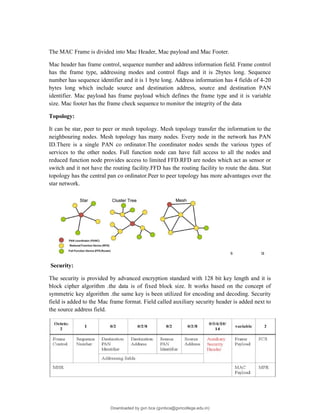
Fig 2.3: IEEE 802.15.4 MAC Format
Downloaded by gvn bca (gvnbca@gvncollege.edu.in)
lOMoARcPSD|20972679
The MAC Frame is divided into Mac Header, Mac payload and Mac Footer.
Mac header has frame control, sequence number and address information field. Frame control
has the frame type, addressing modes and control flags and it is 2bytes long. Sequence
number has sequence identifier and it is 1 byte long. Address information has 4 fields of 4-20
bytes long which include source and destination address, source and destination PAN
identifier. Mac payload has frame payload which defines the frame type and it is variable
size. Mac footer has the frame check sequence to monitor the integrity of the data
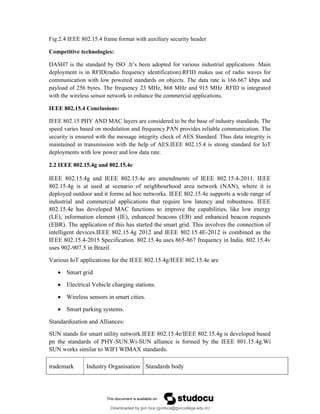
Topology:
It can be star, peer to peer or mesh topology. Mesh topology transfer the information to the
neighbouring nodes. Mesh topology has many nodes. Every node in the network has PAN
ID.There is a single PAN co ordinator.The coordinator nodes sends the various types of
services to the other nodes. Full function node can have full access to all the nodes and
reduced function node provides access to limited FFD.RFD are nodes which act as sensor or
switch and it not have the routing facility.FFD has the routing facility to route the data. Stat
topology has the central pan co ordinator.Peer to peer topology has more advantages over the
star network.
s u
Security:
The security is provided by advanced encryption standard with 128 bit key length and it is
block cipher algorithm .the data is of fixed block size. It works based on the concept of
symmetric key algorithm .the same key is been utilized for encoding and decoding. Security
field is added to the Mac frame format. Field called auxiliary security header is added next to
the source address field.
Downloaded by gvn bca (gvnbca@gvncollege.edu.in)
lOMoARcPSD|20972679
Fig:2.4 IEEE 802.15.4 frame format with auxiliary security header
Competitive technologies:
DASH7 is the standard by ISO .It’s been adopted for various industrial applications .Main
deployment is in RFID(radio frequency identification).RFID makes use of radio waves for
communication with low powered standards on objects. The data rate is 166.667 kbps and
payload of 256 bytes. The frequency 23 MHz, 868 MHz and 915 MHz .RFID is integrated
with the wireless sensor network to enhance the commercial applications.
IEEE 802.15.4 Conclusions:
IEEE 802.15 PHY AND MAC layers are considered to be the base of industry standards. The
speed varies based on modulation and frequency.PAN provides reliable communication. The
security is ensured with the message integrity check of AES Standard. Thus data integrity is
maintained in transmission with the help of AES.IEEE 802.15.4 is strong standard for IoT
deployments with low power and low data rate.
2.2 IEEE 802.15.4g and 802.15.4e
IEEE 802.15.4g and IEEE 802.15.4e are amendments of IEEE 802.15.4-2011. IEEE
802.15.4g is at used at scenario of neighbourhood area network (NAN), where it is
deployed outdoor and it forms ad hoc networks. IEEE 802.15.4e supports a wide range of
industrial and commercial applications that require low latency and robustness. IEEE
802.15.4e has developed MAC functions to improve the capabilities, like low energy
(LE), information element (IE), enhanced beacons (EB) and enhanced beacon requests
(EBR). The application of this has started the smart grid. This involves the connection of
intelligent devices.IEEE 802.15.4g 2012 and IEEE 802.15.4E-2012 is combined as the
IEEE 802.15.4-2015 Specification. 802.15.4u uses 865-867 frequency in India. 802.15.4v
uses 902-907.5 in Brazil.
Various IoT applications for the IEEE 802.15.4g/IEEE 802.15.4e are
 Smart grid
 Electrical Vehicle charging stations.
 Wireless sensors in smart cities.
 Smart parking systems.
Standardization and Alliances:
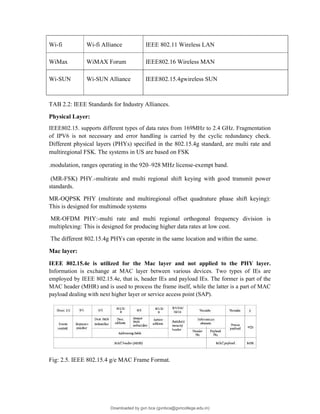
SUN stands for smart utility network.IEEE 802.15.4e/IEEE 802.15.4g is developed based
pn the standards of PHY-SUN.Wi-SUN alliance is formed by the IEEE 801.15.4g.Wi
SUN works similar to WIFI WIMAX standards.
trademark Industry Organisation Standards body
Downloaded by gvn bca (gvnbca@gvncollege.edu.in)
lOMoARcPSD|20972679
Wi-fi Wi-fi Alliance IEEE 802.11 Wireless LAN
WiMax WiMAX Forum IEEE802.16 Wireless MAN
Wi-SUN Wi-SUN Alliance IEEE802.15.4gwireless SUN
TAB 2.2: IEEE Standards for Industry Alliances.
Physical Layer:
IEEE802.15. supports different types of data rates from 169MHz to 2.4 GHz. Fragmentation
of IPV6 is not necessary and error handling is carried by the cyclic redundancy check.
Different physical layers (PHYs) specified in the 802.15.4g standard, are multi rate and
multiregional FSK. The systems in US are based on FSK
.modulation, ranges operating in the 920–928 MHz license-exempt band.
(MR-FSK) PHY.-multirate and multi regional shift keying with good transmit power
standards.
MR-OQPSK PHY (multirate and multiregional offset quadrature phase shift keying):
This is designed for multimode systems
MR-OFDM PHY:-multi rate and multi regional orthogonal frequency division is
multiplexing: This is designed for producing higher data rates at low cost.
The different 802.15.4g PHYs can operate in the same location and within the same.
Mac layer:
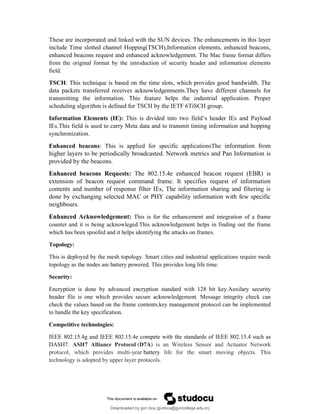
IEEE 802.15.4e is utilized for the Mac layer and not applied to the PHY layer.
Information is exchange at MAC layer between various devices. Two types of IEs are
employed by IEEE 802.15.4e, that is, header IEs and payload IEs. The former is part of the
MAC header (MHR) and is used to process the frame itself, while the latter is a part of MAC
payload dealing with next higher layer or service access point (SAP).
Fig: 2.5. IEEE 802.15.4 g/e MAC Frame Format.
Downloaded by gvn bca (gvnbca@gvncollege.edu.in)
lOMoARcPSD|20972679
These are incorporated and linked with the SUN devices. The enhancements in this layer
include Time slotted channel Hopping(TSCH),Information elements, enhanced beacons,
enhanced beacons request and enhanced acknowledgement. The Mac frame format differs
from the original format by the introduction of security header and information elements
field.
TSCH: This technique is based on the time slots, which provides good bandwidth. The
data packets transferred receives acknowledgenments.They have different channels for
transmitting the information. This feature helps the industrial application. Proper
scheduling algorithm is defined for TSCH by the IETF 6TiSCH group.
Information Elements (IE): This is divided into two field’s header IEs and Payload
IEs.This field is used to carry Meta data and to transmit timing information and hopping
synchronization.
Enhanced beacons: This is applied for specific applicationsThe information from
higher layers to be periodically broadcasted. Network metrics and Pan Information is
provided by the beacons.
Enhanced beacons Requests: The 802.15.4e enhanced beacon request (EBR) is
extension of beacon request command frame. It specifies request of information
contents and number of response filter IEs, The information sharing and filtering is
done by exchanging selected MAC or PHY capability information with few specific
neighbours.
Enhanced Acknowledgement: This is for the enhancement and integration of a frame
counter and it is being acknowleged.This acknowledgement helps in finding out the frame
which has been spoofed and it helps identifying the attacks on frames.
Topology:
This is deployed by the mesh topology. Smart cities and industrial applications require mesh
topology as the nodes are battery powered. This provides long life time.
Security:
Encryption is done by advanced encryption standard with 128 bit key.Auxilary security
header file is one which provides secure acknowledgement. Message integrity check can
check the values based on the frame contents.key management protocol can be implemented
to handle the key specification.
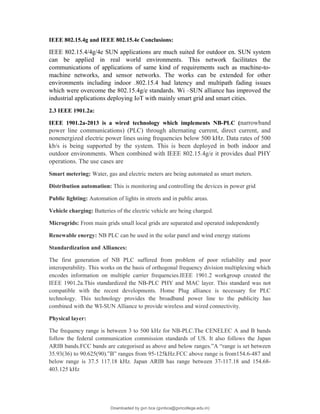
Competitive technologies:
IEEE 802.15.4g and IEEE 802.15.4e compete with the standards of IEEE 802.15.4 such as
DASH7. ASH7 Alliance Protocol (D7A) is an Wireless Sensor and Actuator Network
protocol, which provides multi-year battery life for the smart moving objects. This
technology is adopted by upper layer protocols.
Downloaded by gvn bca (gvnbca@gvncollege.edu.in)
lOMoARcPSD|20972679
IEEE 802.15.4g and IEEE 802.15.4e Conclusions:
IEEE 802.15.4/4g/4e SUN applications are much suited for outdoor en. SUN system
can be applied in real world environments. This network facilitates the
communications of applications of same kind of requirements such as machine-to-
machine networks, and sensor networks. The works can be extended for other
environments including indoor .802.15.4 had latency and multipath fading issues
which were overcome the 802.15.4g/e standards. Wi –SUN alliance has improved the
industrial applications deploying IoT with mainly smart grid and smart cities.
2.3 IEEE 1901.2a:
IEEE 1901.2a-2013 is a wired technology which implements NB-PLC (narrowband
power line communications) (PLC) through alternating current, direct current, and
nonenergized electric power lines using frequencies below 500 kHz. Data rates of 500
kb/s is being supported by the system. This is been deployed in both indoor and
outdoor environments. When combined with IEEE 802.15.4g/e it provides dual PHY
operations. The use cases are
Smart metering: Water, gas and electric meters are being automated as smart meters.
Distribution automation: This is monitoring and controlling the devices in power grid
Public lighting: Automation of lights in streets and in public areas.
Vehicle charging: Batteries of the electric vehicle are being charged.
Microgrids: From main grids small local grids are separated and operated independently
Renewable energy: NB PLC can be used in the solar panel and wind energy stations
Standardization and Alliances:
The first generation of NB PLC suffered from problem of poor reliability and poor
interoperability. This works on the basis of orthogonal frequency division multiplexing which
encodes information on multiple carrier frequencies.IEEE 1901.2 workgroup created the
IEEE 1901.2a.This standardized the NB-PLC PHY and MAC layer. This standard was not
compatible with the recent developments. Home Plug alliance is necessary for PLC
technology. This technology provides the broadband power line to the publicity has
combined with the WI-SUN Alliance to provide wireless and wired connectivity.
Physical layer:
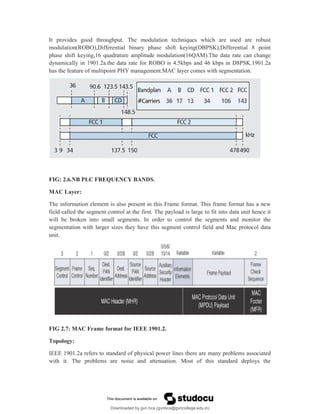
The frequency range is between 3 to 500 kHz for NB-PLC.The CENELEC A and B bands
follow the federal communication commission standards of US. It also follows the Japan
ARIB bands.FCC bands are categorised as above and below ranges.”A “range is set between
35.93(36) to 90.625(90).”B” ranges from 95-125kHz.FCC above range is from154.6-487 and
below range is 37.5 117.18 kHz. Japan ARIB has range between 37-117.18 and 154.68-
403.125 kHz
Downloaded by gvn bca (gvnbca@gvncollege.edu.in)
lOMoARcPSD|20972679
It provides good throughput. The modulation techniques which are used are robust
modulation(ROBO),Differential binary phase shift keying(DBPSK),Differential 8 point
phase shift keying,16 quadrature amplitude modulation(16QAM).The data rate can change
dynamically in 1901.2a.the data rate for ROBO is 4.5kbps and 46 kbps in D8PSK.1901.2a
has the feature of multipoint PHY management.MAC layer comes with segmentation.
FIG: 2.6.NB PLC FREQUENCY BANDS.
MAC Layer:
The information element is also present in this Frame format. This frame format has a new
field called the segment control at the first. The payload is large to fit into data unit hence it
will be broken into small segments. In order to control the segments and monitor the
segmentation with larger sizes they have this segment control field and Mac protocol data
unit.
FIG 2.7: MAC Frame format for IEEE 1901.2.
Topology:
IEEE 1901.2a refers to standard of physical power lines there are many problems associated
with it. The problems are noise and attenuation. Most of this standard deploys the
Downloaded by gvn bca (gvnbca@gvncollege.edu.in)
lOMoARcPSD|20972679
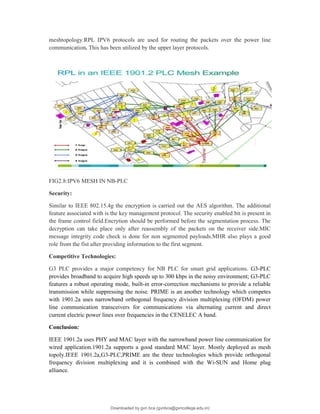
meshtopology.RPL IPV6 protocols are used for routing the packets over the power line
communication. This has been utilized by the upper layer protocols.
FIG2.8:IPV6 MESH IN NB-PLC
Security:
Similar to IEEE 802.15.4g the encryption is carried out the AES algorithm. The additional
feature associated with is the key management protocol. The security enabled bit is present in
the frame control field.Encrytion should be performed before the segmentation process. The
decryption can take place only after reassembly of the packets on the receiver side.MIC
message integrity code check is done for non segmented payloads.MHR also plays a good
role from the fist after providing information to the first segment.
Competitive Technologies:
G3 PLC provides a major competency for NB PLC for smart grid applications. G3-PLC
provides broadband to acquire high speeds up to 300 kbps in the noisy environment; G3-PLC
features a robust operating mode, built-in error-correction mechanisms to provide a reliable
transmission while suppressing the noise. PRIME is an another technology which competes
with 1901.2a uses narrowband orthogonal frequency division multiplexing (OFDM) power
line communication transceivers for communications via alternating current and direct
current electric power lines over frequencies in the CENELEC A band.
Conclusion:
IEEE 1901.2a uses PHY and MAC layer with the narrowband power line communication for
wired application.1901.2a supports a good standard MAC layer. Mostly deployed as mesh
topoly.IEEE 1901.2a,G3-PLC,PRIME are the three technologies which provide orthogonal
frequency division multiplexing and it is combined with the Wi-SUN and Home plug
alliance.
Downloaded by gvn bca (gvnbca@gvncollege.edu.in)
lOMoARcPSD|20972679
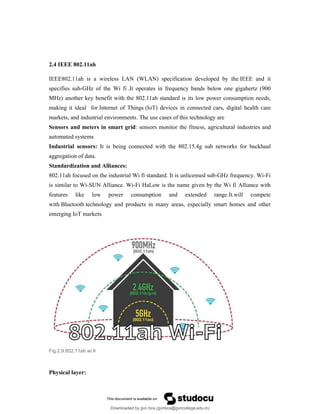
2.4 IEEE 802.11ah
IEEE802.11ah is a wireless LAN (WLAN) specification developed by the IEEE and it
specifies sub-GHz of the Wi fi .It operates in frequency bands below one gigahertz (900
MHz) another key benefit with the 802.11ah standard is its low power consumption needs,
making it ideal for Internet of Things (IoT) devices in connected cars, digital health care
markets, and industrial environments. The use cases of this technology are
Sensors and meters in smart grid: sensors monitor the fitness, agricultural industries and
automated systems
Industrial sensors: It is being connected with the 802.15.4g sub networks for backhaul
aggregation of data.
Standardization and Alliances:
802.11ah focused on the industrial Wi fi standard. It is unlicensed sub-GHz frequency. Wi-Fi
is similar to Wi-SUN Alliance. Wi-Fi HaLow is the name given by the Wi fi Alliance with
features like low power consumption and extended range.It.will compete
with Bluetooth technology and products in many areas, especially smart homes and other
emerging IoT markets.
Fig 2.9:802.11ah wi fi
Physical layer:
Downloaded by gvn bca (gvnbca@gvncollege.edu.in)
lOMoARcPSD|20972679
802.11ah uses orthogonal frequency division multiplexing, OFDM to provide the
modulation scheme for the signal. However there are two categories into which the
802.11ah physical layer PHY can be split: The modulation techniques used are BPSK,
QPSK, 16QAM, 64QAM and 256 QAM
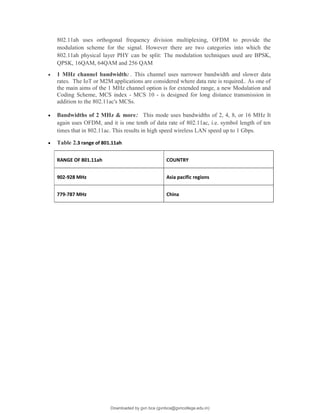
 1 MHz channel bandwidth: . This channel uses narrower bandwidth and slower data
rates. The IoT or M2M applications are considered where data rate is required.. As one of
the main aims of the 1 MHz channel option is for extended range, a new Modulation and
Coding Scheme, MCS index - MCS 10 - is designed for long distance transmission in
addition to the 802.11ac's MCSs.
 Bandwidths of 2 MHz & more: This mode uses bandwidths of 2, 4, 8, or 16 MHz It
again uses OFDM, and it is one tenth of data rate of 802.11ac, i.e. symbol length of ten
times that in 802.11ac. This results in high speed wireless LAN speed up to 1 Gbps.
 Table 2.3 range of 801.11ah
RANGE OF 801.11ah COUNTRY
902-928 MHz Asia pacific regions
779-787 MHz China
Downloaded by gvn bca (gvnbca@gvncollege.edu.in)
lOMoARcPSD|20972679
Fig2.10: BANDWIDTH OF 802.11ah
MAC Layer:
Mac layer provides the facility to add many numbers of access points and end points. It
has the header, null data packet, grouping and sectorization, restricted access window,
target wake time and speed frame exchange.
Relay Access Point:
A Relay Access Point (AP) is one which logically consists of a Relay and a networking
station (STA), or client. Relay station provides connectivity for stations outside the coverage
of the AP. There can be 8192 devices per access point.
Null data packet: This is used to control and manage frames and also helps in low power
consumption by the frames at receiving side
Downloaded by gvn bca (gvnbca@gvncollege.edu.in)
lOMoARcPSD|20972679
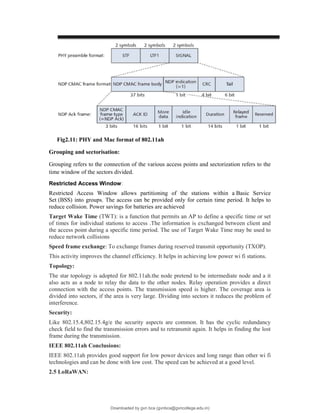
Fig2.11: PHY and Mac format of 802.11ah
Grouping and sectorisation:
Grouping refers to the connection of the various access points and sectorization refers to the
time window of the sectors divided.
Restricted Access Window:
Restricted Access Window allows partitioning of the stations within a Basic Service
Set (BSS) into groups. The access can be provided only for certain time period. It helps to
reduce collision. Power savings for batteries are achieved
Target Wake Time (TWT): is a function that permits an AP to define a specific time or set
of times for individual stations to access .The information is exchanged between client and
the access point during a specific time period. The use of Target Wake Time may be used to
reduce network collisions
Speed frame exchange: To exchange frames during reserved transmit opportunity (TXOP).
This activity improves the channel efficiency. It helps in achieving low power wi fi stations.
Topology:
The star topology is adopted for 802.11ah.the node pretend to be intermediate node and a it
also acts as a node to relay the data to the other nodes. Relay operation provides a direct
connection with the access points. The transmission speed is higher. The coverage area is
divided into sectors, if the area is very large. Dividing into sectors it reduces the problem of
interference.
Security:
Like 802.15.4,802.15.4g/e the security aspects are common. It has the cyclic redundancy
check field to find the transmission errors and to retransmit again. It helps in finding the lost
frame during the transmission.
IEEE 802.11ah Conclusions:
IEEE 802.11ah provides good support for low power devices and long range than other wi fi
technologies and can be done with low cost. The speed can be achieved at a good level.
2.5 LoRaWAN:
Downloaded by gvn bca (gvnbca@gvncollege.edu.in)
lOMoARcPSD|20972679
LoRa (Long Range) is a low-power wide-area network (LPWAN) technology. It operates
based on spread spectrum modulation techniques which was derived from chirp spread
spectrum (CSS) technology.LPWA technology provides unlicensed approach for business
providers interlinked with the internet of things.LPWA collaborates well with the industries.
Standardization and Alliances:
Cycleo was the first company which designed the physical layer of LoRa and it was acquired
by semtech later and finally LoRa alliance was formed. Regional frequency bands and MAC
layer is maintained by the LoRa alliance and the PHY layer is maintained by the semtech.
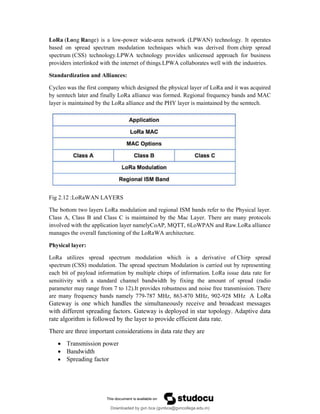
Fig 2.12 :LoRaWAN LAYERS
The bottom two layers LoRa modulation and regional ISM bands refer to the Physical layer.
Class A, Class B and Class C is maintained by the Mac Layer. There are many protocols
involved with the application layer namelyCoAP, MQTT, 6LoWPAN and Raw.LoRa alliance
manages the overall functioning of the LoRaWA architecture.
Physical layer:
LoRa utilizes spread spectrum modulation which is a derivative of Chirp spread
spectrum (CSS) modulation. The spread spectrum Modulation is carried out by representing
each bit of payload information by multiple chirps of information. LoRa issue data rate for
sensitivity with a standard channel bandwidth by fixing the amount of spread (radio
parameter may range from 7 to 12).It provides robustness and noise free transmission. There
are many frequency bands namely 779-787 MHz, 863-870 MHz, 902-928 MHz A LoRa
Gateway is one which handles the simultaneously receive and broadcast messages
with different spreading factors. Gateway is deployed in star topology. Adaptive data
rate algorithm is followed by the layer to provide efficient data rate.
There are three important considerations in data rate they are
 Transmission power
 Bandwidth
 Spreading factor
Downloaded by gvn bca (gvnbca@gvncollege.edu.in)
lOMoARcPSD|20972679
If the spreading factor is less, it covers less distance but it is transmitted at faster speeds. If
the spreading factor is higher, the transmission rate is slow but it achieves good reliability for
longer distances. If you increase the bandwidth the data rate will be faster
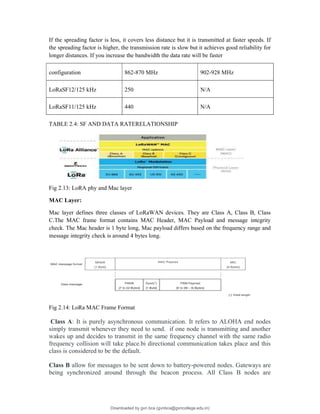
configuration 862-870 MHz 902-928 MHz
LoRaSF12/125 kHz 250 N/A
LoRaSF11/125 kHz 440 N/A
TABLE 2.4: SF AND DATA RATERELATIONSHIP
Fig 2.13: LoRA phy and Mac layer
MAC Layer:
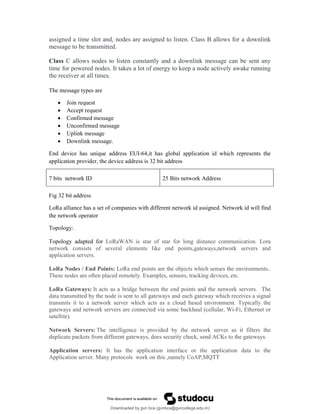
Mac layer defines three classes of LoRaWAN devices. They are Class A, Class B, Class
C.The MAC frame format contains MAC Header, MAC Payload and message integrity
check. The Mac header is 1 byte long, Mac payload differs based on the frequency range and
message integrity check is around 4 bytes long.
Fig 2.14: LoRa MAC Frame Format
Class A: It is purely asynchronous communication. It refers to ALOHA end nodes
simply transmit whenever they need to send. if one node is transmitting and another
wakes up and decides to transmit in the same frequency channel with the same radio
frequency collision will take place.bi directional communication takes place and this
class is considered to be the default.
Class B allow for messages to be sent down to battery-powered nodes. Gateways are
being synchronized around through the beacon process. All Class B nodes are
Downloaded by gvn bca (gvnbca@gvncollege.edu.in)
lOMoARcPSD|20972679
assigned a time slot and, nodes are assigned to listen. Class B allows for a downlink
message to be transmitted.
Class C allows nodes to listen constantly and a downlink message can be sent any
time for powered nodes. It takes a lot of energy to keep a node actively awake running
the receiver at all times.
The message types are
 Join request
 Accept request
 Confirmed message
 Unconfirmed message
 Uplink message
 Downlink message.
End device has unique address EUI-64,it has global application id which represents the
application provider, the device address is 32 bit address
7 bits network ID 25 Bits network Address
Fig 32 bit address
LoRa alliance has a set of companies with different network id assigned. Network id will find
the network operator
Topology:
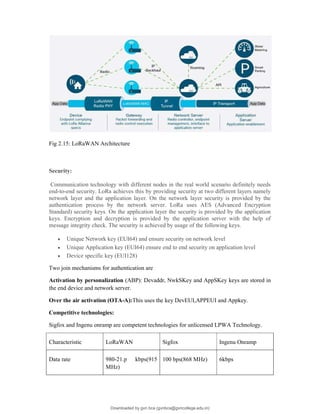
Topology adapted for LoRaWAN is star of star for long distance communication. Lora
network consists of several elements like end points,gateways,network servers and
application servers.
LoRa Nodes / End Points: LoRa end points are the objects which senses the environments..
These nodes are often placed remotely. Examples, sensors, tracking devices, etc.
LoRa Gateways: It acts as a bridge between the end points and the network servers. The
data transmitted by the node is sent to all gateways and each gateway which receives a signal
transmits it to a network server which acts as a cloud based environment. Typically the
gateways and network servers are connected via some backhaul (cellular, Wi-Fi, Ethernet or
satellite).
Network Servers: The intelligence is provided by the network server as it filters the
duplicate packets from different gateways, does security check, send ACKs to the gateways.
Application servers: It has the application interface or the application data to the
Application server. Many protocols work on this ,namely CoAP,MQTT
Downloaded by gvn bca (gvnbca@gvncollege.edu.in)
lOMoARcPSD|20972679
Fig 2.15: LoRaWAN Architecture
Security:
Communication technology with different nodes in the real world scenario definitely needs
end-to-end security. LoRa achieves this by providing security at two different layers namely
network layer and the application layer. On the network layer security is provided by the
authentication process by the network server. LoRa uses AES (Advanced Encryption
Standard) security keys. On the application layer the security is provided by the application
keys. Encryption and decryption is provided by the application server with the help of
message integrity check. The security is achieved by usage of the following keys.
 Unique Network key (EUI64) and ensure security on network level
 Unique Application key (EUI64) ensure end to end security on application level
 Device specific key (EUI128)
Two join mechanisms for authentication are
Activation by personalization (ABP): Devaddr, NwkSKey and AppSKey keys are stored in
the end device and network server.
Over the air activation (OTA-A):This uses the key DevEUI,APPEUI and Appkey.
Competitive technologies:
Sigfox and Ingenu onramp are competent technologies for unlicensed LPWA Technology.
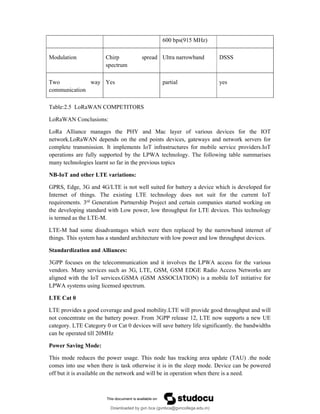
Characteristic LoRaWAN Sigfox Ingenu Onramp
Data rate 980-21.p kbps(915
MHz)
100 bps(868 MHz) 6kbps
Downloaded by gvn bca (gvnbca@gvncollege.edu.in)
lOMoARcPSD|20972679
600 bps(915 MHz)
Modulation Chirp spread
spectrum
Ultra narrowband DSSS
Two way
communication
Yes partial yes
Table:2.5 LoRaWAN COMPETITORS
LoRaWAN Conclusions:
LoRa Alliance manages the PHY and Mac layer of various devices for the IOT
network.LoRaWAN depends on the end points devices, gateways and network servers for
complete transmission. It implements IoT infrastructures for mobile service providers.IoT
operations are fully supported by the LPWA technology. The following table summarises
many technologies learnt so far in the previous topics
NB-IoT and other LTE variations:
GPRS, Edge, 3G and 4G/LTE is not well suited for battery a device which is developed for
Internet of things. The existing LTE technology does not suit for the current IoT
requirements. 3rd Generation Partnership Project and certain companies started working on
the developing standard with Low power, low throughput for LTE devices. This technology
is termed as the LTE-M.
LTE-M had some disadvantages which were then replaced by the narrowband internet of
things. This system has a standard architecture with low power and low throughput devices.
Standardization and Alliances:
3GPP focuses on the telecommunication and it involves the LPWA access for the various
vendors. Many services such as 3G, LTE, GSM, GSM EDGE Radio Access Networks are
aligned with the IoT services.GSMA (GSM ASSOCIATION) is a mobile IoT initiative for
LPWA systems using licensed spectrum.
LTE Cat 0
LTE provides a good coverage and good mobility.LTE will provide good throughput and will
not concentrate on the battery power. From 3GPP release 12, LTE now supports a new UE
category. LTE Category 0 or Cat 0 devices will save battery life significantly. the bandwidths
can be operated till 20MHz
Power Saving Mode:
This mode reduces the power usage. This node has tracking area update (TAU) .the node
comes into use when there is task otherwise it is in the sleep mode. Device can be powered
off but it is available on the network and will be in operation when there is a need.
Downloaded by gvn bca (gvnbca@gvncollege.edu.in)
lOMoARcPSD|20972679
Half duplex mode: as half duplex mode is used there is reduction in cost and most sensors
work on this mode.
Feature CAT 0 CAT 1
DL Peak rate 10 Mbps 1 Mbps
UE Peak rate 5 Mbps 1 Mbps
DUPLEX MODE YES HALF
Table 2.6 CAT 0 AND CAT 1
LTE –M
3GPP LTE Release 13 has enabled the development of LTE-M (LTE-MTC [Machine
Type Communication]), which includes eMTC (enhanced Machine Type Communication).It
is considered as a low power wide area network (LPWAN) for longer range of Mobile
devices and services. It differs from others by lower receiver bandwidth, lower data rate, half
duplex mode and enhanced discontinuous reception.
NB-IOT
Narrowband-Internet of Things (NB-IoT) is a standard developed by 3GPP for generating
low power wide area (LPWA) technology and wide range of services for IoT devices. NB-
IoT significantly improves the power consumption of user devices, system capacity and
spectrum efficiency, especially in deep coverage. Battery life has been improved for more
number of usecases.It is cost efficient and provides good indoor coverage.
NB IoT uses the orthogonal frequency division multiple access with features of uplink and
downlink frequency of 200 kHz. Many companies provide so many proposals namely
 Narrowband GSM (NOKIA proposal)
 Extended coverage GSM(ERICSSON proposal)
 Narrowband LTE(Alcatel proposal)
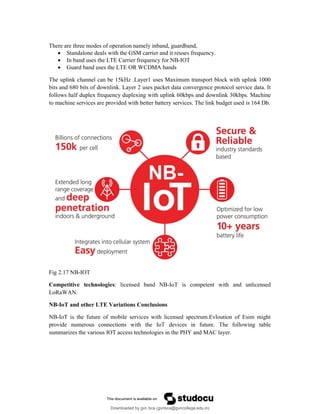
Fig 2.16 :NB-IoT Deployment options
Downloaded by gvn bca (gvnbca@gvncollege.edu.in)
lOMoARcPSD|20972679
There are three modes of operation namely inband, guardband,
 Standalone deals with the GSM carrier and it reuses frequency.
 In band uses the LTE Carrier frequency for NB-IOT
 Guard band uses the LTE OR WCDMA bands
The uplink channel can be 15kHz .Layer1 uses Maximum transport block with uplink 1000
bits and 680 bits of downlink. Layer 2 uses packet data convergence protocol service data. It
follows half duplex frequency duplexing with uplink 60kbps and downlink 30kbps. Machine
to machine services are provided with better battery services. The link budget used is 164 Db.
Fig 2.17 NB-IOT
Competitive technologies: licensed band NB-IoT is competent with and unlicensed
LoRaWAN.
NB-IoT and other LTE Variations Conclusions
NB-IoT is the future of mobile services with licensed spectrum.Evloution of Esim might
provide numerous connections with the IoT devices in future. The following table
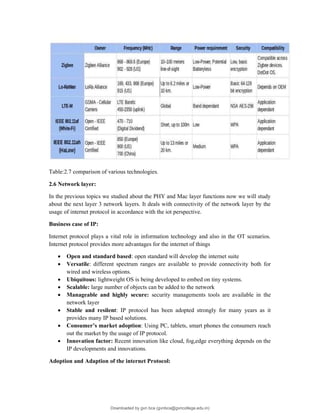
summarizes the various IOT access technologies in the PHY and MAC layer.
Downloaded by gvn bca (gvnbca@gvncollege.edu.in)
lOMoARcPSD|20972679
Table:2.7 comparison of various technologies.
2.6 Network layer:
In the previous topics we studied about the PHY and Mac layer functions now we will study
about the next layer 3 network layers. It deals with connectivity of the network layer by the
usage of internet protocol in accordance with the iot perspective.
Business case of IP:
Internet protocol plays a vital role in information technology and also in the OT scenarios.
Internet protocol provides more advantages for the internet of things
 Open and standard based: open standard will develop the internet suite
 Versatile: different spectrum ranges are available to provide connectivity both for
wired and wireless options.
 Ubiquitous: lightweight OS is being developed to embed on tiny systems.
 Scalable: large number of objects can be added to the network
 Manageable and highly secure: security managements tools are available in the
network layer
 Stable and resilent: IP protocol has been adopted strongly for many years as it
provides many IP based solutions.
 Consumer’s market adoption: Using PC, tablets, smart phones the consumers reach
out the market by the usage of IP protocol.
 Innovation factor: Recent innovation like cloud, fog,edge everything depends on the
IP developments and innovations.
Adoption and Adaption of the internet Protocol:
Downloaded by gvn bca (gvnbca@gvncollege.edu.in)
lOMoARcPSD|20972679
Adaptation involves the application layered gateways for the translation between non-IP and
IP layers Adoption involves the change of non IP layers with IP layer function for making it
simple and easy for the deployment.SCADA applications involve both the adoption and
adaption model.Zigbee runs on non IP and gate way acts as a translator.
For adoption or adaption certain factors should be considered for last mile connectivity
namely bidirectional vs unidirectional data flow, overhead for last mile communication paths,
data flow model and network diversity.
Need for optimizations:
There are many challenges involved in internet protocol for the IoT applications,
optimization technique is mandatory for the layers in IP to incorporate in the IoT
environment
2.7 Constrained nodes: Previously we have elobarated in table about three different classes
for the objects or devices for Iot.These are the constrained nodes. Power consumption on
these nodes is set as an constrained nodes. The Iot device needs the battery power for few
months to years and devices for cellular or wifi needs long term battery lifetime.
IoT Constrained nodes have the following characteristics of power, memory.etc
 Nodes which has limited resources and limited security and management facility
 Device with enough power and able to work with optimized iot stack.
 Devices which have constrain in terms of computing power and bandwidth.
Constrained networks:-
It is a network with low power and lossy network.lossy network refers to the loss of data
during transmission. It has high latency and packet loss. Routing over Low-Power and Lossy
Network (RoLL) designed the IPV6 RPL protocol. Constrained networks can be deployed by
star and mesh topology. These networks have less power and less bandwidth links.lot of
errors occur during transmission resulting in packet loss and connectivity problem. The
network may even collapse and failure in control plane may reduce the lifetime of battery.
2.8 IP VERSIONS:
IETF is working on the versions ofIPV4 and IPV6.the problem with the IPV4 is that it does
not have enough address space.IPV6 can provide wide range of addresses. But in the current
scenario both the versions of IP are used in the various operations. All Iot operations are
carried by both IPV4 and IPV6.old r legacy software work on IPV4 and the recent new
innovation software can be deployed on both the IPV4 and IPV6.
Application protocol:
Ethernet and WI FI supports the IPV4.application protocol can have their option of IP for
example SCADA ,Modbus TCP prefers IPV4.Iot devices linked with the various application
protocol like HTTP,MQTT works well on both the IP version. The option depends on the
specific needs of the application.
Downloaded by gvn bca (gvnbca@gvncollege.edu.in)
lOMoARcPSD|20972679
Cellular provider and technology:
The earlier cellular technologies like GSM, EDGE, 3G works with the IPV4 and the recent
technologies LTE/4G can be operated with both the versions of IPV4 and IPV6
Serial communication:
Legacy Devices had communication only with the help of serial lines initially nowadays the
serial port is used for communication. Router plays a major role in communicating the
information by routing the packets. Complete communication relies on two protocols namely
the TCP and UDP.
IPV6 Adaptation layer:
IPV6 deploys a adaptation layer between network layer and the data link layer of IPV6.This
layer helps the internet of things to work efficiently for various iot related services. There is
technique called MAP-T (Mapping of port address and translation).IPV4 traffic can be
carried over the IPV6.With the introduction of this technique legacy devices can access the
IPV6 version.RPL is routing protocol used for the routing of packets in the iot network.
2.9 Optimizing IP for IOT:
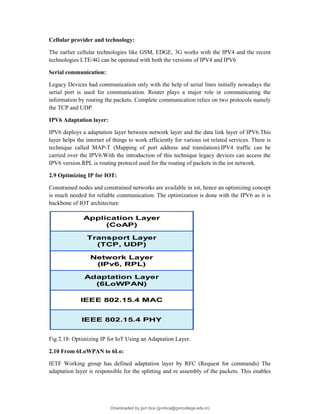
Constrained nodes and constrained networks are available in iot, hence an optimizing concept
is much needed for reliable communication. The optimization is done with the IPV6 as it is
backbone of IOT architecture
Fig 2.18: Optimizing IP for IoT Using an Adaptation Layer.
2.10 From 6LoWPAN to 6Lo:
IETF Working group has defined adaptation layer by RFC (Request for commands) The
adaptation layer is responsible for the splitting and re assembly of the packets. This enables
Downloaded by gvn bca (gvnbca@gvncollege.edu.in)
lOMoARcPSD|20972679
the communication between the IP enabled devices. The IP is being inducted into the lower
layer protocols by the adaptation layer.6LoWPAN are turned to 6Lo.the optimization takes
place on the packets of IPV6 over constrained networks. The 6LoWPAN group has defined
encapsulation and header compression mechanisms that allow IPv6 packets to be sent and
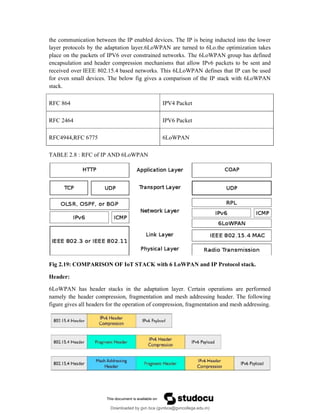
received over IEEE 802.15.4 based networks. This 6LLoWPAN defines that IP can be used
for even small devices. The below fig gives a comparison of the IP stack with 6LoWPAN
stack.
RFC 864 IPV4 Packet
RFC 2464 IPV6 Packet
RFC4944,RFC 6775 6LoWPAN
TABLE 2.8 : RFC of IP AND 6LoWPAN
Fig 2.19: COMPARISON OF IoT STACK with 6 LoWPAN and IP Protocol stack.
Header:
6LoWPAN has header stacks in the adaptation layer. Certain operations are performed
namely the header compression, fragmentation and mesh addressing header. The following
figure gives all headers for the operation of compression, fragmentation and mesh addressing.
Downloaded by gvn bca (gvnbca@gvncollege.edu.in)
lOMoARcPSD|20972679
Fig 2.20:6LoWPAN Header Stacks
Header compression:
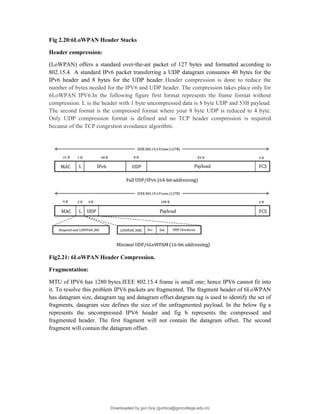
(LoWPAN) offers a standard over-the-air packet of 127 bytes and formatted according to
802.15.4. A standard IPv6 packet transferring a UDP datagram consumes 40 bytes for the
IPv6 header and 8 bytes for the UDP header. Header compression is done to reduce the
number of bytes needed for the IPV6 and UDP header. The compression takes place only for
6LoWPAN IPV6.In the following figure first format represents the frame format without
compression. L is the header with 1 byte uncompressed data is 8 byte UDP and 53B payload.
The second format is the compressed format where your 8 byte UDP is reduced to 4 byte.
Only UDP compression format is defined and no TCP header compression is required
because of the TCP congestion avoidance algorithm.
Fig2.21: 6LoWPAN Header Compression.
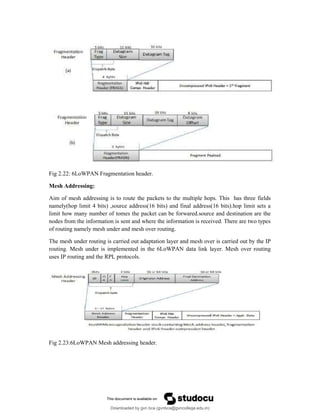
Fragmentation:
MTU of IPV6 has 1280 bytes.IEEE 802.15.4 frame is small one; hence IPV6 cannot fit into
it. To resolve this problem IPV6 packets are fragmented. The fragment header of 6LoWPAN
has datagram size, datagram tag and datagram offset.datgram tag is used to identify the set of
fragments, datagram size defines the size of the unfragmented payload. In the below fig a
represents the uncompressed IPV6 header and fig b represents the compressed and
fragmented header. The first fragment will not contain the datagram offset. The second
fragment will contain the datagram offset.
Downloaded by gvn bca (gvnbca@gvncollege.edu.in)
lOMoARcPSD|20972679
Fig 2.22: 6LoWPAN Fragmentation header.
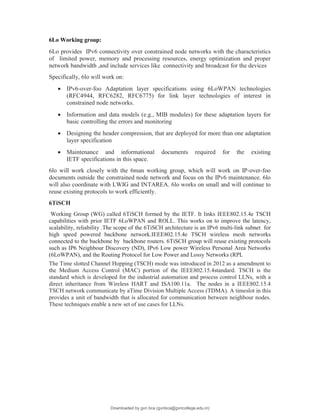
Mesh Addressing:
Aim of mesh addressing is to route the packets to the multiple hops. This has three fields
namely(hop limit 4 bits) ,source address(16 bits) and final address(16 bits).hop limit sets a
limit how many number of tomes the packet can be forwared.source and destination are the
nodes from the information is sent and where the information is received. There are two types
of routing namely mesh under and mesh over routing.
The mesh under routing is carried out adaptation layer and mesh over is carried out by the IP
routing. Mesh under is implemented in the 6LoWPAN data link layer. Mesh over routing
uses IP routing and the RPL protocols.
Fig 2.23:6LoWPAN Mesh addressing header.
Downloaded by gvn bca (gvnbca@gvncollege.edu.in)
lOMoARcPSD|20972679
6Lo Working group:
6Lo provides IPv6 connectivity over constrained node networks with the characteristics
of limited power, memory and processing resources, energy optimization and proper
network bandwidth ,and include services like connectivity and broadcast for the devices
Specifically, 6lo will work on:
 IPv6-over-foo Adaptation layer specifications using 6LoWPAN technologies
(RFC4944, RFC6282, RFC6775) for link layer technologies of interest in
constrained node networks.
 Information and data models (e.g., MIB modules) for these adaptation layers for
basic controlling the errors and monitoring
 Designing the header compression, that are deployed for more than one adaptation
layer specification
 Maintenance and informational documents required for the existing
IETF specifications in this space.
6lo will work closely with the 6man working group, which will work on IP-over-foo
documents outside the constrained node network and focus on the IPv6 maintenance. 6lo
will also coordinate with LWIG and INTAREA. 6lo works on small and will continue to
reuse existing protocols to work efficiently.
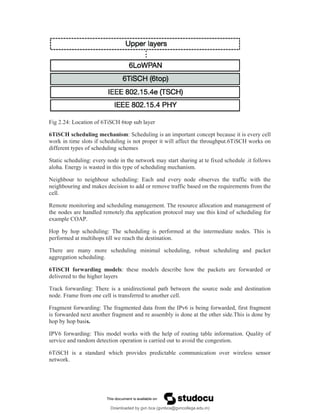
6TiSCH
Working Group (WG) called 6TiSCH formed by the IETF. It links IEEE802.15.4e TSCH
capabilities with prior IETF 6LoWPAN and ROLL. This works on to improve the latency,
scalability, reliability .The scope of the 6TiSCH architecture is an IPv6 multi-link subnet for
high speed powered backbone network.IEEE802.15.4e TSCH wireless mesh networks
connected to the backbone by backbone routers. 6TiSCH group will reuse existing protocols
such as IP6 Neighbour Discovery (ND), IPv6 Low power Wireless Personal Area Networks
(6LoWPAN), and the Routing Protocol for Low Power and Lossy Networks (RPL
The Time slotted Channel Hopping (TSCH) mode was introduced in 2012 as a amendment to
the Medium Access Control (MAC) portion of the IEEE802.15.4standard. TSCH is the
standard which is developed for the industrial automation and process control LLNs, with a
direct inheritance from Wireless HART and ISA100.11a. The nodes in a IEEE802.15.4
TSCH network communicate by aTime Division Multiple Access (TDMA). A timeslot in this
provides a unit of bandwidth that is allocated for communication between neighbour nodes.
These techniques enable a new set of use cases for LLNs.
Downloaded by gvn bca (gvnbca@gvncollege.edu.in)
lOMoARcPSD|20972679
Fig 2.24: Location of 6TiSCH 6top sub layer
6TiSCH scheduling mechanism: Scheduling is an important concept because it is every cell
work in time slots if scheduling is not proper it will affect the throughput.6TiSCH works on
different types of scheduling schemes
Static scheduling: every node in the network may start sharing at te fixed schedule .it follows
aloha. Energy is wasted in this type of scheduling mechanism.
Neighbour to neighbour scheduling: Each and every node observes the traffic with the
neighbouring and makes decision to add or remove traffic based on the requirements from the
cell.
Remote monitoring and scheduling management. The resource allocation and management of
the nodes are handled remotely.tha application protocol may use this kind of scheduling for
example COAP.
Hop by hop scheduling: The scheduling is performed at the intermediate nodes. This is
performed at multihops till we reach the destination.
There are many more scheduling minimal scheduling, robust scheduling and packet
aggregation scheduling.
6TiSCH forwarding models: these models describe how the packets are forwarded or
delivered to the higher layers
Track forwarding: There is a unidirectional path between the source node and destination
node. Frame from one cell is transferred to another cell.
Fragment forwarding: The fragmented data from the IPv6 is being forwarded, first fragment
is forwarded next another fragment and re assembly is done at the other side.This is done by
hop by hop basis.
IPV6 forwarding: This model works with the help of routing table information. Quality of
service and random detection operation is carried out to avoid the congestion.
6TiSCH is a standard which provides predictable communication over wireless sensor
network.
Downloaded by gvn bca (gvnbca@gvncollege.edu.in)
lOMoARcPSD|20972679
2.11 RPL: RPL (Routing Protocol for Low-Power and Lossy Networks) is a routing
protocol networks with low power consumption and it is deployed in wireless environment.
Designed for multi-hop and many-to-one communication, but also supports one-to-one
messages. This protocol is specified in RFC 6550 .This is the routing protocol can quickly
create network routes, share routing knowledge in a more organized and efficient way for the
requirements of the constrained networks. IETF working group was responsible for the
“Routing over Low power and Lossy (ROLL) networks” protocol. This comes under the
mesh over operation. Routing is carried at the IP layer. There are two modes. RPL can
encompass different kinds of traffic and signalling information exchanged among nodes
namely. Multipoint-to-Point (MP2P), Point-to-Multipoint (P2MP), and Point-to-Point (P2P)
traffic.
Storing mode: In this mode the nodes has the entire routing table hence it can reach all
nodes.
Non storing mode: only border router has the routing table hence memory can be saved the
packets are forwarded to the border router and it sends to the destination.
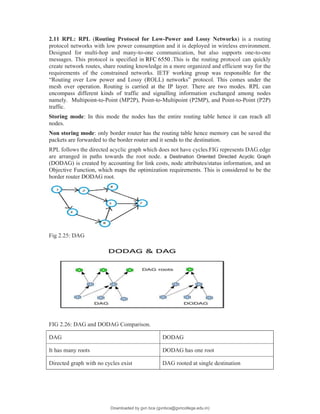
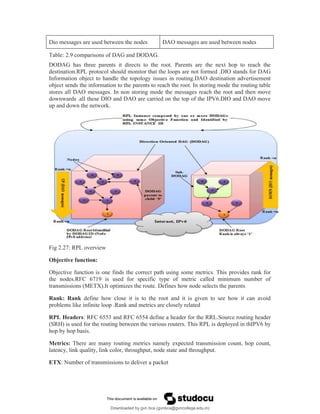
RPL follows the directed acyclic graph which does not have cycles.FIG represents DAG.edge
are arranged in paths towards the root node. a Destination Oriented Directed Acyclic Graph
(DODAG) is created by accounting for link costs, node attributes/status information, and an
Objective Function, which maps the optimization requirements. This is considered to be the
border router DODAG root.
Fig 2.25: DAG
FIG 2.26: DAG and DODAG Comparison.
DAG DODAG
It has many roots DODAG has one root
Directed graph with no cycles exist DAG rooted at single destination
Downloaded by gvn bca (gvnbca@gvncollege.edu.in)
lOMoARcPSD|20972679
Dio messages are used between the nodes DAO messages are used between nodes
Table: 2.9 comparisons of DAG and DODAG.
DODAG has three parents it directs to the root. Parents are the next hop to reach the
destination.RPL protocol should monitor that the loops are not formed .DIO stands for DAG
Information object to handle the topology issues in routing.DAO destination advertisement
object sends the information to the parents to reach the root. In storing mode the routing table
stores all DAO messages. In non storing mode the messages reach the root and then move
downwards .all these DIO and DAO are carried on the top of the IPV6.DIO and DAO move
up and down the network.
Fig 2.27: RPL overview
Objective function:
Objective function is one finds the correct path using some metrics. This provides rank for
the nodes.RFC 6719 is used for specific type of metric called minimum number of
transmissions (METX).It optimizes the route. Defines how node selects the parents
Rank: Rank define how close it is to the root and it is given to see how it can avoid
problems like infinite loop .Rank and metrics are closely related
RPL Headers: RFC 6553 and RFC 6554 define a header for the RRL.Source routing header
(SRH) is used for the routing between the various routers. This RPL is deployed in thIPV6 by
hop by hop basis.
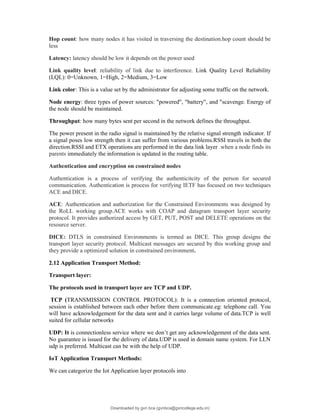
Metrics: There are many routing metrics namely expected transmission count, hop count,
latency, link quality, link color, throughput, node state and throughput.
ETX: Number of transmissions to deliver a packet
Downloaded by gvn bca (gvnbca@gvncollege.edu.in)
lOMoARcPSD|20972679
Hop count: how many nodes it has visited in traversing the destination.hop count should be
less
Latency: latency should be low it depends on the power used
Link quality level: reliability of link due to interference. Link Quality Level Reliability
(LQL): 0=Unknown, 1=High, 2=Medium, 3=Low
Link color: This is a value set by the administrator for adjusting some traffic on the network.
Node energy: three types of power sources: "powered", "battery", and "scavenge. Energy of
the node should be maintained.
Throughput: how many bytes sent per second in the network defines the throughput.
The power present in the radio signal is maintained by the relative signal strength indicator. If
a signal poses low strength then it can suffer from various problems.RSSI travels in both the
direction.RSSI and ETX operations are performed in the data link layer .when a node finds its
parents immediately the information is updated in the routing table.
Authentication and encryption on constrained nodes
Authentication is a process of verifying the authenticitcity of the person for secured
communication. Authentication is process for verifying IETF has focused on two techniques
ACE and DICE.
ACE: Authentication and authorization for the Constrained Environments was designed by
the RoLL working group.ACE works with COAP and datagram transport layer security
protocol. It provides authorized access by GET, PUT, POST and DELETE operations on the
resource server.
DICE: DTLS in constrained Environments is termed as DICE. This group designs the
transport layer security protocol. Multicast messages are secured by this working group and
they provide a optimized solution in constrained environment.
2.12 Application Transport Method:
Transport layer:
The protocols used in transport layer are TCP and UDP.
TCP (TRANSMISSION CONTROL PROTOCOL): It is a connection oriented protocol,
session is established between each other before them communicate.eg: telephone call. You
will have acknowledgement for the data sent and it carries large volume of data.TCP is well
suited for cellular networks
UDP: It is connectionless service where we don’t get any acknowledgement of the data sent.
No guarantee is issued for the delivery of data.UDP is used in domain name system. For LLN
udp is preferred. Multicast can be with the help of UDP.
IoT Application Transport Methods:
We can categorize the Iot Application layer protocols into
Downloaded by gvn bca (gvnbca@gvncollege.edu.in)
lOMoARcPSD|20972679
Application layer not present: payload plays a major role on the layers and no application
layer is present.
Supervisory control and data acquisition: It is a industrial protocol developed before IP.
Generic web based protocol: These protocols WI-FI, LTE which works on IOT device of
non constrained networks.
IoT application protocol: It is being used by constrained nodes. The protocols are MQTT
and COAP.
Application Layer Protocol not Present:
There are devices defined as class 0 by RFC 7228, these devices will not have proper layers
like transport or application layer as they work on constrained modes.
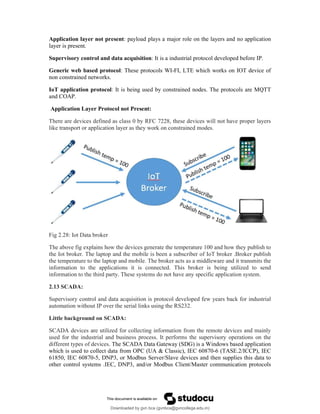
Fig 2.28: Iot Data broker
The above fig explains how the devices generate the temperature 100 and how they publish to
the Iot broker. The laptop and the mobile is been a subscriber of IoT broker .Broker publish
the temperature to the laptop and mobile. The broker acts as a middleware and it transmits the
information to the applications it is connected. This broker is being utilized to send
information to the third party. These systems do not have any specific application system.
2.13 SCADA:
Supervisory control and data acquisition is protocol developed few years back for industrial
automation without IP over the serial links using the RS232.
Little background on SCADA:
SCADA devices are utilized for collecting information from the remote devices and mainly
used for the industrial and business process. It performs the supervisory operations on the
different types of devices. The SCADA Data Gateway (SDG) is a Windows based application
which is used to collect data from OPC (UA & Classic), IEC 60870-6 (TASE.2/ICCP), IEC
61850, IEC 60870-5, DNP3, or Modbus Server/Slave devices and then supplies this data to
other control systems .IEC, DNP3, and/or Modbus Client/Master communication protocols
Downloaded by gvn bca (gvnbca@gvncollege.edu.in)
lOMoARcPSD|20972679
are supported by SCADA. There are about 200 such real time user layer and application
protocols.
Adapting SCADA for IP:
Initially SCADA was developed without IP, then SCADA was improved by to run over
Ethernet and IP.The different type of protocols that support the SCADA. There are few
industrial protocols available namely
DNP3 Protocol: Distributed Network Protocol is a set of communications protocols used
between components in process automation system. DNP3 supports multiple-slave, peer-to-
peer and multiple-master communications. DN3 messages are used over IP.
Modbus: This protocol knows about the controller how it will find the device address and
transfer information to it and it uses TCP at port 502.Modbusx is available
IEC60870-5-104: IEC 60870-5 is the collection of standards produced by the IEC
(International Electro technical Commission).It provided a standard for the transmission of
SCADA telemetry control and information. It uses Ethernet and IPV4.
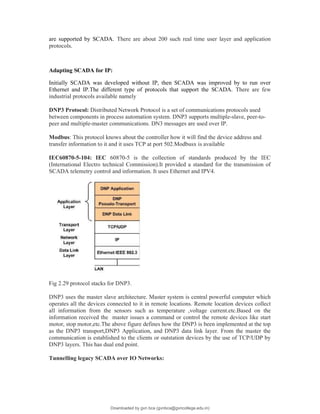
Fig 2.29 protocol stacks for DNP3.
DNP3 uses the master slave architecture. Master system is central powerful computer which
operates all the devices connected to it in remote locations. Remote location devices collect
all information from the sensors such as temperature ,voltage current.etc.Based on the
information received the master issues a command or control the remote devices like start
motor, stop motor,etc.The above figure defines how the DNP3 is been implemented at the top
as the DNP3 transport,DNP3 Application, and DNP3 data link layer. From the master the
communication is established to the clients or outstation devices by the use of TCP/UDP by
DNP3 layers. This has dual end point.
Tunnelling legacy SCADA over IO Networks:
Downloaded by gvn bca (gvnbca@gvncollege.edu.in)
lOMoARcPSD|20972679
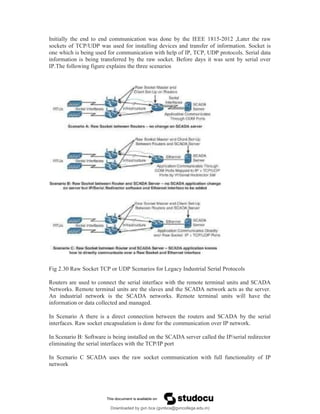
Initially the end to end communication was done by the IEEE 1815-2012 ,Later the raw
sockets of TCP/UDP was used for installing devices and transfer of information. Socket is
one which is being used for communication with help of IP, TCP, UDP protocols. Serial data
information is being transferred by the raw socket. Before days it was sent by serial over
IP.The following figure explains the three scenarios
Fig 2.30 Raw Socket TCP or UDP Scenarios for Legacy Industrial Serial Protocols
Routers are used to connect the serial interface with the remote terminal units and SCADA
Networks. Remote terminal units are the slaves and the SCADA network acts as the server.
An industrial network is the SCADA networks. Remote terminal units will have the
information or data collected and managed.
In Scenario A there is a direct connection between the routers and SCADA by the serial
interfaces. Raw socket encapsulation is done for the communication over IP network.
In Scenario B: Software is being installed on the SCADA server called the IP/serial redirector
eliminating the serial interfaces with the TCP/IP port
In Scenario C SCADA uses the raw socket communication with full functionality of IP
network
Downloaded by gvn bca (gvnbca@gvncollege.edu.in)
lOMoARcPSD|20972679
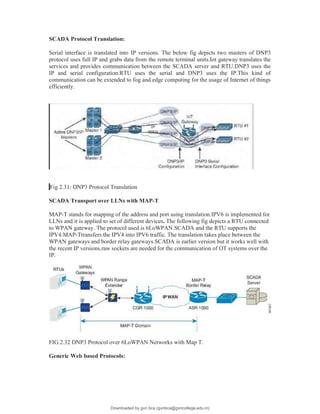
SCADA Protocol Translation:
Serial interface is translated into IP versions. The below fig depicts two masters of DNP3
protocol uses full IP and grabs data from the remote terminal units.Iot gateway translates the
services and provides communication between the SCADA server and RTU.DNP3 uses the
IP and serial configuration.RTU uses the serial and DNP3 uses the IP.This kind of
communication can be extended to fog and edge computing for the usage of Internet of things
efficiently.
SCADA tFig 2.31: DNP3 Protocol Translation
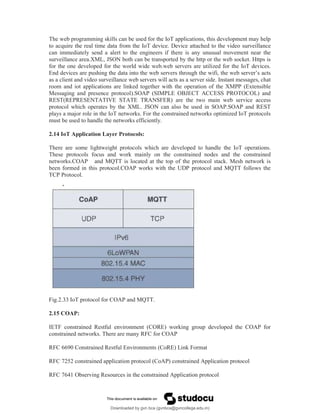
SCADA Transport over LLNs with MAP-T
MAP-T stands for mapping of the address and port using translation.IPV6 is implemented for
LLNs and it is applied to set of different devices. The following fig depicts a RTU connected
to WPAN gateway. The protocol used is 6LoWPAN.SCADA and the RTU supports the
IPV4.MAP-Ttransfers the IPV4 into IPV6 traffic. The translation takes place between the
WPAN gateways and border relay gateways.SCADA is earlier version but it works well with
the recent IP versions.raw sockets are needed for the communication of OT systems over the
IP.
FIG.2.32 DNP3 Protocol over 6LoWPAN Networks with Map T.
Generic Web based Protocols:
Downloaded by gvn bca (gvnbca@gvncollege.edu.in)
lOMoARcPSD|20972679
The web programming skills can be used for the IoT applications, this development may help
to acquire the real time data from the IoT device. Device attached to the video surveillance
can immediately send a alert to the engineers if there is any unusual movement near the
surveillance area.XML, JSON both can be transported by the http or the web socket. Https is
for the one developed for the world wide web.web servers are utilized for the IoT devices.
End devices are pushing the data into the web servers through the wifi, the web server’s acts
as a client and video surveillance web servers will acts as a server side. Instant messages, chat
room and iot applications are linked together with the operation of the XMPP (Extensible
Messaging and presence protocol).SOAP (SIMPLE OBJECT ACCESS PROTOCOL) and
REST(REPRESENTATIVE STATE TRANSFER) are the two main web service access
protocol which operates by the XML. JSON can also be used in SOAP.SOAP and REST
plays a major role in the IoT networks. For the constrained networks optimized IoT protocols
must be used to handle the networks efficiently.
2.14 IoT Application Layer Protocols:
There are some lightweight protocols which are developed to handle the IoT operations.
These protocols focus and work mainly on the constrained nodes and the constrained
networks.COAP and MQTT is located at the top of the protocol stack. Mesh network is
been formed in this protocol.COAP works with the UDP protocol and MQTT follows the
TCP Protocol.
Fig.2.33 IoT protocol for COAP and MQTT.
2.15 COAP:
IETF constrained Restful environment (CORE) working group developed the COAP for
constrained networks. There are many RFC for COAP
RFC 6690 Constrained Restful Environments (CoRE) Link Format
RFC 7252 constrained application protocol (CoAP) constrained Application protocol
RFC 7641 Observing Resources in the constrained Application protocol
Downloaded by gvn bca (gvnbca@gvncollege.edu.in)
lOMoARcPSD|20972679
RFC 7959 Block wise transfers in the constrained Application protocol
The device has the sensors and actuators.CoAP exchange information between endpoint over
UDP socket .CoAP sends short messaging service by LWM2M(Mobile alliance for
lightweight machine to machine) for Iot device management.datagram transport layer
security is a part of the COAP.Security fields are enabled in this protocol. The security fields
are nosec, presharedkey, rawpublickey and certificate.CoAP has a specific message format.
The header is 4 bytes long.
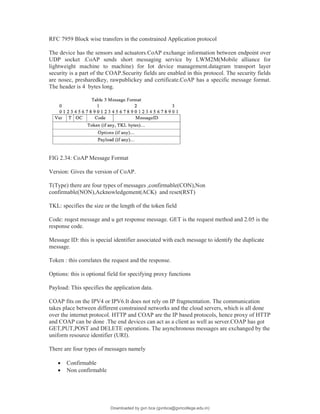
FIG 2.34: CoAP Message Format
Version: Gives the version of CoAP.
T(Type) there are four types of messages ,confirmable(CON),Non
confirmable(NON),Acknowledgement(ACK) and reset(RST)
TKL: specifies the size or the length of the token field
Code: reqest message and u get response message. GET is the request method and 2.05 is the
response code.
Message ID: this is special identifier associated with each message to identify the duplicate
message.
Token : this correlates the request and the response.
Options: this is optional field for specifying proxy functions
Payload: This specifies the application data.
COAP fits on the IPV4 or IPV6.It does not rely on IP fragmentation. The communication
takes place between different constrained networks and the cloud servers, which is all done
over the internet protocol. HTTP and COAP are the IP based protocols, hence proxy of HTTP
and COAP can be done .The end devices can act as a client as well as server.COAP has got
GET,PUT,POST and DELETE operations. The asynchronous messages are exchanged by the
uniform resource identifier (URI).
There are four types of messages namely
 Confirmable
 Non confirmable
Downloaded by gvn bca (gvnbca@gvncollege.edu.in)
lOMoARcPSD|20972679
 Acknowledgement
 Reset
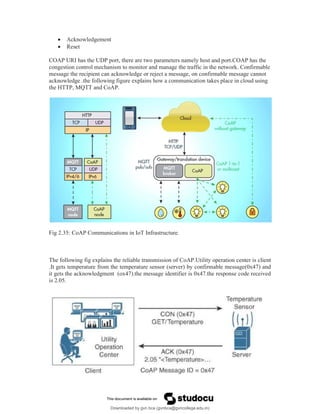
COAP URI has the UDP port, there are two parameters namely host and port.COAP has the
congestion control mechanism to monitor and manage the traffic in the network. Confirmable
message the recipient can acknowledge or reject a message, on confirmable message cannot
acknowledge .the following figure explains how a communication takes place in cloud using
the HTTP, MQTT and CoAP.
Fig 2.35: CoAP Communications in IoT Infrastructure.
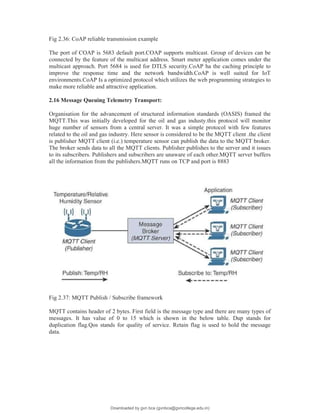
The following fig explains the reliable transmission of CoAP.Utility operation center is client
.It gets temperature from the temperature sensor (server) by confirmable message(0x47) and
it gets the acknowledgment (ox47).the message identifier is 0x47.the response code received
is 2.05.
Downloaded by gvn bca (gvnbca@gvncollege.edu.in)
lOMoARcPSD|20972679
Fig 2.36: CoAP reliable transmission example
The port of COAP is 5683 default port.COAP supports multicast. Group of devices can be
connected by the feature of the multicast address. Smart meter application comes under the
multicast approach. Port 5684 is used for DTLS security.CoAP ha the caching principle to
improve the response time and the network bandwidth.CoAP is well suited for IoT
environments.CoAP Is a optimized protocol which utilizes the web programming strategies to
make more reliable and attractive application.
2.16 Message Queuing Telemetry Transport:
Organisation for the advancement of structured information standards (OASIS) framed the
MQTT.This was initially developed for the oil and gas industy.this protocol will monitor
huge number of sensors from a central server. It was a simple protocol with few features
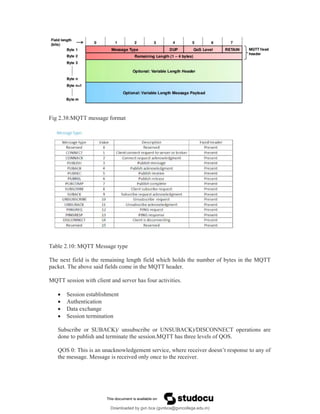
related to the oil and gas industry. Here sensor is considered to be the MQTT client .the client
is publisher MQTT client (i.e.) temperature sensor can publish the data to the MQTT broker.
The broker sends data to all the MQTT clients. Publisher publishes to the server and it issues
to its subscribers. Publishers and subscribers are unaware of each other.MQTT server buffers
all the information from the publishers.MQTT runs on TCP and port is 8883
Fig 2.37: MQTT Publish / Subscribe framework
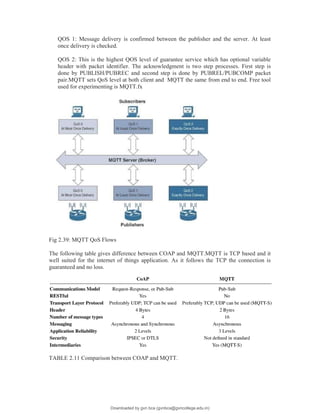
MQTT contains header of 2 bytes. First field is the message type and there are many types of
messages. It has value of 0 to 15 which is shown in the below table. Dup stands for
duplication flag.Qos stands for quality of service. Retain flag is used to hold the message
data.
Downloaded by gvn bca (gvnbca@gvncollege.edu.in)
lOMoARcPSD|20972679
Fig 2.38:MQTT message format
Table 2.10: MQTT Message type
The next field is the remaining length field which holds the number of bytes in the MQTT
packet. The above said fields come in the MQTT header.
MQTT session with client and server has four activities.
 Session establishment
 Authentication
 Data exchange
 Session termination
Subscribe or SUBACK)/ unsubscribe or UNSUBACK)/DISCONNECT operations are
done to publish and terminate the session.MQTT has three levels of QOS.
QOS 0: This is an unacknowledgement service, where receiver doesn’t response to any of
the message. Message is received only once to the receiver.
Downloaded by gvn bca (gvnbca@gvncollege.edu.in)
lOMoARcPSD|20972679
QOS 1: Message delivery is confirmed between the publisher and the server. At least
once delivery is checked.
QOS 2: This is the highest QOS level of guarantee service which has optional variable
header with packet identifier. The acknowledgment is two step processes. First step is
done by PUBLISH/PUBREC and second step is done by PUBREL/PUBCOMP packet
pair.MQTT sets QoS level at both client and MQTT the same from end to end. Free tool
used for experimenting is MQTT.fx
Fig 2.39: MQTT QoS Flows
The following table gives difference between COAP and MQTT.MQTT is TCP based and it
well suited for the internet of things application. As it follows the TCP the connection is
guaranteed and no loss.
TABLE 2.11 Comparison between COAP and MQTT.
Downloaded by gvn bca (gvnbca@gvncollege.edu.in)
lOMoARcPSD|20972679

internet-of-things-2.....................pdf

  • 1.
    Internet of things2 Internet - Of -Things (Pondicherry University) Scan to open on Studocu Studocu is not sponsored or endorsed by any college or university Internet of things 2 Internet - Of -Things (Pondicherry University) Scan to open on Studocu Studocu is not sponsored or endorsed by any college or university Downloaded by gvn bca (gvnbca@gvncollege.edu.in) lOMoARcPSD|20972679
  • 2.
    UNIT 2 IoT PROTOCOLS9 IoT Access Technologies: Physical and MAC layers, topology and Security of IEEE 802.15.4, 802.15.4g, 802.15.4e, 1901.2a, 802.11ah and LoRaWAN – Network Layer: IP versions, Constrained Nodes and Constrained Networks – Optimizing IP for IoT: From 6LoWPAN to 6Lo, Routing over Low Power and Lossy Networks – Application Transport Methods: Supervisory Control and Data Acquisition – Application Layer Protocols: CoAP and MQTT . 2. IoT Access Technologies: The connectivity technologies for IoT involves wireless access, long range communication and mobile IoT systems Network technologies for IoT Connectivity are:  Wireless Access – 3G and standard LTE.  Long Range – LoRA based platform, Zigbee  Mobile IoT – LTE-M, NB-IoT, Wireless Access – Wi Fi, 3G and standard LTE Smart TV, Video surveillance comes under this category. The main network option for this kind of application is the home appliances. For more number of users to connect to this network it would be expensive. Long Range – LoRA based platform, Zigbee Low power connectivity requirements are satisfied by this kind of IoT. This network allows third-party devices to connect to their system.LoRAWan is chirp spread spectrum (CSS) radio modulation technology .On the opposite approach, there is Sigfox, is a network which is build of their own standards.Zigbee is an IEEE 802.15.4-based technology built on the physical layer and media access control used for embedded applications. Mobile IoT Technologies – LTE-M, NB-IoT Smart watches, fitness trackers, and glasses have stand-alone mobile connectivity because of the esim and NB-IoT technologies.LTE network is deployed, the IoT connectivity has good power efficiency. The decision of which technology to adopt, deploy and finally launch IoT services will depend on the specific application. The IoT access technologies is explained in terms of standardisation, physical layer,mac layer, topology and security aspects. Downloaded by gvn bca (gvnbca@gvncollege.edu.in) lOMoARcPSD|20972679
  • 3.
    2.1 IEEE 802.15.4: IEEE802.15.4 is a standard which is designed for low-rate wireless personal area networks (LR-WPANs). It specifies the physical layer and media access control for LR- WPANs.Deploying these networks requires low cost and easy installation procedure. A sensor, remote controls and industrial wireless sensor networks uses this standard. This method adopts the frequency hopping technique. There is a problem of reliability and unbounded latency. Problem arises due to the carrier sense multiple access. Standardisation and Alliances: The IEEE 802.15 Task Group 4 designed standards with low data rate with more years of battery life with very low complexity. 802.15.4 has released many standards on various year consecutively 2003,2006,2011,2015 .The various versions are IEEE 802.15.4 – 2003, IEEE 802.15.4 – 2006, IEEE 802.15.4a, IEEE 802.15.4c, IEEE 802.15.4d, IEEE 802.15.4e, IEEE 802.15.4f, IEEE 802.15.4g.IEE 802.15.4 provides the MAC and PHY layers standards which is the base for the protocols. There are many protocols available namely Zigbee, 6LoWPAN, ZigbeeIP, WirelessHART, Thread. IEEE 802.15.4 DERIVED STANDARDS Zigbee It is given by zigbee alliance. It is being developed for low bandwidth devices like radio system. These devices are used in applications for heating, lighting and security purposes Wireless HART Wireless HART is developed by HART Communication Foundation. They use the 2.4 GHz ISM band and system uses IEEE802.15.4 2006 standard for the lower layers .Self healing and self organised mesh architecture is adopted. 6LoWPAN "IPv6 over Low power Wireless Personal Area Networks" .The data packet is available in the form of IPV6 for transmission. RF4CE RF4CE, Radio Frequency for Consumer Electronics is designed to provide low power radio controls for audio visual applications. MiWi MiWi P2P systems are developed by Microchip Technology for low data transmission rates and minimum distance coverage. Their applications are industrial monitoring and control, remote control and automated meter reading. The cost for deploying this network is less. ISA100.11a This standard has been developed by ISA .This is an open-standard wireless networking technology. This technology focus on industrial automation. Zigbee IP This protocol has evolved from the zigbee and 6lowpan.This makes use of adaptation layer ,ipv6 network layer and RPL routing. This provides enhanced security Thread This is a mesh network developed to connect the devices at home. Thread protocol stack is built on the top of IETF 6LoWPAN/IPv6. Table 2.1 Downloaded by gvn bca (gvnbca@gvncollege.edu.in) lOMoARcPSD|20972679
  • 4.
    Zigbee: Zigbee initially startedin 1990 and later upgraded in the year 2004 as IEEE 802.15.4.Many industries collaborated with zigbee and it made it as a zigbee alliance, they started connecting the network with the iot devices.zigbee collaborated with many vendors and started manufacturing. The set of commands and messages which is given is termed as clusters zigbee focus on the automation of commercial and home products.zigbee uses the IEEE 802.15.4 as the lower layers of PHY and MAC. The first two bottom layers are physical and medium access control layer which deals with the devices and data control. The next third layer is network layer. Network layer provides security for the routing and proper communication. The topology is being decided in the network layer.AES algorithm with 128 bit key is utilized for the security purpose.AODV routing is used by the mesh network of zigbee.It can use any topology star, mesh or tree. This will help in finding the lowest number of hops within the network. The fourth layer is the application support layer or application framework which acts as a interface between the lower layer devices and the application level systems. The fifth layer of the zigbee protocol stack is the application profile which tells about the industrial connection with the vendors. Example of this is smart energy and the home automation. The bottom four layers form the zigbee platform. The radio signals are used by the bottom two layers. FIG:2.1 zigbee protocol stack. ZigBee IP: It is a part of smart energy 2.0 from zigbee Alliance. It has aimed at the smart metering.Zigbee IP has link layer, 6LoWPAN adaptation layer, network layer with many protocols like IPV6, RPL and ICMPV6.The transport layer has two protocols TCP and UDP Downloaded by gvn bca (gvnbca@gvncollege.edu.in) lOMoARcPSD|20972679
  • 5.
    Final layer isthe application layer which is used to integrate with Iot devices and standards. FIG:2.2 Zigbee IP protocol stack. Physical layer: This layer utilizes the direct sequence spread spectrum providing high bandwidth. The transmission range is 2.4 GHz frequency of 16 channels with 250 kbps data rate (used throughout world), 915 MHz frequency of 10 channels with data rate of 40 kbps (used in America) and 868 MHz with 1 channel with data rate of 20 kbps (used in Europe). OQPSK PHY: offset quadrature phase shift keying is modulation technique where phase changes occur and offset is used for reliable transfer. BPSK PHY: binary phase shift keying uses its phase shift as data encoding ASK PHY: it is parallel sequence spread spectrum uses amplitude shifts to signal and it increases data rate. Fig: IEEE 802.15.4 PHY Format. Downloaded by gvn bca (gvnbca@gvncollege.edu.in) lOMoARcPSD|20972679
  • 6.
    SHR – Synchronizationheader has two fields’ preamble and start of frame delimiter fields. Synchronization header is around 5 bytes.PHR- header portion depicts frame length of 1 byte PHY Payload is the data field. This data field is around 127 bytes. Fragmentation of IPV6 packet will occur at the data link layer. MAC Layer: Mac layer manages the access to the physical channel. It describes how the frequency has been accessed by the devices. It performs reliable data transfer and short range operation .It is deployed at low cost and power consumption is low.IEEE 802.15.4 Supports 64 bit MAC address. Payload is 127 bytes long.16 bit short address can be handled by upper layers. Tasks:  It provides security services for the device  The devices are connected in networks and controlled by co coordinators(network beaconing)  It handles association and disassociation between nodes.  It checks for frame validation There are four types of frame namely data frame, beacon frame, acknowledgement frame and Mac command frame. Data frame: is utilized for transfer of information (i.e. data) Beacon frame: frame used to send data to the wireless device from PAN coordinator. Acknowledge frame: The receiving node acknowledges the data being received. Mac command frame: this frame is used to control the communication between the devices. Fig 2.3: IEEE 802.15.4 MAC Format Downloaded by gvn bca (gvnbca@gvncollege.edu.in) lOMoARcPSD|20972679
  • 7.
    The MAC Frameis divided into Mac Header, Mac payload and Mac Footer. Mac header has frame control, sequence number and address information field. Frame control has the frame type, addressing modes and control flags and it is 2bytes long. Sequence number has sequence identifier and it is 1 byte long. Address information has 4 fields of 4-20 bytes long which include source and destination address, source and destination PAN identifier. Mac payload has frame payload which defines the frame type and it is variable size. Mac footer has the frame check sequence to monitor the integrity of the data Topology: It can be star, peer to peer or mesh topology. Mesh topology transfer the information to the neighbouring nodes. Mesh topology has many nodes. Every node in the network has PAN ID.There is a single PAN co ordinator.The coordinator nodes sends the various types of services to the other nodes. Full function node can have full access to all the nodes and reduced function node provides access to limited FFD.RFD are nodes which act as sensor or switch and it not have the routing facility.FFD has the routing facility to route the data. Stat topology has the central pan co ordinator.Peer to peer topology has more advantages over the star network. s u Security: The security is provided by advanced encryption standard with 128 bit key length and it is block cipher algorithm .the data is of fixed block size. It works based on the concept of symmetric key algorithm .the same key is been utilized for encoding and decoding. Security field is added to the Mac frame format. Field called auxiliary security header is added next to the source address field. Downloaded by gvn bca (gvnbca@gvncollege.edu.in) lOMoARcPSD|20972679
  • 8.
    Fig:2.4 IEEE 802.15.4frame format with auxiliary security header Competitive technologies: DASH7 is the standard by ISO .It’s been adopted for various industrial applications .Main deployment is in RFID(radio frequency identification).RFID makes use of radio waves for communication with low powered standards on objects. The data rate is 166.667 kbps and payload of 256 bytes. The frequency 23 MHz, 868 MHz and 915 MHz .RFID is integrated with the wireless sensor network to enhance the commercial applications. IEEE 802.15.4 Conclusions: IEEE 802.15 PHY AND MAC layers are considered to be the base of industry standards. The speed varies based on modulation and frequency.PAN provides reliable communication. The security is ensured with the message integrity check of AES Standard. Thus data integrity is maintained in transmission with the help of AES.IEEE 802.15.4 is strong standard for IoT deployments with low power and low data rate. 2.2 IEEE 802.15.4g and 802.15.4e IEEE 802.15.4g and IEEE 802.15.4e are amendments of IEEE 802.15.4-2011. IEEE 802.15.4g is at used at scenario of neighbourhood area network (NAN), where it is deployed outdoor and it forms ad hoc networks. IEEE 802.15.4e supports a wide range of industrial and commercial applications that require low latency and robustness. IEEE 802.15.4e has developed MAC functions to improve the capabilities, like low energy (LE), information element (IE), enhanced beacons (EB) and enhanced beacon requests (EBR). The application of this has started the smart grid. This involves the connection of intelligent devices.IEEE 802.15.4g 2012 and IEEE 802.15.4E-2012 is combined as the IEEE 802.15.4-2015 Specification. 802.15.4u uses 865-867 frequency in India. 802.15.4v uses 902-907.5 in Brazil. Various IoT applications for the IEEE 802.15.4g/IEEE 802.15.4e are  Smart grid  Electrical Vehicle charging stations.  Wireless sensors in smart cities.  Smart parking systems. Standardization and Alliances: SUN stands for smart utility network.IEEE 802.15.4e/IEEE 802.15.4g is developed based pn the standards of PHY-SUN.Wi-SUN alliance is formed by the IEEE 801.15.4g.Wi SUN works similar to WIFI WIMAX standards. trademark Industry Organisation Standards body Downloaded by gvn bca (gvnbca@gvncollege.edu.in) lOMoARcPSD|20972679
  • 9.
    Wi-fi Wi-fi AllianceIEEE 802.11 Wireless LAN WiMax WiMAX Forum IEEE802.16 Wireless MAN Wi-SUN Wi-SUN Alliance IEEE802.15.4gwireless SUN TAB 2.2: IEEE Standards for Industry Alliances. Physical Layer: IEEE802.15. supports different types of data rates from 169MHz to 2.4 GHz. Fragmentation of IPV6 is not necessary and error handling is carried by the cyclic redundancy check. Different physical layers (PHYs) specified in the 802.15.4g standard, are multi rate and multiregional FSK. The systems in US are based on FSK .modulation, ranges operating in the 920–928 MHz license-exempt band. (MR-FSK) PHY.-multirate and multi regional shift keying with good transmit power standards. MR-OQPSK PHY (multirate and multiregional offset quadrature phase shift keying): This is designed for multimode systems MR-OFDM PHY:-multi rate and multi regional orthogonal frequency division is multiplexing: This is designed for producing higher data rates at low cost. The different 802.15.4g PHYs can operate in the same location and within the same. Mac layer: IEEE 802.15.4e is utilized for the Mac layer and not applied to the PHY layer. Information is exchange at MAC layer between various devices. Two types of IEs are employed by IEEE 802.15.4e, that is, header IEs and payload IEs. The former is part of the MAC header (MHR) and is used to process the frame itself, while the latter is a part of MAC payload dealing with next higher layer or service access point (SAP). Fig: 2.5. IEEE 802.15.4 g/e MAC Frame Format. Downloaded by gvn bca (gvnbca@gvncollege.edu.in) lOMoARcPSD|20972679
  • 10.
    These are incorporatedand linked with the SUN devices. The enhancements in this layer include Time slotted channel Hopping(TSCH),Information elements, enhanced beacons, enhanced beacons request and enhanced acknowledgement. The Mac frame format differs from the original format by the introduction of security header and information elements field. TSCH: This technique is based on the time slots, which provides good bandwidth. The data packets transferred receives acknowledgenments.They have different channels for transmitting the information. This feature helps the industrial application. Proper scheduling algorithm is defined for TSCH by the IETF 6TiSCH group. Information Elements (IE): This is divided into two field’s header IEs and Payload IEs.This field is used to carry Meta data and to transmit timing information and hopping synchronization. Enhanced beacons: This is applied for specific applicationsThe information from higher layers to be periodically broadcasted. Network metrics and Pan Information is provided by the beacons. Enhanced beacons Requests: The 802.15.4e enhanced beacon request (EBR) is extension of beacon request command frame. It specifies request of information contents and number of response filter IEs, The information sharing and filtering is done by exchanging selected MAC or PHY capability information with few specific neighbours. Enhanced Acknowledgement: This is for the enhancement and integration of a frame counter and it is being acknowleged.This acknowledgement helps in finding out the frame which has been spoofed and it helps identifying the attacks on frames. Topology: This is deployed by the mesh topology. Smart cities and industrial applications require mesh topology as the nodes are battery powered. This provides long life time. Security: Encryption is done by advanced encryption standard with 128 bit key.Auxilary security header file is one which provides secure acknowledgement. Message integrity check can check the values based on the frame contents.key management protocol can be implemented to handle the key specification. Competitive technologies: IEEE 802.15.4g and IEEE 802.15.4e compete with the standards of IEEE 802.15.4 such as DASH7. ASH7 Alliance Protocol (D7A) is an Wireless Sensor and Actuator Network protocol, which provides multi-year battery life for the smart moving objects. This technology is adopted by upper layer protocols. Downloaded by gvn bca (gvnbca@gvncollege.edu.in) lOMoARcPSD|20972679
  • 11.
    IEEE 802.15.4g andIEEE 802.15.4e Conclusions: IEEE 802.15.4/4g/4e SUN applications are much suited for outdoor en. SUN system can be applied in real world environments. This network facilitates the communications of applications of same kind of requirements such as machine-to- machine networks, and sensor networks. The works can be extended for other environments including indoor .802.15.4 had latency and multipath fading issues which were overcome the 802.15.4g/e standards. Wi –SUN alliance has improved the industrial applications deploying IoT with mainly smart grid and smart cities. 2.3 IEEE 1901.2a: IEEE 1901.2a-2013 is a wired technology which implements NB-PLC (narrowband power line communications) (PLC) through alternating current, direct current, and nonenergized electric power lines using frequencies below 500 kHz. Data rates of 500 kb/s is being supported by the system. This is been deployed in both indoor and outdoor environments. When combined with IEEE 802.15.4g/e it provides dual PHY operations. The use cases are Smart metering: Water, gas and electric meters are being automated as smart meters. Distribution automation: This is monitoring and controlling the devices in power grid Public lighting: Automation of lights in streets and in public areas. Vehicle charging: Batteries of the electric vehicle are being charged. Microgrids: From main grids small local grids are separated and operated independently Renewable energy: NB PLC can be used in the solar panel and wind energy stations Standardization and Alliances: The first generation of NB PLC suffered from problem of poor reliability and poor interoperability. This works on the basis of orthogonal frequency division multiplexing which encodes information on multiple carrier frequencies.IEEE 1901.2 workgroup created the IEEE 1901.2a.This standardized the NB-PLC PHY and MAC layer. This standard was not compatible with the recent developments. Home Plug alliance is necessary for PLC technology. This technology provides the broadband power line to the publicity has combined with the WI-SUN Alliance to provide wireless and wired connectivity. Physical layer: The frequency range is between 3 to 500 kHz for NB-PLC.The CENELEC A and B bands follow the federal communication commission standards of US. It also follows the Japan ARIB bands.FCC bands are categorised as above and below ranges.”A “range is set between 35.93(36) to 90.625(90).”B” ranges from 95-125kHz.FCC above range is from154.6-487 and below range is 37.5 117.18 kHz. Japan ARIB has range between 37-117.18 and 154.68- 403.125 kHz Downloaded by gvn bca (gvnbca@gvncollege.edu.in) lOMoARcPSD|20972679
  • 12.
    It provides goodthroughput. The modulation techniques which are used are robust modulation(ROBO),Differential binary phase shift keying(DBPSK),Differential 8 point phase shift keying,16 quadrature amplitude modulation(16QAM).The data rate can change dynamically in 1901.2a.the data rate for ROBO is 4.5kbps and 46 kbps in D8PSK.1901.2a has the feature of multipoint PHY management.MAC layer comes with segmentation. FIG: 2.6.NB PLC FREQUENCY BANDS. MAC Layer: The information element is also present in this Frame format. This frame format has a new field called the segment control at the first. The payload is large to fit into data unit hence it will be broken into small segments. In order to control the segments and monitor the segmentation with larger sizes they have this segment control field and Mac protocol data unit. FIG 2.7: MAC Frame format for IEEE 1901.2. Topology: IEEE 1901.2a refers to standard of physical power lines there are many problems associated with it. The problems are noise and attenuation. Most of this standard deploys the Downloaded by gvn bca (gvnbca@gvncollege.edu.in) lOMoARcPSD|20972679
  • 13.
    meshtopology.RPL IPV6 protocolsare used for routing the packets over the power line communication. This has been utilized by the upper layer protocols. FIG2.8:IPV6 MESH IN NB-PLC Security: Similar to IEEE 802.15.4g the encryption is carried out the AES algorithm. The additional feature associated with is the key management protocol. The security enabled bit is present in the frame control field.Encrytion should be performed before the segmentation process. The decryption can take place only after reassembly of the packets on the receiver side.MIC message integrity code check is done for non segmented payloads.MHR also plays a good role from the fist after providing information to the first segment. Competitive Technologies: G3 PLC provides a major competency for NB PLC for smart grid applications. G3-PLC provides broadband to acquire high speeds up to 300 kbps in the noisy environment; G3-PLC features a robust operating mode, built-in error-correction mechanisms to provide a reliable transmission while suppressing the noise. PRIME is an another technology which competes with 1901.2a uses narrowband orthogonal frequency division multiplexing (OFDM) power line communication transceivers for communications via alternating current and direct current electric power lines over frequencies in the CENELEC A band. Conclusion: IEEE 1901.2a uses PHY and MAC layer with the narrowband power line communication for wired application.1901.2a supports a good standard MAC layer. Mostly deployed as mesh topoly.IEEE 1901.2a,G3-PLC,PRIME are the three technologies which provide orthogonal frequency division multiplexing and it is combined with the Wi-SUN and Home plug alliance. Downloaded by gvn bca (gvnbca@gvncollege.edu.in) lOMoARcPSD|20972679
  • 14.
    2.4 IEEE 802.11ah IEEE802.11ahis a wireless LAN (WLAN) specification developed by the IEEE and it specifies sub-GHz of the Wi fi .It operates in frequency bands below one gigahertz (900 MHz) another key benefit with the 802.11ah standard is its low power consumption needs, making it ideal for Internet of Things (IoT) devices in connected cars, digital health care markets, and industrial environments. The use cases of this technology are Sensors and meters in smart grid: sensors monitor the fitness, agricultural industries and automated systems Industrial sensors: It is being connected with the 802.15.4g sub networks for backhaul aggregation of data. Standardization and Alliances: 802.11ah focused on the industrial Wi fi standard. It is unlicensed sub-GHz frequency. Wi-Fi is similar to Wi-SUN Alliance. Wi-Fi HaLow is the name given by the Wi fi Alliance with features like low power consumption and extended range.It.will compete with Bluetooth technology and products in many areas, especially smart homes and other emerging IoT markets. Fig 2.9:802.11ah wi fi Physical layer: Downloaded by gvn bca (gvnbca@gvncollege.edu.in) lOMoARcPSD|20972679
  • 15.
    802.11ah uses orthogonalfrequency division multiplexing, OFDM to provide the modulation scheme for the signal. However there are two categories into which the 802.11ah physical layer PHY can be split: The modulation techniques used are BPSK, QPSK, 16QAM, 64QAM and 256 QAM  1 MHz channel bandwidth: . This channel uses narrower bandwidth and slower data rates. The IoT or M2M applications are considered where data rate is required.. As one of the main aims of the 1 MHz channel option is for extended range, a new Modulation and Coding Scheme, MCS index - MCS 10 - is designed for long distance transmission in addition to the 802.11ac's MCSs.  Bandwidths of 2 MHz & more: This mode uses bandwidths of 2, 4, 8, or 16 MHz It again uses OFDM, and it is one tenth of data rate of 802.11ac, i.e. symbol length of ten times that in 802.11ac. This results in high speed wireless LAN speed up to 1 Gbps.  Table 2.3 range of 801.11ah RANGE OF 801.11ah COUNTRY 902-928 MHz Asia pacific regions 779-787 MHz China Downloaded by gvn bca (gvnbca@gvncollege.edu.in) lOMoARcPSD|20972679
  • 16.
    Fig2.10: BANDWIDTH OF802.11ah MAC Layer: Mac layer provides the facility to add many numbers of access points and end points. It has the header, null data packet, grouping and sectorization, restricted access window, target wake time and speed frame exchange. Relay Access Point: A Relay Access Point (AP) is one which logically consists of a Relay and a networking station (STA), or client. Relay station provides connectivity for stations outside the coverage of the AP. There can be 8192 devices per access point. Null data packet: This is used to control and manage frames and also helps in low power consumption by the frames at receiving side Downloaded by gvn bca (gvnbca@gvncollege.edu.in) lOMoARcPSD|20972679
  • 17.
    Fig2.11: PHY andMac format of 802.11ah Grouping and sectorisation: Grouping refers to the connection of the various access points and sectorization refers to the time window of the sectors divided. Restricted Access Window: Restricted Access Window allows partitioning of the stations within a Basic Service Set (BSS) into groups. The access can be provided only for certain time period. It helps to reduce collision. Power savings for batteries are achieved Target Wake Time (TWT): is a function that permits an AP to define a specific time or set of times for individual stations to access .The information is exchanged between client and the access point during a specific time period. The use of Target Wake Time may be used to reduce network collisions Speed frame exchange: To exchange frames during reserved transmit opportunity (TXOP). This activity improves the channel efficiency. It helps in achieving low power wi fi stations. Topology: The star topology is adopted for 802.11ah.the node pretend to be intermediate node and a it also acts as a node to relay the data to the other nodes. Relay operation provides a direct connection with the access points. The transmission speed is higher. The coverage area is divided into sectors, if the area is very large. Dividing into sectors it reduces the problem of interference. Security: Like 802.15.4,802.15.4g/e the security aspects are common. It has the cyclic redundancy check field to find the transmission errors and to retransmit again. It helps in finding the lost frame during the transmission. IEEE 802.11ah Conclusions: IEEE 802.11ah provides good support for low power devices and long range than other wi fi technologies and can be done with low cost. The speed can be achieved at a good level. 2.5 LoRaWAN: Downloaded by gvn bca (gvnbca@gvncollege.edu.in) lOMoARcPSD|20972679
  • 18.
    LoRa (Long Range)is a low-power wide-area network (LPWAN) technology. It operates based on spread spectrum modulation techniques which was derived from chirp spread spectrum (CSS) technology.LPWA technology provides unlicensed approach for business providers interlinked with the internet of things.LPWA collaborates well with the industries. Standardization and Alliances: Cycleo was the first company which designed the physical layer of LoRa and it was acquired by semtech later and finally LoRa alliance was formed. Regional frequency bands and MAC layer is maintained by the LoRa alliance and the PHY layer is maintained by the semtech. Fig 2.12 :LoRaWAN LAYERS The bottom two layers LoRa modulation and regional ISM bands refer to the Physical layer. Class A, Class B and Class C is maintained by the Mac Layer. There are many protocols involved with the application layer namelyCoAP, MQTT, 6LoWPAN and Raw.LoRa alliance manages the overall functioning of the LoRaWA architecture. Physical layer: LoRa utilizes spread spectrum modulation which is a derivative of Chirp spread spectrum (CSS) modulation. The spread spectrum Modulation is carried out by representing each bit of payload information by multiple chirps of information. LoRa issue data rate for sensitivity with a standard channel bandwidth by fixing the amount of spread (radio parameter may range from 7 to 12).It provides robustness and noise free transmission. There are many frequency bands namely 779-787 MHz, 863-870 MHz, 902-928 MHz A LoRa Gateway is one which handles the simultaneously receive and broadcast messages with different spreading factors. Gateway is deployed in star topology. Adaptive data rate algorithm is followed by the layer to provide efficient data rate. There are three important considerations in data rate they are  Transmission power  Bandwidth  Spreading factor Downloaded by gvn bca (gvnbca@gvncollege.edu.in) lOMoARcPSD|20972679
  • 19.
    If the spreadingfactor is less, it covers less distance but it is transmitted at faster speeds. If the spreading factor is higher, the transmission rate is slow but it achieves good reliability for longer distances. If you increase the bandwidth the data rate will be faster configuration 862-870 MHz 902-928 MHz LoRaSF12/125 kHz 250 N/A LoRaSF11/125 kHz 440 N/A TABLE 2.4: SF AND DATA RATERELATIONSHIP Fig 2.13: LoRA phy and Mac layer MAC Layer: Mac layer defines three classes of LoRaWAN devices. They are Class A, Class B, Class C.The MAC frame format contains MAC Header, MAC Payload and message integrity check. The Mac header is 1 byte long, Mac payload differs based on the frequency range and message integrity check is around 4 bytes long. Fig 2.14: LoRa MAC Frame Format Class A: It is purely asynchronous communication. It refers to ALOHA end nodes simply transmit whenever they need to send. if one node is transmitting and another wakes up and decides to transmit in the same frequency channel with the same radio frequency collision will take place.bi directional communication takes place and this class is considered to be the default. Class B allow for messages to be sent down to battery-powered nodes. Gateways are being synchronized around through the beacon process. All Class B nodes are Downloaded by gvn bca (gvnbca@gvncollege.edu.in) lOMoARcPSD|20972679
  • 20.
    assigned a timeslot and, nodes are assigned to listen. Class B allows for a downlink message to be transmitted. Class C allows nodes to listen constantly and a downlink message can be sent any time for powered nodes. It takes a lot of energy to keep a node actively awake running the receiver at all times. The message types are  Join request  Accept request  Confirmed message  Unconfirmed message  Uplink message  Downlink message. End device has unique address EUI-64,it has global application id which represents the application provider, the device address is 32 bit address 7 bits network ID 25 Bits network Address Fig 32 bit address LoRa alliance has a set of companies with different network id assigned. Network id will find the network operator Topology: Topology adapted for LoRaWAN is star of star for long distance communication. Lora network consists of several elements like end points,gateways,network servers and application servers. LoRa Nodes / End Points: LoRa end points are the objects which senses the environments.. These nodes are often placed remotely. Examples, sensors, tracking devices, etc. LoRa Gateways: It acts as a bridge between the end points and the network servers. The data transmitted by the node is sent to all gateways and each gateway which receives a signal transmits it to a network server which acts as a cloud based environment. Typically the gateways and network servers are connected via some backhaul (cellular, Wi-Fi, Ethernet or satellite). Network Servers: The intelligence is provided by the network server as it filters the duplicate packets from different gateways, does security check, send ACKs to the gateways. Application servers: It has the application interface or the application data to the Application server. Many protocols work on this ,namely CoAP,MQTT Downloaded by gvn bca (gvnbca@gvncollege.edu.in) lOMoARcPSD|20972679
  • 21.
    Fig 2.15: LoRaWANArchitecture Security: Communication technology with different nodes in the real world scenario definitely needs end-to-end security. LoRa achieves this by providing security at two different layers namely network layer and the application layer. On the network layer security is provided by the authentication process by the network server. LoRa uses AES (Advanced Encryption Standard) security keys. On the application layer the security is provided by the application keys. Encryption and decryption is provided by the application server with the help of message integrity check. The security is achieved by usage of the following keys.  Unique Network key (EUI64) and ensure security on network level  Unique Application key (EUI64) ensure end to end security on application level  Device specific key (EUI128) Two join mechanisms for authentication are Activation by personalization (ABP): Devaddr, NwkSKey and AppSKey keys are stored in the end device and network server. Over the air activation (OTA-A):This uses the key DevEUI,APPEUI and Appkey. Competitive technologies: Sigfox and Ingenu onramp are competent technologies for unlicensed LPWA Technology. Characteristic LoRaWAN Sigfox Ingenu Onramp Data rate 980-21.p kbps(915 MHz) 100 bps(868 MHz) 6kbps Downloaded by gvn bca (gvnbca@gvncollege.edu.in) lOMoARcPSD|20972679
  • 22.
    600 bps(915 MHz) ModulationChirp spread spectrum Ultra narrowband DSSS Two way communication Yes partial yes Table:2.5 LoRaWAN COMPETITORS LoRaWAN Conclusions: LoRa Alliance manages the PHY and Mac layer of various devices for the IOT network.LoRaWAN depends on the end points devices, gateways and network servers for complete transmission. It implements IoT infrastructures for mobile service providers.IoT operations are fully supported by the LPWA technology. The following table summarises many technologies learnt so far in the previous topics NB-IoT and other LTE variations: GPRS, Edge, 3G and 4G/LTE is not well suited for battery a device which is developed for Internet of things. The existing LTE technology does not suit for the current IoT requirements. 3rd Generation Partnership Project and certain companies started working on the developing standard with Low power, low throughput for LTE devices. This technology is termed as the LTE-M. LTE-M had some disadvantages which were then replaced by the narrowband internet of things. This system has a standard architecture with low power and low throughput devices. Standardization and Alliances: 3GPP focuses on the telecommunication and it involves the LPWA access for the various vendors. Many services such as 3G, LTE, GSM, GSM EDGE Radio Access Networks are aligned with the IoT services.GSMA (GSM ASSOCIATION) is a mobile IoT initiative for LPWA systems using licensed spectrum. LTE Cat 0 LTE provides a good coverage and good mobility.LTE will provide good throughput and will not concentrate on the battery power. From 3GPP release 12, LTE now supports a new UE category. LTE Category 0 or Cat 0 devices will save battery life significantly. the bandwidths can be operated till 20MHz Power Saving Mode: This mode reduces the power usage. This node has tracking area update (TAU) .the node comes into use when there is task otherwise it is in the sleep mode. Device can be powered off but it is available on the network and will be in operation when there is a need. Downloaded by gvn bca (gvnbca@gvncollege.edu.in) lOMoARcPSD|20972679
  • 23.
    Half duplex mode:as half duplex mode is used there is reduction in cost and most sensors work on this mode. Feature CAT 0 CAT 1 DL Peak rate 10 Mbps 1 Mbps UE Peak rate 5 Mbps 1 Mbps DUPLEX MODE YES HALF Table 2.6 CAT 0 AND CAT 1 LTE –M 3GPP LTE Release 13 has enabled the development of LTE-M (LTE-MTC [Machine Type Communication]), which includes eMTC (enhanced Machine Type Communication).It is considered as a low power wide area network (LPWAN) for longer range of Mobile devices and services. It differs from others by lower receiver bandwidth, lower data rate, half duplex mode and enhanced discontinuous reception. NB-IOT Narrowband-Internet of Things (NB-IoT) is a standard developed by 3GPP for generating low power wide area (LPWA) technology and wide range of services for IoT devices. NB- IoT significantly improves the power consumption of user devices, system capacity and spectrum efficiency, especially in deep coverage. Battery life has been improved for more number of usecases.It is cost efficient and provides good indoor coverage. NB IoT uses the orthogonal frequency division multiple access with features of uplink and downlink frequency of 200 kHz. Many companies provide so many proposals namely  Narrowband GSM (NOKIA proposal)  Extended coverage GSM(ERICSSON proposal)  Narrowband LTE(Alcatel proposal) Fig 2.16 :NB-IoT Deployment options Downloaded by gvn bca (gvnbca@gvncollege.edu.in) lOMoARcPSD|20972679
  • 24.
    There are threemodes of operation namely inband, guardband,  Standalone deals with the GSM carrier and it reuses frequency.  In band uses the LTE Carrier frequency for NB-IOT  Guard band uses the LTE OR WCDMA bands The uplink channel can be 15kHz .Layer1 uses Maximum transport block with uplink 1000 bits and 680 bits of downlink. Layer 2 uses packet data convergence protocol service data. It follows half duplex frequency duplexing with uplink 60kbps and downlink 30kbps. Machine to machine services are provided with better battery services. The link budget used is 164 Db. Fig 2.17 NB-IOT Competitive technologies: licensed band NB-IoT is competent with and unlicensed LoRaWAN. NB-IoT and other LTE Variations Conclusions NB-IoT is the future of mobile services with licensed spectrum.Evloution of Esim might provide numerous connections with the IoT devices in future. The following table summarizes the various IOT access technologies in the PHY and MAC layer. Downloaded by gvn bca (gvnbca@gvncollege.edu.in) lOMoARcPSD|20972679
  • 25.
    Table:2.7 comparison ofvarious technologies. 2.6 Network layer: In the previous topics we studied about the PHY and Mac layer functions now we will study about the next layer 3 network layers. It deals with connectivity of the network layer by the usage of internet protocol in accordance with the iot perspective. Business case of IP: Internet protocol plays a vital role in information technology and also in the OT scenarios. Internet protocol provides more advantages for the internet of things  Open and standard based: open standard will develop the internet suite  Versatile: different spectrum ranges are available to provide connectivity both for wired and wireless options.  Ubiquitous: lightweight OS is being developed to embed on tiny systems.  Scalable: large number of objects can be added to the network  Manageable and highly secure: security managements tools are available in the network layer  Stable and resilent: IP protocol has been adopted strongly for many years as it provides many IP based solutions.  Consumer’s market adoption: Using PC, tablets, smart phones the consumers reach out the market by the usage of IP protocol.  Innovation factor: Recent innovation like cloud, fog,edge everything depends on the IP developments and innovations. Adoption and Adaption of the internet Protocol: Downloaded by gvn bca (gvnbca@gvncollege.edu.in) lOMoARcPSD|20972679
  • 26.
    Adaptation involves theapplication layered gateways for the translation between non-IP and IP layers Adoption involves the change of non IP layers with IP layer function for making it simple and easy for the deployment.SCADA applications involve both the adoption and adaption model.Zigbee runs on non IP and gate way acts as a translator. For adoption or adaption certain factors should be considered for last mile connectivity namely bidirectional vs unidirectional data flow, overhead for last mile communication paths, data flow model and network diversity. Need for optimizations: There are many challenges involved in internet protocol for the IoT applications, optimization technique is mandatory for the layers in IP to incorporate in the IoT environment 2.7 Constrained nodes: Previously we have elobarated in table about three different classes for the objects or devices for Iot.These are the constrained nodes. Power consumption on these nodes is set as an constrained nodes. The Iot device needs the battery power for few months to years and devices for cellular or wifi needs long term battery lifetime. IoT Constrained nodes have the following characteristics of power, memory.etc  Nodes which has limited resources and limited security and management facility  Device with enough power and able to work with optimized iot stack.  Devices which have constrain in terms of computing power and bandwidth. Constrained networks:- It is a network with low power and lossy network.lossy network refers to the loss of data during transmission. It has high latency and packet loss. Routing over Low-Power and Lossy Network (RoLL) designed the IPV6 RPL protocol. Constrained networks can be deployed by star and mesh topology. These networks have less power and less bandwidth links.lot of errors occur during transmission resulting in packet loss and connectivity problem. The network may even collapse and failure in control plane may reduce the lifetime of battery. 2.8 IP VERSIONS: IETF is working on the versions ofIPV4 and IPV6.the problem with the IPV4 is that it does not have enough address space.IPV6 can provide wide range of addresses. But in the current scenario both the versions of IP are used in the various operations. All Iot operations are carried by both IPV4 and IPV6.old r legacy software work on IPV4 and the recent new innovation software can be deployed on both the IPV4 and IPV6. Application protocol: Ethernet and WI FI supports the IPV4.application protocol can have their option of IP for example SCADA ,Modbus TCP prefers IPV4.Iot devices linked with the various application protocol like HTTP,MQTT works well on both the IP version. The option depends on the specific needs of the application. Downloaded by gvn bca (gvnbca@gvncollege.edu.in) lOMoARcPSD|20972679
  • 27.
    Cellular provider andtechnology: The earlier cellular technologies like GSM, EDGE, 3G works with the IPV4 and the recent technologies LTE/4G can be operated with both the versions of IPV4 and IPV6 Serial communication: Legacy Devices had communication only with the help of serial lines initially nowadays the serial port is used for communication. Router plays a major role in communicating the information by routing the packets. Complete communication relies on two protocols namely the TCP and UDP. IPV6 Adaptation layer: IPV6 deploys a adaptation layer between network layer and the data link layer of IPV6.This layer helps the internet of things to work efficiently for various iot related services. There is technique called MAP-T (Mapping of port address and translation).IPV4 traffic can be carried over the IPV6.With the introduction of this technique legacy devices can access the IPV6 version.RPL is routing protocol used for the routing of packets in the iot network. 2.9 Optimizing IP for IOT: Constrained nodes and constrained networks are available in iot, hence an optimizing concept is much needed for reliable communication. The optimization is done with the IPV6 as it is backbone of IOT architecture Fig 2.18: Optimizing IP for IoT Using an Adaptation Layer. 2.10 From 6LoWPAN to 6Lo: IETF Working group has defined adaptation layer by RFC (Request for commands) The adaptation layer is responsible for the splitting and re assembly of the packets. This enables Downloaded by gvn bca (gvnbca@gvncollege.edu.in) lOMoARcPSD|20972679
  • 28.
    the communication betweenthe IP enabled devices. The IP is being inducted into the lower layer protocols by the adaptation layer.6LoWPAN are turned to 6Lo.the optimization takes place on the packets of IPV6 over constrained networks. The 6LoWPAN group has defined encapsulation and header compression mechanisms that allow IPv6 packets to be sent and received over IEEE 802.15.4 based networks. This 6LLoWPAN defines that IP can be used for even small devices. The below fig gives a comparison of the IP stack with 6LoWPAN stack. RFC 864 IPV4 Packet RFC 2464 IPV6 Packet RFC4944,RFC 6775 6LoWPAN TABLE 2.8 : RFC of IP AND 6LoWPAN Fig 2.19: COMPARISON OF IoT STACK with 6 LoWPAN and IP Protocol stack. Header: 6LoWPAN has header stacks in the adaptation layer. Certain operations are performed namely the header compression, fragmentation and mesh addressing header. The following figure gives all headers for the operation of compression, fragmentation and mesh addressing. Downloaded by gvn bca (gvnbca@gvncollege.edu.in) lOMoARcPSD|20972679
  • 29.
    Fig 2.20:6LoWPAN HeaderStacks Header compression: (LoWPAN) offers a standard over-the-air packet of 127 bytes and formatted according to 802.15.4. A standard IPv6 packet transferring a UDP datagram consumes 40 bytes for the IPv6 header and 8 bytes for the UDP header. Header compression is done to reduce the number of bytes needed for the IPV6 and UDP header. The compression takes place only for 6LoWPAN IPV6.In the following figure first format represents the frame format without compression. L is the header with 1 byte uncompressed data is 8 byte UDP and 53B payload. The second format is the compressed format where your 8 byte UDP is reduced to 4 byte. Only UDP compression format is defined and no TCP header compression is required because of the TCP congestion avoidance algorithm. Fig2.21: 6LoWPAN Header Compression. Fragmentation: MTU of IPV6 has 1280 bytes.IEEE 802.15.4 frame is small one; hence IPV6 cannot fit into it. To resolve this problem IPV6 packets are fragmented. The fragment header of 6LoWPAN has datagram size, datagram tag and datagram offset.datgram tag is used to identify the set of fragments, datagram size defines the size of the unfragmented payload. In the below fig a represents the uncompressed IPV6 header and fig b represents the compressed and fragmented header. The first fragment will not contain the datagram offset. The second fragment will contain the datagram offset. Downloaded by gvn bca (gvnbca@gvncollege.edu.in) lOMoARcPSD|20972679
  • 30.
    Fig 2.22: 6LoWPANFragmentation header. Mesh Addressing: Aim of mesh addressing is to route the packets to the multiple hops. This has three fields namely(hop limit 4 bits) ,source address(16 bits) and final address(16 bits).hop limit sets a limit how many number of tomes the packet can be forwared.source and destination are the nodes from the information is sent and where the information is received. There are two types of routing namely mesh under and mesh over routing. The mesh under routing is carried out adaptation layer and mesh over is carried out by the IP routing. Mesh under is implemented in the 6LoWPAN data link layer. Mesh over routing uses IP routing and the RPL protocols. Fig 2.23:6LoWPAN Mesh addressing header. Downloaded by gvn bca (gvnbca@gvncollege.edu.in) lOMoARcPSD|20972679
  • 31.
    6Lo Working group: 6Loprovides IPv6 connectivity over constrained node networks with the characteristics of limited power, memory and processing resources, energy optimization and proper network bandwidth ,and include services like connectivity and broadcast for the devices Specifically, 6lo will work on:  IPv6-over-foo Adaptation layer specifications using 6LoWPAN technologies (RFC4944, RFC6282, RFC6775) for link layer technologies of interest in constrained node networks.  Information and data models (e.g., MIB modules) for these adaptation layers for basic controlling the errors and monitoring  Designing the header compression, that are deployed for more than one adaptation layer specification  Maintenance and informational documents required for the existing IETF specifications in this space. 6lo will work closely with the 6man working group, which will work on IP-over-foo documents outside the constrained node network and focus on the IPv6 maintenance. 6lo will also coordinate with LWIG and INTAREA. 6lo works on small and will continue to reuse existing protocols to work efficiently. 6TiSCH Working Group (WG) called 6TiSCH formed by the IETF. It links IEEE802.15.4e TSCH capabilities with prior IETF 6LoWPAN and ROLL. This works on to improve the latency, scalability, reliability .The scope of the 6TiSCH architecture is an IPv6 multi-link subnet for high speed powered backbone network.IEEE802.15.4e TSCH wireless mesh networks connected to the backbone by backbone routers. 6TiSCH group will reuse existing protocols such as IP6 Neighbour Discovery (ND), IPv6 Low power Wireless Personal Area Networks (6LoWPAN), and the Routing Protocol for Low Power and Lossy Networks (RPL The Time slotted Channel Hopping (TSCH) mode was introduced in 2012 as a amendment to the Medium Access Control (MAC) portion of the IEEE802.15.4standard. TSCH is the standard which is developed for the industrial automation and process control LLNs, with a direct inheritance from Wireless HART and ISA100.11a. The nodes in a IEEE802.15.4 TSCH network communicate by aTime Division Multiple Access (TDMA). A timeslot in this provides a unit of bandwidth that is allocated for communication between neighbour nodes. These techniques enable a new set of use cases for LLNs. Downloaded by gvn bca (gvnbca@gvncollege.edu.in) lOMoARcPSD|20972679
  • 32.
    Fig 2.24: Locationof 6TiSCH 6top sub layer 6TiSCH scheduling mechanism: Scheduling is an important concept because it is every cell work in time slots if scheduling is not proper it will affect the throughput.6TiSCH works on different types of scheduling schemes Static scheduling: every node in the network may start sharing at te fixed schedule .it follows aloha. Energy is wasted in this type of scheduling mechanism. Neighbour to neighbour scheduling: Each and every node observes the traffic with the neighbouring and makes decision to add or remove traffic based on the requirements from the cell. Remote monitoring and scheduling management. The resource allocation and management of the nodes are handled remotely.tha application protocol may use this kind of scheduling for example COAP. Hop by hop scheduling: The scheduling is performed at the intermediate nodes. This is performed at multihops till we reach the destination. There are many more scheduling minimal scheduling, robust scheduling and packet aggregation scheduling. 6TiSCH forwarding models: these models describe how the packets are forwarded or delivered to the higher layers Track forwarding: There is a unidirectional path between the source node and destination node. Frame from one cell is transferred to another cell. Fragment forwarding: The fragmented data from the IPv6 is being forwarded, first fragment is forwarded next another fragment and re assembly is done at the other side.This is done by hop by hop basis. IPV6 forwarding: This model works with the help of routing table information. Quality of service and random detection operation is carried out to avoid the congestion. 6TiSCH is a standard which provides predictable communication over wireless sensor network. Downloaded by gvn bca (gvnbca@gvncollege.edu.in) lOMoARcPSD|20972679
  • 33.
    2.11 RPL: RPL(Routing Protocol for Low-Power and Lossy Networks) is a routing protocol networks with low power consumption and it is deployed in wireless environment. Designed for multi-hop and many-to-one communication, but also supports one-to-one messages. This protocol is specified in RFC 6550 .This is the routing protocol can quickly create network routes, share routing knowledge in a more organized and efficient way for the requirements of the constrained networks. IETF working group was responsible for the “Routing over Low power and Lossy (ROLL) networks” protocol. This comes under the mesh over operation. Routing is carried at the IP layer. There are two modes. RPL can encompass different kinds of traffic and signalling information exchanged among nodes namely. Multipoint-to-Point (MP2P), Point-to-Multipoint (P2MP), and Point-to-Point (P2P) traffic. Storing mode: In this mode the nodes has the entire routing table hence it can reach all nodes. Non storing mode: only border router has the routing table hence memory can be saved the packets are forwarded to the border router and it sends to the destination. RPL follows the directed acyclic graph which does not have cycles.FIG represents DAG.edge are arranged in paths towards the root node. a Destination Oriented Directed Acyclic Graph (DODAG) is created by accounting for link costs, node attributes/status information, and an Objective Function, which maps the optimization requirements. This is considered to be the border router DODAG root. Fig 2.25: DAG FIG 2.26: DAG and DODAG Comparison. DAG DODAG It has many roots DODAG has one root Directed graph with no cycles exist DAG rooted at single destination Downloaded by gvn bca (gvnbca@gvncollege.edu.in) lOMoARcPSD|20972679
  • 34.
    Dio messages areused between the nodes DAO messages are used between nodes Table: 2.9 comparisons of DAG and DODAG. DODAG has three parents it directs to the root. Parents are the next hop to reach the destination.RPL protocol should monitor that the loops are not formed .DIO stands for DAG Information object to handle the topology issues in routing.DAO destination advertisement object sends the information to the parents to reach the root. In storing mode the routing table stores all DAO messages. In non storing mode the messages reach the root and then move downwards .all these DIO and DAO are carried on the top of the IPV6.DIO and DAO move up and down the network. Fig 2.27: RPL overview Objective function: Objective function is one finds the correct path using some metrics. This provides rank for the nodes.RFC 6719 is used for specific type of metric called minimum number of transmissions (METX).It optimizes the route. Defines how node selects the parents Rank: Rank define how close it is to the root and it is given to see how it can avoid problems like infinite loop .Rank and metrics are closely related RPL Headers: RFC 6553 and RFC 6554 define a header for the RRL.Source routing header (SRH) is used for the routing between the various routers. This RPL is deployed in thIPV6 by hop by hop basis. Metrics: There are many routing metrics namely expected transmission count, hop count, latency, link quality, link color, throughput, node state and throughput. ETX: Number of transmissions to deliver a packet Downloaded by gvn bca (gvnbca@gvncollege.edu.in) lOMoARcPSD|20972679
  • 35.
    Hop count: howmany nodes it has visited in traversing the destination.hop count should be less Latency: latency should be low it depends on the power used Link quality level: reliability of link due to interference. Link Quality Level Reliability (LQL): 0=Unknown, 1=High, 2=Medium, 3=Low Link color: This is a value set by the administrator for adjusting some traffic on the network. Node energy: three types of power sources: "powered", "battery", and "scavenge. Energy of the node should be maintained. Throughput: how many bytes sent per second in the network defines the throughput. The power present in the radio signal is maintained by the relative signal strength indicator. If a signal poses low strength then it can suffer from various problems.RSSI travels in both the direction.RSSI and ETX operations are performed in the data link layer .when a node finds its parents immediately the information is updated in the routing table. Authentication and encryption on constrained nodes Authentication is a process of verifying the authenticitcity of the person for secured communication. Authentication is process for verifying IETF has focused on two techniques ACE and DICE. ACE: Authentication and authorization for the Constrained Environments was designed by the RoLL working group.ACE works with COAP and datagram transport layer security protocol. It provides authorized access by GET, PUT, POST and DELETE operations on the resource server. DICE: DTLS in constrained Environments is termed as DICE. This group designs the transport layer security protocol. Multicast messages are secured by this working group and they provide a optimized solution in constrained environment. 2.12 Application Transport Method: Transport layer: The protocols used in transport layer are TCP and UDP. TCP (TRANSMISSION CONTROL PROTOCOL): It is a connection oriented protocol, session is established between each other before them communicate.eg: telephone call. You will have acknowledgement for the data sent and it carries large volume of data.TCP is well suited for cellular networks UDP: It is connectionless service where we don’t get any acknowledgement of the data sent. No guarantee is issued for the delivery of data.UDP is used in domain name system. For LLN udp is preferred. Multicast can be with the help of UDP. IoT Application Transport Methods: We can categorize the Iot Application layer protocols into Downloaded by gvn bca (gvnbca@gvncollege.edu.in) lOMoARcPSD|20972679
  • 36.
    Application layer notpresent: payload plays a major role on the layers and no application layer is present. Supervisory control and data acquisition: It is a industrial protocol developed before IP. Generic web based protocol: These protocols WI-FI, LTE which works on IOT device of non constrained networks. IoT application protocol: It is being used by constrained nodes. The protocols are MQTT and COAP. Application Layer Protocol not Present: There are devices defined as class 0 by RFC 7228, these devices will not have proper layers like transport or application layer as they work on constrained modes. Fig 2.28: Iot Data broker The above fig explains how the devices generate the temperature 100 and how they publish to the Iot broker. The laptop and the mobile is been a subscriber of IoT broker .Broker publish the temperature to the laptop and mobile. The broker acts as a middleware and it transmits the information to the applications it is connected. This broker is being utilized to send information to the third party. These systems do not have any specific application system. 2.13 SCADA: Supervisory control and data acquisition is protocol developed few years back for industrial automation without IP over the serial links using the RS232. Little background on SCADA: SCADA devices are utilized for collecting information from the remote devices and mainly used for the industrial and business process. It performs the supervisory operations on the different types of devices. The SCADA Data Gateway (SDG) is a Windows based application which is used to collect data from OPC (UA & Classic), IEC 60870-6 (TASE.2/ICCP), IEC 61850, IEC 60870-5, DNP3, or Modbus Server/Slave devices and then supplies this data to other control systems .IEC, DNP3, and/or Modbus Client/Master communication protocols Downloaded by gvn bca (gvnbca@gvncollege.edu.in) lOMoARcPSD|20972679
  • 37.
    are supported bySCADA. There are about 200 such real time user layer and application protocols. Adapting SCADA for IP: Initially SCADA was developed without IP, then SCADA was improved by to run over Ethernet and IP.The different type of protocols that support the SCADA. There are few industrial protocols available namely DNP3 Protocol: Distributed Network Protocol is a set of communications protocols used between components in process automation system. DNP3 supports multiple-slave, peer-to- peer and multiple-master communications. DN3 messages are used over IP. Modbus: This protocol knows about the controller how it will find the device address and transfer information to it and it uses TCP at port 502.Modbusx is available IEC60870-5-104: IEC 60870-5 is the collection of standards produced by the IEC (International Electro technical Commission).It provided a standard for the transmission of SCADA telemetry control and information. It uses Ethernet and IPV4. Fig 2.29 protocol stacks for DNP3. DNP3 uses the master slave architecture. Master system is central powerful computer which operates all the devices connected to it in remote locations. Remote location devices collect all information from the sensors such as temperature ,voltage current.etc.Based on the information received the master issues a command or control the remote devices like start motor, stop motor,etc.The above figure defines how the DNP3 is been implemented at the top as the DNP3 transport,DNP3 Application, and DNP3 data link layer. From the master the communication is established to the clients or outstation devices by the use of TCP/UDP by DNP3 layers. This has dual end point. Tunnelling legacy SCADA over IO Networks: Downloaded by gvn bca (gvnbca@gvncollege.edu.in) lOMoARcPSD|20972679
  • 38.
    Initially the endto end communication was done by the IEEE 1815-2012 ,Later the raw sockets of TCP/UDP was used for installing devices and transfer of information. Socket is one which is being used for communication with help of IP, TCP, UDP protocols. Serial data information is being transferred by the raw socket. Before days it was sent by serial over IP.The following figure explains the three scenarios Fig 2.30 Raw Socket TCP or UDP Scenarios for Legacy Industrial Serial Protocols Routers are used to connect the serial interface with the remote terminal units and SCADA Networks. Remote terminal units are the slaves and the SCADA network acts as the server. An industrial network is the SCADA networks. Remote terminal units will have the information or data collected and managed. In Scenario A there is a direct connection between the routers and SCADA by the serial interfaces. Raw socket encapsulation is done for the communication over IP network. In Scenario B: Software is being installed on the SCADA server called the IP/serial redirector eliminating the serial interfaces with the TCP/IP port In Scenario C SCADA uses the raw socket communication with full functionality of IP network Downloaded by gvn bca (gvnbca@gvncollege.edu.in) lOMoARcPSD|20972679
  • 39.
    SCADA Protocol Translation: Serialinterface is translated into IP versions. The below fig depicts two masters of DNP3 protocol uses full IP and grabs data from the remote terminal units.Iot gateway translates the services and provides communication between the SCADA server and RTU.DNP3 uses the IP and serial configuration.RTU uses the serial and DNP3 uses the IP.This kind of communication can be extended to fog and edge computing for the usage of Internet of things efficiently. SCADA tFig 2.31: DNP3 Protocol Translation SCADA Transport over LLNs with MAP-T MAP-T stands for mapping of the address and port using translation.IPV6 is implemented for LLNs and it is applied to set of different devices. The following fig depicts a RTU connected to WPAN gateway. The protocol used is 6LoWPAN.SCADA and the RTU supports the IPV4.MAP-Ttransfers the IPV4 into IPV6 traffic. The translation takes place between the WPAN gateways and border relay gateways.SCADA is earlier version but it works well with the recent IP versions.raw sockets are needed for the communication of OT systems over the IP. FIG.2.32 DNP3 Protocol over 6LoWPAN Networks with Map T. Generic Web based Protocols: Downloaded by gvn bca (gvnbca@gvncollege.edu.in) lOMoARcPSD|20972679
  • 40.
    The web programmingskills can be used for the IoT applications, this development may help to acquire the real time data from the IoT device. Device attached to the video surveillance can immediately send a alert to the engineers if there is any unusual movement near the surveillance area.XML, JSON both can be transported by the http or the web socket. Https is for the one developed for the world wide web.web servers are utilized for the IoT devices. End devices are pushing the data into the web servers through the wifi, the web server’s acts as a client and video surveillance web servers will acts as a server side. Instant messages, chat room and iot applications are linked together with the operation of the XMPP (Extensible Messaging and presence protocol).SOAP (SIMPLE OBJECT ACCESS PROTOCOL) and REST(REPRESENTATIVE STATE TRANSFER) are the two main web service access protocol which operates by the XML. JSON can also be used in SOAP.SOAP and REST plays a major role in the IoT networks. For the constrained networks optimized IoT protocols must be used to handle the networks efficiently. 2.14 IoT Application Layer Protocols: There are some lightweight protocols which are developed to handle the IoT operations. These protocols focus and work mainly on the constrained nodes and the constrained networks.COAP and MQTT is located at the top of the protocol stack. Mesh network is been formed in this protocol.COAP works with the UDP protocol and MQTT follows the TCP Protocol. Fig.2.33 IoT protocol for COAP and MQTT. 2.15 COAP: IETF constrained Restful environment (CORE) working group developed the COAP for constrained networks. There are many RFC for COAP RFC 6690 Constrained Restful Environments (CoRE) Link Format RFC 7252 constrained application protocol (CoAP) constrained Application protocol RFC 7641 Observing Resources in the constrained Application protocol Downloaded by gvn bca (gvnbca@gvncollege.edu.in) lOMoARcPSD|20972679
  • 41.
    RFC 7959 Blockwise transfers in the constrained Application protocol The device has the sensors and actuators.CoAP exchange information between endpoint over UDP socket .CoAP sends short messaging service by LWM2M(Mobile alliance for lightweight machine to machine) for Iot device management.datagram transport layer security is a part of the COAP.Security fields are enabled in this protocol. The security fields are nosec, presharedkey, rawpublickey and certificate.CoAP has a specific message format. The header is 4 bytes long. FIG 2.34: CoAP Message Format Version: Gives the version of CoAP. T(Type) there are four types of messages ,confirmable(CON),Non confirmable(NON),Acknowledgement(ACK) and reset(RST) TKL: specifies the size or the length of the token field Code: reqest message and u get response message. GET is the request method and 2.05 is the response code. Message ID: this is special identifier associated with each message to identify the duplicate message. Token : this correlates the request and the response. Options: this is optional field for specifying proxy functions Payload: This specifies the application data. COAP fits on the IPV4 or IPV6.It does not rely on IP fragmentation. The communication takes place between different constrained networks and the cloud servers, which is all done over the internet protocol. HTTP and COAP are the IP based protocols, hence proxy of HTTP and COAP can be done .The end devices can act as a client as well as server.COAP has got GET,PUT,POST and DELETE operations. The asynchronous messages are exchanged by the uniform resource identifier (URI). There are four types of messages namely  Confirmable  Non confirmable Downloaded by gvn bca (gvnbca@gvncollege.edu.in) lOMoARcPSD|20972679
  • 42.
     Acknowledgement  Reset COAPURI has the UDP port, there are two parameters namely host and port.COAP has the congestion control mechanism to monitor and manage the traffic in the network. Confirmable message the recipient can acknowledge or reject a message, on confirmable message cannot acknowledge .the following figure explains how a communication takes place in cloud using the HTTP, MQTT and CoAP. Fig 2.35: CoAP Communications in IoT Infrastructure. The following fig explains the reliable transmission of CoAP.Utility operation center is client .It gets temperature from the temperature sensor (server) by confirmable message(0x47) and it gets the acknowledgment (ox47).the message identifier is 0x47.the response code received is 2.05. Downloaded by gvn bca (gvnbca@gvncollege.edu.in) lOMoARcPSD|20972679
  • 43.
    Fig 2.36: CoAPreliable transmission example The port of COAP is 5683 default port.COAP supports multicast. Group of devices can be connected by the feature of the multicast address. Smart meter application comes under the multicast approach. Port 5684 is used for DTLS security.CoAP ha the caching principle to improve the response time and the network bandwidth.CoAP is well suited for IoT environments.CoAP Is a optimized protocol which utilizes the web programming strategies to make more reliable and attractive application. 2.16 Message Queuing Telemetry Transport: Organisation for the advancement of structured information standards (OASIS) framed the MQTT.This was initially developed for the oil and gas industy.this protocol will monitor huge number of sensors from a central server. It was a simple protocol with few features related to the oil and gas industry. Here sensor is considered to be the MQTT client .the client is publisher MQTT client (i.e.) temperature sensor can publish the data to the MQTT broker. The broker sends data to all the MQTT clients. Publisher publishes to the server and it issues to its subscribers. Publishers and subscribers are unaware of each other.MQTT server buffers all the information from the publishers.MQTT runs on TCP and port is 8883 Fig 2.37: MQTT Publish / Subscribe framework MQTT contains header of 2 bytes. First field is the message type and there are many types of messages. It has value of 0 to 15 which is shown in the below table. Dup stands for duplication flag.Qos stands for quality of service. Retain flag is used to hold the message data. Downloaded by gvn bca (gvnbca@gvncollege.edu.in) lOMoARcPSD|20972679
  • 44.
    Fig 2.38:MQTT messageformat Table 2.10: MQTT Message type The next field is the remaining length field which holds the number of bytes in the MQTT packet. The above said fields come in the MQTT header. MQTT session with client and server has four activities.  Session establishment  Authentication  Data exchange  Session termination Subscribe or SUBACK)/ unsubscribe or UNSUBACK)/DISCONNECT operations are done to publish and terminate the session.MQTT has three levels of QOS. QOS 0: This is an unacknowledgement service, where receiver doesn’t response to any of the message. Message is received only once to the receiver. Downloaded by gvn bca (gvnbca@gvncollege.edu.in) lOMoARcPSD|20972679
  • 45.
    QOS 1: Messagedelivery is confirmed between the publisher and the server. At least once delivery is checked. QOS 2: This is the highest QOS level of guarantee service which has optional variable header with packet identifier. The acknowledgment is two step processes. First step is done by PUBLISH/PUBREC and second step is done by PUBREL/PUBCOMP packet pair.MQTT sets QoS level at both client and MQTT the same from end to end. Free tool used for experimenting is MQTT.fx Fig 2.39: MQTT QoS Flows The following table gives difference between COAP and MQTT.MQTT is TCP based and it well suited for the internet of things application. As it follows the TCP the connection is guaranteed and no loss. TABLE 2.11 Comparison between COAP and MQTT. Downloaded by gvn bca (gvnbca@gvncollege.edu.in) lOMoARcPSD|20972679