Chapter 1
Introduction to IoT
Outline
• Definition of IoT
• Characteristics of IoT
• Building Blocksof IoT
• Physicaldesign of IoT
• Logical design of IoT
• IoTprotocols
• IoTlevels and deployment templates
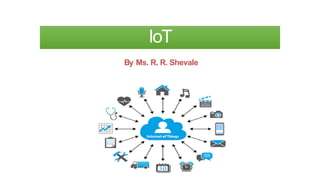
IoT
By Ms. R. R. Shevale
IoT
• https://www.youtube.com/watch?v=GIfWNtMfYvk&t=1s
• https://www.youtube.com/watch?v=Q3ur8wzzhBU
• https://youtu.be/NjYTzvAVozo
• https://youtu.be/91aXs9E0qAI
• https://youtu.be/WtRpFLx34BY
• https://youtu.be/MR_-tRnfFgs
IoT
• Internet Of Things is Fully Networked and Connected Devicessending
analytics data back to cloud or datacenter.
• The definition of Internet of things is that it is the network in which
every object or thing is provided unique identifier and data is
transferred through anetwork without any verbalcommunication.
• Scope of IoT is not justlimited to justconnecting things to the
internet, but it allows these things to communicate and
exchange data, process them as well as control them while
executing applications.
Formal Definition of IoT
• A dynamic global network infrastructure with self- configuring
capabilities based on standard and interoperable communication
protocols, where physical and virtual “things” have identities, physical
attributes, and use intelligent interfaces, and are seamlessly integrated
into information network that communicate data with users and
environments.
Characteristics of IoT
• Dynamic Global network & Self-Adapting : Adapt thechanges
w.r.t changing contexts
• Self Configuring : Eg.Fetching latest s/w updates without manual
intervention.
• Interoperable Communication Protocols : Communicate
through various protocols
• Unique Identity : SuchasUnique IPAddress or a URI
• Integrated into Information Network : Thisallows tocommunicate
and exchange data with other devices to perform certainanalysis.
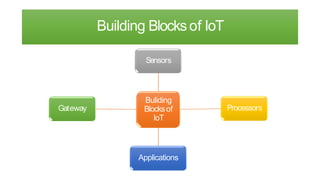
Building Blocksof IoT
Buliding
Blocksof
IoT
Sensors
Processors
Applications
Gateway
Buliding Blocksof IoT…..Sensors
• Sensors are the front end of the IoT devices. They really mean
“things” in IoT.
• Their main task is to get necessarydata from surroundings and passit
further to database or processingsystems.
• Theymust be uniquely findable from there IPaddress becausethey
are basic front end interface in the large network of other devices.
• Sensorscollect real time data and caneither work autonomous or can
be user controlled.
• Examplesof sensorsare: gassensor,water quality sensor,moisture
sensor, etc.
Buliding Blocksof IoT…..Processors
• Processorsare the brain of the IoTsystem.
• Themain job of processors it to process raw data collected by the
sensorsand transforms them to some meaningful information and
knowledge. In short, we cansaythat its job is togive intelligence to
the data.
• Processorsare easily controllable by applications and their onemore
important job is to securing data. Theyperform encryption and
decryption of data.
• Microcontroller, embedded hardware devices, etc canprocess the
data using processors attached within the devices.
Buliding Blocksof IoT…..Gateways
Main task of gateways is to route the processed data and transfer it to
proper databases or network storage for properutilization. Other words,
Communication gateway helps in communication of the data.
Examplesof gateways are LAN,WAN,PAN, etc.
Buliding Blocksof IoT…..Applications
• Applications are another end of an IoT system. Applications do proper
utilization of all the data collected and provide interface to users to
interact with that data. These applications could be cloud based
applications which are responsible for rendering data collected.
Applications are user controllable and are delivery points of particular
services.
• Examples of applications are: smart home apps, security system
control applications, industrial control hub applications,etc.
PhysicalDesignof IoT
• Things in IoT
• IoTProtocols
Things in IoT
• Refers to IoT devices which have unique identities that can perform
sensing, actuating and monitoring capabilities.
• IoT devices can exchange data with other connected devices or collect
data from other devices and process the data either locally or send
the data to centralized servers or cloud – based application back-ends
for processing the data.
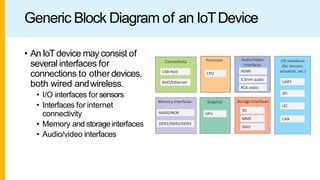
Generic Block Diagram of an IoTDevice
• An IoTdevice may consist of
several interfaces for
connections to otherdevices,
both wired andwireless.
• I/O interfaces for sensors
• Interfaces for internet
connectivity
• Memory and storageinterfaces
• Audio/video interfaces
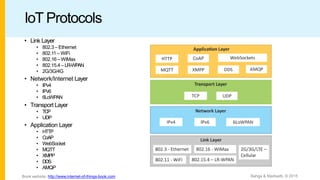
IoT Protocols
• Link Layer
• 802.3 – Ethernet
• 802.11 – WiFi
• 802.16 – WiMax
• 802.15.4 – LR-WPAN
• 2G/3G/4G
• Network/Internet Layer
• IPv4
• IPv6
• 6LoWPAN
• Transport Layer
• TCP
• UDP
• Application Layer
• HTTP
• CoAP
• WebSocket
• MQTT
• XMPP
• DDS
• AMQP
Bahga & Madisetti, © 2015
Book website: http://www.internet-of-things-book.com
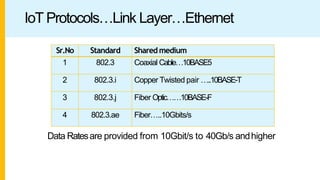
IoT Protocols…Link Layer…Ethernet
Sr.No Standard Shared medium
1 802.3 Coaxial Cable…10BASE5
2 802.3.i Copper Twisted pair …..10BASE-T
3 802.3.j Fiber Optic……10BASE-F
4 802.3.ae Fiber…..10Gbits/s
Data Ratesare provided from 10Gbit/s to 40Gb/s andhigher
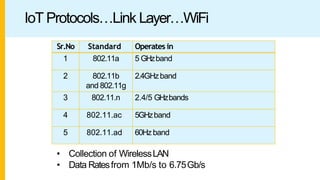
IoT Protocols…Link Layer…WiFi
Sr.No Standard Operates in
1 802.11a 5 GHzband
2 802.11b
and 802.11g
2.4GHzband
3 802.11.n 2.4/5 GHzbands
4 802.11.ac 5GHzband
5 802.11.ad 60Hz band
• Collection of WirelessLAN
• Data Ratesfrom 1Mb/s to 6.75Gb/s
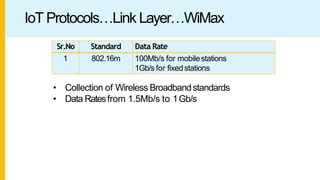
IoT Protocols…Link Layer…WiMax
Sr.No Standard Data Rate
1 802.16m 100Mb/s for mobilestations
1Gb/s for fixedstations
• Collection of Wireless Broadbandstandards
• Data Ratesfrom 1.5Mb/s to 1Gb/s
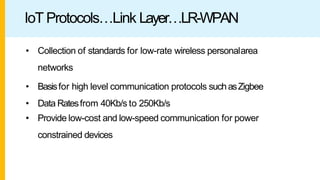
IoT Protocols…Link Layer…LR-WPAN
• Collection of standards for low-rate wireless personalarea
networks
• Basisfor high level communication protocols suchasZigbee
• Data Ratesfrom 40Kb/s to 250Kb/s
• Provide low-cost and low-speed communication for power
constrained devices
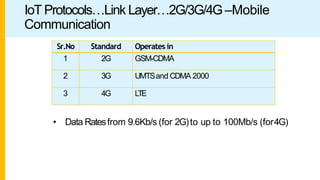
IoT Protocols…Link Layer…2G/3G/4G –Mobile
Communication
Sr.No Standard Operates in
1 2G GSM-CDMA
2 3G UMTSand CDMA 2000
3 4G LTE
• Data Ratesfrom 9.6Kb/s (for 2G)to up to 100Mb/s (for4G)
IoT Protocols…Network/Internet Layer
• Responsible for sending of IPdatagrams from source to destination
network
• Performs the host addressing and packet routing
• Host identification is done using hierarchical IPaddressing schemessuch
asIPV4or IPV6
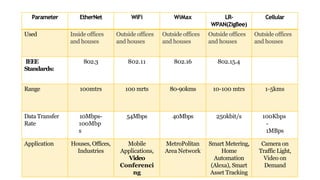
Parameter EtherNet WiFi WiMax LR-
WPAN(ZigBee)
Cellular
Used Inside offices
and houses
Outside offices
and houses
Outside offices
and houses
Outside offices
and houses
Outside offices
and houses
IEEE
Standards:
802.3 802.11 802.16 802.15.4
Range 100mtrs 100 mrts 80-90kms 10-100 mtrs 1-5kms
Data Transfer
Rate
10Mbps-
100Mbp
s
54Mbps 40Mbps 250kbit/s 100Kbps
-
1MBps
Application Houses, Offices,
Industries
Mobile
Applications,
Video
Conferenci
ng
MetroPolitan
Area Network
Smart Metering,
Home
Automation
(Alexa), Smart
Asset Tracking
Camera on
Traffic Light,
Video on
Demand
IoT Protocols…Network Layer
• IPV4
• Usedto identify thedevices on anetwork using hierarchical addressing scheme
• Uses32-bit address scheme
• IPV6
• Uses128-bit address scheme
• 6LoWPAN(IPV6over Low power Wireless PersonalArea Network)
• Usedfor devices with limited processingcapacity
• Operates in 2.4Ghz
• Data Ratesof 250Kb/s
IoT Protocols…Transport Layer
• Provide end-to-end messagetransfer capability independent of
the underlying network
• It provides functions suchaserror control, segmentation,flow-
control and congestioncontrol
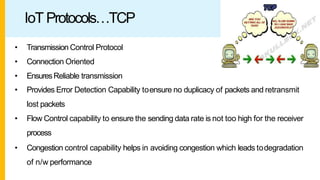
IoT Protocols…TCP
• Transmission Control Protocol
• Connection Oriented
• EnsuresReliable transmission
• Provides Error Detection Capability toensure no duplicacy of packets and retransmit
lost packets
• Flow Control capability to ensure the sending data rate is not too high for the receiver
process
• Congestion control capability helps in avoiding congestion which leads todegradation
of n/w performance
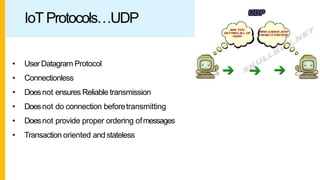
IoT Protocols…UDP
• User Datagram Protocol
• Connectionless
• Doesnot ensures Reliable transmission
• Doesnot do connection beforetransmitting
• Doesnot provide proper ordering ofmessages
• Transaction oriented andstateless
IoT Protocols…Application Layer…HyperTransfer
Protocol
• Forms foundation of World WideWeb(WWW)
• Includes commands such asGET
,PUT
,POST
,HEAD,OPTIONS,TRACE..etc
• Follows arequest-response model
• UsesUniversal Resource Identifiers(URIs) to identify HTTPresources
IoT Protocols…Application Layer…CoAP
• ConstrainedApplication Protocol
• Usedfor Machine to machine (M2M) applications meant forconstrained
devices and n/w’s
• Web transfer protocol for IoTand usesrequest-response
model
• Usesclient –server architecture
• Supports methods suchasGET
,POST
,PUTandDELETE
IoT Protocols…Application Layer…WebSocket
• Allows full-duplex communication over singlesocket
• Basedon TCP
• Client canbe abrowser, IoTdevice or mobile application
IoTProtocols…Application Layer…MQTT
• MessageQueue Telemetry Transport , light-weight messagingprotocol
• Basedon publish-subscribe model
• Well suited for constrained environments where devices have limited processing,low
memory and n/w bandwithrequirement
IoT Protocols…Application Layer…XMPP
• Extensible messagingand presence protocol
• For Realtime communication and streaming XMLdata between n/w
entities
• Usedfor Applications such asMulti-party chat and voice/video calls.
• Decentralized protocol and usesclient server architecture.
IoT Protocols…Application Layer…DDS
• Data Distribution service is adata-centric middleware standard for
device-to-device or machine-to-machine communication.
• Publish subscribe model where publishers create topics to which
subscribers can use.
• Provides Quality-of-service control and configurable reliability.
IoT Protocols…Application Layer…AMQP
• Advanced Messaging Queuing Protocol used for business messaging.
• Supports both point-to-point and publisher/subscriber models, routing
and queuing
• Broker here receives messagesfrom publishers and route them over
connections to consumers through messagingqueues.
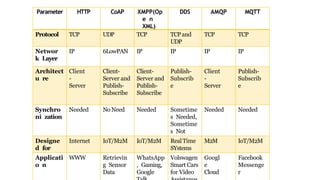
Parameter HTTP CoAP XMPP(Op
e n
XML)
DDS AMQP MQTT
Protocol TCP UDP TCP TCPand
UDP
TCP TCP
Networ
k Layer
IP 6LowPAN IP IP IP IP
Architect
u re
Client
-
Server
Client-
Server and
Publish-
Subscribe
Client-
Server and
Publish-
Subscribe
Publish-
Subscrib
e
Client
-
Server
Publish-
Subscrib
e
Synchro
ni zation
Needed No Need Needed Sometime
s Needed,
Sometime
s Not
Needed Needed
Designe
d for
Internet IoT/M2M IoT/M2M RealTime
SYstems
M2M IoT/M2M
Applicati
o n
WWW Retrievin
g Sensor
Data
WhatsApp
, Gaming,
Google
Volswagen
Smart Cars
for Video
Googl
e
Cloud
Facebook
Messenge
r
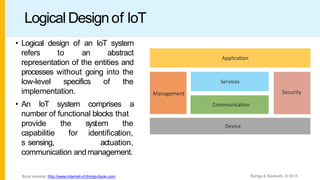
Logical Designof IoT
• Logical design of an IoT system
refers to an abstract
representation of the entities and
processes without going into the
low-level specifics of the
implementation.
• An IoT system comprises a
number of functional blocks that
the system the
for
provide
capabilitie
s sensing,
identification,
actuation,
communication andmanagement.
Bahga & Madisetti, © 2015
Book website: http://www.internet-of-things-book.com
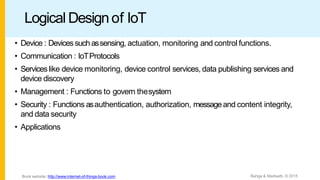
Logical Designof IoT
• Device : Devicessuch assensing, actuation, monitoring and control functions.
• Communication : IoTProtocols
• Serviceslike device monitoring, device control services, data publishing services and
device discovery
• Management : Functions to govern thesystem
• Security : Functions asauthentication, authorization, messageand content integrity,
and data security
• Applications
Bahga & Madisetti, © 2015
Book website: http://www.internet-of-things-book.com
CommunicationModels
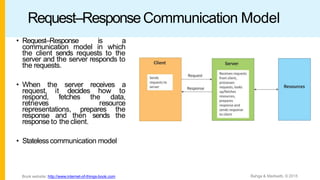
Request–ResponseCommunication Model
• Request–Response is a
communication model in which
the client sends requests to the
server and the server responds to
the requests.
• When the server receives a
request, it decides how to
respond, fetches the data,
retrieves resource
representations, prepares the
response and then sends the
response to the client.
• Statelesscommunication model
Bahga & Madisetti, © 2015
Book website: http://www.internet-of-things-book.com
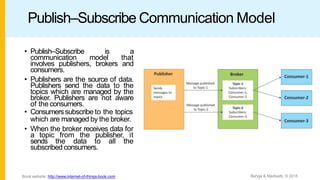
Publish–Subscribe Communication Model
• Publish–Subscribe is a
communication model that
involves publishers, brokers and
consumers.
• Publishers are the source of data.
Publishers send the data to the
topics which are managed by the
broker. Publishers are not aware
of the consumers.
• Consumerssubscribe to the topics
which are managed by the broker.
• When the broker receives data for
a topic from the publisher, it
sends the data to all the
subscribed consumers.
Bahga & Madisetti, © 2015
Book website: http://www.internet-of-things-book.com
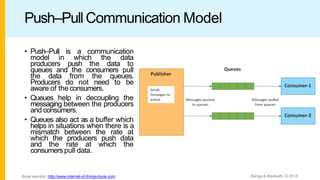
Push–Pull Communication Model
• Push–Pull is a communication
model in which the data
producers push the data to
queues and the consumers pull
the data from the queues.
Producers do not need to be
aware of the consumers.
• Queues help in decoupling the
messaging between the producers
and consumers.
• Queues also act as a buffer which
helps in situations when there is a
mismatch between the rate at
which the producers push data
and the rate at which the
consumers pull data.
Bahga & Madisetti, © 2015
Book website: http://www.internet-of-things-book.com
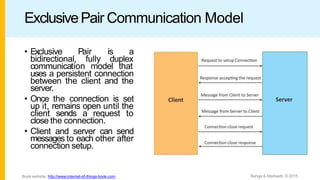
ExclusivePair Communication Model
• Exclusive Pair is a
bidirectional, fully duplex
communication model that
uses a persistent connection
between the client and the
server.
• Once the connection is set
up it, remains open until the
client sends a request to
close the connection.
• Client and server can send
messages to each other after
connection setup.
Bahga & Madisetti, © 2015
Book website: http://www.internet-of-things-book.com
CommunicationAPIs
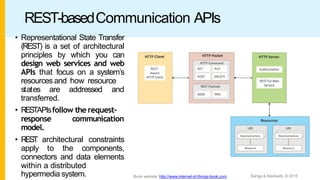
REST-basedCommunication APIs
• Representational State Transfer
(REST) is a set of architectural
principles by which you can
design web services and web
APIs that focus on a system’s
resources and how resource
states are addressed and
transferred.
• RESTAPIsfollow the request–
response communication
model.
• REST architectural constraints
apply to the components,
connectors and data elements
within a distributed
hypermedia system. Bahga & Madisetti, © 2015
Book website: http://www.internet-of-things-book.com
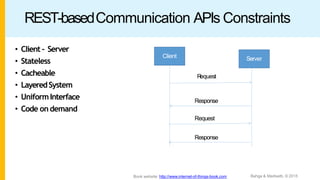
REST-basedCommunication APIs Constraints
• Client – Server
• Stateless
• Cacheable
• LayeredSystem
• UniformInterface
• Code ondemand
Bahga & Madisetti, © 2015
Book website: http://www.internet-of-things-book.com
Client Server
R
equest
Response
Request
Response
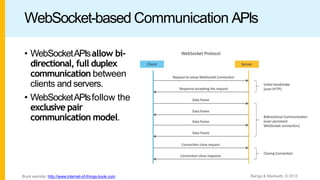
WebSocket-based Communication APIs
• WebSocketAPIsallow bi-
directional, full duplex
communication between
clients and servers.
• WebSocketAPIsfollow the
exclusive pair
communication model.
Bahga & Madisetti, © 2015
Book website: http://www.internet-of-things-book.com
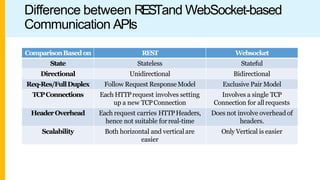
ComparisonBasedon REST Websocket
State Stateless Stateful
Directional Unidirectional Bidirectional
Req-Res/FullDuplex Follow Request ResponseModel Exclusive Pair Model
TCPConnections Each HTTPrequest involves setting
up a new TCPConnection
Involves a single TCP
Connection for allrequests
HeaderOverhead Each request carries HTTPHeaders,
hence not suitable forreal-time
Does not involve overhead of
headers.
Scalability Both horizontal and verticalare
easier
Only Vertical is easier
Difference between RESTand WebSocket-based
Communication APIs
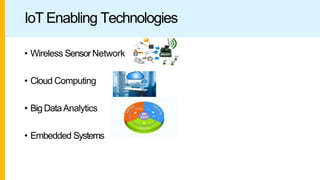
IoT Enabling Technologies
• Wireless SensorNetwork
• Cloud Computing
• BigDataAnalytics
• Embedded Systems
WSN
• Distributed Devices with sensors used to monitor theenvironmental
and physical conditions
• Consistsof several end-nodes acting as routers or coordinatorstoo
• Coordinators collects data from all nodes / acts as gateway that
connects WSNtointernet
• Routers route the data packets from end nodes tocoordinators.
Exampleof WSNs in IoT& Protocols used
Example
• Weather monitoring system
• Indoor Air quality monitoring system
• Soil moisture monitoring system
• Survelliance systems
• Health monitoring systems
Protocols
• Zigbee
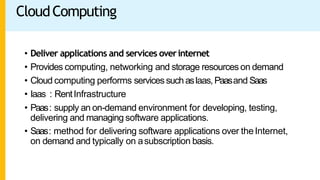
CloudComputing
• Deliver applications and services overinternet
• Provides computing, networking and storage resources on demand
• Cloud computing performs servicessuch asIaas,Paasand Saas
• Iaas : RentInfrastructure
• Paas: supply an on-demand environment for developing, testing,
delivering and managing software applications.
• Saas: method for delivering software applications over theInternet,
on demand and typically on asubscription basis.
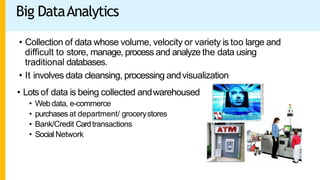
Big DataAnalytics
• Collection of data whose volume, velocity or variety is too large and
difficult to store, manage, process and analyze the data using
traditional databases.
• It involves data cleansing, processing andvisualization
• Lots of data is being collected andwarehoused
• Web data, e-commerce
• purchases at department/ grocerystores
• Bank/Credit Cardtransactions
• Social Network
Big DataAnalytics
Variety Includes different types ofdata
• Structured
• Unstructured
• SemiStructured
• All of above
Big DataAnalytics
Velocity Refers to speed at which data isprocessed
• Batch
• Real-time
• STreams
Big DataAnalytics
Volume refers to the amount ofdata
• Terabyte
• Records
• Transactions
• Files
• Tables
IoT Levelsand Deployment Templates
An IoTsystemcomprises the followingcomponents:
• Device: An IoT device allows identification, remote sensing, actuating and
remote monitoring capabilities.
• Resource: Resources are software components on the IoT device for
accessing, processing and storing sensor information, or for controlling
actuators connected to the device. Resources also include the software
components thatenable network accessfor the device.
• Controller Service: Controller service is a native service that runs on the
device and interacts with the web services. Controller service sends data
from the device to the web service and receives commands from the
application (via web services) for controlling thedevice.
Bahga & Madisetti, © 2015
Book website: http://www.internet-of-things-book.com
IoT Levelsand Deployment Templates
• Database: Database can be either local or in the cloud and stores the data
generated by the IoTdevice.
• Web Service: Webservices serve asalink between the IoTdevice,
application, database and analysis components. Webservice canbe
implemented using HTTPand RESTprinciples (RESTservice) or using the
WebSocketprotocol (WebSocketservice).
• Analysis Component: Thisis responsible for analyzing the IoTdataand
generating results in a form that is easyfor the user to understand.
• Application: IoTapplications provide an interface that theusers canuseto
control and monitor various aspects of the IoTsystem.Applications also
allow users to view the systemstatus and the processed data.
Bahga & Madisetti, © 2015
Book website: http://www.internet-of-things-book.com
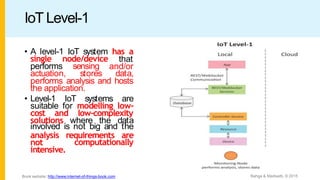
IoT Level-1
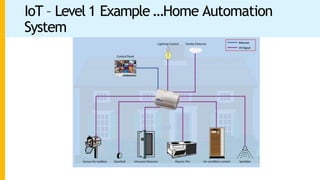
• A level-1 IoT system has a
single node/device
performs sensing
that
and/or
actuation, stores data,
performs analysis and hosts
the application.
• Level-1 IoT systems are
suitable for modelling low-
cost and low-complexity
solutions where the data
involved is not big and the
analysis requirements are
computationally
not
intensive.
Bahga & Madisetti, © 2015
Book website: http://www.internet-of-things-book.com
IoT – Level 1 Example …Home Automation
System
IoT Level-2
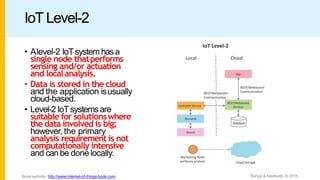
• Alevel-2 IoTsystem hasa
single node thatperforms
sensing and/or actuation
and localanalysis.
• Data is stored in the cloud
and the application isusually
cloud-based.
• Level-2 IoTsystemsare
suitable for solutionswhere
the data involved is big;
however, the primary
analysis requirement is not
computationally intensive
and canbe donelocally.
Bahga & Madisetti, © 2015
Book website: http://www.internet-of-things-book.com
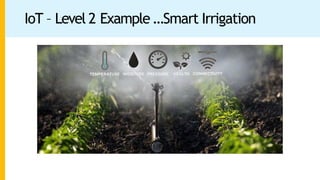
IoT – Level 2 Example …Smart Irrigation
IoT Level-3
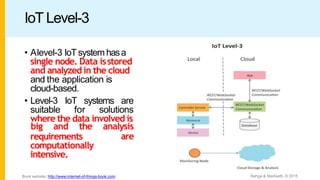
• Alevel-3 IoTsystem hasa
single node. Data isstored
and analyzed in the cloud
and the application is
cloud-based.
• Level-3 IoT systems are
suitable for solutions
where the data involved is
requirements
big and the analysis
are
computationally
intensive.
Bahga & Madisetti, © 2015
Book website: http://www.internet-of-things-book.com
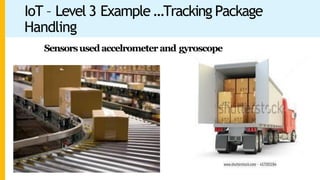
IoT – Level 3 Example …Tracking Package
Handling
Sensorsusedaccelrometerand gyroscope
IoT Level-4
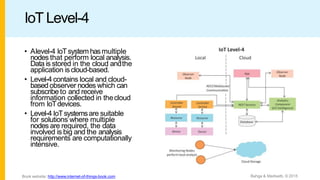
• Alevel-4 IoTsystem hasmultiple
nodes that perform local analysis.
Data is stored in the cloud andthe
application iscloud-based.
• Level-4 contains local and cloud-
based observer nodes which can
subscribe to and receive
information collected in thecloud
from IoTdevices.
• Level-4 IoTsystemsare suitable
for solutions where multiple
nodes are required, the data
involved is big and the analysis
requirements are computationally
intensive.
Bahga & Madisetti, © 2015
Book website: http://www.internet-of-things-book.com
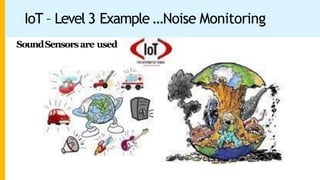
IoT – Level 3 Example …Noise Monitoring
SoundSensorsare used
IoT Level-5
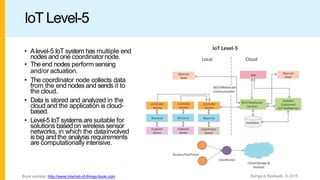
• Alevel-5 IoT system has multiple end
nodes and one coordinatornode.
• Theend nodes perform sensing
and/or actuation.
• The coordinator node collects data
from the end nodes and sends it to
the cloud.
• Data is stored and analyzed in the
cloud and the application is cloud-
based.
• Level-5 IoTsystemsare suitable for
solutions basedon wireless sensor
networks, in which the datainvolved
is big and the analysis requirements
are computationally intensive.
Bahga & Madisetti, © 2015
Book website: http://www.internet-of-things-book.com
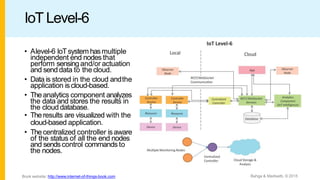
IoT Level-6
• Alevel-6 IoTsystem hasmultiple
independent end nodes that
perform sensingand/or actuation
and send data to thecloud.
• Data is stored in the cloud andthe
application iscloud-based.
• Theanalytics component analyzes
the data and stores the results in
the clouddatabase.
• Theresults are visualized with the
cloud-based application.
• Thecentralized controller isaware
of the status of all the end nodes
and sendscontrol commands to
the nodes.
Bahga & Madisetti, © 2015
Book website: http://www.internet-of-things-book.com
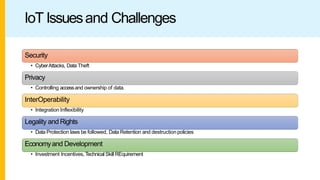
IoT Issuesand Challenges
Security
• CyberAttacks, Data Theft
Privacy
• Controlling accessand ownership of data.
InterOperability
• Integration Inflexibility
Legality and Rights
• Data Protection laws be followed, Data Retention and destruction policies
Economyand Development
• Investment Incentives, Technical Skill REquirement
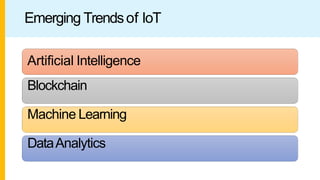
Emerging Trendsof IoT
Artificial Intelligence
Blockchain
Machine Learning
DataAnalytics

Unit 4 Internet of Things communication models.pdf

  • 1.
  • 2.
    Outline • Definition ofIoT • Characteristics of IoT • Building Blocksof IoT • Physicaldesign of IoT • Logical design of IoT • IoTprotocols • IoTlevels and deployment templates
  • 3.
    IoT By Ms. R.R. Shevale
  • 4.
    IoT • https://www.youtube.com/watch?v=GIfWNtMfYvk&t=1s • https://www.youtube.com/watch?v=Q3ur8wzzhBU •https://youtu.be/NjYTzvAVozo • https://youtu.be/91aXs9E0qAI • https://youtu.be/WtRpFLx34BY • https://youtu.be/MR_-tRnfFgs
  • 5.
    IoT • Internet OfThings is Fully Networked and Connected Devicessending analytics data back to cloud or datacenter. • The definition of Internet of things is that it is the network in which every object or thing is provided unique identifier and data is transferred through anetwork without any verbalcommunication. • Scope of IoT is not justlimited to justconnecting things to the internet, but it allows these things to communicate and exchange data, process them as well as control them while executing applications.
  • 6.
    Formal Definition ofIoT • A dynamic global network infrastructure with self- configuring capabilities based on standard and interoperable communication protocols, where physical and virtual “things” have identities, physical attributes, and use intelligent interfaces, and are seamlessly integrated into information network that communicate data with users and environments.
  • 7.
    Characteristics of IoT •Dynamic Global network & Self-Adapting : Adapt thechanges w.r.t changing contexts • Self Configuring : Eg.Fetching latest s/w updates without manual intervention. • Interoperable Communication Protocols : Communicate through various protocols • Unique Identity : SuchasUnique IPAddress or a URI • Integrated into Information Network : Thisallows tocommunicate and exchange data with other devices to perform certainanalysis.
  • 8.
  • 9.
    Buliding Blocksof IoT…..Sensors •Sensors are the front end of the IoT devices. They really mean “things” in IoT. • Their main task is to get necessarydata from surroundings and passit further to database or processingsystems. • Theymust be uniquely findable from there IPaddress becausethey are basic front end interface in the large network of other devices. • Sensorscollect real time data and caneither work autonomous or can be user controlled. • Examplesof sensorsare: gassensor,water quality sensor,moisture sensor, etc.
  • 10.
    Buliding Blocksof IoT…..Processors •Processorsare the brain of the IoTsystem. • Themain job of processors it to process raw data collected by the sensorsand transforms them to some meaningful information and knowledge. In short, we cansaythat its job is togive intelligence to the data. • Processorsare easily controllable by applications and their onemore important job is to securing data. Theyperform encryption and decryption of data. • Microcontroller, embedded hardware devices, etc canprocess the data using processors attached within the devices.
  • 11.
    Buliding Blocksof IoT…..Gateways Maintask of gateways is to route the processed data and transfer it to proper databases or network storage for properutilization. Other words, Communication gateway helps in communication of the data. Examplesof gateways are LAN,WAN,PAN, etc.
  • 12.
    Buliding Blocksof IoT…..Applications •Applications are another end of an IoT system. Applications do proper utilization of all the data collected and provide interface to users to interact with that data. These applications could be cloud based applications which are responsible for rendering data collected. Applications are user controllable and are delivery points of particular services. • Examples of applications are: smart home apps, security system control applications, industrial control hub applications,etc.
  • 13.
    PhysicalDesignof IoT • Thingsin IoT • IoTProtocols
  • 14.
    Things in IoT •Refers to IoT devices which have unique identities that can perform sensing, actuating and monitoring capabilities. • IoT devices can exchange data with other connected devices or collect data from other devices and process the data either locally or send the data to centralized servers or cloud – based application back-ends for processing the data.
  • 15.
    Generic Block Diagramof an IoTDevice • An IoTdevice may consist of several interfaces for connections to otherdevices, both wired andwireless. • I/O interfaces for sensors • Interfaces for internet connectivity • Memory and storageinterfaces • Audio/video interfaces
  • 16.
    IoT Protocols • LinkLayer • 802.3 – Ethernet • 802.11 – WiFi • 802.16 – WiMax • 802.15.4 – LR-WPAN • 2G/3G/4G • Network/Internet Layer • IPv4 • IPv6 • 6LoWPAN • Transport Layer • TCP • UDP • Application Layer • HTTP • CoAP • WebSocket • MQTT • XMPP • DDS • AMQP Bahga & Madisetti, © 2015 Book website: http://www.internet-of-things-book.com
  • 17.
    IoT Protocols…Link Layer…Ethernet Sr.NoStandard Shared medium 1 802.3 Coaxial Cable…10BASE5 2 802.3.i Copper Twisted pair …..10BASE-T 3 802.3.j Fiber Optic……10BASE-F 4 802.3.ae Fiber…..10Gbits/s Data Ratesare provided from 10Gbit/s to 40Gb/s andhigher
  • 18.
    IoT Protocols…Link Layer…WiFi Sr.NoStandard Operates in 1 802.11a 5 GHzband 2 802.11b and 802.11g 2.4GHzband 3 802.11.n 2.4/5 GHzbands 4 802.11.ac 5GHzband 5 802.11.ad 60Hz band • Collection of WirelessLAN • Data Ratesfrom 1Mb/s to 6.75Gb/s
  • 19.
    IoT Protocols…Link Layer…WiMax Sr.NoStandard Data Rate 1 802.16m 100Mb/s for mobilestations 1Gb/s for fixedstations • Collection of Wireless Broadbandstandards • Data Ratesfrom 1.5Mb/s to 1Gb/s
  • 20.
    IoT Protocols…Link Layer…LR-WPAN •Collection of standards for low-rate wireless personalarea networks • Basisfor high level communication protocols suchasZigbee • Data Ratesfrom 40Kb/s to 250Kb/s • Provide low-cost and low-speed communication for power constrained devices
  • 21.
    IoT Protocols…Link Layer…2G/3G/4G–Mobile Communication Sr.No Standard Operates in 1 2G GSM-CDMA 2 3G UMTSand CDMA 2000 3 4G LTE • Data Ratesfrom 9.6Kb/s (for 2G)to up to 100Mb/s (for4G)
  • 22.
    IoT Protocols…Network/Internet Layer •Responsible for sending of IPdatagrams from source to destination network • Performs the host addressing and packet routing • Host identification is done using hierarchical IPaddressing schemessuch asIPV4or IPV6
  • 23.
    Parameter EtherNet WiFiWiMax LR- WPAN(ZigBee) Cellular Used Inside offices and houses Outside offices and houses Outside offices and houses Outside offices and houses Outside offices and houses IEEE Standards: 802.3 802.11 802.16 802.15.4 Range 100mtrs 100 mrts 80-90kms 10-100 mtrs 1-5kms Data Transfer Rate 10Mbps- 100Mbp s 54Mbps 40Mbps 250kbit/s 100Kbps - 1MBps Application Houses, Offices, Industries Mobile Applications, Video Conferenci ng MetroPolitan Area Network Smart Metering, Home Automation (Alexa), Smart Asset Tracking Camera on Traffic Light, Video on Demand
  • 24.
    IoT Protocols…Network Layer •IPV4 • Usedto identify thedevices on anetwork using hierarchical addressing scheme • Uses32-bit address scheme • IPV6 • Uses128-bit address scheme • 6LoWPAN(IPV6over Low power Wireless PersonalArea Network) • Usedfor devices with limited processingcapacity • Operates in 2.4Ghz • Data Ratesof 250Kb/s
  • 25.
    IoT Protocols…Transport Layer •Provide end-to-end messagetransfer capability independent of the underlying network • It provides functions suchaserror control, segmentation,flow- control and congestioncontrol
  • 26.
    IoT Protocols…TCP • TransmissionControl Protocol • Connection Oriented • EnsuresReliable transmission • Provides Error Detection Capability toensure no duplicacy of packets and retransmit lost packets • Flow Control capability to ensure the sending data rate is not too high for the receiver process • Congestion control capability helps in avoiding congestion which leads todegradation of n/w performance
  • 27.
    IoT Protocols…UDP • UserDatagram Protocol • Connectionless • Doesnot ensures Reliable transmission • Doesnot do connection beforetransmitting • Doesnot provide proper ordering ofmessages • Transaction oriented andstateless
  • 28.
    IoT Protocols…Application Layer…HyperTransfer Protocol •Forms foundation of World WideWeb(WWW) • Includes commands such asGET ,PUT ,POST ,HEAD,OPTIONS,TRACE..etc • Follows arequest-response model • UsesUniversal Resource Identifiers(URIs) to identify HTTPresources
  • 29.
    IoT Protocols…Application Layer…CoAP •ConstrainedApplication Protocol • Usedfor Machine to machine (M2M) applications meant forconstrained devices and n/w’s • Web transfer protocol for IoTand usesrequest-response model • Usesclient –server architecture • Supports methods suchasGET ,POST ,PUTandDELETE
  • 30.
    IoT Protocols…Application Layer…WebSocket •Allows full-duplex communication over singlesocket • Basedon TCP • Client canbe abrowser, IoTdevice or mobile application IoTProtocols…Application Layer…MQTT • MessageQueue Telemetry Transport , light-weight messagingprotocol • Basedon publish-subscribe model • Well suited for constrained environments where devices have limited processing,low memory and n/w bandwithrequirement
  • 31.
    IoT Protocols…Application Layer…XMPP •Extensible messagingand presence protocol • For Realtime communication and streaming XMLdata between n/w entities • Usedfor Applications such asMulti-party chat and voice/video calls. • Decentralized protocol and usesclient server architecture.
  • 32.
    IoT Protocols…Application Layer…DDS •Data Distribution service is adata-centric middleware standard for device-to-device or machine-to-machine communication. • Publish subscribe model where publishers create topics to which subscribers can use. • Provides Quality-of-service control and configurable reliability.
  • 33.
    IoT Protocols…Application Layer…AMQP •Advanced Messaging Queuing Protocol used for business messaging. • Supports both point-to-point and publisher/subscriber models, routing and queuing • Broker here receives messagesfrom publishers and route them over connections to consumers through messagingqueues.
  • 34.
    Parameter HTTP CoAPXMPP(Op e n XML) DDS AMQP MQTT Protocol TCP UDP TCP TCPand UDP TCP TCP Networ k Layer IP 6LowPAN IP IP IP IP Architect u re Client - Server Client- Server and Publish- Subscribe Client- Server and Publish- Subscribe Publish- Subscrib e Client - Server Publish- Subscrib e Synchro ni zation Needed No Need Needed Sometime s Needed, Sometime s Not Needed Needed Designe d for Internet IoT/M2M IoT/M2M RealTime SYstems M2M IoT/M2M Applicati o n WWW Retrievin g Sensor Data WhatsApp , Gaming, Google Volswagen Smart Cars for Video Googl e Cloud Facebook Messenge r
  • 35.
    Logical Designof IoT •Logical design of an IoT system refers to an abstract representation of the entities and processes without going into the low-level specifics of the implementation. • An IoT system comprises a number of functional blocks that the system the for provide capabilitie s sensing, identification, actuation, communication andmanagement. Bahga & Madisetti, © 2015 Book website: http://www.internet-of-things-book.com
  • 36.
    Logical Designof IoT •Device : Devicessuch assensing, actuation, monitoring and control functions. • Communication : IoTProtocols • Serviceslike device monitoring, device control services, data publishing services and device discovery • Management : Functions to govern thesystem • Security : Functions asauthentication, authorization, messageand content integrity, and data security • Applications Bahga & Madisetti, © 2015 Book website: http://www.internet-of-things-book.com
  • 37.
  • 38.
    Request–ResponseCommunication Model • Request–Responseis a communication model in which the client sends requests to the server and the server responds to the requests. • When the server receives a request, it decides how to respond, fetches the data, retrieves resource representations, prepares the response and then sends the response to the client. • Statelesscommunication model Bahga & Madisetti, © 2015 Book website: http://www.internet-of-things-book.com
  • 39.
    Publish–Subscribe Communication Model •Publish–Subscribe is a communication model that involves publishers, brokers and consumers. • Publishers are the source of data. Publishers send the data to the topics which are managed by the broker. Publishers are not aware of the consumers. • Consumerssubscribe to the topics which are managed by the broker. • When the broker receives data for a topic from the publisher, it sends the data to all the subscribed consumers. Bahga & Madisetti, © 2015 Book website: http://www.internet-of-things-book.com
  • 40.
    Push–Pull Communication Model •Push–Pull is a communication model in which the data producers push the data to queues and the consumers pull the data from the queues. Producers do not need to be aware of the consumers. • Queues help in decoupling the messaging between the producers and consumers. • Queues also act as a buffer which helps in situations when there is a mismatch between the rate at which the producers push data and the rate at which the consumers pull data. Bahga & Madisetti, © 2015 Book website: http://www.internet-of-things-book.com
  • 41.
    ExclusivePair Communication Model •Exclusive Pair is a bidirectional, fully duplex communication model that uses a persistent connection between the client and the server. • Once the connection is set up it, remains open until the client sends a request to close the connection. • Client and server can send messages to each other after connection setup. Bahga & Madisetti, © 2015 Book website: http://www.internet-of-things-book.com
  • 42.
  • 43.
    REST-basedCommunication APIs • RepresentationalState Transfer (REST) is a set of architectural principles by which you can design web services and web APIs that focus on a system’s resources and how resource states are addressed and transferred. • RESTAPIsfollow the request– response communication model. • REST architectural constraints apply to the components, connectors and data elements within a distributed hypermedia system. Bahga & Madisetti, © 2015 Book website: http://www.internet-of-things-book.com
  • 44.
    REST-basedCommunication APIs Constraints •Client – Server • Stateless • Cacheable • LayeredSystem • UniformInterface • Code ondemand Bahga & Madisetti, © 2015 Book website: http://www.internet-of-things-book.com Client Server R equest Response Request Response
  • 45.
    WebSocket-based Communication APIs •WebSocketAPIsallow bi- directional, full duplex communication between clients and servers. • WebSocketAPIsfollow the exclusive pair communication model. Bahga & Madisetti, © 2015 Book website: http://www.internet-of-things-book.com
  • 46.
    ComparisonBasedon REST Websocket StateStateless Stateful Directional Unidirectional Bidirectional Req-Res/FullDuplex Follow Request ResponseModel Exclusive Pair Model TCPConnections Each HTTPrequest involves setting up a new TCPConnection Involves a single TCP Connection for allrequests HeaderOverhead Each request carries HTTPHeaders, hence not suitable forreal-time Does not involve overhead of headers. Scalability Both horizontal and verticalare easier Only Vertical is easier Difference between RESTand WebSocket-based Communication APIs
  • 47.
    IoT Enabling Technologies •Wireless SensorNetwork • Cloud Computing • BigDataAnalytics • Embedded Systems
  • 48.
    WSN • Distributed Deviceswith sensors used to monitor theenvironmental and physical conditions • Consistsof several end-nodes acting as routers or coordinatorstoo • Coordinators collects data from all nodes / acts as gateway that connects WSNtointernet • Routers route the data packets from end nodes tocoordinators.
  • 49.
    Exampleof WSNs inIoT& Protocols used Example • Weather monitoring system • Indoor Air quality monitoring system • Soil moisture monitoring system • Survelliance systems • Health monitoring systems Protocols • Zigbee
  • 50.
    CloudComputing • Deliver applicationsand services overinternet • Provides computing, networking and storage resources on demand • Cloud computing performs servicessuch asIaas,Paasand Saas • Iaas : RentInfrastructure • Paas: supply an on-demand environment for developing, testing, delivering and managing software applications. • Saas: method for delivering software applications over theInternet, on demand and typically on asubscription basis.
  • 51.
    Big DataAnalytics • Collectionof data whose volume, velocity or variety is too large and difficult to store, manage, process and analyze the data using traditional databases. • It involves data cleansing, processing andvisualization • Lots of data is being collected andwarehoused • Web data, e-commerce • purchases at department/ grocerystores • Bank/Credit Cardtransactions • Social Network
  • 52.
    Big DataAnalytics Variety Includesdifferent types ofdata • Structured • Unstructured • SemiStructured • All of above
  • 53.
    Big DataAnalytics Velocity Refersto speed at which data isprocessed • Batch • Real-time • STreams
  • 54.
    Big DataAnalytics Volume refersto the amount ofdata • Terabyte • Records • Transactions • Files • Tables
  • 55.
    IoT Levelsand DeploymentTemplates An IoTsystemcomprises the followingcomponents: • Device: An IoT device allows identification, remote sensing, actuating and remote monitoring capabilities. • Resource: Resources are software components on the IoT device for accessing, processing and storing sensor information, or for controlling actuators connected to the device. Resources also include the software components thatenable network accessfor the device. • Controller Service: Controller service is a native service that runs on the device and interacts with the web services. Controller service sends data from the device to the web service and receives commands from the application (via web services) for controlling thedevice. Bahga & Madisetti, © 2015 Book website: http://www.internet-of-things-book.com
  • 56.
    IoT Levelsand DeploymentTemplates • Database: Database can be either local or in the cloud and stores the data generated by the IoTdevice. • Web Service: Webservices serve asalink between the IoTdevice, application, database and analysis components. Webservice canbe implemented using HTTPand RESTprinciples (RESTservice) or using the WebSocketprotocol (WebSocketservice). • Analysis Component: Thisis responsible for analyzing the IoTdataand generating results in a form that is easyfor the user to understand. • Application: IoTapplications provide an interface that theusers canuseto control and monitor various aspects of the IoTsystem.Applications also allow users to view the systemstatus and the processed data. Bahga & Madisetti, © 2015 Book website: http://www.internet-of-things-book.com
  • 57.
    IoT Level-1 • Alevel-1 IoT system has a single node/device performs sensing that and/or actuation, stores data, performs analysis and hosts the application. • Level-1 IoT systems are suitable for modelling low- cost and low-complexity solutions where the data involved is not big and the analysis requirements are computationally not intensive. Bahga & Madisetti, © 2015 Book website: http://www.internet-of-things-book.com
  • 58.
    IoT – Level1 Example …Home Automation System
  • 59.
    IoT Level-2 • Alevel-2IoTsystem hasa single node thatperforms sensing and/or actuation and localanalysis. • Data is stored in the cloud and the application isusually cloud-based. • Level-2 IoTsystemsare suitable for solutionswhere the data involved is big; however, the primary analysis requirement is not computationally intensive and canbe donelocally. Bahga & Madisetti, © 2015 Book website: http://www.internet-of-things-book.com
  • 60.
    IoT – Level2 Example …Smart Irrigation
  • 61.
    IoT Level-3 • Alevel-3IoTsystem hasa single node. Data isstored and analyzed in the cloud and the application is cloud-based. • Level-3 IoT systems are suitable for solutions where the data involved is requirements big and the analysis are computationally intensive. Bahga & Madisetti, © 2015 Book website: http://www.internet-of-things-book.com
  • 62.
    IoT – Level3 Example …Tracking Package Handling Sensorsusedaccelrometerand gyroscope
  • 63.
    IoT Level-4 • Alevel-4IoTsystem hasmultiple nodes that perform local analysis. Data is stored in the cloud andthe application iscloud-based. • Level-4 contains local and cloud- based observer nodes which can subscribe to and receive information collected in thecloud from IoTdevices. • Level-4 IoTsystemsare suitable for solutions where multiple nodes are required, the data involved is big and the analysis requirements are computationally intensive. Bahga & Madisetti, © 2015 Book website: http://www.internet-of-things-book.com
  • 64.
    IoT – Level3 Example …Noise Monitoring SoundSensorsare used
  • 65.
    IoT Level-5 • Alevel-5IoT system has multiple end nodes and one coordinatornode. • Theend nodes perform sensing and/or actuation. • The coordinator node collects data from the end nodes and sends it to the cloud. • Data is stored and analyzed in the cloud and the application is cloud- based. • Level-5 IoTsystemsare suitable for solutions basedon wireless sensor networks, in which the datainvolved is big and the analysis requirements are computationally intensive. Bahga & Madisetti, © 2015 Book website: http://www.internet-of-things-book.com
  • 66.
    IoT Level-6 • Alevel-6IoTsystem hasmultiple independent end nodes that perform sensingand/or actuation and send data to thecloud. • Data is stored in the cloud andthe application iscloud-based. • Theanalytics component analyzes the data and stores the results in the clouddatabase. • Theresults are visualized with the cloud-based application. • Thecentralized controller isaware of the status of all the end nodes and sendscontrol commands to the nodes. Bahga & Madisetti, © 2015 Book website: http://www.internet-of-things-book.com
  • 67.
    IoT Issuesand Challenges Security •CyberAttacks, Data Theft Privacy • Controlling accessand ownership of data. InterOperability • Integration Inflexibility Legality and Rights • Data Protection laws be followed, Data Retention and destruction policies Economyand Development • Investment Incentives, Technical Skill REquirement
  • 68.
    Emerging Trendsof IoT ArtificialIntelligence Blockchain Machine Learning DataAnalytics