Internet Connectivity Principles
Internet connectivity
Introduction
Application Layer
Protocols
Introduction
Internet is a global network with a set of
connectivity protocols for
• Connected devices gateway for
sending the data frames of the
devices or to the devices.
• The data communicate over the
network as packets, which
communicate through a set of
routers at the Internet.
• The devices perform the controlling
and monitoring functions using the
messages, data-stacks and commands
sent through the Internet by the
applications, services or business
processes.
Introduction
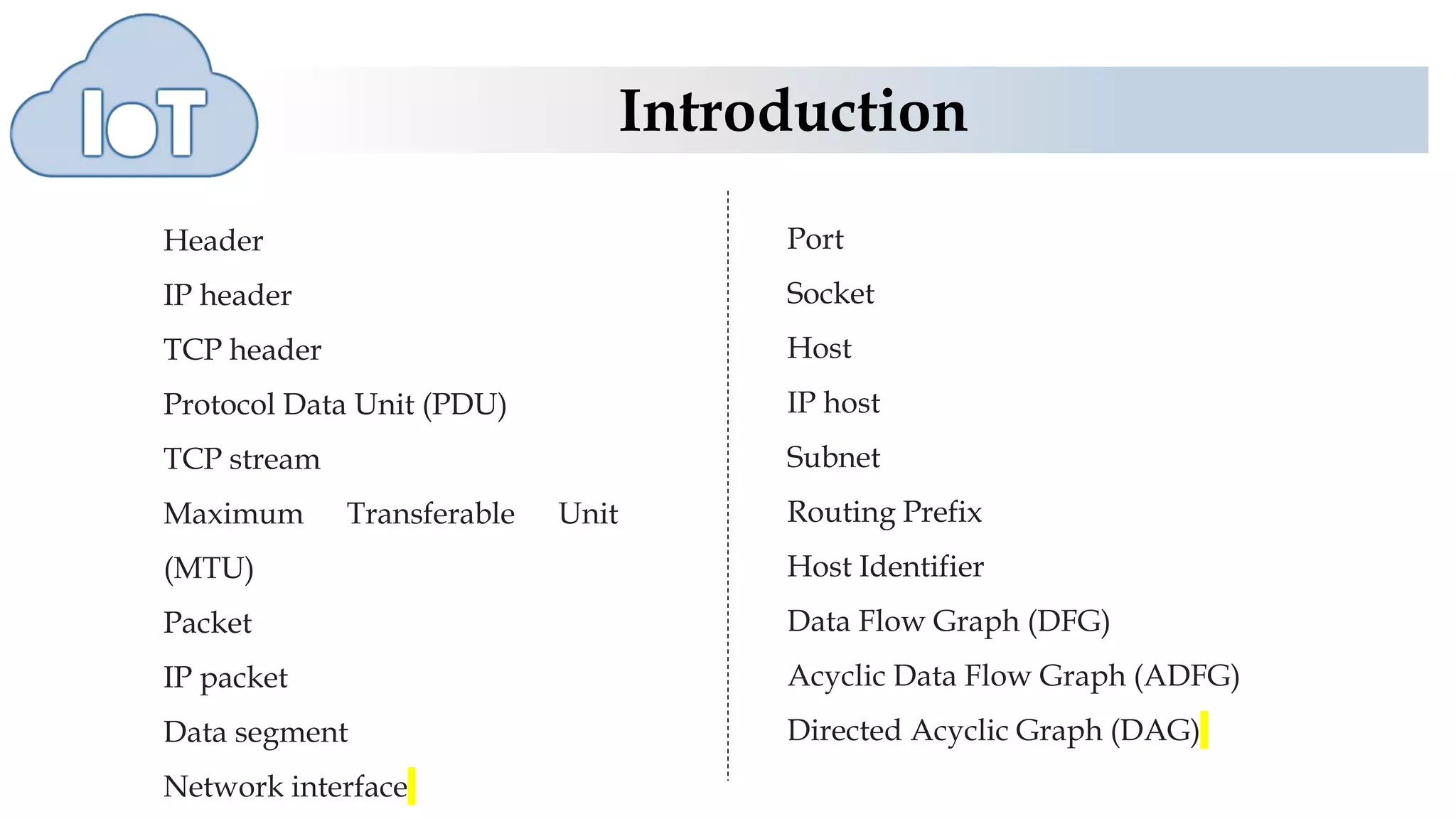
Header
IP header
TCP header
Protocol Data Unit (PDU)
TCP stream
Maximum Transferable Unit
(MTU)
Packet
IP packet
Data segment
Network interface
Port
Socket
Host
IP host
Subnet
Routing Prefix
Host Identifier
Data Flow Graph (DFG)
Acyclic Data Flow Graph (ADFG)
Directed Acyclic Graph (DAG)
Introduction
Header
IP header
TCP header
Protocol Data Unit (PDU)
TCP stream
Maximum Transferable Unit
(MTU)
Packet
IP packet
Data segment
Network interface
which are required for processing a
received data stack at a layer and which
envelopes the data stack of the preceding
upper layer before transfer to the
succeeding lower layer.
Introduction
Header
IP header
TCP header
Protocol Data Unit (PDU)
TCP stream
Maximum Transferable Unit
(MTU)
Packet
IP packet
Data segment
Network interface
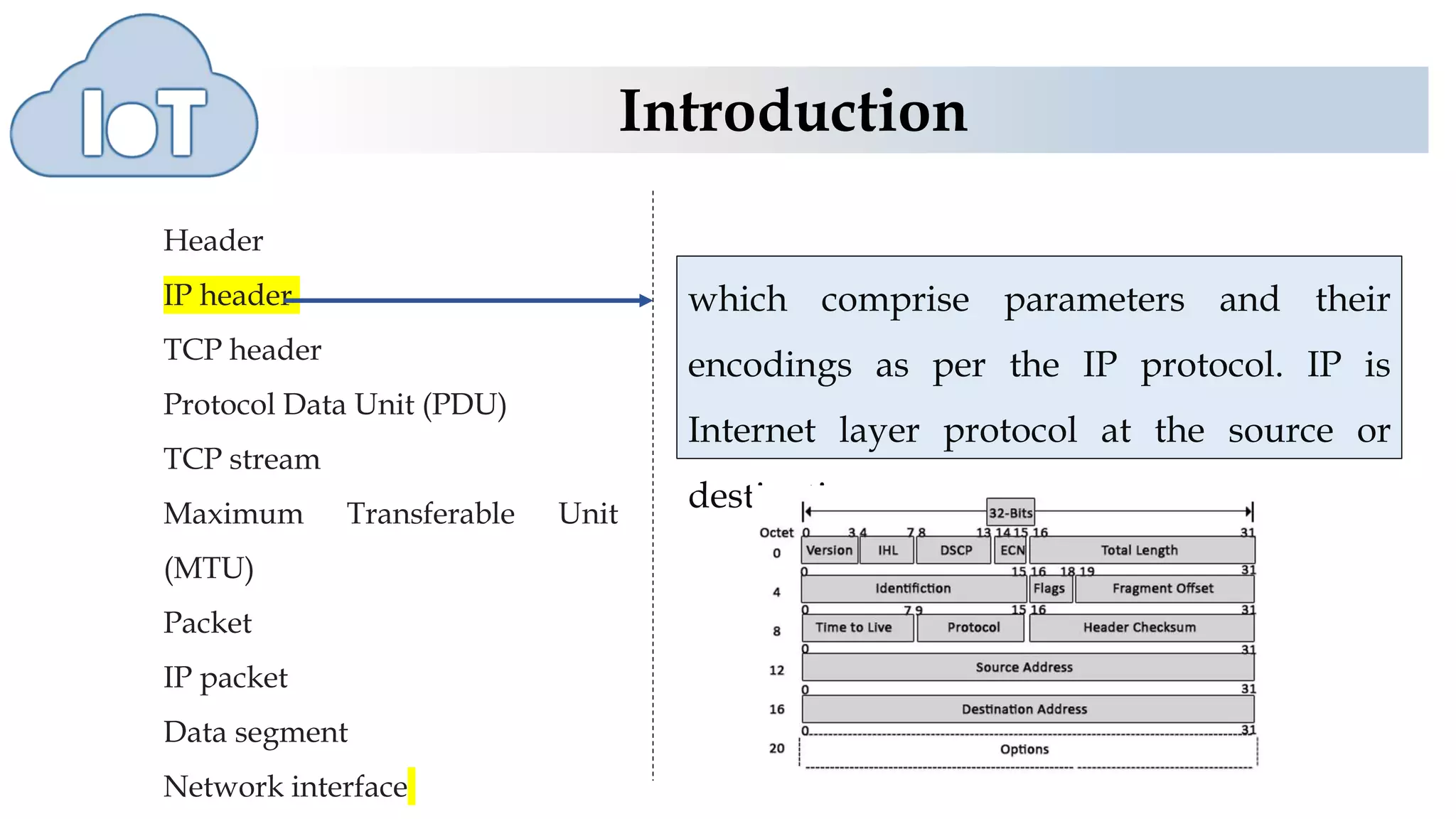
which comprise parameters and their
encodings as per the IP protocol. IP is
Internet layer protocol at the source or
destination
Introduction
Header
IP header
TCP header
Protocol Data Unit (PDU)
TCP stream
Maximum Transferable Unit
(MTU)
Packet
IP packet
Data segment
Network interface
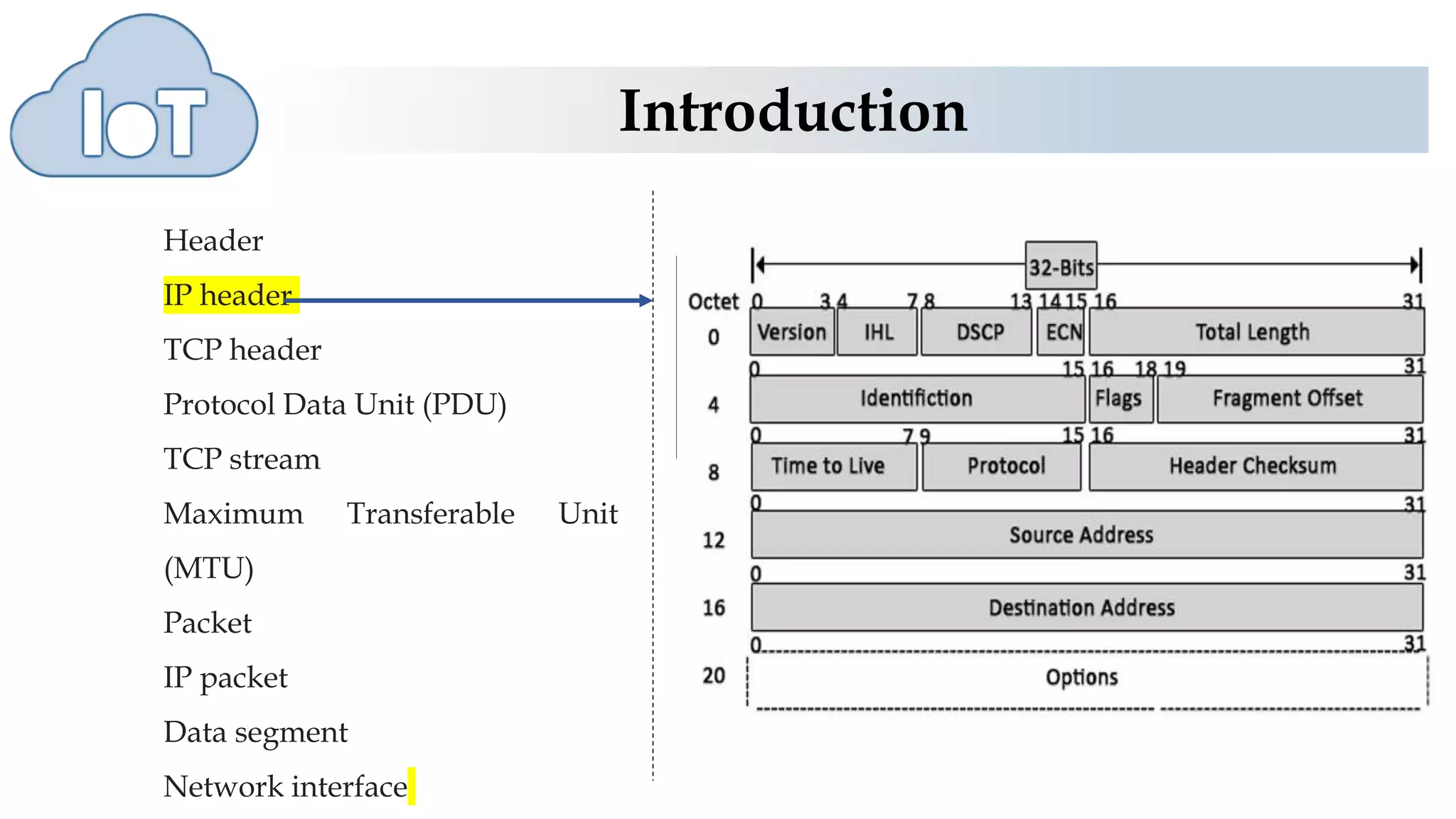
which comprise parameters and their
encodings as per the IP protocol. IP is
Internet layer protocol at the source or
destination
Introduction
Header
IP header
TCP header
Protocol Data Unit (PDU)
TCP stream
Maximum Transferable Unit
(MTU)
Packet
IP packet
Data segment
Network interface
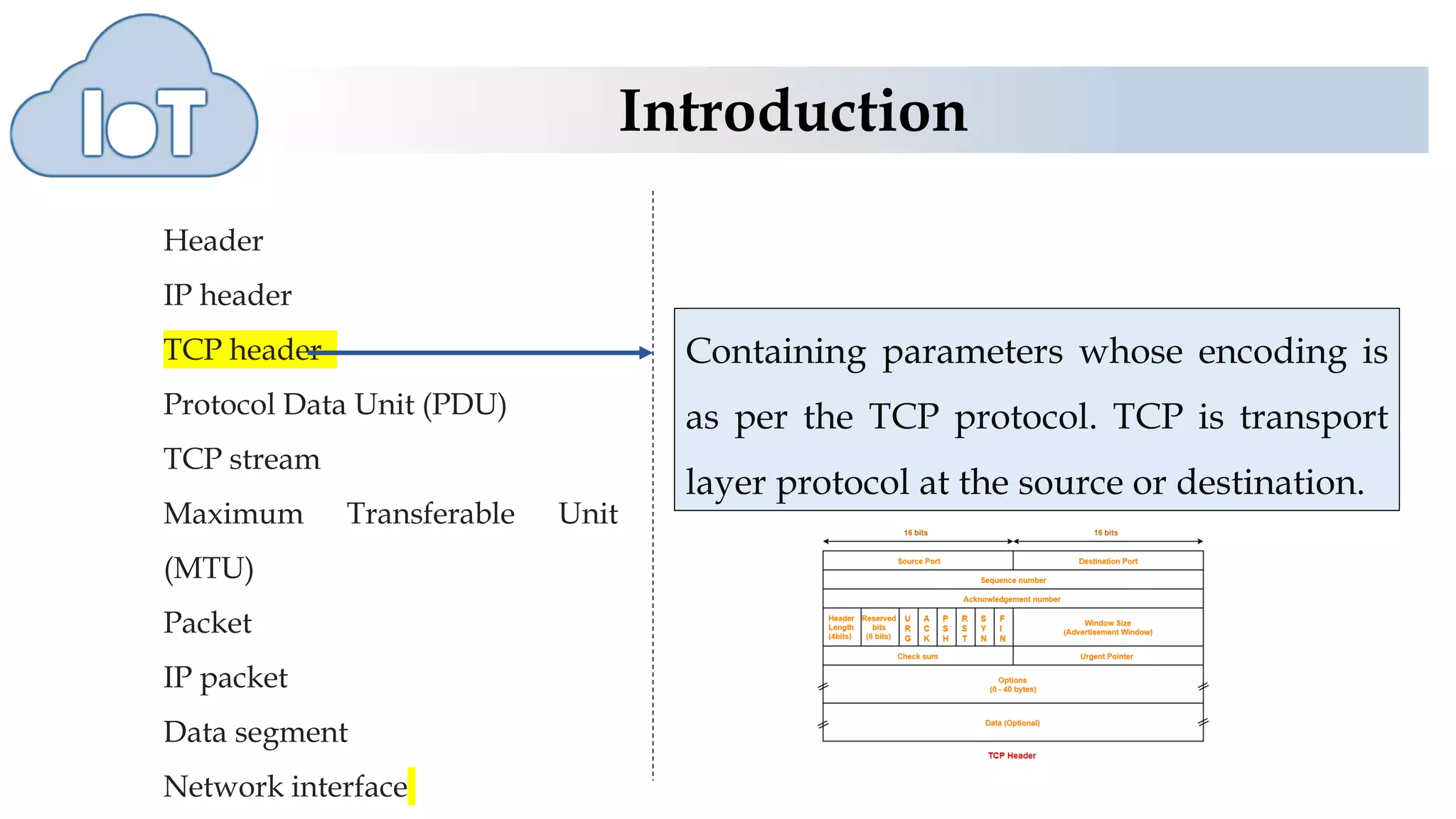
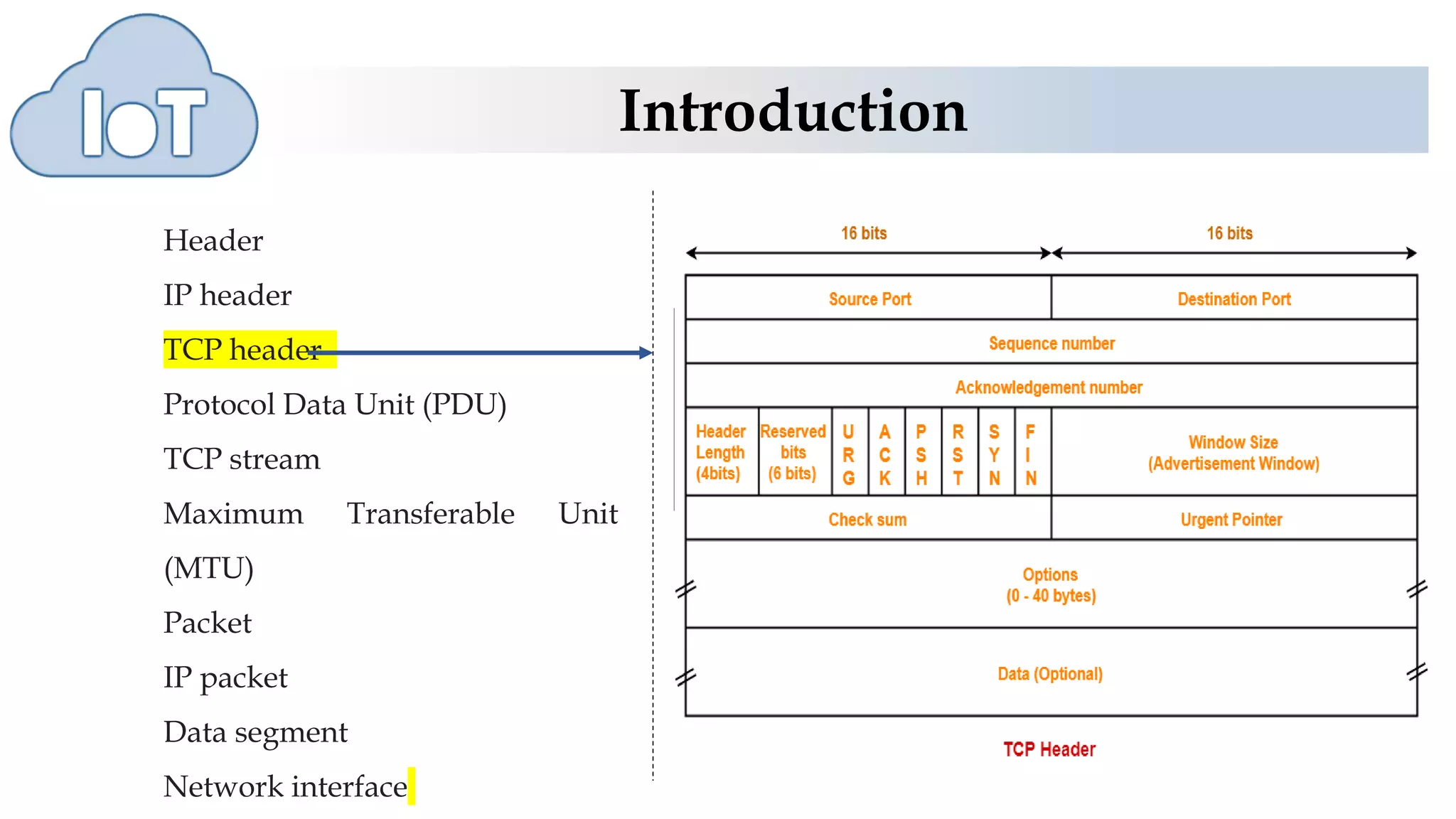
Containing parameters whose encoding is
as per the TCP protocol. TCP is transport
layer protocol at the source or destination.
Introduction
Header
IP header
TCP header
Protocol Data Unit (PDU)
TCP stream
Maximum Transferable Unit
(MTU)
Packet
IP packet
Data segment
Network interface
Containing parameters whose encoding is
as per the TCP protocol. TCP is transport
layer protocol at the source or destination.
Introduction
Header
IP header
TCP header
Protocol Data Unit (PDU)
TCP stream
Maximum Transferable Unit
(MTU)
Packet
IP packet
Data segment
Network interface
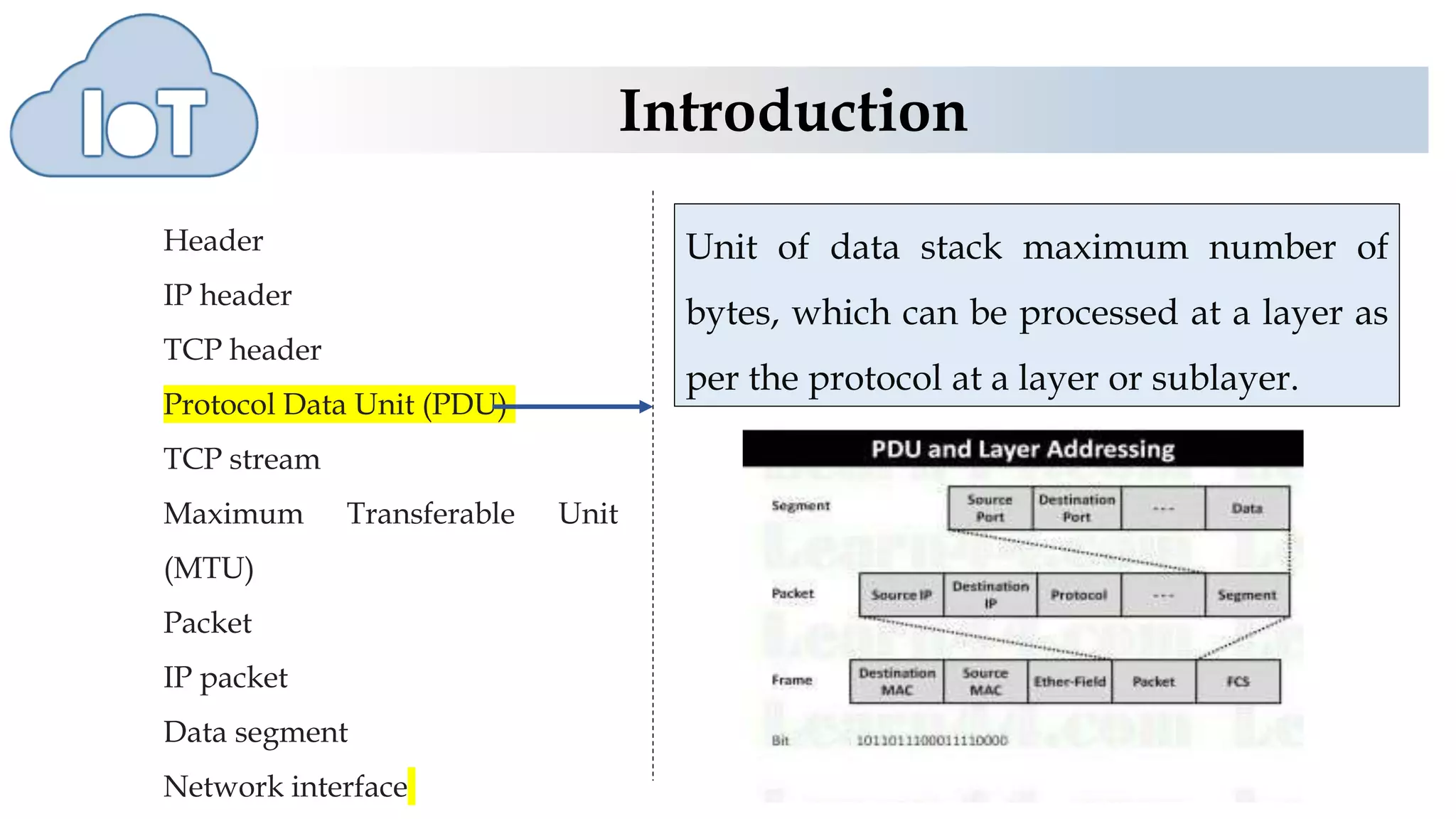
Unit of data stack maximum number of
bytes, which can be processed at a layer as
per the protocol at a layer or sublayer.
Introduction
Header
IP header
TCP header
Protocol Data Unit (PDU)
TCP stream
Maximum Transferable Unit
(MTU)
Packet
IP packet
Data segment
Network interface
sequence of bytes or words in the data
stack created at the transport layer that
transmits to the destination-end transport
layer.
Introduction
Header
IP header
TCP header
Protocol Data Unit (PDU)
TCP stream
Maximum Transferable Unit
(MTU)
Packet
IP packet
Data segment
Network interface
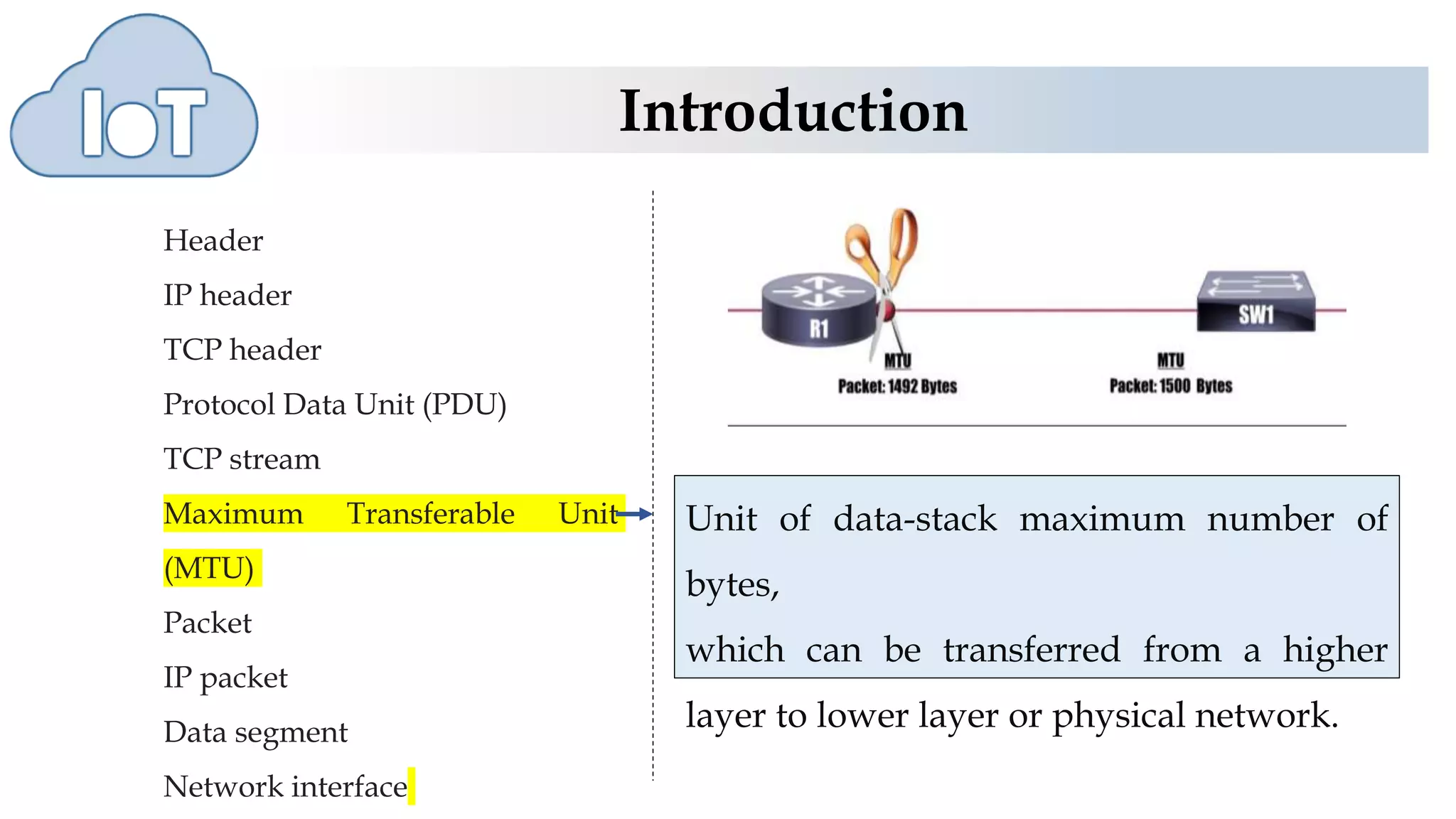
Unit of data-stack maximum number of
bytes,
which can be transferred from a higher
layer to lower layer or physical network.
Introduction
Header
IP header
TCP header
Protocol Data Unit (PDU)
TCP stream
Maximum Transferable Unit
(MTU)
Packet
IP packet
Data segment
Network interface
Set of bytes with a fixed maximum
specified size that transfers from network
layer and communicates from one router to
another, until it reaches at physical, data-
link and network layer at the receiver’s
Introduction
Header
IP header
TCP header
Protocol Data Unit (PDU)
TCP stream
Maximum Transferable Unit
(MTU)
Packet
IP packet
Data segment
Network interface
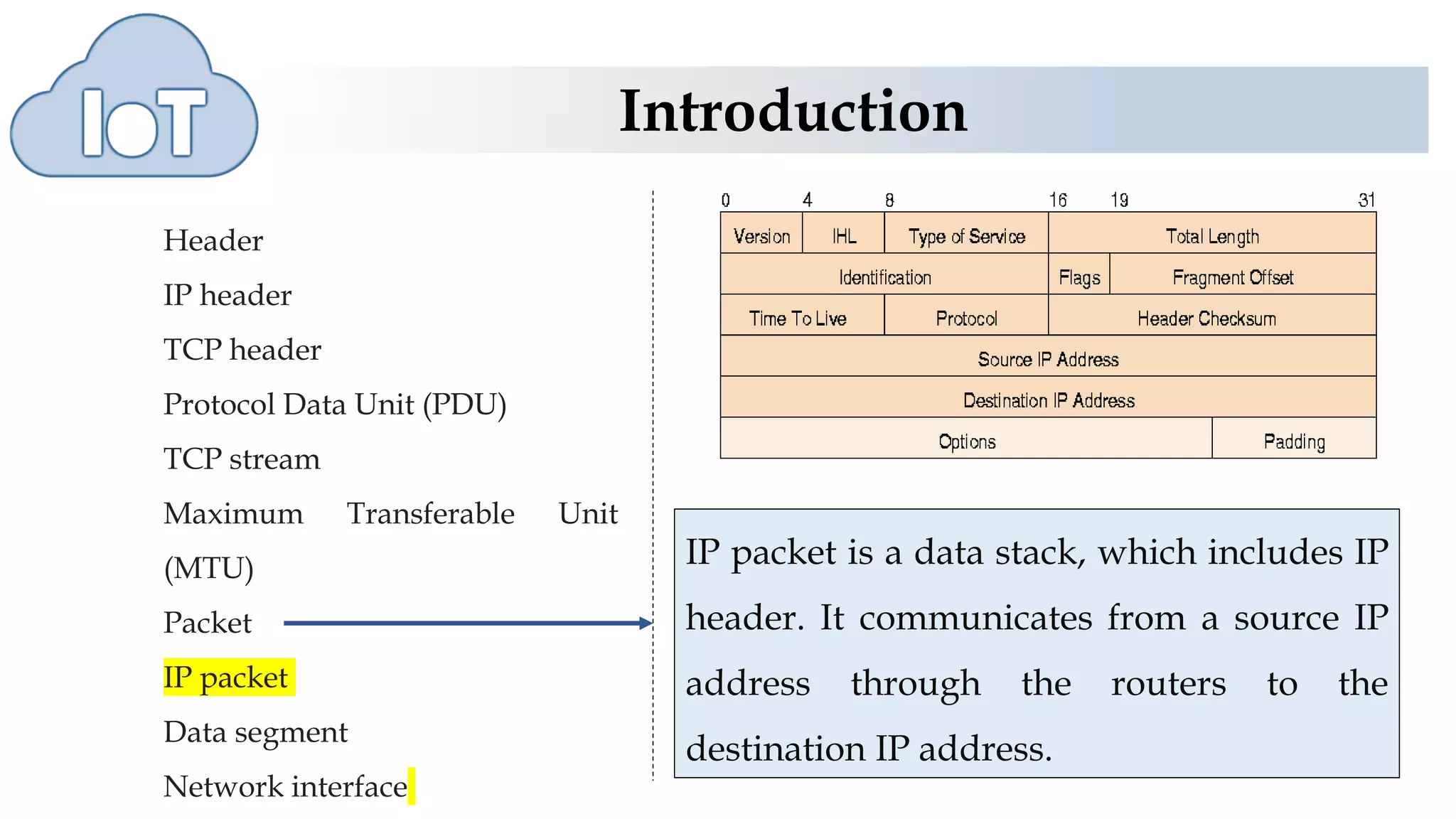
IP packet is a data stack, which includes IP
header. It communicates from a source IP
address through the routers to the
destination IP address.
Introduction
Header
IP header
TCP header
Protocol Data Unit (PDU)
TCP stream
Maximum Transferable Unit
(MTU)
Packet
IP packet
Data segment
Network interface
Data segment refers to data stack from
application-support layer for transport.
Application data is divided into the
segments when its size is more than the
transportable limit.
Introduction
Header
IP header
TCP header
Protocol Data Unit (PDU)
TCP stream
Maximum Transferable Unit
(MTU)
Packet
IP packet
Data segment
Network interface
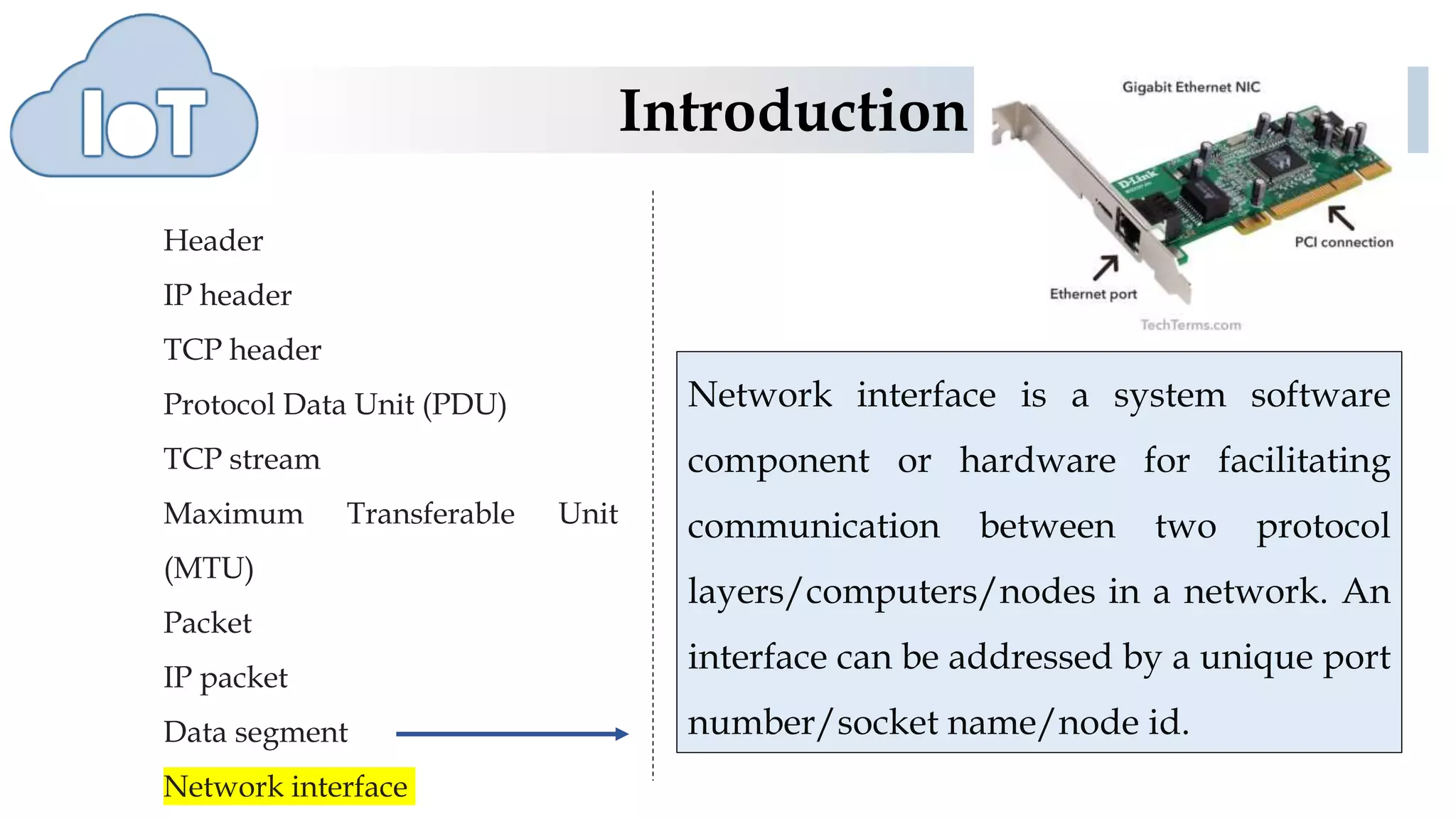
Network interface is a system software
component or hardware for facilitating
communication between two protocol
layers/computers/nodes in a network. An
interface can be addressed by a unique port
number/socket name/node id.
Introduction
Header
IP header
TCP header
Protocol Data Unit (PDU)
TCP stream
Maximum Transferable Unit
(MTU)
Packet
IP packet
Data segment
Network interface
Port
Socket
Host
IP host
Subnet
Routing Prefix
Host Identifier
Data Flow Graph (DFG)
Acyclic Data Flow Graph (ADFG)
Directed Acyclic Graph (DAG)
Introduction
Port
Socket
Host
IP host
Subnet
Routing Prefix
Host Identifier
Data Flow Graph (DFG)
Acyclic Data Flow Graph
(ADFG)
Directed Acyclic Graph (DAG)
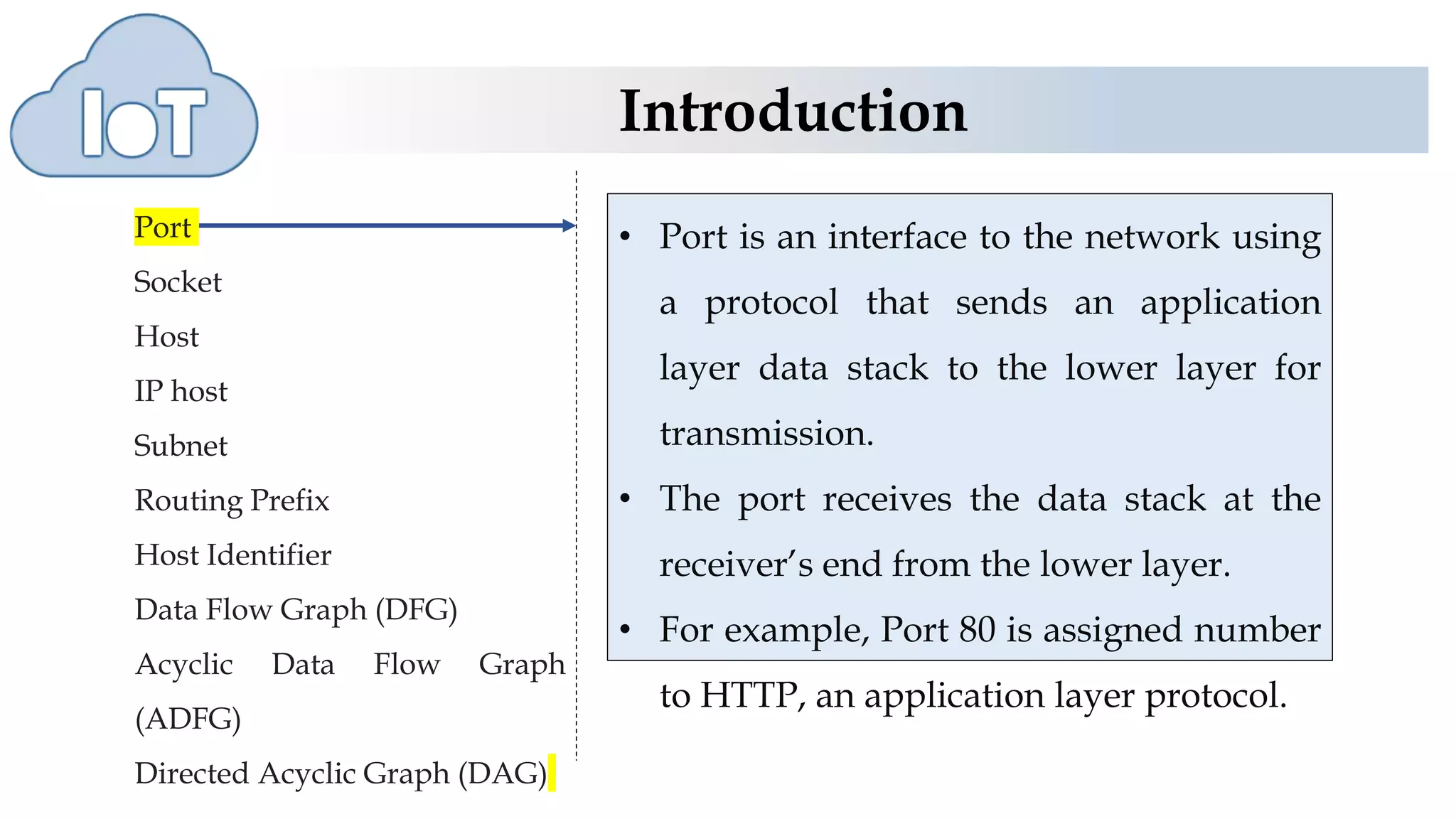
• Port is an interface to the network using
a protocol that sends an application
layer data stack to the lower layer for
transmission.
• The port receives the data stack at the
receiver’s end from the lower layer.
• For example, Port 80 is assigned number
to HTTP, an application layer protocol.
Introduction
Port
Socket
Host
IP host
Subnet
Routing Prefix
Host Identifier
Data Flow Graph (DFG)
Acyclic Data Flow Graph
(ADFG)
Directed Acyclic Graph (DAG)
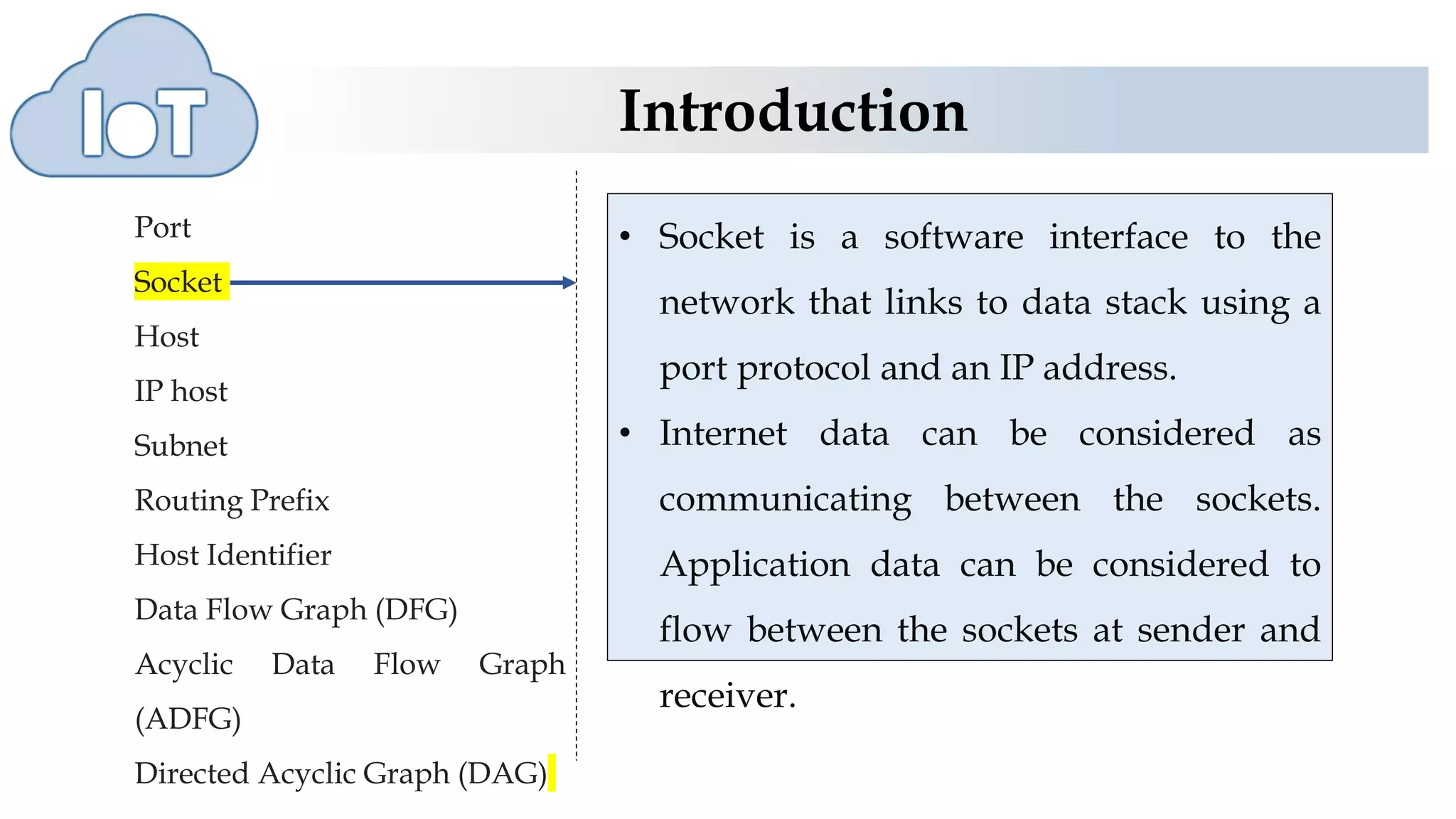
• Socket is a software interface to the
network that links to data stack using a
port protocol and an IP address.
• Internet data can be considered as
communicating between the sockets.
Application data can be considered to
flow between the sockets at sender and
receiver.
Introduction
Port
Socket
Host
IP host
Subnet
Routing Prefix
Host Identifier
Data Flow Graph (DFG)
Acyclic Data Flow Graph
(ADFG)
Directed Acyclic Graph (DAG)
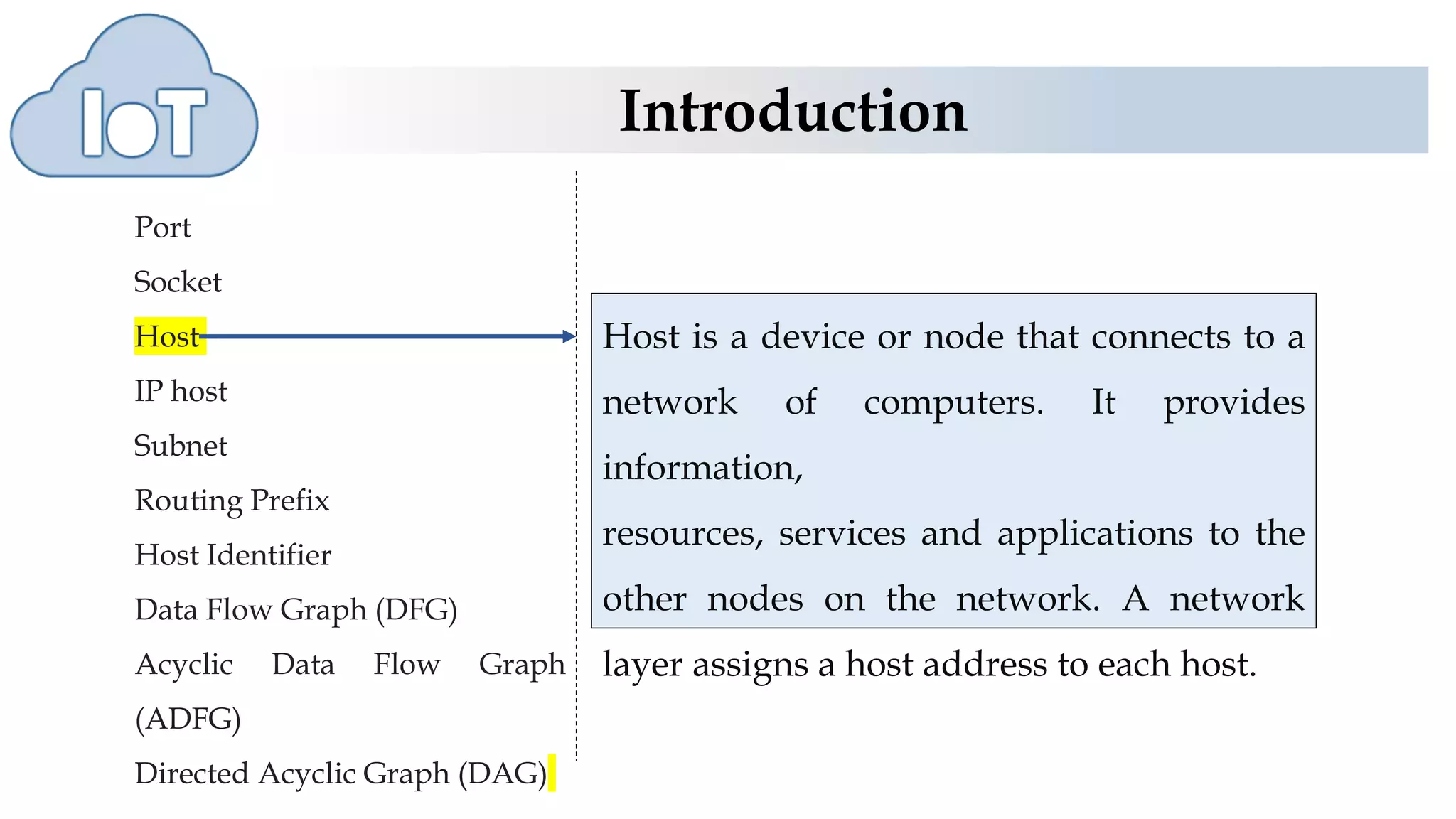
Host is a device or node that connects to a
network of computers. It provides
information,
resources, services and applications to the
other nodes on the network. A network
layer assigns a host address to each host.
Introduction
Port
Socket
Host
IP host
Subnet
Routing Prefix
Host Identifier
Data Flow Graph (DFG)
Acyclic Data Flow Graph
(ADFG)
Directed Acyclic Graph (DAG)
IP host is the one that uses the Internet
protocol suite. An IP host has one or more
IP addresses for the network interfaces.
Introduction
Port
Socket
Host
IP host
Subnet
Routing Prefix
Host Identifier
Data Flow Graph (DFG)
Acyclic Data Flow Graph
(ADFG)
Directed Acyclic Graph (DAG)
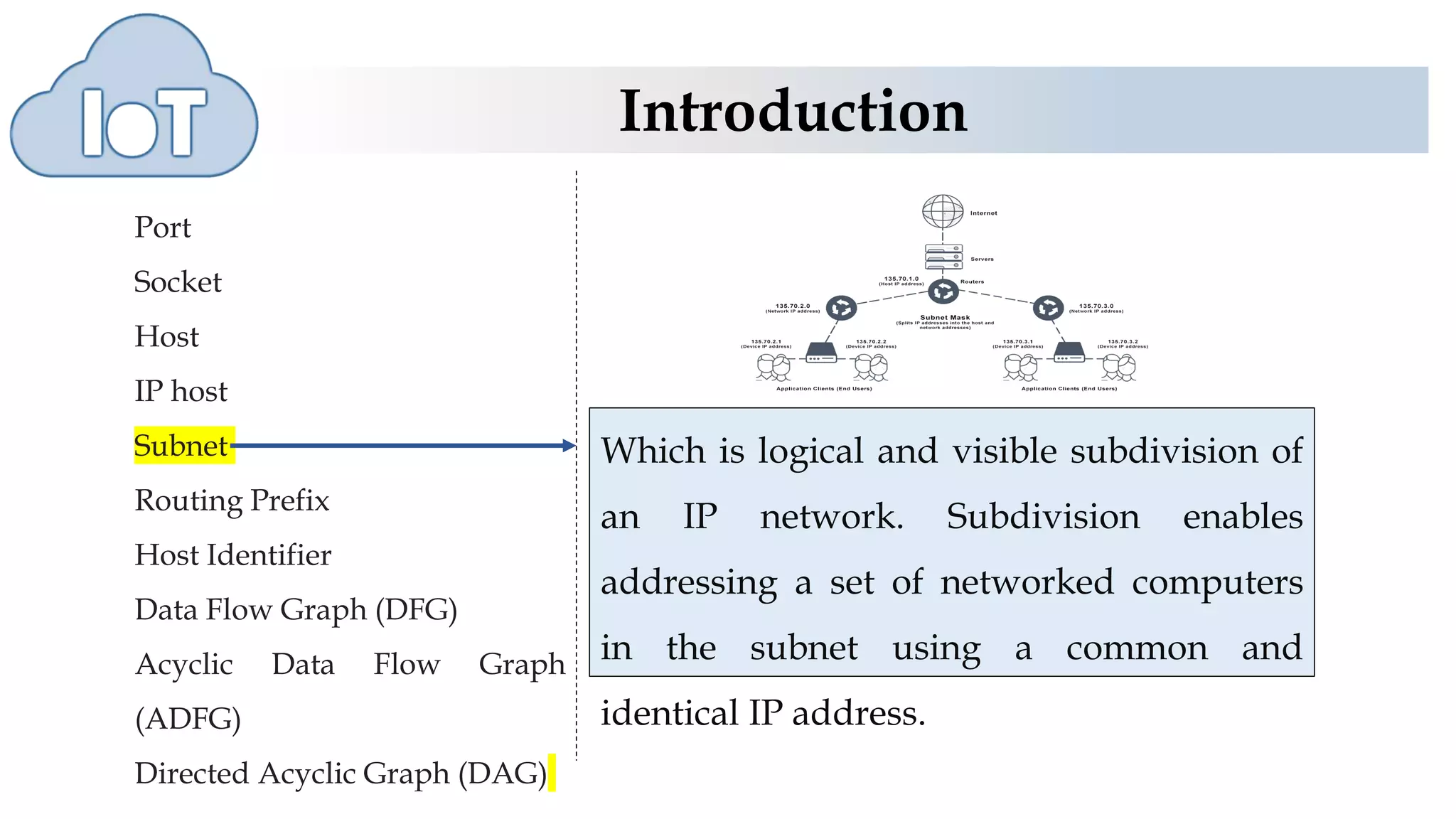
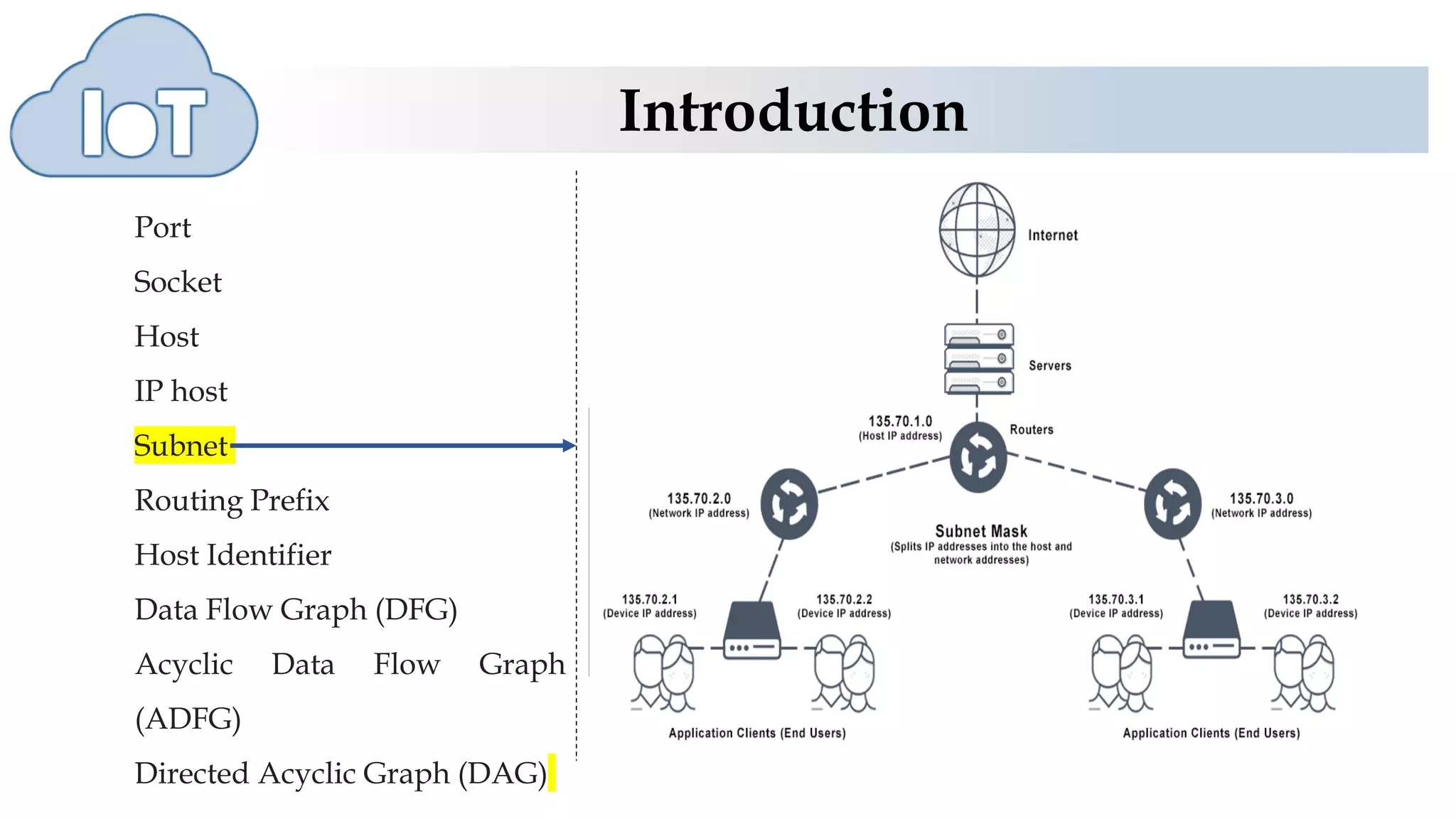
Which is logical and visible subdivision of
an IP network. Subdivision enables
addressing a set of networked computers
in the subnet using a common and
identical IP address.
Introduction
Port
Socket
Host
IP host
Subnet
Routing Prefix
Host Identifier
Data Flow Graph (DFG)
Acyclic Data Flow Graph
(ADFG)
Directed Acyclic Graph (DAG)
Which is logical and visible subdivision of
an IP network. Subdivision enables
addressing a set of networked computers
in the subnet using a common and
identical IP address.
Introduction
Port
Socket
Host
IP host
Subnet
Routing Prefix
Host Identifier
Data Flow Graph (DFG)
Acyclic Data Flow Graph
(ADFG)
Directed Acyclic Graph (DAG)
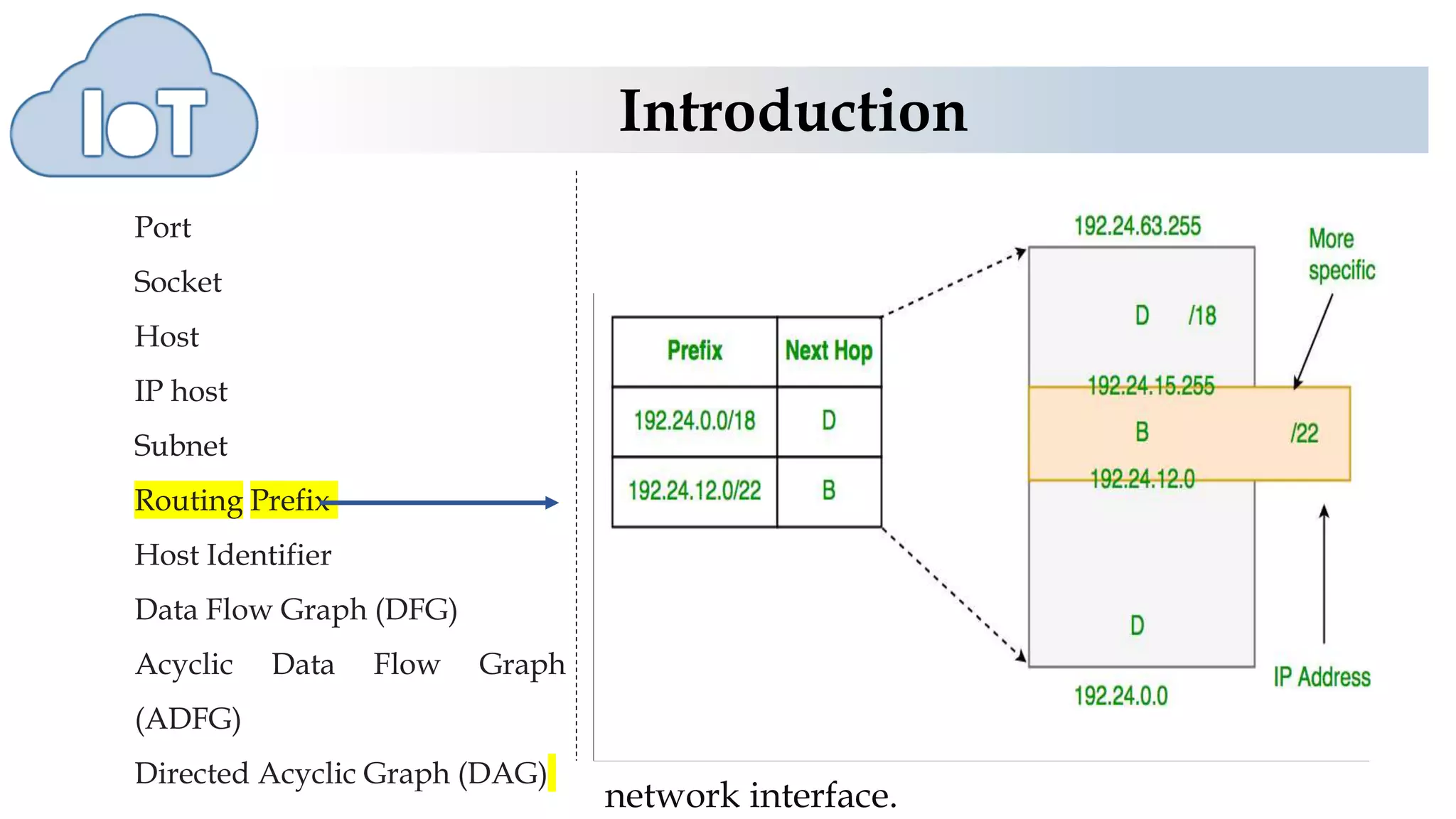
Thirty-two bits IP address can be divided into
the msbs consisting of 8, 16 or 24 bits and
remaining lsbs. The division results in the
logical division of an IP address into two
fields—a network address or routing prefix
field and a rest field or host identifier. The rest
field is an identifier for a specific host or
network interface.
Introduction
Port
Socket
Host
IP host
Subnet
Routing Prefix
Host Identifier
Data Flow Graph (DFG)
Acyclic Data Flow Graph
(ADFG)
Directed Acyclic Graph (DAG)
Thirty-two bits IP address can be divided into
the msbs consisting of 8, 16 or 24 bits and
remaining lsbs. The division results in the
logical division of an IP address into two
fields—a network address or routing prefix
field and a rest field or host identifier. The rest
field is an identifier for a specific host or
network interface.
Introduction
Port
Socket
Host
IP host
Subnet
Routing Prefix
Host Identifier
Data Flow Graph (DFG)
Acyclic Data Flow Graph
(ADFG)
Directed Acyclic Graph (DAG)
The rest field may also have two sub-
fields—one for subnet id and other for the
host identifier. When a network subdivides
into subnets and subnet has a number of
hosts.
Introduction
Port
Socket
Host
IP host
Subnet
Routing Prefix
Host Identifier
Data Flow Graph (DFG)
Acyclic Data Flow Graph
(ADFG)
Directed Acyclic Graph (DAG)
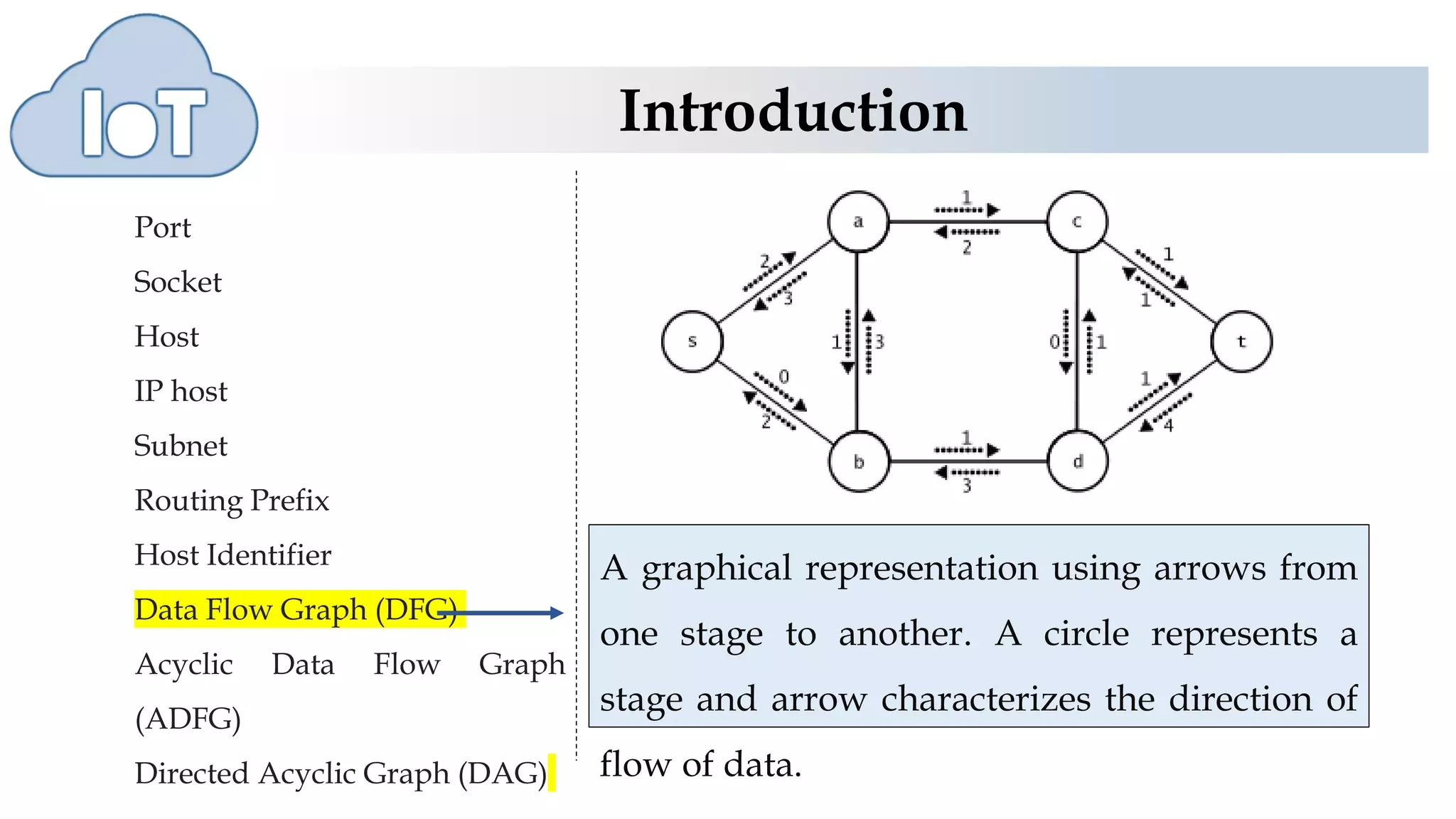
A graphical representation using arrows from
one stage to another. A circle represents a
stage and arrow characterizes the direction of
flow of data.
Introduction
Port
Socket
Host
IP host
Subnet
Routing Prefix
Host Identifier
Data Flow Graph (DFG)
Acyclic Data Flow Graph
(ADFG)
Directed Acyclic Graph (DAG)
DFG where only one set of inputs generate
only one set of outputs for the given input-
set in the DFG model.
Introduction
Port
Socket
Host
IP host
Subnet
Routing Prefix
Host Identifier
Data Flow Graph (DFG)
Acyclic Data Flow Graph
(ADFG)
Directed Acyclic Graph (DAG)
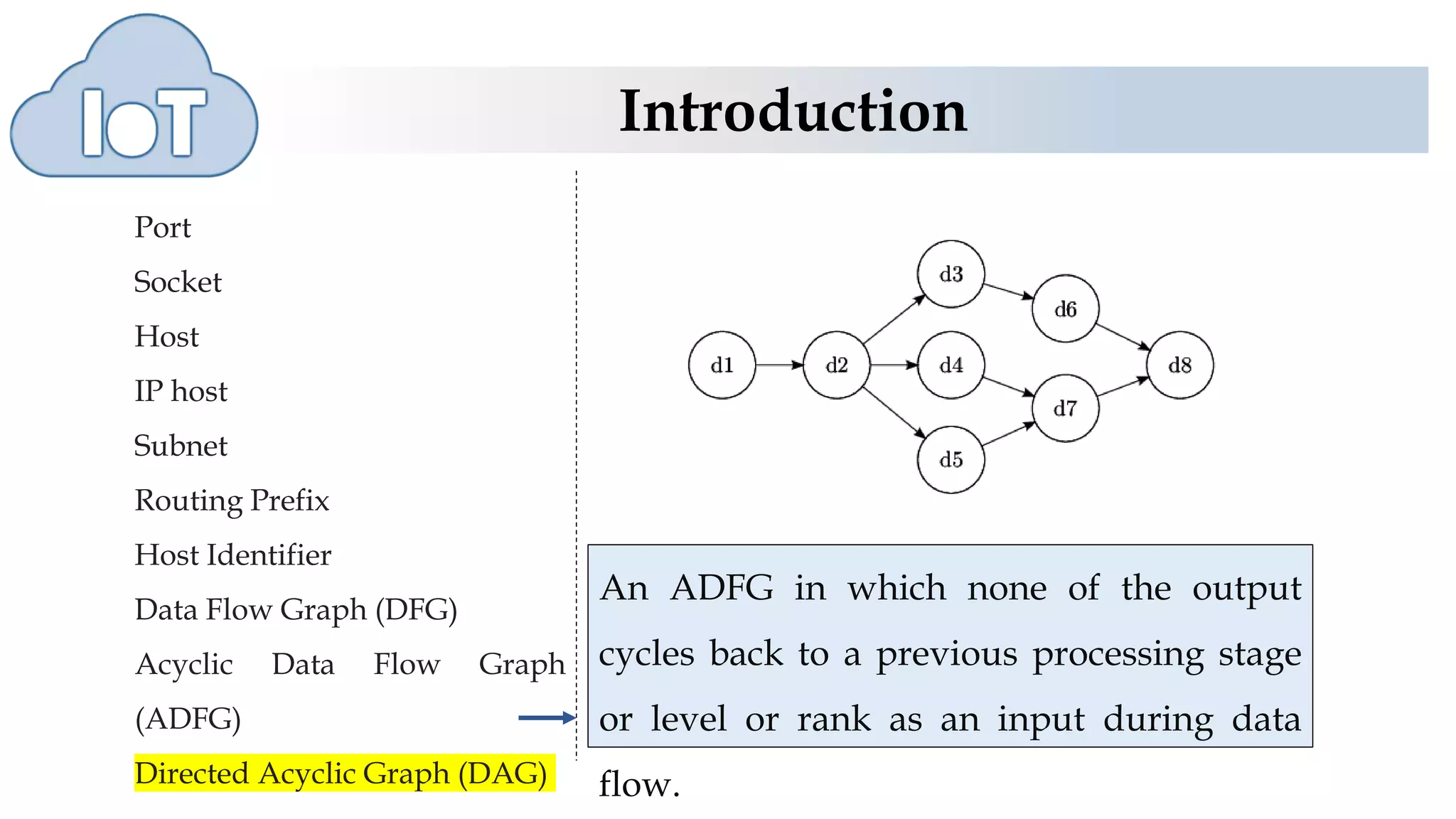
An ADFG in which none of the output
cycles back to a previous processing stage
or level or rank as an input during data
flow.
Introduction
Header
IP header
TCP header
Protocol Data Unit (PDU)
TCP stream
Maximum Transferable Unit
(MTU)
Packet
IP packet
Data segment
Network interface
Port
Socket
Host
IP host
Subnet
Routing Prefix
Host Identifier
Data Flow Graph (DFG)
Acyclic Data Flow Graph (ADFG)
Directed Acyclic Graph (DAG)
Internet Connectivity Principles
Internet connectivity
Introduction
Application Layer
Protocols

Introduction for internet connectivity (IoT)

  • 2.
    Internet Connectivity Principles Internetconnectivity Introduction Application Layer Protocols
  • 3.
    Introduction Internet is aglobal network with a set of connectivity protocols for • Connected devices gateway for sending the data frames of the devices or to the devices. • The data communicate over the network as packets, which communicate through a set of routers at the Internet. • The devices perform the controlling and monitoring functions using the messages, data-stacks and commands sent through the Internet by the applications, services or business processes.
  • 4.
    Introduction Header IP header TCP header ProtocolData Unit (PDU) TCP stream Maximum Transferable Unit (MTU) Packet IP packet Data segment Network interface Port Socket Host IP host Subnet Routing Prefix Host Identifier Data Flow Graph (DFG) Acyclic Data Flow Graph (ADFG) Directed Acyclic Graph (DAG)
  • 5.
    Introduction Header IP header TCP header ProtocolData Unit (PDU) TCP stream Maximum Transferable Unit (MTU) Packet IP packet Data segment Network interface which are required for processing a received data stack at a layer and which envelopes the data stack of the preceding upper layer before transfer to the succeeding lower layer.
  • 6.
    Introduction Header IP header TCP header ProtocolData Unit (PDU) TCP stream Maximum Transferable Unit (MTU) Packet IP packet Data segment Network interface which comprise parameters and their encodings as per the IP protocol. IP is Internet layer protocol at the source or destination
  • 7.
    Introduction Header IP header TCP header ProtocolData Unit (PDU) TCP stream Maximum Transferable Unit (MTU) Packet IP packet Data segment Network interface which comprise parameters and their encodings as per the IP protocol. IP is Internet layer protocol at the source or destination
  • 8.
    Introduction Header IP header TCP header ProtocolData Unit (PDU) TCP stream Maximum Transferable Unit (MTU) Packet IP packet Data segment Network interface Containing parameters whose encoding is as per the TCP protocol. TCP is transport layer protocol at the source or destination.
  • 9.
    Introduction Header IP header TCP header ProtocolData Unit (PDU) TCP stream Maximum Transferable Unit (MTU) Packet IP packet Data segment Network interface Containing parameters whose encoding is as per the TCP protocol. TCP is transport layer protocol at the source or destination.
  • 10.
    Introduction Header IP header TCP header ProtocolData Unit (PDU) TCP stream Maximum Transferable Unit (MTU) Packet IP packet Data segment Network interface Unit of data stack maximum number of bytes, which can be processed at a layer as per the protocol at a layer or sublayer.
  • 11.
    Introduction Header IP header TCP header ProtocolData Unit (PDU) TCP stream Maximum Transferable Unit (MTU) Packet IP packet Data segment Network interface sequence of bytes or words in the data stack created at the transport layer that transmits to the destination-end transport layer.
  • 12.
    Introduction Header IP header TCP header ProtocolData Unit (PDU) TCP stream Maximum Transferable Unit (MTU) Packet IP packet Data segment Network interface Unit of data-stack maximum number of bytes, which can be transferred from a higher layer to lower layer or physical network.
  • 13.
    Introduction Header IP header TCP header ProtocolData Unit (PDU) TCP stream Maximum Transferable Unit (MTU) Packet IP packet Data segment Network interface Set of bytes with a fixed maximum specified size that transfers from network layer and communicates from one router to another, until it reaches at physical, data- link and network layer at the receiver’s
  • 14.
    Introduction Header IP header TCP header ProtocolData Unit (PDU) TCP stream Maximum Transferable Unit (MTU) Packet IP packet Data segment Network interface IP packet is a data stack, which includes IP header. It communicates from a source IP address through the routers to the destination IP address.
  • 15.
    Introduction Header IP header TCP header ProtocolData Unit (PDU) TCP stream Maximum Transferable Unit (MTU) Packet IP packet Data segment Network interface Data segment refers to data stack from application-support layer for transport. Application data is divided into the segments when its size is more than the transportable limit.
  • 16.
    Introduction Header IP header TCP header ProtocolData Unit (PDU) TCP stream Maximum Transferable Unit (MTU) Packet IP packet Data segment Network interface Network interface is a system software component or hardware for facilitating communication between two protocol layers/computers/nodes in a network. An interface can be addressed by a unique port number/socket name/node id.
  • 17.
    Introduction Header IP header TCP header ProtocolData Unit (PDU) TCP stream Maximum Transferable Unit (MTU) Packet IP packet Data segment Network interface Port Socket Host IP host Subnet Routing Prefix Host Identifier Data Flow Graph (DFG) Acyclic Data Flow Graph (ADFG) Directed Acyclic Graph (DAG)
  • 18.
    Introduction Port Socket Host IP host Subnet Routing Prefix HostIdentifier Data Flow Graph (DFG) Acyclic Data Flow Graph (ADFG) Directed Acyclic Graph (DAG) • Port is an interface to the network using a protocol that sends an application layer data stack to the lower layer for transmission. • The port receives the data stack at the receiver’s end from the lower layer. • For example, Port 80 is assigned number to HTTP, an application layer protocol.
  • 19.
    Introduction Port Socket Host IP host Subnet Routing Prefix HostIdentifier Data Flow Graph (DFG) Acyclic Data Flow Graph (ADFG) Directed Acyclic Graph (DAG) • Socket is a software interface to the network that links to data stack using a port protocol and an IP address. • Internet data can be considered as communicating between the sockets. Application data can be considered to flow between the sockets at sender and receiver.
  • 20.
    Introduction Port Socket Host IP host Subnet Routing Prefix HostIdentifier Data Flow Graph (DFG) Acyclic Data Flow Graph (ADFG) Directed Acyclic Graph (DAG) Host is a device or node that connects to a network of computers. It provides information, resources, services and applications to the other nodes on the network. A network layer assigns a host address to each host.
  • 21.
    Introduction Port Socket Host IP host Subnet Routing Prefix HostIdentifier Data Flow Graph (DFG) Acyclic Data Flow Graph (ADFG) Directed Acyclic Graph (DAG) IP host is the one that uses the Internet protocol suite. An IP host has one or more IP addresses for the network interfaces.
  • 22.
    Introduction Port Socket Host IP host Subnet Routing Prefix HostIdentifier Data Flow Graph (DFG) Acyclic Data Flow Graph (ADFG) Directed Acyclic Graph (DAG) Which is logical and visible subdivision of an IP network. Subdivision enables addressing a set of networked computers in the subnet using a common and identical IP address.
  • 23.
    Introduction Port Socket Host IP host Subnet Routing Prefix HostIdentifier Data Flow Graph (DFG) Acyclic Data Flow Graph (ADFG) Directed Acyclic Graph (DAG) Which is logical and visible subdivision of an IP network. Subdivision enables addressing a set of networked computers in the subnet using a common and identical IP address.
  • 24.
    Introduction Port Socket Host IP host Subnet Routing Prefix HostIdentifier Data Flow Graph (DFG) Acyclic Data Flow Graph (ADFG) Directed Acyclic Graph (DAG) Thirty-two bits IP address can be divided into the msbs consisting of 8, 16 or 24 bits and remaining lsbs. The division results in the logical division of an IP address into two fields—a network address or routing prefix field and a rest field or host identifier. The rest field is an identifier for a specific host or network interface.
  • 25.
    Introduction Port Socket Host IP host Subnet Routing Prefix HostIdentifier Data Flow Graph (DFG) Acyclic Data Flow Graph (ADFG) Directed Acyclic Graph (DAG) Thirty-two bits IP address can be divided into the msbs consisting of 8, 16 or 24 bits and remaining lsbs. The division results in the logical division of an IP address into two fields—a network address or routing prefix field and a rest field or host identifier. The rest field is an identifier for a specific host or network interface.
  • 26.
    Introduction Port Socket Host IP host Subnet Routing Prefix HostIdentifier Data Flow Graph (DFG) Acyclic Data Flow Graph (ADFG) Directed Acyclic Graph (DAG) The rest field may also have two sub- fields—one for subnet id and other for the host identifier. When a network subdivides into subnets and subnet has a number of hosts.
  • 27.
    Introduction Port Socket Host IP host Subnet Routing Prefix HostIdentifier Data Flow Graph (DFG) Acyclic Data Flow Graph (ADFG) Directed Acyclic Graph (DAG) A graphical representation using arrows from one stage to another. A circle represents a stage and arrow characterizes the direction of flow of data.
  • 28.
    Introduction Port Socket Host IP host Subnet Routing Prefix HostIdentifier Data Flow Graph (DFG) Acyclic Data Flow Graph (ADFG) Directed Acyclic Graph (DAG) DFG where only one set of inputs generate only one set of outputs for the given input- set in the DFG model.
  • 29.
    Introduction Port Socket Host IP host Subnet Routing Prefix HostIdentifier Data Flow Graph (DFG) Acyclic Data Flow Graph (ADFG) Directed Acyclic Graph (DAG) An ADFG in which none of the output cycles back to a previous processing stage or level or rank as an input during data flow.
  • 30.
    Introduction Header IP header TCP header ProtocolData Unit (PDU) TCP stream Maximum Transferable Unit (MTU) Packet IP packet Data segment Network interface Port Socket Host IP host Subnet Routing Prefix Host Identifier Data Flow Graph (DFG) Acyclic Data Flow Graph (ADFG) Directed Acyclic Graph (DAG)
  • 31.
    Internet Connectivity Principles Internetconnectivity Introduction Application Layer Protocols