International Research Journal of Engineering and Technology (IRJET) e-ISSN: 2395-0056
Volume: 09 Issue: 08 | Aug 2022 www.irjet.net p-ISSN: 2395-0072
© 2022, IRJET | Impact Factor value: 7.529 | ISO 9001:2008 Certified Journal | Page 2068
IoT Based Anti-Theft Detection and Alarm System Using NodeMCU and
Blynk Application
Zin Min Htike1, Ko Ko Aung2, Shwe Khine Pyone3, Khin Sandar Lin4, Kyaw Saw Win5, Naung
Naung6
1,2,4,5Department of Physics, Pathein University, Pathein, Myanmar
6Department of Mathematics, Pathein University, Pathein, Myanmar
3Department of Physics, Taunggoke University, Taunggoke, Myanmar
-------------------------------------------------------------------------***----------------------------------------------------------------------
Abstract - The purpose of building this system is to prevent
the loss of property due to theft that we face in our daily
lives. This system includes NodeMCU with Esp8266 Wi-Fi
module based on microcontroller, PIR sensor to use the
motion detection, ultrasonic sensor to know the distance
from the obstacles, buzzer to use the alarm system, Blynk
application to use the reporting message and light bulb to
illuminate around the environments. When sensor detected
the movement of objects, sends a message to phone, lights
up the bulb, and then alert alarm because Esp8226 Wi-Fi
module is connected to Blynk application. The problems
found with existing systems were that they can only identify
the intruder after the theft, or cannot distinguish between
human and non-human objects. So, this system will be
essential for every building because it is not just easy to use
but is also inexpensive.
Keywords: NodeMCU, IoT, Blynk application, PIR sensor,
Ultrasonic sensor.
1. INTRODUCTION
In our country, there has been the loss of property every
year due to thieves and strangers. Therefore, security is
very important [1]. This system is intended to provide
security in unsafe places. This is because it is to prevent
the loss of important documents and property in offices,
departments, classrooms, homes and buildings etc. The
key to security is IoT system [2]. The Internet of Things
(IoT) describes physical objects (or groups of such
objects) with sensors, processing ability, software, and
other technologies that connect and exchange data with
other devices and systems over the Internet or other
communications networks [3]. Internet of things has been
considered a misnomer because devices do not need to be
connected to the public internet, they only need to be
connected to a network and be individually addressable
[4]. Traditional fields of embedded systems, wireless
sensor networks, control systems, automation (including
home and building automation), independently and
collectively enable the Internet of things [5]. In the
consumer market, IoT technology is most synonymous
with products pertaining to the concept of the "smart
buildings", including devices and appliances (such as
lighting fixtures, thermostats, home security systems,
cameras, and other home appliances) [6]. Nowadays,
people are creating everything using IoT system because
of the advancement of IT technology [7]. The block
diagram of anti-theft detection and alarm system is shown
in Fig 1.
Fig-1: Block diagram of anti-theft detection and alarm
system
2. METHODOLOGY
Basically, the design and development of this system are
divided into two main parts: hardware architecture and
software details. In the hardware architecture, the design
of the circuit was constructed and the prototype of the
system was built. While in the software development, the
whole complete prototype was operated via programming
codes.
2.1 Hardware Architecture
NodeMCU
NodeMCU is an open-source development board and
firmware based in the widely used ESP8266 - 12E WiFi
module as shown in Fig 2. It allows to program the
ESP8266 WiFi module with the simple and powerful LUA
Power
Supply
PIR Sensor
Ultrasonic
Sensor
AC 220V
NodeMCU
Buzzer
LEDs
Relay
LCD
Message
Blynk
Application
Bulb
International Research Journal of Engineering and Technology (IRJET) e-ISSN: 2395-0056
Volume: 09 Issue: 08 | Aug 2022 www.irjet.net p-ISSN: 2395-0072
© 2022, IRJET | Impact Factor value: 7.529 | ISO 9001:2008 Certified Journal | Page 2069
programming language or Arduino IDE [8]. With just a few
lines of code can establish a WiFi connection and define
input/output pins according to needs exactly like arduino,
turning your ESP8266 into a web server and a lot more. It
is the WiFi equivalent of ethernet module [9]. With its
USB-TTL, the nodeMCU Dev board supports directly
flashing from USB port. It combines features of WIFI
accesspoint and station + microcontroller. These features
make the NodeMCU extremly powerful tool for Wifi
networking. It can be used as access point and/or
NodeMCU Blynk application Relay Bulb Buzzer LCD
Message Power Supply IR sensor PIR sensor 9V battery
station, host a webserver or connect to internet to fetch or
upload data [10].
Fig-2: NodeMCU
Internet of things
The internet of things, or IoT, is a system of interrelated
computing devices, mechanical and digital machines,
objects that are provided with unique identifiers (UIDs)
and the ability to transfer data over a network without
requiring human-to-human or human-to-computer
interaction as shown in Fig 3. A thing in the internet of
things can be a person with a heart monitor implant, an
automically anti-theft detection and alarm system, an
automobile that has built-in sensors to alert the driver
when tire pressure is low or any other natural or man-
made object that can be assigned an Internet Protocol (IP)
address and is able to transfer data over a network.
Increasingly, organizations in a variety of industries are
using IoT to operate more efficiently, better understand
customers to deliver enhanced customer service, improve
decision-making and increase the value of the business
[11].
Fig-3: Internet of Things
Blynk Application
Blynk was designed for the Internet of Things as shown in
Fig 4. It can control hardware remotely, it can display
sensor data, it can store data, visualize it and do many
other cool things. There are three major components in
the platform:
 Blynk App - allows to create amazing interfaces
for researches using various widgets.
 Blynk Server - responsible for all the
communications between the smartphone and
hardware. Our Blynk Cloud can be used or your
private Blynk server is locally run. It’s open-
source, could easily handle thousands of devices
and can even be launched on a NodeMCU.
 Blynk Libraries - for all the popular hardware
platforms - enable communication with the server
and process all the incoming and outcoming
commands.
Every time it is pressed a Button in the Blynk app, the
message travels to space the Blynk Cloud, where it
magically finds its way to hardware. It works the same in
the opposite direction and everything happens in a Blynk
of an eye.
Fig-4: Blynk Application
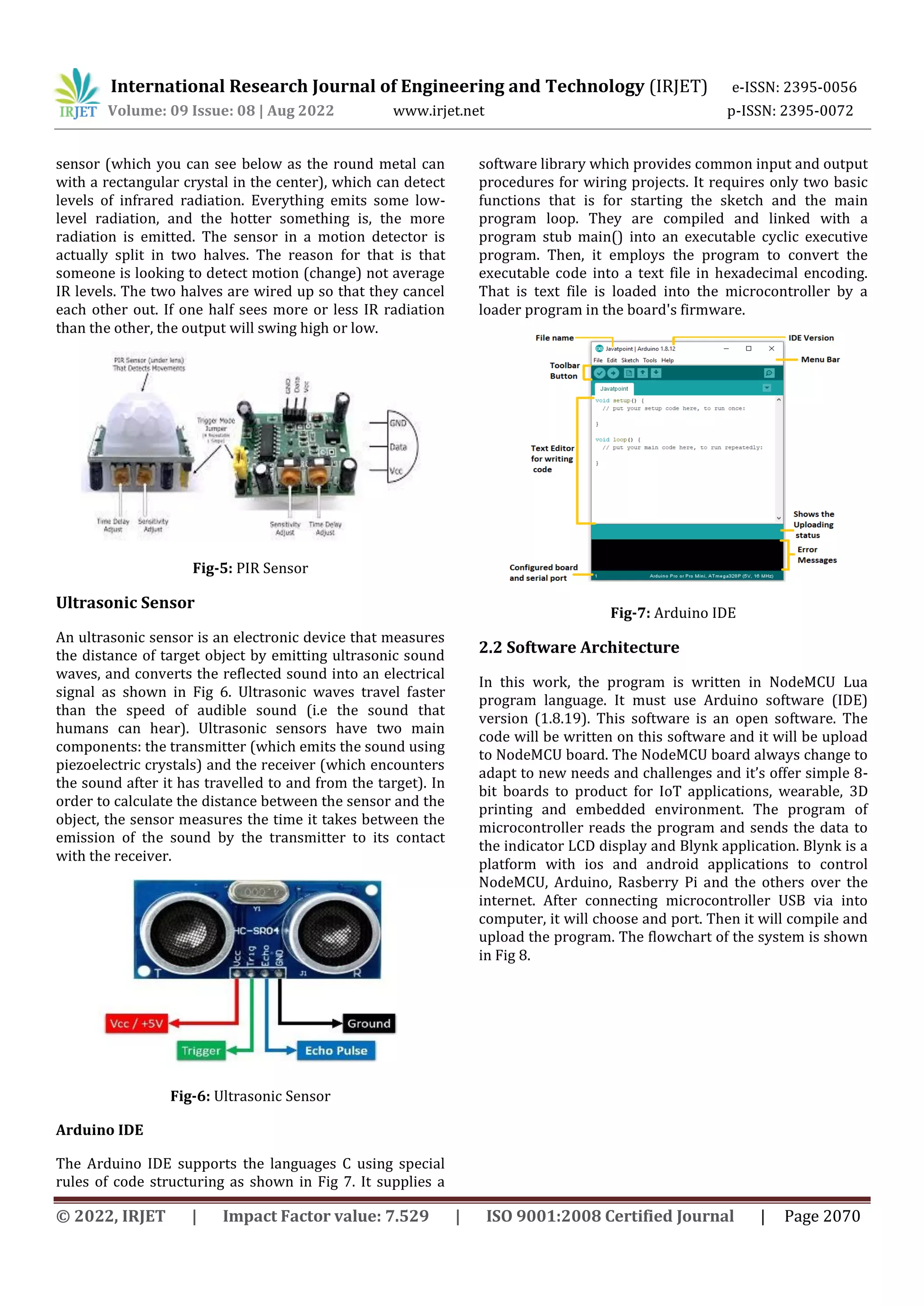
PIR Sensor
PIR sensors allow to sense motion, almost always used to
detect whether a human has moved in or out of the
sensors range as shown in Fig 5. They are small,
inexpensive, low-power, easy to use and don't wear out.
For that reason, they are commonly found in appliances
and gadgets used in homes or businesses. They are often
referred to as PIR, "Passive Infrared", "Pyroelectric", or "IR
motion" sensors. PIRs are basically made of a pyroelectric
International Research Journal of Engineering and Technology (IRJET) e-ISSN: 2395-0056
Volume: 09 Issue: 08 | Aug 2022 www.irjet.net p-ISSN: 2395-0072
© 2022, IRJET | Impact Factor value: 7.529 | ISO 9001:2008 Certified Journal | Page 2070
sensor (which you can see below as the round metal can
with a rectangular crystal in the center), which can detect
levels of infrared radiation. Everything emits some low-
level radiation, and the hotter something is, the more
radiation is emitted. The sensor in a motion detector is
actually split in two halves. The reason for that is that
someone is looking to detect motion (change) not average
IR levels. The two halves are wired up so that they cancel
each other out. If one half sees more or less IR radiation
than the other, the output will swing high or low.
Fig-5: PIR Sensor
Ultrasonic Sensor
An ultrasonic sensor is an electronic device that measures
the distance of target object by emitting ultrasonic sound
waves, and converts the reflected sound into an electrical
signal as shown in Fig 6. Ultrasonic waves travel faster
than the speed of audible sound (i.e the sound that
humans can hear). Ultrasonic sensors have two main
components: the transmitter (which emits the sound using
piezoelectric crystals) and the receiver (which encounters
the sound after it has travelled to and from the target). In
order to calculate the distance between the sensor and the
object, the sensor measures the time it takes between the
emission of the sound by the transmitter to its contact
with the receiver.
Fig-6: Ultrasonic Sensor
Arduino IDE
The Arduino IDE supports the languages C using special
rules of code structuring as shown in Fig 7. It supplies a
software library which provides common input and output
procedures for wiring projects. It requires only two basic
functions that is for starting the sketch and the main
program loop. They are compiled and linked with a
program stub main() into an executable cyclic executive
program. Then, it employs the program to convert the
executable code into a text file in hexadecimal encoding.
That is text file is loaded into the microcontroller by a
loader program in the board's firmware.
Fig-7: Arduino IDE
2.2 Software Architecture
In this work, the program is written in NodeMCU Lua
program language. It must use Arduino software (IDE)
version (1.8.19). This software is an open software. The
code will be written on this software and it will be upload
to NodeMCU board. The NodeMCU board always change to
adapt to new needs and challenges and it’s offer simple 8-
bit boards to product for IoT applications, wearable, 3D
printing and embedded environment. The program of
microcontroller reads the program and sends the data to
the indicator LCD display and Blynk application. Blynk is a
platform with ios and android applications to control
NodeMCU, Arduino, Rasberry Pi and the others over the
internet. After connecting microcontroller USB via into
computer, it will choose and port. Then it will compile and
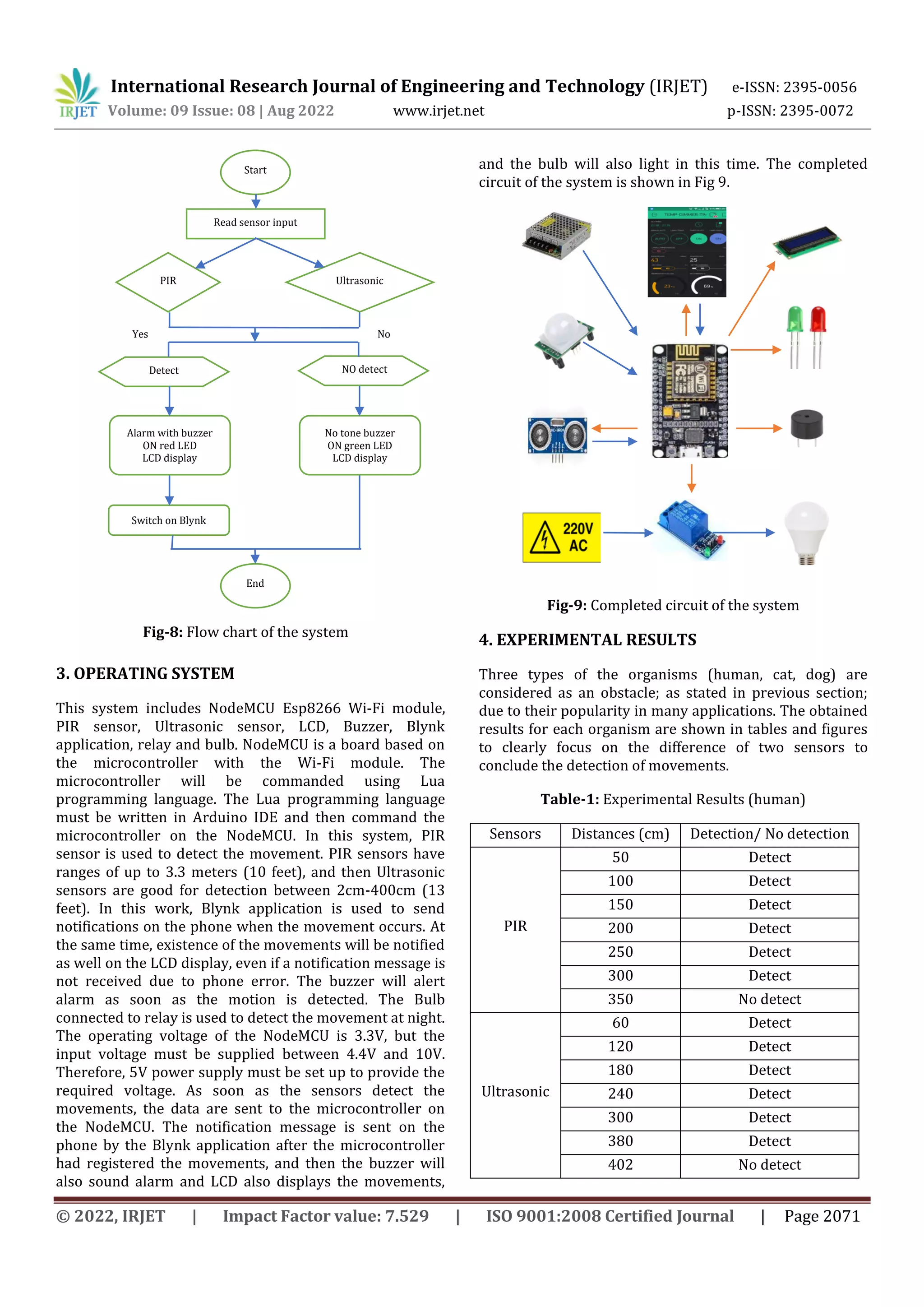
upload the program. The flowchart of the system is shown
in Fig 8.
International Research Journal of Engineering and Technology (IRJET) e-ISSN: 2395-0056
Volume: 09 Issue: 08 | Aug 2022 www.irjet.net p-ISSN: 2395-0072
© 2022, IRJET | Impact Factor value: 7.529 | ISO 9001:2008 Certified Journal | Page 2071
3. OPERATING SYSTEM
This system includes NodeMCU Esp8266 Wi-Fi module,
PIR sensor, Ultrasonic sensor, LCD, Buzzer, Blynk
application, relay and bulb. NodeMCU is a board based on
the microcontroller with the Wi-Fi module. The
microcontroller will be commanded using Lua
programming language. The Lua programming language
must be written in Arduino IDE and then command the
microcontroller on the NodeMCU. In this system, PIR
sensor is used to detect the movement. PIR sensors have
ranges of up to 3.3 meters (10 feet), and then Ultrasonic
sensors are good for detection between 2cm-400cm (13
feet). In this work, Blynk application is used to send
notifications on the phone when the movement occurs. At
the same time, existence of the movements will be notified
as well on the LCD display, even if a notification message is
not received due to phone error. The buzzer will alert
alarm as soon as the motion is detected. The Bulb
connected to relay is used to detect the movement at night.
The operating voltage of the NodeMCU is 3.3V, but the
input voltage must be supplied between 4.4V and 10V.
Therefore, 5V power supply must be set up to provide the
required voltage. As soon as the sensors detect the
movements, the data are sent to the microcontroller on
the NodeMCU. The notification message is sent on the
phone by the Blynk application after the microcontroller
had registered the movements, and then the buzzer will
also sound alarm and LCD also displays the movements,
and the bulb will also light in this time. The completed
circuit of the system is shown in Fig 9.
Fig-9: Completed circuit of the system
4. EXPERIMENTAL RESULTS
Three types of the organisms (human, cat, dog) are
considered as an obstacle; as stated in previous section;
due to their popularity in many applications. The obtained
results for each organism are shown in tables and figures
to clearly focus on the difference of two sensors to
conclude the detection of movements.
Table-1: Experimental Results (human)
Sensors Distances (cm) Detection/ No detection
PIR
50 Detect
100 Detect
150 Detect
200 Detect
250 Detect
300 Detect
350 No detect
Ultrasonic
60 Detect
120 Detect
180 Detect
240 Detect
300 Detect
380 Detect
402 No detect
Start
End
Read sensor input
PIR Ultrasonic
Detect NO detect
Alarm with buzzer
ON red LED
LCD display
Switch on Blynk
No tone buzzer
ON green LED
LCD display
Yes No
Fig-8: Flow chart of the system
International Research Journal of Engineering and Technology (IRJET) e-ISSN: 2395-0056
Volume: 09 Issue: 08 | Aug 2022 www.irjet.net p-ISSN: 2395-0072
© 2022, IRJET | Impact Factor value: 7.529 | ISO 9001:2008 Certified Journal | Page 2072
Fig-10: The condition that detected the human
Table-2: Experimental Results (cat)
Sensors Distances (cm) Detection/ No detection
PIR
50 Detect
100 Detect
150 Detect
200 Detect
250 Detect
300 Detect
350 No detect
Ultrasonic
60 Detect
120 Detect
180 Detect
240 Detect
300 Detect
380 Detect
402 No detect
Fig-11: The condition that detected the cat
Table-3: Experimental Results (dog)
Sensors Distances (cm) Detection/ No detection
PIR
50 Detect
100 Detect
150 Detect
200 Detect
250 Detect
300 Detect
350 No detect
Ultrasonic
60 Detect
120 Detect
180 Detect
240 Detect
300 Detect
380 Detect
402 No detect
Fig-12: The condition that detected the dog
5. CONCLUSION
The research on this system mainly focused on solving the
security problems. It is hoped that it will help people
across the country reduce theft. It has provided a novel
wireless sensing system for the surveillance and detection
of a human intruder as well as instant notification of the
intrusion to prevent theft. This system is suitable for small
personal area surveillance, i.e., offices, departments,
classrooms, homes and buildings. The main advantage of
the system is easy to use, low cost with high quality. New
research challenges of security and privacy have arisen
due to an increase in products that connect the cyber and
physical worlds. It is expected that these research
problems will be further resolved in the upcoming future.
ACKNOWLEDGEMENTS
I wish to express my deepest gratitude to Dr Than Tun,
Rector, Pathein University for his encouragement to
submit this paper. Further I wish to thank U Ko Ko Aung,
Lecturer, Department of Physics, Pathein University for his
valuable suggestions. I would like to thank U Khin Maung
Aye, Lecturer, Department of English, Pathein University
for his encouragement to do this work.
REFERENCES
[1] Brown & Eric, 20 September 2016. "21 Open
Source Projects for IoT".
International Research Journal of Engineering and Technology (IRJET) e-ISSN: 2395-0056
Volume: 09 Issue: 08 | Aug 2022 www.irjet.net p-ISSN: 2395-0072
© 2022, IRJET | Impact Factor value: 7.529 | ISO 9001:2008 Certified Journal | Page 2073
[2] ITU, Retrieved 26 June 2015. "Internet of Things
Global Standards Initiative".
[3] Hendricks & Drew, Retrieved 10 August 2015.
"The Trouble with the Internet of Things". London
Data store. Greater London Authority.
[4] Nilanjan Dey, Aboul Ella Hassanien, Chintan Bhatt,
Amira Ashour, Suresh Chandra Satapathy & Cham,
2018. “Internet of things and big data analytics
toward next-generation intelligence”.
[5] Gartner, Retrieved 3 March 2022. "Forecast: The
Internet of Things, Worldwide, 2013".
[6] Hu, Niu, Carrasco, Lennox & Arvin, 2022. "Fault-
tolerant cooperative navigation of networked UAV
swarms for forest fire monitoring"
[7] Lennox & Arvin, 2022. "Robust formation control
for networked robotic systems using Negative
Imaginary dynamics".
[8] Zeroday, Retrieved 2 April 2015. "A lua based
firmware for wifisoc esp8266".
[9] Hari Wiguna, Retrieved 2 April 2015. "NodeMCU
LUA Firmware".
[10] Retrieved 3 June 2017. Jump up to: abSystems,
Espressif. "Espressif Systems". EspressifWikiDevi.
Archived from the original on 1 December 2017.
[11] Gillis & Alexander, 2021. "What is internet of
things (IoT)?".

IoT Based Anti-Theft Detection and Alarm System Using NodeMCU and Blynk Application

  • 1.
    International Research Journalof Engineering and Technology (IRJET) e-ISSN: 2395-0056 Volume: 09 Issue: 08 | Aug 2022 www.irjet.net p-ISSN: 2395-0072 © 2022, IRJET | Impact Factor value: 7.529 | ISO 9001:2008 Certified Journal | Page 2068 IoT Based Anti-Theft Detection and Alarm System Using NodeMCU and Blynk Application Zin Min Htike1, Ko Ko Aung2, Shwe Khine Pyone3, Khin Sandar Lin4, Kyaw Saw Win5, Naung Naung6 1,2,4,5Department of Physics, Pathein University, Pathein, Myanmar 6Department of Mathematics, Pathein University, Pathein, Myanmar 3Department of Physics, Taunggoke University, Taunggoke, Myanmar -------------------------------------------------------------------------***---------------------------------------------------------------------- Abstract - The purpose of building this system is to prevent the loss of property due to theft that we face in our daily lives. This system includes NodeMCU with Esp8266 Wi-Fi module based on microcontroller, PIR sensor to use the motion detection, ultrasonic sensor to know the distance from the obstacles, buzzer to use the alarm system, Blynk application to use the reporting message and light bulb to illuminate around the environments. When sensor detected the movement of objects, sends a message to phone, lights up the bulb, and then alert alarm because Esp8226 Wi-Fi module is connected to Blynk application. The problems found with existing systems were that they can only identify the intruder after the theft, or cannot distinguish between human and non-human objects. So, this system will be essential for every building because it is not just easy to use but is also inexpensive. Keywords: NodeMCU, IoT, Blynk application, PIR sensor, Ultrasonic sensor. 1. INTRODUCTION In our country, there has been the loss of property every year due to thieves and strangers. Therefore, security is very important [1]. This system is intended to provide security in unsafe places. This is because it is to prevent the loss of important documents and property in offices, departments, classrooms, homes and buildings etc. The key to security is IoT system [2]. The Internet of Things (IoT) describes physical objects (or groups of such objects) with sensors, processing ability, software, and other technologies that connect and exchange data with other devices and systems over the Internet or other communications networks [3]. Internet of things has been considered a misnomer because devices do not need to be connected to the public internet, they only need to be connected to a network and be individually addressable [4]. Traditional fields of embedded systems, wireless sensor networks, control systems, automation (including home and building automation), independently and collectively enable the Internet of things [5]. In the consumer market, IoT technology is most synonymous with products pertaining to the concept of the "smart buildings", including devices and appliances (such as lighting fixtures, thermostats, home security systems, cameras, and other home appliances) [6]. Nowadays, people are creating everything using IoT system because of the advancement of IT technology [7]. The block diagram of anti-theft detection and alarm system is shown in Fig 1. Fig-1: Block diagram of anti-theft detection and alarm system 2. METHODOLOGY Basically, the design and development of this system are divided into two main parts: hardware architecture and software details. In the hardware architecture, the design of the circuit was constructed and the prototype of the system was built. While in the software development, the whole complete prototype was operated via programming codes. 2.1 Hardware Architecture NodeMCU NodeMCU is an open-source development board and firmware based in the widely used ESP8266 - 12E WiFi module as shown in Fig 2. It allows to program the ESP8266 WiFi module with the simple and powerful LUA Power Supply PIR Sensor Ultrasonic Sensor AC 220V NodeMCU Buzzer LEDs Relay LCD Message Blynk Application Bulb
  • 2.
    International Research Journalof Engineering and Technology (IRJET) e-ISSN: 2395-0056 Volume: 09 Issue: 08 | Aug 2022 www.irjet.net p-ISSN: 2395-0072 © 2022, IRJET | Impact Factor value: 7.529 | ISO 9001:2008 Certified Journal | Page 2069 programming language or Arduino IDE [8]. With just a few lines of code can establish a WiFi connection and define input/output pins according to needs exactly like arduino, turning your ESP8266 into a web server and a lot more. It is the WiFi equivalent of ethernet module [9]. With its USB-TTL, the nodeMCU Dev board supports directly flashing from USB port. It combines features of WIFI accesspoint and station + microcontroller. These features make the NodeMCU extremly powerful tool for Wifi networking. It can be used as access point and/or NodeMCU Blynk application Relay Bulb Buzzer LCD Message Power Supply IR sensor PIR sensor 9V battery station, host a webserver or connect to internet to fetch or upload data [10]. Fig-2: NodeMCU Internet of things The internet of things, or IoT, is a system of interrelated computing devices, mechanical and digital machines, objects that are provided with unique identifiers (UIDs) and the ability to transfer data over a network without requiring human-to-human or human-to-computer interaction as shown in Fig 3. A thing in the internet of things can be a person with a heart monitor implant, an automically anti-theft detection and alarm system, an automobile that has built-in sensors to alert the driver when tire pressure is low or any other natural or man- made object that can be assigned an Internet Protocol (IP) address and is able to transfer data over a network. Increasingly, organizations in a variety of industries are using IoT to operate more efficiently, better understand customers to deliver enhanced customer service, improve decision-making and increase the value of the business [11]. Fig-3: Internet of Things Blynk Application Blynk was designed for the Internet of Things as shown in Fig 4. It can control hardware remotely, it can display sensor data, it can store data, visualize it and do many other cool things. There are three major components in the platform:  Blynk App - allows to create amazing interfaces for researches using various widgets.  Blynk Server - responsible for all the communications between the smartphone and hardware. Our Blynk Cloud can be used or your private Blynk server is locally run. It’s open- source, could easily handle thousands of devices and can even be launched on a NodeMCU.  Blynk Libraries - for all the popular hardware platforms - enable communication with the server and process all the incoming and outcoming commands. Every time it is pressed a Button in the Blynk app, the message travels to space the Blynk Cloud, where it magically finds its way to hardware. It works the same in the opposite direction and everything happens in a Blynk of an eye. Fig-4: Blynk Application PIR Sensor PIR sensors allow to sense motion, almost always used to detect whether a human has moved in or out of the sensors range as shown in Fig 5. They are small, inexpensive, low-power, easy to use and don't wear out. For that reason, they are commonly found in appliances and gadgets used in homes or businesses. They are often referred to as PIR, "Passive Infrared", "Pyroelectric", or "IR motion" sensors. PIRs are basically made of a pyroelectric
  • 3.
    International Research Journalof Engineering and Technology (IRJET) e-ISSN: 2395-0056 Volume: 09 Issue: 08 | Aug 2022 www.irjet.net p-ISSN: 2395-0072 © 2022, IRJET | Impact Factor value: 7.529 | ISO 9001:2008 Certified Journal | Page 2070 sensor (which you can see below as the round metal can with a rectangular crystal in the center), which can detect levels of infrared radiation. Everything emits some low- level radiation, and the hotter something is, the more radiation is emitted. The sensor in a motion detector is actually split in two halves. The reason for that is that someone is looking to detect motion (change) not average IR levels. The two halves are wired up so that they cancel each other out. If one half sees more or less IR radiation than the other, the output will swing high or low. Fig-5: PIR Sensor Ultrasonic Sensor An ultrasonic sensor is an electronic device that measures the distance of target object by emitting ultrasonic sound waves, and converts the reflected sound into an electrical signal as shown in Fig 6. Ultrasonic waves travel faster than the speed of audible sound (i.e the sound that humans can hear). Ultrasonic sensors have two main components: the transmitter (which emits the sound using piezoelectric crystals) and the receiver (which encounters the sound after it has travelled to and from the target). In order to calculate the distance between the sensor and the object, the sensor measures the time it takes between the emission of the sound by the transmitter to its contact with the receiver. Fig-6: Ultrasonic Sensor Arduino IDE The Arduino IDE supports the languages C using special rules of code structuring as shown in Fig 7. It supplies a software library which provides common input and output procedures for wiring projects. It requires only two basic functions that is for starting the sketch and the main program loop. They are compiled and linked with a program stub main() into an executable cyclic executive program. Then, it employs the program to convert the executable code into a text file in hexadecimal encoding. That is text file is loaded into the microcontroller by a loader program in the board's firmware. Fig-7: Arduino IDE 2.2 Software Architecture In this work, the program is written in NodeMCU Lua program language. It must use Arduino software (IDE) version (1.8.19). This software is an open software. The code will be written on this software and it will be upload to NodeMCU board. The NodeMCU board always change to adapt to new needs and challenges and it’s offer simple 8- bit boards to product for IoT applications, wearable, 3D printing and embedded environment. The program of microcontroller reads the program and sends the data to the indicator LCD display and Blynk application. Blynk is a platform with ios and android applications to control NodeMCU, Arduino, Rasberry Pi and the others over the internet. After connecting microcontroller USB via into computer, it will choose and port. Then it will compile and upload the program. The flowchart of the system is shown in Fig 8.
  • 4.
    International Research Journalof Engineering and Technology (IRJET) e-ISSN: 2395-0056 Volume: 09 Issue: 08 | Aug 2022 www.irjet.net p-ISSN: 2395-0072 © 2022, IRJET | Impact Factor value: 7.529 | ISO 9001:2008 Certified Journal | Page 2071 3. OPERATING SYSTEM This system includes NodeMCU Esp8266 Wi-Fi module, PIR sensor, Ultrasonic sensor, LCD, Buzzer, Blynk application, relay and bulb. NodeMCU is a board based on the microcontroller with the Wi-Fi module. The microcontroller will be commanded using Lua programming language. The Lua programming language must be written in Arduino IDE and then command the microcontroller on the NodeMCU. In this system, PIR sensor is used to detect the movement. PIR sensors have ranges of up to 3.3 meters (10 feet), and then Ultrasonic sensors are good for detection between 2cm-400cm (13 feet). In this work, Blynk application is used to send notifications on the phone when the movement occurs. At the same time, existence of the movements will be notified as well on the LCD display, even if a notification message is not received due to phone error. The buzzer will alert alarm as soon as the motion is detected. The Bulb connected to relay is used to detect the movement at night. The operating voltage of the NodeMCU is 3.3V, but the input voltage must be supplied between 4.4V and 10V. Therefore, 5V power supply must be set up to provide the required voltage. As soon as the sensors detect the movements, the data are sent to the microcontroller on the NodeMCU. The notification message is sent on the phone by the Blynk application after the microcontroller had registered the movements, and then the buzzer will also sound alarm and LCD also displays the movements, and the bulb will also light in this time. The completed circuit of the system is shown in Fig 9. Fig-9: Completed circuit of the system 4. EXPERIMENTAL RESULTS Three types of the organisms (human, cat, dog) are considered as an obstacle; as stated in previous section; due to their popularity in many applications. The obtained results for each organism are shown in tables and figures to clearly focus on the difference of two sensors to conclude the detection of movements. Table-1: Experimental Results (human) Sensors Distances (cm) Detection/ No detection PIR 50 Detect 100 Detect 150 Detect 200 Detect 250 Detect 300 Detect 350 No detect Ultrasonic 60 Detect 120 Detect 180 Detect 240 Detect 300 Detect 380 Detect 402 No detect Start End Read sensor input PIR Ultrasonic Detect NO detect Alarm with buzzer ON red LED LCD display Switch on Blynk No tone buzzer ON green LED LCD display Yes No Fig-8: Flow chart of the system
  • 5.
    International Research Journalof Engineering and Technology (IRJET) e-ISSN: 2395-0056 Volume: 09 Issue: 08 | Aug 2022 www.irjet.net p-ISSN: 2395-0072 © 2022, IRJET | Impact Factor value: 7.529 | ISO 9001:2008 Certified Journal | Page 2072 Fig-10: The condition that detected the human Table-2: Experimental Results (cat) Sensors Distances (cm) Detection/ No detection PIR 50 Detect 100 Detect 150 Detect 200 Detect 250 Detect 300 Detect 350 No detect Ultrasonic 60 Detect 120 Detect 180 Detect 240 Detect 300 Detect 380 Detect 402 No detect Fig-11: The condition that detected the cat Table-3: Experimental Results (dog) Sensors Distances (cm) Detection/ No detection PIR 50 Detect 100 Detect 150 Detect 200 Detect 250 Detect 300 Detect 350 No detect Ultrasonic 60 Detect 120 Detect 180 Detect 240 Detect 300 Detect 380 Detect 402 No detect Fig-12: The condition that detected the dog 5. CONCLUSION The research on this system mainly focused on solving the security problems. It is hoped that it will help people across the country reduce theft. It has provided a novel wireless sensing system for the surveillance and detection of a human intruder as well as instant notification of the intrusion to prevent theft. This system is suitable for small personal area surveillance, i.e., offices, departments, classrooms, homes and buildings. The main advantage of the system is easy to use, low cost with high quality. New research challenges of security and privacy have arisen due to an increase in products that connect the cyber and physical worlds. It is expected that these research problems will be further resolved in the upcoming future. ACKNOWLEDGEMENTS I wish to express my deepest gratitude to Dr Than Tun, Rector, Pathein University for his encouragement to submit this paper. Further I wish to thank U Ko Ko Aung, Lecturer, Department of Physics, Pathein University for his valuable suggestions. I would like to thank U Khin Maung Aye, Lecturer, Department of English, Pathein University for his encouragement to do this work. REFERENCES [1] Brown & Eric, 20 September 2016. "21 Open Source Projects for IoT".
  • 6.
    International Research Journalof Engineering and Technology (IRJET) e-ISSN: 2395-0056 Volume: 09 Issue: 08 | Aug 2022 www.irjet.net p-ISSN: 2395-0072 © 2022, IRJET | Impact Factor value: 7.529 | ISO 9001:2008 Certified Journal | Page 2073 [2] ITU, Retrieved 26 June 2015. "Internet of Things Global Standards Initiative". [3] Hendricks & Drew, Retrieved 10 August 2015. "The Trouble with the Internet of Things". London Data store. Greater London Authority. [4] Nilanjan Dey, Aboul Ella Hassanien, Chintan Bhatt, Amira Ashour, Suresh Chandra Satapathy & Cham, 2018. “Internet of things and big data analytics toward next-generation intelligence”. [5] Gartner, Retrieved 3 March 2022. "Forecast: The Internet of Things, Worldwide, 2013". [6] Hu, Niu, Carrasco, Lennox & Arvin, 2022. "Fault- tolerant cooperative navigation of networked UAV swarms for forest fire monitoring" [7] Lennox & Arvin, 2022. "Robust formation control for networked robotic systems using Negative Imaginary dynamics". [8] Zeroday, Retrieved 2 April 2015. "A lua based firmware for wifisoc esp8266". [9] Hari Wiguna, Retrieved 2 April 2015. "NodeMCU LUA Firmware". [10] Retrieved 3 June 2017. Jump up to: abSystems, Espressif. "Espressif Systems". EspressifWikiDevi. Archived from the original on 1 December 2017. [11] Gillis & Alexander, 2021. "What is internet of things (IoT)?".