Halogen derivatives
PRESENTED BY:
FREYA CARDOZO
PRESENTED BY: FREYA CARDOZO 1
Classification based on Hydrocarbon
skeleton
On the basis of hydrocarbon skeleton to which halogen atom is bonded, the halogen derivatives
are classified as haloalkanes, haloalkenes, haloalkynes and haloarenes.
PRESENTED BY: FREYA CARDOZO 2
Based on no. Of halogen atoms
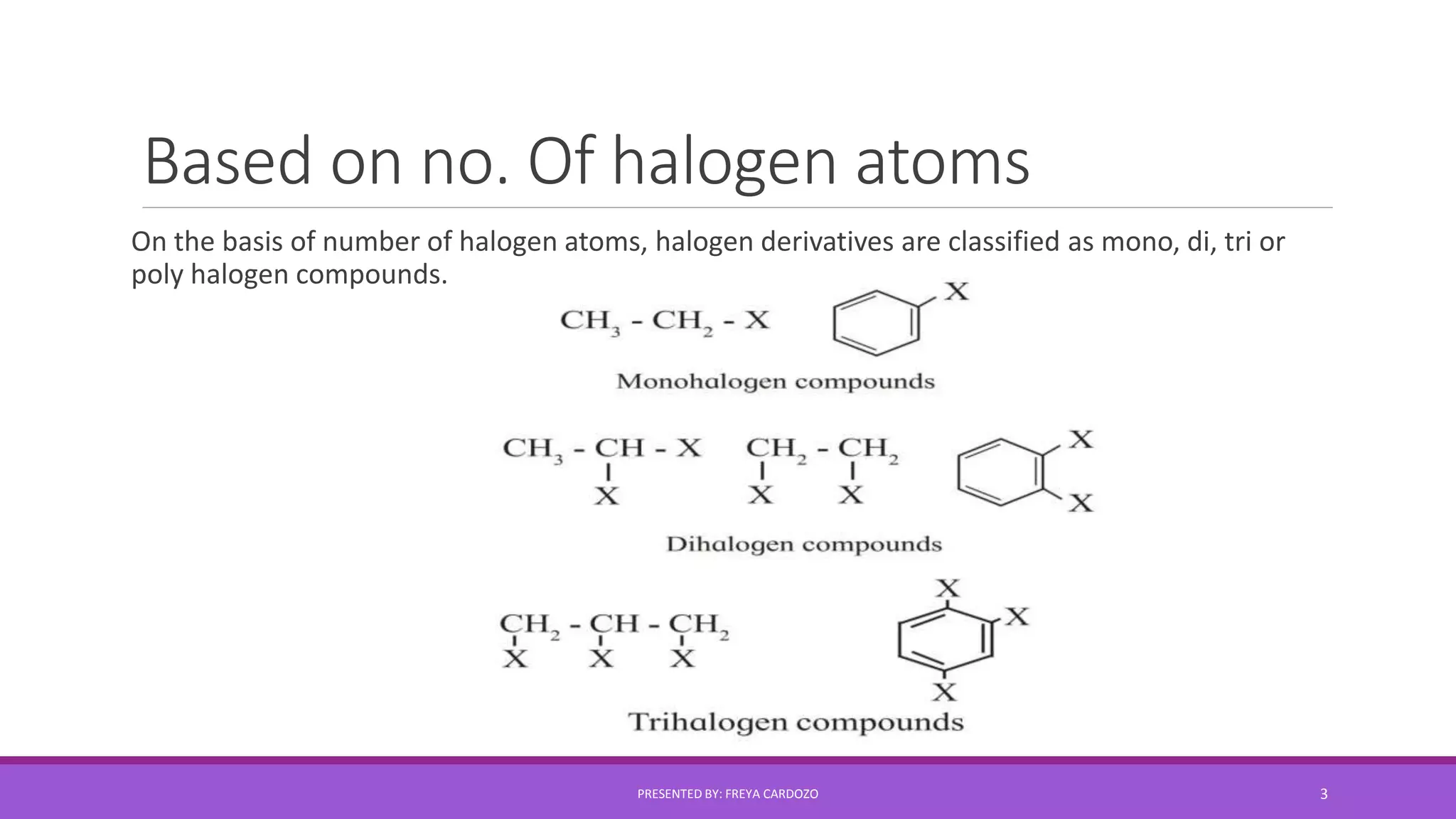
On the basis of number of halogen atoms, halogen derivatives are classified as mono, di, tri or
poly halogen compounds.
PRESENTED BY: FREYA CARDOZO 3
Monohalogen compunds
Alkyl halides or haloalkanes
Allylic halides
Benzylic halides
vinylic halides
Haloalkynes
Aryl halides or haloarenes
PRESENTED BY: FREYA CARDOZO 4
Haloalkanes or alkyl halides
halogen atom is bonded to sp3 hybridized carbon which is a part of saturated carbon skeleton.
Alkyl halides may be primary, secondary or tertiary depending on the substitution state of the
carbon to which halogen is attached
PRESENTED BY: FREYA CARDOZO 5
Identify
PRESENTED BY: FREYA CARDOZO 6
Allylic halides
In allylic halides, halogen
atom is bonded to a sp3
hybridized carbon
atom next to a carbon-carbon double bond
PRESENTED BY: FREYA CARDOZO 7
Benzylic halides
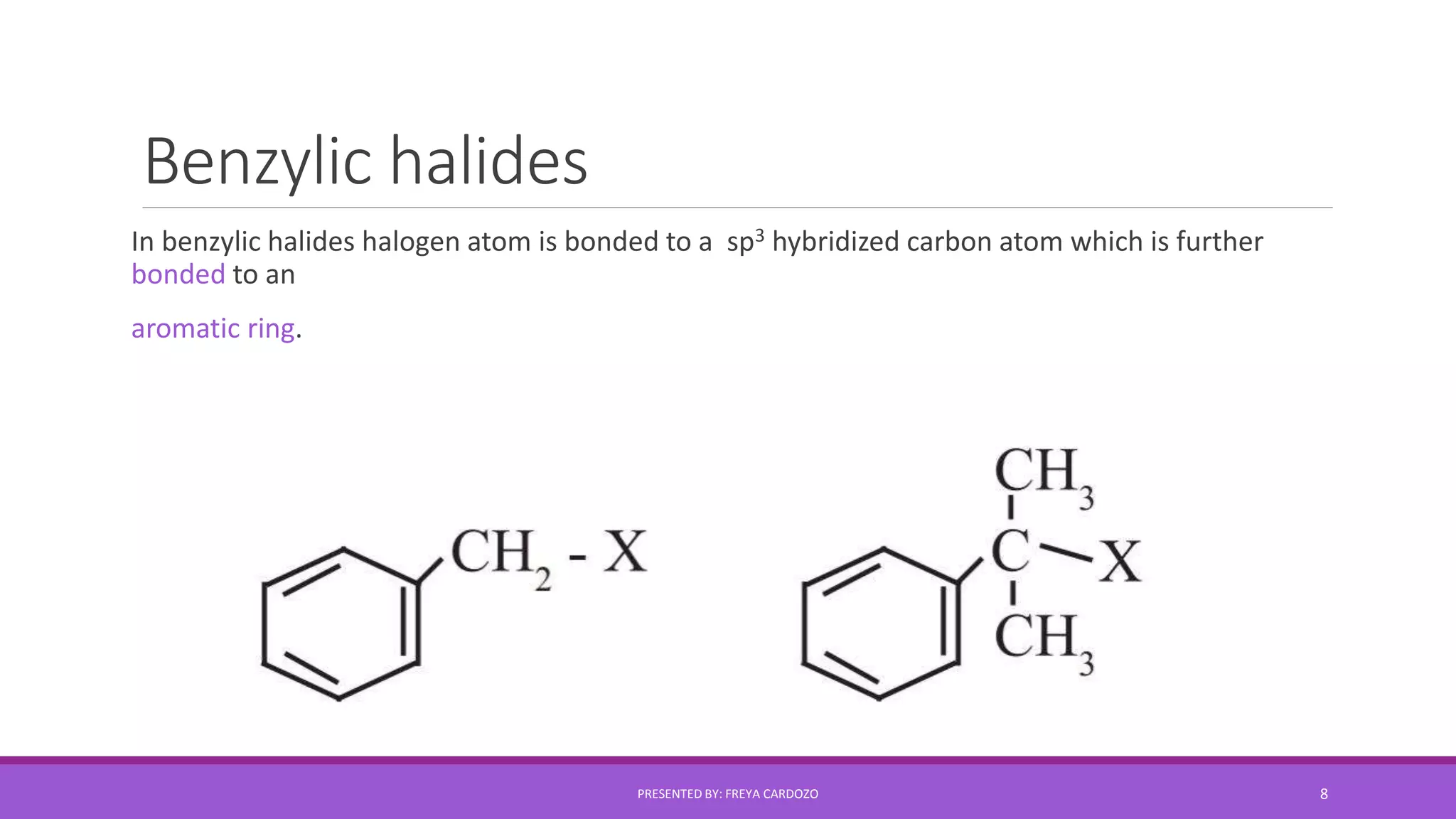
In benzylic halides halogen atom is bonded to a sp3 hybridized carbon atom which is further
bonded to an
aromatic ring.
PRESENTED BY: FREYA CARDOZO 8
Vinylic halides
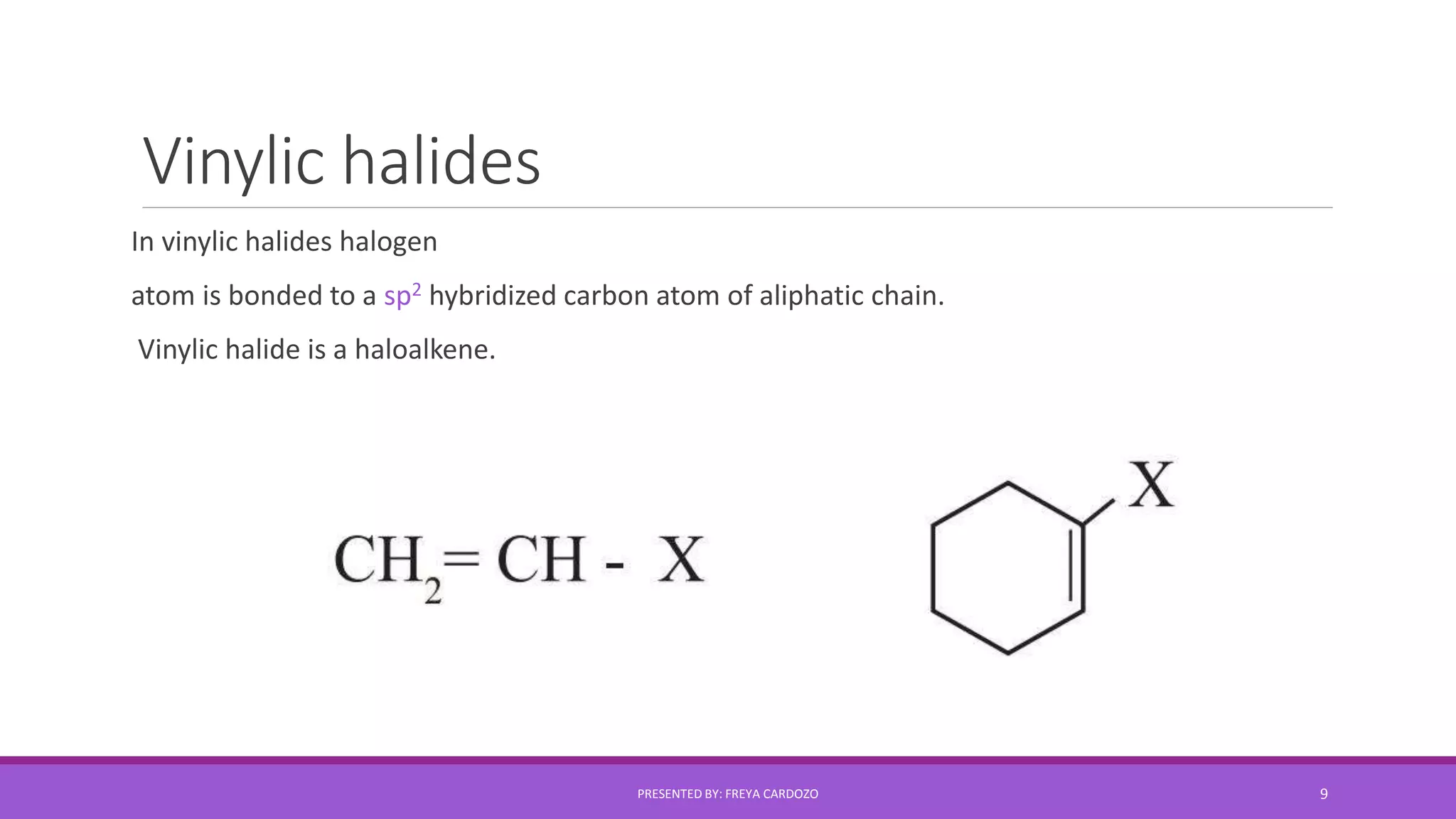
In vinylic halides halogen
atom is bonded to a sp2 hybridized carbon atom of aliphatic chain.
Vinylic halide is a haloalkene.
PRESENTED BY: FREYA CARDOZO 9
Haloalkynes
When a halogen atom is
bonded to a sp hybridized carbon atom it is
a haloalkyne.
PRESENTED BY: FREYA CARDOZO 10
Haloarenes or aryl halides
In aryl
halides, halogen atom is directly bonded to
the sp2 hybridized carbon atom of aromatic
Ring.
PRESENTED BY: FREYA CARDOZO 11
PRESENTED BY: FREYA CARDOZO 12
PRESENTED BY: FREYA CARDOZO 13
Things you need to know!
Carbon ke 4 haath hai, so it can always form only 4 bonds
-ane = single bonds, ene = double bond, yne = triple bond, -ol= OH group i.e. alcohol
Rememeber
1 C Methane F Fluoride Fluoro
2 C Ethane Br Bromine Bromo
3 C Propane Cl Chlorine Chloro
4 C Butane I Iodine Iodo
5 C Pentane
6 C Hexane
PRESENTED BY: FREYA CARDOZO 14
Preperation of alkyl
halide
PRESENTED BY: FREYA CARDOZO 15
Four main methods
• Using hydrogen halides (HX)
• Using phosphorus halide (PCl3 ; PCl5)
• Using thionyl chloride (SoCl2)
From alcohol
• Alkane
• Alkenes – For asymmetrical alkenes  Markonikoff and Anti-Markonikoff
From hydrocarbon –
alkene
• Finkelstein reaction
• Swartz reactionHalogen exchange
Electrophilic
substitution
PRESENTED BY: FREYA CARDOZO 16
From Alcohols- Hydrogen acids
R-OH + HX
PRESENTED BY: FREYA CARDOZO 17
From HCl
PRESENTED BY: FREYA CARDOZO 18
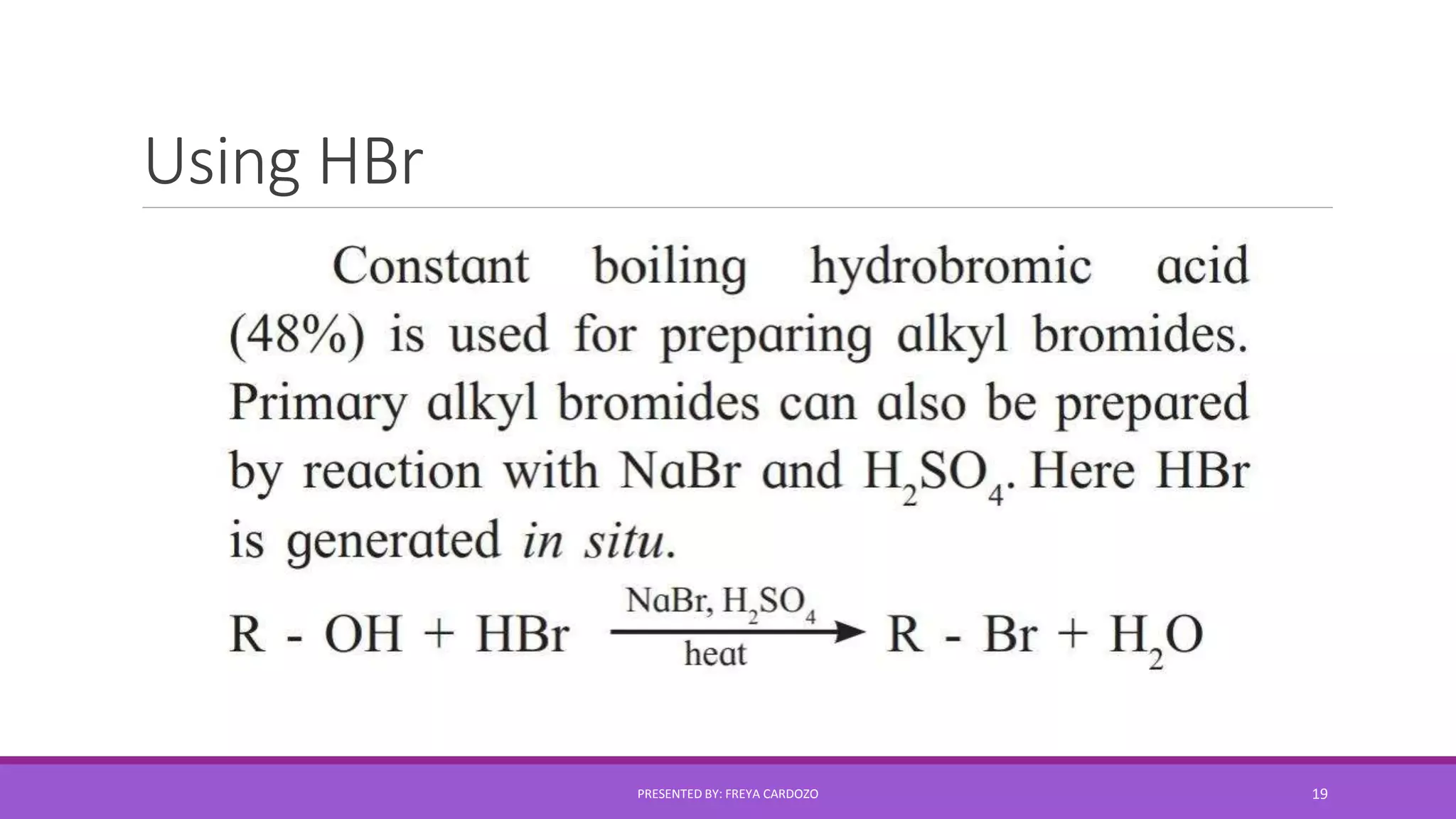
Using HBr
PRESENTED BY: FREYA CARDOZO 19
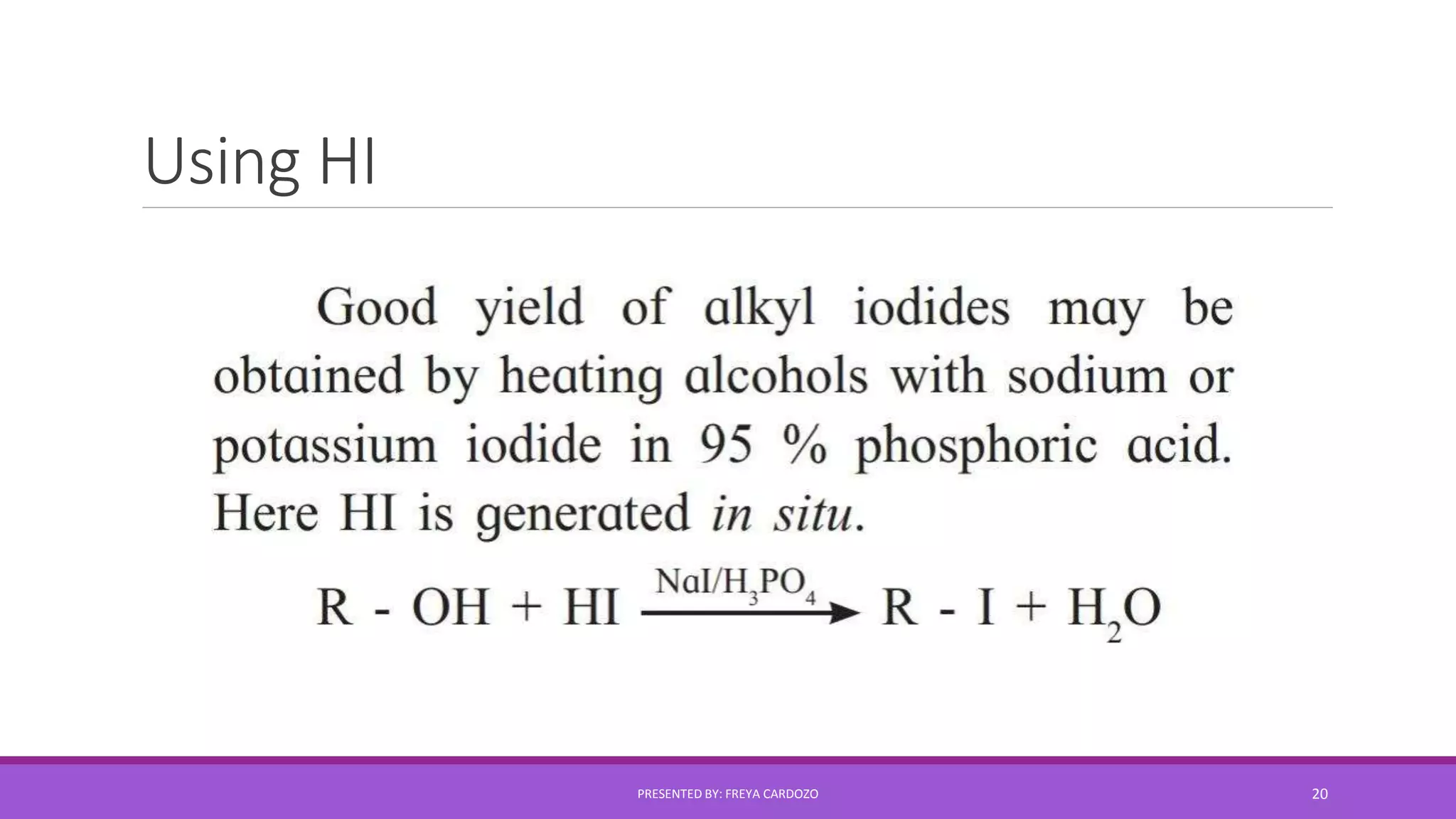
Using HI
PRESENTED BY: FREYA CARDOZO 20
Phosphorus trichloride PCl3
PRESENTED BY: FREYA CARDOZO 21
Phosphorus pentachloride PCl5
PRESENTED BY: FREYA CARDOZO 22
PRESENTED BY: FREYA CARDOZO 23
Thionyl Chloride SOCl2
PRESENTED BY: FREYA CARDOZO 24
PRESENTED BY: FREYA CARDOZO 25
From Hydrocarbons
Alkanes
Alkenes
Alkenes + CCl4
PRESENTED BY: FREYA CARDOZO 26
PRESENTED BY: FREYA CARDOZO 27
PRESENTED BY: FREYA CARDOZO 28
Write reaction and iupac name of major
product
PRESENTED BY: FREYA CARDOZO 29
PRESENTED BY: FREYA CARDOZO 30
Halogen exchange reaction
Finkelstein reaction
PRESENTED BY: FREYA CARDOZO 31
Swartz reaction
PRESENTED BY: FREYA CARDOZO 32
Electrophilic substitution
PRESENTED BY: FREYA CARDOZO 33
Electrophilic substitution
PRESENTED BY: FREYA CARDOZO 34
Questions
Convert
1. But-1-ene to n-butyl iodide
2. Aniline to chlorobenzene
PRESENTED BY: FREYA CARDOZO 35
PRESENTED BY: FREYA CARDOZO 36
PRESENTED BY: FREYA CARDOZO 37
PRESENTED BY: FREYA CARDOZO 38
Physical properties
PRESENTED BY: FREYA CARDOZO 39
Bond strength
Carbon atom that carries halogen develops a partial positive charge while the halogen carries a
partial negative charge. Thus carbon-halogen bond in alkyl halide is a polar covalent bond.
Therefore alkyl halides are moderately polar compounds
Size of the halogen atom increases from fluorine to iodine. Hence the C-X bond length increases.
The C-X bond strength decreases with an increase in size of halogen.
This is because as the size of p-orbital of halogen increases the p-orbital becomes more
diffusedand the extent of overlap with orbital of carbon decreases
PRESENTED BY: FREYA CARDOZO 40
PRESENTED BY: FREYA CARDOZO 41
Boiling point
Boiling points of alkyl halides are considerably higher than those of corresponding alkanes due
to higher polarity and higher molecular mass
1. For alkyl halides with same R group the B.P depends upon the size of halogen atom.More
larger the atom more is B.P . Because Vander waals forces increase
Thus boiling point of alkyl halide decreases in the order RI > RBr > RCl > RF
PRESENTED BY: FREYA CARDOZO 42
2. With same X atom and different R group...
Longer R group chain or more number of carbon atoms
More is the Vander waal forces
Higher B.p
PRESENTED BY: FREYA CARDOZO 43
3. For isomeric alkanes i.e R group with same number of carbon atoms
More the branching
Lesser the surface area
Lesser Vander waal forces
Thus lesser B.P
PRESENTED BY: FREYA CARDOZO 44
Question
Arrange the following
compounds in order of increasing boiling
points : bromoform, chloromethane,
dibromomethane, bromomethane.
PRESENTED BY: FREYA CARDOZO 45
Solubility
Though alkyl halides
are moderately polar, they are insoluble in
water. It is due to inability of alkyl halides to
form hydrogen bonds with water. Attraction
between alkyl halide molecules is stronger
than attraction between alkyl halide and
water. Alkyl halides are soluble in non-polar
organic solvents.
Aryl halides are also insoluble in water
but soluble in organic solvents.
PRESENTED BY: FREYA CARDOZO 46
Alkyl halides though polar are immiscible with water.Give reason
PRESENTED BY: FREYA CARDOZO 47
Reactions of alkyl
halides
• L A B T E S T
• S U B S T I T U T I O N R E A C T I O N S
• D E H Y D R O H A L O G R N A T I O N / B E T A E L I M I N A T I O N
•
PRESENTED BY: FREYA CARDOZO 48
Lab test
PRESENTED BY: FREYA CARDOZO 49
Substitution reactions
Formation of
1. alcohol
2. Amines
3. cyanide
4. Isocyanide
5. Esters
6. Ethers
7. Nitroalkanes
8. Alkyl nitrite
PRESENTED BY: FREYA CARDOZO 50
PRESENTED BY: FREYA CARDOZO 51
PRESENTED BY: FREYA CARDOZO 52
PRESENTED BY: FREYA CARDOZO 53
PRESENTED BY: FREYA CARDOZO 54
PRESENTED BY: FREYA CARDOZO 55
PRESENTED BY: FREYA CARDOZO 56
PRESENTED BY: FREYA CARDOZO 57
PRESENTED BY: FREYA CARDOZO 58
Optical activity
PRESENTED BY: FREYA CARDOZO 59
Draw 2-chlorobutane
PRESENTED BY: FREYA CARDOZO 60
Carbon atom in a molecule which carries four different groups/atoms is called chiral carbon
atom.
Thus, the C-2 in 2-chlorobutane is a chiral carbon. Chiral atom in a molecule is marked with
asterisk (*).
PRESENTED BY: FREYA CARDOZO 61
PRESENTED BY: FREYA CARDOZO 62
PRESENTED BY: FREYA CARDOZO 63
Optical isomers and optical activity
The stereoisomerism in which the isomers have different spatial arrangements of groups/atoms
around a chiral atom is called optical isomerism.
The optical isomers differ from each other in terms of a measurable property called optical
activity
PRESENTED BY: FREYA CARDOZO 64
Plane polarized light
light having oscillations only in one plane perpendicular to direction of propagation of light is
known as plane polarized light.
PRESENTED BY: FREYA CARDOZO 65
PRESENTED BY: FREYA CARDOZO 66
Definitions
property of a substance by which it rotates plane of polarization of incident plane polarized light is
known as optical activity.
The compounds which rotate the plane of plane polarized light are called optically active compounds
and those which do not rotate it are optically inactive compounds.
Optical activity of a substance is expressed numerically in terms of optical rotation. The angle
through which a substance rotates the plane of plane polarized light on passing through it is called
optical rotation.
In accordance with the direction of optical rotation an optically active substance is either
dextrorotatory or laevorotatory.
A compound which rotates the plane of plane polarized light towards right is called dextrorotatoryand
designated by symbol d- or by (+)sign.
A compound which rotates plane of Plane polarized light towards left is called laevorotatory and
designated by symbol l-or by (-) sign.
PRESENTED BY: FREYA CARDOZO 67
Enantiomers
The optical isomers which are non-superimposable mirror image of each other are called
enantiomers or enantiomorphs or optical antipodes.
Enantiomers have equal and opposite optical rotation. Thus, enantiomers are a kind of optical
isomers.
Enantiomers have identical physical properties (Such as melting point, boiling points, densities,
refractive index) except the sign of optical rotation.
The magnitude of their optical rotation is equal but the sign of optical rotation is opposite.
They have identical chemical properties except towards optically active reagent.
PRESENTED BY: FREYA CARDOZO 68
PRESENTED BY: FREYA CARDOZO 69
Racemic mixture
An equimolar mixture of enantiomers (dextrorotatory and laevorotatory) is called racemic
modification or racemic mixture.
A racemic modification is optically inactive because optical rotation due to molecules of one
enatiomer is cancelled by equal and opposite optical rotation due to molecules of the other
enantiomer.
A racemic modification is designated as (dl) or by (±) sign.
PRESENTED BY: FREYA CARDOZO 70
SN mechanism
PRESENTED BY: FREYA CARDOZO 71
PRESENTED BY: FREYA CARDOZO 72
PRESENTED BY: FREYA CARDOZO 73
PRESENTED BY: FREYA CARDOZO 74
Distinguish between
PRESENTED BY: FREYA CARDOZO 75
Factors influencing SN1 and SN2
mechanism
Nature of substrate
Nucleophilicity of reagent
solvent polarity
PRESENTED BY: FREYA CARDOZO 76
Nature of substrate
1° alkyl halide – SN2 reaction
3° alkyl halide – SN1 reaction
T.S in SN2 is pentacoordinate carbon which is crowded this not favoured by 3°
Steric hinderance doesn’t allow 3° to proceed by this mechanism
For SN1 it proceeds with formation of carbocation which is stabilized by hyperconjugation and +I
inductive effect of alkyl group
Thus favours 3° R-X
PRESENTED BY: FREYA CARDOZO 77
Nucleophilicity of reagent
Nucleophilicity is similiar to concept of Lewis base
Lewis base- donates an electron pair
easier the nucleophile donating the electron pair better Nucleophilic reagent
In SN2 reaction rate depends on nucleophile thus stronger nucleophile will be needed for such
reaction
Poor nucleophile undergo SN1 beacuse rate is independent of nucleophile
PRESENTED BY: FREYA CARDOZO 78
Solvent polarity
SN1 reactions proceed rapidly in protic and polar solvents
SN1mechanism proceeds via formation of carbocation intermediate.
A good ionizing solvent, polar solvent, stabilizes the ions by solvation.
Cations are poorly solvated but anions solvation is of key importance
Anions are solvated by hydrogen bonding solvents, that is, protic solvents
PRESENTED BY: FREYA CARDOZO 79
aprotic solvents or solvents of low polarity will favour SN2 mechanism.
Polar protic solvents usually decrease the rate of SN2 reaction.
In the rate determining step of SN2 mechanism substrate as well as nucleophile is involved.
A polar solvent stabilizes nucleophile (one of the reactant) by solvation. Thus solvent deactivates
the nucleophile by stabilizing it.
PRESENTED BY: FREYA CARDOZO 80
Which of the following
two compounds would react faster by SN2
mechanism and Why ?
1-chlorobutane and 2-chlorobutane
PRESENTED BY: FREYA CARDOZO 81
PRESENTED BY: FREYA CARDOZO 82
PRESENTED BY: FREYA CARDOZO 83
PRESENTED BY: FREYA CARDOZO 84
Primary allylic and primary benzylic halides show higher reactivity by SN1 mechanism than other
primary alkyl halides. Explain.
PRESENTED BY: FREYA CARDOZO 85
PRESENTED BY: FREYA CARDOZO 86
PRESENTED BY: FREYA CARDOZO 87
PRESENTED BY: FREYA CARDOZO 88
Haloarenes
PRESENTED BY: FREYA CARDOZO 89
Sandmeyers reaction
Aniline reacts with nitrous acid HNO2 (NaNo2 + HCl) to give benzene diazonium chloride which
when treated with copper chloride forms Chlorobenzene and nitrogen gas.
PRESENTED BY: FREYA CARDOZO 90
Reaction with metals
PRESENTED BY: FREYA CARDOZO 91
Fittig Reaction
PRESENTED BY: FREYA CARDOZO 92
Wurtz fittig Reaction
PRESENTED BY: FREYA CARDOZO 93
G.R
Why cleavage of C-X bonds in haloarenes proceeds with great difficulty?
Resonance effect
Sp2 hybridization of carbon chlorine
PRESENTED BY: FREYA CARDOZO 94
How to break C-X bond
Placing –I or electronwithdrawing groups at the o or p position
More grps easier reaction
PRESENTED BY: FREYA CARDOZO 95
Nucleophilic substitution
PRESENTED BY: FREYA CARDOZO 96
PRESENTED BY: FREYA CARDOZO 97
GR. Therefore Cl is o-/p- directing but
ring deactivating group.
PRESENTED BY: FREYA CARDOZO 98
GR.
Aryl halides undergo electrophilic substitution reaction slowly as compared to benzene.
In resonance structures of chlorobenzene elelctron density is relatively more at ortho and para
position.
Therefore incoming electrophilic group is more likely to attack at these positions. But due to
steric hinderance at ortho position, para product usually predominates.
In haloarenes, halogen atom has strong electron withdrawing inductive effect (-I).
This deactivates the ring and electrophilic substitution reaction occurs slowly.
PRESENTED BY: FREYA CARDOZO 99
Electrophilic substitution
PRESENTED BY: FREYA CARDOZO 100
Halogenation
PRESENTED BY: FREYA CARDOZO 101
Nitration
PRESENTED BY: FREYA CARDOZO 102
SULphonation
PRESENTED BY: FREYA CARDOZO 103
Fridel crafts Alkylation
PRESENTED BY: FREYA CARDOZO 104
Fridel crafts acylation
PRESENTED BY: FREYA CARDOZO 105

Halogen derivates of alkanes HDA

  • 1.
    Halogen derivatives PRESENTED BY: FREYACARDOZO PRESENTED BY: FREYA CARDOZO 1
  • 2.
    Classification based onHydrocarbon skeleton On the basis of hydrocarbon skeleton to which halogen atom is bonded, the halogen derivatives are classified as haloalkanes, haloalkenes, haloalkynes and haloarenes. PRESENTED BY: FREYA CARDOZO 2
  • 3.
    Based on no.Of halogen atoms On the basis of number of halogen atoms, halogen derivatives are classified as mono, di, tri or poly halogen compounds. PRESENTED BY: FREYA CARDOZO 3
  • 4.
    Monohalogen compunds Alkyl halidesor haloalkanes Allylic halides Benzylic halides vinylic halides Haloalkynes Aryl halides or haloarenes PRESENTED BY: FREYA CARDOZO 4
  • 5.
    Haloalkanes or alkylhalides halogen atom is bonded to sp3 hybridized carbon which is a part of saturated carbon skeleton. Alkyl halides may be primary, secondary or tertiary depending on the substitution state of the carbon to which halogen is attached PRESENTED BY: FREYA CARDOZO 5
  • 6.
  • 7.
    Allylic halides In allylichalides, halogen atom is bonded to a sp3 hybridized carbon atom next to a carbon-carbon double bond PRESENTED BY: FREYA CARDOZO 7
  • 8.
    Benzylic halides In benzylichalides halogen atom is bonded to a sp3 hybridized carbon atom which is further bonded to an aromatic ring. PRESENTED BY: FREYA CARDOZO 8
  • 9.
    Vinylic halides In vinylichalides halogen atom is bonded to a sp2 hybridized carbon atom of aliphatic chain. Vinylic halide is a haloalkene. PRESENTED BY: FREYA CARDOZO 9
  • 10.
    Haloalkynes When a halogenatom is bonded to a sp hybridized carbon atom it is a haloalkyne. PRESENTED BY: FREYA CARDOZO 10
  • 11.
    Haloarenes or arylhalides In aryl halides, halogen atom is directly bonded to the sp2 hybridized carbon atom of aromatic Ring. PRESENTED BY: FREYA CARDOZO 11
  • 12.
  • 13.
  • 14.
    Things you needto know! Carbon ke 4 haath hai, so it can always form only 4 bonds -ane = single bonds, ene = double bond, yne = triple bond, -ol= OH group i.e. alcohol Rememeber 1 C Methane F Fluoride Fluoro 2 C Ethane Br Bromine Bromo 3 C Propane Cl Chlorine Chloro 4 C Butane I Iodine Iodo 5 C Pentane 6 C Hexane PRESENTED BY: FREYA CARDOZO 14
  • 15.
  • 16.
    Four main methods •Using hydrogen halides (HX) • Using phosphorus halide (PCl3 ; PCl5) • Using thionyl chloride (SoCl2) From alcohol • Alkane • Alkenes – For asymmetrical alkenes  Markonikoff and Anti-Markonikoff From hydrocarbon – alkene • Finkelstein reaction • Swartz reactionHalogen exchange Electrophilic substitution PRESENTED BY: FREYA CARDOZO 16
  • 17.
    From Alcohols- Hydrogenacids R-OH + HX PRESENTED BY: FREYA CARDOZO 17
  • 18.
    From HCl PRESENTED BY:FREYA CARDOZO 18
  • 19.
    Using HBr PRESENTED BY:FREYA CARDOZO 19
  • 20.
    Using HI PRESENTED BY:FREYA CARDOZO 20
  • 21.
  • 22.
  • 23.
  • 24.
  • 25.
  • 26.
    From Hydrocarbons Alkanes Alkenes Alkenes +CCl4 PRESENTED BY: FREYA CARDOZO 26
  • 27.
  • 28.
  • 29.
    Write reaction andiupac name of major product PRESENTED BY: FREYA CARDOZO 29
  • 30.
  • 31.
    Halogen exchange reaction Finkelsteinreaction PRESENTED BY: FREYA CARDOZO 31
  • 32.
  • 33.
  • 34.
  • 35.
    Questions Convert 1. But-1-ene ton-butyl iodide 2. Aniline to chlorobenzene PRESENTED BY: FREYA CARDOZO 35
  • 36.
  • 37.
  • 38.
  • 39.
  • 40.
    Bond strength Carbon atomthat carries halogen develops a partial positive charge while the halogen carries a partial negative charge. Thus carbon-halogen bond in alkyl halide is a polar covalent bond. Therefore alkyl halides are moderately polar compounds Size of the halogen atom increases from fluorine to iodine. Hence the C-X bond length increases. The C-X bond strength decreases with an increase in size of halogen. This is because as the size of p-orbital of halogen increases the p-orbital becomes more diffusedand the extent of overlap with orbital of carbon decreases PRESENTED BY: FREYA CARDOZO 40
  • 41.
  • 42.
    Boiling point Boiling pointsof alkyl halides are considerably higher than those of corresponding alkanes due to higher polarity and higher molecular mass 1. For alkyl halides with same R group the B.P depends upon the size of halogen atom.More larger the atom more is B.P . Because Vander waals forces increase Thus boiling point of alkyl halide decreases in the order RI > RBr > RCl > RF PRESENTED BY: FREYA CARDOZO 42
  • 43.
    2. With sameX atom and different R group... Longer R group chain or more number of carbon atoms More is the Vander waal forces Higher B.p PRESENTED BY: FREYA CARDOZO 43
  • 44.
    3. For isomericalkanes i.e R group with same number of carbon atoms More the branching Lesser the surface area Lesser Vander waal forces Thus lesser B.P PRESENTED BY: FREYA CARDOZO 44
  • 45.
    Question Arrange the following compoundsin order of increasing boiling points : bromoform, chloromethane, dibromomethane, bromomethane. PRESENTED BY: FREYA CARDOZO 45
  • 46.
    Solubility Though alkyl halides aremoderately polar, they are insoluble in water. It is due to inability of alkyl halides to form hydrogen bonds with water. Attraction between alkyl halide molecules is stronger than attraction between alkyl halide and water. Alkyl halides are soluble in non-polar organic solvents. Aryl halides are also insoluble in water but soluble in organic solvents. PRESENTED BY: FREYA CARDOZO 46
  • 47.
    Alkyl halides thoughpolar are immiscible with water.Give reason PRESENTED BY: FREYA CARDOZO 47
  • 48.
    Reactions of alkyl halides •L A B T E S T • S U B S T I T U T I O N R E A C T I O N S • D E H Y D R O H A L O G R N A T I O N / B E T A E L I M I N A T I O N • PRESENTED BY: FREYA CARDOZO 48
  • 49.
    Lab test PRESENTED BY:FREYA CARDOZO 49
  • 50.
    Substitution reactions Formation of 1.alcohol 2. Amines 3. cyanide 4. Isocyanide 5. Esters 6. Ethers 7. Nitroalkanes 8. Alkyl nitrite PRESENTED BY: FREYA CARDOZO 50
  • 51.
  • 52.
  • 53.
  • 54.
  • 55.
  • 56.
  • 57.
  • 58.
  • 59.
  • 60.
  • 61.
    Carbon atom ina molecule which carries four different groups/atoms is called chiral carbon atom. Thus, the C-2 in 2-chlorobutane is a chiral carbon. Chiral atom in a molecule is marked with asterisk (*). PRESENTED BY: FREYA CARDOZO 61
  • 62.
  • 63.
  • 64.
    Optical isomers andoptical activity The stereoisomerism in which the isomers have different spatial arrangements of groups/atoms around a chiral atom is called optical isomerism. The optical isomers differ from each other in terms of a measurable property called optical activity PRESENTED BY: FREYA CARDOZO 64
  • 65.
    Plane polarized light lighthaving oscillations only in one plane perpendicular to direction of propagation of light is known as plane polarized light. PRESENTED BY: FREYA CARDOZO 65
  • 66.
  • 67.
    Definitions property of asubstance by which it rotates plane of polarization of incident plane polarized light is known as optical activity. The compounds which rotate the plane of plane polarized light are called optically active compounds and those which do not rotate it are optically inactive compounds. Optical activity of a substance is expressed numerically in terms of optical rotation. The angle through which a substance rotates the plane of plane polarized light on passing through it is called optical rotation. In accordance with the direction of optical rotation an optically active substance is either dextrorotatory or laevorotatory. A compound which rotates the plane of plane polarized light towards right is called dextrorotatoryand designated by symbol d- or by (+)sign. A compound which rotates plane of Plane polarized light towards left is called laevorotatory and designated by symbol l-or by (-) sign. PRESENTED BY: FREYA CARDOZO 67
  • 68.
    Enantiomers The optical isomerswhich are non-superimposable mirror image of each other are called enantiomers or enantiomorphs or optical antipodes. Enantiomers have equal and opposite optical rotation. Thus, enantiomers are a kind of optical isomers. Enantiomers have identical physical properties (Such as melting point, boiling points, densities, refractive index) except the sign of optical rotation. The magnitude of their optical rotation is equal but the sign of optical rotation is opposite. They have identical chemical properties except towards optically active reagent. PRESENTED BY: FREYA CARDOZO 68
  • 69.
  • 70.
    Racemic mixture An equimolarmixture of enantiomers (dextrorotatory and laevorotatory) is called racemic modification or racemic mixture. A racemic modification is optically inactive because optical rotation due to molecules of one enatiomer is cancelled by equal and opposite optical rotation due to molecules of the other enantiomer. A racemic modification is designated as (dl) or by (±) sign. PRESENTED BY: FREYA CARDOZO 70
  • 71.
  • 72.
  • 73.
  • 74.
  • 75.
  • 76.
    Factors influencing SN1and SN2 mechanism Nature of substrate Nucleophilicity of reagent solvent polarity PRESENTED BY: FREYA CARDOZO 76
  • 77.
    Nature of substrate 1°alkyl halide – SN2 reaction 3° alkyl halide – SN1 reaction T.S in SN2 is pentacoordinate carbon which is crowded this not favoured by 3° Steric hinderance doesn’t allow 3° to proceed by this mechanism For SN1 it proceeds with formation of carbocation which is stabilized by hyperconjugation and +I inductive effect of alkyl group Thus favours 3° R-X PRESENTED BY: FREYA CARDOZO 77
  • 78.
    Nucleophilicity of reagent Nucleophilicityis similiar to concept of Lewis base Lewis base- donates an electron pair easier the nucleophile donating the electron pair better Nucleophilic reagent In SN2 reaction rate depends on nucleophile thus stronger nucleophile will be needed for such reaction Poor nucleophile undergo SN1 beacuse rate is independent of nucleophile PRESENTED BY: FREYA CARDOZO 78
  • 79.
    Solvent polarity SN1 reactionsproceed rapidly in protic and polar solvents SN1mechanism proceeds via formation of carbocation intermediate. A good ionizing solvent, polar solvent, stabilizes the ions by solvation. Cations are poorly solvated but anions solvation is of key importance Anions are solvated by hydrogen bonding solvents, that is, protic solvents PRESENTED BY: FREYA CARDOZO 79
  • 80.
    aprotic solvents orsolvents of low polarity will favour SN2 mechanism. Polar protic solvents usually decrease the rate of SN2 reaction. In the rate determining step of SN2 mechanism substrate as well as nucleophile is involved. A polar solvent stabilizes nucleophile (one of the reactant) by solvation. Thus solvent deactivates the nucleophile by stabilizing it. PRESENTED BY: FREYA CARDOZO 80
  • 81.
    Which of thefollowing two compounds would react faster by SN2 mechanism and Why ? 1-chlorobutane and 2-chlorobutane PRESENTED BY: FREYA CARDOZO 81
  • 82.
  • 83.
  • 84.
  • 85.
    Primary allylic andprimary benzylic halides show higher reactivity by SN1 mechanism than other primary alkyl halides. Explain. PRESENTED BY: FREYA CARDOZO 85
  • 86.
  • 87.
  • 88.
  • 89.
  • 90.
    Sandmeyers reaction Aniline reactswith nitrous acid HNO2 (NaNo2 + HCl) to give benzene diazonium chloride which when treated with copper chloride forms Chlorobenzene and nitrogen gas. PRESENTED BY: FREYA CARDOZO 90
  • 91.
    Reaction with metals PRESENTEDBY: FREYA CARDOZO 91
  • 92.
  • 93.
    Wurtz fittig Reaction PRESENTEDBY: FREYA CARDOZO 93
  • 94.
    G.R Why cleavage ofC-X bonds in haloarenes proceeds with great difficulty? Resonance effect Sp2 hybridization of carbon chlorine PRESENTED BY: FREYA CARDOZO 94
  • 95.
    How to breakC-X bond Placing –I or electronwithdrawing groups at the o or p position More grps easier reaction PRESENTED BY: FREYA CARDOZO 95
  • 96.
  • 97.
  • 98.
    GR. Therefore Clis o-/p- directing but ring deactivating group. PRESENTED BY: FREYA CARDOZO 98
  • 99.
    GR. Aryl halides undergoelectrophilic substitution reaction slowly as compared to benzene. In resonance structures of chlorobenzene elelctron density is relatively more at ortho and para position. Therefore incoming electrophilic group is more likely to attack at these positions. But due to steric hinderance at ortho position, para product usually predominates. In haloarenes, halogen atom has strong electron withdrawing inductive effect (-I). This deactivates the ring and electrophilic substitution reaction occurs slowly. PRESENTED BY: FREYA CARDOZO 99
  • 100.
  • 101.
  • 102.
  • 103.
  • 104.
  • 105.
    Fridel crafts acylation PRESENTEDBY: FREYA CARDOZO 105