“To encourage and empower small rural communities to
take ownership of and develop community led renewable
energy solutions for the benefit of their own locality”
Ss
Biogas / Anaerobic Digestion for the Community
Noel Gavigan
Technical Executive
Irish BioEnergy Association
Noelgavigan [at] irbea.ie
• Recycles organic material
• Recovers the energy and
converts it into usable gas
• Recovers the nutrients and
allows them be used back on
farmland
BIOGAS DIGESTER
Animal slurries,
Energy Crops
Food Waste,
Food
processing
Waste
Electricity Heat Vehicle Fuel
Digestate
Fertiliser
What is Biogas /
Anaerobic digestion??
https://www.youtube.com/watch?t=3&v
=KgUwdepePF4
What is Biogas? - What Happens?
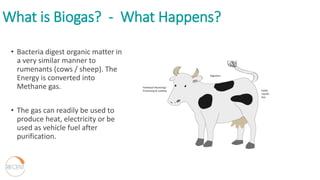
• Bacteria digest organic matter in
a very similar manner to
rumenants (cows / sheep). The
Energy is converted into
Methane gas.
• The gas can readily be used to
produce heat, electricity or be
used as vehicle fuel after
purification.
Industrial Scale Biogas
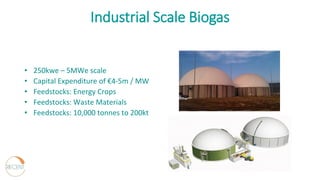
• 250kwe – 5MWe scale
• Capital Expenditure of €4-5m / MW
• Feedstocks: Energy Crops
• Feedstocks: Waste Materials
• Feedstocks: 10,000 tonnes to 200kt
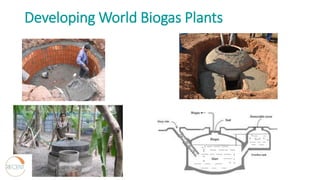
Developing World Biogas Plants
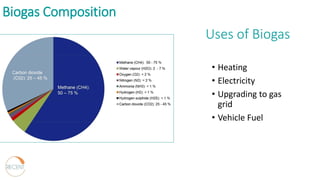
Biogas Composition
• Heating
• Electricity
• Upgrading to gas
grid
• Vehicle Fuel
Uses of Biogas
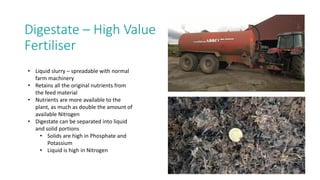
Digestate – High Value
Fertiliser
• Liquid slurry – spreadable with normal
farm machinery
• Retains all the original nutrients from
the feed material
• Nutrients are more available to the
plant, as much as double the amount of
available Nitrogen
• Digestate can be separated into liquid
and solid portions
• Solids are high in Phosphate and
Potassium
• Liquid is high in Nitrogen
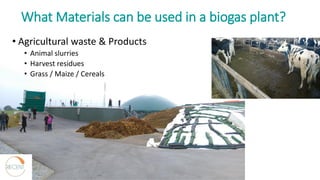
What Materials can be used in a biogas plant?
• Agricultural waste & Products
• Animal slurries
• Harvest residues
• Grass / Maize / Cereals
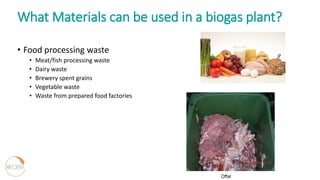
What Materials can be used in a biogas plant?
• Food processing waste
• Meat/fish processing waste
• Dairy waste
• Brewery spent grains
• Vegetable waste
• Waste from prepared food factories
Offal
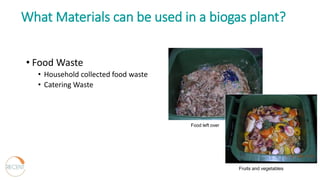
Food left over
Fruits and vegetables
• Food Waste
• Household collected food waste
• Catering Waste
What Materials can be used in a biogas plant?
Gas Yield from Various Materials
Substrate Dry matter Biogas
Methane
Content
Net Energy
Heating value Electricity Electric value
90% efficient 35% efficient 19c/kwh
[%]
m3
/ton fresh
weight
% kWH / Tonne @8c/kwh [kWh el./ton]
(not including heat
value)
Cattle Manure
8 25 60 162 € 11.70 57 € 10.80
Pig manure 6 20 60 130 € 9.36 45 € 8.64
Milk whey 8 58 53 333 € 23.97 117 € 22.14
Brewers yeast
(pressed, cooked)
25 152 62 1021 € 73.48 357 € 67.87
Potato pulp 19 108 50 585 € 42.11 205 € 38.89
Slaughterhouse
waste (rumen)
15 60 55 357 € 25.73 125 € 23.77
Bread and baking
residues
77 570 53 3272 € 235.57 1145 € 217.57
Corn silage 35 216 52 1216 € 87.58 426 € 80.89
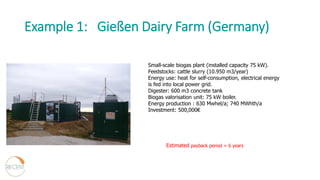
Example 1: Gießen Dairy Farm (Germany)
Small-scale biogas plant (installed capacity 75 kW).
Feedstocks: cattle slurry (10.950 m3/year)
Energy use: heat for self-consumption, electrical energy
is fed into local power grid.
Digester: 600 m3 concrete tank
Biogas valorisation unit: 75 kW boiler.
Energy production : 630 Mwhel/a; 740 MWhth/a
Investment: 500,000€
Estimated payback period = 6 years
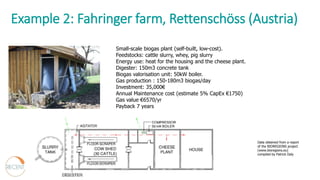
Example 2: Fahringer farm, Rettenschöss (Austria)
Small-scale biogas plant (self-built, low-cost).
Feedstocks: cattle slurry, whey, pig slurry
Energy use: heat for the housing and the cheese plant.
Digester: 150m3 concrete tank
Biogas valorisation unit: 50kW boiler.
Gas production : 150-180m3 biogas/day
Investment: 35,000€
Annual Maintenance cost (estimate 5% CapEx €1750)
Gas value €6570/yr
Payback 7 years
Data obtained from a report
of the BIOREGIONS project
(www.bioregions.eu)
compiled by Patrick Daly
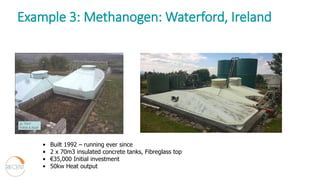
Example 3: Methanogen: Waterford, Ireland
• Built 1992 – running ever since
• 2 x 70m3 insulated concrete tanks, Fibreglass top
• €35,000 Initial investment
• 50kw Heat output
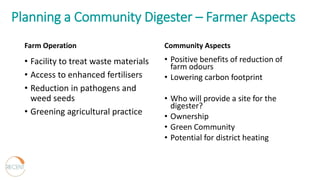
Planning a Community Digester – Farmer Aspects
Farm Operation
• Facility to treat waste materials
• Access to enhanced fertilisers
• Reduction in pathogens and
weed seeds
• Greening agricultural practice
Community Aspects
• Positive benefits of reduction of
farm odours
• Lowering carbon footprint
• Who will provide a site for the
digester?
• Ownership
• Green Community
• Potential for district heating
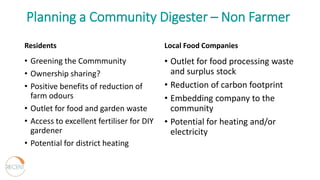
Planning a Community Digester – Non Farmer
Residents
• Greening the Commmunity
• Ownership sharing?
• Positive benefits of reduction of
farm odours
• Outlet for food and garden waste
• Access to excellent fertiliser for DIY
gardener
• Potential for district heating
Local Food Companies
• Outlet for food processing waste
and surplus stock
• Reduction of carbon footprint
• Embedding company to the
community
• Potential for heating and/or
electricity
What must be done?
• Survey of available feedstocks (Community Meetings)
• Identify a suitable site
• Identify suitable uses for the gas in terms of heat, electricity or gas
upgrading
• Community Meetings!
• Financial feasibility
• Regulatory aspects (planning, waste licencing etc..)
• Community Meetings!!
• Financing the project and ownership
• Community Meetings!!!
Ss
Biogas / Anaerobic Digestion for the Community
Noel Gavigan
Technical Executive
Irish BioEnergy Association
noelgavigan@irbea.ie

RECENT Biogas Presentation

  • 1.
    “To encourage andempower small rural communities to take ownership of and develop community led renewable energy solutions for the benefit of their own locality”
  • 2.
    Ss Biogas / AnaerobicDigestion for the Community Noel Gavigan Technical Executive Irish BioEnergy Association Noelgavigan [at] irbea.ie
  • 3.
    • Recycles organicmaterial • Recovers the energy and converts it into usable gas • Recovers the nutrients and allows them be used back on farmland BIOGAS DIGESTER Animal slurries, Energy Crops Food Waste, Food processing Waste Electricity Heat Vehicle Fuel Digestate Fertiliser What is Biogas / Anaerobic digestion?? https://www.youtube.com/watch?t=3&v =KgUwdepePF4
  • 4.
    What is Biogas?- What Happens? • Bacteria digest organic matter in a very similar manner to rumenants (cows / sheep). The Energy is converted into Methane gas. • The gas can readily be used to produce heat, electricity or be used as vehicle fuel after purification.
  • 5.
    Industrial Scale Biogas •250kwe – 5MWe scale • Capital Expenditure of €4-5m / MW • Feedstocks: Energy Crops • Feedstocks: Waste Materials • Feedstocks: 10,000 tonnes to 200kt
  • 6.
  • 7.
    Biogas Composition • Heating •Electricity • Upgrading to gas grid • Vehicle Fuel Uses of Biogas
  • 8.
    Digestate – HighValue Fertiliser • Liquid slurry – spreadable with normal farm machinery • Retains all the original nutrients from the feed material • Nutrients are more available to the plant, as much as double the amount of available Nitrogen • Digestate can be separated into liquid and solid portions • Solids are high in Phosphate and Potassium • Liquid is high in Nitrogen
  • 9.
    What Materials canbe used in a biogas plant? • Agricultural waste & Products • Animal slurries • Harvest residues • Grass / Maize / Cereals
  • 10.
    What Materials canbe used in a biogas plant? • Food processing waste • Meat/fish processing waste • Dairy waste • Brewery spent grains • Vegetable waste • Waste from prepared food factories Offal
  • 11.
    Food left over Fruitsand vegetables • Food Waste • Household collected food waste • Catering Waste What Materials can be used in a biogas plant?
  • 12.
    Gas Yield fromVarious Materials Substrate Dry matter Biogas Methane Content Net Energy Heating value Electricity Electric value 90% efficient 35% efficient 19c/kwh [%] m3 /ton fresh weight % kWH / Tonne @8c/kwh [kWh el./ton] (not including heat value) Cattle Manure 8 25 60 162 € 11.70 57 € 10.80 Pig manure 6 20 60 130 € 9.36 45 € 8.64 Milk whey 8 58 53 333 € 23.97 117 € 22.14 Brewers yeast (pressed, cooked) 25 152 62 1021 € 73.48 357 € 67.87 Potato pulp 19 108 50 585 € 42.11 205 € 38.89 Slaughterhouse waste (rumen) 15 60 55 357 € 25.73 125 € 23.77 Bread and baking residues 77 570 53 3272 € 235.57 1145 € 217.57 Corn silage 35 216 52 1216 € 87.58 426 € 80.89
  • 13.
    Example 1: GießenDairy Farm (Germany) Small-scale biogas plant (installed capacity 75 kW). Feedstocks: cattle slurry (10.950 m3/year) Energy use: heat for self-consumption, electrical energy is fed into local power grid. Digester: 600 m3 concrete tank Biogas valorisation unit: 75 kW boiler. Energy production : 630 Mwhel/a; 740 MWhth/a Investment: 500,000€ Estimated payback period = 6 years
  • 14.
    Example 2: Fahringerfarm, Rettenschöss (Austria) Small-scale biogas plant (self-built, low-cost). Feedstocks: cattle slurry, whey, pig slurry Energy use: heat for the housing and the cheese plant. Digester: 150m3 concrete tank Biogas valorisation unit: 50kW boiler. Gas production : 150-180m3 biogas/day Investment: 35,000€ Annual Maintenance cost (estimate 5% CapEx €1750) Gas value €6570/yr Payback 7 years Data obtained from a report of the BIOREGIONS project (www.bioregions.eu) compiled by Patrick Daly
  • 15.
    Example 3: Methanogen:Waterford, Ireland • Built 1992 – running ever since • 2 x 70m3 insulated concrete tanks, Fibreglass top • €35,000 Initial investment • 50kw Heat output
  • 16.
    Planning a CommunityDigester – Farmer Aspects Farm Operation • Facility to treat waste materials • Access to enhanced fertilisers • Reduction in pathogens and weed seeds • Greening agricultural practice Community Aspects • Positive benefits of reduction of farm odours • Lowering carbon footprint • Who will provide a site for the digester? • Ownership • Green Community • Potential for district heating
  • 17.
    Planning a CommunityDigester – Non Farmer Residents • Greening the Commmunity • Ownership sharing? • Positive benefits of reduction of farm odours • Outlet for food and garden waste • Access to excellent fertiliser for DIY gardener • Potential for district heating Local Food Companies • Outlet for food processing waste and surplus stock • Reduction of carbon footprint • Embedding company to the community • Potential for heating and/or electricity
  • 18.
    What must bedone? • Survey of available feedstocks (Community Meetings) • Identify a suitable site • Identify suitable uses for the gas in terms of heat, electricity or gas upgrading • Community Meetings! • Financial feasibility • Regulatory aspects (planning, waste licencing etc..) • Community Meetings!! • Financing the project and ownership • Community Meetings!!!
  • 19.
    Ss Biogas / AnaerobicDigestion for the Community Noel Gavigan Technical Executive Irish BioEnergy Association noelgavigan@irbea.ie