INTEGERS
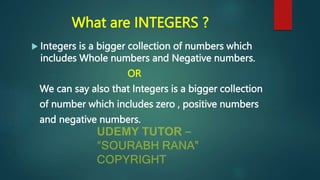
What are INTEGERS ?
 Integers is a bigger collection of numbers which
includes Whole numbers and Negative numbers.
OR
We can say also that Integers is a bigger collection
of number which includes zero , positive numbers
and negative numbers.
Properties of Addition/Subtraction of
Integers
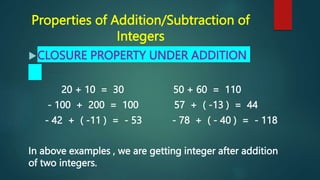
CLOSURE PROPERTY UNDER ADDITION
20 + 10 = 30 50 + 60 = 110
- 100 + 200 = 100 57 + ( -13 ) = 44
- 42 + ( -11 ) = - 53 - 78 + ( - 40 ) = - 118
In above examples , we are getting integer after addition
of two integers.
 Since addition of integers , gives integers , we can say
integers are closed under addition.
Therefore, we can say in general
For any two integers a and b , a + b is also an
integer.
https://www.udemy.com/course/basics-of-
math/?referralCode=6FF51E8FD0CE20F9
9D35
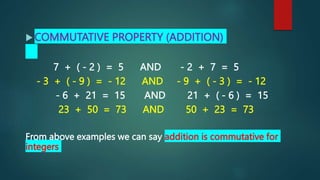
COMMUTATIVE PROPERTY (ADDITION)
7 + ( - 2 ) = 5 AND - 2 + 7 = 5
- 3 + ( - 9 ) = - 12 AND - 9 + ( - 3 ) = - 12
- 6 + 21 = 15 AND 21 + ( - 6 ) = 15
23 + 50 = 73 AND 50 + 23 = 73
From above examples we can say addition is commutative for
integers
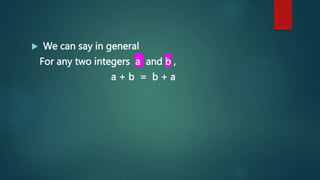
 We can say in general
For any two integers a and b ,
a + b = b + a
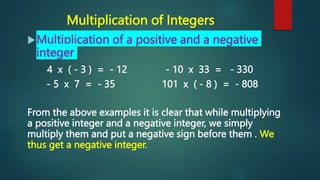
Multiplication of Integers
Multiplication of a positive and a negative
integer
4 x ( - 3 ) = - 12 - 10 x 33 = - 330
- 5 x 7 = - 35 101 x ( - 8 ) = - 808
From the above examples it is clear that while multiplying
a positive integer and a negative integer, we simply
multiply them and put a negative sign before them . We
thus get a negative integer.
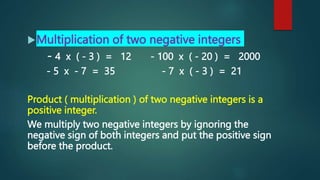
Multiplication of two negative integers
- 4 x ( - 3 ) = 12 - 100 x ( - 20 ) = 2000
- 5 x - 7 = 35 - 7 x ( - 3 ) = 21
Product ( multiplication ) of two negative integers is a
positive integer.
We multiply two negative integers by ignoring the
negative sign of both integers and put the positive sign
before the product.
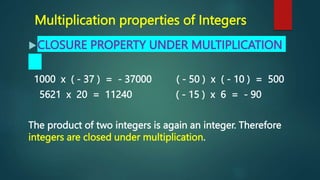
Multiplication properties of Integers
CLOSURE PROPERTY UNDER MULTIPLICATION
1000 x ( - 37 ) = - 37000 ( - 50 ) x ( - 10 ) = 500
5621 x 20 = 11240 ( - 15 ) x 6 = - 90
The product of two integers is again an integer. Therefore
integers are closed under multiplication.
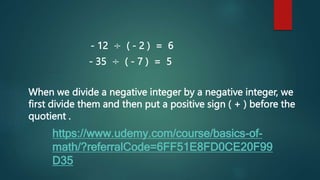
- 12 ÷ ( - 2 ) = 6
- 35 ÷ ( - 7 ) = 5
When we divide a negative integer by a negative integer, we
first divide them and then put a positive sign ( + ) before the
quotient .
https://www.udemy.com/course/basics-of-
math/?referralCode=6FF51E8FD0CE20F99
D35
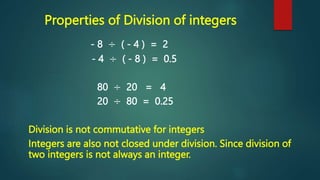
Properties of Division of integers
- 8 ÷ ( - 4 ) = 2
- 4 ÷ ( - 8 ) = 0.5
80 ÷ 20 = 4
20 ÷ 80 = 0.25
Division is not commutative for integers
Integers are also not closed under division. Since division of
two integers is not always an integer.
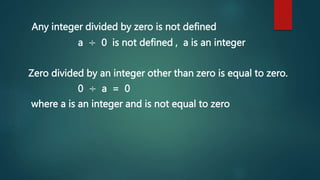
Any integer divided by zero is not defined
a ÷ 0 is not defined , a is an integer
Zero divided by an integer other than zero is equal to zero.
0 ÷ a = 0
where a is an integer and is not equal to zero
FOR COMPLETE TOPICS/LECTURES ON INTEGERS
Visit my Udemy lectures. Link is given below
https://www.udemy.com/course/basics-of-
math/?referralCode=6FF51E8FD0CE20F99D35

INTEGERS

  • 1.
  • 2.
    What are INTEGERS?  Integers is a bigger collection of numbers which includes Whole numbers and Negative numbers. OR We can say also that Integers is a bigger collection of number which includes zero , positive numbers and negative numbers.
  • 3.
    Properties of Addition/Subtractionof Integers CLOSURE PROPERTY UNDER ADDITION 20 + 10 = 30 50 + 60 = 110 - 100 + 200 = 100 57 + ( -13 ) = 44 - 42 + ( -11 ) = - 53 - 78 + ( - 40 ) = - 118 In above examples , we are getting integer after addition of two integers.
  • 4.
     Since additionof integers , gives integers , we can say integers are closed under addition. Therefore, we can say in general For any two integers a and b , a + b is also an integer. https://www.udemy.com/course/basics-of- math/?referralCode=6FF51E8FD0CE20F9 9D35
  • 5.
    COMMUTATIVE PROPERTY (ADDITION) 7+ ( - 2 ) = 5 AND - 2 + 7 = 5 - 3 + ( - 9 ) = - 12 AND - 9 + ( - 3 ) = - 12 - 6 + 21 = 15 AND 21 + ( - 6 ) = 15 23 + 50 = 73 AND 50 + 23 = 73 From above examples we can say addition is commutative for integers
  • 6.
     We cansay in general For any two integers a and b , a + b = b + a
  • 7.
    Multiplication of Integers Multiplicationof a positive and a negative integer 4 x ( - 3 ) = - 12 - 10 x 33 = - 330 - 5 x 7 = - 35 101 x ( - 8 ) = - 808 From the above examples it is clear that while multiplying a positive integer and a negative integer, we simply multiply them and put a negative sign before them . We thus get a negative integer.
  • 8.
    Multiplication of twonegative integers - 4 x ( - 3 ) = 12 - 100 x ( - 20 ) = 2000 - 5 x - 7 = 35 - 7 x ( - 3 ) = 21 Product ( multiplication ) of two negative integers is a positive integer. We multiply two negative integers by ignoring the negative sign of both integers and put the positive sign before the product.
  • 9.
    Multiplication properties ofIntegers CLOSURE PROPERTY UNDER MULTIPLICATION 1000 x ( - 37 ) = - 37000 ( - 50 ) x ( - 10 ) = 500 5621 x 20 = 11240 ( - 15 ) x 6 = - 90 The product of two integers is again an integer. Therefore integers are closed under multiplication.
  • 10.
    - 12 ÷( - 2 ) = 6 - 35 ÷ ( - 7 ) = 5 When we divide a negative integer by a negative integer, we first divide them and then put a positive sign ( + ) before the quotient . https://www.udemy.com/course/basics-of- math/?referralCode=6FF51E8FD0CE20F99 D35
  • 11.
    Properties of Divisionof integers - 8 ÷ ( - 4 ) = 2 - 4 ÷ ( - 8 ) = 0.5 80 ÷ 20 = 4 20 ÷ 80 = 0.25 Division is not commutative for integers Integers are also not closed under division. Since division of two integers is not always an integer.
  • 12.
    Any integer dividedby zero is not defined a ÷ 0 is not defined , a is an integer Zero divided by an integer other than zero is equal to zero. 0 ÷ a = 0 where a is an integer and is not equal to zero
  • 13.
    FOR COMPLETE TOPICS/LECTURESON INTEGERS Visit my Udemy lectures. Link is given below https://www.udemy.com/course/basics-of- math/?referralCode=6FF51E8FD0CE20F99D35