-By Garima Gupta
Genderissues in agricultural services
What is gender?
Gender refers to the socially constructed
roles and responsibilities of men and
women, in a given culture or location. These
roles are influenced by perceptions and
expectations arising from cultural, political,
environmental, economic, social, and religious
factors, as well as custom, law, class, ethnicity,
and individual or institutional bias. Gender
attitudes and behaviours are learned and can
be changed.
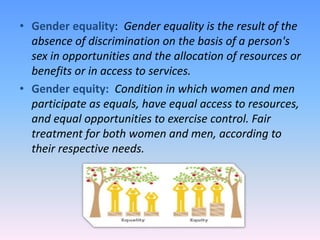
• Gender equality: Gender equality is the result of the
absence of discrimination on the basis of a person's
sex in opportunities and the allocation of resources or
benefits or in access to services.
• Gender equity: Condition in which women and men
participate as equals, have equal access to resources,
and equal opportunities to exercise control. Fair
treatment for both women and men, according to
their respective needs.
Women in Agriculture
• Women constitute a great deal of the labour force in agricultural
value chains in many parts of the world.
• Rural women produce 50% of the world’s food.
– 60-80% of the food in developing countries
• Women more likely than men to spend income in well-being
– Greater propensity to buy foods over non-foods;
– Acquire more nutritious foods;
– Tend to spend more in kids education and health care.
• But, compared to men - women receive a less-than-
proportionate share of investment in agriculture and unequal
access to resources, opportunities, political voice
Mythsand Facts
Myth 1: Women’s roles and responsibilities are rooted
in household work
Fact 1: Women contribute to agriculture and other
economic activities
Myth 2: Women work exclusively as subsistence
farmers
Fact 2: Women contribute labour to both subsistence
and cash crops
- BUT have less control over resources.
Women’s Constraints in Agriculture
• Greater time constraints
– Work longer total hours on productive and household
work; paid and unpaid work
– Due to gender division of labor carry the burden of child
care and most household chores
• Less Mobility than men
– Child care and household tasks
– Socio-cultural norms also limit women’s mobility
• Less Education and training
– Less access to education and training
– Illiteracy limits access to/ability of digesting technical
information
Despite many constraints and limitations,
Women Can Do Well in Agriculture if
resources and opportunities are more
equitably distributed!
So, despite this fact, why are Gender-
sensitization approaches not widely
adopted?
REASONS
• Women are regarded as home producers and not as
farmers and economic agents in their own right.
• Increasing recognition of the role of women in food
security, but remains the notion that
– Women’s role is confined to food production; and
– Women production of cash crops and
diversification off the farm can threaten food
security
• Extreme view of women as “marginalized and
Vulnerable” leads to
– Adoption of welfare approaches rather than
development and empowerment approaches
• Development community lacks key data on women’s
participation, and roles as a basis to refine programs
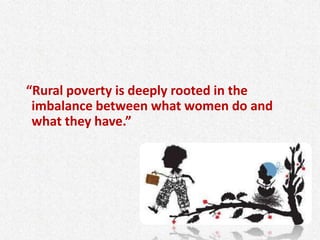
“Rural poverty is deeply rooted in the
imbalance between what women do and
what they have.”
Recommendationsfor Empowering Women in
Agriculture
I. Implement gender responsive approaches to improve
productivity in subsistence farming
• Adequate input packages;
• Delivery of extension tailored for women;
• Land access and tenure security/titling;
• Strengthen market/profit orientation.
II. Improve knowledge about women in agriculture,
particularly commercial/high value
• Engender value chain analysis;
• Engender monitoring and evaluation frameworks;
• Engender Impact Evaluations.
III. Engender policies and practices in agribusinesses
• Contract directly with women farmers
• BUT also, provide women direct access to resources and
services
• Engage with rural women associations
• Strengthen women’s roles in mixed gender groups
• Improve wages, and occupational mobility for women wage-
workers in agribusinesses
THANK YOU!

Gender issues in agricultural services

  • 1.
    -By Garima Gupta Genderissuesin agricultural services
  • 2.
    What is gender? Genderrefers to the socially constructed roles and responsibilities of men and women, in a given culture or location. These roles are influenced by perceptions and expectations arising from cultural, political, environmental, economic, social, and religious factors, as well as custom, law, class, ethnicity, and individual or institutional bias. Gender attitudes and behaviours are learned and can be changed.
  • 3.
    • Gender equality:Gender equality is the result of the absence of discrimination on the basis of a person's sex in opportunities and the allocation of resources or benefits or in access to services. • Gender equity: Condition in which women and men participate as equals, have equal access to resources, and equal opportunities to exercise control. Fair treatment for both women and men, according to their respective needs.
  • 5.
    Women in Agriculture •Women constitute a great deal of the labour force in agricultural value chains in many parts of the world. • Rural women produce 50% of the world’s food. – 60-80% of the food in developing countries • Women more likely than men to spend income in well-being – Greater propensity to buy foods over non-foods; – Acquire more nutritious foods; – Tend to spend more in kids education and health care. • But, compared to men - women receive a less-than- proportionate share of investment in agriculture and unequal access to resources, opportunities, political voice
  • 6.
    Mythsand Facts Myth 1:Women’s roles and responsibilities are rooted in household work Fact 1: Women contribute to agriculture and other economic activities Myth 2: Women work exclusively as subsistence farmers Fact 2: Women contribute labour to both subsistence and cash crops - BUT have less control over resources.
  • 7.
    Women’s Constraints inAgriculture • Greater time constraints – Work longer total hours on productive and household work; paid and unpaid work – Due to gender division of labor carry the burden of child care and most household chores • Less Mobility than men – Child care and household tasks – Socio-cultural norms also limit women’s mobility • Less Education and training – Less access to education and training – Illiteracy limits access to/ability of digesting technical information
  • 8.
    Despite many constraintsand limitations, Women Can Do Well in Agriculture if resources and opportunities are more equitably distributed!
  • 9.
    So, despite thisfact, why are Gender- sensitization approaches not widely adopted?
  • 10.
    REASONS • Women areregarded as home producers and not as farmers and economic agents in their own right. • Increasing recognition of the role of women in food security, but remains the notion that – Women’s role is confined to food production; and – Women production of cash crops and diversification off the farm can threaten food security
  • 11.
    • Extreme viewof women as “marginalized and Vulnerable” leads to – Adoption of welfare approaches rather than development and empowerment approaches • Development community lacks key data on women’s participation, and roles as a basis to refine programs
  • 12.
    “Rural poverty isdeeply rooted in the imbalance between what women do and what they have.”
  • 13.
    Recommendationsfor Empowering Womenin Agriculture I. Implement gender responsive approaches to improve productivity in subsistence farming • Adequate input packages; • Delivery of extension tailored for women; • Land access and tenure security/titling; • Strengthen market/profit orientation. II. Improve knowledge about women in agriculture, particularly commercial/high value • Engender value chain analysis; • Engender monitoring and evaluation frameworks; • Engender Impact Evaluations.
  • 14.
    III. Engender policiesand practices in agribusinesses • Contract directly with women farmers • BUT also, provide women direct access to resources and services • Engage with rural women associations • Strengthen women’s roles in mixed gender groups • Improve wages, and occupational mobility for women wage- workers in agribusinesses
  • 15.