By
Satyendra Kumar Jaladi
Robotics & Mechatronics Engineering
Inverse Kinematics Analysis of Serial Manipulators
Using Genetic Algorithms
December 18th 2018
Contents
Aim & Objectives
• To provide Accurate,fast,efficient algorithm to
Inverse Kinematics(IK) of Serial Manipulators, As
DOF gets increased solving IK becomes more
complex(more than 1 solution).
• Solve IK of Serial Manipulators using Nature
Inspired optimization algorithms.
• Employ recently developed Optimization
Techniques for solving position level IK problems
of Robot Arms.
What is Kinematics
Robot Kinematics Terminology
Homogeneous Transformation Matrix (HTM)
0Tn = 0A1 * 1A2 * 2A3 .... n−1An
Forward Kinematics
ξN = Қ (qj)
Inverse Kinematics
qj = Қ-1 (ξN)
ξN = Pose of the Robot end effector.
qj = Vector of Robot joint angles.
j ϵ [1…. n].
DOF
N = 3 (r – 1) – 2p (Planar)
N = 6 (r – 1 ) – 5p (Spatial)
D-H Parameters
Joint angle θj
Revolute
joint variable
Link Offset dj
Prismatic
joint variable
Link Length aj constant
Link Twist αj constant
J-1TJ = trotz(theta_j) * transl(0,0,d_j) * transl(a_j,0,0) * trotx(alpha_j)
What is Genetic Algorithm? Why is it chosen?
• It’s a class of stochastic search
strategies modeled after evolutionary
mechanisms.
• Why use GA instead of Newton-
Raphson for minimization.
• Newton-Raphson( ̈𝑋𝑋) method is based
on the use of local information.
Genetic Algorithm
Minimize: min f(x1 x2 x3 xn)
𝒕𝒕𝒕𝒕𝒕𝒕𝒕𝒕𝒕𝒕, 𝐟𝐟𝐟𝐟𝐟𝐟𝐟𝐟, exitflag,output,population,scores = 𝒈𝒈𝒈𝒈(𝑭𝑭𝑭𝑭𝑭𝑭 𝑭𝑭𝑭𝑭𝑭𝑭𝑭𝑭_𝑭𝑭𝑭𝑭𝑭𝑭𝑭𝑭𝑭𝑭𝑭𝑭𝑭𝑭 𝑭𝑭, 𝒏𝒏𝒏𝒏𝒏𝒏𝒏𝒏𝒏𝒏, [], [], [], [], 𝑳𝑳𝑳𝑳, 𝑼𝑼𝑼𝑼, [], 𝒐𝒐𝒐𝒐𝒐𝒐𝒐𝒐);
Literature Survey
 By using a niching method, the algorithm is able to calculate multiple solutions of the IK
problem for both positioning and orienting the end-effector (Tabandeh, Saleh, Christopher M.
Clark, and William Melek)
 Some of the other well-known soft computing techniques which explored to solve the
Inverse kinematics are fuzzy logic, neural network, artificial neural network, ANFIS,
hybrid neural network etc. At the same time, much focus toward the use of the nature-
inspired algorithm for resolving the inverse kinematics problem of the industrial
manipulator as well as other problems related to the engineering field. The most commonly
used algorithms for solving the real-world problems are artificial bee colony(ABC). (Golak
Bihari Mahanta, B. B. V. L. Deepak, M. Dileep, B. B. Biswaland S. K. Pattanayak)
Methodology
• Min(GA) = FK+ Known Coordinates +TSP.
• Plugin Forward Kinematics equations.
• Feed the known Coordinates [Px , Py ,Pz]
(X1,Y1)
(X2,Y2)
0
0.5
1
1.5
2
2.5
3
3.5
0 0.5 1 1.5 2 2.5 3 3.5
Euclidian Distance
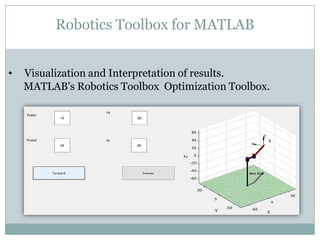
Robotics Toolbox for MATLAB
• Visualization and Interpretation of results.
MATLAB's Robotics Toolbox Optimization Toolbox.
Fitness(Maximize/Minimize) Function
 Fitness function solves the FK equations and minimizes the
difference between the actual and desired pose resulting in
greater positioning accuracy.
2 2 2
1
( ) ( ) ( )
n
t x t y t z
j
x p y p z p
=
− + − + −∑Minimize
Subjected to angle bounds [LB,UB] θmin
θmax
Use 4-bit binary strings for range between [0 ≤ θ1 ,θ2 ≤ 90].
Accuracy =
XU – XL
(24 )– 1
=
𝟗𝟗𝟗𝟗 −𝟎𝟎
𝟏𝟏𝟏𝟏 −𝟏𝟏
= 60
Example of 2-DOF Robot ARM
Results
ABB (ASEA Brown Boveri)
Robot Type Handling
capacity(kg)
Reach(m)
IRB 1600 6kg 1.45m
P1 = [1.533;0.270;-0.4035];
P2 = [1.400;0.3512;-0.1089];
P3 = [-0.8502;1.1421;2.392];
ABB IRB 1600-6KG/1.45m Robot(6-DOF)
CAD model (MSC ADAMS)
Output Joint Angles [ degree ]0
θ1
19.01 29.00 9.00
θ2
19.21 19.21 19.21
θ3
20.22 34.04 32.0
θ4
20.01 20.01 20.01
θ5
29.99 9.01 59.01
θ6
59.01 59.01 59.01
References
1. Števo, Stanislav, Ivan Sekaj, and Martin Dekan. "Optimization of robotic arm trajectory using genetic algorithm." IFAC Proceedings Volumes 47, no. 3
(2014): 1748-1753.
2. Tabandeh, Saleh, William W. Melek, and Christopher M. Clark. "An adaptive niching genetic algorithm approach for generating multiple solutions of serial
manipulator inverse kinematics with applications to modular robots." Robotica 28, no. 4 (2010): 493-07.
3. Mahanta, Golak Bihari, B. B. V. L. Deepak, M. Dileep, B. B. Biswal, and S. K. Pattanayak. "Prediction of Inverse Kinematics for a 6-DOF Industrial Robot
Arm Using Soft Computing Techniques." In Soft Computing for Problem Solving, pp. 519-530. Springer, Singapore, 2019.
4. Corke, Peter I. "A robotics toolbox for MATLAB." IEEE Robotics & Automation Magazine 3, no. 1 (1996): 24-32.
5. Saha, S. K. (2014). Introduction to robotics. Tata McGraw-Hill Education .
6. Mittal, R. K., and I. J. Nagrath. Robotics and control. Tata McGraw-Hill, 2003.
7. Garg, D. P., & Kumar, M. (2002). Optimization techniques applied to multiple ma-nipulators for path planning and torque minimization. Engineering
Applications of Ar-tificial Intelligence, 15(3–4), 241–252.
8. Davidor, Y. (1991). Genetic Algorithms and Robotics, a Heuristic Strategy for Optimization. World Scientific Eiben, A.E., Smith, J.E. (2007). Introduction to
evolutionary computing. Springer.
THANK YOU.

Inverse Kinematics Using Genetic Algorithms

  • 1.
    By Satyendra Kumar Jaladi Robotics& Mechatronics Engineering Inverse Kinematics Analysis of Serial Manipulators Using Genetic Algorithms December 18th 2018
  • 2.
  • 3.
    Aim & Objectives •To provide Accurate,fast,efficient algorithm to Inverse Kinematics(IK) of Serial Manipulators, As DOF gets increased solving IK becomes more complex(more than 1 solution). • Solve IK of Serial Manipulators using Nature Inspired optimization algorithms. • Employ recently developed Optimization Techniques for solving position level IK problems of Robot Arms.
  • 4.
  • 5.
    Robot Kinematics Terminology HomogeneousTransformation Matrix (HTM) 0Tn = 0A1 * 1A2 * 2A3 .... n−1An Forward Kinematics ξN = Қ (qj) Inverse Kinematics qj = Қ-1 (ξN) ξN = Pose of the Robot end effector. qj = Vector of Robot joint angles. j ϵ [1…. n]. DOF N = 3 (r – 1) – 2p (Planar) N = 6 (r – 1 ) – 5p (Spatial) D-H Parameters Joint angle θj Revolute joint variable Link Offset dj Prismatic joint variable Link Length aj constant Link Twist αj constant J-1TJ = trotz(theta_j) * transl(0,0,d_j) * transl(a_j,0,0) * trotx(alpha_j)
  • 6.
    What is GeneticAlgorithm? Why is it chosen? • It’s a class of stochastic search strategies modeled after evolutionary mechanisms. • Why use GA instead of Newton- Raphson for minimization. • Newton-Raphson( ̈𝑋𝑋) method is based on the use of local information. Genetic Algorithm Minimize: min f(x1 x2 x3 xn) 𝒕𝒕𝒕𝒕𝒕𝒕𝒕𝒕𝒕𝒕, 𝐟𝐟𝐟𝐟𝐟𝐟𝐟𝐟, exitflag,output,population,scores = 𝒈𝒈𝒈𝒈(𝑭𝑭𝑭𝑭𝑭𝑭 𝑭𝑭𝑭𝑭𝑭𝑭𝑭𝑭_𝑭𝑭𝑭𝑭𝑭𝑭𝑭𝑭𝑭𝑭𝑭𝑭𝑭𝑭 𝑭𝑭, 𝒏𝒏𝒏𝒏𝒏𝒏𝒏𝒏𝒏𝒏, [], [], [], [], 𝑳𝑳𝑳𝑳, 𝑼𝑼𝑼𝑼, [], 𝒐𝒐𝒐𝒐𝒐𝒐𝒐𝒐);
  • 7.
    Literature Survey  Byusing a niching method, the algorithm is able to calculate multiple solutions of the IK problem for both positioning and orienting the end-effector (Tabandeh, Saleh, Christopher M. Clark, and William Melek)  Some of the other well-known soft computing techniques which explored to solve the Inverse kinematics are fuzzy logic, neural network, artificial neural network, ANFIS, hybrid neural network etc. At the same time, much focus toward the use of the nature- inspired algorithm for resolving the inverse kinematics problem of the industrial manipulator as well as other problems related to the engineering field. The most commonly used algorithms for solving the real-world problems are artificial bee colony(ABC). (Golak Bihari Mahanta, B. B. V. L. Deepak, M. Dileep, B. B. Biswaland S. K. Pattanayak)
  • 8.
    Methodology • Min(GA) =FK+ Known Coordinates +TSP. • Plugin Forward Kinematics equations. • Feed the known Coordinates [Px , Py ,Pz] (X1,Y1) (X2,Y2) 0 0.5 1 1.5 2 2.5 3 3.5 0 0.5 1 1.5 2 2.5 3 3.5 Euclidian Distance
  • 9.
    Robotics Toolbox forMATLAB • Visualization and Interpretation of results. MATLAB's Robotics Toolbox Optimization Toolbox.
  • 10.
    Fitness(Maximize/Minimize) Function  Fitnessfunction solves the FK equations and minimizes the difference between the actual and desired pose resulting in greater positioning accuracy. 2 2 2 1 ( ) ( ) ( ) n t x t y t z j x p y p z p = − + − + −∑Minimize Subjected to angle bounds [LB,UB] θmin θmax Use 4-bit binary strings for range between [0 ≤ θ1 ,θ2 ≤ 90]. Accuracy = XU – XL (24 )– 1 = 𝟗𝟗𝟗𝟗 −𝟎𝟎 𝟏𝟏𝟏𝟏 −𝟏𝟏 = 60 Example of 2-DOF Robot ARM
  • 11.
    Results ABB (ASEA BrownBoveri) Robot Type Handling capacity(kg) Reach(m) IRB 1600 6kg 1.45m P1 = [1.533;0.270;-0.4035]; P2 = [1.400;0.3512;-0.1089]; P3 = [-0.8502;1.1421;2.392]; ABB IRB 1600-6KG/1.45m Robot(6-DOF) CAD model (MSC ADAMS) Output Joint Angles [ degree ]0 θ1 19.01 29.00 9.00 θ2 19.21 19.21 19.21 θ3 20.22 34.04 32.0 θ4 20.01 20.01 20.01 θ5 29.99 9.01 59.01 θ6 59.01 59.01 59.01
  • 12.
    References 1. Števo, Stanislav,Ivan Sekaj, and Martin Dekan. "Optimization of robotic arm trajectory using genetic algorithm." IFAC Proceedings Volumes 47, no. 3 (2014): 1748-1753. 2. Tabandeh, Saleh, William W. Melek, and Christopher M. Clark. "An adaptive niching genetic algorithm approach for generating multiple solutions of serial manipulator inverse kinematics with applications to modular robots." Robotica 28, no. 4 (2010): 493-07. 3. Mahanta, Golak Bihari, B. B. V. L. Deepak, M. Dileep, B. B. Biswal, and S. K. Pattanayak. "Prediction of Inverse Kinematics for a 6-DOF Industrial Robot Arm Using Soft Computing Techniques." In Soft Computing for Problem Solving, pp. 519-530. Springer, Singapore, 2019. 4. Corke, Peter I. "A robotics toolbox for MATLAB." IEEE Robotics & Automation Magazine 3, no. 1 (1996): 24-32. 5. Saha, S. K. (2014). Introduction to robotics. Tata McGraw-Hill Education . 6. Mittal, R. K., and I. J. Nagrath. Robotics and control. Tata McGraw-Hill, 2003. 7. Garg, D. P., & Kumar, M. (2002). Optimization techniques applied to multiple ma-nipulators for path planning and torque minimization. Engineering Applications of Ar-tificial Intelligence, 15(3–4), 241–252. 8. Davidor, Y. (1991). Genetic Algorithms and Robotics, a Heuristic Strategy for Optimization. World Scientific Eiben, A.E., Smith, J.E. (2007). Introduction to evolutionary computing. Springer.
  • 13.