Operations Management II
Juan Ignacio Camino Moya
Álvaro Fernández-Novel Rodríguez
 Objective: strike a balance between inventory
investment and customer service.
 Functions:
1. To separate various parts of the production process.
2. To decouple the firm from fluctuations in demand and
provide a stock of goods that will provide a selection
for customers.
3. To take advantage of quantity discounts.
4. To hedge against inflation.
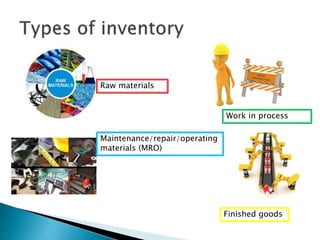
Raw materials
Work in process
Maintenance/repair/operating
materials (MRO)
Finished goods
Inventories
Classification
Inventory
Records
Maintenance
Pareto
Principle
•Many trivial goods
•Few crucial ones
Measurement
•Annual demand of each product
•Cost per unit
Classes
•Class A: 15% of total inventory, but 70% of dollar usage.
•Class B: 30% of total inventory, but 25% of dollar usage
•Class C: 55% of total inventory, but 5% of dollar usage
IMPORTANT: Know what you have and what you
need.
Precise decisions about ordering, scheduling and
shipping
Correct incoming and outgoing record keeping,
stock- room security…
A Items:
Frequent
C Items:
Least
B Items:
Medium
Service sector needs
inventory control
•Inventory in transit is lost
value
•Inventory damaged or
stolen prior to sale is a
lost
Retail business
•Shrinkage: Retail
inventory unaccounted
between receipt and sale
•Pilferage: Inventory theft.
Applicable measures
•Good personnel selection,
training and discipline
•Control of incoming
shipments
•Effective control of all
goods leaving the facility
Basic Economy Order Quantity Model
Production Order Quantity Model
Quantity Discount Model
Demand for an item is known, constant and independent
from other items
Lead time is known and consistent
Receipt of inventory instantaneous and complete
Quantity discounts not possible
The only variable costs are the ones previously explained
Shortages can be completely avoided
Significant costs are holding
and ordering costs.
 Assumptions
1. Demand for an item is known, constant and
independent.
2. Lead time is known and consistent.
3. Receipt of inventory is instantaneous and
complete. The inventory from an order arrives in
one batch at one time.
4. No quantity discounts
5. Holding, ordering and set up costs are variable.
6. Shortages can be avoided if orders are placed at
the right time
 Objective:
 How much to order (Q*p) and when to order (ROP)
so that we minimize costs
1. Demand for an item is known, constant and
independent.
2. Lead time is known and consistent.
3. Receipt of inventory is instantaneous and
complete. The inventory from an order
arrives in one batch at one time.
4. No quantity discounts
5. Holding, ordering and set up costs are
variable.
6. Shortages can be avoided if orders are
placed at the right time
 A quantity discount is a reduced price per
unit of item when we purchase it in larger
quantities.
Discount
number
Discount
quantity
Discount
(%)
Discount price
1 0 to 999 0 $5.00
2 1000 to 1999 4 $4.80
3 2000 and over 5 $4.75
 Objective: How much to order to minimize
costs?
Ordering
quantities with
the highest
discount?
 Step 1: calculate Q* for each discount
 Step 2: Adjust Q* to the lowest quantity that will qualify
for the discount
 Step 3: Apply the total cost equation for each order
quantity and pick the one with the lowest cost.
D = Annual demand
S = Set up cost per
order
I = holding cost as %
of unit price
P = price per unit
Discount
Category
Unit Cost
Order
Quantity
Annual cost
Holding Ordering Purchase Total
1
2
3
$5.00
4.85
4.75
700
1000
2500
$350
485
1188
$350
245
98
$25,000
24,500
23,750
$25,700
24,980
25,036
1. Demand for an item is known, constant and
independent.
2. Lead time is known and consistent.
3. Receipt of inventory is instantaneous and
complete. The inventory from an order
arrives in one batch at one time.
4. No quantity discounts
5. Holding, ordering and set up costs are
variable.
6. Shortages can be avoided if orders are
placed at the right time
 Key issue : maintaining an adequate service
level in the face of uncertain demand.
 Service level: 1-probability of stockout
 Stockout is reduced with safety stock.
 Therefore:
 Objective: find such safety stock level that
satisfies the given service level and minimizes total
costs
One order is placed for each product
Remaining products have little or no value after sales period
Exact demand is never known, so we consider a probability
distribution
Consider probability of stock out and have left overs
Cs: Cost of shortage
Sales Price/Unit – Cost/Unit
Co: Cost of overage
Cost/Unit – Residual Value/Unit
Same order
amount
each time
•Inventory decreases
to reorder point
•New order is placed
Perpetual
monitoring
system
•Every movement of
inventory must be
recorded
Fixed
period
system
•Inventory is ordered
at the end of a
giving period
•Always same
amount per interval
Thank you for your attention

Inventory presentation

  • 1.
    Operations Management II JuanIgnacio Camino Moya Álvaro Fernández-Novel Rodríguez
  • 2.
     Objective: strikea balance between inventory investment and customer service.  Functions: 1. To separate various parts of the production process. 2. To decouple the firm from fluctuations in demand and provide a stock of goods that will provide a selection for customers. 3. To take advantage of quantity discounts. 4. To hedge against inflation.
  • 3.
    Raw materials Work inprocess Maintenance/repair/operating materials (MRO) Finished goods
  • 4.
  • 5.
    Pareto Principle •Many trivial goods •Fewcrucial ones Measurement •Annual demand of each product •Cost per unit Classes •Class A: 15% of total inventory, but 70% of dollar usage. •Class B: 30% of total inventory, but 25% of dollar usage •Class C: 55% of total inventory, but 5% of dollar usage
  • 7.
    IMPORTANT: Know whatyou have and what you need. Precise decisions about ordering, scheduling and shipping Correct incoming and outgoing record keeping, stock- room security…
  • 8.
  • 9.
    Service sector needs inventorycontrol •Inventory in transit is lost value •Inventory damaged or stolen prior to sale is a lost Retail business •Shrinkage: Retail inventory unaccounted between receipt and sale •Pilferage: Inventory theft. Applicable measures •Good personnel selection, training and discipline •Control of incoming shipments •Effective control of all goods leaving the facility
  • 12.
    Basic Economy OrderQuantity Model Production Order Quantity Model Quantity Discount Model
  • 14.
    Demand for anitem is known, constant and independent from other items Lead time is known and consistent Receipt of inventory instantaneous and complete Quantity discounts not possible The only variable costs are the ones previously explained Shortages can be completely avoided
  • 15.
    Significant costs areholding and ordering costs.
  • 20.
     Assumptions 1. Demandfor an item is known, constant and independent. 2. Lead time is known and consistent. 3. Receipt of inventory is instantaneous and complete. The inventory from an order arrives in one batch at one time. 4. No quantity discounts 5. Holding, ordering and set up costs are variable. 6. Shortages can be avoided if orders are placed at the right time
  • 21.
     Objective:  Howmuch to order (Q*p) and when to order (ROP) so that we minimize costs
  • 23.
    1. Demand foran item is known, constant and independent. 2. Lead time is known and consistent. 3. Receipt of inventory is instantaneous and complete. The inventory from an order arrives in one batch at one time. 4. No quantity discounts 5. Holding, ordering and set up costs are variable. 6. Shortages can be avoided if orders are placed at the right time
  • 24.
     A quantitydiscount is a reduced price per unit of item when we purchase it in larger quantities. Discount number Discount quantity Discount (%) Discount price 1 0 to 999 0 $5.00 2 1000 to 1999 4 $4.80 3 2000 and over 5 $4.75
  • 25.
     Objective: Howmuch to order to minimize costs? Ordering quantities with the highest discount?
  • 26.
     Step 1:calculate Q* for each discount  Step 2: Adjust Q* to the lowest quantity that will qualify for the discount  Step 3: Apply the total cost equation for each order quantity and pick the one with the lowest cost. D = Annual demand S = Set up cost per order I = holding cost as % of unit price P = price per unit
  • 27.
    Discount Category Unit Cost Order Quantity Annual cost HoldingOrdering Purchase Total 1 2 3 $5.00 4.85 4.75 700 1000 2500 $350 485 1188 $350 245 98 $25,000 24,500 23,750 $25,700 24,980 25,036
  • 28.
    1. Demand foran item is known, constant and independent. 2. Lead time is known and consistent. 3. Receipt of inventory is instantaneous and complete. The inventory from an order arrives in one batch at one time. 4. No quantity discounts 5. Holding, ordering and set up costs are variable. 6. Shortages can be avoided if orders are placed at the right time
  • 29.
     Key issue: maintaining an adequate service level in the face of uncertain demand.  Service level: 1-probability of stockout  Stockout is reduced with safety stock.  Therefore:
  • 30.
     Objective: findsuch safety stock level that satisfies the given service level and minimizes total costs
  • 31.
    One order isplaced for each product Remaining products have little or no value after sales period Exact demand is never known, so we consider a probability distribution Consider probability of stock out and have left overs
  • 32.
    Cs: Cost ofshortage Sales Price/Unit – Cost/Unit Co: Cost of overage Cost/Unit – Residual Value/Unit
  • 33.
    Same order amount each time •Inventorydecreases to reorder point •New order is placed Perpetual monitoring system •Every movement of inventory must be recorded Fixed period system •Inventory is ordered at the end of a giving period •Always same amount per interval
  • 34.
    Thank you foryour attention