Inventory Control and 
Management
Uncertainty in stocks 
 There Is always some uncertainty in stocks maybe because price 
rise with inflation, operations change, supply chains are 
disrupted and so on. 
 The main uncertainty Is likely to be in customer demand which is 
quite volatile. 
 Problems can be classified according to following variables:- 
 Unknown-in which we have complete ignorance of the situation 
and any analysis is difficult 
 Known- in which we know the values taken by parameters and 
can use deterministic models. 
 Uncertain-in which we have probability distributions for the 
variables and can use probabilistic or stochastic models.
Uncertainty in other areas 
 Demand – Demand for an item usually comes from a 
number of separate customers.The organization has no 
control over who buys their products and in what 
quantity.These fluctuations in the number and size of 
orders give an uncertain demand. 
 Costs-costs tend to drift upwards with inflation. There can 
be short term variations as well due to changes in 
operations,products etc. 
 Lead Time- Lead time is prone to variability as well which 
is inevitable as it involves many stages between the decision 
to buy an item and having it available for use. 
 Deliveries- deliveries ultimately depend on supplier 
reliability. They can fluctuate due to rejection during 
quality checks,overage etc.
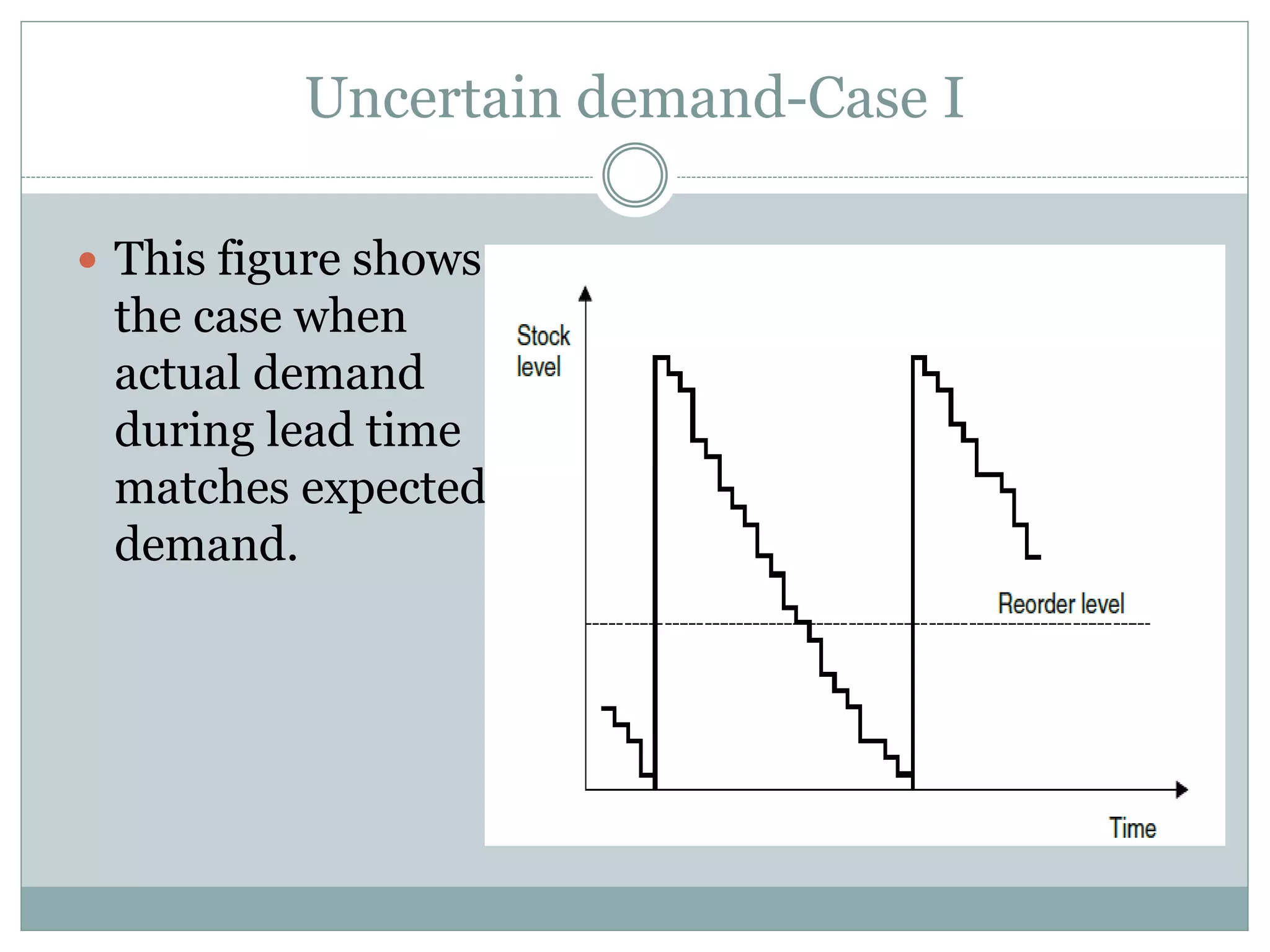
Uncertain demand-Case I 
 This figure shows 
the case when 
actual demand 
during lead time 
matches expected 
demand.
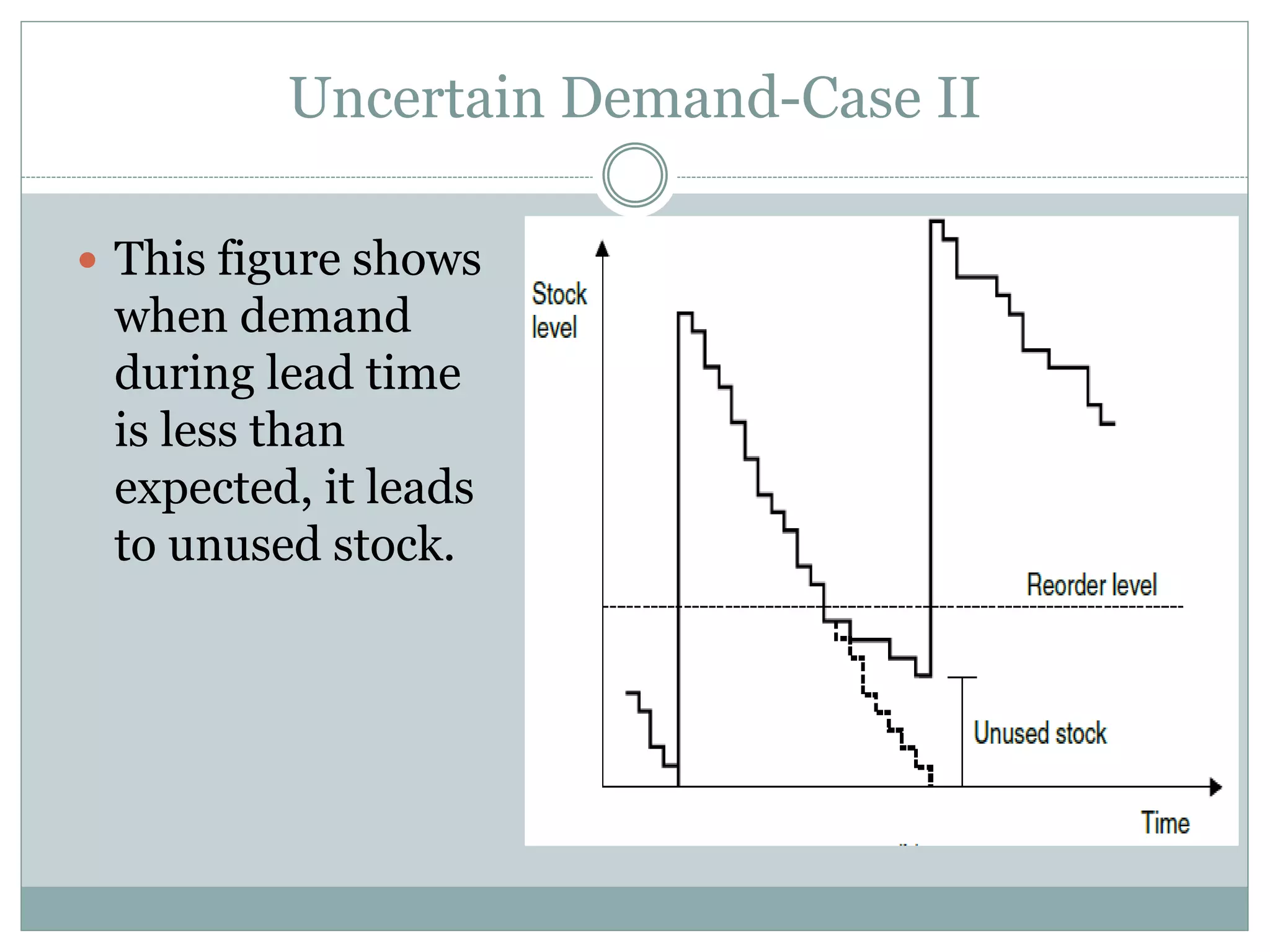
Uncertain Demand-Case II 
 This figure shows 
when demand 
during lead time 
is less than 
expected, it leads 
to unused stock.
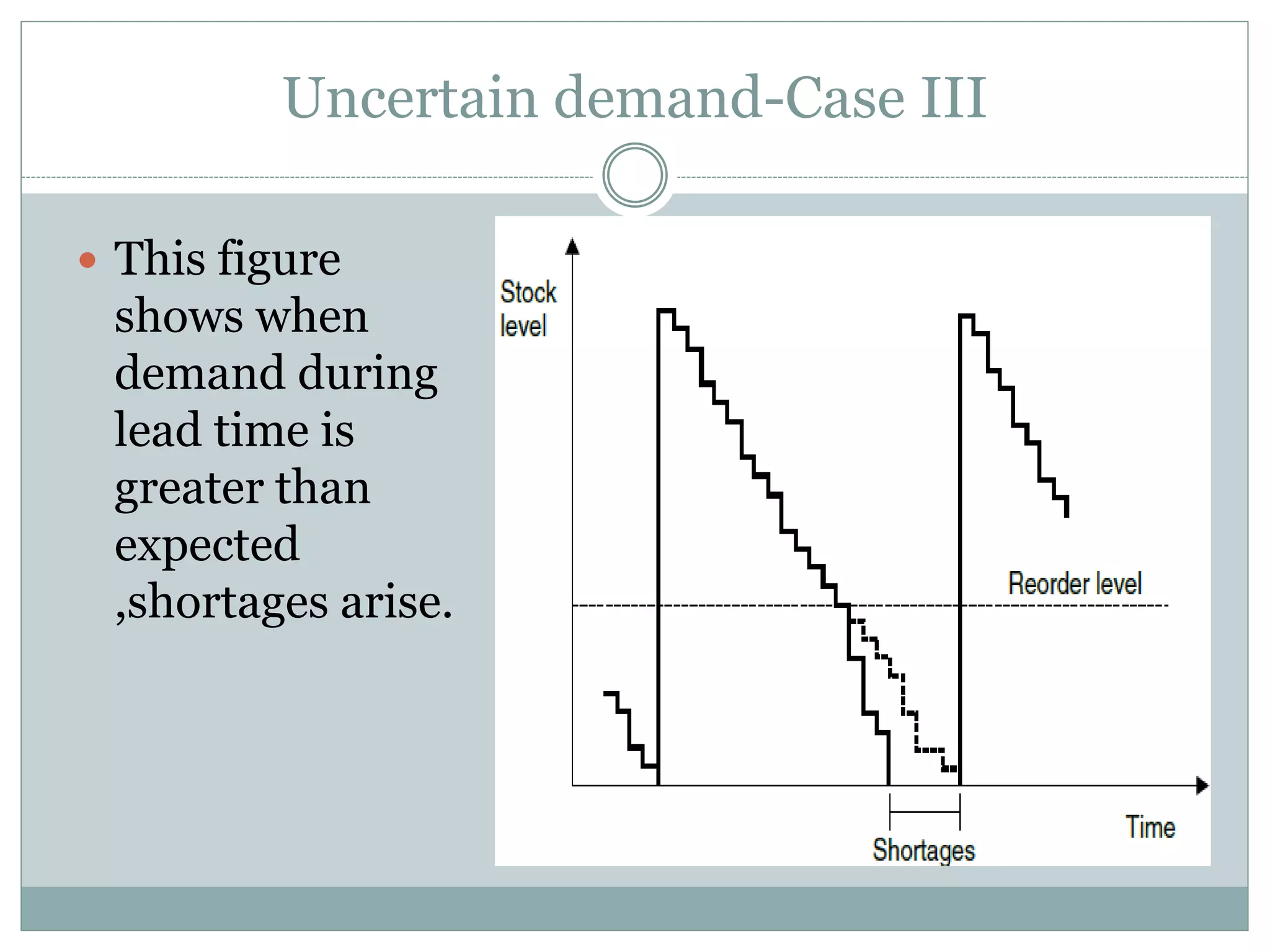
Uncertain demand-Case III 
 This figure 
shows when 
demand during 
lead time is 
greater than 
expected 
,shortages arise.
Models for discrete demand 
 If the demand is discrete, and we place a very small order 
for Q units the probability of selling the Qth unit is high 
and expected profit is greater than expected loss. 
 If a large order is placed the probability of selling Qth 
unit is low and the expected profit is less than the 
expected loss. Which leads us to the conclusion that best 
order size is the quantity which gives a profit on Qth unit 
and a loss on (Q+1)th and following units and any units 
unsold will be sold at their scrap value. 
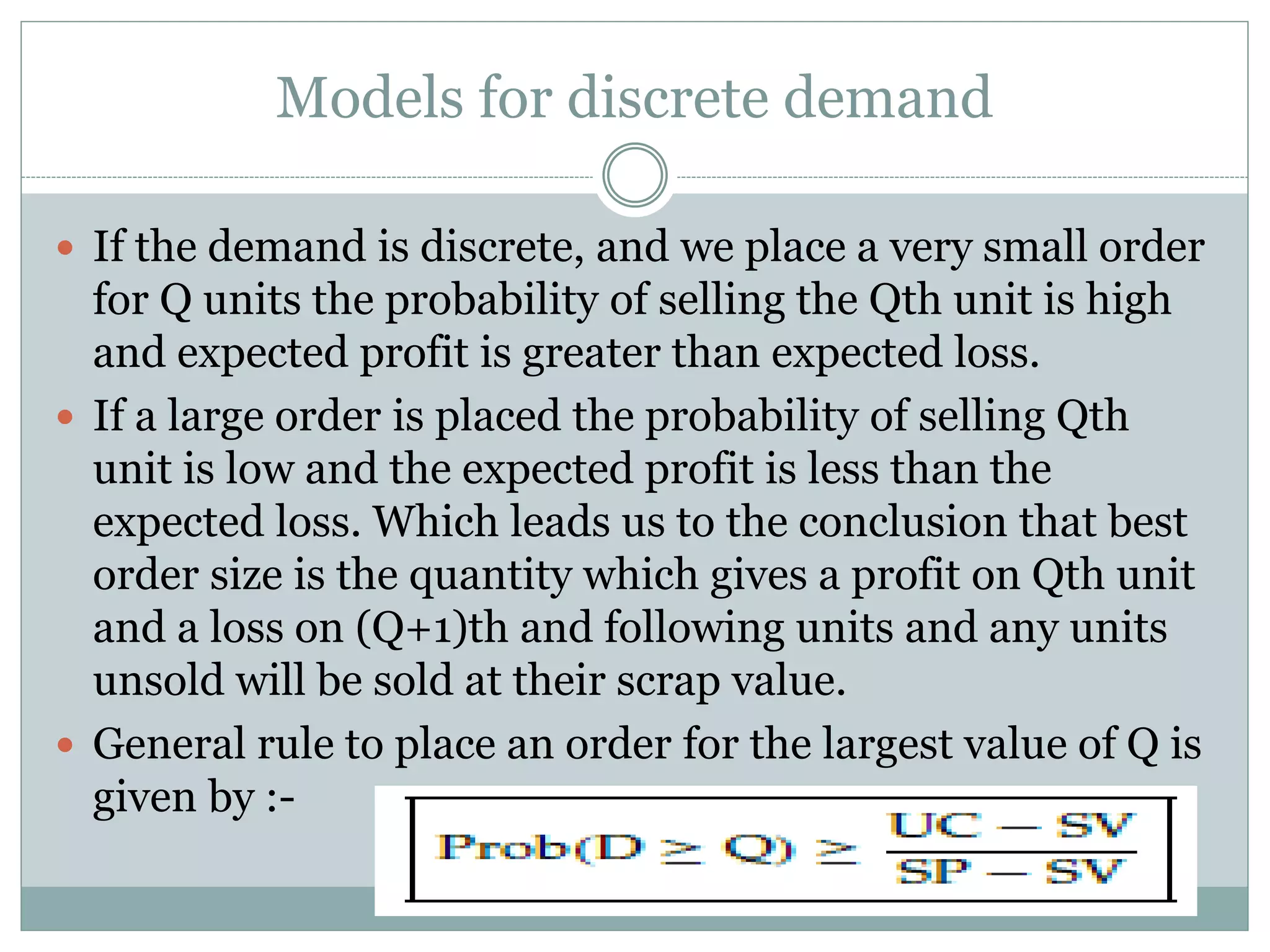
 General rule to place an order for the largest value of Q is 
given by :-
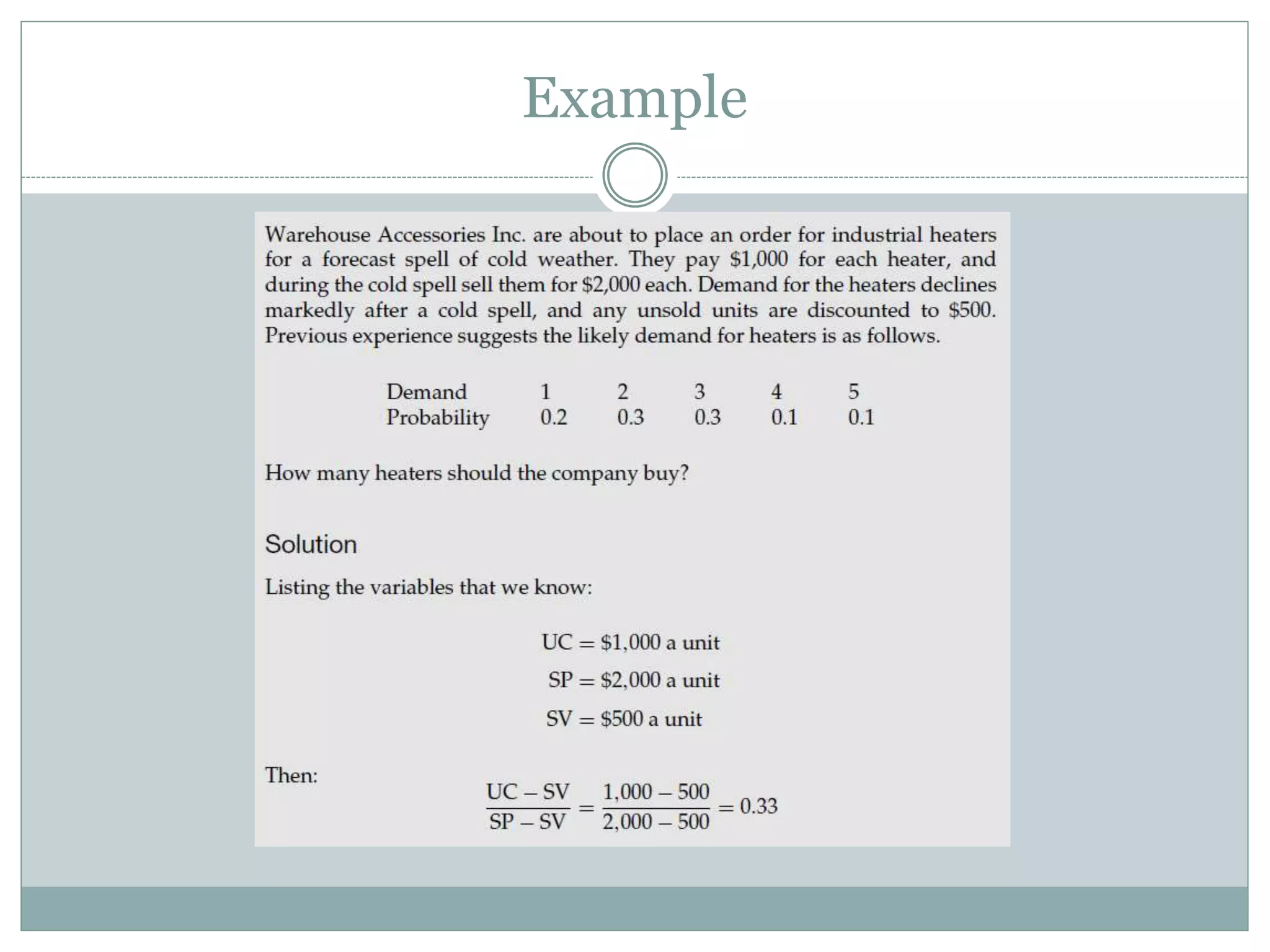
Example
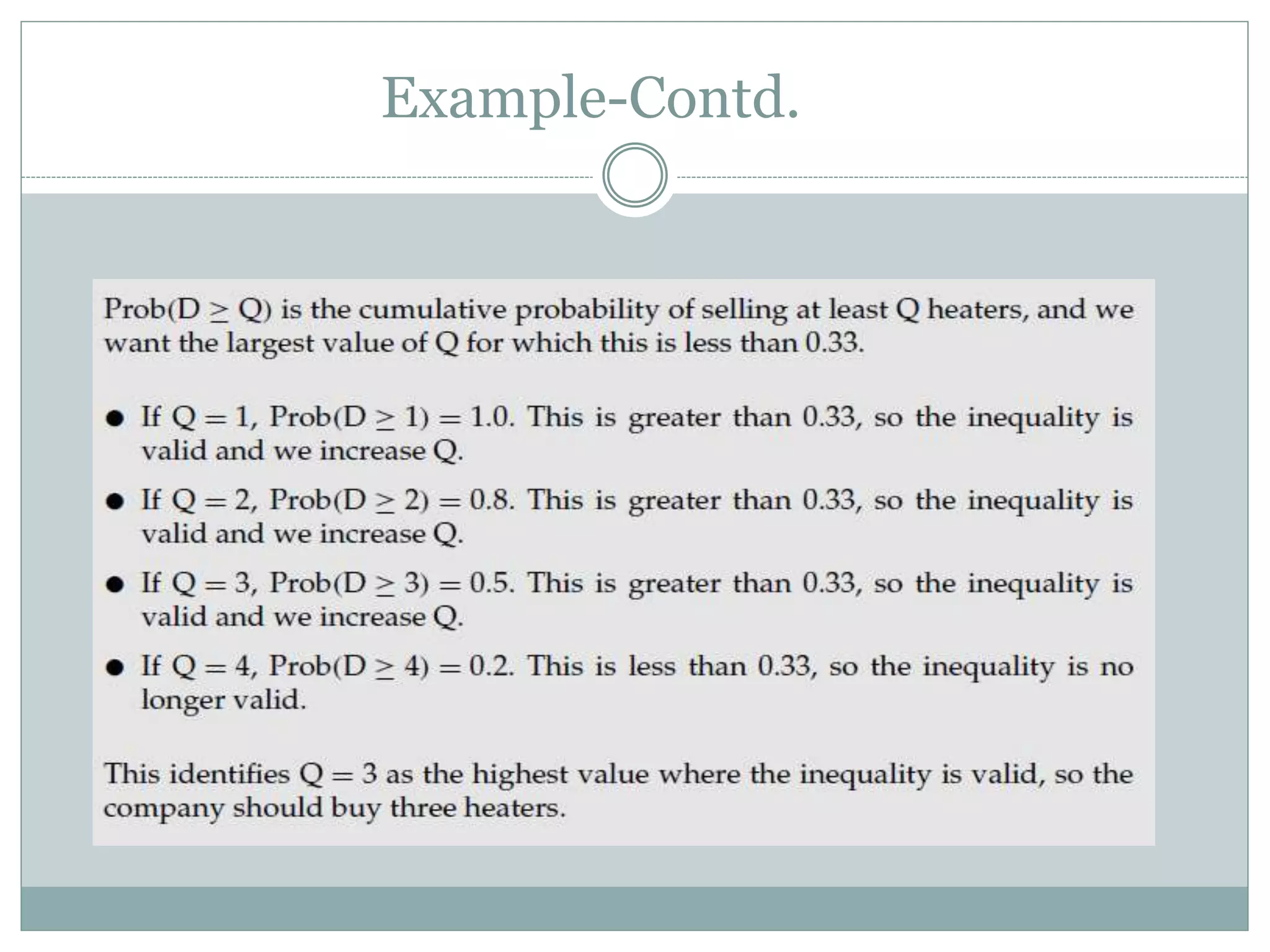
Example-Contd.
Newsboy Problem 
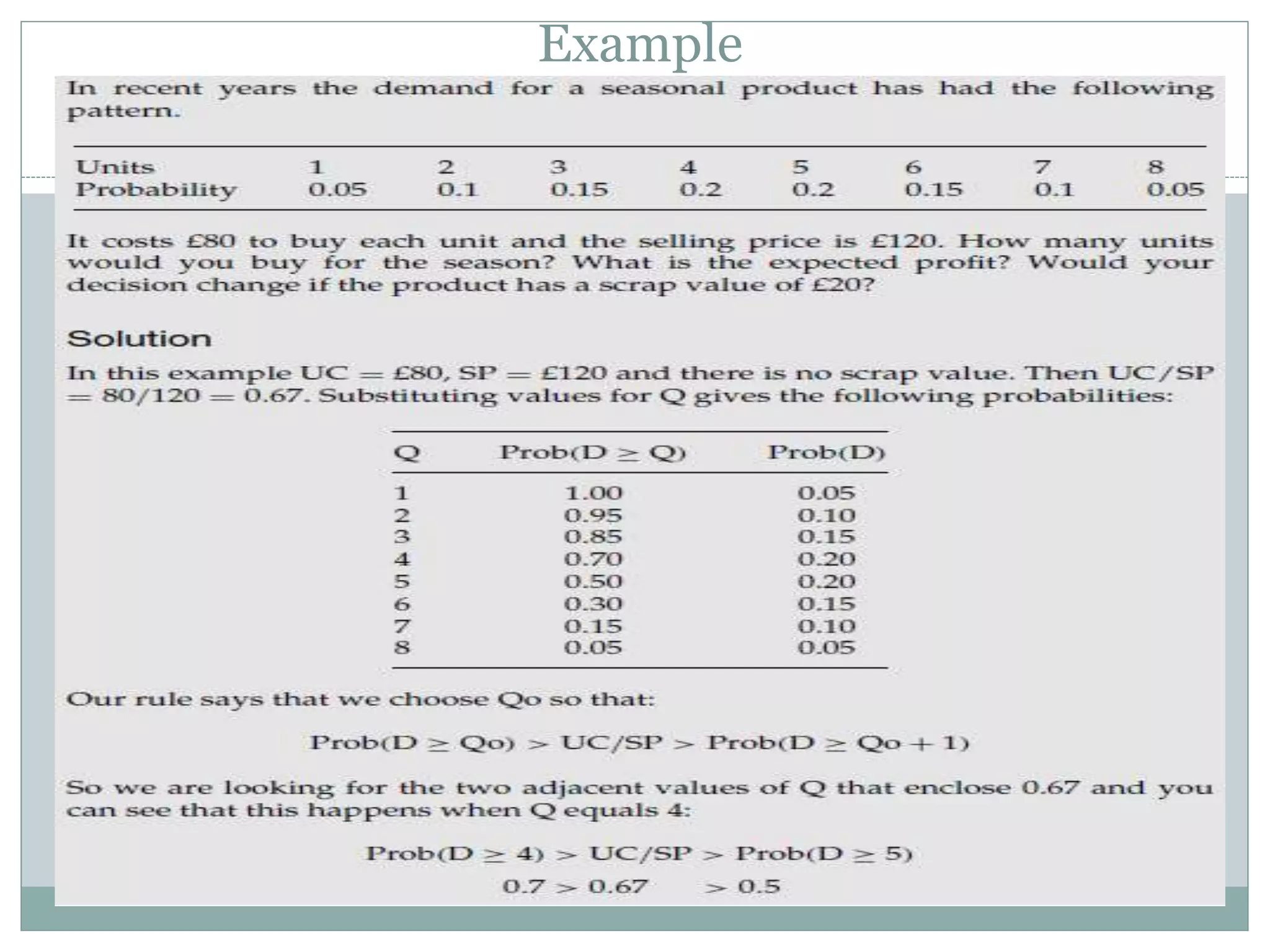
 Marginal analysis is useful for seasonal goods and a 
standard example is of a newsboy selling papers on a 
street corner. He has to decide how many papers to 
buy from his supplier when customer demand is 
uncertain. 
 If too many papers are bought he will be left with 
unsold stock which has no value and if too few 
papers are bought he will be devoid of higher profit. 
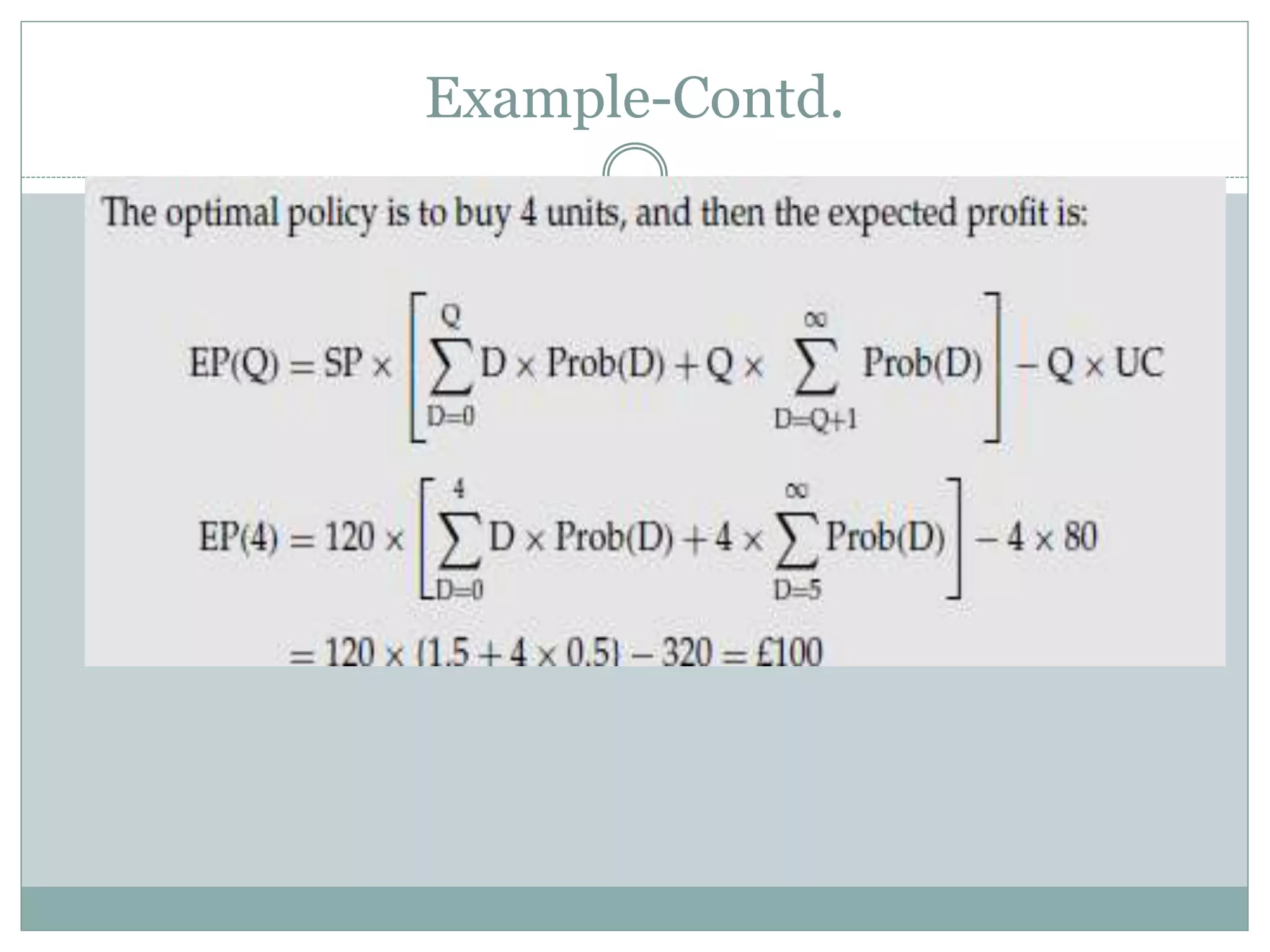
 The total expected profit from buying Q newspapers 
is the sum of the profits multiplied by their 
probabilities.
Newsboy Problem-Contd. 
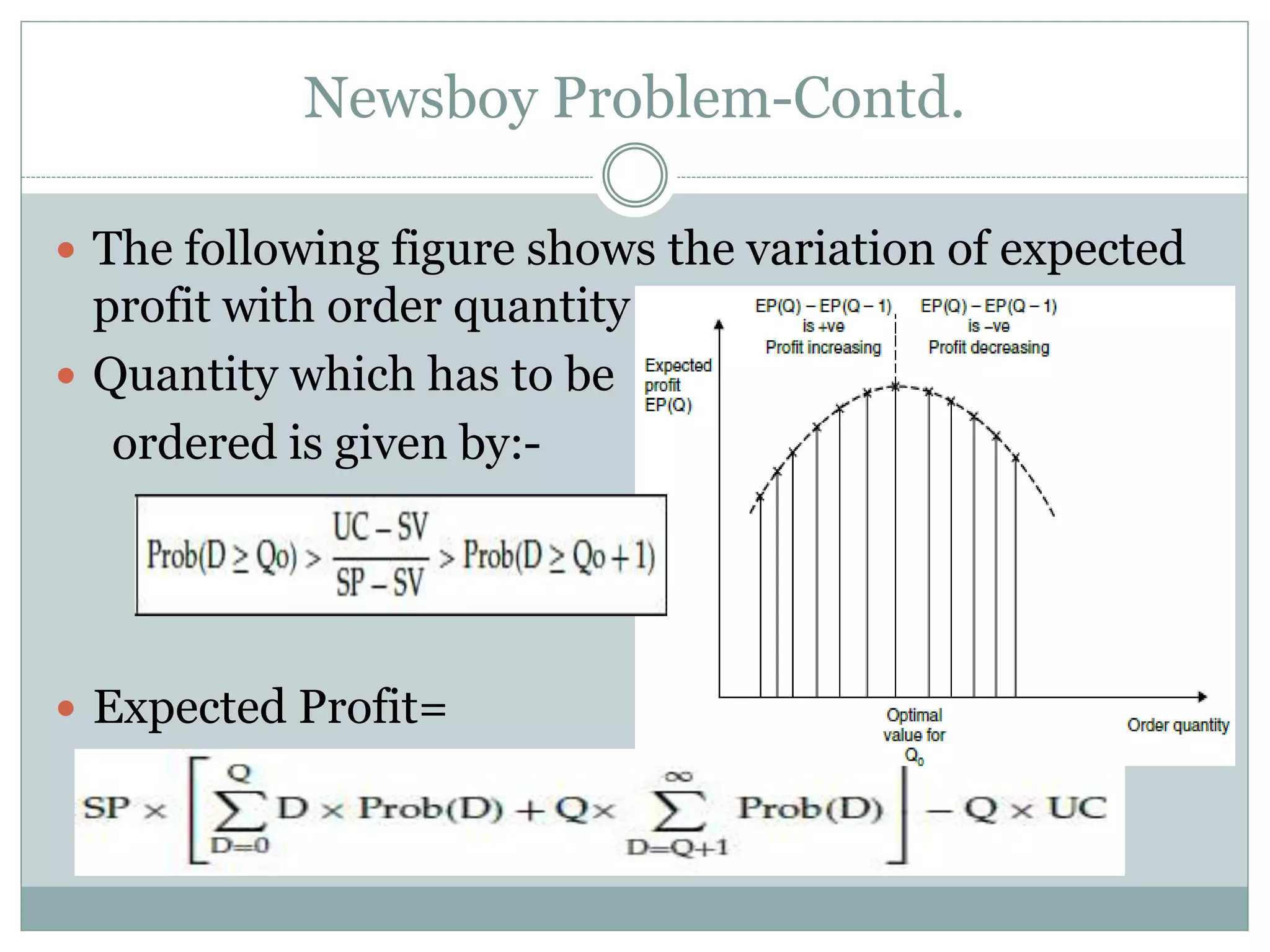
 The following figure shows the variation of expected 
profit with order quantity 
 Quantity which has to be 
ordered is given by:- 
 Expected Profit=
Example
Example-Contd.
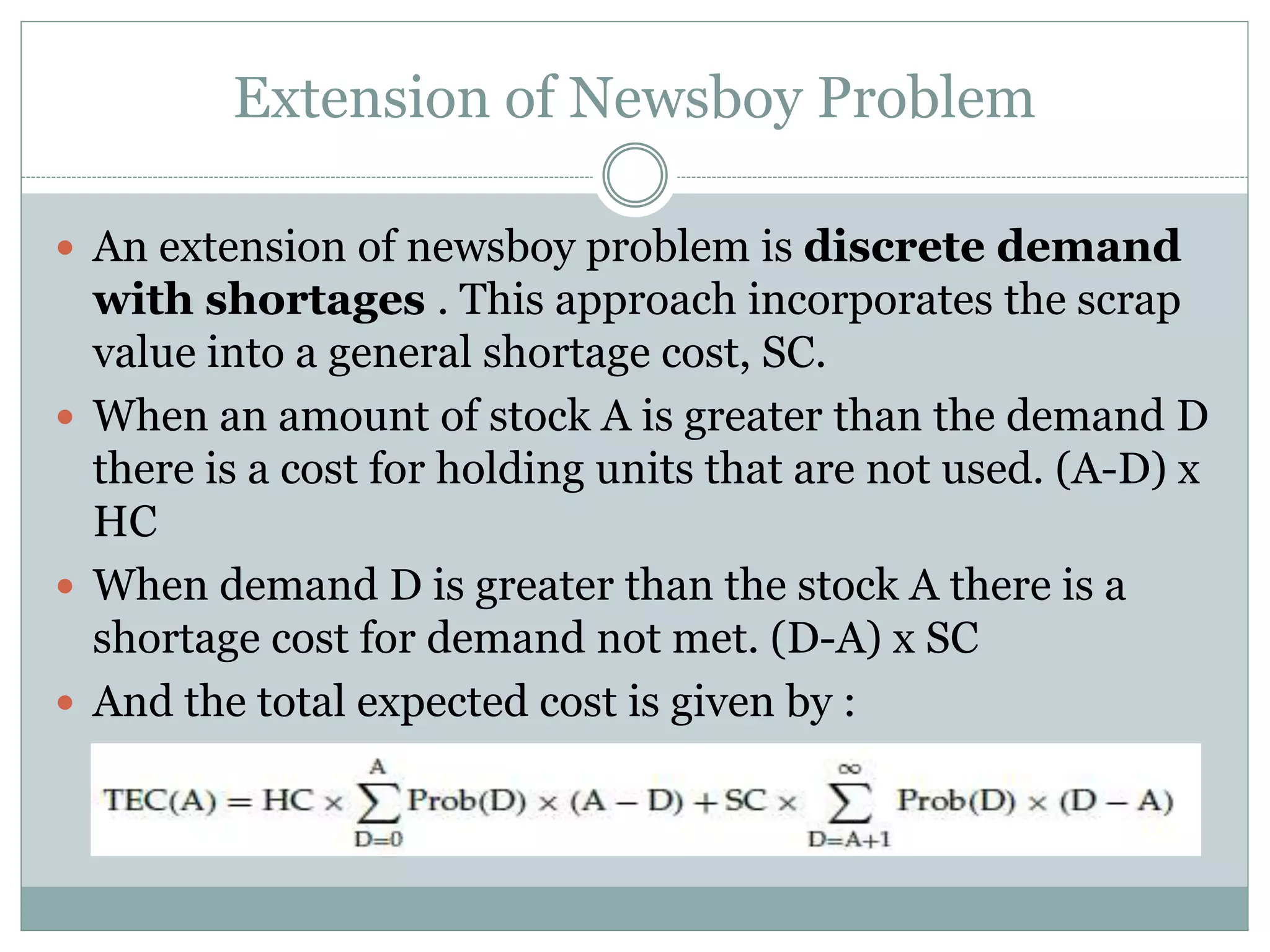
Extension of Newsboy Problem 
 An extension of newsboy problem is discrete demand 
with shortages . This approach incorporates the scrap 
value into a general shortage cost, SC. 
 When an amount of stock A is greater than the demand D 
there is a cost for holding units that are not used. (A-D) x 
HC 
 When demand D is greater than the stock A there is a 
shortage cost for demand not met. (D-A) x SC 
 And the total expected cost is given by :
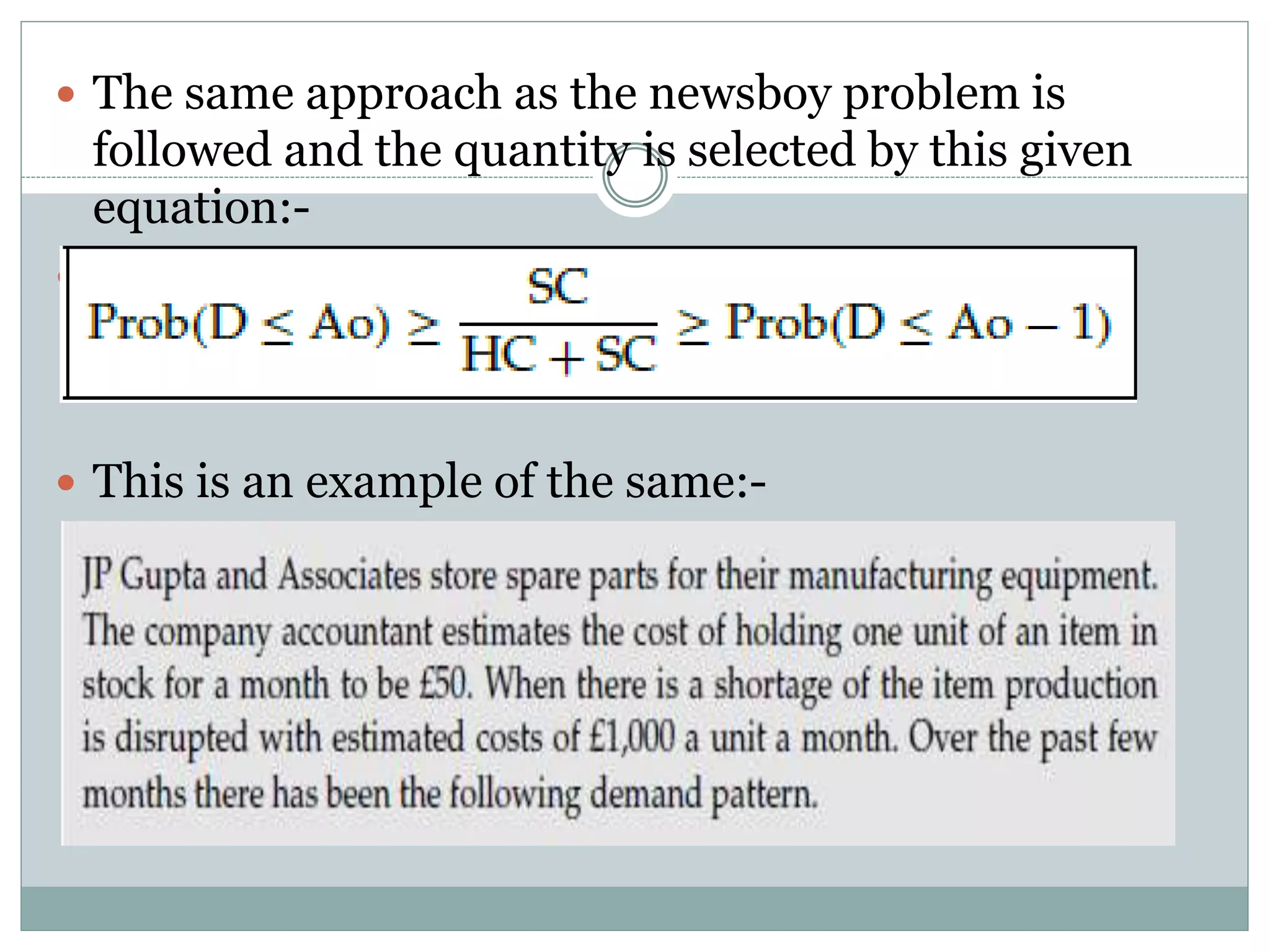
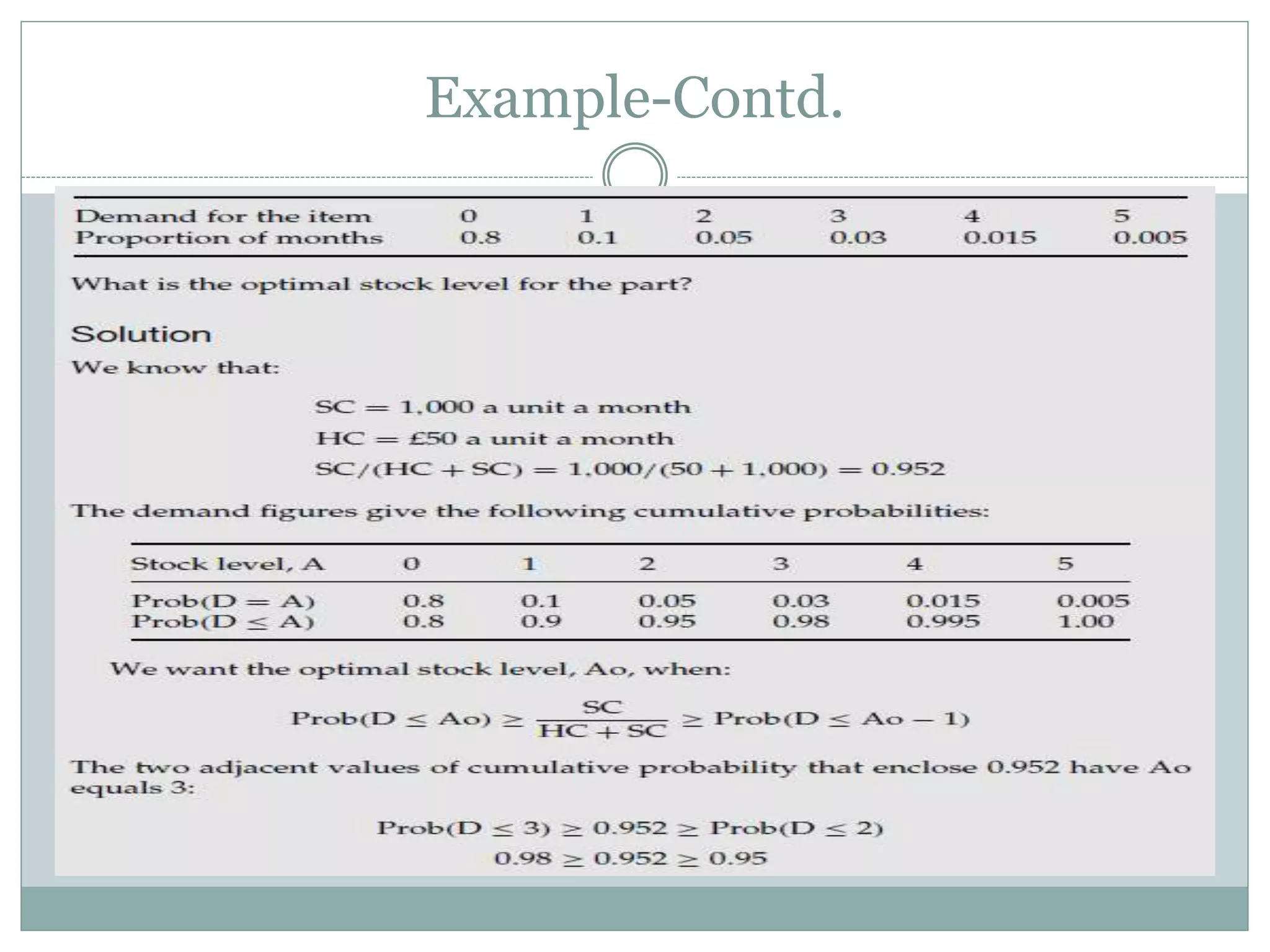
 The same approach as the newsboy problem is 
followed and the quantity is selected by this given 
equation:- 
  
 This is an example of the same:-
Example-Contd.
Intermittent Demand 
 Many Organizations have a particular problem with 
stocks of spare parts for equipments. These part may 
be used rarely but have high storage costs that they 
must remain in stock . Demand of this type is called 
intermittent or lumpy with a typical pattern for 
consecutive periods like 
 0 0 10 0 0 0 0 0 25 0 0 0 0 0 0 0 0 0 5 0 0 0 0
 There are similar problems with components for 
batch production. The materials needed in one 
batch must be in stock when this batch is being 
worked on , but then they are not needed for other 
batches . The main problem is finding a reasonable 
forecast . One approach is to consider separately: 
 1: Expected no. of periods between demands , ET 
 2: Expected size of a demand , ED
 Then the probability of a demand in any period is 
1/ET, so we can forecast demand from : Forecast 
Demand = ED/ET 
 If we know the shortage cost we can balance this 
against holding cost and calculate an optimal value 
for A, the amount of stock that minimizes the 
expected total cost . Alternatively , we can look at 
the service level , with Service level = 1- 
prob(shortage) 
=1-[prob(there is demand)xProb(demand>A)]
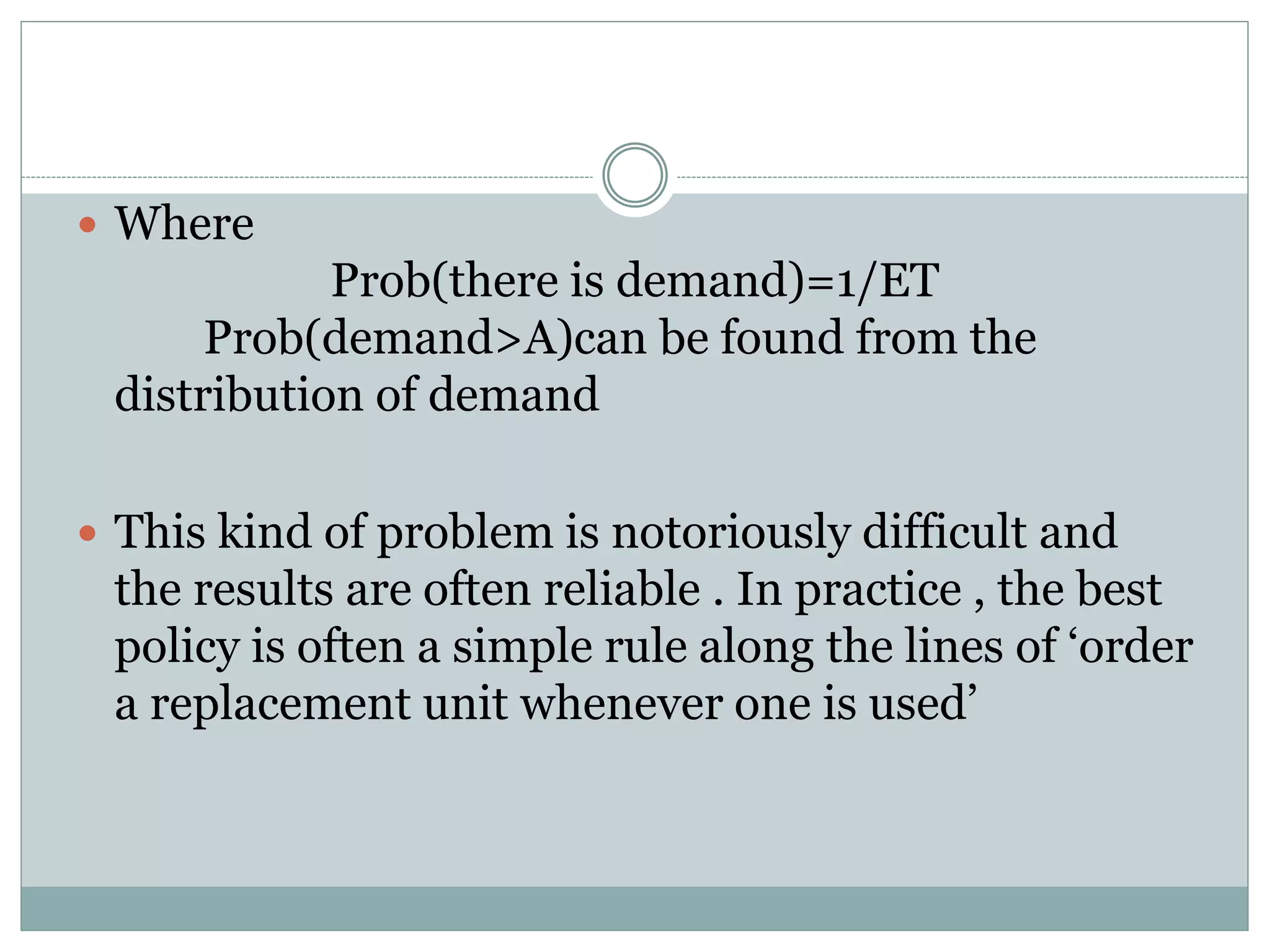
 Where 
Prob(there is demand)=1/ET 
Prob(demand>A)can be found from the 
distribution of demand 
 This kind of problem is notoriously difficult and 
the results are often reliable . In practice , the best 
policy is often a simple rule along the lines of ‘order 
a replacement unit whenever one is used’
 Example : Mean time between demands for spare part 
is 5 weeks, and the mean demand size is 10 units . If 
the demand size is normally dist. With Std. deviation of 
3 units , what stock level would give a 95% service 
level? 
 Ans: we know that service level = 
1-[Prob(there is demand)xProb(demand>A)] and we 
want Prob(there is demand)xProb(demand>A)=.05 
but Prob(there is demand) = 1/5 so Prob(demand>A) 
= .05/2 =.25 for the norm. dist. This equals to 0.67 s.d 
giving A=ED+Z.σ=10+0.67x3 =12units . This ans 
makes assumptions but its reasonable
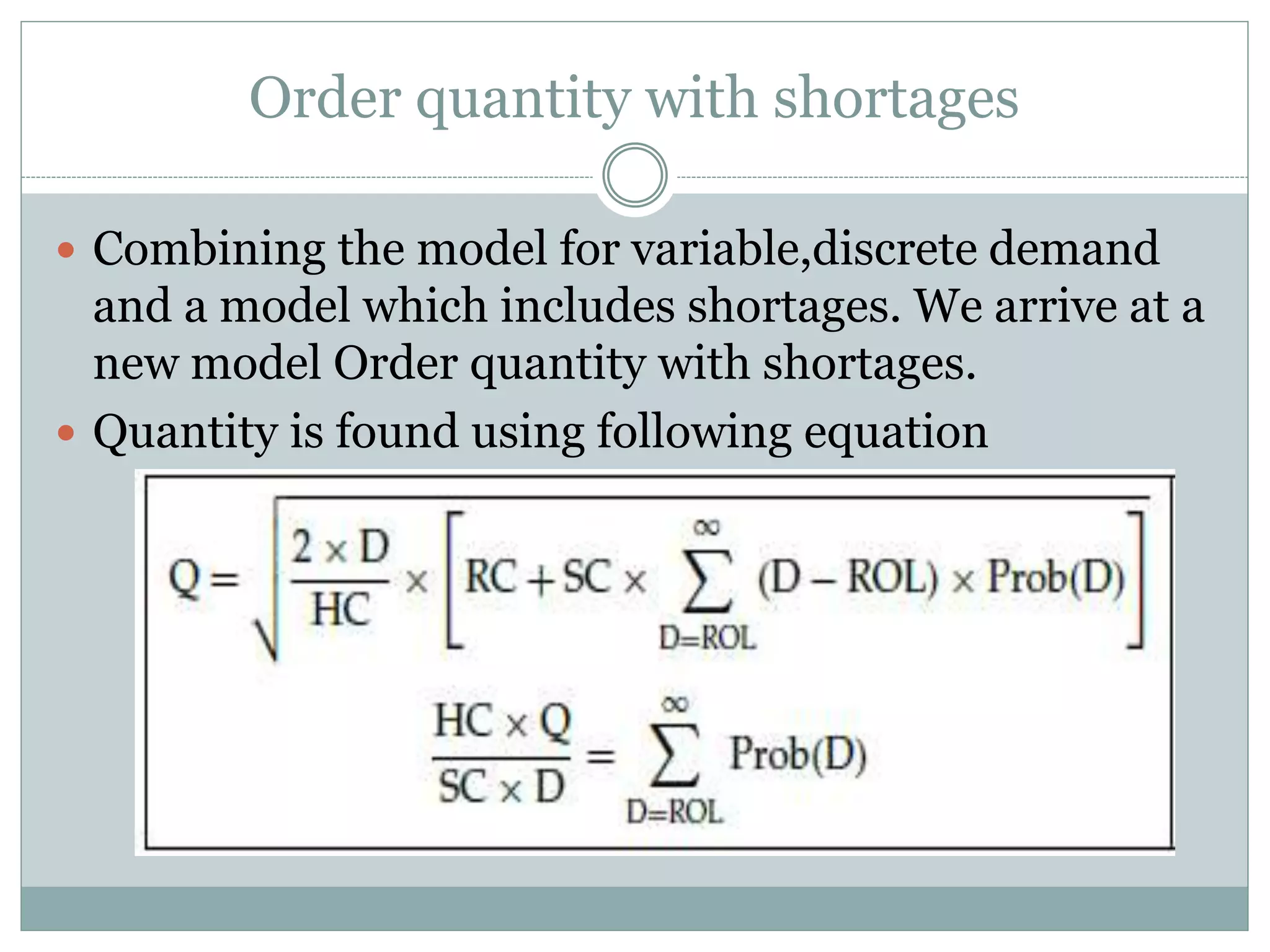
Order quantity with shortages 
 Combining the model for variable,discrete demand 
and a model which includes shortages. We arrive at a 
new model Order quantity with shortages. 
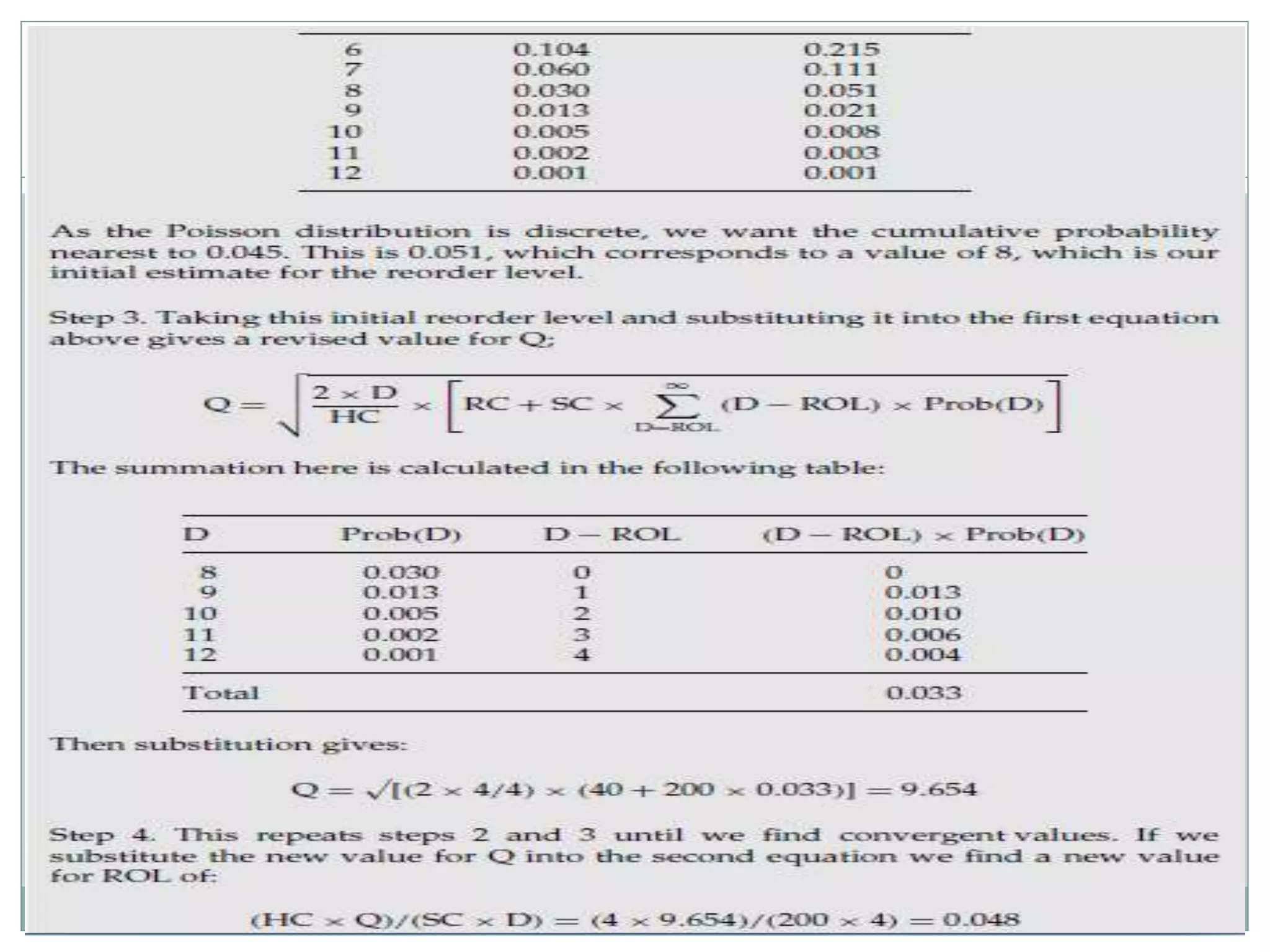
 Quantity is found using following equation
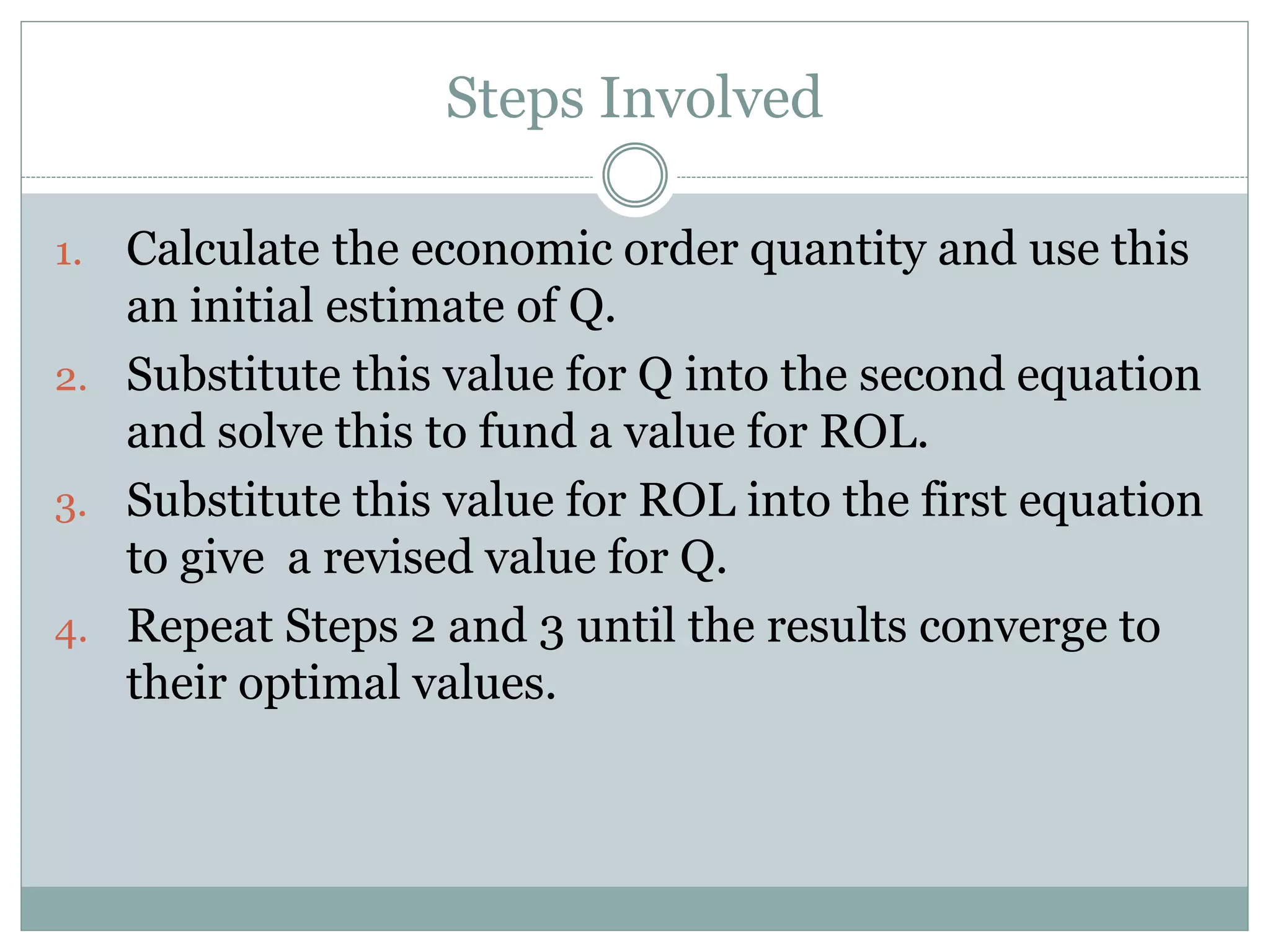
Steps Involved 
1. Calculate the economic order quantity and use this 
an initial estimate of Q. 
2. Substitute this value for Q into the second equation 
and solve this to fund a value for ROL. 
3. Substitute this value for ROL into the first equation 
to give a revised value for Q. 
4. Repeat Steps 2 and 3 until the results converge to 
their optimal values.
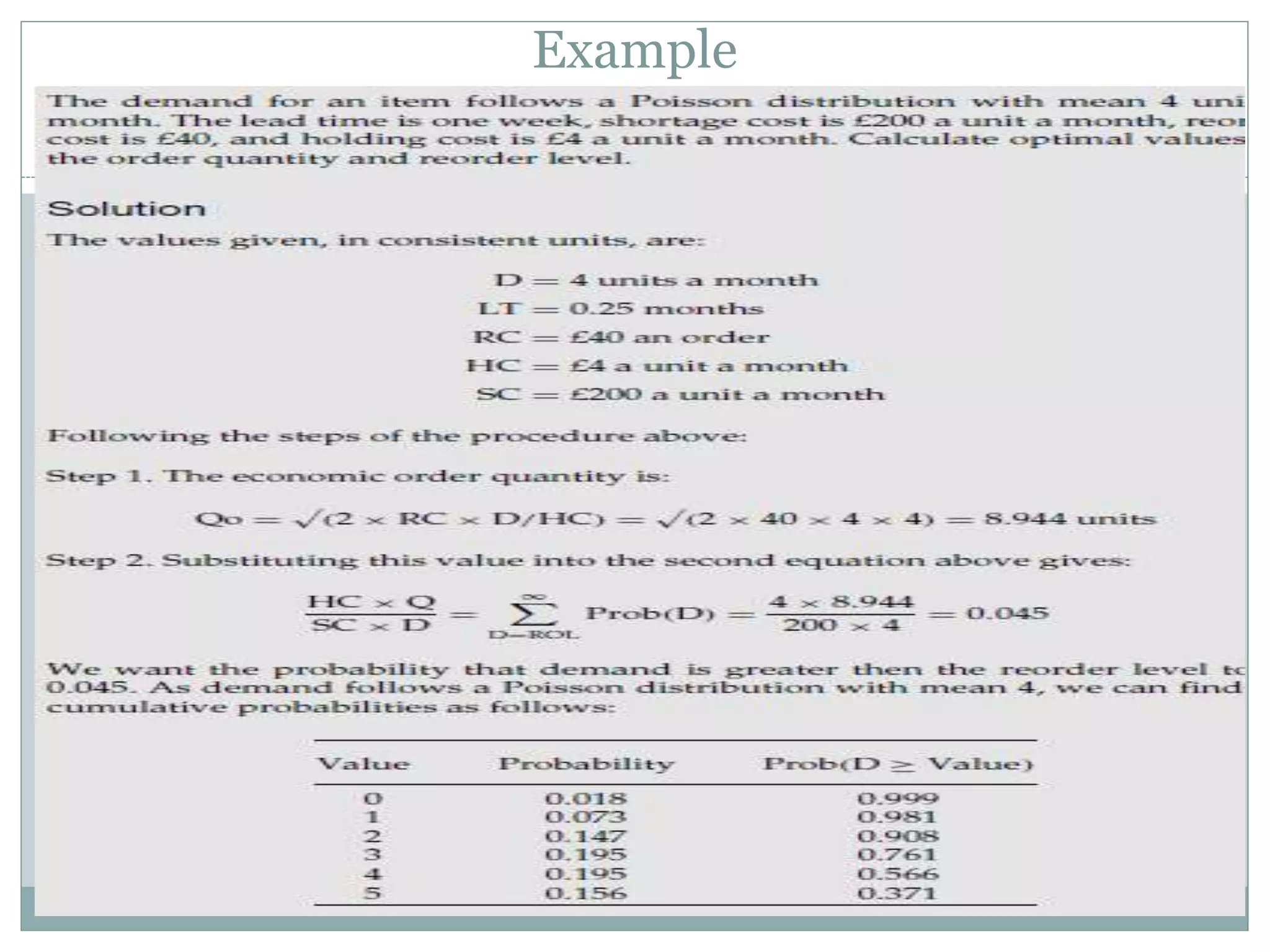
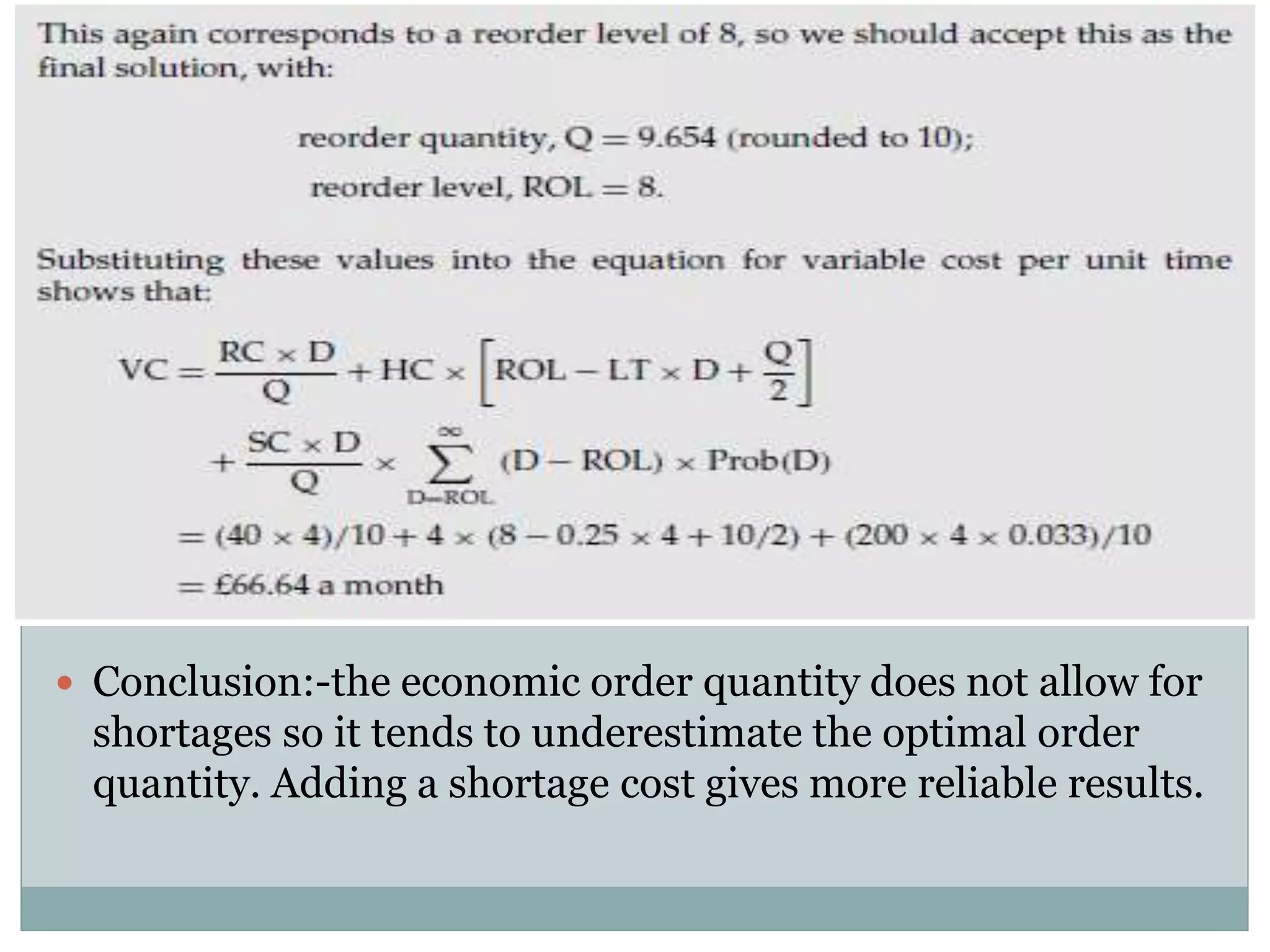
Example
 Conclusion:-the economic order quantity does not allow for 
shortages so it tends to underestimate the optimal order 
quantity. Adding a shortage cost gives more reliable results.
Service Level 
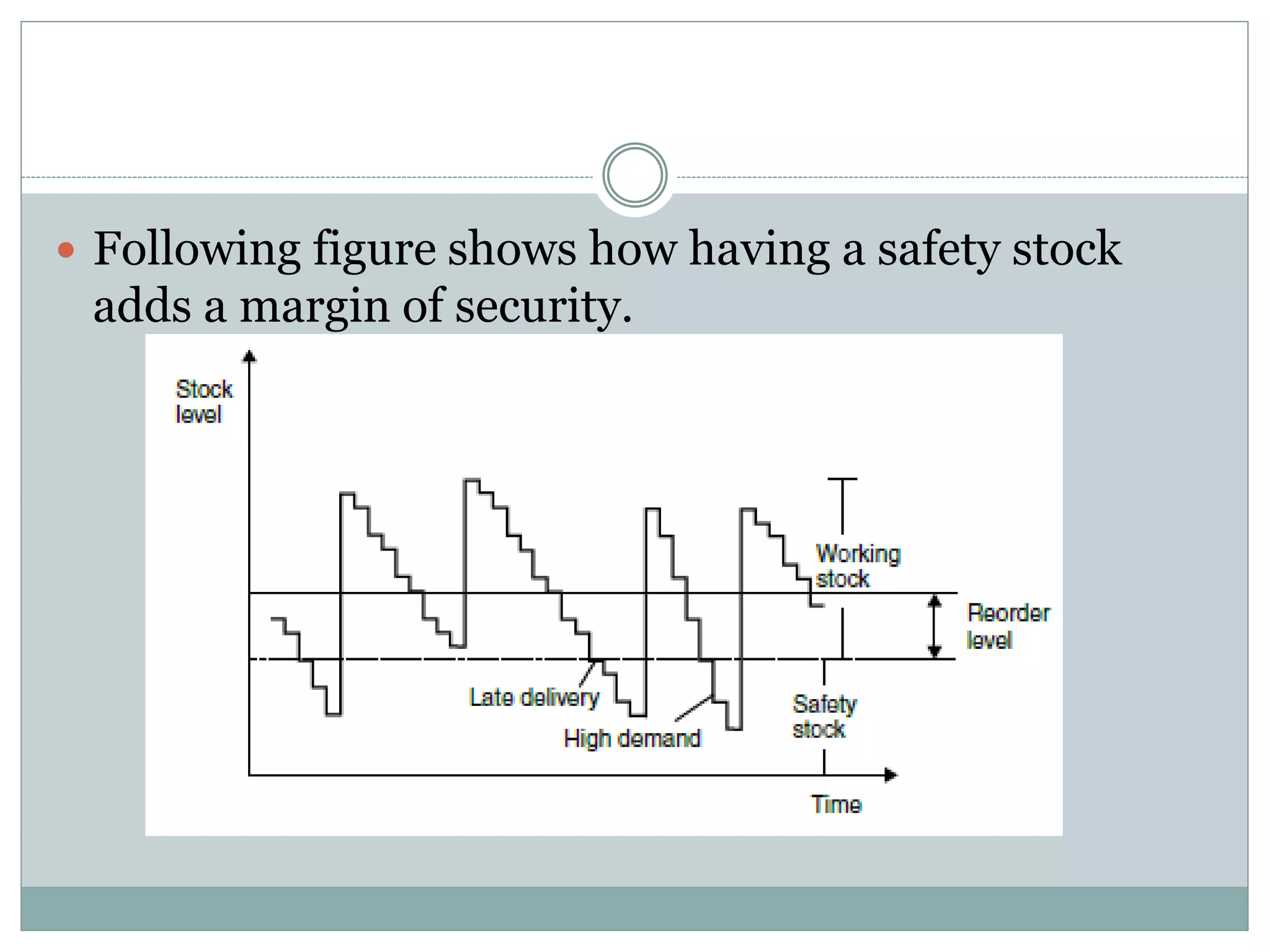
 Organizations hold an extra reserve of stock knowing 
that It will normally not be used but it is available 
when deliveries are late or demand is higher than 
expected. This reserve stock forms the safety stock. 
 Service level is a target for the proportion of demand 
that is met directly from stock – or alternatively, the 
maximum acceptable probability that a demand 
cannot be met from stock. A service level is usually 
specified by the organization.
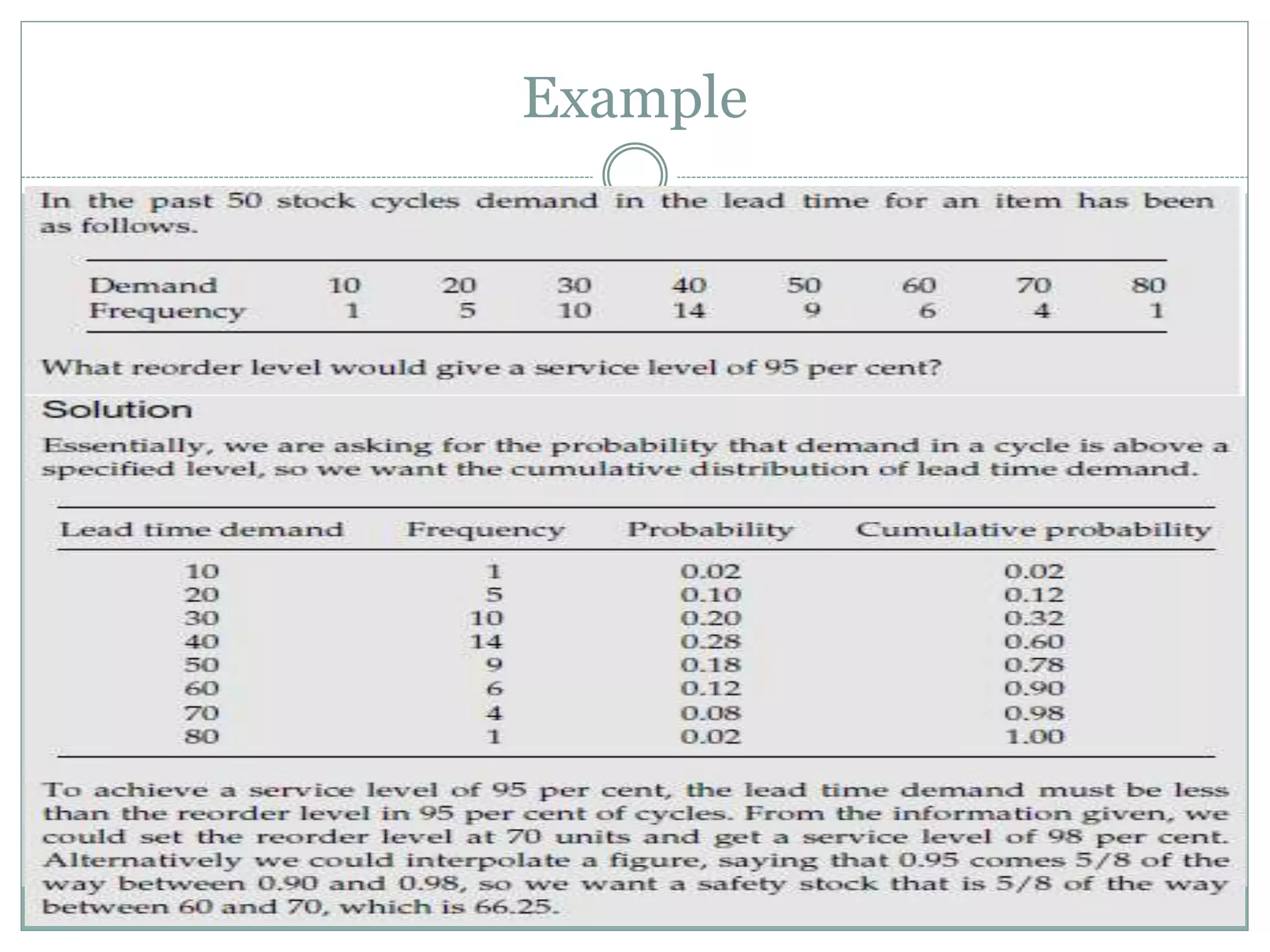
 Following figure shows how having a safety stock 
adds a margin of security.
Example
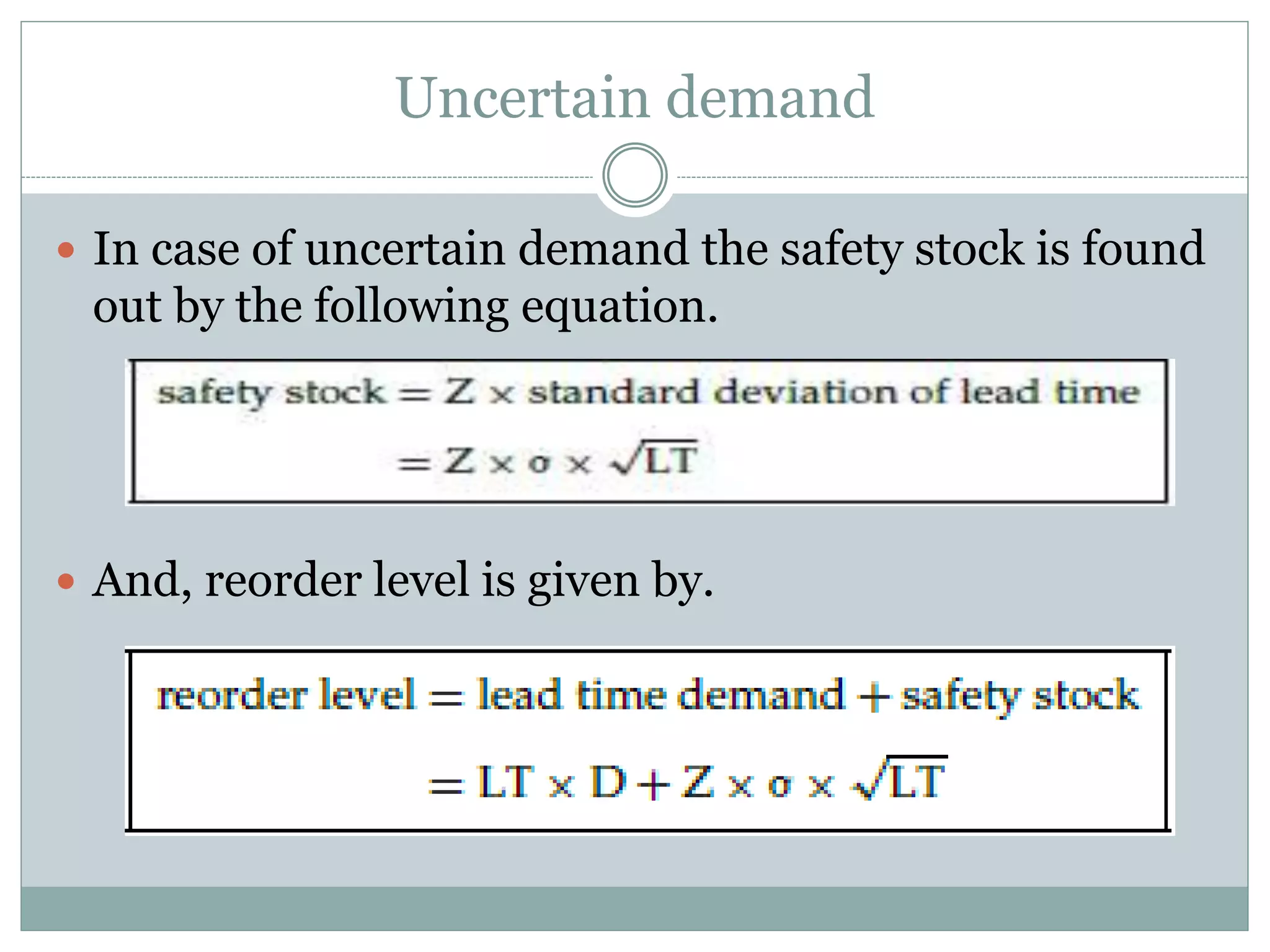
Uncertain demand 
 In case of uncertain demand the safety stock is found 
out by the following equation. 
 And, reorder level is given by.
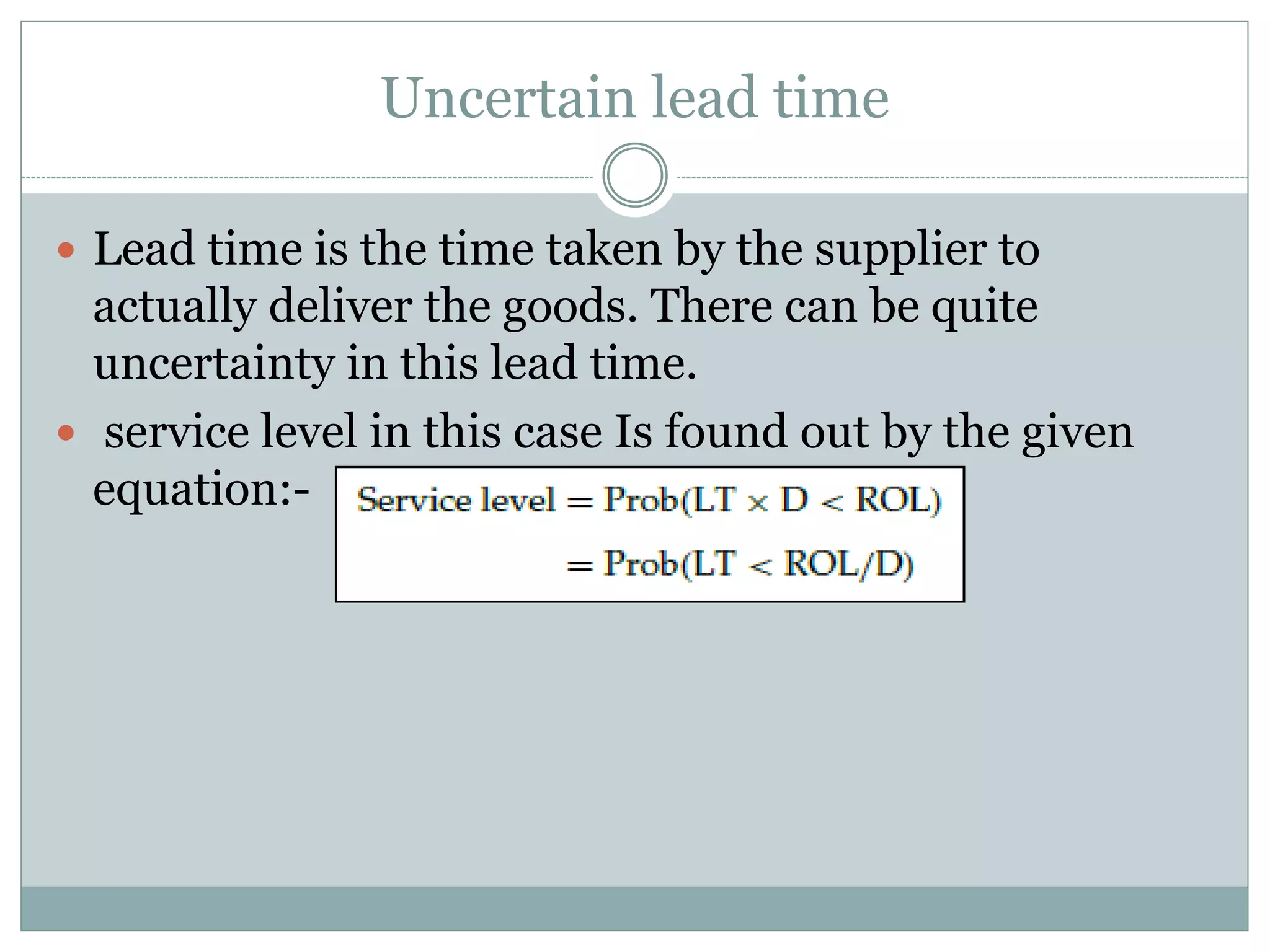
Uncertain lead time 
 Lead time is the time taken by the supplier to 
actually deliver the goods. There can be quite 
uncertainty in this lead time. 
 service level in this case Is found out by the given 
equation:-
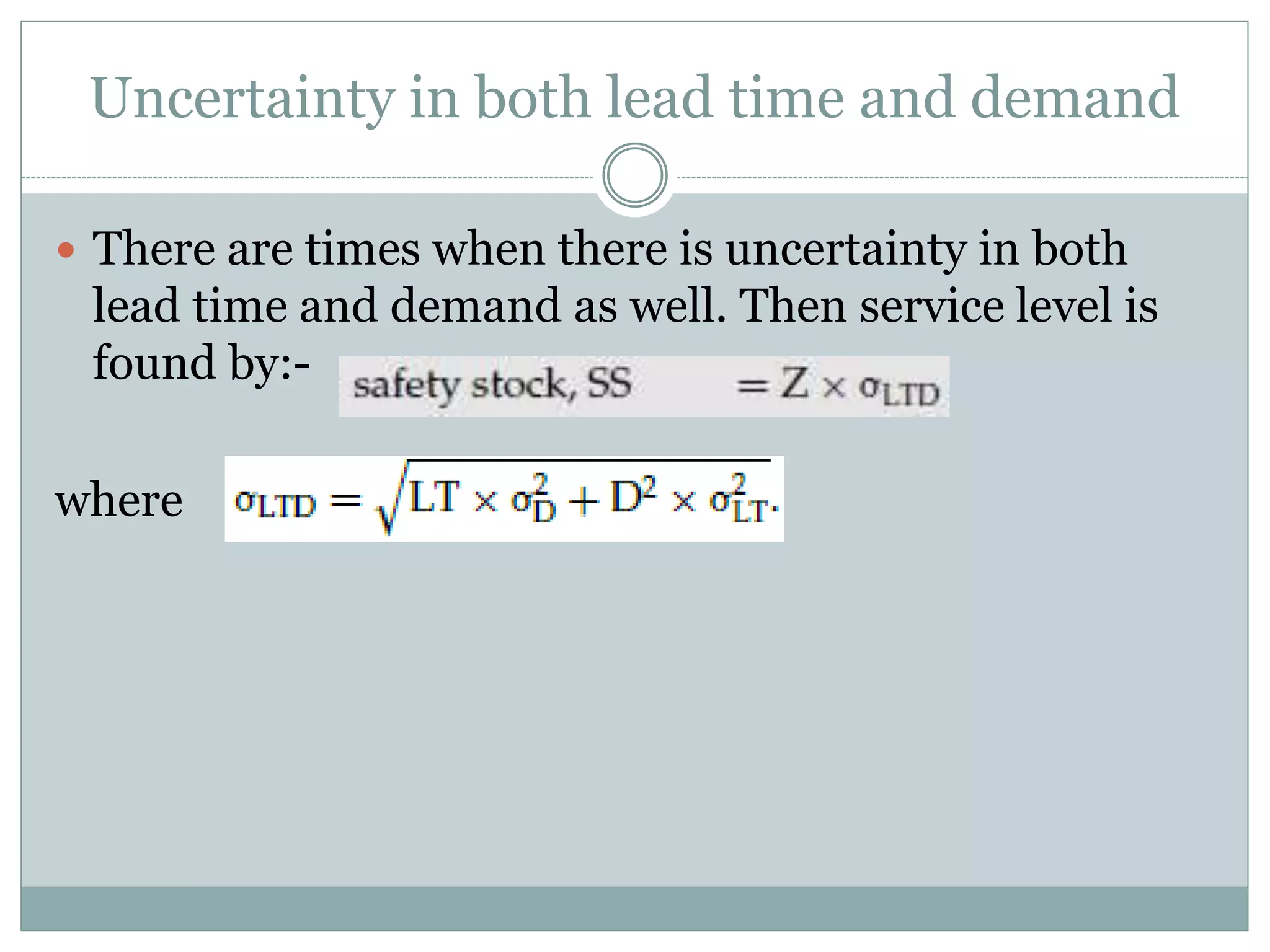
Uncertainty in both lead time and demand 
 There are times when there is uncertainty in both 
lead time and demand as well. Then service level is 
found by:- 
where
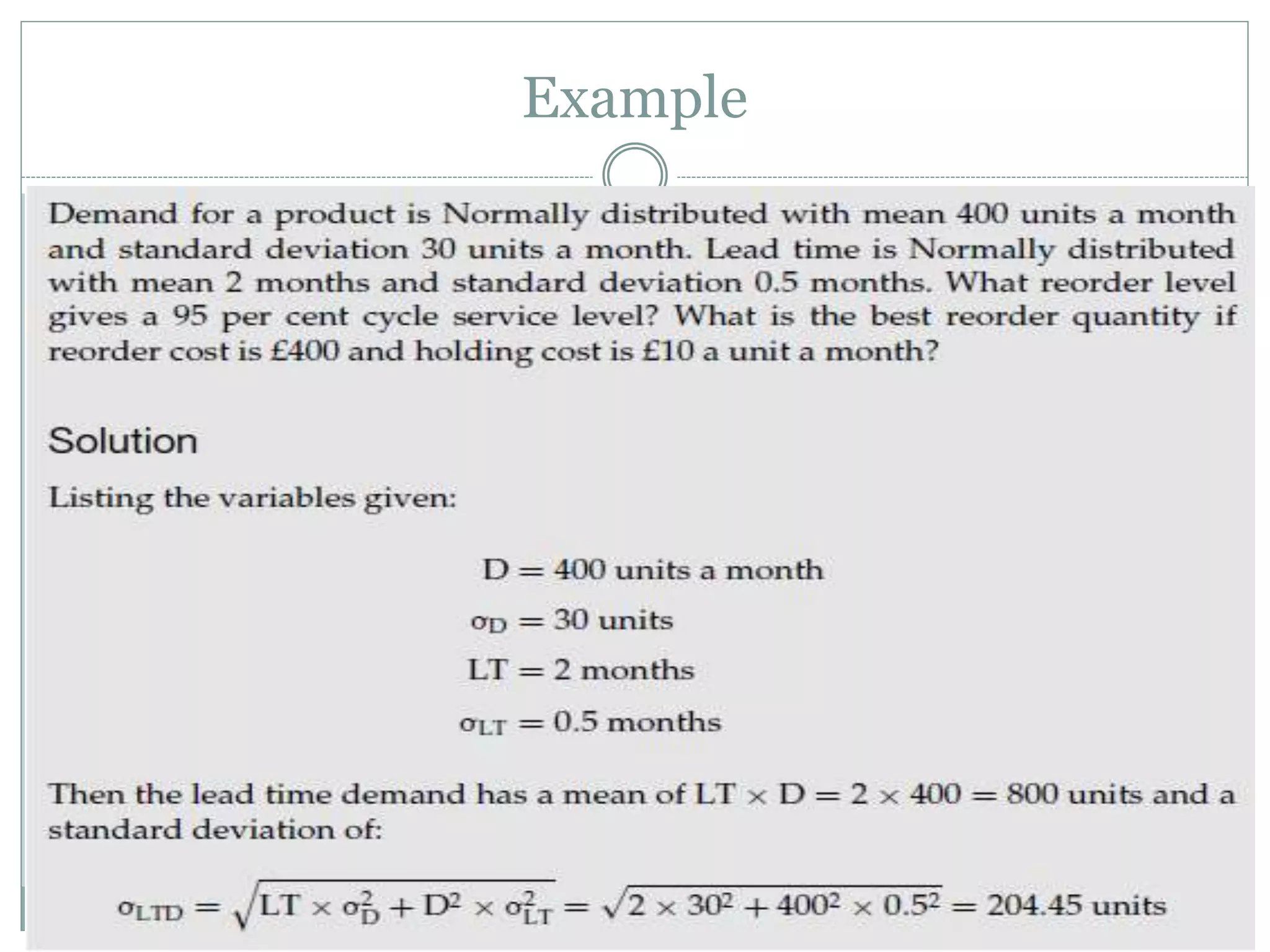
Example
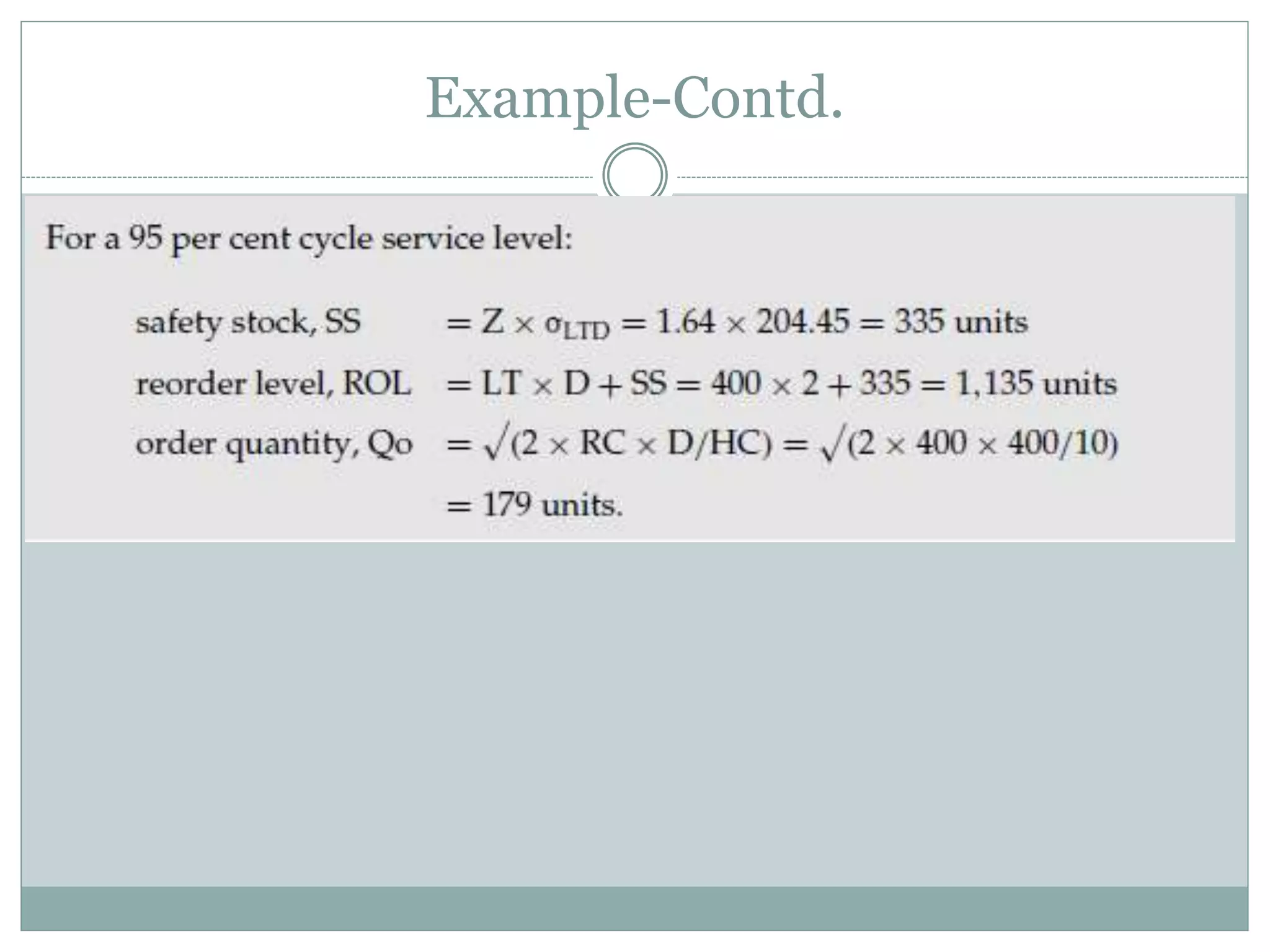
Example-Contd.
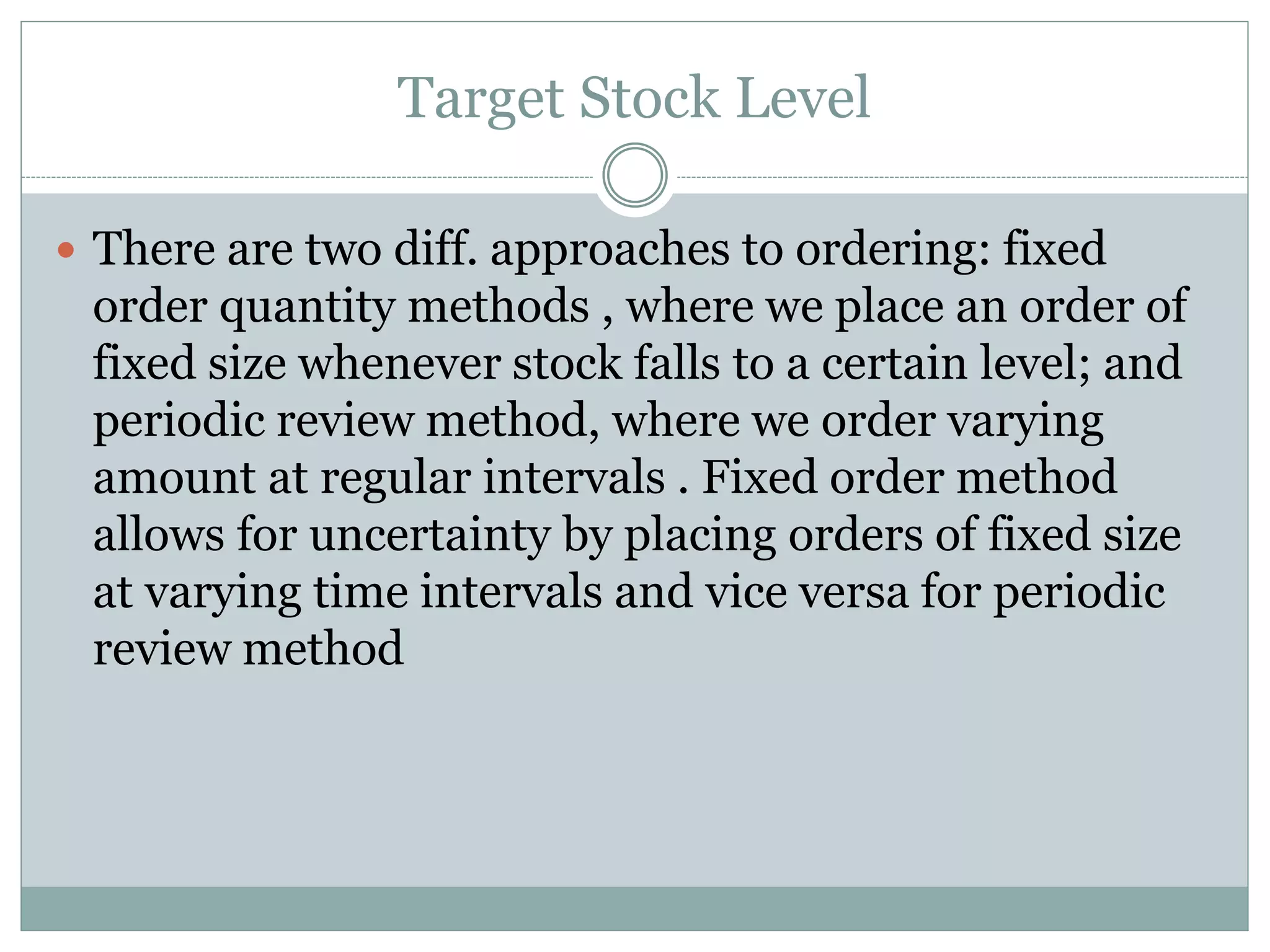
Target Stock Level 
 There are two diff. approaches to ordering: fixed 
order quantity methods , where we place an order of 
fixed size whenever stock falls to a certain level; and 
periodic review method, where we order varying 
amount at regular intervals . Fixed order method 
allows for uncertainty by placing orders of fixed size 
at varying time intervals and vice versa for periodic 
review method
 These two approaches are identical if demand is constant 
, differences appear only when demand is uncertain . 
 With periodic review method, the stock level is examined 
at a specified time, and the amount needed to bring this 
up to a target level is ordered . 
 The order level T can be any convenient period . It might 
be easiest to place an order at the end of every week, or 
every morning, or at the end of a month
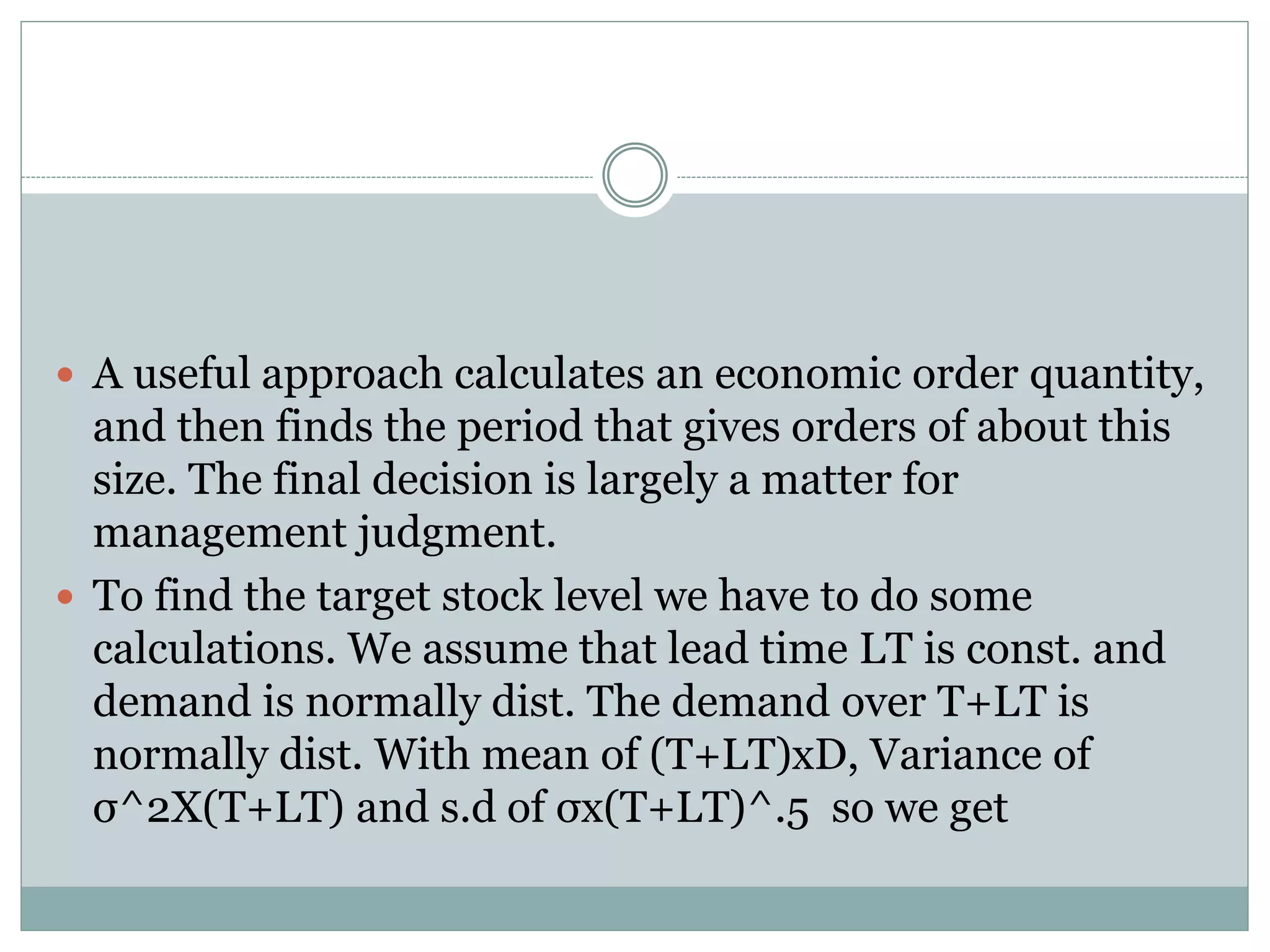
 A useful approach calculates an economic order quantity, 
and then finds the period that gives orders of about this 
size. The final decision is largely a matter for 
management judgment. 
 To find the target stock level we have to do some 
calculations. We assume that lead time LT is const. and 
demand is normally dist. The demand over T+LT is 
normally dist. With mean of (T+LT)xD, Variance of 
σ^2X(T+LT) and s.d of σx(T+LT)^.5 so we get
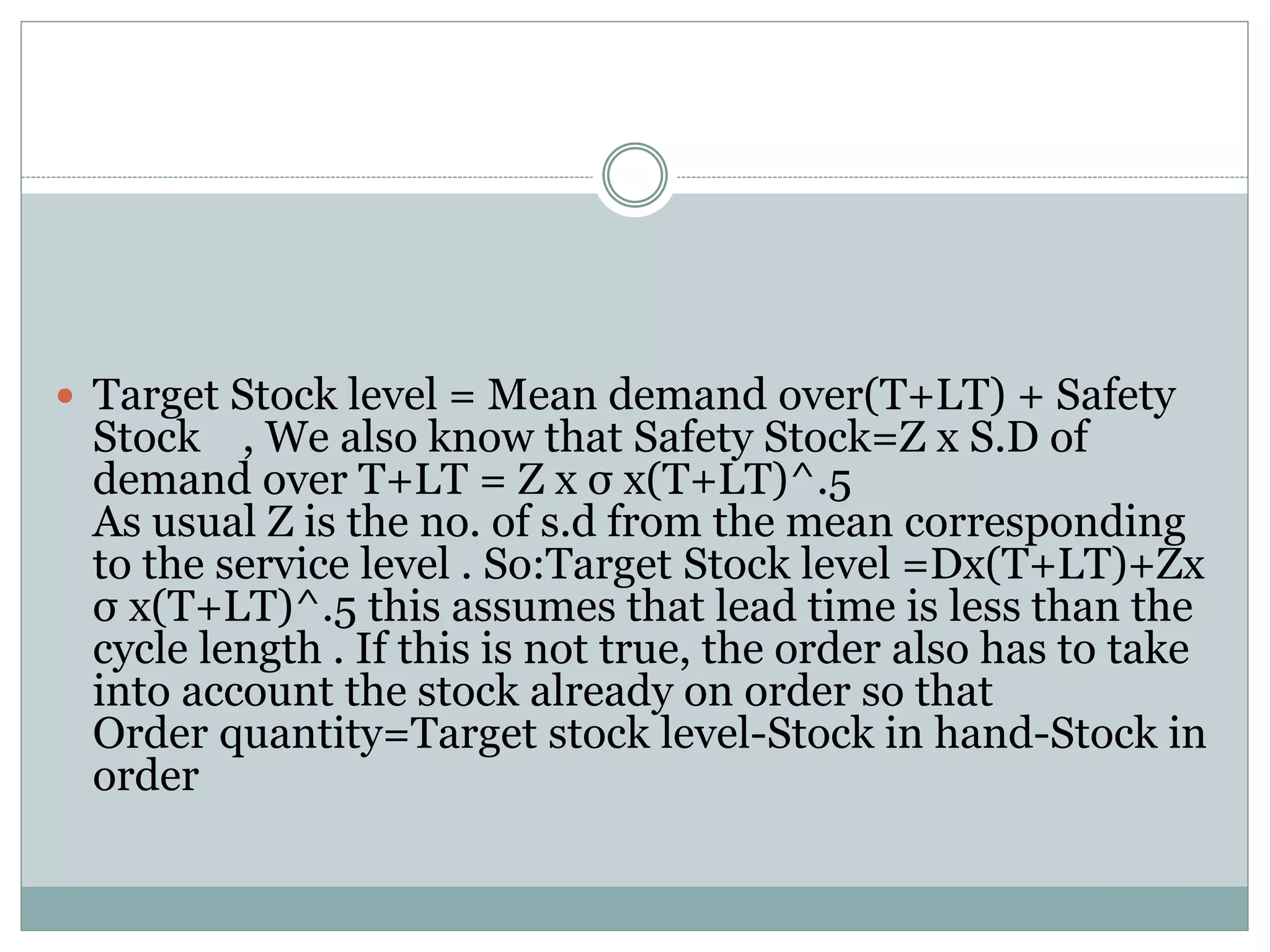
 Target Stock level = Mean demand over(T+LT) + Safety 
Stock , We also know that Safety Stock=Z x S.D of 
demand over T+LT = Z x σ x(T+LT)^.5 
As usual Z is the no. of s.d from the mean corresponding 
to the service level . So:Target Stock level =Dx(T+LT)+Zx 
σ x(T+LT)^.5 this assumes that lead time is less than the 
cycle length . If this is not true, the order also has to take 
into account the stock already on order so that 
Order quantity=Target stock level-Stock in hand-Stock in 
order
Example 
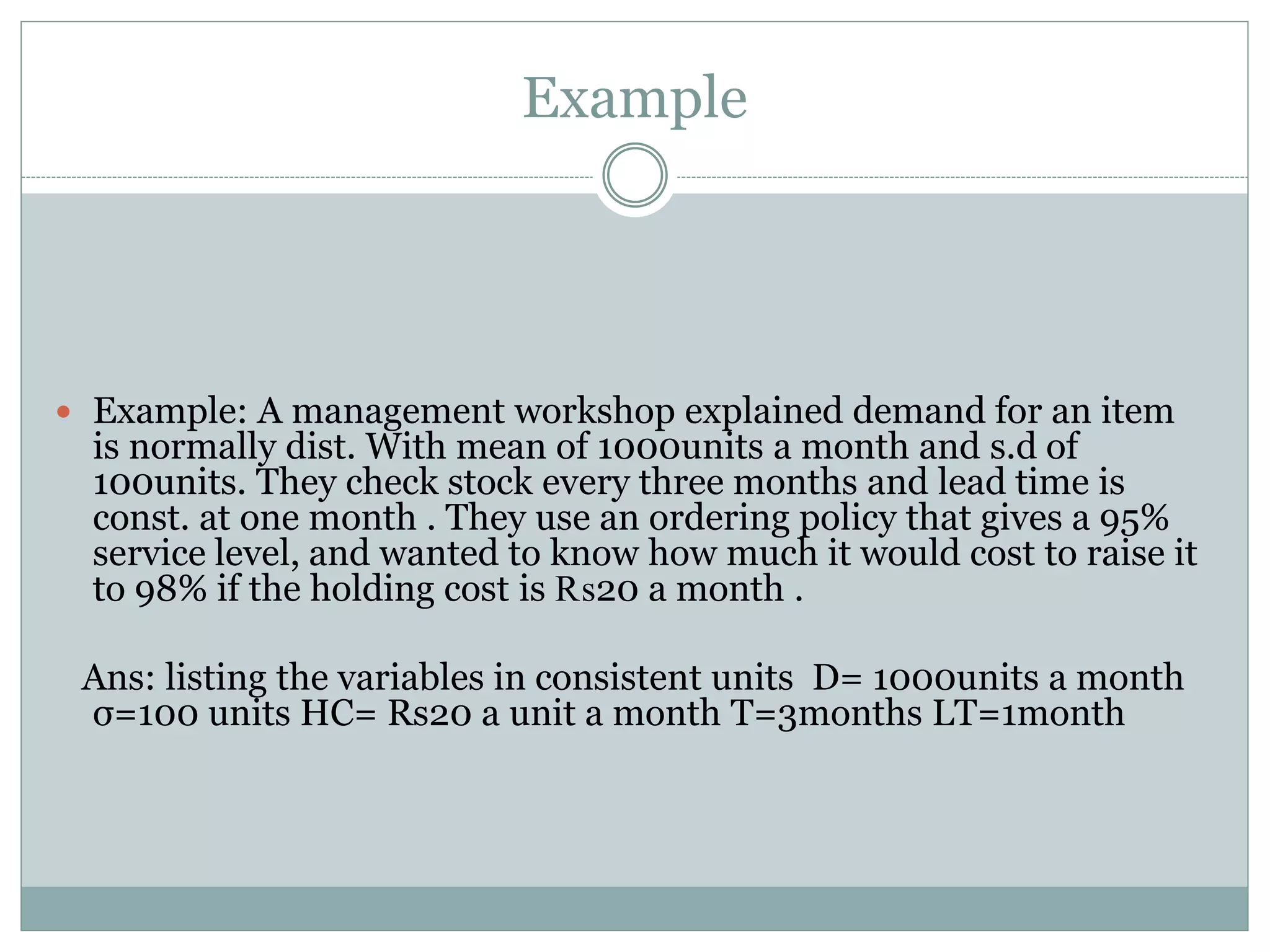
 Example: A management workshop explained demand for an item 
is normally dist. With mean of 1000units a month and s.d of 
100units. They check stock every three months and lead time is 
const. at one month . They use an ordering policy that gives a 95% 
service level, and wanted to know how much it would cost to raise it 
to 98% if the holding cost is ₨20 a month . 
Ans: listing the variables in consistent units D= 1000units a month 
σ=100 units HC= Rs20 a unit a month T=3months LT=1month
Example-contd. 
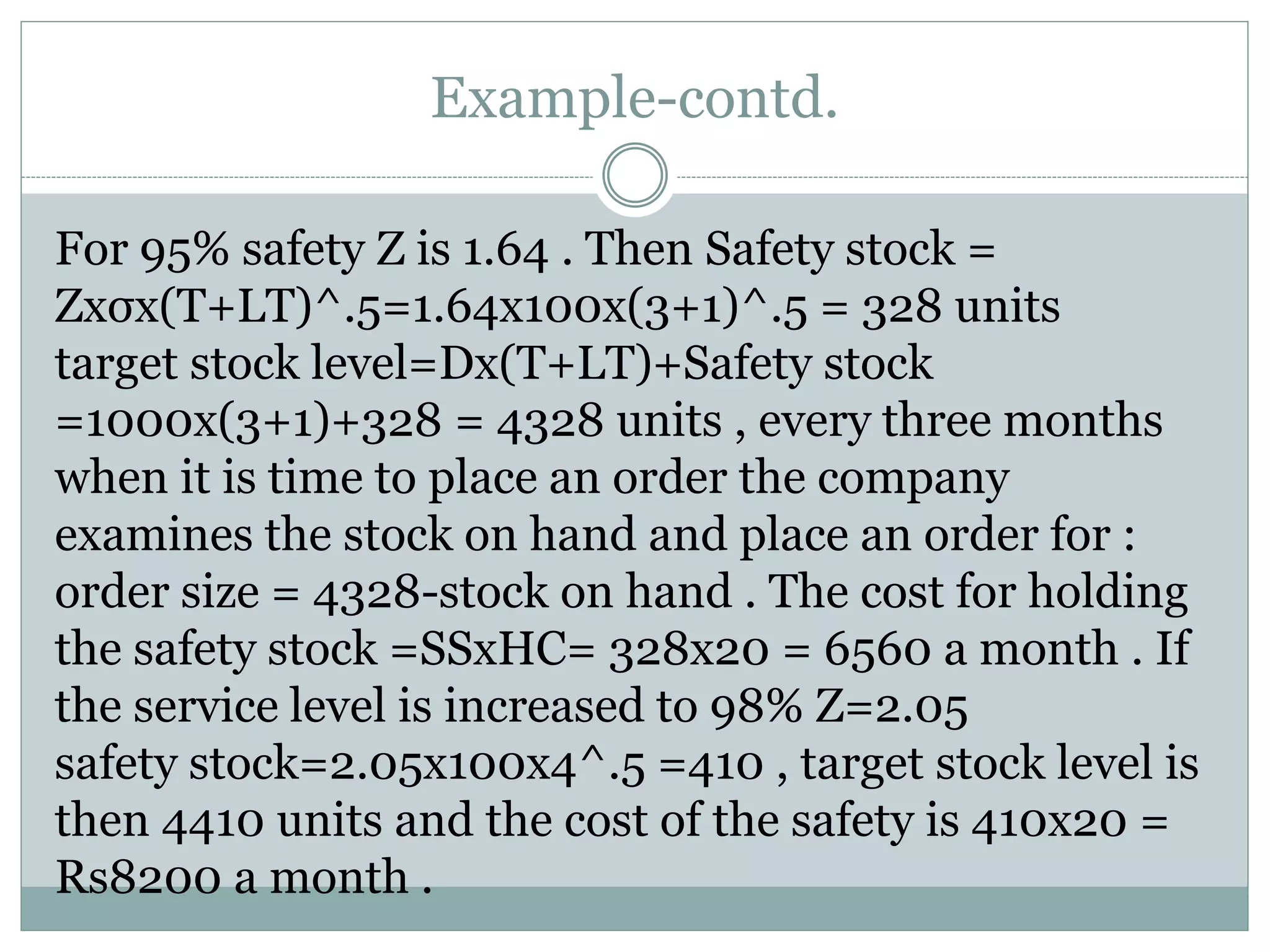
For 95% safety Z is 1.64 . Then Safety stock = 
Zxσx(T+LT)^.5=1.64x100x(3+1)^.5 = 328 units 
target stock level=Dx(T+LT)+Safety stock 
=1000x(3+1)+328 = 4328 units , every three months 
when it is time to place an order the company 
examines the stock on hand and place an order for : 
order size = 4328-stock on hand . The cost for holding 
the safety stock =SSxHC= 328x20 = 6560 a month . If 
the service level is increased to 98% Z=2.05 
safety stock=2.05x100x4^.5 =410 , target stock level is 
then 4410 units and the cost of the safety is 410x20 = 
Rs8200 a month .

Inventory control and management

  • 1.
  • 2.
    Uncertainty in stocks  There Is always some uncertainty in stocks maybe because price rise with inflation, operations change, supply chains are disrupted and so on.  The main uncertainty Is likely to be in customer demand which is quite volatile.  Problems can be classified according to following variables:-  Unknown-in which we have complete ignorance of the situation and any analysis is difficult  Known- in which we know the values taken by parameters and can use deterministic models.  Uncertain-in which we have probability distributions for the variables and can use probabilistic or stochastic models.
  • 3.
    Uncertainty in otherareas  Demand – Demand for an item usually comes from a number of separate customers.The organization has no control over who buys their products and in what quantity.These fluctuations in the number and size of orders give an uncertain demand.  Costs-costs tend to drift upwards with inflation. There can be short term variations as well due to changes in operations,products etc.  Lead Time- Lead time is prone to variability as well which is inevitable as it involves many stages between the decision to buy an item and having it available for use.  Deliveries- deliveries ultimately depend on supplier reliability. They can fluctuate due to rejection during quality checks,overage etc.
  • 4.
    Uncertain demand-Case I  This figure shows the case when actual demand during lead time matches expected demand.
  • 5.
    Uncertain Demand-Case II  This figure shows when demand during lead time is less than expected, it leads to unused stock.
  • 6.
    Uncertain demand-Case III  This figure shows when demand during lead time is greater than expected ,shortages arise.
  • 7.
    Models for discretedemand  If the demand is discrete, and we place a very small order for Q units the probability of selling the Qth unit is high and expected profit is greater than expected loss.  If a large order is placed the probability of selling Qth unit is low and the expected profit is less than the expected loss. Which leads us to the conclusion that best order size is the quantity which gives a profit on Qth unit and a loss on (Q+1)th and following units and any units unsold will be sold at their scrap value.  General rule to place an order for the largest value of Q is given by :-
  • 8.
  • 9.
  • 10.
    Newsboy Problem Marginal analysis is useful for seasonal goods and a standard example is of a newsboy selling papers on a street corner. He has to decide how many papers to buy from his supplier when customer demand is uncertain.  If too many papers are bought he will be left with unsold stock which has no value and if too few papers are bought he will be devoid of higher profit.  The total expected profit from buying Q newspapers is the sum of the profits multiplied by their probabilities.
  • 11.
    Newsboy Problem-Contd. The following figure shows the variation of expected profit with order quantity  Quantity which has to be ordered is given by:-  Expected Profit=
  • 12.
  • 13.
  • 14.
    Extension of NewsboyProblem  An extension of newsboy problem is discrete demand with shortages . This approach incorporates the scrap value into a general shortage cost, SC.  When an amount of stock A is greater than the demand D there is a cost for holding units that are not used. (A-D) x HC  When demand D is greater than the stock A there is a shortage cost for demand not met. (D-A) x SC  And the total expected cost is given by :
  • 15.
     The sameapproach as the newsboy problem is followed and the quantity is selected by this given equation:-   This is an example of the same:-
  • 16.
  • 17.
    Intermittent Demand Many Organizations have a particular problem with stocks of spare parts for equipments. These part may be used rarely but have high storage costs that they must remain in stock . Demand of this type is called intermittent or lumpy with a typical pattern for consecutive periods like  0 0 10 0 0 0 0 0 25 0 0 0 0 0 0 0 0 0 5 0 0 0 0
  • 18.
     There aresimilar problems with components for batch production. The materials needed in one batch must be in stock when this batch is being worked on , but then they are not needed for other batches . The main problem is finding a reasonable forecast . One approach is to consider separately:  1: Expected no. of periods between demands , ET  2: Expected size of a demand , ED
  • 19.
     Then theprobability of a demand in any period is 1/ET, so we can forecast demand from : Forecast Demand = ED/ET  If we know the shortage cost we can balance this against holding cost and calculate an optimal value for A, the amount of stock that minimizes the expected total cost . Alternatively , we can look at the service level , with Service level = 1- prob(shortage) =1-[prob(there is demand)xProb(demand>A)]
  • 20.
     Where Prob(thereis demand)=1/ET Prob(demand>A)can be found from the distribution of demand  This kind of problem is notoriously difficult and the results are often reliable . In practice , the best policy is often a simple rule along the lines of ‘order a replacement unit whenever one is used’
  • 21.
     Example :Mean time between demands for spare part is 5 weeks, and the mean demand size is 10 units . If the demand size is normally dist. With Std. deviation of 3 units , what stock level would give a 95% service level?  Ans: we know that service level = 1-[Prob(there is demand)xProb(demand>A)] and we want Prob(there is demand)xProb(demand>A)=.05 but Prob(there is demand) = 1/5 so Prob(demand>A) = .05/2 =.25 for the norm. dist. This equals to 0.67 s.d giving A=ED+Z.σ=10+0.67x3 =12units . This ans makes assumptions but its reasonable
  • 22.
    Order quantity withshortages  Combining the model for variable,discrete demand and a model which includes shortages. We arrive at a new model Order quantity with shortages.  Quantity is found using following equation
  • 23.
    Steps Involved 1.Calculate the economic order quantity and use this an initial estimate of Q. 2. Substitute this value for Q into the second equation and solve this to fund a value for ROL. 3. Substitute this value for ROL into the first equation to give a revised value for Q. 4. Repeat Steps 2 and 3 until the results converge to their optimal values.
  • 24.
  • 26.
     Conclusion:-the economicorder quantity does not allow for shortages so it tends to underestimate the optimal order quantity. Adding a shortage cost gives more reliable results.
  • 27.
    Service Level Organizations hold an extra reserve of stock knowing that It will normally not be used but it is available when deliveries are late or demand is higher than expected. This reserve stock forms the safety stock.  Service level is a target for the proportion of demand that is met directly from stock – or alternatively, the maximum acceptable probability that a demand cannot be met from stock. A service level is usually specified by the organization.
  • 28.
     Following figureshows how having a safety stock adds a margin of security.
  • 29.
  • 30.
    Uncertain demand In case of uncertain demand the safety stock is found out by the following equation.  And, reorder level is given by.
  • 31.
    Uncertain lead time  Lead time is the time taken by the supplier to actually deliver the goods. There can be quite uncertainty in this lead time.  service level in this case Is found out by the given equation:-
  • 32.
    Uncertainty in bothlead time and demand  There are times when there is uncertainty in both lead time and demand as well. Then service level is found by:- where
  • 33.
  • 34.
  • 35.
    Target Stock Level  There are two diff. approaches to ordering: fixed order quantity methods , where we place an order of fixed size whenever stock falls to a certain level; and periodic review method, where we order varying amount at regular intervals . Fixed order method allows for uncertainty by placing orders of fixed size at varying time intervals and vice versa for periodic review method
  • 36.
     These twoapproaches are identical if demand is constant , differences appear only when demand is uncertain .  With periodic review method, the stock level is examined at a specified time, and the amount needed to bring this up to a target level is ordered .  The order level T can be any convenient period . It might be easiest to place an order at the end of every week, or every morning, or at the end of a month
  • 37.
     A usefulapproach calculates an economic order quantity, and then finds the period that gives orders of about this size. The final decision is largely a matter for management judgment.  To find the target stock level we have to do some calculations. We assume that lead time LT is const. and demand is normally dist. The demand over T+LT is normally dist. With mean of (T+LT)xD, Variance of σ^2X(T+LT) and s.d of σx(T+LT)^.5 so we get
  • 38.
     Target Stocklevel = Mean demand over(T+LT) + Safety Stock , We also know that Safety Stock=Z x S.D of demand over T+LT = Z x σ x(T+LT)^.5 As usual Z is the no. of s.d from the mean corresponding to the service level . So:Target Stock level =Dx(T+LT)+Zx σ x(T+LT)^.5 this assumes that lead time is less than the cycle length . If this is not true, the order also has to take into account the stock already on order so that Order quantity=Target stock level-Stock in hand-Stock in order
  • 39.
    Example  Example:A management workshop explained demand for an item is normally dist. With mean of 1000units a month and s.d of 100units. They check stock every three months and lead time is const. at one month . They use an ordering policy that gives a 95% service level, and wanted to know how much it would cost to raise it to 98% if the holding cost is ₨20 a month . Ans: listing the variables in consistent units D= 1000units a month σ=100 units HC= Rs20 a unit a month T=3months LT=1month
  • 40.
    Example-contd. For 95%safety Z is 1.64 . Then Safety stock = Zxσx(T+LT)^.5=1.64x100x(3+1)^.5 = 328 units target stock level=Dx(T+LT)+Safety stock =1000x(3+1)+328 = 4328 units , every three months when it is time to place an order the company examines the stock on hand and place an order for : order size = 4328-stock on hand . The cost for holding the safety stock =SSxHC= 328x20 = 6560 a month . If the service level is increased to 98% Z=2.05 safety stock=2.05x100x4^.5 =410 , target stock level is then 4410 units and the cost of the safety is 410x20 = Rs8200 a month .