
WHAT IS INVENTORY
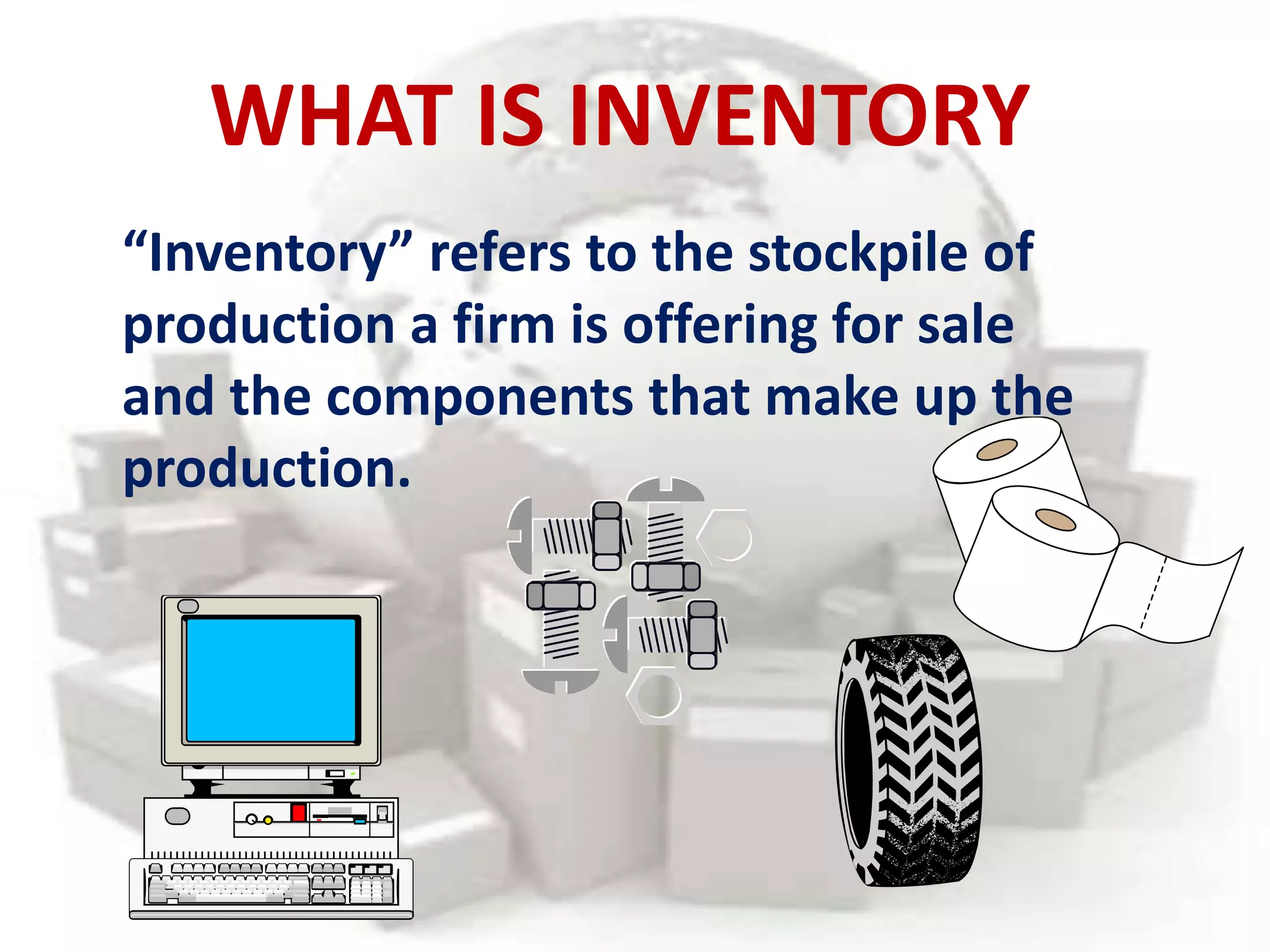
“Inventory” refers to the stockpile of
production a firm is offering for sale
and the components that make up the
production.
 Raw material
 Purchased but not processed
 Work-in-process
 Undergone some change but not completed
 A function of cycle time for a product
 Maintenance/repair/operating (MRO)
 Necessary to keep machinery and processes
productive
 Finished goods
 Completed product awaiting shipment
TYPES OF INVENTORY
1. Avoid irregularities in supply.
2. Demand met during off production.
3. To meet seasonal demand
4. Advantage of price discount.
5. Maintain continuity to production
FUNCTIONS OF INVENTORY
FIVE CATEGORIES OF
STOCKS
1.PIPELINE STOCK
2.CYCLE STOCK
3.SEASONAL STOCK
4.SAFETY STOCK
5.OTHER STOCKS
• the unnecessary tie up of the firm’s funds and
loss of profit.
• excessive carrying cost
• the risk of liquidity
DANGERS OF EXCESSIVE
INVENTORY
On the other hand, a low level of
inventories may result in frequent
interruptions in the production schedule
resulting in under-utilization of capacity
and lower sales
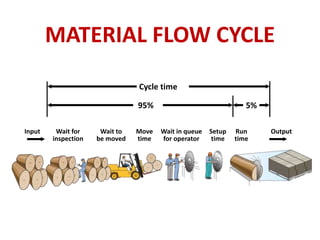
MATERIAL FLOW CYCLE
Input Wait for Wait to Move Wait in queue Setup Run Output
inspection be moved time for operator time time
Cycle time
95% 5%
INVENTORY MANAGEMENT
It is management of materials which
include material planning , purchasing
,receiving ,stores ,inventory control ,scrap
and surplus disposal
COST OF INVENTORY
1.Procurement cost: cost of order is fixed not
dependent on order quantity
2.Inventory holding cost: cost associated with
existence of inventories
3.Shortage cost : cost associated with stock
out.
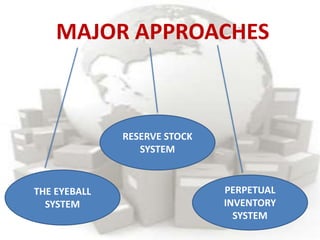
MAJOR APPROACHES
THE EYEBALL
SYSTEM
PERPETUAL
INVENTORY
SYSTEM
RESERVE STOCK
SYSTEM
THE EYEBALL SYSTEM
Standard inventory control system for the
vast majority of small retail and many
small manufacturing operations and is
very simple in application.
RESERVE STOCK SYSTEM
This approach is much more systematic
than the eyeball system. It involves keeping
a reserve stock of items aside, often
literally in a brown bag placed at the rear
of the stock bin or storage area
Various types of perpetual inventory systems
include manual, card-oriented, and
computer- operated systems.
In computer-operated systems, programmed
instruction referred to commonly as a trigger,
automatically transmits an order to the
appropriate vendor once supplies fall below
a prescribed level
PERPETUAL INVENTORY
SYSTEM
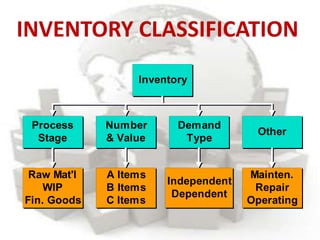
Inventory
Process
Stage
Demand
Type
Number
& Value
Other
Raw Mat'l
WIP
Fin. Goods
Independent
Dependent
A Items
B Items
C Items
Mainten.
Repair
Operating
Inventory
Process
Stage
Demand
Type
Number
& Value
Other
Raw Mat'l
WIP
Fin. Goods
Independent
Dependent
A Items
B Items
C Items
Mainten.
Repair
Operating
INVENTORY CLASSIFICATION
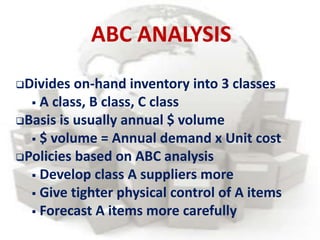
Divides on-hand inventory into 3 classes
 A class, B class, C class
Basis is usually annual $ volume
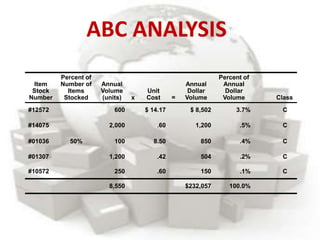
 $ volume = Annual demand x Unit cost
Policies based on ABC analysis
 Develop class A suppliers more
 Give tighter physical control of A items
 Forecast A items more carefully
ABC ANALYSIS
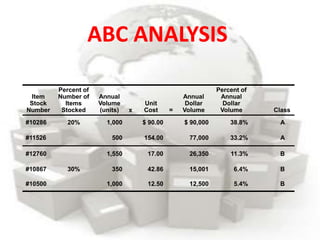
Item
Stock
Number
Percent of
Number of
Items
Stocked
Annual
Volume
(units) x
Unit
Cost =
Annual
Dollar
Volume
Percent of
Annual
Dollar
Volume Class
#10286 20% 1,000 $ 90.00 $ 90,000 38.8% A
#11526 500 154.00 77,000 33.2% A
#12760 1,550 17.00 26,350 11.3% B
#10867 30% 350 42.86 15,001 6.4% B
#10500 1,000 12.50 12,500 5.4% B
ABC ANALYSIS
ABC ANALYSIS
Item
Stock
Number
Percent of
Number of
Items
Stocked
Annual
Volume
(units) x
Unit
Cost =
Annual
Dollar
Volume
Percent of
Annual
Dollar
Volume Class
#12572 600 $ 14.17 $ 8,502 3.7% C
#14075 2,000 .60 1,200 .5% C
#01036 50% 100 8.50 850 .4% C
#01307 1,200 .42 504 .2% C
#10572 250 .60 150 .1% C
8,550 $232,057 100.0%
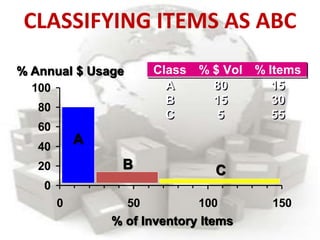
CLASSIFYING ITEMS AS ABC
0
20
40
60
80
100
0 50 100 150
% of Inventory Items
% Annual $ Usage
A
B C
Class % $ Vol % Items
A 80 15
B 15 30
C 5 55
Class % $ Vol % Items
A 80 15
B 15 30
C 5 55
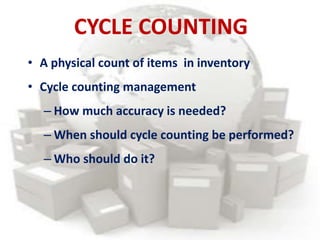
CYCLE COUNTING
• A physical count of items in inventory
• Cycle counting management
– How much accuracy is needed?
– When should cycle counting be performed?
– Who should do it?
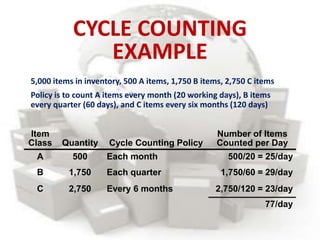
CYCLE COUNTING
EXAMPLE
5,000 items in inventory, 500 A items, 1,750 B items, 2,750 C items
Policy is to count A items every month (20 working days), B items
every quarter (60 days), and C items every six months (120 days)
Item
Class Quantity Cycle Counting Policy
Number of Items
Counted per Day
A 500 Each month 500/20 = 25/day
B 1,750 Each quarter 1,750/60 = 29/day
C 2,750 Every 6 months 2,750/120 = 23/day
77/day
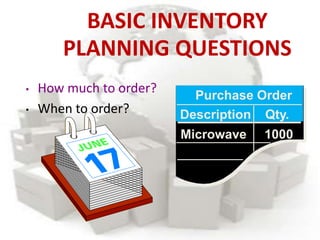
BASIC INVENTORY
PLANNING QUESTIONS
• How much to order?
• When to order?
Purchase Order
Description Qty.
Microwave 1000
INVENTORY MODELS
• Fixed order quantity
models
– Economic order quantity
– Production order
quantity
– Quantity discount
• Probabilistic models
• Fixed order period models
Help answer the inventory
planning questions!
© 1984-1994
T/Maker Co.
DEPENDENT v/s INDEPENDENT
• Independent demand – finished goods,
items that are ready to be sold
– E.g. a computer
• Dependent demand – components of
finished products
– E.g. parts that make up the computer
Need to determine when and how much to
order
Basic economic order
quantity
Production order quantity
Quantity discount model
INVENTORY MODELS FOR
INDEPENDENT DEMAND
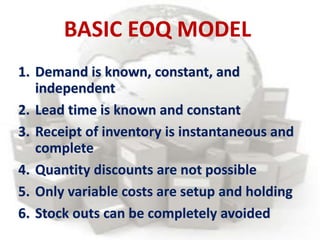
1. Demand is known, constant, and
independent
2. Lead time is known and constant
3. Receipt of inventory is instantaneous and
complete
4. Quantity discounts are not possible
5. Only variable costs are setup and holding
6. Stock outs can be completely avoided
BASIC EOQ MODEL
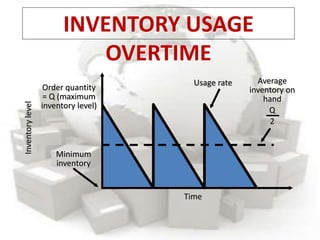
INVENTORY USAGE
OVERTIME
Order quantity
= Q (maximum
inventory level)
Inventorylevel
Time
Usage rate Average
inventory on
hand
Q
2
Minimum
inventory
© 2011 Pearson Education, Inc. publishing as
Prentice Hall
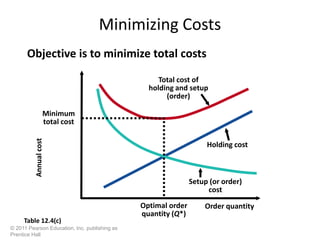
Minimizing Costs
Objective is to minimize total costs
Table 12.4(c)
Annualcost
Order quantity
Total cost of
holding and setup
(order)
Holding cost
Setup (or order)
cost
Minimum
total cost
Optimal order
quantity (Q*)
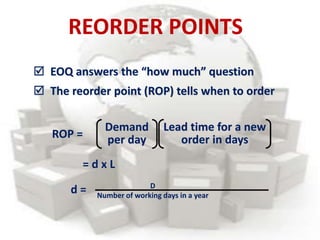
 EOQ answers the “how much” question
 The reorder point (ROP) tells when to order
ROP =
Lead time for a new
order in days
Demand
per day
= d x L
d = D
Number of working days in a year
REORDER POINTS
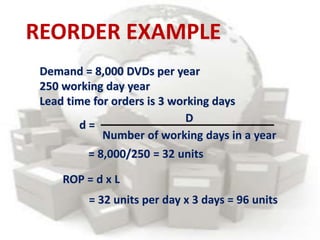
Demand = 8,000 DVDs per year
250 working day year
Lead time for orders is 3 working days
ROP = d x L
d =
D
Number of working days in a year
= 8,000/250 = 32 units
= 32 units per day x 3 days = 96 units
REORDER EXAMPLE
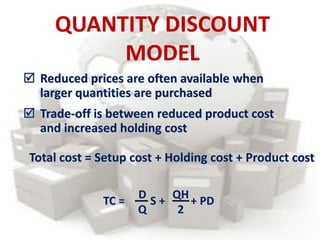
 Reduced prices are often available when
larger quantities are purchased
 Trade-off is between reduced product cost
and increased holding cost
Total cost = Setup cost + Holding cost + Product cost
TC = S + + PD
D
Q
QH
2
QUANTITY DISCOUNT
MODEL
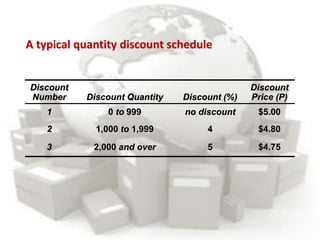
Discount
Number Discount Quantity Discount (%)
Discount
Price (P)
1 0 to 999 no discount $5.00
2 1,000 to 1,999 4 $4.80
3 2,000 and over 5 $4.75
A typical quantity discount schedule
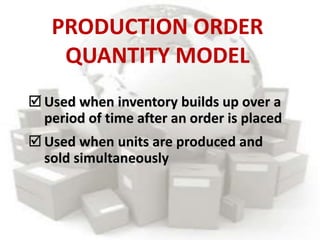
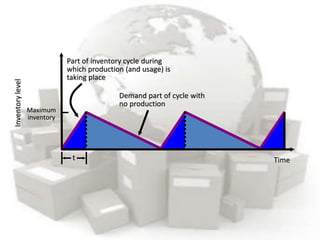
 Used when inventory builds up over a
period of time after an order is placed
 Used when units are produced and
sold simultaneously
PRODUCTION ORDER
QUANTITY MODEL
Inventorylevel
Time
Demand part of cycle with
no production
Part of inventory cycle during
which production (and usage) is
taking place
t
Maximum
inventory
PROBALISTIC MODEL AND SAFETY
STOCK
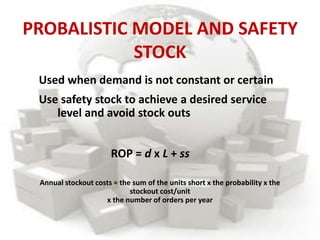
Used when demand is not constant or certain
Use safety stock to achieve a desired service
level and avoid stock outs
ROP = d x L + ss
Annual stockout costs = the sum of the units short x the probability x the
stockout cost/unit
x the number of orders per year
SAFETY STOCK EXAMPLE
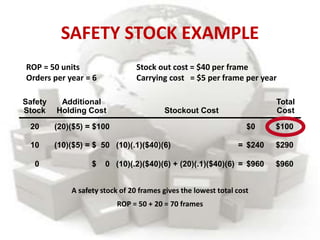
ROP = 50 units Stock out cost = $40 per frame
Orders per year = 6 Carrying cost = $5 per frame per year
Safety
Stock
Additional
Holding Cost Stockout Cost
Total
Cost
20 (20)($5) = $100 $0 $100
10 (10)($5) = $ 50 (10)(.1)($40)(6) = $240 $290
0 $ 0 (10)(.2)($40)(6) + (20)(.1)($40)(6) = $960 $960
A safety stock of 20 frames gives the lowest total cost
ROP = 50 + 20 = 70 frames
OTHER PROBALISTIC MODEL
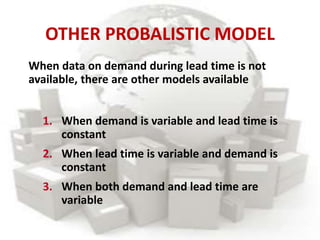
1. When demand is variable and lead time is
constant
2. When lead time is variable and demand is
constant
3. When both demand and lead time are
variable
When data on demand during lead time is not
available, there are other models available
SINGLE PERIOD MODEL
• Only one order is placed for a product
• Units have little or no value at the end
of the sales period
Inventory mgmt

Inventory mgmt

  • 1.
    WHAT IS INVENTORY “Inventory”refers to the stockpile of production a firm is offering for sale and the components that make up the production.
  • 2.
     Raw material Purchased but not processed  Work-in-process  Undergone some change but not completed  A function of cycle time for a product  Maintenance/repair/operating (MRO)  Necessary to keep machinery and processes productive  Finished goods  Completed product awaiting shipment TYPES OF INVENTORY
  • 3.
    1. Avoid irregularitiesin supply. 2. Demand met during off production. 3. To meet seasonal demand 4. Advantage of price discount. 5. Maintain continuity to production FUNCTIONS OF INVENTORY
  • 4.
    FIVE CATEGORIES OF STOCKS 1.PIPELINESTOCK 2.CYCLE STOCK 3.SEASONAL STOCK 4.SAFETY STOCK 5.OTHER STOCKS
  • 5.
    • the unnecessarytie up of the firm’s funds and loss of profit. • excessive carrying cost • the risk of liquidity DANGERS OF EXCESSIVE INVENTORY
  • 6.
    On the otherhand, a low level of inventories may result in frequent interruptions in the production schedule resulting in under-utilization of capacity and lower sales
  • 7.
    MATERIAL FLOW CYCLE InputWait for Wait to Move Wait in queue Setup Run Output inspection be moved time for operator time time Cycle time 95% 5%
  • 8.
    INVENTORY MANAGEMENT It ismanagement of materials which include material planning , purchasing ,receiving ,stores ,inventory control ,scrap and surplus disposal
  • 9.
    COST OF INVENTORY 1.Procurementcost: cost of order is fixed not dependent on order quantity 2.Inventory holding cost: cost associated with existence of inventories 3.Shortage cost : cost associated with stock out.
  • 10.
  • 11.
    THE EYEBALL SYSTEM Standardinventory control system for the vast majority of small retail and many small manufacturing operations and is very simple in application.
  • 12.
    RESERVE STOCK SYSTEM Thisapproach is much more systematic than the eyeball system. It involves keeping a reserve stock of items aside, often literally in a brown bag placed at the rear of the stock bin or storage area
  • 13.
    Various types ofperpetual inventory systems include manual, card-oriented, and computer- operated systems. In computer-operated systems, programmed instruction referred to commonly as a trigger, automatically transmits an order to the appropriate vendor once supplies fall below a prescribed level PERPETUAL INVENTORY SYSTEM
  • 14.
    Inventory Process Stage Demand Type Number & Value Other Raw Mat'l WIP Fin.Goods Independent Dependent A Items B Items C Items Mainten. Repair Operating Inventory Process Stage Demand Type Number & Value Other Raw Mat'l WIP Fin. Goods Independent Dependent A Items B Items C Items Mainten. Repair Operating INVENTORY CLASSIFICATION
  • 15.
    Divides on-hand inventoryinto 3 classes  A class, B class, C class Basis is usually annual $ volume  $ volume = Annual demand x Unit cost Policies based on ABC analysis  Develop class A suppliers more  Give tighter physical control of A items  Forecast A items more carefully ABC ANALYSIS
  • 16.
    Item Stock Number Percent of Number of Items Stocked Annual Volume (units)x Unit Cost = Annual Dollar Volume Percent of Annual Dollar Volume Class #10286 20% 1,000 $ 90.00 $ 90,000 38.8% A #11526 500 154.00 77,000 33.2% A #12760 1,550 17.00 26,350 11.3% B #10867 30% 350 42.86 15,001 6.4% B #10500 1,000 12.50 12,500 5.4% B ABC ANALYSIS
  • 17.
    ABC ANALYSIS Item Stock Number Percent of Numberof Items Stocked Annual Volume (units) x Unit Cost = Annual Dollar Volume Percent of Annual Dollar Volume Class #12572 600 $ 14.17 $ 8,502 3.7% C #14075 2,000 .60 1,200 .5% C #01036 50% 100 8.50 850 .4% C #01307 1,200 .42 504 .2% C #10572 250 .60 150 .1% C 8,550 $232,057 100.0%
  • 18.
    CLASSIFYING ITEMS ASABC 0 20 40 60 80 100 0 50 100 150 % of Inventory Items % Annual $ Usage A B C Class % $ Vol % Items A 80 15 B 15 30 C 5 55 Class % $ Vol % Items A 80 15 B 15 30 C 5 55
  • 19.
    CYCLE COUNTING • Aphysical count of items in inventory • Cycle counting management – How much accuracy is needed? – When should cycle counting be performed? – Who should do it?
  • 20.
    CYCLE COUNTING EXAMPLE 5,000 itemsin inventory, 500 A items, 1,750 B items, 2,750 C items Policy is to count A items every month (20 working days), B items every quarter (60 days), and C items every six months (120 days) Item Class Quantity Cycle Counting Policy Number of Items Counted per Day A 500 Each month 500/20 = 25/day B 1,750 Each quarter 1,750/60 = 29/day C 2,750 Every 6 months 2,750/120 = 23/day 77/day
  • 21.
    BASIC INVENTORY PLANNING QUESTIONS •How much to order? • When to order? Purchase Order Description Qty. Microwave 1000
  • 22.
    INVENTORY MODELS • Fixedorder quantity models – Economic order quantity – Production order quantity – Quantity discount • Probabilistic models • Fixed order period models Help answer the inventory planning questions! © 1984-1994 T/Maker Co.
  • 23.
    DEPENDENT v/s INDEPENDENT •Independent demand – finished goods, items that are ready to be sold – E.g. a computer • Dependent demand – components of finished products – E.g. parts that make up the computer
  • 24.
    Need to determinewhen and how much to order Basic economic order quantity Production order quantity Quantity discount model INVENTORY MODELS FOR INDEPENDENT DEMAND
  • 25.
    1. Demand isknown, constant, and independent 2. Lead time is known and constant 3. Receipt of inventory is instantaneous and complete 4. Quantity discounts are not possible 5. Only variable costs are setup and holding 6. Stock outs can be completely avoided BASIC EOQ MODEL
  • 26.
    INVENTORY USAGE OVERTIME Order quantity =Q (maximum inventory level) Inventorylevel Time Usage rate Average inventory on hand Q 2 Minimum inventory
  • 27.
    © 2011 PearsonEducation, Inc. publishing as Prentice Hall Minimizing Costs Objective is to minimize total costs Table 12.4(c) Annualcost Order quantity Total cost of holding and setup (order) Holding cost Setup (or order) cost Minimum total cost Optimal order quantity (Q*)
  • 28.
     EOQ answersthe “how much” question  The reorder point (ROP) tells when to order ROP = Lead time for a new order in days Demand per day = d x L d = D Number of working days in a year REORDER POINTS
  • 29.
    Demand = 8,000DVDs per year 250 working day year Lead time for orders is 3 working days ROP = d x L d = D Number of working days in a year = 8,000/250 = 32 units = 32 units per day x 3 days = 96 units REORDER EXAMPLE
  • 30.
     Reduced pricesare often available when larger quantities are purchased  Trade-off is between reduced product cost and increased holding cost Total cost = Setup cost + Holding cost + Product cost TC = S + + PD D Q QH 2 QUANTITY DISCOUNT MODEL
  • 31.
    Discount Number Discount QuantityDiscount (%) Discount Price (P) 1 0 to 999 no discount $5.00 2 1,000 to 1,999 4 $4.80 3 2,000 and over 5 $4.75 A typical quantity discount schedule
  • 32.
     Used wheninventory builds up over a period of time after an order is placed  Used when units are produced and sold simultaneously PRODUCTION ORDER QUANTITY MODEL
  • 33.
    Inventorylevel Time Demand part ofcycle with no production Part of inventory cycle during which production (and usage) is taking place t Maximum inventory
  • 34.
    PROBALISTIC MODEL ANDSAFETY STOCK Used when demand is not constant or certain Use safety stock to achieve a desired service level and avoid stock outs ROP = d x L + ss Annual stockout costs = the sum of the units short x the probability x the stockout cost/unit x the number of orders per year
  • 35.
    SAFETY STOCK EXAMPLE ROP= 50 units Stock out cost = $40 per frame Orders per year = 6 Carrying cost = $5 per frame per year Safety Stock Additional Holding Cost Stockout Cost Total Cost 20 (20)($5) = $100 $0 $100 10 (10)($5) = $ 50 (10)(.1)($40)(6) = $240 $290 0 $ 0 (10)(.2)($40)(6) + (20)(.1)($40)(6) = $960 $960 A safety stock of 20 frames gives the lowest total cost ROP = 50 + 20 = 70 frames
  • 36.
    OTHER PROBALISTIC MODEL 1.When demand is variable and lead time is constant 2. When lead time is variable and demand is constant 3. When both demand and lead time are variable When data on demand during lead time is not available, there are other models available
  • 37.
    SINGLE PERIOD MODEL •Only one order is placed for a product • Units have little or no value at the end of the sales period