Sonal
Arshpreet
Aman
Hosp.2nd
yr
UIAMS
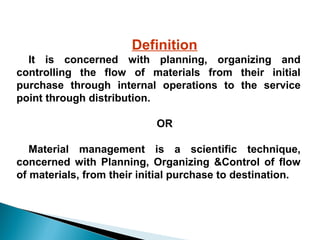
Definition
It is concerned with planning, organizing and
controlling the flow of materials from their initial
purchase through internal operations to the service
point through distribution.
OR
Material management is a scientific technique,
concerned with Planning, Organizing &Control of flow
of materials, from their initial purchase to destination.
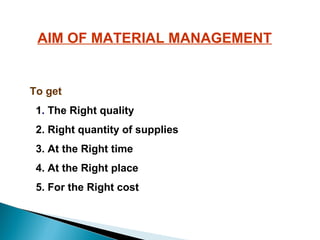
AIM OF MATERIAL MANAGEMENT

To get
1. The Right quality
2. Right quantity of supplies
3. At the Right time
4. At the Right place
5. For the Right cost
PURPOSE OF MATERIAL MANAGEMENT
To gain economy in purchasing
To satisfy the

demand during period of

replenishment
To carry reserve stock to avoid stock out
To provide
services

reasonable level of client
Objective of material management

PRIMARY OBJECTIVES
SECONDARY OBJECTIVES
PRIMARY OBJECTIVES
Buying the best item at the lowest cost
 Reduction in inventory cost and High inventory
turnover
 Maintaining the flow of production
 Maintaining the consistency of quality
 Optimisation of acquisition and possession,
resulting in lower cost
 Cordial relationship with suppliers
 Maintaining good records
 Contribution towards competitiveness

Promotion of standardisation with suppliers
 Committees to decide on economic make –
or- buy decisions
 Development
of
inter
departmental
relationships
 Can undertake acquisitions

Four basic needs of Material
management
1. To have adequate materials on hand when needed
2. To pay the lowest possible prices, consistent with
quality and value requirement for purchases
materials
3. To minimize the inventory investment
4. To operate efficiently








Cost can be lowered
Controlling of indirect cost (such as materials
movement)
Risk of inventory loss minimised (theft, pilferage )
Control of manufacturing cycle
Material congestion in storage places avoided
Improvement in delivery of the product
PLANNING (Plans for capacity or production
levels and required inventory levels
 MATERIAL UTILISATION (efficiency of the flow
of materials through the plant)
 PHYSICAL (storing, receiving and issuing of
materials and physical checking of inventory of
raw materials, work in process, finished goods,
record keeping)
 CONTROL OR FOLLOW UP (feedback and
corrective action involved)

 Selection

of appropriate vendors
 Land and storage cost increase
 Difficulty in forecasting demand accurately
Scarce capital for investment in materials
inventory
 Diversification of product lines
 Optimising time and quantity for products
Management of information
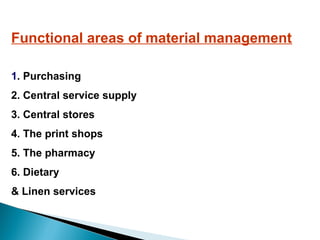
Functional areas of material management
1. Purchasing
2. Central service supply
3. Central stores
4. The print shops
5. The pharmacy
6. Dietary
& Linen services
(ABC = Always Better Control)
This is based on cost criteria.
It helps to exercise selective control when
confronted with large number of items it rationalizes
the number of orders, number of items & reduce the
inventory.
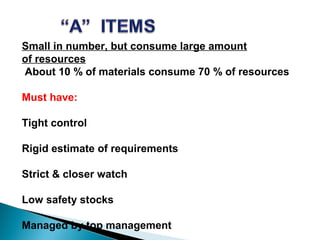
Small in number, but consume large amount
of resources
About 10 % of materials consume 70 % of resources
 
Must have:
Tight control
Rigid estimate of requirements
Strict & closer watch
Low safety stocks
Managed by top management
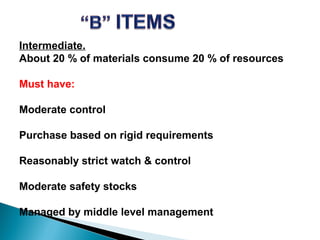
Intermediate.
About 20 % of materials consume 20 % of resources
Must have:
Moderate control
Purchase based on rigid requirements
Reasonably strict watch & control
Moderate safety stocks
Managed by middle level management
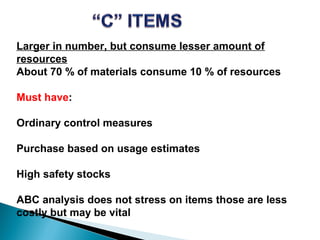
Larger in number, but consume lesser amount of
resources
About 70 % of materials consume 10 % of resources
Must have:
Ordinary control measures
Purchase based on usage estimates
High safety stocks
ABC analysis does not stress on items those are less
costly but may be vital
This approach helps the materials manager to exercise
selective control and focus his attention only on a few
items when he is confronted with lakhs of stores items.
 By concerning on ‘A’ category the materials manager is
able to control inventories and show visible results in a
short span of time
 By controlling the ‘A’ its and doing a proper inventory
analysis, obsolete stocks are automatically pinpointed.
 Many organizations have claimed that the ABC analysis
has helped in reducing the clerical costs and resulted in
better planning and improved inventory turnover.

•

•

ABC analysis has to be resorted to because
equal attention to ‘A’ ‘B’ and ‘C’ items will not be
worth while and would be very expensive.
Concentrating on all the items is likely to have a
diffused effect on all the items irrespective of the
priorities.
It gets harder to do correctly the longer you do
them.
Needs to be completed in the moment for the most
accuracy.
Still might reflect the biases of the data collector.

Material Management and ABC analysis

  • 1.
  • 2.
    Definition It is concernedwith planning, organizing and controlling the flow of materials from their initial purchase through internal operations to the service point through distribution. OR Material management is a scientific technique, concerned with Planning, Organizing &Control of flow of materials, from their initial purchase to destination.
  • 3.
    AIM OF MATERIALMANAGEMENT To get 1. The Right quality 2. Right quantity of supplies 3. At the Right time 4. At the Right place 5. For the Right cost
  • 4.
    PURPOSE OF MATERIALMANAGEMENT To gain economy in purchasing To satisfy the demand during period of replenishment To carry reserve stock to avoid stock out To provide services reasonable level of client
  • 5.
    Objective of materialmanagement PRIMARY OBJECTIVES SECONDARY OBJECTIVES
  • 6.
    PRIMARY OBJECTIVES Buying thebest item at the lowest cost  Reduction in inventory cost and High inventory turnover  Maintaining the flow of production  Maintaining the consistency of quality  Optimisation of acquisition and possession, resulting in lower cost  Cordial relationship with suppliers  Maintaining good records  Contribution towards competitiveness 
  • 7.
    Promotion of standardisationwith suppliers  Committees to decide on economic make – or- buy decisions  Development of inter departmental relationships  Can undertake acquisitions 
  • 8.
    Four basic needsof Material management 1. To have adequate materials on hand when needed 2. To pay the lowest possible prices, consistent with quality and value requirement for purchases materials 3. To minimize the inventory investment 4. To operate efficiently
  • 9.
          Cost can belowered Controlling of indirect cost (such as materials movement) Risk of inventory loss minimised (theft, pilferage ) Control of manufacturing cycle Material congestion in storage places avoided Improvement in delivery of the product
  • 10.
    PLANNING (Plans forcapacity or production levels and required inventory levels  MATERIAL UTILISATION (efficiency of the flow of materials through the plant)  PHYSICAL (storing, receiving and issuing of materials and physical checking of inventory of raw materials, work in process, finished goods, record keeping)  CONTROL OR FOLLOW UP (feedback and corrective action involved) 
  • 11.
     Selection of appropriatevendors  Land and storage cost increase  Difficulty in forecasting demand accurately Scarce capital for investment in materials inventory  Diversification of product lines  Optimising time and quantity for products Management of information
  • 12.
    Functional areas ofmaterial management 1. Purchasing 2. Central service supply 3. Central stores 4. The print shops 5. The pharmacy 6. Dietary & Linen services
  • 14.
    (ABC = AlwaysBetter Control) This is based on cost criteria. It helps to exercise selective control when confronted with large number of items it rationalizes the number of orders, number of items & reduce the inventory.
  • 15.
    Small in number,but consume large amount of resources About 10 % of materials consume 70 % of resources   Must have: Tight control Rigid estimate of requirements Strict & closer watch Low safety stocks Managed by top management
  • 16.
    Intermediate. About 20 %of materials consume 20 % of resources Must have: Moderate control Purchase based on rigid requirements Reasonably strict watch & control Moderate safety stocks Managed by middle level management
  • 17.
    Larger in number,but consume lesser amount of resources About 70 % of materials consume 10 % of resources Must have: Ordinary control measures Purchase based on usage estimates High safety stocks ABC analysis does not stress on items those are less costly but may be vital
  • 18.
    This approach helpsthe materials manager to exercise selective control and focus his attention only on a few items when he is confronted with lakhs of stores items.  By concerning on ‘A’ category the materials manager is able to control inventories and show visible results in a short span of time  By controlling the ‘A’ its and doing a proper inventory analysis, obsolete stocks are automatically pinpointed.  Many organizations have claimed that the ABC analysis has helped in reducing the clerical costs and resulted in better planning and improved inventory turnover. 
  • 19.
    • • ABC analysis hasto be resorted to because equal attention to ‘A’ ‘B’ and ‘C’ items will not be worth while and would be very expensive. Concentrating on all the items is likely to have a diffused effect on all the items irrespective of the priorities.
  • 20.
    It gets harderto do correctly the longer you do them. Needs to be completed in the moment for the most accuracy. Still might reflect the biases of the data collector.