Replenishment Process for
Modern Trade
BY ABHISHEK CHOUDHURY
PGPEX-2019, IIM CALCUTTA
1
Modern Trade
 Consists of supermarkets and hypermarkets that retail FMCG
 Format started in India in the early 1990s*
 Spencer’s, Big Bazaar, Spar, etc.
 As per Boston Consulting Group, modern trade is expected to grow at 20% pa **
Source:
* https://www.equitymaster.com/
** BCG and Retailers Association of India report Retail 2020: Retrospect, Reinvent, Rewrite
2
Supply Chain in Modern Trade
 SCM, the term was coined in 1980s
 Integrating philosophy to manage total flow of a distribution channel from supplier to ultimate
customer (Ellram and Cooper 1993)
 Aims to match demand with supply and do so with minimal inventory
 Achieve most efficient use of resources, including distribution capacity, inventory and labour
3
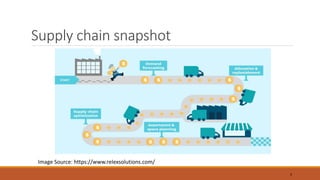
Supply chain snapshot
Image Source: https://www.relexsolutions.com/
4
Replenishment
 Movement of inventory from upstream to downstream
 Upstream – the supplier’s supply chain
 Downstream – the customer’s supply chain
 Purpose – keep inventory flowing and maintaining efficient order and line item fill rates
5
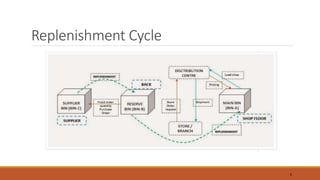
Replenishment Cycle
6
Why do we need it?
 Too much or too less inventory on hand
- Lead to excess inventory carrying costs
- Or loss of sale due to unavailability
 Locate products easier
 Speed up fulfillment times *
 Reduce operation costs
* Fulfillment time – Time taken to complete the process from Point of Sales inquiry to delivering the
product to the customer
7
Factors in Replenishment
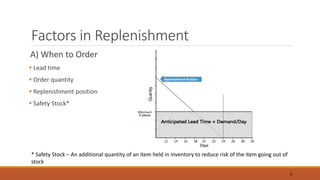
A) When to Order
 Lead time
 Order quantity
 Replenishment position
 Safety Stock*
8
* Safety Stock – An additional quantity of an item held in inventory to reduce risk of the item going out of
stock
Factors in Replenishment
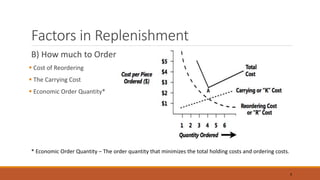
B) How much to Order
 Cost of Reordering
 The Carrying Cost
 Economic Order Quantity*
9
* Economic Order Quantity – The order quantity that minimizes the total holding costs and ordering costs.
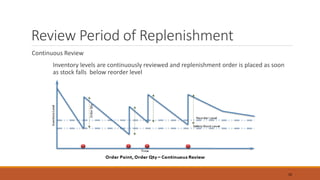
Review Period of Replenishment
Continuous Review
Inventory levels are continuously reviewed and replenishment order is placed as soon
as stock falls below reorder level
10
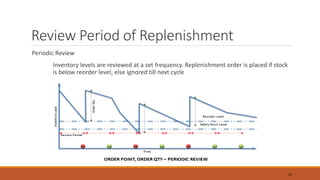
Review Period of Replenishment
Periodic Review
Inventory levels are reviewed at a set frequency. Replenishment order is placed if stock
is below reorder level, else ignored till next cycle
11
Automated Stock Replenishment
 Concept that leverages integrated demand forecasting, proportional inventory management
and automatic order generation to create automatic replenishment plans and orders
 Particularly used in Vendor Managed Inventory (VMI) environment where vendor is responsible
for availability
 Uses advanced algorithms based on demand forecasting and order generation
 Benefits
- More on time deliveries with fewer stock outs
- Optimal drop sizes
- Reduced loss of opportunity/sale
12
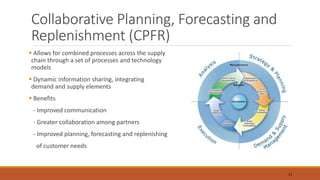
Collaborative Planning, Forecasting and
Replenishment (CPFR)
 Allows for combined processes across the supply
chain through a set of processes and technology
models
 Dynamic information sharing, integrating
demand and supply elements
 Benefits
- Improved communication
- Greater collaboration among partners
- Improved planning, forecasting and replenishing
of customer needs
13
Flow Through/Cross Docking
 Distribution system that eliminates all non value-added activities such as storage at
manufacturer or wholesaler distribution centre
 Reduces the number of distribution channels to be maintained
 For example - M suppliers, N stores and 1 Distribution centre would require (M+N) channels,
instead of (M*N) channels without the Distribution centre
 Benefits
- Reduced distribution costs and storage space
- Increased turn over and availability of products
- Streamlined distribution process
14
Technology Intervention
8 Technology trends in SCM according to Gartner
 Artificial Intelligence
 Advanced Analytics
 Internet of Things (IoT)
 Intelligent Things – autonomous vehicles
 Conversational Systems – virtual personal assistants (VPAs) and chatbots
 Robotic Process Automation (RPA)
 Immersive Technologies – virtual reality (VR), augmented reality
 Blockchain
15
Benefits
 Provides one true version inventory
 Higher inventory turn over
 Reduced inventory carrying costs
 Reduction in stock outs and loss of opportunity/sale
 Efficient fulfillment times leading to greater customer experience
 Increase overall productivity
 Seamless information flow
 Reduced wastage of perishable items
 Increase in business profits
16
Thank You
17

Replenishment Process for Modern Trade

  • 1.
    Replenishment Process for ModernTrade BY ABHISHEK CHOUDHURY PGPEX-2019, IIM CALCUTTA 1
  • 2.
    Modern Trade  Consistsof supermarkets and hypermarkets that retail FMCG  Format started in India in the early 1990s*  Spencer’s, Big Bazaar, Spar, etc.  As per Boston Consulting Group, modern trade is expected to grow at 20% pa ** Source: * https://www.equitymaster.com/ ** BCG and Retailers Association of India report Retail 2020: Retrospect, Reinvent, Rewrite 2
  • 3.
    Supply Chain inModern Trade  SCM, the term was coined in 1980s  Integrating philosophy to manage total flow of a distribution channel from supplier to ultimate customer (Ellram and Cooper 1993)  Aims to match demand with supply and do so with minimal inventory  Achieve most efficient use of resources, including distribution capacity, inventory and labour 3
  • 4.
    Supply chain snapshot ImageSource: https://www.relexsolutions.com/ 4
  • 5.
    Replenishment  Movement ofinventory from upstream to downstream  Upstream – the supplier’s supply chain  Downstream – the customer’s supply chain  Purpose – keep inventory flowing and maintaining efficient order and line item fill rates 5
  • 6.
  • 7.
    Why do weneed it?  Too much or too less inventory on hand - Lead to excess inventory carrying costs - Or loss of sale due to unavailability  Locate products easier  Speed up fulfillment times *  Reduce operation costs * Fulfillment time – Time taken to complete the process from Point of Sales inquiry to delivering the product to the customer 7
  • 8.
    Factors in Replenishment A)When to Order  Lead time  Order quantity  Replenishment position  Safety Stock* 8 * Safety Stock – An additional quantity of an item held in inventory to reduce risk of the item going out of stock
  • 9.
    Factors in Replenishment B)How much to Order  Cost of Reordering  The Carrying Cost  Economic Order Quantity* 9 * Economic Order Quantity – The order quantity that minimizes the total holding costs and ordering costs.
  • 10.
    Review Period ofReplenishment Continuous Review Inventory levels are continuously reviewed and replenishment order is placed as soon as stock falls below reorder level 10
  • 11.
    Review Period ofReplenishment Periodic Review Inventory levels are reviewed at a set frequency. Replenishment order is placed if stock is below reorder level, else ignored till next cycle 11
  • 12.
    Automated Stock Replenishment Concept that leverages integrated demand forecasting, proportional inventory management and automatic order generation to create automatic replenishment plans and orders  Particularly used in Vendor Managed Inventory (VMI) environment where vendor is responsible for availability  Uses advanced algorithms based on demand forecasting and order generation  Benefits - More on time deliveries with fewer stock outs - Optimal drop sizes - Reduced loss of opportunity/sale 12
  • 13.
    Collaborative Planning, Forecastingand Replenishment (CPFR)  Allows for combined processes across the supply chain through a set of processes and technology models  Dynamic information sharing, integrating demand and supply elements  Benefits - Improved communication - Greater collaboration among partners - Improved planning, forecasting and replenishing of customer needs 13
  • 14.
    Flow Through/Cross Docking Distribution system that eliminates all non value-added activities such as storage at manufacturer or wholesaler distribution centre  Reduces the number of distribution channels to be maintained  For example - M suppliers, N stores and 1 Distribution centre would require (M+N) channels, instead of (M*N) channels without the Distribution centre  Benefits - Reduced distribution costs and storage space - Increased turn over and availability of products - Streamlined distribution process 14
  • 15.
    Technology Intervention 8 Technologytrends in SCM according to Gartner  Artificial Intelligence  Advanced Analytics  Internet of Things (IoT)  Intelligent Things – autonomous vehicles  Conversational Systems – virtual personal assistants (VPAs) and chatbots  Robotic Process Automation (RPA)  Immersive Technologies – virtual reality (VR), augmented reality  Blockchain 15
  • 16.
    Benefits  Provides onetrue version inventory  Higher inventory turn over  Reduced inventory carrying costs  Reduction in stock outs and loss of opportunity/sale  Efficient fulfillment times leading to greater customer experience  Increase overall productivity  Seamless information flow  Reduced wastage of perishable items  Increase in business profits 16
  • 17.