Inventory
Presented By :
Chitrasen Jaiswar
Subhrat Das
Sudhanshu Singh
Bharat Yadav
Pritesh Singh
Divyansh Srivastav
Presented To :
R.K . Tomar
Content:
A. Introduction of Inventory
B. Characteristics of Inventory
C. Types of Inventory
D. Explanation of EOQ Model
Introduction of Inventory
Characteristics of Inventory
A. Inventory serves as a cushion to absorb stocks.
B. Inventory is necessary evil.
C. Inventory are the results of many interrelated decision
and policies within the organization .
D. Inventory provides production economies for achieving
proper production be require ideal inventory
EOQ Model
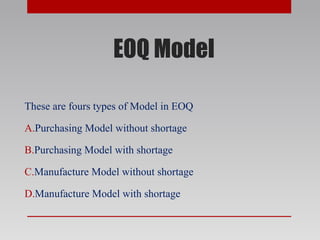
These are fours types of Model in EOQ
A.Purchasing Model without shortage
B.Purchasing Model with shortage
C.Manufacture Model without shortage
D.Manufacture Model with shortage
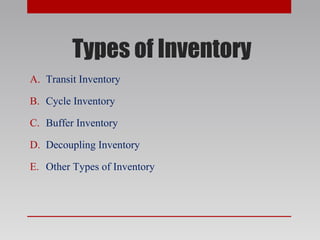
Types of Inventory
A. Transit Inventory
B. Cycle Inventory
C. Buffer Inventory
D. Decoupling Inventory
E. Other Types of Inventory
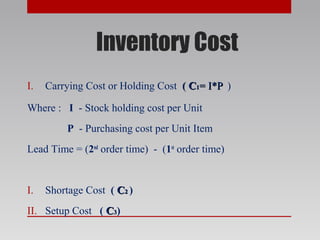
Inventory Cost
I. Carrying Cost or Holding Cost (( CC11= I*P= I*P )
Where : I - Stock holding cost per Unit
P - Purchasing cost per Unit Item
Lead Time = (2nd
order time) - (1st
order time)
I. Shortage Cost ( CC22 )
II. Setup Cost ( CC33)
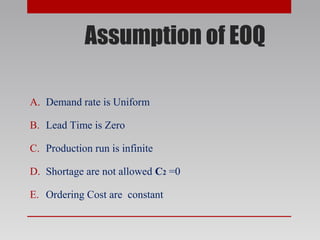
Assumption of EOQ
A. Demand rate is Uniform
B. Lead Time is Zero
C. Production run is infinite
D. Shortage are not allowed C2 =0
E. Ordering Cost are constant
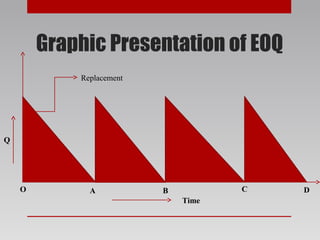
Graphic Presentation of EOQ
A
Time
Q
Replacement
A B C DO
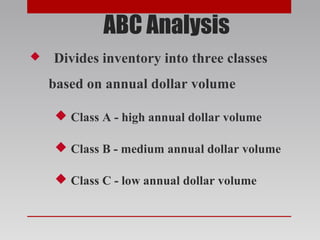
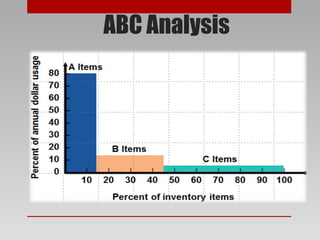
ABC Analysis
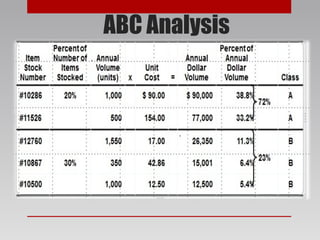
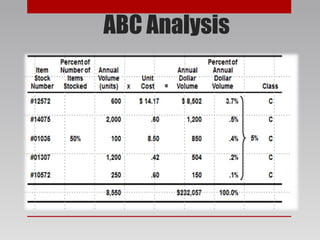
 Divides inventory into three classes
based on annual dollar volume
 Class A - high annual dollar volume
 Class B - medium annual dollar volume
 Class C - low annual dollar volume
ABC Analysis
ABC Analysis
ABC Analysis
Thanks

What is inventory

  • 1.
    Inventory Presented By : ChitrasenJaiswar Subhrat Das Sudhanshu Singh Bharat Yadav Pritesh Singh Divyansh Srivastav Presented To : R.K . Tomar
  • 2.
    Content: A. Introduction ofInventory B. Characteristics of Inventory C. Types of Inventory D. Explanation of EOQ Model
  • 3.
  • 4.
    Characteristics of Inventory A.Inventory serves as a cushion to absorb stocks. B. Inventory is necessary evil. C. Inventory are the results of many interrelated decision and policies within the organization . D. Inventory provides production economies for achieving proper production be require ideal inventory
  • 5.
    EOQ Model These arefours types of Model in EOQ A.Purchasing Model without shortage B.Purchasing Model with shortage C.Manufacture Model without shortage D.Manufacture Model with shortage
  • 6.
    Types of Inventory A.Transit Inventory B. Cycle Inventory C. Buffer Inventory D. Decoupling Inventory E. Other Types of Inventory
  • 7.
    Inventory Cost I. CarryingCost or Holding Cost (( CC11= I*P= I*P ) Where : I - Stock holding cost per Unit P - Purchasing cost per Unit Item Lead Time = (2nd order time) - (1st order time) I. Shortage Cost ( CC22 ) II. Setup Cost ( CC33)
  • 8.
    Assumption of EOQ A.Demand rate is Uniform B. Lead Time is Zero C. Production run is infinite D. Shortage are not allowed C2 =0 E. Ordering Cost are constant
  • 9.
    Graphic Presentation ofEOQ A Time Q Replacement A B C DO
  • 10.
    ABC Analysis  Dividesinventory into three classes based on annual dollar volume  Class A - high annual dollar volume  Class B - medium annual dollar volume  Class C - low annual dollar volume
  • 11.
  • 12.
  • 13.
  • 14.