Transportation in a Supply Chain
E-Mail: divyachoudhary@iiml.ac.in
1
Transportation Modes and Their Role in a
Supply Chain
• Movement of product from one location to another
• Products rarely produced and consumed in the
same location
• Significant cost component
• Deliver right quantity of products at right time at
right location with minimum cost.
• Focus on cost only??
Transportation Function = TC + Responsiveness Achieved
Transportation Modes and Their Role in a
Supply Chain
• Role of transportation in SC strategy
• Shipper requires the movement of the product
• Carrier moves or transports the product
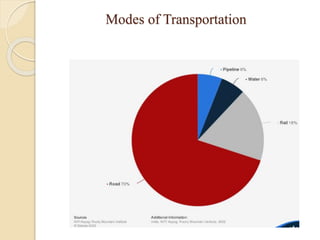
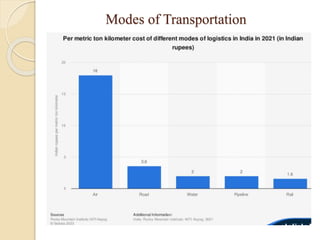
Modes of Transportation
• Air
• Package carriers
• Truck
• Rail
• Water
• Pipeline
• Intermodal
Modes of Transportation
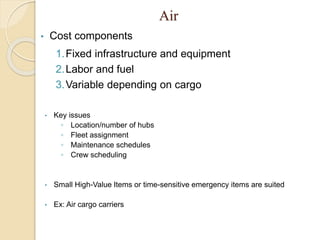
Air
• Cost components
1.Fixed infrastructure and equipment
2.Labor and fuel
3.Variable depending on cargo
• Key issues
◦ Location/number of hubs
◦ Fleet assignment
◦ Maintenance schedules
◦ Crew scheduling
• Small High-Value Items or time-sensitive emergency items are suited
• Ex: Air cargo carriers
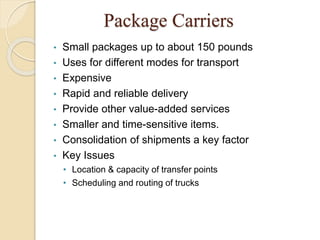
Package Carriers
• Small packages up to about 150 pounds
• Uses for different modes for transport
• Expensive
• Rapid and reliable delivery
• Provide other value-added services
• Smaller and time-sensitive items.
• Consolidation of shipments a key factor
• Key Issues
• Location & capacity of transfer points
• Scheduling and routing of trucks
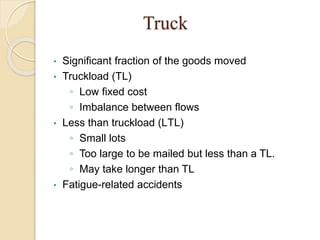
Truck
• Significant fraction of the goods moved
• Truckload (TL)
◦ Low fixed cost
◦ Imbalance between flows
• Less than truckload (LTL)
◦ Small lots
◦ Too large to be mailed but less than a TL.
◦ May take longer than TL
• Fatigue-related accidents
Rail
• Move commodities over large distances
• High fixed costs in equipment and facilities
• Transportation time can be long
• Track Congestions
• Heavy Low value shipment; not time-sensitive
• Key Issues
• Scheduling
• Poor-on-time performance
• Travel time is a fraction total time
• Trains ‘built’ not scheduled
Water
• Limited to certain geographic areas
• Ocean, inland waterway system, coastal waters
• Very large loads at very low cost
• Slowest
• Dominant in global trade
• Containers
Pipeline
• Primarily for crude petroleum, refined petroleum
products, natural gas
• High fixed cost
• Best for large and stable flows
• Encourages use for predicable component of
demand
• Fluctuations covered by other modes
Intermodal
• Use of more than one mode of transportation to
move a shipment
• Grown considerably with increased use of
containers
• May be the only option for global trade
• Price/service better than any single mode
• Key issue – exchange of information to facilitate
transfer between different modes
Design Options for a Transportation
Network
• Well-designed transportation network facilitates
desired degree of responsiveness at low cost.
• When designing a transportation network
1. Should transportation be direct or through an
intermediate site?
2. Should the intermediate site stock product or
only serve as a cross-docking location?
3. Should each delivery route supply a single
destination or multiple destinations?
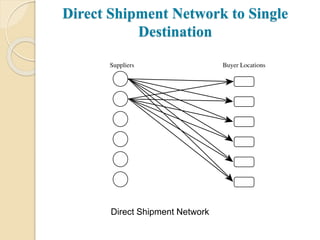
Direct Shipment Network to Single
Destination
Direct Shipment Network
Direct Shipment Network to Single
Destination
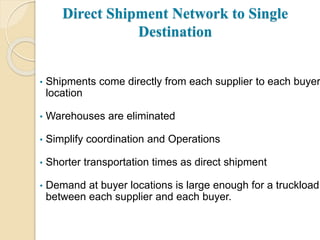
• Shipments come directly from each supplier to each buyer
location
• Warehouses are eliminated
• Simplify coordination and Operations
• Shorter transportation times as direct shipment
• Demand at buyer locations is large enough for a truckload
between each supplier and each buyer.
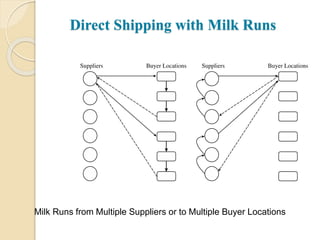
Direct Shipping with Milk Runs
Milk Runs from Multiple Suppliers or to Multiple Buyer Locations
Direct Shipping with Milk Runs
• Milk run: Single supplier to multiple retailer or multiple
supplier to single buyer location. Ex: Zomato, Newspaper
• Routing is critical
• Lower transportation cost
• Demand is too small for TL but multiple locations are
close enough that combined quantity fills truck
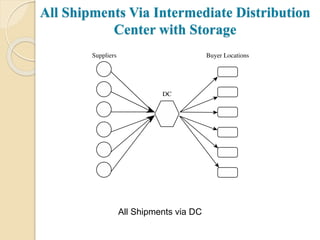
All Shipments Via Intermediate Distribution
Center with Storage
All Shipments via DC
All Shipments Via Intermediate
Distribution Center with Storage
• Shipped from supplier to distribution center and stored till
shipped to each buyer location.
• Suited when inbound support economies of scale and
outbound can not be coordinated.
• Lower Outbound transportation cost
All Shipments Via Intermediate Transit Point
with Cross-Docking
• Suppliers send their shipments to an intermediate transit point
• They are cross-docked and sent to buyer locations without
storing them
• Inbound truck contain products for several buyers and
outbound contain from several suppliers.
• Faster Product flow with lower handling cost.
• Suited when economies scale are supported at both inbound
and outbound side with coordination possible.
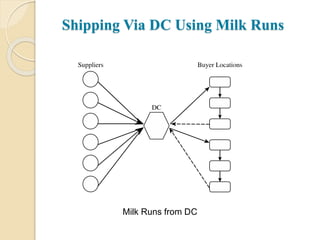
Shipping Via DC Using Milk Runs
Milk Runs from DC
Shipping Via D C Using Milk Runs
• Milk runs can be used from a dc if lot sizes to be delivered to
each buyer location are small.
• Reduces outbound transportation cost though consolidation
• High degree of coordination with proper routing.
Tailored Network
• Suitable combination of previous options to reduce cost and
improve responsiveness
• High level of Information Infrastructure
Trade-Offs in Transportation Design
• Trade-offs
◦ Transportation cost and inventory cost trade-off
◦ Transportation cost and customer
responsiveness trade off
• Transportation and inventory cost trade-off
◦ Choice of transportation mode
◦ Inventory aggregation
Trade-Offs in Transportation Design
Choice of transportation mode
• Lowest cost transportation mode might not
necessarily result in lowest supply chain cost
• Cheaper modes have longer lead times and larger
minimum shipment quantiles resulting higher
inventories in SC.
• Shipping in small quantities lower the Inventory but
requires high transportation cost
Trade-Offs in Transportation Design
Choice of transportation mode
• Faster transportation modes vs Cheaper Modes
• Faster transportation modes: high value to weight ratio
(reducing inventory is important due to high cost)
• Cheaper modes: small value to weight ratio
• Transportation mode selection = Inventory cost
+transportation cost
Trade-Offs in Transportation Design
Inventory Aggregation
• Transportation cost increases with degree of Inventory
aggregation
• High disaggregation also increases Transportation cost
• Inventory aggregation: high value to weight ratio and high
demand uncertainty
• Inventory aggregation can lead to high transportation cost for
products with low value to weight ratio.
Trade-Offs in Transportation Design
Trade off between Transportation cost and
customer responsiveness
• Responsive SCs have higher transportation costs.
• Temporal aggregation delays responsiveness

Transportation in Supply chain management

  • 1.
    Transportation in aSupply Chain E-Mail: divyachoudhary@iiml.ac.in 1
  • 2.
    Transportation Modes andTheir Role in a Supply Chain • Movement of product from one location to another • Products rarely produced and consumed in the same location • Significant cost component • Deliver right quantity of products at right time at right location with minimum cost. • Focus on cost only?? Transportation Function = TC + Responsiveness Achieved
  • 3.
    Transportation Modes andTheir Role in a Supply Chain • Role of transportation in SC strategy • Shipper requires the movement of the product • Carrier moves or transports the product
  • 4.
    Modes of Transportation •Air • Package carriers • Truck • Rail • Water • Pipeline • Intermodal
  • 5.
  • 6.
  • 7.
    Air • Cost components 1.Fixedinfrastructure and equipment 2.Labor and fuel 3.Variable depending on cargo • Key issues ◦ Location/number of hubs ◦ Fleet assignment ◦ Maintenance schedules ◦ Crew scheduling • Small High-Value Items or time-sensitive emergency items are suited • Ex: Air cargo carriers
  • 8.
    Package Carriers • Smallpackages up to about 150 pounds • Uses for different modes for transport • Expensive • Rapid and reliable delivery • Provide other value-added services • Smaller and time-sensitive items. • Consolidation of shipments a key factor • Key Issues • Location & capacity of transfer points • Scheduling and routing of trucks
  • 9.
    Truck • Significant fractionof the goods moved • Truckload (TL) ◦ Low fixed cost ◦ Imbalance between flows • Less than truckload (LTL) ◦ Small lots ◦ Too large to be mailed but less than a TL. ◦ May take longer than TL • Fatigue-related accidents
  • 10.
    Rail • Move commoditiesover large distances • High fixed costs in equipment and facilities • Transportation time can be long • Track Congestions • Heavy Low value shipment; not time-sensitive • Key Issues • Scheduling • Poor-on-time performance • Travel time is a fraction total time • Trains ‘built’ not scheduled
  • 11.
    Water • Limited tocertain geographic areas • Ocean, inland waterway system, coastal waters • Very large loads at very low cost • Slowest • Dominant in global trade • Containers
  • 12.
    Pipeline • Primarily forcrude petroleum, refined petroleum products, natural gas • High fixed cost • Best for large and stable flows • Encourages use for predicable component of demand • Fluctuations covered by other modes
  • 13.
    Intermodal • Use ofmore than one mode of transportation to move a shipment • Grown considerably with increased use of containers • May be the only option for global trade • Price/service better than any single mode • Key issue – exchange of information to facilitate transfer between different modes
  • 14.
    Design Options fora Transportation Network • Well-designed transportation network facilitates desired degree of responsiveness at low cost. • When designing a transportation network 1. Should transportation be direct or through an intermediate site? 2. Should the intermediate site stock product or only serve as a cross-docking location? 3. Should each delivery route supply a single destination or multiple destinations?
  • 15.
    Direct Shipment Networkto Single Destination Direct Shipment Network
  • 16.
    Direct Shipment Networkto Single Destination • Shipments come directly from each supplier to each buyer location • Warehouses are eliminated • Simplify coordination and Operations • Shorter transportation times as direct shipment • Demand at buyer locations is large enough for a truckload between each supplier and each buyer.
  • 17.
    Direct Shipping withMilk Runs Milk Runs from Multiple Suppliers or to Multiple Buyer Locations
  • 18.
    Direct Shipping withMilk Runs • Milk run: Single supplier to multiple retailer or multiple supplier to single buyer location. Ex: Zomato, Newspaper • Routing is critical • Lower transportation cost • Demand is too small for TL but multiple locations are close enough that combined quantity fills truck
  • 19.
    All Shipments ViaIntermediate Distribution Center with Storage All Shipments via DC
  • 20.
    All Shipments ViaIntermediate Distribution Center with Storage • Shipped from supplier to distribution center and stored till shipped to each buyer location. • Suited when inbound support economies of scale and outbound can not be coordinated. • Lower Outbound transportation cost
  • 21.
    All Shipments ViaIntermediate Transit Point with Cross-Docking • Suppliers send their shipments to an intermediate transit point • They are cross-docked and sent to buyer locations without storing them • Inbound truck contain products for several buyers and outbound contain from several suppliers. • Faster Product flow with lower handling cost. • Suited when economies scale are supported at both inbound and outbound side with coordination possible.
  • 22.
    Shipping Via DCUsing Milk Runs Milk Runs from DC
  • 23.
    Shipping Via DC Using Milk Runs • Milk runs can be used from a dc if lot sizes to be delivered to each buyer location are small. • Reduces outbound transportation cost though consolidation • High degree of coordination with proper routing.
  • 24.
    Tailored Network • Suitablecombination of previous options to reduce cost and improve responsiveness • High level of Information Infrastructure
  • 25.
    Trade-Offs in TransportationDesign • Trade-offs ◦ Transportation cost and inventory cost trade-off ◦ Transportation cost and customer responsiveness trade off • Transportation and inventory cost trade-off ◦ Choice of transportation mode ◦ Inventory aggregation
  • 26.
    Trade-Offs in TransportationDesign Choice of transportation mode • Lowest cost transportation mode might not necessarily result in lowest supply chain cost • Cheaper modes have longer lead times and larger minimum shipment quantiles resulting higher inventories in SC. • Shipping in small quantities lower the Inventory but requires high transportation cost
  • 27.
    Trade-Offs in TransportationDesign Choice of transportation mode • Faster transportation modes vs Cheaper Modes • Faster transportation modes: high value to weight ratio (reducing inventory is important due to high cost) • Cheaper modes: small value to weight ratio • Transportation mode selection = Inventory cost +transportation cost
  • 28.
    Trade-Offs in TransportationDesign Inventory Aggregation • Transportation cost increases with degree of Inventory aggregation • High disaggregation also increases Transportation cost • Inventory aggregation: high value to weight ratio and high demand uncertainty • Inventory aggregation can lead to high transportation cost for products with low value to weight ratio.
  • 29.
    Trade-Offs in TransportationDesign Trade off between Transportation cost and customer responsiveness • Responsive SCs have higher transportation costs. • Temporal aggregation delays responsiveness

Editor's Notes