INVENTORY MANAGEMENT
CONTENTS
 Management
 Basic principles of management
 Inventory Management
 Activities in Inventory Management
 Order Methods
WHY DID I CHOOSE THIS TOPIC?
Management
 It is the art of creating the environment in which people
can perform and individuals can cooperate towards
attainment of organisational goals. It is the art of
removing blocks to such performance and a way of
optimizing efficiency in reaching goals; by Harold Koontz.
Management is a distinct process consisting of planning,
organizing, actuating and controlling, performed to
determine and accomplish stated objectives, by the use of
human beings and other resources; by George R Terry.
Basic Principles of Management
 Division of work according to the ability, capacity and
aptitude of the workers is essential in any organisation for
optimal utilization of scarce human resource and to
maximize productivity in any form.
 Well-defined responsibility leads to accountability and
thus enhances performance of individuals.
 Organisational goals should receive preference and are
more important then individual goals.
 An employee should ideally receive his/her orders only from
one superior since multiple commanding authorities would
lead to confusion and chaos.
 Remuneration in form of pay and allowances should be pre-
determined for all personnel, to avoid uncertainty.
 Employees should function in well defined functional chain
of senior-subordinate relationships, called scalar chains
 Team spirit (spirit-de-corps) is essential for any
organisational work.
As Doctors why we must study management!
The Planning Process in Health Sector
 Situational analysis.
 Objectives and goals.
 Resources and constraints.
 Delegating responsibilities.
 Assigning the time frame.
 Evaluation, monitoring and feedback.
 Re-planning.
INVENTORY MANAGEMENT
 The systematic and scientific process of planning,
implementing and controlling the efficient and effective
storage and flow of resources(goods & services)from point
of origin to the point of consumption in order to meet the
customer’s requirements.
Functions of Inventory Management
 To provide maximum supply service, consistent with
maximum efficiency and optimum investment.
 To provide a cushion between forecasted and actual
demand for a material.
 The basic issue involved in inventory management is to ensure
that adequate amount of raw materials are available to meet
the demand of the organisation.
 While at the same time ensuring that too much inventory is
not accumulated and also that there are no ‘stock-outs’ in the
organisation.
 Thus, a well managed organisation would necessarily have a
higher inventory turn-over rate and lesser cash would be
blocked as inventory/stocks.
Inventory Management in Health Care
Setup
 Any healthcare establishment is heavily dependent on
material, equipment's and medicines and hence inventory
management assumes great importance since availability
of the right item, at right time, right place and in the
hands of the right person can often make the difference
between life and death in a hospital.
Activities involved in Inventory
Management
 Tendering, procurement and inspection.
 Storage, standardization, codification and classification.
 Materials accounting and physical distribution.
 Transportation.
 Maintenance and Repair of materials.
 Condemnation and disposal of stores.
Tendering, procurement and inspection:
 Any organisation has to resort to purchasing of goods or
services to ensure an uninterrupted flow of materials, a
minimum inventory investment and to buy materials/
services at a reasonable cost .
Steps involved in purchasing
 Storage, Standardization, Codification &
Classification:
 The storage system
• Any storage system in an organisation consists of the
following sub- systems which work together to cater to the
existing demands and also the further growth potential of
an organisation;
i. Receipt system.
ii. Maintenance & upkeep system.
iii. Issue system.
 Codification of goods
• Alphabetical system
CLASS GROUP CODE
PATIENT BED (PB) IRON(I)
HYDRAULIC(H)
PB-I-H
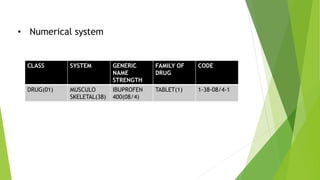
• Numerical system
CLASS SYSTEM GENERIC
NAME
STRENGTH
FAMILY OF
DRUG
CODE
DRUG(01) MUSCULO
SKELETAL(38)
IBUPROFEN
400(08/4)
TABLET(1) 1-38-08/4-1
• Combined alphabetical and Numerical.
• Other systems; British and Kodak systems.
 Accounting of Stores
 It is essential that in order to demand the optimal material,
the stock held with the stores must be accurately known and
maintained.
 This is important to prevent over-ordering of material and is
absolutely essential to avoid ‘stock- outs’, both of which are
detrimental to functioning of an organisation.
 In order to continuously keep a track of the
material available in stock, the following systems
are adopted:
• Bin Cards
• Stock identification cards
• Material requisition slip
• Material received note
• Stores ledger
• Material return note
• Material transfer note
Concept of Flow of Goods and Stores
Accounting
 Flow of goods is of utmost importance in any health care
setup since the problems of obsolete items, expired
medicines and old stocks are faced by every store keeper
in a hospital.
 Such avoidable wastages not only increase the cost of
managing a hospital but may also occasionally result in a
fatality due to issue of out of date medicine to a critical
patient.
some of the methods followed for flow of goods and stores
accounting are
 First In, First Out (FIFO) : Material from the oldest stock is
issued first with the view to turnover the stock.
 Last In, First Out (LIFO) : Materials which are received last
are issued first in this case, but it usually results in poor
inventory management and hence is generally not
recommended in health care establishments.
Specific cost method : Provides the most realistic valuation of
inventory stock and physical stock-taking of stores can be
done any time of the year. Under this method, values of the
material charged off / taken on charge are identical to the
material issued / received and hence is the most suitable
method of maintaining stocks in commercial organisations.
Average cost method : Average cost of each item issued from
stores/ received at stores is assessed and this value is taken
for maintaining the cost of inventory held by the
organisation. Though easy to follow, this method often leads
to inaccurate values of inventory in the organisation
Types of Inventory Management
 ‘Pareto’s law’ forms the basis for inventory control,
wherein it is theorized that a few items in the inventory
will account for a large proportion of total cost whereas
bulk of the items will account for only a small percentage
of the cost or importance of total inventory.
 Thus, basic principle of inventory control is based on the
effort to closely control costly/critical items in inventory
all the time, while other, less important/less costly items
could enjoy less stringent controls.
 ABC analysis:
• It is also popularly known as ‘Always Better Control’.
• This type of analysis is based on the annual cost of drugs.
• It is usually seen that 10% of the stores would cost 70% of
the total resources (Group A items); 20% of the items
would cost around 20% of total resources (Group B items)
and remaining 70% of items would cost only 10% of the
total resources (Group C items).
ACTIVITY GROUP A GROUP B GROUP C
MONITORING VERY STRICT STRICT MODERATE
SAFETY STOCK TO
BE KEPT
LOW MEDIUM HIGH
LEVEL OF
CONTROL
TIGHT MODERATE LOW
ESTIMATES OF
REQUIREMENTS
VERY ACCURATE MODERATELY
ACCURATE
MAY BE LOW
FREQUENCY OF
PURCHASE
MOST FREQUENT LESS FREQUENT LEAST FREQUENT
TURN OVER MAXIMUM MEDIUM LEAST
MANAGEMENT
INVOLVEMENT
TOP LEVEL MIDDLE LEVEL LOWER LEVEL
VED:
• Based on criticality and importance of consumables and not
merely on the annual cost of consumption, items are
classified as Vital (V), Essential (E) and Desirable (D).
• Vital items (V) are items like Oxygen which are vital for
functioning of a health care establishment and whose
shortage will have serious adverse effects on routine
functioning of the organisation. Such vital items should be
monitored by top management, irrespective of their cost
and their availability should be ensured with sufficient
stocks available in medical stores.
• Essential items(E) are the items whose shortage or non–
availability can only be afforded for a short time (such as
intravenous sets & IV fluids in a hospital) and if their
shortage continues for anything more than the shortest
time, the functioning would be affected seriously and
adversely.
• Desirable items(D) are those items whose shortage would
not affect the routine functioning of an organisation even if
the shortage is for a long time
 Combination of ABC & VED
V E D CATEGORY MANAGEMENT
A AV AE AD 1 Most Important
B BV BE BD 2 Important
C CV CE CD 3 Least Important
 SDE analysis
 FSN analysis
 HML analysis
 GOLF analysis
The Order Methods
 The determination of optimum order quantity is
influences by the forces pushing in opposite directions.
Large purchase quantity maximizes inventory carrying cost
and minimizes ordering cost while converse is true when
purchase quantities are reduced.
HOW MUCH TO ORDER
Economic Order Quantity: Most economical amount at
which ordering and carrying cost is equal which is
given by;
2D.Oc
Cc
Where; D= Annual demand of items
Oc= Cost of each unit
Cc= Inventory Carrying cost
 Two Bin System: is the method of ordering in which the
order is placed when the stock of an item reaches a certain
predetermined level. For this it is essential to know the
 Lead Time
 Buffer Stock
 Reorder Level
 Cyclic System: Periodically stocks are checked to know
the consumption pattern and orders placed to bring the
stock to the desired level.
 Maintenance and Repair
 It has been noticed that only 50% of the equipment in any
health service facility are in usable condition at a given
time,so there is a need to develop an organised system of
preventive maintenance of equipment including the
transport for smooth running of services.
 In State Government,a State Health Transport Organisation
has been created to take care of vehicles belonging to
public health services.
 Repair Of Equipment
 Maintenance and repair should go hand in hand.
 Engineering unit should have the responsibility and
accountability for repairs and should be able to take
spot decisions.
Records needed for maintenance:
1) History sheet of equipment.
2) Log book for equipment.
3) Performance record of equipment.
 Condemnation and Disposal
 Criteria for Condemnation: The equipment has become
 Non functional and beyond economical repair.
 Non functional and obsolete.
 Functional but obsolete.
 Functional but hazardous.
 Functional but no longer required.
 The routine items like B.P intruments,ECG machines etc are
condemned on the recommendation of condemnation
committee or HOD or in house engineering unit.
 Disposal of condemned articles is carried out by auction or
burning.
TAKE HOME MESSAGE
Bibliography
 Text Book of Public Health and Community Medicine-
Rajvir Bhalvar
 MME-201; Block-6: Policies, Planning and Management
THANK YOU

inventory management.pptx for reference for PGs

  • 1.
  • 2.
    CONTENTS  Management  Basicprinciples of management  Inventory Management  Activities in Inventory Management  Order Methods
  • 3.
    WHY DID ICHOOSE THIS TOPIC?
  • 4.
    Management  It isthe art of creating the environment in which people can perform and individuals can cooperate towards attainment of organisational goals. It is the art of removing blocks to such performance and a way of optimizing efficiency in reaching goals; by Harold Koontz.
  • 5.
    Management is adistinct process consisting of planning, organizing, actuating and controlling, performed to determine and accomplish stated objectives, by the use of human beings and other resources; by George R Terry.
  • 6.
    Basic Principles ofManagement  Division of work according to the ability, capacity and aptitude of the workers is essential in any organisation for optimal utilization of scarce human resource and to maximize productivity in any form.  Well-defined responsibility leads to accountability and thus enhances performance of individuals.  Organisational goals should receive preference and are more important then individual goals.
  • 7.
     An employeeshould ideally receive his/her orders only from one superior since multiple commanding authorities would lead to confusion and chaos.  Remuneration in form of pay and allowances should be pre- determined for all personnel, to avoid uncertainty.  Employees should function in well defined functional chain of senior-subordinate relationships, called scalar chains  Team spirit (spirit-de-corps) is essential for any organisational work.
  • 8.
    As Doctors whywe must study management!
  • 9.
    The Planning Processin Health Sector  Situational analysis.  Objectives and goals.  Resources and constraints.  Delegating responsibilities.  Assigning the time frame.  Evaluation, monitoring and feedback.  Re-planning.
  • 10.
    INVENTORY MANAGEMENT  Thesystematic and scientific process of planning, implementing and controlling the efficient and effective storage and flow of resources(goods & services)from point of origin to the point of consumption in order to meet the customer’s requirements.
  • 11.
    Functions of InventoryManagement  To provide maximum supply service, consistent with maximum efficiency and optimum investment.  To provide a cushion between forecasted and actual demand for a material.
  • 12.
     The basicissue involved in inventory management is to ensure that adequate amount of raw materials are available to meet the demand of the organisation.  While at the same time ensuring that too much inventory is not accumulated and also that there are no ‘stock-outs’ in the organisation.  Thus, a well managed organisation would necessarily have a higher inventory turn-over rate and lesser cash would be blocked as inventory/stocks.
  • 13.
    Inventory Management inHealth Care Setup  Any healthcare establishment is heavily dependent on material, equipment's and medicines and hence inventory management assumes great importance since availability of the right item, at right time, right place and in the hands of the right person can often make the difference between life and death in a hospital.
  • 14.
    Activities involved inInventory Management  Tendering, procurement and inspection.  Storage, standardization, codification and classification.  Materials accounting and physical distribution.  Transportation.  Maintenance and Repair of materials.  Condemnation and disposal of stores.
  • 15.
    Tendering, procurement andinspection:  Any organisation has to resort to purchasing of goods or services to ensure an uninterrupted flow of materials, a minimum inventory investment and to buy materials/ services at a reasonable cost .
  • 16.
  • 17.
     Storage, Standardization,Codification & Classification:  The storage system • Any storage system in an organisation consists of the following sub- systems which work together to cater to the existing demands and also the further growth potential of an organisation; i. Receipt system. ii. Maintenance & upkeep system. iii. Issue system.
  • 18.
     Codification ofgoods • Alphabetical system CLASS GROUP CODE PATIENT BED (PB) IRON(I) HYDRAULIC(H) PB-I-H
  • 19.
    • Numerical system CLASSSYSTEM GENERIC NAME STRENGTH FAMILY OF DRUG CODE DRUG(01) MUSCULO SKELETAL(38) IBUPROFEN 400(08/4) TABLET(1) 1-38-08/4-1
  • 20.
    • Combined alphabeticaland Numerical. • Other systems; British and Kodak systems.
  • 21.
     Accounting ofStores  It is essential that in order to demand the optimal material, the stock held with the stores must be accurately known and maintained.  This is important to prevent over-ordering of material and is absolutely essential to avoid ‘stock- outs’, both of which are detrimental to functioning of an organisation.
  • 22.
     In orderto continuously keep a track of the material available in stock, the following systems are adopted: • Bin Cards • Stock identification cards • Material requisition slip • Material received note • Stores ledger • Material return note • Material transfer note
  • 23.
    Concept of Flowof Goods and Stores Accounting  Flow of goods is of utmost importance in any health care setup since the problems of obsolete items, expired medicines and old stocks are faced by every store keeper in a hospital.  Such avoidable wastages not only increase the cost of managing a hospital but may also occasionally result in a fatality due to issue of out of date medicine to a critical patient.
  • 24.
    some of themethods followed for flow of goods and stores accounting are  First In, First Out (FIFO) : Material from the oldest stock is issued first with the view to turnover the stock.  Last In, First Out (LIFO) : Materials which are received last are issued first in this case, but it usually results in poor inventory management and hence is generally not recommended in health care establishments.
  • 25.
    Specific cost method: Provides the most realistic valuation of inventory stock and physical stock-taking of stores can be done any time of the year. Under this method, values of the material charged off / taken on charge are identical to the material issued / received and hence is the most suitable method of maintaining stocks in commercial organisations. Average cost method : Average cost of each item issued from stores/ received at stores is assessed and this value is taken for maintaining the cost of inventory held by the organisation. Though easy to follow, this method often leads to inaccurate values of inventory in the organisation
  • 26.
    Types of InventoryManagement  ‘Pareto’s law’ forms the basis for inventory control, wherein it is theorized that a few items in the inventory will account for a large proportion of total cost whereas bulk of the items will account for only a small percentage of the cost or importance of total inventory.  Thus, basic principle of inventory control is based on the effort to closely control costly/critical items in inventory all the time, while other, less important/less costly items could enjoy less stringent controls.
  • 27.
     ABC analysis: •It is also popularly known as ‘Always Better Control’. • This type of analysis is based on the annual cost of drugs. • It is usually seen that 10% of the stores would cost 70% of the total resources (Group A items); 20% of the items would cost around 20% of total resources (Group B items) and remaining 70% of items would cost only 10% of the total resources (Group C items).
  • 28.
    ACTIVITY GROUP AGROUP B GROUP C MONITORING VERY STRICT STRICT MODERATE SAFETY STOCK TO BE KEPT LOW MEDIUM HIGH LEVEL OF CONTROL TIGHT MODERATE LOW ESTIMATES OF REQUIREMENTS VERY ACCURATE MODERATELY ACCURATE MAY BE LOW FREQUENCY OF PURCHASE MOST FREQUENT LESS FREQUENT LEAST FREQUENT TURN OVER MAXIMUM MEDIUM LEAST MANAGEMENT INVOLVEMENT TOP LEVEL MIDDLE LEVEL LOWER LEVEL
  • 30.
    VED: • Based oncriticality and importance of consumables and not merely on the annual cost of consumption, items are classified as Vital (V), Essential (E) and Desirable (D). • Vital items (V) are items like Oxygen which are vital for functioning of a health care establishment and whose shortage will have serious adverse effects on routine functioning of the organisation. Such vital items should be monitored by top management, irrespective of their cost and their availability should be ensured with sufficient stocks available in medical stores.
  • 31.
    • Essential items(E)are the items whose shortage or non– availability can only be afforded for a short time (such as intravenous sets & IV fluids in a hospital) and if their shortage continues for anything more than the shortest time, the functioning would be affected seriously and adversely. • Desirable items(D) are those items whose shortage would not affect the routine functioning of an organisation even if the shortage is for a long time
  • 32.
     Combination ofABC & VED V E D CATEGORY MANAGEMENT A AV AE AD 1 Most Important B BV BE BD 2 Important C CV CE CD 3 Least Important
  • 33.
     SDE analysis FSN analysis  HML analysis  GOLF analysis
  • 34.
    The Order Methods The determination of optimum order quantity is influences by the forces pushing in opposite directions. Large purchase quantity maximizes inventory carrying cost and minimizes ordering cost while converse is true when purchase quantities are reduced.
  • 35.
    HOW MUCH TOORDER Economic Order Quantity: Most economical amount at which ordering and carrying cost is equal which is given by; 2D.Oc Cc Where; D= Annual demand of items Oc= Cost of each unit Cc= Inventory Carrying cost
  • 36.
     Two BinSystem: is the method of ordering in which the order is placed when the stock of an item reaches a certain predetermined level. For this it is essential to know the  Lead Time  Buffer Stock  Reorder Level
  • 37.
     Cyclic System:Periodically stocks are checked to know the consumption pattern and orders placed to bring the stock to the desired level.
  • 38.
     Maintenance andRepair  It has been noticed that only 50% of the equipment in any health service facility are in usable condition at a given time,so there is a need to develop an organised system of preventive maintenance of equipment including the transport for smooth running of services.  In State Government,a State Health Transport Organisation has been created to take care of vehicles belonging to public health services.
  • 39.
     Repair OfEquipment  Maintenance and repair should go hand in hand.  Engineering unit should have the responsibility and accountability for repairs and should be able to take spot decisions.
  • 40.
    Records needed formaintenance: 1) History sheet of equipment. 2) Log book for equipment. 3) Performance record of equipment.
  • 41.
     Condemnation andDisposal  Criteria for Condemnation: The equipment has become  Non functional and beyond economical repair.  Non functional and obsolete.  Functional but obsolete.  Functional but hazardous.  Functional but no longer required.
  • 42.
     The routineitems like B.P intruments,ECG machines etc are condemned on the recommendation of condemnation committee or HOD or in house engineering unit.  Disposal of condemned articles is carried out by auction or burning.
  • 43.
  • 44.
    Bibliography  Text Bookof Public Health and Community Medicine- Rajvir Bhalvar  MME-201; Block-6: Policies, Planning and Management
  • 45.