Estimating Drug Requirements
Effective Healthcare !!! To be effective, healthcare requires a judicious balance of preventive & curative services
Effective Healthcare !!! This presentation deals with a crucial & deficient input to curative services:  AN ADEQUATE SUPPLY OF APPROPRIATE DRUGS
Effective Healthcare !!! This requires an effective drug supply management system
Components of An Effective Drug Supply Management  Selection:   Deciding what drugs are needed
Components of An Effective Drug Supply Management   Quantification:  Estimating how much of each drug is needed
Components of An Effective Drug Supply Management   Procurement:  Selecting suppliers, placing & monitoring orders, checking delivery quantities & quality, & paying suppliers
Components of An Effective Drug Supply Management   Distribution:  Reception, storage, stock control, transportation, & record keeping for monitoring & control
Components of An Effective Drug Supply Management   Use:  Prescription, dispensing & use of drugs, & patients’ compliance with prescriptions
QUANTIFICATION Quantification should  NOT  be regarded as a purely computational procedure Effective quantification requires  specific  data concerning morbidity & drug use, & fundamental decisions about drugs which are to be available & how they are to be prescribed
Symptoms of  Poor Quantification
Symptoms of Poor Quantification Chronic & widespread shortages of commonly used drugs, despite adequate funding, procurement, & distribution
Symptoms of Poor Quantification Surpluses of a significant number of commonly used drugs or large surpluses of a smaller number of drugs This may be due to: Overestimation of certain drugs Poor selection Drugs are NOT appropriate to the morbidity pattern of the population Drugs are NOT in the form or dosage preferred by prescribers or by patients, and therefore remain unused
Symptoms of Poor Quantification Inequity of supply between different levels of health services; urban based facilities & hospitals are better supplied than rural based facilities For example, certain levels of service have regular surpluses whereas others have chronic shortages This leads patients to by-pass the appropriate primary health care level to higher levels; because primary levels are ill-supplied
Symptoms of Poor Quantification Inadequate cost-effectiveness by failure to use cheaper but equally effective drugs or dosage forms For example, expensive broad spectrum antibiotics are used when much cheaper penicillin would be just as effective for most patients, the more expensive broad spectrum drugs reserved for resistant cases Similarly, injectables & other expensive forms are often used where cheaper tablet forms would suffice
Symptoms of Poor Quantification Irrational adjustment to budgetary constraints, which leads to inadequate irrational order quantities
Symptoms of Poor Quantification Irrational or ineffective prescribing Prescribers faced with inadequate or inappropriate drug supplies usually either shorten treatments in an attempt to stretch their insufficient drug supplies as far as possible, or substitute alternative drugs for those in scarce supply In extreme cases, the treatments are shortened to the point of ineffectiveness, and the alternative drugs used are inappropriate
Symptoms of Poor Quantification Suppression or distortion of demand  An overall shortage of drugs discourages patients from seeking care & suppresses overall demand
Preparing an Action Plan
Preparing an Action Plan The Preparatory Phase The Quantification Phase
The Preparatory Phase ………………………………………… .
The Quantification Phase Data collection, quantification, costing, reconciliation to budget, calculation of final quantities per 1000 cases Feedback results to managers for placing orders & allocating drugs to individual facilities Provide training in prescribing & stock management Evaluate the quantification process & make any necessary improvements
Methods of Quantification
The Two Methods of Quantification The Patient Morbidity- Standard Treatment Method (Morbidity Method) The Adjusted Consumption Method (Consumption Method)
Advantages  Morbidity Method Does NOT require drug consumption data; useable for new services where such data are NOT available Based on rational prescribing; provides a systematic basis for reviewing drug use & prescribing Motivates reliable morbidity recording Consumption Method Does not require detailed morbidity data or standard treatment schedules Requires less detailed calculations Useful in hospitals where health problems are numerous & drug treatments are complex Reliable if consumption is well-recorded & stable Identifies stock management problems & encourages improvements
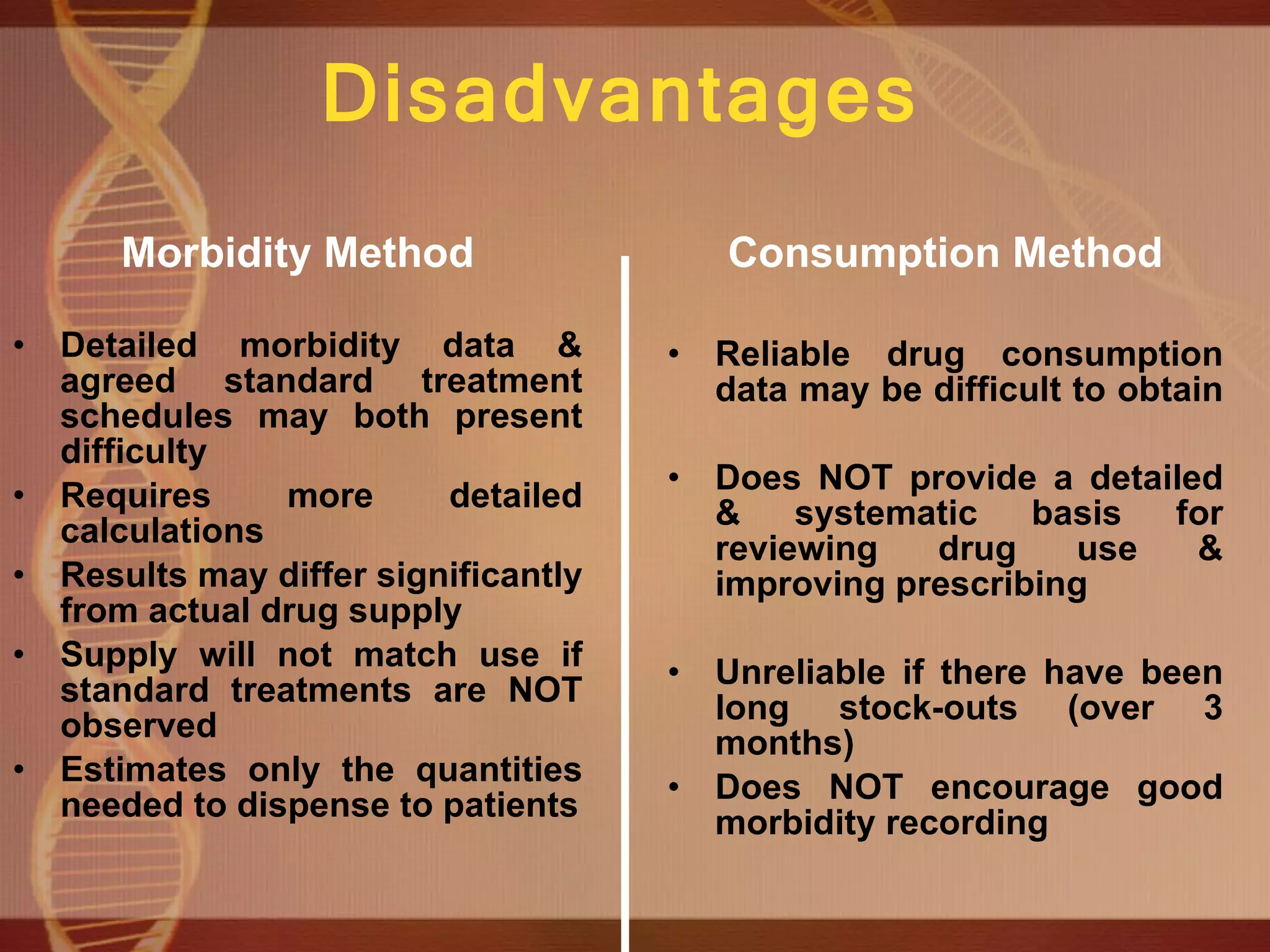
Disadvantages  Morbidity Method Detailed morbidity data & agreed standard treatment schedules may both present difficulty Requires more detailed calculations Results may differ significantly from actual drug supply Supply will not match use if standard treatments are NOT observed Estimates only the quantities needed to dispense to patients Consumption Method Reliable drug consumption data may be difficult to obtain  Does NOT provide a detailed & systematic basis for reviewing drug use & improving prescribing Unreliable if there have been long stock-outs (over 3 months) Does NOT encourage good morbidity recording
The Patient Morbidity- Standard Treatment Method (Morbidity Method) This method starts from  FOUR  basic sets of data: Essential drug lists with packaging & price data  Pharmaceutical budgets ” إدارة التوريد بالمنطقة“ بعد إتمام تحديد الكميات يتم  إعادة ضبطها على  الميزانية المتوفرة متوفرة  !!
This method starts from  FOUR  basic sets of data: The number of episodes of each health problem treated by the type or types of facilities for which drug requirements are to be estimated ( Patient Morbidity Profile ) Average standard treatment schedules agreed for each health problem defined يتم تحديد كل منها على مستوى ملفات الوحدة The Patient Morbidity- Standard Treatment Method (Morbidity Method)
Morbidity Method The  quantity  of drugs given as a standard treatment for each health problem, multiplied by the  number of treatment episodes  of that problem, gives the total quantity of drugs required for it
Morbidity Method Quantity of the drug  specified for a  standard course  of treatment X Number of  treatment  episodes of  the health problem Total quantity  of a drug  required for a  given  health problem =
This calculation is repeated for each health problem & its corresponding drugs Where a drug is given for  MORE than ONE  health problem, the respective  totals are added  together to obtain the total quantity required Morbidity Method
To give the average drug requirements per 1,000 treatment episodes, the total quantity of each drug is divided by the total number of treatment episodes of all kinds, expressed in thousands Morbidity Method
The Quantification Phase Using Morbidity Method Draw up average standard drug treatment schedule for quantification Tabulate number of episodes of treatment for each health problem. Or, if data not available, conduct a sample survey & estimate total number of episodes of treatment
The Quantification Phase Using Morbidity Method Calculate quantities required of each drug Estimate cost of drug quantities required Reconcile quantities to budget if necessary
The Quantification Phase Using Morbidity Method Calculate drugs required per 1000 treatment episodes OR per 1000 patient contacts Feed back reults to managers for placing orders & allocating drugs to individual facilities
The Quantification Phase Using Morbidity Method Provide prescribing control guidelines & stock management guidelines & training Evaluate the quantification process & make any necessary improvements
Preparing Average Standard Treatment Schedules The following steps are described assuming that  prescribing is rational
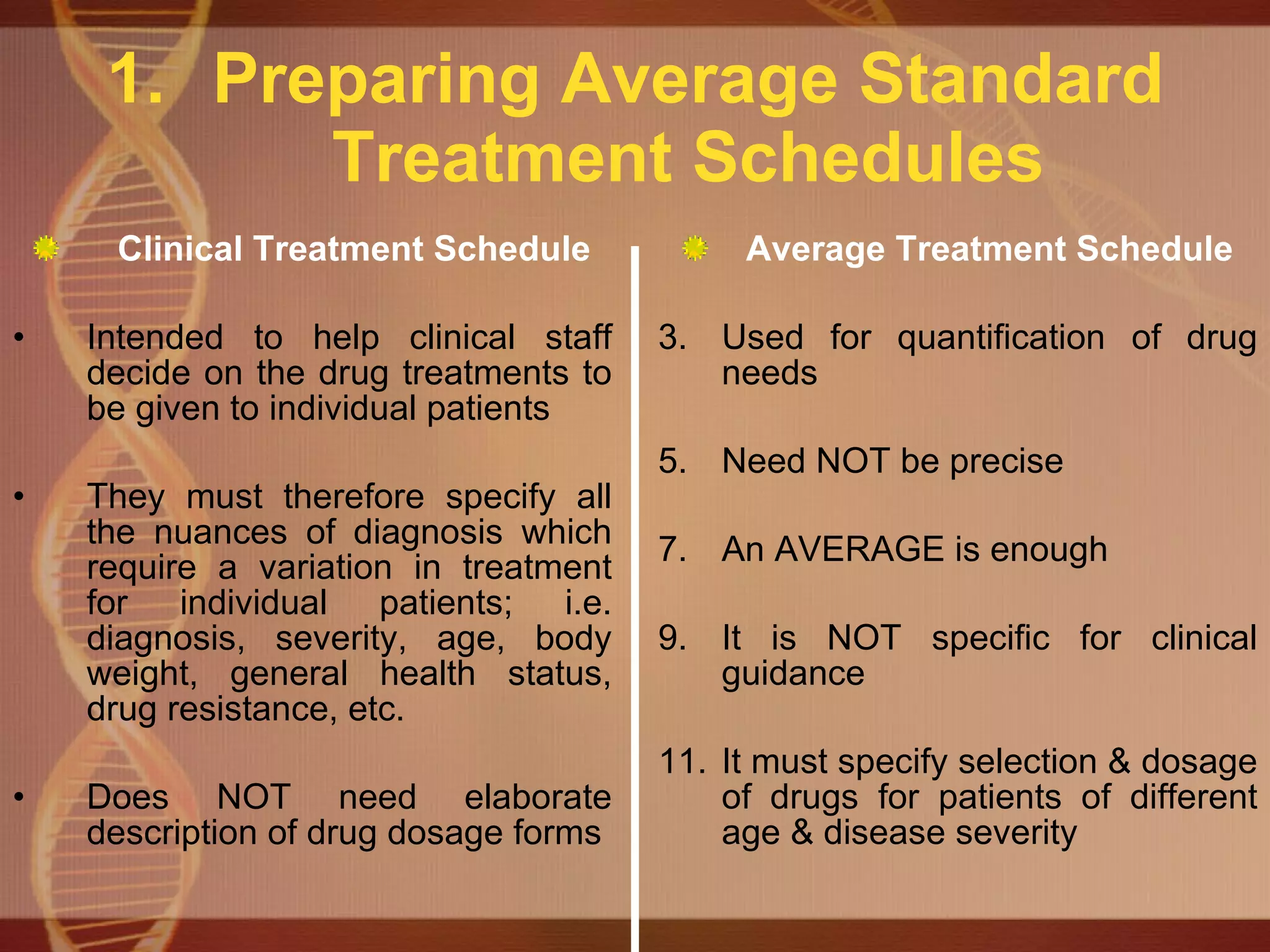
Preparing Average Standard Treatment Schedules Clinical Treatment Schedule Intended to help clinical staff decide on the drug treatments to be given to individual patients They must therefore specify all the nuances of diagnosis which require a variation in treatment for individual patients; i.e. diagnosis, severity, age, body weight, general health status, drug resistance, etc. Does NOT need elaborate description of drug dosage forms Average Treatment Schedule Used for quantification of drug needs Need NOT be precise An AVERAGE is enough It is NOT specific for clinical guidance It must specify selection & dosage of drugs for patients of different age & disease severity
Preparing Average Standard Treatment Schedules Average & clinical drug treatment schedules are of course related Average schedules are valid  ONLY IF  the represent the average treatments which will actually be used clinically For the quantification method to have an actual effect, clinical staff should ( must ) be  committed  to the used clinical guideline
Preparing Average Standard Treatment Schedules The schedules will  only  be effective if prescribers are trained in their use, and actually apply them There should be  continuous monitoring  & feedback on what is actually happening
Remember: Morbidity method estimates  ONLY   the quantities needed to dispense to patients It does not take losses or  wastage into consideration
N.B. It is important that physicians &  other higher level health service staff  should be  REASSURED  that  average treatment schedules do  NOT   infringe on their clinical freedom  to adapt the drug dosages to  the needs of individual patients
Examples!!
Preparing Average Standard Treatment Schedules Examples: Suppose that the standard treatment for iron deficiency anemia (ICD-10  ) should be 84 tablets of ferrous sulphate, if prescribers continue to give 120 tablets, then the average does  NOT  reflect reality
Preparing Average Standard Treatment Schedules Examples: The average standard treatment for a mild case of malaria in adults is ten 150 mg base tablets of chloroquine This average  allows for  &  reflects  variations in the courses of drug treatments prescribed for individual patients
Items of Average Drug Treatment Schedule The name of the health problem, and the ICD-10 number(s) of diagnosis it includes The generic name, dosage form & strength of each drug to be used in the treatment
Items of Average Drug Treatment Schedule The average dose The average number of doses per day
Items of Average Drug Treatment Schedule The average number of days these doses are to be given The total average quantity of each drug used for a standard course of treatment;  for acute conditions . The total quantity given per prescription  for chronic conditions
Items of Average Drug Treatment Schedule In general; two age groups should be distinguished (below five years, & five years and older) The severity of the disease should  ONLY  be included in the average drug treatment schedules if a more severe case would need a different drug
Before You Start; Selection of drugs is based on Essential Medicines List; bearing in mind the diagnostic & treatment capabilities to administer each treatment schedule More detailed clinical criteria must be applied to each health problem to determine the most appropriate average dosage form and drug quantity
Before You Start; Consider the  physical feasibility  of administering the proposed average treatment, e.g. injection versus tablets Average treatments which go against  cultural preferences  may be far more effective or cost-effective, but they must be explained & made acceptable to prescribers & patients
Ideally, reviewing average treatment schedules requires cooperation from: Experienced health service staff from the type of facility for which the treatment schedules are intended, who are familiar with diagnostic possibilities & prescribing patterns, & ca advise on what is feasible in practice 1
Ideally, reviewing average treatment schedules requires cooperation from: Experienced senior clinicians in different fields, who can advise on the treatments which they consider most effective 2
Ideally, reviewing average treatment schedules requires cooperation from: Pharmacists & administrators who can point out technical requirements, such as special storage conditions & ensure that costs are also borne in mind, so that proposed treatments are not only effective but also cost-effective 3
Illustrative Standard Treatment for Quantification of Drug Requirements Based on Average Doses
Examples in this presentation are hypothetical  and NOT based on systematic search 6 3 2 1 tab Co-trimoxazole tab Children Assume 4 sachets As required O.R.S. 24 3 4 2 caps Tetracycline 250 mg Adults Cholera 001 Bacterial Infections & Zoonosis 1- Infections & Parasitic Diseases Amount per Course of Treatment Number of Days Times per Day Dose Drugs Indication ICD
ICD-10 Code
Preparing Number of Treatment Episodes of Each Health Problem Watch the  difference !!!!!!!!
Treatment Episode: A patient contact for which a standard course of drug treatment is required Preparing Number of Treatment Episodes of Each Health Problem

Estimating drug requirements

  • 1.
  • 2.
    Effective Healthcare !!!To be effective, healthcare requires a judicious balance of preventive & curative services
  • 3.
    Effective Healthcare !!!This presentation deals with a crucial & deficient input to curative services: AN ADEQUATE SUPPLY OF APPROPRIATE DRUGS
  • 4.
    Effective Healthcare !!!This requires an effective drug supply management system
  • 5.
    Components of AnEffective Drug Supply Management Selection: Deciding what drugs are needed
  • 6.
    Components of AnEffective Drug Supply Management Quantification: Estimating how much of each drug is needed
  • 7.
    Components of AnEffective Drug Supply Management Procurement: Selecting suppliers, placing & monitoring orders, checking delivery quantities & quality, & paying suppliers
  • 8.
    Components of AnEffective Drug Supply Management Distribution: Reception, storage, stock control, transportation, & record keeping for monitoring & control
  • 9.
    Components of AnEffective Drug Supply Management Use: Prescription, dispensing & use of drugs, & patients’ compliance with prescriptions
  • 10.
    QUANTIFICATION Quantification should NOT be regarded as a purely computational procedure Effective quantification requires specific data concerning morbidity & drug use, & fundamental decisions about drugs which are to be available & how they are to be prescribed
  • 11.
    Symptoms of Poor Quantification
  • 12.
    Symptoms of PoorQuantification Chronic & widespread shortages of commonly used drugs, despite adequate funding, procurement, & distribution
  • 13.
    Symptoms of PoorQuantification Surpluses of a significant number of commonly used drugs or large surpluses of a smaller number of drugs This may be due to: Overestimation of certain drugs Poor selection Drugs are NOT appropriate to the morbidity pattern of the population Drugs are NOT in the form or dosage preferred by prescribers or by patients, and therefore remain unused
  • 14.
    Symptoms of PoorQuantification Inequity of supply between different levels of health services; urban based facilities & hospitals are better supplied than rural based facilities For example, certain levels of service have regular surpluses whereas others have chronic shortages This leads patients to by-pass the appropriate primary health care level to higher levels; because primary levels are ill-supplied
  • 15.
    Symptoms of PoorQuantification Inadequate cost-effectiveness by failure to use cheaper but equally effective drugs or dosage forms For example, expensive broad spectrum antibiotics are used when much cheaper penicillin would be just as effective for most patients, the more expensive broad spectrum drugs reserved for resistant cases Similarly, injectables & other expensive forms are often used where cheaper tablet forms would suffice
  • 16.
    Symptoms of PoorQuantification Irrational adjustment to budgetary constraints, which leads to inadequate irrational order quantities
  • 17.
    Symptoms of PoorQuantification Irrational or ineffective prescribing Prescribers faced with inadequate or inappropriate drug supplies usually either shorten treatments in an attempt to stretch their insufficient drug supplies as far as possible, or substitute alternative drugs for those in scarce supply In extreme cases, the treatments are shortened to the point of ineffectiveness, and the alternative drugs used are inappropriate
  • 18.
    Symptoms of PoorQuantification Suppression or distortion of demand An overall shortage of drugs discourages patients from seeking care & suppresses overall demand
  • 19.
  • 20.
    Preparing an ActionPlan The Preparatory Phase The Quantification Phase
  • 21.
    The Preparatory Phase………………………………………… .
  • 22.
    The Quantification PhaseData collection, quantification, costing, reconciliation to budget, calculation of final quantities per 1000 cases Feedback results to managers for placing orders & allocating drugs to individual facilities Provide training in prescribing & stock management Evaluate the quantification process & make any necessary improvements
  • 23.
  • 24.
    The Two Methodsof Quantification The Patient Morbidity- Standard Treatment Method (Morbidity Method) The Adjusted Consumption Method (Consumption Method)
  • 25.
    Advantages MorbidityMethod Does NOT require drug consumption data; useable for new services where such data are NOT available Based on rational prescribing; provides a systematic basis for reviewing drug use & prescribing Motivates reliable morbidity recording Consumption Method Does not require detailed morbidity data or standard treatment schedules Requires less detailed calculations Useful in hospitals where health problems are numerous & drug treatments are complex Reliable if consumption is well-recorded & stable Identifies stock management problems & encourages improvements
  • 26.
    Disadvantages MorbidityMethod Detailed morbidity data & agreed standard treatment schedules may both present difficulty Requires more detailed calculations Results may differ significantly from actual drug supply Supply will not match use if standard treatments are NOT observed Estimates only the quantities needed to dispense to patients Consumption Method Reliable drug consumption data may be difficult to obtain Does NOT provide a detailed & systematic basis for reviewing drug use & improving prescribing Unreliable if there have been long stock-outs (over 3 months) Does NOT encourage good morbidity recording
  • 27.
    The Patient Morbidity-Standard Treatment Method (Morbidity Method) This method starts from FOUR basic sets of data: Essential drug lists with packaging & price data Pharmaceutical budgets ” إدارة التوريد بالمنطقة“ بعد إتمام تحديد الكميات يتم إعادة ضبطها على الميزانية المتوفرة متوفرة !!
  • 28.
    This method startsfrom FOUR basic sets of data: The number of episodes of each health problem treated by the type or types of facilities for which drug requirements are to be estimated ( Patient Morbidity Profile ) Average standard treatment schedules agreed for each health problem defined يتم تحديد كل منها على مستوى ملفات الوحدة The Patient Morbidity- Standard Treatment Method (Morbidity Method)
  • 29.
    Morbidity Method The quantity of drugs given as a standard treatment for each health problem, multiplied by the number of treatment episodes of that problem, gives the total quantity of drugs required for it
  • 30.
    Morbidity Method Quantityof the drug specified for a standard course of treatment X Number of treatment episodes of the health problem Total quantity of a drug required for a given health problem =
  • 31.
    This calculation isrepeated for each health problem & its corresponding drugs Where a drug is given for MORE than ONE health problem, the respective totals are added together to obtain the total quantity required Morbidity Method
  • 32.
    To give theaverage drug requirements per 1,000 treatment episodes, the total quantity of each drug is divided by the total number of treatment episodes of all kinds, expressed in thousands Morbidity Method
  • 33.
    The Quantification PhaseUsing Morbidity Method Draw up average standard drug treatment schedule for quantification Tabulate number of episodes of treatment for each health problem. Or, if data not available, conduct a sample survey & estimate total number of episodes of treatment
  • 34.
    The Quantification PhaseUsing Morbidity Method Calculate quantities required of each drug Estimate cost of drug quantities required Reconcile quantities to budget if necessary
  • 35.
    The Quantification PhaseUsing Morbidity Method Calculate drugs required per 1000 treatment episodes OR per 1000 patient contacts Feed back reults to managers for placing orders & allocating drugs to individual facilities
  • 36.
    The Quantification PhaseUsing Morbidity Method Provide prescribing control guidelines & stock management guidelines & training Evaluate the quantification process & make any necessary improvements
  • 37.
    Preparing Average StandardTreatment Schedules The following steps are described assuming that prescribing is rational
  • 38.
    Preparing Average StandardTreatment Schedules Clinical Treatment Schedule Intended to help clinical staff decide on the drug treatments to be given to individual patients They must therefore specify all the nuances of diagnosis which require a variation in treatment for individual patients; i.e. diagnosis, severity, age, body weight, general health status, drug resistance, etc. Does NOT need elaborate description of drug dosage forms Average Treatment Schedule Used for quantification of drug needs Need NOT be precise An AVERAGE is enough It is NOT specific for clinical guidance It must specify selection & dosage of drugs for patients of different age & disease severity
  • 39.
    Preparing Average StandardTreatment Schedules Average & clinical drug treatment schedules are of course related Average schedules are valid ONLY IF the represent the average treatments which will actually be used clinically For the quantification method to have an actual effect, clinical staff should ( must ) be committed to the used clinical guideline
  • 40.
    Preparing Average StandardTreatment Schedules The schedules will only be effective if prescribers are trained in their use, and actually apply them There should be continuous monitoring & feedback on what is actually happening
  • 41.
    Remember: Morbidity methodestimates ONLY the quantities needed to dispense to patients It does not take losses or wastage into consideration
  • 42.
    N.B. It isimportant that physicians & other higher level health service staff should be REASSURED that average treatment schedules do NOT infringe on their clinical freedom to adapt the drug dosages to the needs of individual patients
  • 43.
  • 44.
    Preparing Average StandardTreatment Schedules Examples: Suppose that the standard treatment for iron deficiency anemia (ICD-10 ) should be 84 tablets of ferrous sulphate, if prescribers continue to give 120 tablets, then the average does NOT reflect reality
  • 45.
    Preparing Average StandardTreatment Schedules Examples: The average standard treatment for a mild case of malaria in adults is ten 150 mg base tablets of chloroquine This average allows for & reflects variations in the courses of drug treatments prescribed for individual patients
  • 46.
    Items of AverageDrug Treatment Schedule The name of the health problem, and the ICD-10 number(s) of diagnosis it includes The generic name, dosage form & strength of each drug to be used in the treatment
  • 47.
    Items of AverageDrug Treatment Schedule The average dose The average number of doses per day
  • 48.
    Items of AverageDrug Treatment Schedule The average number of days these doses are to be given The total average quantity of each drug used for a standard course of treatment; for acute conditions . The total quantity given per prescription for chronic conditions
  • 49.
    Items of AverageDrug Treatment Schedule In general; two age groups should be distinguished (below five years, & five years and older) The severity of the disease should ONLY be included in the average drug treatment schedules if a more severe case would need a different drug
  • 50.
    Before You Start;Selection of drugs is based on Essential Medicines List; bearing in mind the diagnostic & treatment capabilities to administer each treatment schedule More detailed clinical criteria must be applied to each health problem to determine the most appropriate average dosage form and drug quantity
  • 51.
    Before You Start;Consider the physical feasibility of administering the proposed average treatment, e.g. injection versus tablets Average treatments which go against cultural preferences may be far more effective or cost-effective, but they must be explained & made acceptable to prescribers & patients
  • 52.
    Ideally, reviewing averagetreatment schedules requires cooperation from: Experienced health service staff from the type of facility for which the treatment schedules are intended, who are familiar with diagnostic possibilities & prescribing patterns, & ca advise on what is feasible in practice 1
  • 53.
    Ideally, reviewing averagetreatment schedules requires cooperation from: Experienced senior clinicians in different fields, who can advise on the treatments which they consider most effective 2
  • 54.
    Ideally, reviewing averagetreatment schedules requires cooperation from: Pharmacists & administrators who can point out technical requirements, such as special storage conditions & ensure that costs are also borne in mind, so that proposed treatments are not only effective but also cost-effective 3
  • 55.
    Illustrative Standard Treatmentfor Quantification of Drug Requirements Based on Average Doses
  • 56.
    Examples in thispresentation are hypothetical and NOT based on systematic search 6 3 2 1 tab Co-trimoxazole tab Children Assume 4 sachets As required O.R.S. 24 3 4 2 caps Tetracycline 250 mg Adults Cholera 001 Bacterial Infections & Zoonosis 1- Infections & Parasitic Diseases Amount per Course of Treatment Number of Days Times per Day Dose Drugs Indication ICD
  • 57.
  • 58.
    Preparing Number ofTreatment Episodes of Each Health Problem Watch the difference !!!!!!!!
  • 59.
    Treatment Episode: Apatient contact for which a standard course of drug treatment is required Preparing Number of Treatment Episodes of Each Health Problem