Introduction
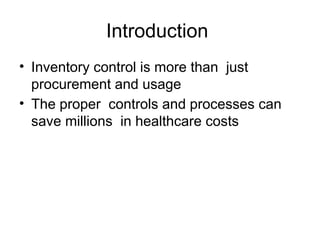
• Inventory control is more than just
procurement and usage
• The proper controls and processes can
save millions in healthcare costs
Inventory
An idle resource of any kind, provided that such
resource has economic value.
Definition of Inventory Control
• Planned method of determining what to indent, when to
buy, how much to indent and how much to stock so that
purchasing & storing cost is lowest without adversely
affecting the functioning of the organization
• It means stocking adequate number and kind of stores,
so that the materials are available whenever required
and wherever required.
Objectives
• To supply the materials on time
• To meet unforeseen future demand
• To average out demand fluctuations
• To meet the customer requirement timely, effectively,
efficiently, smoothly and satisfactorily.
• To smoothen the production process.
• To facilitate intermittent production of several
products on the same facility.
• To gain economy of production or purchase in lots.
Principles of Inventory
Control
• What to order
• When to order
• How much to order
• How much to stock
• How often to order
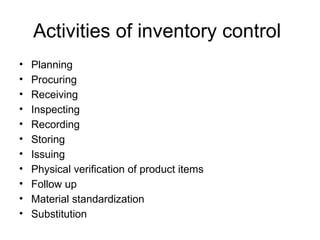
Activities of inventory control
• Planning
• Procuring
• Receiving
• Inspecting
• Recording
• Storing
• Issuing
• Physical verification of product items
• Follow up
• Material standardization
• Substitution
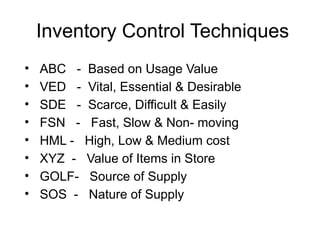
Inventory Control Techniques
• ABC - Based on Usage Value
• VED - Vital, Essential & Desirable
• SDE - Scarce, Difficult & Easily
• FSN - Fast, Slow & Non- moving
• HML - High, Low & Medium cost
• XYZ - Value of Items in Store
• GOLF- Source of Supply
• SOS - Nature of Supply
ABC(ALWAYS, BETTER,
CONTROL)Analysis
• Equal attention to all items - impossible
• ABC analysis is based on Usage Value of items.
• Usage Value : Consumption x Unit Cost.
• Classify according to high, medium & low usage
value as ‘A’ ‘B’ ‘C’.
• Aim is to give max attn to ‘A’ & least attn to ‘C’ items
A-ITEM
• Small in number
• Managed by top management
• Tight control and rigid estimate of requirement
• Strict and close watch
• Require low safety stock
• Consume measure portion of fund
e.g. Ventilator, Dialysis machine, Defibrillator, CT-
Scan machine, MRI Machine, USG, Heart-lung
machine
B-ITEM
• Moderate control
• Purchased on rigid requirement
• Strict watch and control is needed
• Safety stock are maintained moderately
• Managed by middle level management
e.g. Suction machine, Oxygen Cylinder,
Nebulizer, Humidifier, Cardiac monitor
C-ITEM
• Needed large in number
• Consumed lesser amount of cost
• Ordinary control
• Purchase on usage estimate
• Require high safety stock
e.g. Syringes, Cannula, Gloves, Suction Catheters
etc.
Pareto Theory Principle in ABC
ITEM % OF ITEM
( CONSUMPTION)
% OF RUPEE VALUE
(COST)
A 10 70
B 20 20
C 70 10
Advantages
• Investment can be maintained
• Easy to control wastage of costly item
• Help in maintaining safety to total cost
• Easy to maintain stock and turnover rate
• Manager is able to control the investment specially
A-item.
Disadvantages
• Proper standardization is required.
• Considered the only money value not importance
of item.
• Periodic review become difficult.
VED Analysis
VED ( VITAL, ESSENTIAL,
DESIRABLE) ANALYSIS
• Classification is based on criticality than on
functional basis.
• V-VITAL ITEMS
It includes items without which a hospital cannot
function
These items should be adequately stocked for smooth
functioning of an organization
Stocked in abundance
Shortage can’t be tolerated
E.g. Oxygen supply, ET tube, ventilator, Defibrillator
CONTD.
• E-ESSENTIAL ITEMS
It includes items without which a hospital can
function for a short time but affect the quality of
patient care to a limited extent.
Reasonable risk can be taken.
Controlled by middle-level managers.
E.g. Antibiotics, IVF, X-ray machine, electric
cautery, patient trolley etc.
Contd..
• D-DESIRABLE ITEMS
The non-availability of which for a considerable
period may not affect the functioning the
hospital.
They can be purchased easily when required.
Low in stock or not in stock
E.g. Tonics , Cough Syp, B Complex
Advantages
• To monitor and control inventory
• Determines criticality of an item
Disadvantages
• Cost Value Not Considered
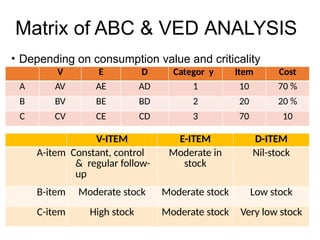
Matrix of ABC & VED ANALYSIS
• Depending on consumption value and criticality
V E D Categor y Item Cost
A AV AE AD 1 10 70 %
B BV BE BD 2 20 20 %
C CV CE CD 3 70 10
V-ITEM E-ITEM D-ITEM
A-item Constant, control
& regular follow-
up
Moderate in
stock
Nil-stock
B-item Moderate stock Moderate stock Low stock
C-item High stock Moderate stock Very low stock
FSN ( FAST MOVING, SLOW-
MOVING NON- MOVING)
ANALYSIS
• Analysis is based on consumption pattern of item
and issue pattern of item from stock.
• For analysis, issuing of item in past 2-3 years is
considered.
• Period of consideration and limited number of
issue may vary from organization to
organization.
Contd..
• Non-moving item
If no issuing of item during 2-3 year
• S- Slow-moving Item
If issuing 10-15 times during 2-3 Years
• F-Fast Moving Item
If issuing > 10-15 times during 2-3 years
SDE( SCARCE, DIFFICULT,
EASY TO OBTAIN) ANALYSIS
• Based on problem faced in procurement and
availability of item
• S-scarce item
Difficult to obtain
Generally imported
In-short supply
Management by top managers
A big safety stock is maintained for such item
Contd..
• D-DIFFICULT ITEM
Difficult to procure
Come from distant places
Moderate safety stock is maintained
• E-EASY ITEM
Easy to procure
Readily available in local market
Supply exceeds demand
Minimum safety demand
HML Analysis
• Based on unit value of the items
H - High unit cost
M - Medium unit cost
L - Low unit cost
• Purchasing policy is decided
XYZ Analysis
• Based on demand variability and
predictability of their demand
• Best for organising consumables and
relative short lifecycles
• X - Fixed Demand
• Y - Fluctuating Demand
• Z - Uncertain Demand
GOLF Classification
• Based on nature of suppliers
• ‘G’ - Government agencies, Public sector undertakings
items are imported through govt. agencies.
• Long lead, processing time.
• No credit facility.
• ‘O’ - Ordinary suppliers who form bulk of supplier and
procurement is easy.
• ‘L’ - Local suppliers sell on cash-purchase basis
• ‘F’ - Foreign suppliers, Long lead time
• Govt regulation - import license, port clearance
• Requires higher level of co-ordination
SOS (SEASONAL, OFF
SEASONAL) ANALYSIS
• Based on season/ according to necessity in a
specific time
• Seasonal
Available only for a limited period
• Off seasonal
Available through out the year
Role of nurse
• Keeping an adequate amount of equipment
and supplies in the ward
• Make sure that equipment and supplies are
in good condition
• Put in a requisition for necessary equipment
for repair and maintenance when needed
• Make sure that equipment and supplies are
conveniently located
Contd…
• To be observant of waste and misuse
• To delegate someone the responsibility for
handling supplies and equipment
• Set a standard for the quality of each item
to be maintained in the ward all the time
Conclusion
• Careful classification of the inventory and
continuing analysis of those
classifications, can play a vital role in
maintaining cost and providing quality care
• Inventory control is a constant requirement
of any organization
inventory control PowerPoint presentations

inventory control PowerPoint presentations

  • 2.
    Introduction • Inventory controlis more than just procurement and usage • The proper controls and processes can save millions in healthcare costs
  • 3.
    Inventory An idle resourceof any kind, provided that such resource has economic value.
  • 4.
    Definition of InventoryControl • Planned method of determining what to indent, when to buy, how much to indent and how much to stock so that purchasing & storing cost is lowest without adversely affecting the functioning of the organization • It means stocking adequate number and kind of stores, so that the materials are available whenever required and wherever required.
  • 5.
    Objectives • To supplythe materials on time • To meet unforeseen future demand • To average out demand fluctuations • To meet the customer requirement timely, effectively, efficiently, smoothly and satisfactorily. • To smoothen the production process. • To facilitate intermittent production of several products on the same facility. • To gain economy of production or purchase in lots.
  • 6.
    Principles of Inventory Control •What to order • When to order • How much to order • How much to stock • How often to order
  • 7.
    Activities of inventorycontrol • Planning • Procuring • Receiving • Inspecting • Recording • Storing • Issuing • Physical verification of product items • Follow up • Material standardization • Substitution
  • 8.
    Inventory Control Techniques •ABC - Based on Usage Value • VED - Vital, Essential & Desirable • SDE - Scarce, Difficult & Easily • FSN - Fast, Slow & Non- moving • HML - High, Low & Medium cost • XYZ - Value of Items in Store • GOLF- Source of Supply • SOS - Nature of Supply
  • 9.
    ABC(ALWAYS, BETTER, CONTROL)Analysis • Equalattention to all items - impossible • ABC analysis is based on Usage Value of items. • Usage Value : Consumption x Unit Cost. • Classify according to high, medium & low usage value as ‘A’ ‘B’ ‘C’. • Aim is to give max attn to ‘A’ & least attn to ‘C’ items
  • 11.
    A-ITEM • Small innumber • Managed by top management • Tight control and rigid estimate of requirement • Strict and close watch • Require low safety stock • Consume measure portion of fund e.g. Ventilator, Dialysis machine, Defibrillator, CT- Scan machine, MRI Machine, USG, Heart-lung machine
  • 12.
    B-ITEM • Moderate control •Purchased on rigid requirement • Strict watch and control is needed • Safety stock are maintained moderately • Managed by middle level management e.g. Suction machine, Oxygen Cylinder, Nebulizer, Humidifier, Cardiac monitor
  • 13.
    C-ITEM • Needed largein number • Consumed lesser amount of cost • Ordinary control • Purchase on usage estimate • Require high safety stock e.g. Syringes, Cannula, Gloves, Suction Catheters etc.
  • 14.
    Pareto Theory Principlein ABC ITEM % OF ITEM ( CONSUMPTION) % OF RUPEE VALUE (COST) A 10 70 B 20 20 C 70 10
  • 15.
    Advantages • Investment canbe maintained • Easy to control wastage of costly item • Help in maintaining safety to total cost • Easy to maintain stock and turnover rate • Manager is able to control the investment specially A-item.
  • 16.
    Disadvantages • Proper standardizationis required. • Considered the only money value not importance of item. • Periodic review become difficult.
  • 17.
  • 18.
    VED ( VITAL,ESSENTIAL, DESIRABLE) ANALYSIS • Classification is based on criticality than on functional basis. • V-VITAL ITEMS It includes items without which a hospital cannot function These items should be adequately stocked for smooth functioning of an organization Stocked in abundance Shortage can’t be tolerated E.g. Oxygen supply, ET tube, ventilator, Defibrillator
  • 19.
    CONTD. • E-ESSENTIAL ITEMS Itincludes items without which a hospital can function for a short time but affect the quality of patient care to a limited extent. Reasonable risk can be taken. Controlled by middle-level managers. E.g. Antibiotics, IVF, X-ray machine, electric cautery, patient trolley etc.
  • 20.
    Contd.. • D-DESIRABLE ITEMS Thenon-availability of which for a considerable period may not affect the functioning the hospital. They can be purchased easily when required. Low in stock or not in stock E.g. Tonics , Cough Syp, B Complex
  • 21.
    Advantages • To monitorand control inventory • Determines criticality of an item Disadvantages • Cost Value Not Considered
  • 22.
    Matrix of ABC& VED ANALYSIS • Depending on consumption value and criticality V E D Categor y Item Cost A AV AE AD 1 10 70 % B BV BE BD 2 20 20 % C CV CE CD 3 70 10 V-ITEM E-ITEM D-ITEM A-item Constant, control & regular follow- up Moderate in stock Nil-stock B-item Moderate stock Moderate stock Low stock C-item High stock Moderate stock Very low stock
  • 23.
    FSN ( FASTMOVING, SLOW- MOVING NON- MOVING) ANALYSIS • Analysis is based on consumption pattern of item and issue pattern of item from stock. • For analysis, issuing of item in past 2-3 years is considered. • Period of consideration and limited number of issue may vary from organization to organization.
  • 24.
    Contd.. • Non-moving item Ifno issuing of item during 2-3 year • S- Slow-moving Item If issuing 10-15 times during 2-3 Years • F-Fast Moving Item If issuing > 10-15 times during 2-3 years
  • 25.
    SDE( SCARCE, DIFFICULT, EASYTO OBTAIN) ANALYSIS • Based on problem faced in procurement and availability of item • S-scarce item Difficult to obtain Generally imported In-short supply Management by top managers A big safety stock is maintained for such item
  • 26.
    Contd.. • D-DIFFICULT ITEM Difficultto procure Come from distant places Moderate safety stock is maintained • E-EASY ITEM Easy to procure Readily available in local market Supply exceeds demand Minimum safety demand
  • 27.
    HML Analysis • Basedon unit value of the items H - High unit cost M - Medium unit cost L - Low unit cost • Purchasing policy is decided
  • 28.
    XYZ Analysis • Basedon demand variability and predictability of their demand • Best for organising consumables and relative short lifecycles • X - Fixed Demand • Y - Fluctuating Demand • Z - Uncertain Demand
  • 29.
    GOLF Classification • Basedon nature of suppliers • ‘G’ - Government agencies, Public sector undertakings items are imported through govt. agencies. • Long lead, processing time. • No credit facility. • ‘O’ - Ordinary suppliers who form bulk of supplier and procurement is easy. • ‘L’ - Local suppliers sell on cash-purchase basis • ‘F’ - Foreign suppliers, Long lead time • Govt regulation - import license, port clearance • Requires higher level of co-ordination
  • 30.
    SOS (SEASONAL, OFF SEASONAL)ANALYSIS • Based on season/ according to necessity in a specific time • Seasonal Available only for a limited period • Off seasonal Available through out the year
  • 31.
    Role of nurse •Keeping an adequate amount of equipment and supplies in the ward • Make sure that equipment and supplies are in good condition • Put in a requisition for necessary equipment for repair and maintenance when needed • Make sure that equipment and supplies are conveniently located
  • 32.
    Contd… • To beobservant of waste and misuse • To delegate someone the responsibility for handling supplies and equipment • Set a standard for the quality of each item to be maintained in the ward all the time
  • 33.
    Conclusion • Careful classificationof the inventory and continuing analysis of those classifications, can play a vital role in maintaining cost and providing quality care • Inventory control is a constant requirement of any organization