Inventory Control
BY
PRANAV ANIL TELI
Introduction
Inventory: An idle resource of any kind that has
potential economic value or simply materials in stock
Types of Inventory
1. Raw materials
2. Bought out parts
3. Work-in-process inventories
4. Finished good inventories
5. Maintenance, repair & operating stores
6. Tool inventory
7. Miscellaneous inventories
Reasons for carrying inventory
1. To stabilize production
2. To take advantage of price discount
3. To meet the demand during replenishment period
4. To prevent loss of orders
5. To keep pace with changing market conditions
Benefits of inventory control
• Improvement in customers relationship
• Smooth production
• Efficient utilization of working capital
• Economy in purchasing
• Eliminates possibility of duplicate ordering
• Helps in minimizing loss
Costs in inventory
1. Purchase cost
2. Capital cost
3. Ordering cost
4. Holding cost
5. Shortage cost
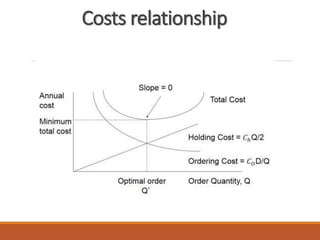
Costs relationship
Inventory models
1. Economic order quantity with instantaneous stock replenishment
2. Economic order quantity with non instantaneous stock
replenishment
3. Inventory model when shortages are permitted
4. Inventory model with price discounts
Parameters
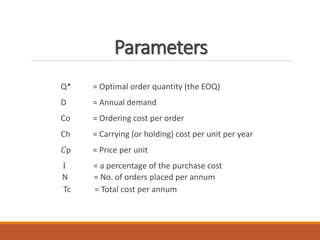
Q* = Optimal order quantity (the EOQ)
D = Annual demand
Co = Ordering cost per order
Ch = Carrying (or holding) cost per unit per year
𝐶p = Price per unit
I = a percentage of the purchase cost
N = No. of orders placed per annum
Tc = Total cost per annum
Safety stock
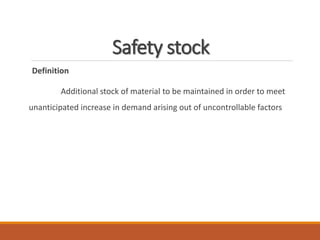
Definition
Additional stock of material to be maintained in order to meet
unanticipated increase in demand arising out of uncontrollable factors
Replenishment system
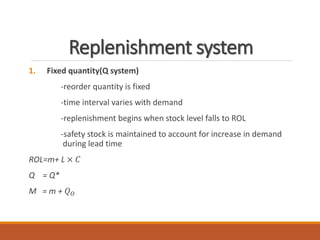
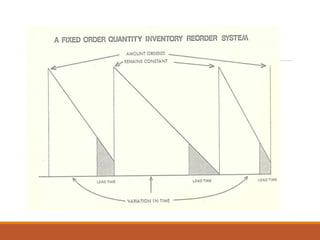
1. Fixed quantity(Q system)
-reorder quantity is fixed
-time interval varies with demand
-replenishment begins when stock level falls to ROL
-safety stock is maintained to account for increase in demand
during lead time
ROL=m+ L × 𝐶
Q = Q*
M = m + 𝑄 𝑂
Advantages:
1.simple and cheaper to operate
2.suiatable for low value item
3.stock control will be accurate
Limitations:
1.load on ordering system
2.stock level records & usage rate are to be maintained
Two bin system
Operates on ROL system and physically segregates stock of entire items
into two bins
First bin =order quantity(Q-LC)
Second bin =ROL(m+LC)
Working
Emptying of first bin indicates ROL and replenishment is
initiated
Quantity in second bin are thus consumed during
replenishment period
2. Fixed period system(P system)
-order interval is fixed
-stock is reviewed periodically
Max level=m + C(R+L)
Reorder quantity(Q) =max stock – stock held at review
time
Inventory Management- A Case Study
Research Article
By
Dr. Angel Raphella. S
Mr. Gomathi Nathan. S
Ms. Chitra. G
Introduction
• second largest asset category for manufacturing companies,next only to plant and equipment
An effective inventory management should:
1. Ensure a continuous supply of raw materials to facilitate uninterrupted production.
2. Maintain sufficient finished goods inventory for smooth sales operation and efficient
customer services.
3. Minimize the carrying cost and time.
4. Control investment in investment in inventories and keep it at an optimum level.
5. It permits a better utilization of available stocks by facilitating interdepartmental transfers
with in a company.
6. Maintain sufficient stocks of raw materials in periods of short supply and anticipated price
changes.
Objectives of the study
 To find out the economic order quantity of the various products of the
company.
 To analyze the inventory management technique used in the company.
 To suggest ideas to manage the inventory level of the organization.
Research Methodology
The data pertaining to March 2013 to February 2014 are considered for
the analysis.
To be able to calculate a basic EOQ, certain assumptions are necessary:
(i) That there is a known, constant, stock holding cost
(ii) That there is a known, constant ordering cost
(iii) That the rates of demand are known
(iv) That there is a known constant price per unit
(v) That replenishment is made instantaneously, that is the whole batch
is delivered at once
(vi) No stock-outs are allowed
FINDINGS and RECOMMENDATIONS
•Cement and sand is fast moving throughout the year
•Gravel, Bricks and Steel are given less importance in the stock
•Materials management unit should also pay attention to sales growth over the
years and thus take into consideration
•Steel being more valuable is considered high among the inventory
•Cement comes under the average category
•Bricks, Sand and Gravel are in the lowest category of the inventory
•The management can take some measures for controlling wastage of raw
inventories. Emphasis can be normally placed on the economic order quantity
model because it was seen to be in the best interest of organization to maintain
an optimal level of materials in store
Conclusions
Inventory problems of too great or too small quantities on hand can cause
business failures. If an organization experiences stock-out of a critical
inventory item, production halts could result. Inventory management
indicates the broad frame work of managing inventory. The inventory
management technique is more useful in determine the optimum level of
inventory and finding answers to problem of safety stock and lead time.
Inventory management has become highly developed to meet the rising
challenges in most Corporate entities and this is in response to the fact that
inventory is an asset of distinct feature
References
• Industrial Eng. & production model by Martang Telsang
• http://www.Wikipedia.org/inventory_control
• W.Harris Ford, How Many Parts to Make at Once, Operations Research
THANK YOU

Inventory control

  • 1.
  • 2.
    Introduction Inventory: An idleresource of any kind that has potential economic value or simply materials in stock
  • 3.
    Types of Inventory 1.Raw materials 2. Bought out parts 3. Work-in-process inventories 4. Finished good inventories 5. Maintenance, repair & operating stores 6. Tool inventory 7. Miscellaneous inventories
  • 5.
    Reasons for carryinginventory 1. To stabilize production 2. To take advantage of price discount 3. To meet the demand during replenishment period 4. To prevent loss of orders 5. To keep pace with changing market conditions
  • 6.
    Benefits of inventorycontrol • Improvement in customers relationship • Smooth production • Efficient utilization of working capital • Economy in purchasing • Eliminates possibility of duplicate ordering • Helps in minimizing loss
  • 7.
    Costs in inventory 1.Purchase cost 2. Capital cost 3. Ordering cost 4. Holding cost 5. Shortage cost
  • 8.
  • 9.
    Inventory models 1. Economicorder quantity with instantaneous stock replenishment 2. Economic order quantity with non instantaneous stock replenishment 3. Inventory model when shortages are permitted 4. Inventory model with price discounts
  • 10.
    Parameters Q* = Optimalorder quantity (the EOQ) D = Annual demand Co = Ordering cost per order Ch = Carrying (or holding) cost per unit per year 𝐶p = Price per unit I = a percentage of the purchase cost N = No. of orders placed per annum Tc = Total cost per annum
  • 13.
    Safety stock Definition Additional stockof material to be maintained in order to meet unanticipated increase in demand arising out of uncontrollable factors
  • 15.
    Replenishment system 1. Fixedquantity(Q system) -reorder quantity is fixed -time interval varies with demand -replenishment begins when stock level falls to ROL -safety stock is maintained to account for increase in demand during lead time ROL=m+ L × 𝐶 Q = Q* M = m + 𝑄 𝑂
  • 17.
    Advantages: 1.simple and cheaperto operate 2.suiatable for low value item 3.stock control will be accurate Limitations: 1.load on ordering system 2.stock level records & usage rate are to be maintained
  • 18.
    Two bin system Operateson ROL system and physically segregates stock of entire items into two bins First bin =order quantity(Q-LC) Second bin =ROL(m+LC) Working Emptying of first bin indicates ROL and replenishment is initiated Quantity in second bin are thus consumed during replenishment period
  • 20.
    2. Fixed periodsystem(P system) -order interval is fixed -stock is reviewed periodically Max level=m + C(R+L) Reorder quantity(Q) =max stock – stock held at review time
  • 22.
    Inventory Management- ACase Study Research Article By Dr. Angel Raphella. S Mr. Gomathi Nathan. S Ms. Chitra. G
  • 23.
    Introduction • second largestasset category for manufacturing companies,next only to plant and equipment An effective inventory management should: 1. Ensure a continuous supply of raw materials to facilitate uninterrupted production. 2. Maintain sufficient finished goods inventory for smooth sales operation and efficient customer services. 3. Minimize the carrying cost and time. 4. Control investment in investment in inventories and keep it at an optimum level. 5. It permits a better utilization of available stocks by facilitating interdepartmental transfers with in a company. 6. Maintain sufficient stocks of raw materials in periods of short supply and anticipated price changes.
  • 24.
    Objectives of thestudy  To find out the economic order quantity of the various products of the company.  To analyze the inventory management technique used in the company.  To suggest ideas to manage the inventory level of the organization.
  • 25.
    Research Methodology The datapertaining to March 2013 to February 2014 are considered for the analysis. To be able to calculate a basic EOQ, certain assumptions are necessary: (i) That there is a known, constant, stock holding cost (ii) That there is a known, constant ordering cost (iii) That the rates of demand are known (iv) That there is a known constant price per unit (v) That replenishment is made instantaneously, that is the whole batch is delivered at once (vi) No stock-outs are allowed
  • 38.
    FINDINGS and RECOMMENDATIONS •Cementand sand is fast moving throughout the year •Gravel, Bricks and Steel are given less importance in the stock •Materials management unit should also pay attention to sales growth over the years and thus take into consideration •Steel being more valuable is considered high among the inventory •Cement comes under the average category •Bricks, Sand and Gravel are in the lowest category of the inventory •The management can take some measures for controlling wastage of raw inventories. Emphasis can be normally placed on the economic order quantity model because it was seen to be in the best interest of organization to maintain an optimal level of materials in store
  • 39.
    Conclusions Inventory problems oftoo great or too small quantities on hand can cause business failures. If an organization experiences stock-out of a critical inventory item, production halts could result. Inventory management indicates the broad frame work of managing inventory. The inventory management technique is more useful in determine the optimum level of inventory and finding answers to problem of safety stock and lead time. Inventory management has become highly developed to meet the rising challenges in most Corporate entities and this is in response to the fact that inventory is an asset of distinct feature
  • 40.
    References • Industrial Eng.& production model by Martang Telsang • http://www.Wikipedia.org/inventory_control • W.Harris Ford, How Many Parts to Make at Once, Operations Research
  • 41.