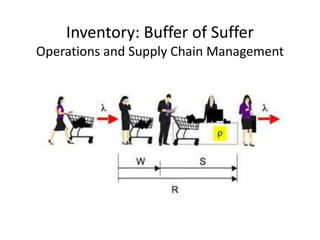




Inventory: Buffer of Suffer 
Operations and Supply Chain Management
Adaptation 
• This is adapted from a 
course in Operations 
Management on 
Coursera from 
Wharton. 
• Professor Christian 
Terwiesch
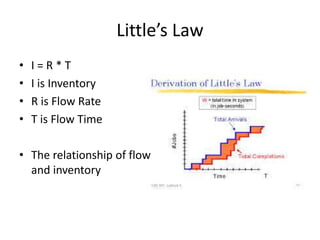
Little’s Law 
• I = R * T 
• I is Inventory 
• R is Flow Rate 
• T is Flow Time 
• The relationship of flow 
and inventory
Email Example 
• If you have 240 emails 
in you in box and you 
can answer 60 per day 
on average 
• How long will it take 
you to answer them? 
• I = 240 
• R = 60 
• I/R = T 
• 240/60 = 4 days
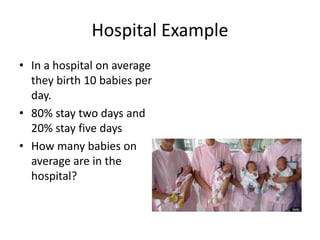
Hospital Example 
• In a hospital on average 
they birth 10 babies per 
day. 
• 80% stay two days and 
20% stay five days 
• How many babies on 
average are in the 
hospital?
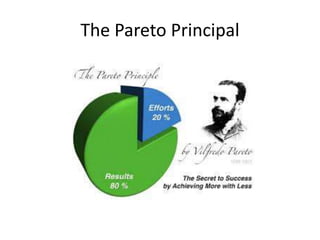
Pareto Principle 
• The Pareto 
principle (also known as 
the 80–20 rule, the law 
of the vital few, and 
the principle of factor 
sparsity) states that, for 
many events, roughly 
80% of the effects come 
from 20% of the causes.
The Pareto Principal
Hospital Example 
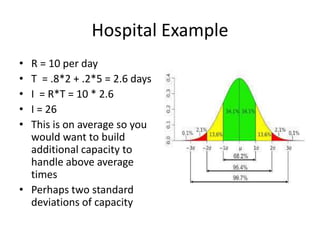
• R = 10 per day 
• T = .8*2 + .2*5 = 2.6 days 
• I = R*T = 10 * 2.6 
• I = 26 
• This is on average so you 
would want to build 
additional capacity to 
handle above average 
times 
• Perhaps two standard 
deviations of capacity
Inventory Turns 
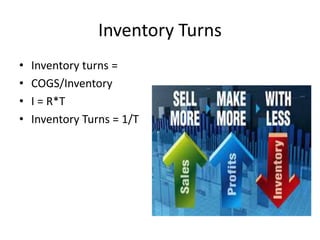
• Inventory turns = 
• COGS/Inventory 
• I = R*T 
• Inventory Turns = 1/T
Computer Example 
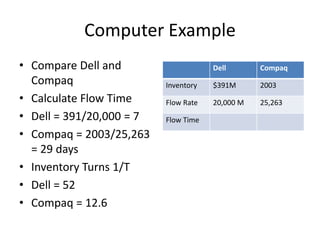
• Compare Dell and 
Compaq 
• Calculate Flow Time 
• Dell = 391/20,000 = 7 
• Compaq = 2003/25,263 
= 29 days 
• Inventory Turns 1/T 
• Dell = 52 
• Compaq = 12.6 
Dell Compaq 
Inventory $391M 2003 
Flow Rate 20,000 M 25,263 
Flow Time
Significance 
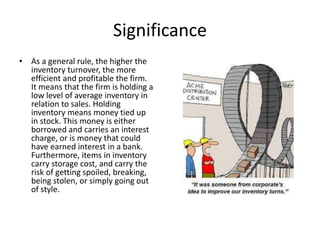
• As a general rule, the higher the 
inventory turnover, the more 
efficient and profitable the firm. 
It means that the firm is holding a 
low level of average inventory in 
relation to sales. Holding 
inventory means money tied up 
in stock. This money is either 
borrowed and carries an interest 
charge, or is money that could 
have earned interest in a bank. 
Furthermore, items in inventory 
carry storage cost, and carry the 
risk of getting spoiled, breaking, 
being stolen, or simply going out 
of style.
Sandwich Flow Rate 
• Product: you might 
make 0,1 or 2 in ten 
minutes 
• You might have 0,1 or 2 
customers in ten 
minutes 
• What is the average 
flow? 
• 1?
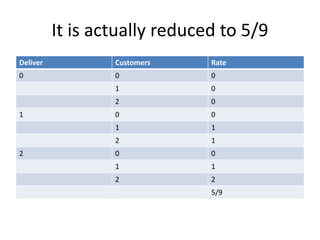
It is actually reduced to 5/9 
Deliver Customers Rate 
0 0 0 
1 0 
2 0 
1 0 0 
1 1 
2 1 
2 0 0 
1 1 
2 2 
5/9
Buffer or Suffer 
• Inventory de-couples 
Supply from Demand 
• Protects against the 
variability of: 
– Demand 
– Process Time 
• Make to Stock 
• Make to Order
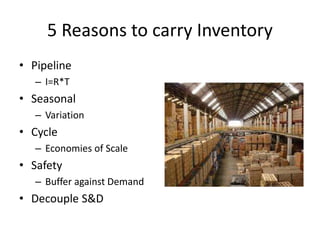
5 Reasons to carry Inventory 
• Pipeline 
– I=R*T 
• Seasonal 
– Variation 
• Cycle 
– Economies of Scale 
• Safety 
– Buffer against Demand 
• Decouple S&D
Inventory: Buffer or Suffer  operations and supply chain management

Inventory: Buffer or Suffer operations and supply chain management

  • 1.
    Inventory: Buffer ofSuffer Operations and Supply Chain Management
  • 2.
    Adaptation • Thisis adapted from a course in Operations Management on Coursera from Wharton. • Professor Christian Terwiesch
  • 3.
    Little’s Law •I = R * T • I is Inventory • R is Flow Rate • T is Flow Time • The relationship of flow and inventory
  • 4.
    Email Example •If you have 240 emails in you in box and you can answer 60 per day on average • How long will it take you to answer them? • I = 240 • R = 60 • I/R = T • 240/60 = 4 days
  • 5.
    Hospital Example •In a hospital on average they birth 10 babies per day. • 80% stay two days and 20% stay five days • How many babies on average are in the hospital?
  • 6.
    Pareto Principle •The Pareto principle (also known as the 80–20 rule, the law of the vital few, and the principle of factor sparsity) states that, for many events, roughly 80% of the effects come from 20% of the causes.
  • 7.
  • 8.
    Hospital Example •R = 10 per day • T = .8*2 + .2*5 = 2.6 days • I = R*T = 10 * 2.6 • I = 26 • This is on average so you would want to build additional capacity to handle above average times • Perhaps two standard deviations of capacity
  • 9.
    Inventory Turns •Inventory turns = • COGS/Inventory • I = R*T • Inventory Turns = 1/T
  • 10.
    Computer Example •Compare Dell and Compaq • Calculate Flow Time • Dell = 391/20,000 = 7 • Compaq = 2003/25,263 = 29 days • Inventory Turns 1/T • Dell = 52 • Compaq = 12.6 Dell Compaq Inventory $391M 2003 Flow Rate 20,000 M 25,263 Flow Time
  • 11.
    Significance • Asa general rule, the higher the inventory turnover, the more efficient and profitable the firm. It means that the firm is holding a low level of average inventory in relation to sales. Holding inventory means money tied up in stock. This money is either borrowed and carries an interest charge, or is money that could have earned interest in a bank. Furthermore, items in inventory carry storage cost, and carry the risk of getting spoiled, breaking, being stolen, or simply going out of style.
  • 12.
    Sandwich Flow Rate • Product: you might make 0,1 or 2 in ten minutes • You might have 0,1 or 2 customers in ten minutes • What is the average flow? • 1?
  • 13.
    It is actuallyreduced to 5/9 Deliver Customers Rate 0 0 0 1 0 2 0 1 0 0 1 1 2 1 2 0 0 1 1 2 2 5/9
  • 14.
    Buffer or Suffer • Inventory de-couples Supply from Demand • Protects against the variability of: – Demand – Process Time • Make to Stock • Make to Order
  • 15.
    5 Reasons tocarry Inventory • Pipeline – I=R*T • Seasonal – Variation • Cycle – Economies of Scale • Safety – Buffer against Demand • Decouple S&D