1
Creating a Lean Supply
Chain at Cardinal Health
June 26, 2007
William Owad
SVP, Operational Excellence
Cardinal Health
2
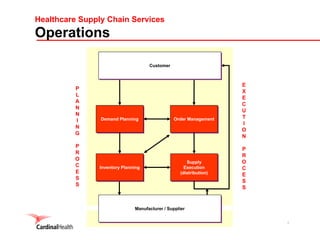
Healthcare Supply Chain Services
Operations
Demand PlanningDemand Planning Order ManagementOrder Management
Inventory PlanningInventory Planning
Supply
Execution
(distribution)
Supply
Execution
(distribution)
P
L
A
N
N
I
N
G
P
R
O
C
E
S
S
E
X
E
C
U
T
I
O
N
P
R
O
C
E
S
S
CustomerCustomer
Manufacturer / SupplierManufacturer / Supplier
3
Cardinal Health
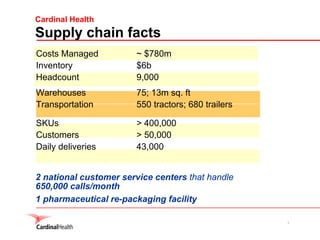
Supply chain facts
Costs Managed ~ $780m
Inventory $6b
Headcount 9,000
Warehouses 75; 13m sq. ft
Transportation 550 tractors; 680 trailers
SKUs > 400,000
Customers > 50,000
Daily deliveries 43,000
2 national customer service centers that handle
650,000 calls/month
1 pharmaceutical re-packaging facility
4
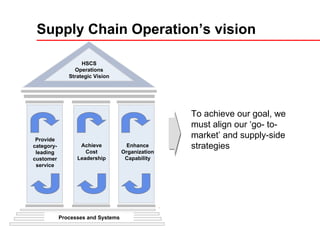
Supply Chain Operation’s vision
To achieve our goal, we
must align our ‘go- to-
market’ and supply-side
strategies
HSCS
Operations
Strategic Vision
Provide
category-
leading
customer
service
Achieve
Cost
Leadership
Enhance
Organization
Capability
Processes and Systems
5
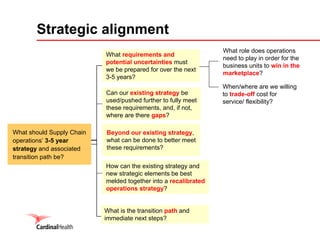
Strategic alignment
What requirements and
potential uncertainties must
we be prepared for over the next
3-5 years?
Can our existing strategy be
used/pushed further to fully meet
these requirements, and, if not,
where are there gaps?
Beyond our existing strategy,
what can be done to better meet
these requirements?
How can the existing strategy and
new strategic elements be best
melded together into a recalibrated
operations strategy?
What should Supply Chain
operations’ 3-5 year
strategy and associated
transition path be?
What role does operations
need to play in order for the
business units to win in the
marketplace?
When/where are we willing
to trade-off cost for
service/ flexibility?
What is the transition path and
immediate next steps?
6
Representative customers
7
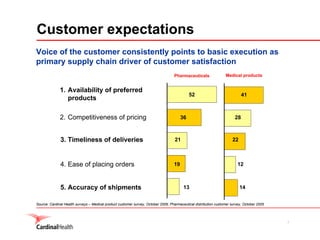
Source: Cardinal Health surveys – Medical product customer survey, October 2006; Pharmaceutical distribution customer survey, October 2005
41
22
14
Medical products
52
21
19
13
Pharmaceuticals
1. Availability of preferred
products
2. Competitiveness of pricing
Voice of the customer consistently points to basic execution as
primary supply chain driver of customer satisfaction
Customer expectations
5. Accuracy of shipments
36 28
124. Ease of placing orders
3. Timeliness of deliveries
8
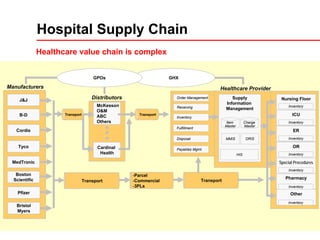
Hospital Supply Chain
Healthcare value chain is complex
Supply
Information
Management
MMIS
Healthcare Provider
Item
Master
Charge
Master
ORIS
HIS
B-D
MedTronic
Pfizer
Bristol
Myers
Boston
Scientific
Manufacturers
J&J
Cordis
Tyco
-Parcel
-Commercial
-3PLs
TransportTransport
GHXGPOs
McKesson
O&M
ABC
Others
Cardinal
Health
Transport
Distributors
Transport
Other
Inventory
Pharmacy
ER
ICU
OR
Nursing Floor
Inventory
Inventory
Inventory
Inventory
Inventory
Special Procedures
Inventory
Receiving
Fulfillment
Payables Mgmt.
Disposal
Order Management
Inventory
9
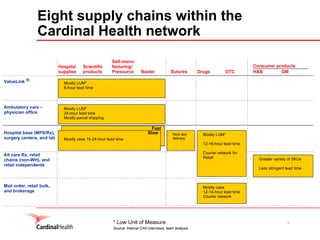
Hospital base (MPS/Rx),
surgery centers, and lab
Hospital
supplies
Scientific
products
Self-manu-
facturing/
Presource Baxter Sutures Drugs OTC H&B GM
Mostly LUM*
24-hour lead time
Mostly parcel shipping
Ambulatory care –
physician office
Mostly LUM*
12-16-hour lead time
Courier network for
Retail Greater variety of SKUs
Less stringent lead time
Alt care Rx, retail
chains (non-WH), and
retail independents
Mostly case
12-14-hour lead time
Courier network
Mail order, retail bulk,
and brokerage
Consumer products
99% service levelsMostly LUM*
6-hour lead time
ValueLink
Mostly case 15-24-hour lead time
Next day
delivery
Slow
Fast
®
Eight supply chains within the
Cardinal Health network
* Low Unit of Measure
Source: Internal CAH interviews; team analysis
10
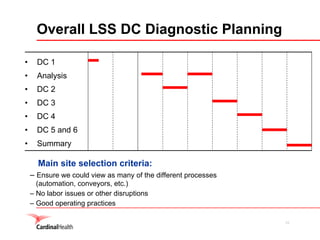
Overall LSS DC Diagnostic Planning
• DC 1
• DC 5 and 6
• Summary
• DC 4
• DC 3
• DC 2
• Analysis
Main site selection criteria:
– Ensure we could view as many of the different processes
(automation, conveyors, etc.)
– No labor issues or other disruptions
– Good operating practices
11
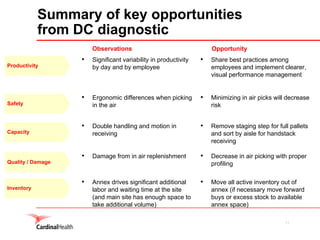
Summary of key opportunities
from DC diagnostic
Productivity
• Significant variability in productivity
by day and by employee
Observations
• Share best practices among
employees and implement clearer,
visual performance management
Opportunity
• Ergonomic differences when picking
in the air
• Minimizing in air picks will decrease
riskSafety
• Double handling and motion in
receiving
• Remove staging step for full pallets
and sort by aisle for handstack
receiving
Capacity
Quality / Damage
• Damage from in air replenishment • Decrease in air picking with proper
profiling
• Annex drives significant additional
labor and waiting time at the site
(and main site has enough space to
take additional volume)
• Move all active inventory out of
annex (if necessary move forward
buys or excess stock to available
annex space)
Inventory
12
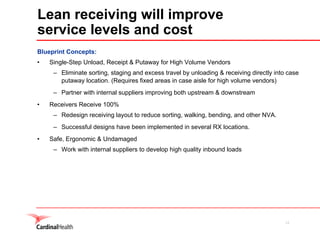
Lean receiving will improve
service levels and cost
Blueprint Concepts:
• Single-Step Unload, Receipt & Putaway for High Volume Vendors
– Eliminate sorting, staging and excess travel by unloading & receiving directly into case
putaway location. (Requires fixed areas in case aisle for high volume vendors)
– Partner with internal suppliers improving both upstream & downstream
• Receivers Receive 100%
– Redesign receiving layout to reduce sorting, walking, bending, and other NVA.
– Successful designs have been implemented in several RX locations.
• Safe, Ergonomic & Undamaged
– Work with internal suppliers to develop high quality inbound loads
13
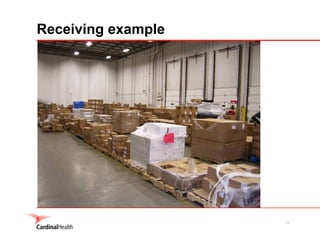
Receiving example
14
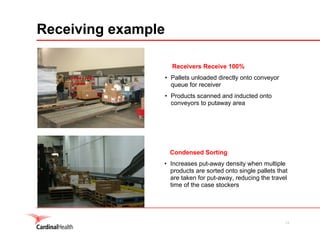
Receivers Receive 100%
• Pallets unloaded directly onto conveyor
queue for receiver
• Products scanned and inducted onto
conveyors to putaway area
Condensed Sorting
• Increases put-away density when multiple
products are sorted onto single pallets that
are taken for put-away, reducing the travel
time of the case stockers
Receiving example
15
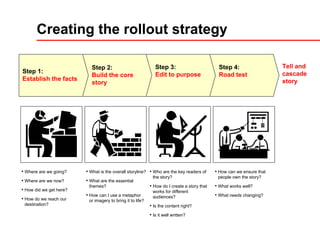
Creating the rollout strategy
Step 1:
Establish the facts
Step 2:
Build the core
story
Step 3:
Edit to purpose
Step 4:
Road test
• Where are we going?
• Where are we now?
• How did we get here?
• How do we reach our
destination?
• What is the overall storyline?
• What are the essential
themes?
• How can I use a metaphor
or imagery to bring it to life?
• Who are the key readers of
the story?
• How do I create a story that
works for different
audiences?
• Is the content right?
• Is it well written?
• How can we ensure that
people own the story?
• What works well?
• What needs changing?
Tell and
cascade
story
16
Supporting our healthcare customers
• Our business operates 24/7 to support healthcare
• Cardinal Health employees:
– Distribute life-sustaining medications to healthcare customers
– Manufacture and deliver vital medical supplies
Having the right people in the right place
at the right time is critical to our work, our customers’ work,
and ultimately, patient care
Creating Lean Supply Chains

Creating Lean Supply Chains

  • 1.
    1 Creating a LeanSupply Chain at Cardinal Health June 26, 2007 William Owad SVP, Operational Excellence Cardinal Health
  • 2.
    2 Healthcare Supply ChainServices Operations Demand PlanningDemand Planning Order ManagementOrder Management Inventory PlanningInventory Planning Supply Execution (distribution) Supply Execution (distribution) P L A N N I N G P R O C E S S E X E C U T I O N P R O C E S S CustomerCustomer Manufacturer / SupplierManufacturer / Supplier
  • 3.
    3 Cardinal Health Supply chainfacts Costs Managed ~ $780m Inventory $6b Headcount 9,000 Warehouses 75; 13m sq. ft Transportation 550 tractors; 680 trailers SKUs > 400,000 Customers > 50,000 Daily deliveries 43,000 2 national customer service centers that handle 650,000 calls/month 1 pharmaceutical re-packaging facility
  • 4.
    4 Supply Chain Operation’svision To achieve our goal, we must align our ‘go- to- market’ and supply-side strategies HSCS Operations Strategic Vision Provide category- leading customer service Achieve Cost Leadership Enhance Organization Capability Processes and Systems
  • 5.
    5 Strategic alignment What requirementsand potential uncertainties must we be prepared for over the next 3-5 years? Can our existing strategy be used/pushed further to fully meet these requirements, and, if not, where are there gaps? Beyond our existing strategy, what can be done to better meet these requirements? How can the existing strategy and new strategic elements be best melded together into a recalibrated operations strategy? What should Supply Chain operations’ 3-5 year strategy and associated transition path be? What role does operations need to play in order for the business units to win in the marketplace? When/where are we willing to trade-off cost for service/ flexibility? What is the transition path and immediate next steps?
  • 6.
  • 7.
    7 Source: Cardinal Healthsurveys – Medical product customer survey, October 2006; Pharmaceutical distribution customer survey, October 2005 41 22 14 Medical products 52 21 19 13 Pharmaceuticals 1. Availability of preferred products 2. Competitiveness of pricing Voice of the customer consistently points to basic execution as primary supply chain driver of customer satisfaction Customer expectations 5. Accuracy of shipments 36 28 124. Ease of placing orders 3. Timeliness of deliveries
  • 8.
    8 Hospital Supply Chain Healthcarevalue chain is complex Supply Information Management MMIS Healthcare Provider Item Master Charge Master ORIS HIS B-D MedTronic Pfizer Bristol Myers Boston Scientific Manufacturers J&J Cordis Tyco -Parcel -Commercial -3PLs TransportTransport GHXGPOs McKesson O&M ABC Others Cardinal Health Transport Distributors Transport Other Inventory Pharmacy ER ICU OR Nursing Floor Inventory Inventory Inventory Inventory Inventory Special Procedures Inventory Receiving Fulfillment Payables Mgmt. Disposal Order Management Inventory
  • 9.
    9 Hospital base (MPS/Rx), surgerycenters, and lab Hospital supplies Scientific products Self-manu- facturing/ Presource Baxter Sutures Drugs OTC H&B GM Mostly LUM* 24-hour lead time Mostly parcel shipping Ambulatory care – physician office Mostly LUM* 12-16-hour lead time Courier network for Retail Greater variety of SKUs Less stringent lead time Alt care Rx, retail chains (non-WH), and retail independents Mostly case 12-14-hour lead time Courier network Mail order, retail bulk, and brokerage Consumer products 99% service levelsMostly LUM* 6-hour lead time ValueLink Mostly case 15-24-hour lead time Next day delivery Slow Fast ® Eight supply chains within the Cardinal Health network * Low Unit of Measure Source: Internal CAH interviews; team analysis
  • 10.
    10 Overall LSS DCDiagnostic Planning • DC 1 • DC 5 and 6 • Summary • DC 4 • DC 3 • DC 2 • Analysis Main site selection criteria: – Ensure we could view as many of the different processes (automation, conveyors, etc.) – No labor issues or other disruptions – Good operating practices
  • 11.
    11 Summary of keyopportunities from DC diagnostic Productivity • Significant variability in productivity by day and by employee Observations • Share best practices among employees and implement clearer, visual performance management Opportunity • Ergonomic differences when picking in the air • Minimizing in air picks will decrease riskSafety • Double handling and motion in receiving • Remove staging step for full pallets and sort by aisle for handstack receiving Capacity Quality / Damage • Damage from in air replenishment • Decrease in air picking with proper profiling • Annex drives significant additional labor and waiting time at the site (and main site has enough space to take additional volume) • Move all active inventory out of annex (if necessary move forward buys or excess stock to available annex space) Inventory
  • 12.
    12 Lean receiving willimprove service levels and cost Blueprint Concepts: • Single-Step Unload, Receipt & Putaway for High Volume Vendors – Eliminate sorting, staging and excess travel by unloading & receiving directly into case putaway location. (Requires fixed areas in case aisle for high volume vendors) – Partner with internal suppliers improving both upstream & downstream • Receivers Receive 100% – Redesign receiving layout to reduce sorting, walking, bending, and other NVA. – Successful designs have been implemented in several RX locations. • Safe, Ergonomic & Undamaged – Work with internal suppliers to develop high quality inbound loads
  • 13.
  • 14.
    14 Receivers Receive 100% •Pallets unloaded directly onto conveyor queue for receiver • Products scanned and inducted onto conveyors to putaway area Condensed Sorting • Increases put-away density when multiple products are sorted onto single pallets that are taken for put-away, reducing the travel time of the case stockers Receiving example
  • 15.
    15 Creating the rolloutstrategy Step 1: Establish the facts Step 2: Build the core story Step 3: Edit to purpose Step 4: Road test • Where are we going? • Where are we now? • How did we get here? • How do we reach our destination? • What is the overall storyline? • What are the essential themes? • How can I use a metaphor or imagery to bring it to life? • Who are the key readers of the story? • How do I create a story that works for different audiences? • Is the content right? • Is it well written? • How can we ensure that people own the story? • What works well? • What needs changing? Tell and cascade story
  • 16.
    16 Supporting our healthcarecustomers • Our business operates 24/7 to support healthcare • Cardinal Health employees: – Distribute life-sustaining medications to healthcare customers – Manufacture and deliver vital medical supplies Having the right people in the right place at the right time is critical to our work, our customers’ work, and ultimately, patient care